
Small Apartment Storage Ideas
Where to Put an Air Purifier in a Small Apartment With Limited Floor Space
Choose the room before the leftover corner, confirm the purifier is sized for that area, then protect the invisible airflow and service space around it before spending scarce floor or furniture surface.
In This Guide
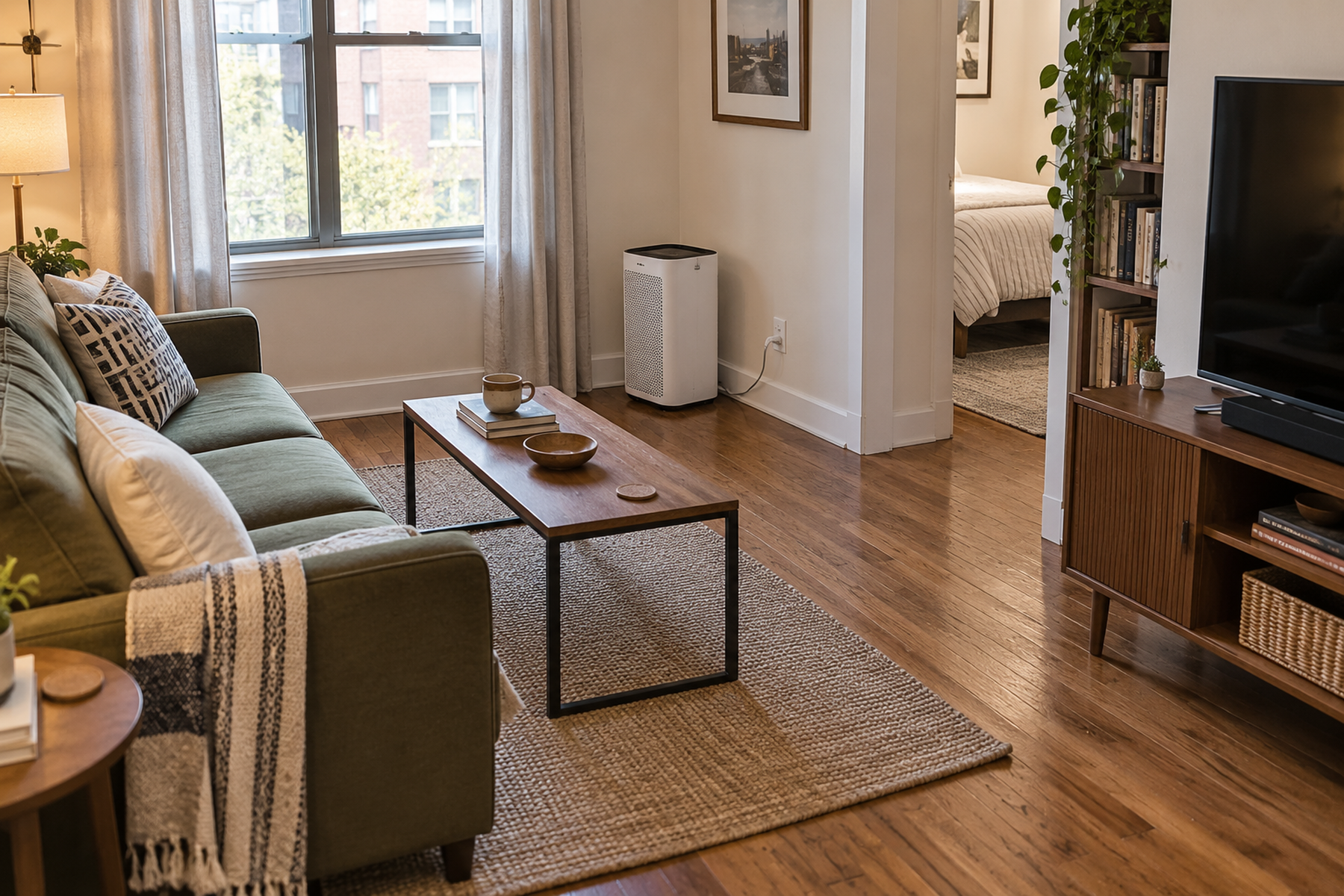
An air purifier can have a compact body and still demand more space than its product dimensions suggest. The unit needs room to pull in and discharge air, enough access for filters and cleaning, and a cord path that does not turn the appliance into a walking obstacle.
That makes the best empty corner a weak starting point. Decide which room or open area the purifier is actually meant to serve, confirm the unit is sized for that job, and only then look for the least disruptive location that preserves the actual model’s airflow, surface, and service requirements.
Quick Answer
Choose the Air Zone First, Then Protect the Purifier’s Operating Envelope
Treat the visible body as only part of the footprint. A valid small-apartment placement also has to preserve the airflow around the unit and the space needed to service it.
01
Choose the room or open area first
Portable air cleaners are primarily room-or-area devices. Prioritize the room where the purifier has a clear job instead of placing one unit in a hallway and assuming the whole apartment behaves like a single air zone.
02
Confirm the purifier is sized for that area
Use the unit’s verified room-size or CADR information before solving the furniture layout. Better placement cannot compensate for a purifier that is undersized for the room it is expected to serve.
03
Preserve airflow and service access before hiding the unit
Follow the actual model’s wall and furniture clearances, keep curtains and furniture out of the intake and outlet path, and leave enough room to remove filters without dismantling the room.
01
Choose the Room Before the Corner
Start with the air-cleaning job, not the leftover floor space. EPA describes portable air cleaners as devices intended to filter the air in a single room or area, so a studio, open living-dining room, and closed bedroom should not automatically be treated as the same placement problem.
If one purifier has to serve one priority room, EPA guidance supports placing it where people spend substantial time. That can make the bedroom a strong choice for overnight use or the living room a stronger choice when most waking hours happen there.
A specific pollutant source can change that priority, but source proximity does not override the room job or the product instructions. A litter box, cooking area, or other identifiable source may justify a nearby intake position only when the location remains appropriate for the unit and the surrounding heat, moisture, and airflow conditions.
Do not move the purifier to an irrelevant spare corner simply because the furniture layout is easier there. The correct room comes first; the exact floor or furniture position comes after.
02
Confirm the Purifier Is Sized for That Room
Placement cannot rescue an undersized purifier. EPA advises selecting a Clean Air Delivery Rate, or CADR, appropriate for the room or area where the unit will operate.
AHAM Verifide’s current general rule of thumb uses a smoke CADR of at least two-thirds of the room’s square footage under its normal assumptions, with higher ceilings requiring additional sizing consideration. Treat that as sizing guidance, not a health-outcome guarantee.
Measure the actual contiguous area the purifier is expected to serve rather than the apartment’s mailing-list square footage. A 500-square-foot studio can behave very differently from a 500-square-foot one-bedroom with walls and a closed bedroom door.
If the real need spans two closed rooms with competing priorities, the decision may be to move one unit between rooms or use separate room-specific units. Do not assume that a larger unit placed in the hallway automatically produces equivalent cleaning in every room.
Measure / Check First
Before committing to a corner, side table, or room location, verify the purifier’s actual job and the invisible space it needs to operate.
Check Room Fit, Airflow Clearance, and Service Access First
01
Room or area sizing
Confirm the purifier’s verified CADR or room-size guidance against the actual contiguous room or open area, including ceiling-height considerations where relevant. Do not size from total apartment square footage when walls and doors divide the space.
02
Airflow and model-specific clearance
Identify the intake and outlet, then apply the exact manufacturer’s wall, furniture, curtain, heat, moisture, and surface instructions. Do not substitute a universal clearance number.
03
Service, cord, and circulation
Open the filter cover, test filter removal, trace the power cord, and walk past the unit with the room furnished normally. A location that works only until maintenance or daily circulation begins is not a complete fit.
If the purifier is undersized for the chosen room, the intake or outlet is boxed in, the filter cannot be removed, or the cord crosses the walking path, change the room or position before trying to hide the device more aggressively.
03
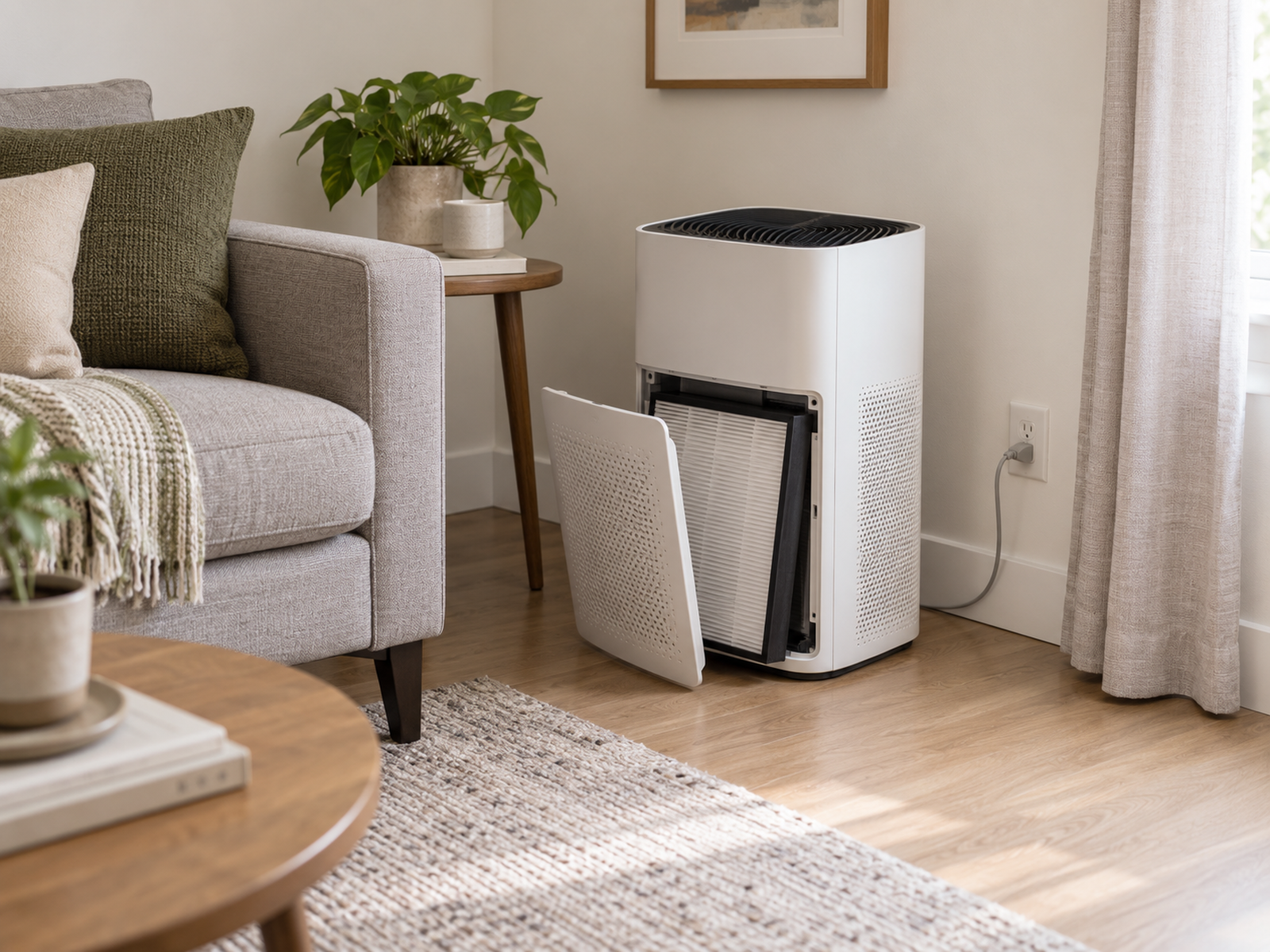
Measure the Purifier’s Three Footprints
The purifier has three footprints: the physical footprint of the body, the airflow footprint around its intake and outlet, and the service footprint needed to change filters or clean the unit.
The physical footprint is the easiest to see and the easiest to overvalue. A narrow tower may fit beside a sofa, but that tells you nothing about whether the sofa blocks an intake, whether the wall is too close, or whether the filter cover can open.
Wall and furniture spacing are model-specific. Blueair currently publishes a five-inch wall-and-furniture guideline for one Classic support context, while current Winix manuals for the T810 and 5510 use larger model-specific spacing. That variation is exactly why the product manual, not a universal internet number, controls the final clearance.
Test the service footprint before the location feels permanent. Open the filter cover, trace the filter-removal direction, confirm sensor or pre-filter access when applicable, and make sure the purifier can be rotated or lifted as instructed without first moving half the room.
04
Use a Corner Only If the Purifier Can Breathe
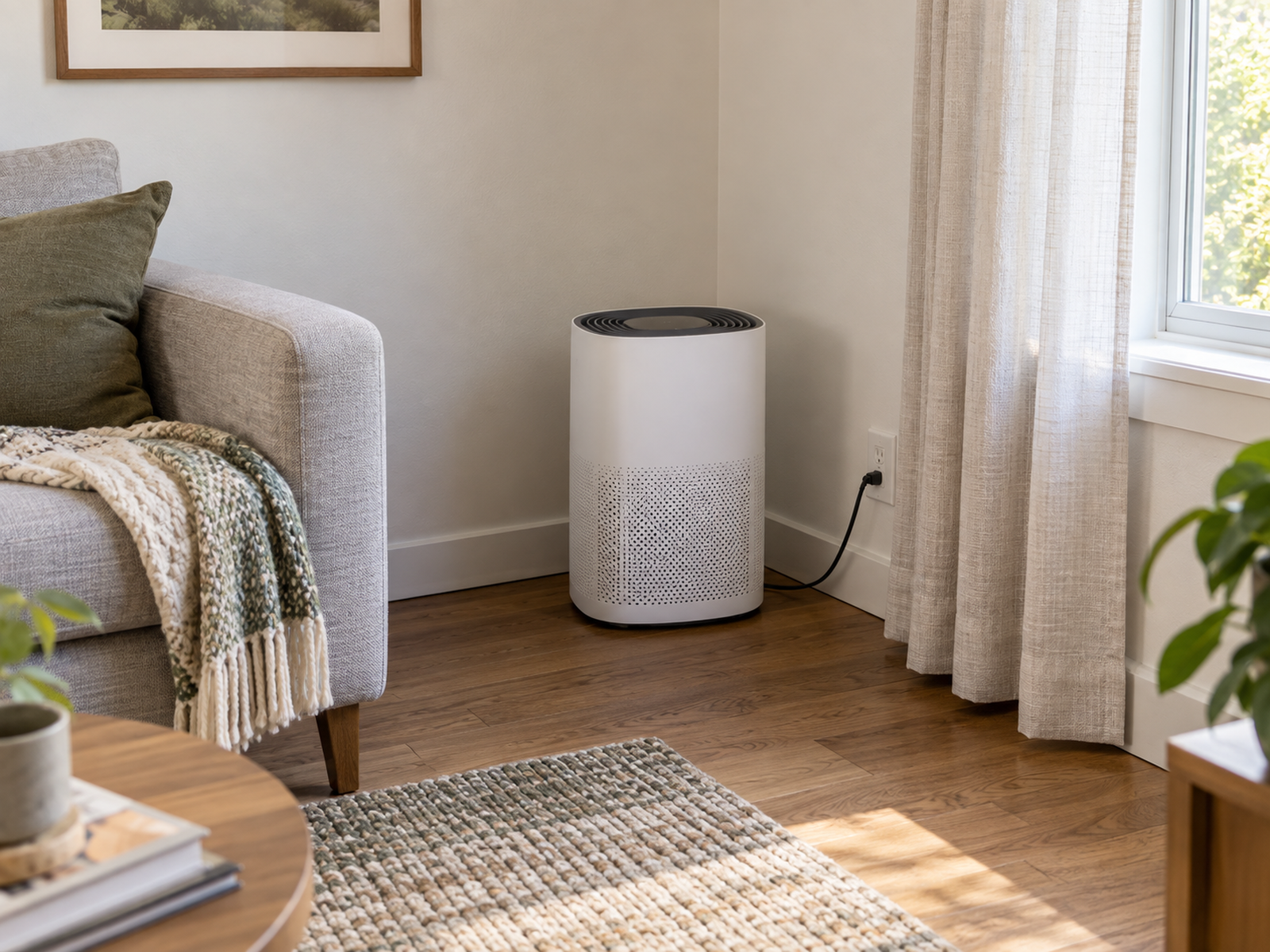
A residual corner can be excellent small-apartment real estate, but it is not automatically an air-purifier zone. Corners place two walls close to the unit before furniture, curtains, baskets, or plants are added.
EPA specifically advises keeping airflow unobstructed and keeping air cleaners away from curtains and other objects that block airflow. That makes a purifier behind a sofa, inside an open closet, or squeezed between a curtain and side table a clearance test rather than a concealment strategy.
Check the actual intake and exhaust geometry. A purifier that draws air around multiple sides can need a different relationship to walls and furniture than a model with a more directional intake. Do not infer the required buffer from body shape alone.
If a corner passes the manufacturer’s clearance rules, keeps the intake and outlet open, and still allows filter access, it can be a strong low-value floor zone. Protect that empty space from slowly becoming storage for a basket, plant, pet bed, or folded laundry.
05
Use Tabletop Placement Only for Models Designed for It
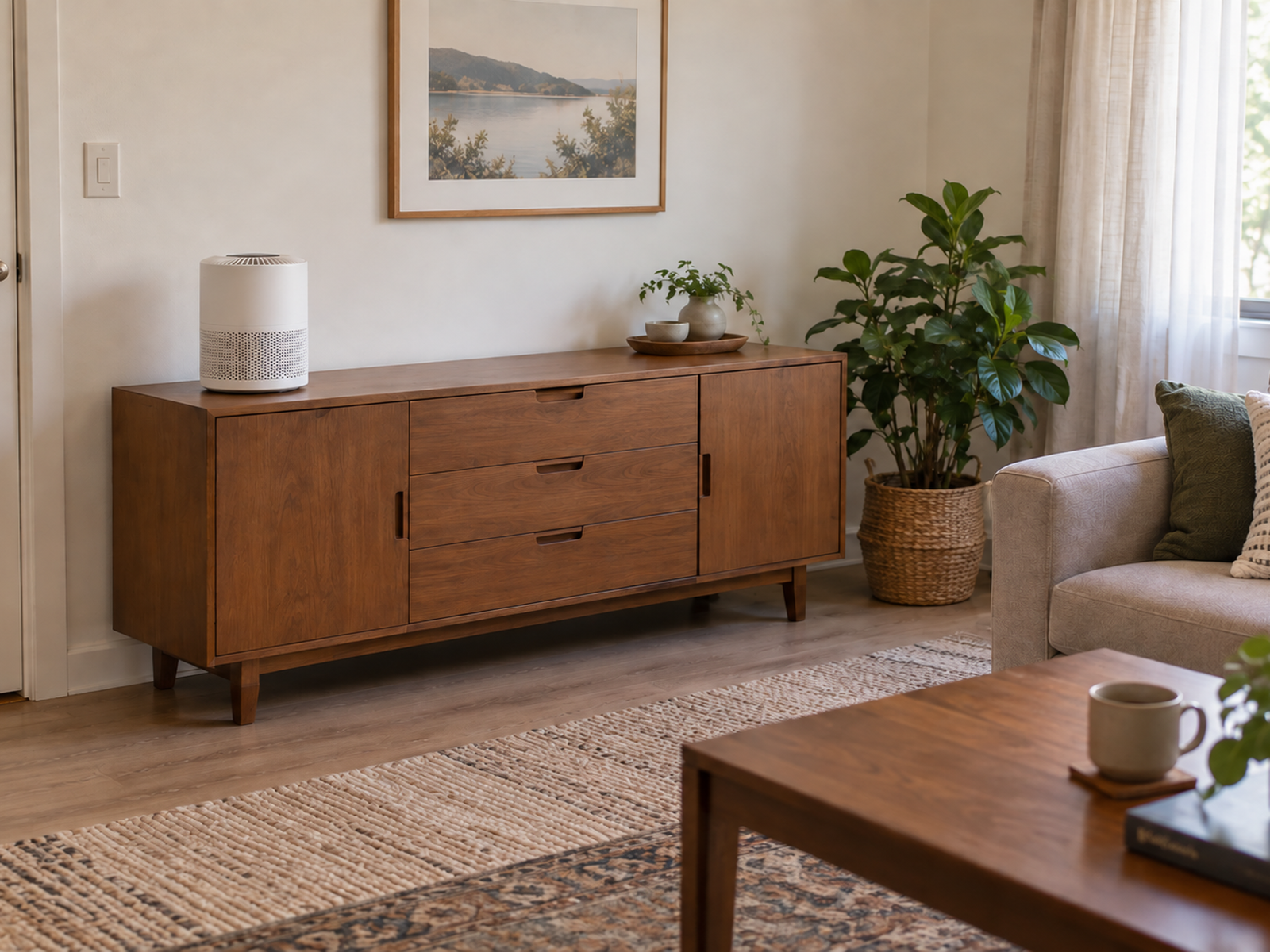
Elevating a purifier can recover floor area, but it is not a universal small-space upgrade. EPA notes that many portable air cleaners are designed for floor placement while some are designed for tabletops, so the exact model has to permit the operating position.
The furniture also becomes part of the appliance system. The surface should be hard, stable, level, large enough for the full base, and positioned so books, curtains, electronics, or the wall do not close off the intake or outlet.
Current Winix T810 instructions, for example, specify a hard, flat surface and warn that flimsy or slanted placement can create abnormal noise and vibration. That is model-specific evidence for why a narrow side table should not be treated as a generic purifier pedestal.
Tabletop placement is most useful when the purifier was designed for it and the furniture already deserves its footprint. Adding a new stand purely to get the purifier off the floor can simply convert one floor-space problem into two pieces of furniture.
Use / Skip
Tabletop Placement
Use
Use it when the model and furniture both support the placement
Choose tabletop placement when the purifier is explicitly designed or permitted for furniture use, the surface is hard and stable, the full base fits, airflow remains open, and filter access does not require unloading the table.
Skip
Skip it when elevation creates a second fit problem
Keep the purifier off furniture when the model is floor-only, the surface is narrow or unstable, vibration transfers into the furniture, or books, curtains, walls, and electronics crowd the intake, outlet, or service path.
06
Do Not Use a Hallway as a Shortcut for Multiple Rooms
A hallway can look like the mathematical center of a small apartment, but central location is not the same as effective multi-room cleaning. EPA says a central position can work well when airflow is free, yet portable units are still framed as room-or-area devices.
Walls and closed doors matter. A purifier outside the bedroom does not automatically provide the same result as a properly sized unit operating inside that bedroom, and the same logic applies to a closed office or nursery.
Open-plan apartments are different. One appropriately sized purifier may reasonably serve one contiguous living-kitchen-dining area when the unit’s rating and airflow path match that area. The question is the actual air zone, not whether the apartment is subjectively small.
If one unit is being shared between rooms, make the relocation realistic. A lightweight purifier that moves between bedroom and living room can be more useful than a theoretically central position, but only if the cord, carrying path, and daily routine are simple enough that the move actually happens.
07
Let Noise, Draft, Heat, Moisture, and the Cord Change the Final Position
A placement can pass the airflow test and still fail in daily life. EPA treats noise as an operational factor because a purifier that is annoying enough to be turned down or switched off is not functioning as planned.
Direct airflow can also affect comfort. If the outlet creates an uncomfortable draft at the bed, sofa, or desk, redirect the airflow or move the unit while preserving the model’s clearance requirements rather than treating maximum proximity as the goal.
Heat, steam, direct sun, and wet areas are also model-sensitive. Current Winix documentation for the T810 and 5510 includes restrictions involving direct sunlight, hot objects, steam, and excessively humid or wet locations. A visually empty spot beside a stove, humidifier, shower doorway, or strong sunny window can therefore be the wrong operating environment.
Finally, include the power cord in the footprint. The purifier may run for long periods, so avoid a position that sends the cord across the main walking route or creates a high-friction routine of unplugging and moving the unit every day.
08
Protect the Purifier Zone From Future Clutter
Once a location passes, treat its operating clearance as functional empty space. It is not spare storage simply because the floor or wall beside the purifier looks unused.
This matters most in small apartments because residual zones naturally attract baskets, plants, laundry, pet items, side tables, and curtains. A purifier that was installed correctly can become obstructed gradually without ever being intentionally moved.
Keep the filter-removal path protected too. If every filter change requires moving a sofa or unloading a shelf, maintenance becomes easier to postpone and the location was never fully resolved.
The final placement should survive ordinary life: furniture stays usable, the walkway stays clear, the purifier can run at a tolerable setting, the cord stays out of circulation, and the airflow and service envelope remain open after the room is fully lived in.
Closing Decision
Protect the Operating Envelope Before You Protect the Aesthetic
The best small-apartment placement is the room-relevant position that gives the purifier enough verified airflow and service space with the least disruptive physical footprint. A residual corner, open wall zone, or tabletop position can all work, but only after the room job, sizing, model clearance, and maintenance path pass.
Function should win before concealment. Keep curtains, furniture, baskets, and future clutter out of the operating envelope, and let noise, draft comfort, cord routing, heat, moisture, and real daily circulation refine the final location. A purifier that can breathe, be serviced, and stay running is a better small-space fit than one that disappears perfectly behind the sofa.
RELATED GUIDES
What to Read Next
NEXT GUIDE
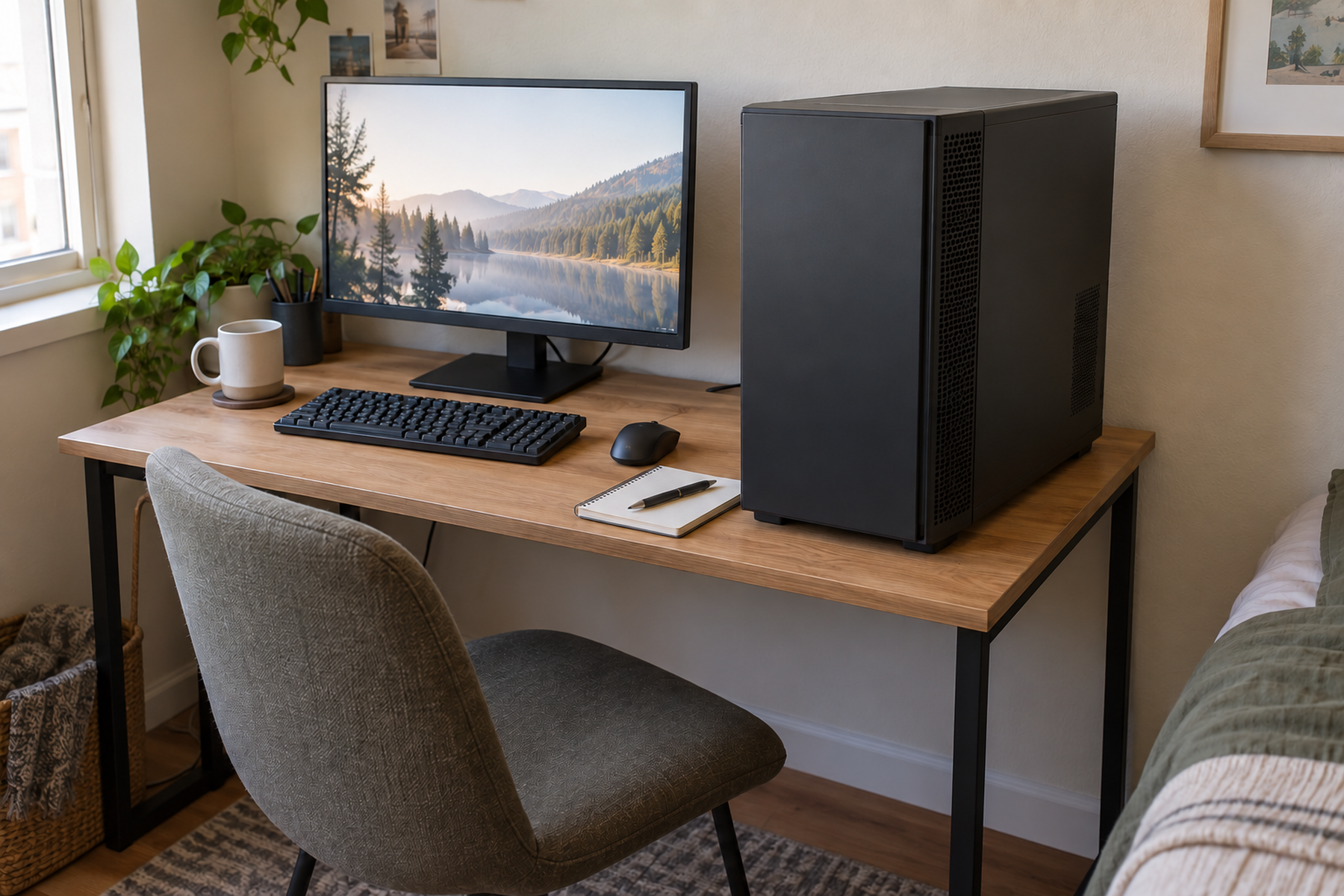
How to Place a PC Tower Around a Small Desk Without Losing Work Surface
Use this next if another always-on device is competing for floor or perimeter space; that guide applies a similar operating-clearance mindset to computer airflow, access, and workstation geometry.
GUIDE
How to Store a Broom, Mop, and Vacuum in a Small Apartment With No Utility Closet
Use this if the purifier is competing with cleaning equipment for the same residual floor or wall zones; that guide focuses on stored footprint, retrieval, charging, and renter-friendly tool storage.