
Small Apartment Storage Ideas
How to Store a Broom, Mop, and Vacuum in a Small Apartment With No Utility Closet
When there is no broom or utility closet, the goal is not to force every cleaning tool into one cabinet. Give each tool a realistic ready-to-store state, build one low-conflict parking zone, and use the lowest-intervention support method that still keeps doors, walkways, drying, and model-specific vacuum storage working.
In This Guide
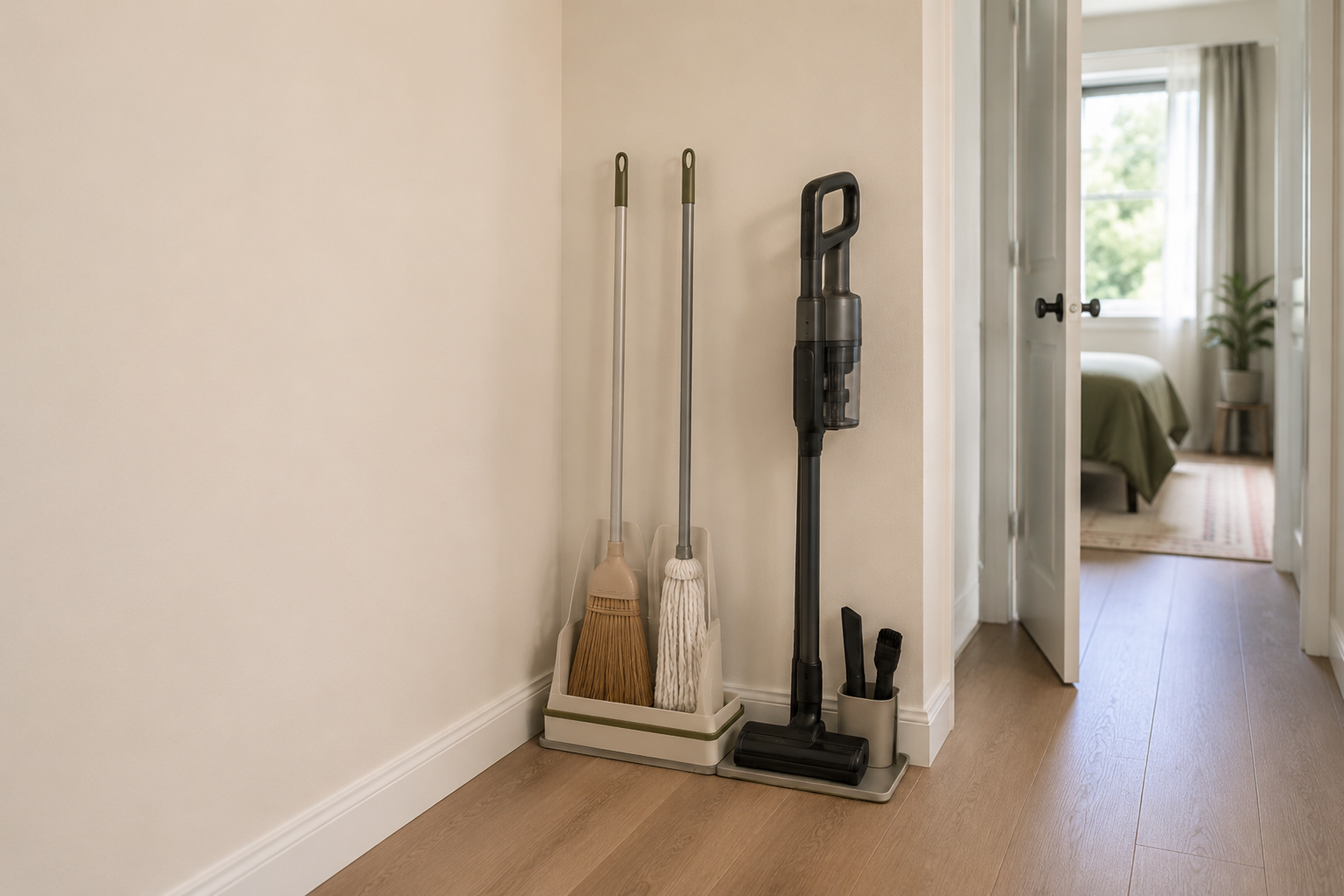
A broom, mop, and vacuum can all be “cleaning tools” and still need completely different storage. One is a tall handle with a wide head, one may be damp after use, and one may depend on a specific dock, folded position, cord, hose, or floor footprint.
That is why a missing utility closet is not solved by finding one organizer big enough for everything. Start with the state each tool must be in when it is actually ready to put away, then give the group one practical home base that does not block circulation or require more intervention than the rental can support.
Quick Answer
Plan the Put-Away State Before the Organizer
The easiest cleaning-tool system is the one that matches how the tools really finish a cleaning session. Separate what can be stored dry, what may need a temporary drying state, and what has model-specific storage or charging requirements.
01
Separate the storage states
Treat dry long tools, a damp mop, powered equipment, and small attachments as different storage jobs even if they share one overall home base.
02
Choose the parking zone by the biggest footprint
Measure for the vacuum head, mop base, bucket, or canister—not just the narrow handles. The widest or deepest part often determines whether the zone really works.
03
Use the lowest-intervention support each tool can accept
A freestanding stand, exact-product removable gripper, model-supported compact vacuum position, or installed dock are different intervention levels. Do not treat them as interchangeable.
01
Separate Dry, Drying, and Powered Tools Before You Choose Storage
Lay out the cleaning tools you actually use and sort them by the state they need to reach before they can be parked. A dry broom and dustpan may be ready immediately. A mop may need time in an open drying position. A cordless vacuum may need a manufacturer-supported dock, folded storage mode, or another exact-model arrangement.
This first sort keeps the storage system from solving one tool by creating a problem for another. A closed cabinet can conceal dry tools beautifully and still be the wrong immediate destination for a damp mop. A wall can save floor area and still be unusable if a vacuum dock requires fixings that are not appropriate for the rental.
Also remove obsolete or duplicate tools before creating a new utility zone. In a small apartment, storing fewer awkward objects can be more valuable than buying a larger organizer for equipment that no longer earns its footprint.
Measure / Check First
Do not judge a cleaning-tool zone by whether the handles fit vertically. Test the real stored footprint and the full return path for the bulkiest parts of the system.
Measure the Parking Zone Around the Widest Tool
01
Measure heads, bases, buckets, and canisters
The vacuum floor head, mop base, dustpan, bucket, or canister body may project far beyond the handles. Use those shapes to test the real floor and wall envelope.
02
Test the full door and walking path
Open nearby doors completely, walk the normal route, and remove each tool as if you were about to clean. A zone fails if one item must be moved just to release another or if a tool head projects into the primary path.
03
Confirm the exact storage mode
Check whether the vacuum stands, folds, docks, hangs, or needs another manufacturer-supported state, and whether the mop must dry before entering enclosed storage. Do not design the zone around a storage mode the tool does not actually support.
There is no universal utility-zone width, behind-door clearance, vacuum footprint, or mop-head size that proves a layout will work. Use the real tools, the exact storage instructions that matter, and the apartment’s normal door and circulation pattern as the test.
02
Build One Primary Parking Zone With a Few Micro-States
A missing utility closet does not have to be replaced by one piece of furniture. The stronger goal is one predictable service zone where the cleaning setup can return after use.
That zone might be a laundry alcove, a low-conflict hall wall, a closet side zone that does not compromise clothing storage, a compact service corner, or a slim freestanding unit. Inside the zone, the broom and dry mop can occupy a vertical lane, the vacuum can use its own supported storage position, and small attachments can live in one nearby caddy.
Keeping those micro-states close together reduces the chance that the vacuum ends up in a bedroom corner while the dustpan, nozzle attachments, and mop migrate to unrelated cabinets. The system can be visible if it is controlled; concealment is useful only when it does not make the reset harder.
03
Give Dry Long Tools the Lowest-Intervention Support That Works
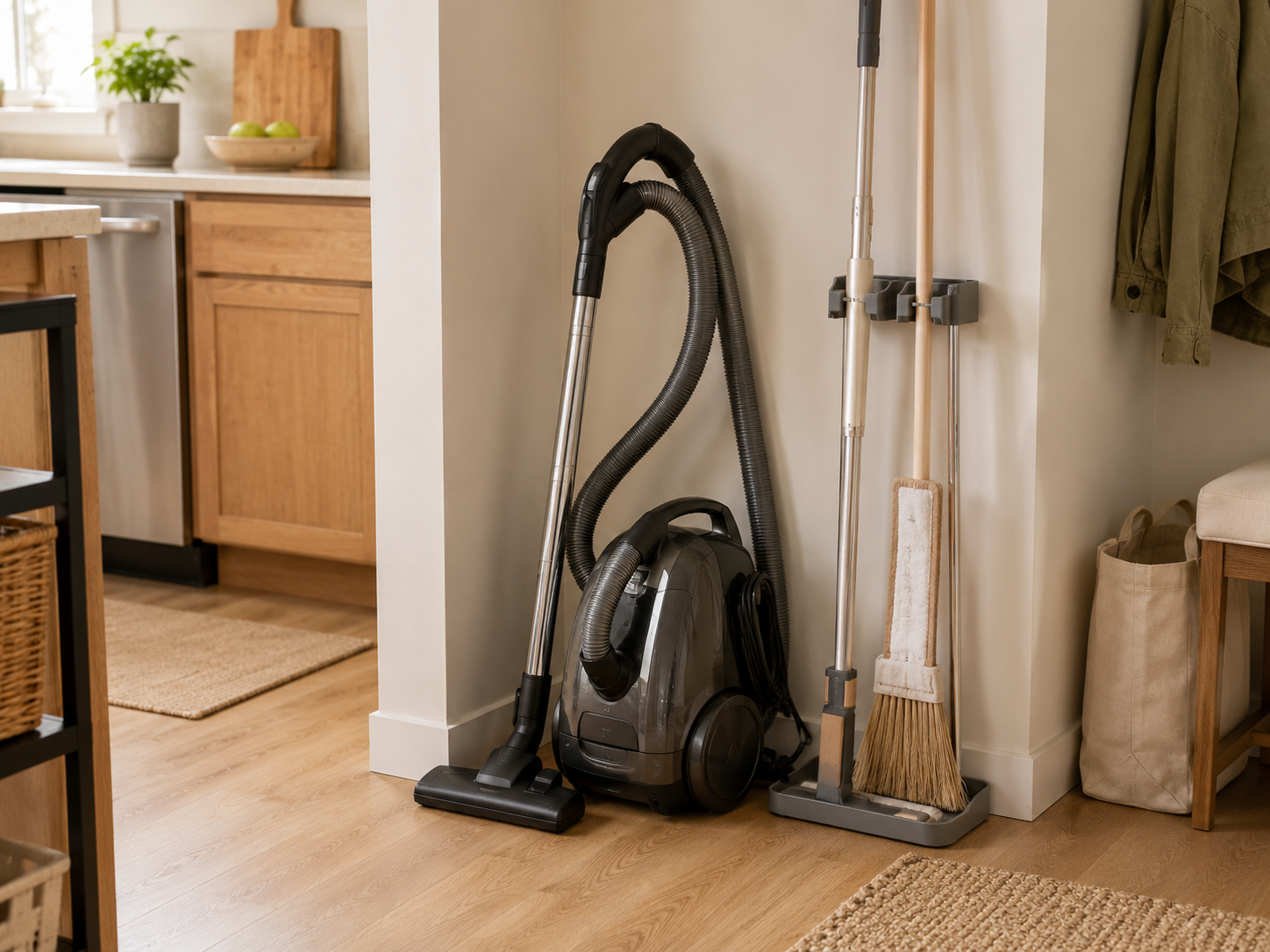
For brooms, dustpans, and a fully dry mop, start with the least permanent method that keeps the tools upright and easy to release. A freestanding tool stand avoids wall mounting but costs floor area. A removable wall gripper can preserve floor space, but it must match the exact tool and surface.
3M’s current Command Broom Gripper is one manufacturer-specific example: the product has defined handle and weight limits and its own application conditions. That is useful evidence for the storage family, not permission to assume that every broom, mop, adhesive holder, or apartment wall is compatible.
Behind-door placement is another conditional option rather than automatic dead space. Use it only when the door still opens and closes normally, the tool head does not strike the wall, and the stored group stays outside the main walking path.
Use / Skip
When an Open Parking Zone Beats Hidden Storage
Use
Use — Use an open zone when returnability matters more than concealment
A narrow, calm service corner or freestanding stand can be the better choice when daily tools are easy to return, the footprint stays out of circulation, and a cabinet would add door-swing or anchoring problems.
Skip
Skip — Skip concealment that adds more steps than it removes
Do not hide frequently used tools in a cabinet, clothes closet, or behind-door setup if each cleaning session requires moving unrelated storage, disassembling the vacuum, or fighting the door to put everything back.
04
Treat the Vacuum as Its Own Storage Decision
A vacuum is not simply another long handle. Upright, canister, cordless stick, fold-over stick, and wall-dock designs can have very different stored footprints and installation requirements.
For example, Dyson’s V7 dock guidance uses wall fixings, so an included dock should not be assumed to be a no-drill renter solution. By contrast, Shark’s Vertex IZ462H product information describes a model-specific folded, freestanding storage mode.
Those examples prove that storage mode can vary by model; they are not recommendations for either vacuum. For the vacuum you already own, use its actual supported storage and charging instructions. If its geometry repeatedly defeats the apartment, stored footprint can become a legitimate criterion the next time replacement is genuinely needed.
What Not to Do
Don’t Treat “Wall-Mount It” as a Universal Renter Solution
Wall storage can preserve floor area, but the intervention can range from an exact-product removable gripper to screws, dock fixings, rails, or furniture anchors. Check the real mounting method, surface, load, removal process, and lease context instead of treating vertical space as free storage.
05
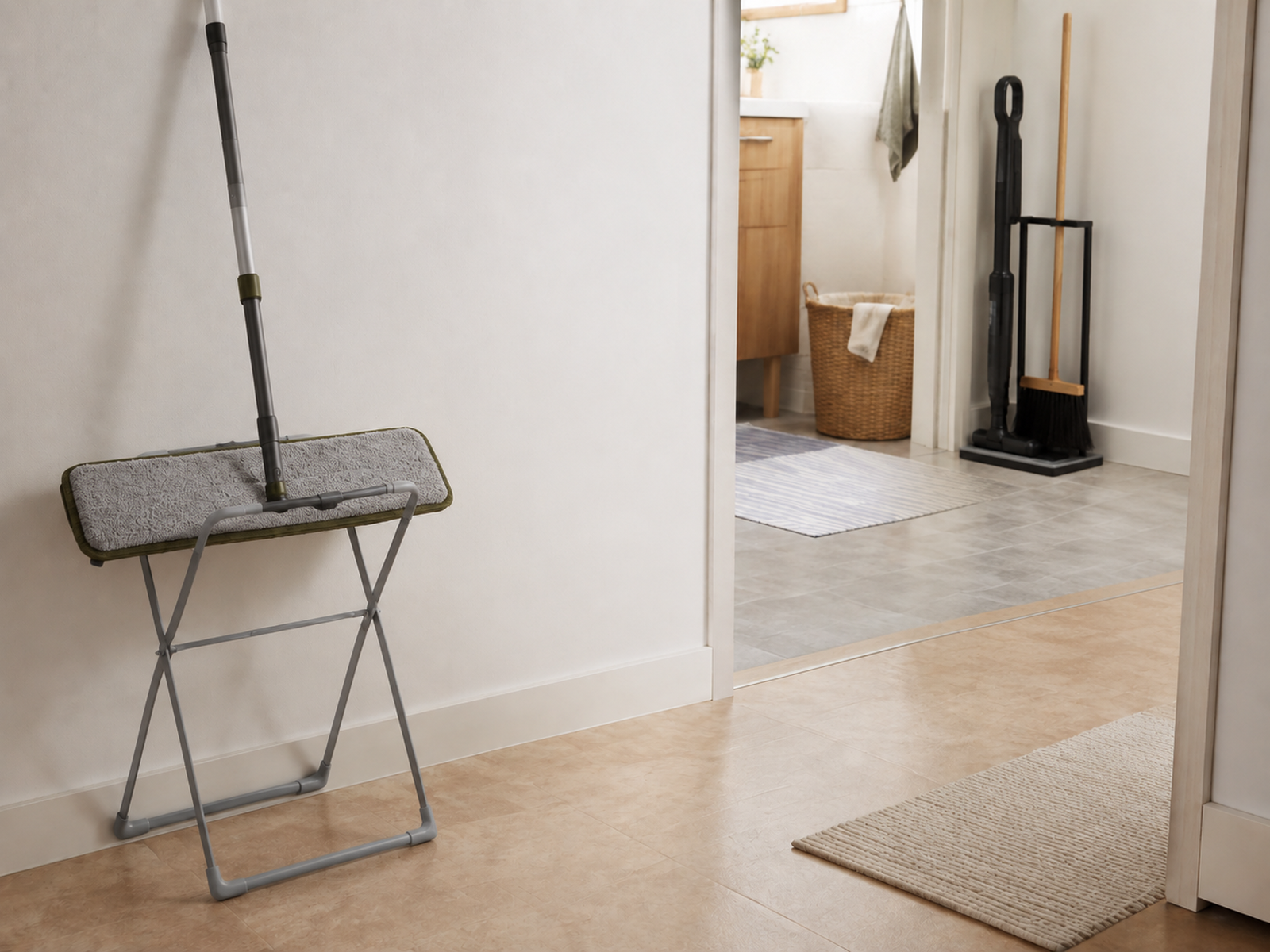
Give a Damp Mop a Drying State Before Its Final Storage State
A mop may need a temporary state between cleaning and storage. That transition belongs in the organization system rather than being treated as an inconvenience outside it.
O-Cedar’s current mop-head care guidance instructs several of its microfiber mop heads to air-dry, and its EasyWring care guidance includes drying steps before storage for that exact system. Follow the instructions for your own mop rather than assuming every mop has the same care requirement.
When drying is required, use an open, ventilated temporary position that does not block the walkway or door, then move the dry tool into the main parking zone. Do not design a closed utility cabinet as the immediate post-use destination for a tool whose exact care instructions require drying first.
06
Add a Cabinet or Behind-Door Layer Only After the Access Test
If visible storage is still a problem, test concealment after the tool geometry and storage states are already understood. A slim utility cabinet can hide several tools, but its interior must fit the real heads and bases, its door needs room to operate, and its footprint becomes permanent floor use.
Tall furniture also has a stability boundary. CPSC’s Anchor It! guidance advises securing top-heavy furniture and following manufacturer instructions, so a tall freestanding cabinet is not automatically a wall-independent renter solution.
The same principle applies to borrowing another closet. A side zone in an existing clothes closet can work when it does not break the closet’s primary job, but moving the cleaning problem into the apartment’s only functional clothing storage is a trade, not a free win.

Closing Decision
Give the Tools a Home That Matches How They Actually Store
Without a utility closet, the most reliable cleaning-tool system starts with the tools rather than the organizer. Separate dry, drying, and powered storage states; choose one low-conflict home base; measure the widest heads and the full return path; and use the lowest-intervention support method each tool genuinely accepts. Keep vacuum storage model-specific, make drying part of the plan when the exact mop requires it, and add cabinets or mounted hardware only when their floor, stability, installation, and access costs are worth the trade. A small apartment does not need a perfect hidden utility closet substitute—it needs a parking system that is easy enough to reset after every clean.
RELATED GUIDES
What to Read Next
NEXT GUIDE
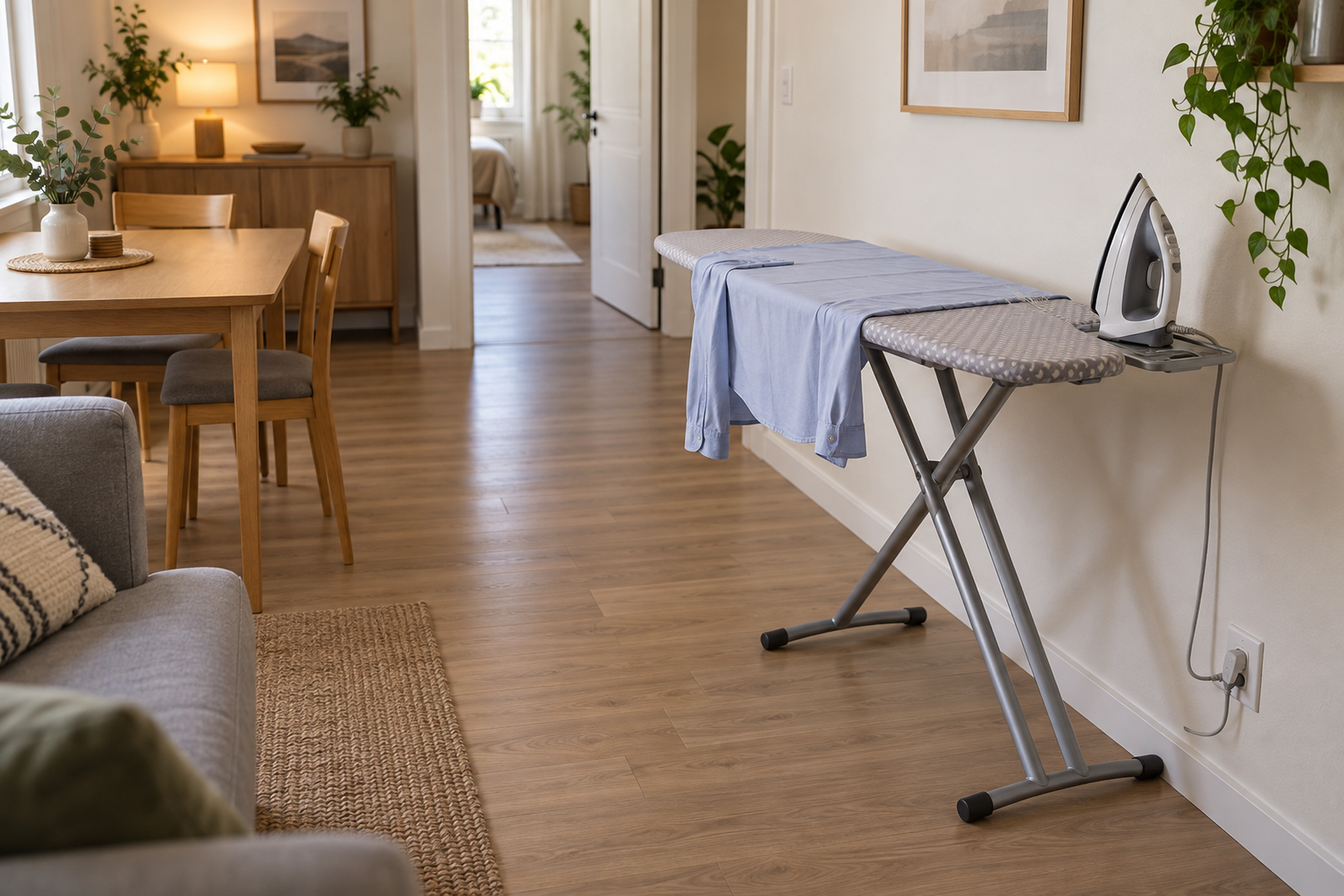
How to Store and Use an Ironing Board in a Small Apartment
Useful for another long, awkward household tool that needs both a storage position and usable setup clearance.
GUIDE
How to Store Laundry Supplies in a Small Closet With a Stacked Washer and Dryer
Continues utility-item storage when a compact laundry zone has little or no shelf space.
GUIDE
How to Store Household Backstock in a Small Apartment With No Storage Closet
Useful for separating reserve household supplies from the active tools and products used every day.