
Small Apartment Storage Ideas
How to Store and Use an Ironing Board in a Small Apartment
Choose the pressing surface by the work you actually do, then compare a full-size board, tabletop board, fold-in-half board, or ironing blanket by where each one puts the space cost: storage height, floor setup, borrowed table space, or installation.
In This Guide
- Choose the Pressing Surface by Task and Frequency
- Check for a Vertical Slot Before Downsizing
- Use a Tabletop Board When the Table Is Truly Available
- Treat Wall-Integrated Boards as Installation Projects
More
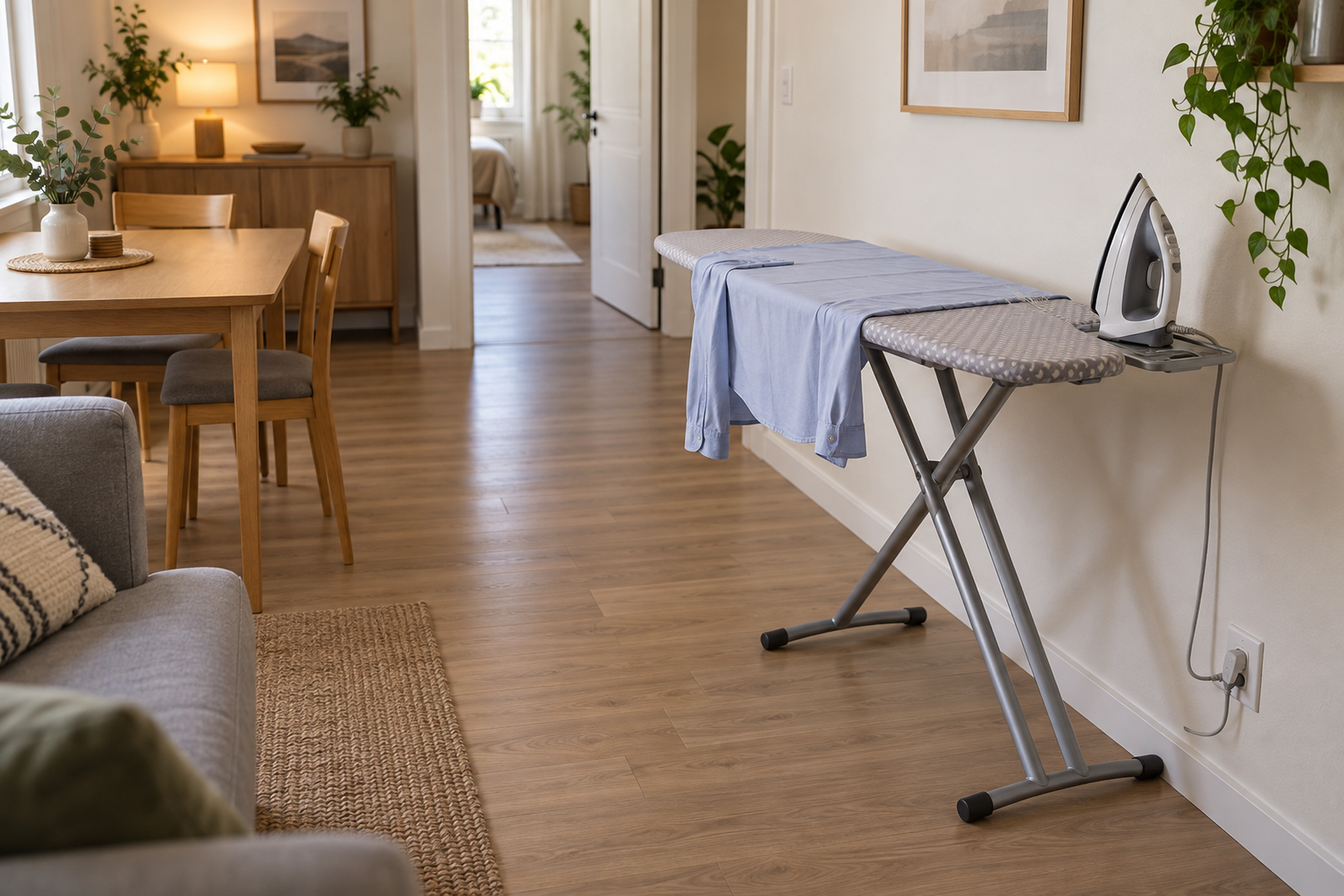
An ironing board creates more than one space problem. It has a folded storage footprint, an open working footprint, and—if the system uses a tabletop board or ironing blanket—a borrowed-surface footprint on the dining table, desk, or counter beneath it.
The smallest folded product is therefore not automatically the strongest small-apartment solution. The better choice preserves the pressing surface the household actually needs, fits the room when open, stores without blocking another category, and has a realistic cool-down and reset path after the ironing itself is finished.
Quick Answer
Choose the Smallest Total System That Still Does the Pressing Job
01
Start with the real ironing task
Occasional touch-ups can justify a smaller surface and more garment repositioning. Regular batches of shirts, dresses, or pants increase the value of a larger independent pressing surface.
02
Check for a narrow vertical slot before replacing a full-size board
A conventional board can be awkward in length but only a few inches deep when folded, so a tall residual slot may be more useful than buying a smaller board that depends on the dining table.
03
Count the table as part of a tabletop or blanket system
A compact board or ironing blanket saves floor storage by borrowing an existing flat surface. That trade works only when the table is stable, available, and appropriate for the exact product.
04
Plan the hot-iron state before you plan the final storage state
The board may be ready to fold before the iron is ready for ordinary storage. Follow the exact iron and storage-product instructions instead of treating cool-down as an afterthought.
01
Choose the Pressing Surface by Task and Frequency
Begin with what you actually press. A person touching up one shirt occasionally can accept a smaller work surface more easily than someone ironing several work garments in one session. The storage system should preserve that required result instead of quietly changing the task.
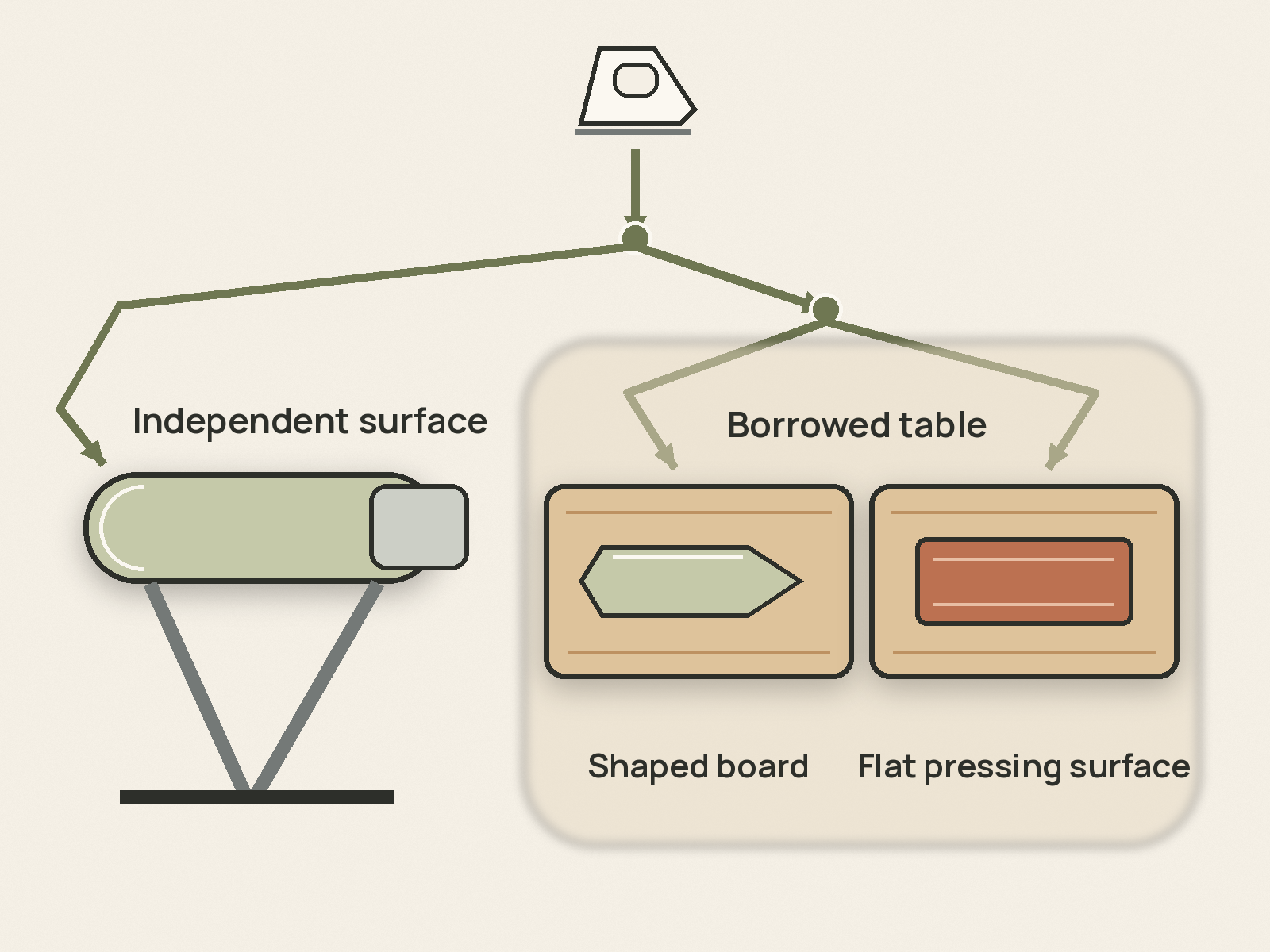
A full-size board creates its own adjustable-height work surface and gives garments more room to drape and move. A tabletop board preserves a shaped board surface in a smaller package but borrows a table or counter. An ironing blanket removes most board hardware entirely, but it turns an existing suitable surface into the pressing station.
Do not solve the apartment constraint by defaulting to a steamer if the user still needs pressing. Current user evidence in the Research Package includes small-space users who explicitly found steaming insufficient for work dresses, pants, and shirts. A steamer can remain an optional task-specific alternative, not the baseline answer.
02
Count the Stored, Setup, and Borrowed-Surface Footprints
Measure three different footprints before buying anything. The stored footprint is the board, mat, hook, or folded package when put away. The setup footprint is the room area needed while pressing. The borrowed-surface footprint is the table, counter, or desk that becomes unavailable when a tabletop board or blanket is in use.
These footprints can move in opposite directions. A full-size board may be thin in storage but large when open. A tabletop board may store easily but occupy the dining table. An ironing blanket may have almost no rigid storage footprint yet convert a large part of the only shared work surface in the apartment.
Also map the retrieval path. A board stored behind three bins or squeezed into a slot that requires moving furniture is technically stored but operationally expensive. Small-space success depends on whether one person can retrieve, set up, and reset the system without dismantling another storage category.
Measure / Check First
Before replacing a full-size board or buying a compact alternative, test the complete ironing system against the apartment rather than measuring the folded product alone.
Check the Working Surface, Storage Envelope, and Reset Path
01
Working surface and setup area
Decide how much pressing surface the actual garments need, then confirm the open board or borrowed table leaves enough room for circulation, garment movement, a stable iron-rest position, and the appliance manufacturer’s electrical setup.
02
Stored dimensions and retrieval path
Measure folded height, width, depth, and weight, then check the entire path in and out of the proposed vertical slot, closet, cabinet, or hanging position. A board that fits only after moving another category is not low-friction storage.
03
Support surface, heat, moisture, and cool-down
For tabletop boards and blankets, follow the exact product requirements for the supporting surface and steam or heat use. Separately plan where the unplugged iron can cool and when it can enter ordinary storage according to the iron or purpose-built storage-product instructions.
If the product stores neatly but cannot be set up without blocking the room, borrows a surface the household cannot spare, or has no workable cool-down and reset path, the total system does not fit the apartment.
03
Check for a Vertical Slot Before Downsizing
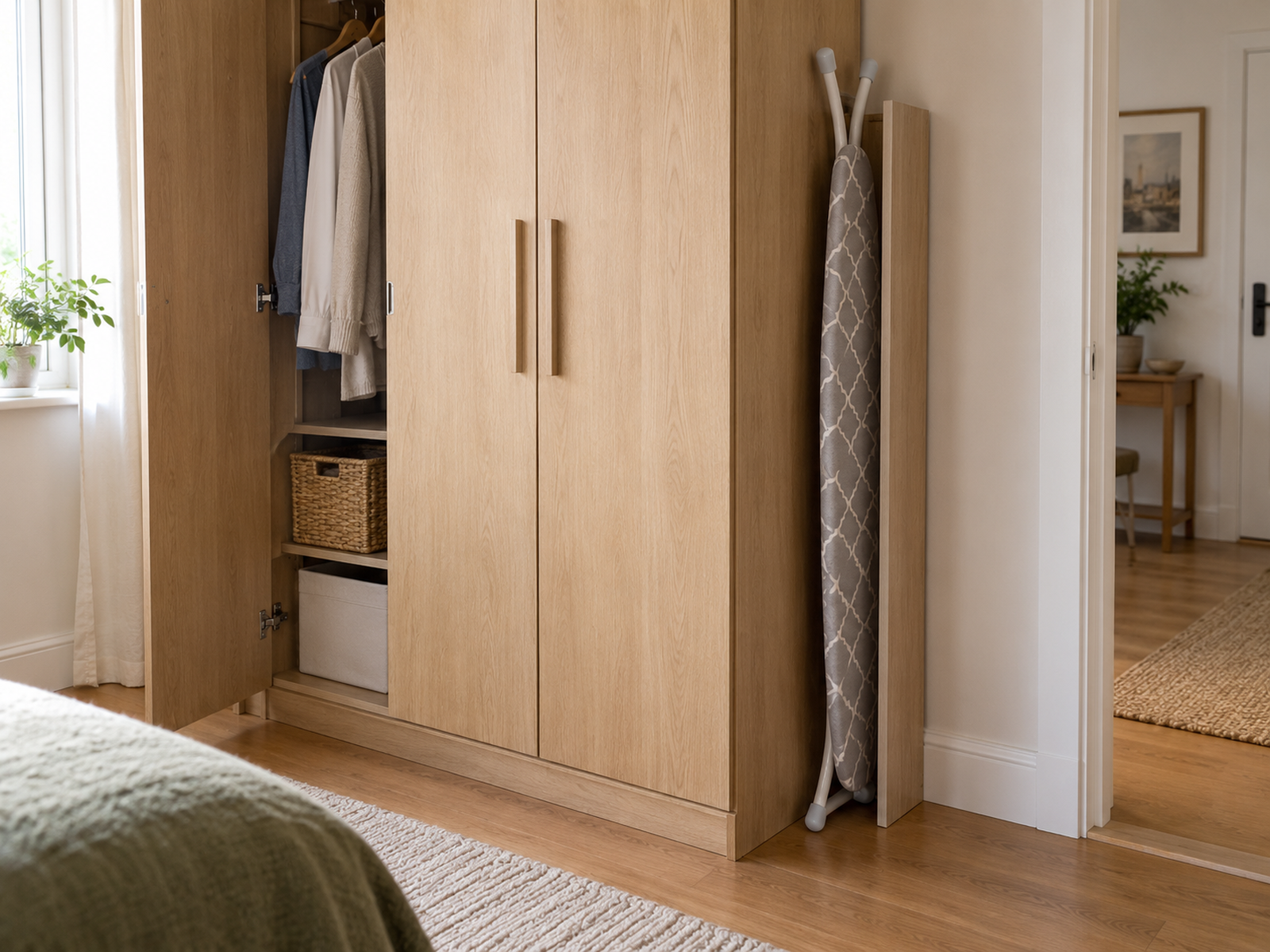
Do not reject a full-size folding board simply because the apartment has no utility closet. Many boards are tall when folded but comparatively thin, which means a narrow vertical slot can sometimes preserve a better working surface without consuming a cabinet shelf or dining table.
Brabantia’s current 49-by-18-inch Ironing Board C is one useful scale example. The manufacturer lists a folded envelope of about 64.2 inches high, 18.1 inches wide, and 3 inches deep for that model. Those dimensions are product-specific, but they show why “too big” should be tested in three dimensions rather than assumed from the open board length.
Look for a dry, stable slot beside a wardrobe, along a closet side bay, or in another non-appliance storage zone where the full folded board can be removed without unloading other items. Keep doors, baseboards, heaters, electrical equipment, appliance clearances, and normal circulation out of the storage path.
If the board needs a hanger, verify the exact hanger and board compatibility. An existing suitable rated hook can be reversible; a new wall or door hanger may introduce fasteners, door-load, and swing-clearance questions. Do not hang a heavy board from a generic over-door hook simply because the geometry looks possible.
04
Use a Tabletop Board When the Table Is Truly Available
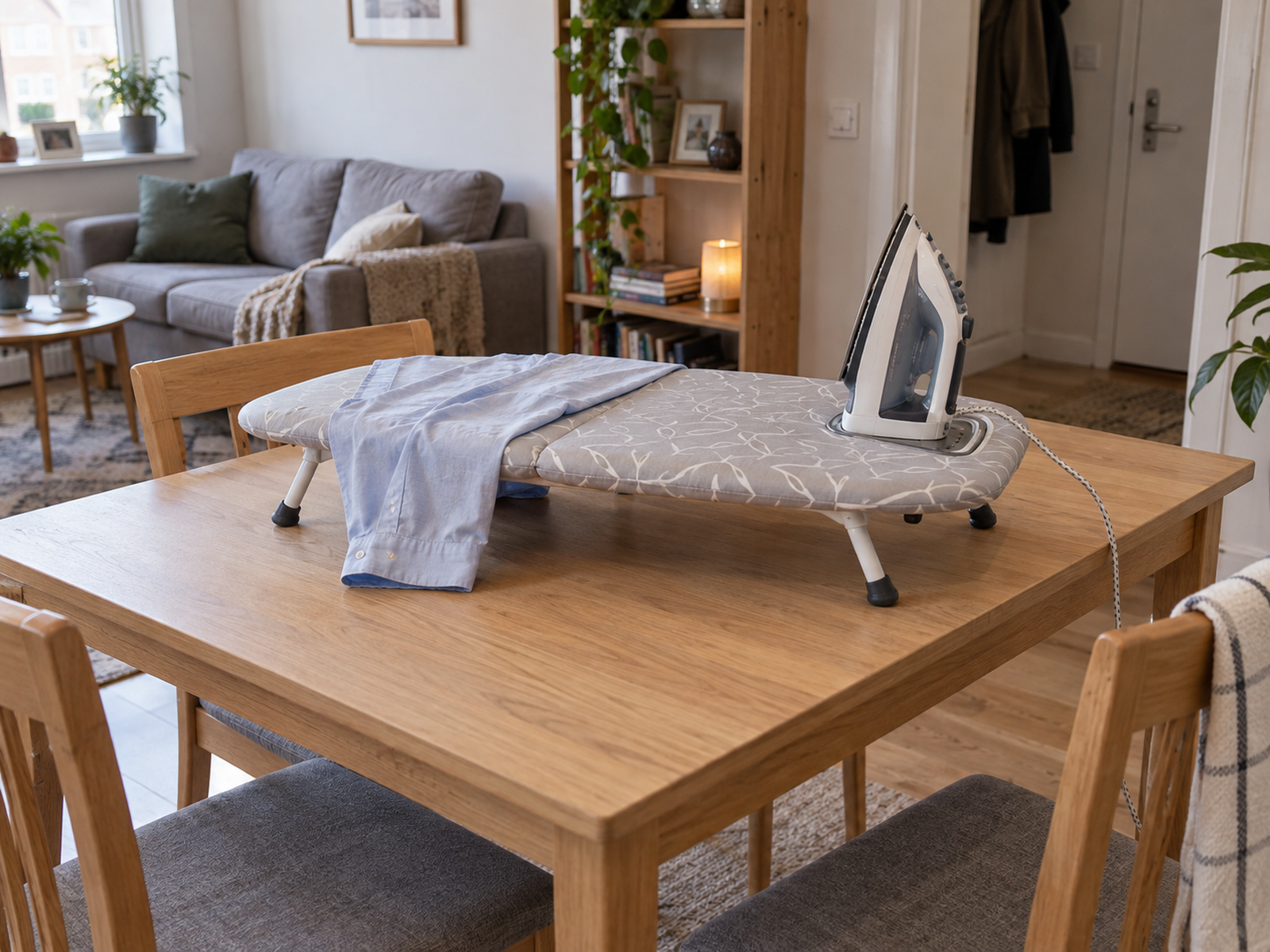
A tabletop board is strongest when the apartment genuinely has a stable flat surface that can be borrowed without disrupting a more important daily function. It removes the freestanding floor footprint, but the support furniture becomes part of the ironing system every time the board comes out.
IKEA’s current JÄLL tabletop board is one simple example. IKEA lists it at about 28 3/4 inches long, 12 1/2 inches wide, and 5 inches high, says it folds flat, includes a hook for hanging storage, and requires a flat support surface.
That compactness comes with a smaller working area than a full-size board, so larger garments may require more repositioning. If the only available support is also the household’s dining table or desk, include the clearing and reset work in the decision rather than treating that surface as free space.
A tabletop board is a good trade when the table is easy to clear, the working height is acceptable, and the household’s pressing tasks fit the smaller surface. If the table is constantly in use or the board makes large garments frustrating, the smaller stored object may create more total friction.
05
Use a Fold-in-Half Board When Stored Length Is the Main Constraint
A fold-in-half tabletop board solves a different problem from a tiny compact board. Its goal is to preserve a relatively long pressing surface while shortening the stored package enough to fit a cabinet, closet shelf, or smaller hanging zone.
Joseph Joseph’s current Pocket Max demonstrates that form with a 43-inch ironing surface and closed dimensions of about 21.73 by 13.78 by 6.1 inches. Those figures apply to that exact product, but they prove the broader design possibility: a shorter stored length does not always require a tiny working surface.
The trade is still borrowed furniture. The product needs a suitable support surface, and the folded package is thicker and more mechanically complex than a simple flat tabletop board.
Pocket Max also makes the reset boundary explicit. Joseph Joseph instructs users to let the iron cool to room temperature before placing it in the integrated storage compartment and to make sure the cover is dry before folding and storing. Treat those instructions as product-specific, not as a universal timing rule for every board and iron.
06
Use an Ironing Blanket When a Flat Pressing Surface Fits the Task
An ironing blanket minimizes rigid storage more aggressively than a board because it removes the legs and frame. It can be an excellent fit when the household already has a suitable table and the work does not depend on a shaped board nose or independent standing height.
Brabantia’s current ironing blanket is one verified purpose-built example at roughly 25.6 by 47.2 inches. The manufacturer describes a multi-layer construction intended for normal and steam irons, including a non-permeable layer designed to protect the surface below from heat and moisture, plus a non-slip base and compact hanging or rolled storage.
Do not generalize that protection to ordinary towels or to every pressing mat. The exact product instructions and the underlying furniture surface matter. A dining table finish is part of the setup, not an invisible background condition.
The blanket also changes garment handling. It provides a broad flat rectangle but no independent board structure. If that form matches the household’s pressing tasks, the storage advantage is substantial; if not, the smallest stored solution can become the slowest one to use.
07
Plan the Iron Cool-Down and Reset Path
The board is only part of the reset. When the garment is finished, the iron may still be too hot for ordinary enclosed storage, which is one reason an otherwise compact ironing setup can remain visible long after the task is over.
Follow the exact iron manufacturer. Rowenta’s current U.S. care guidance for its steam irons, for example, instructs users to unplug, allow approximately one hour of cooling, empty the water tank, wrap the cord, and store the iron vertically. That cooling period is product-specific and should not be turned into a category-wide rule.
A purpose-built storage product can have different instructions. Brabantia’s current Iron Store is specifically designed as a heat-resistant holder that can accept a hot iron and also hang a compatible board. That capability belongs to the designed product; it does not make an ordinary cabinet, plastic bin, basket, or generic hook safe for hot-iron storage.
Design the shutdown as two states when necessary: board reset and iron cool-down. The board may be able to fold away while the unplugged iron remains in its manufacturer-appropriate cooling position. The apartment does not need to keep the entire ironing station open merely because one component is still cooling.
08
Treat Wall-Integrated Boards as Installation Projects
A wall-integrated ironing center can remove the loose board from the room when stored, but it does not remove the open-board geometry. It also exchanges a storage problem for permanent wall, cabinet, and sometimes electrical installation.
Iron-A-Way’s current E-42 is one example of the category. Its fold-down board is 42 inches long, and current manufacturer documentation for surface mounting requires wall or stud anchoring. The manufacturer also states that its 42-inch swivel board needs about 47 inches from the wall to the board tip to swivel.
That makes a built-in center a weak default for renters. It can be an efficient owner-controlled solution when the wall, clearances, and installation requirements are genuinely appropriate, but “folds into the wall” does not mean “uses no room.”
Use the same skepticism with new wall hooks and mounted board brackets. Reversible tabletop, blanket, or freestanding systems should be evaluated before drilling into walls, doors, or landlord-owned cabinetry merely to make the board disappear.
09
Run the Full Retrieve-to-Reset Test
Before finalizing the system, perform the whole cycle once: retrieve the board or blanket, set up the support surface, place the iron according to its instructions, press a representative garment, handle cool-down, and return every part to storage.
Count what the apartment loses during the task. Does the board block the hallway? Does the tabletop system eliminate the dining table? Does the blanket require clearing the desk? Does the stored board prevent a closet door from closing? The best solution has the lowest total disruption, not merely the smallest folded object.
Then count the reset steps. A system that is difficult to put away will eventually become permanent visual clutter. The board, cover, hanger, iron, cord, and any water reservoir all need a clear end state that one person can complete without shifting unrelated storage.
When two options both fit, choose the one that preserves the required pressing result with fewer borrowed surfaces, furniture moves, installation commitments, and delayed reset steps. That is the real space-saving system.
Closing Decision
Choose the Smallest Total System, Not the Smallest Board
A small apartment does not automatically need a tabletop board or ironing blanket. First preserve the pressing surface the household actually needs, then compare where each solution moves the footprint. A full-size board may be the better compact choice if a narrow vertical slot exists and the room can handle the open board without blocking daily circulation.
When floor setup is the harder constraint, a tabletop or fold-in-half board can trade floor area for a borrowed table, while a purpose-built ironing blanket can reduce stored hardware even further. Keep wall-integrated systems in the installation category, plan the hot-iron state separately, and judge every option by the full retrieve → set up → press → cool → reset cycle.
RELATED GUIDES
What to Read Next
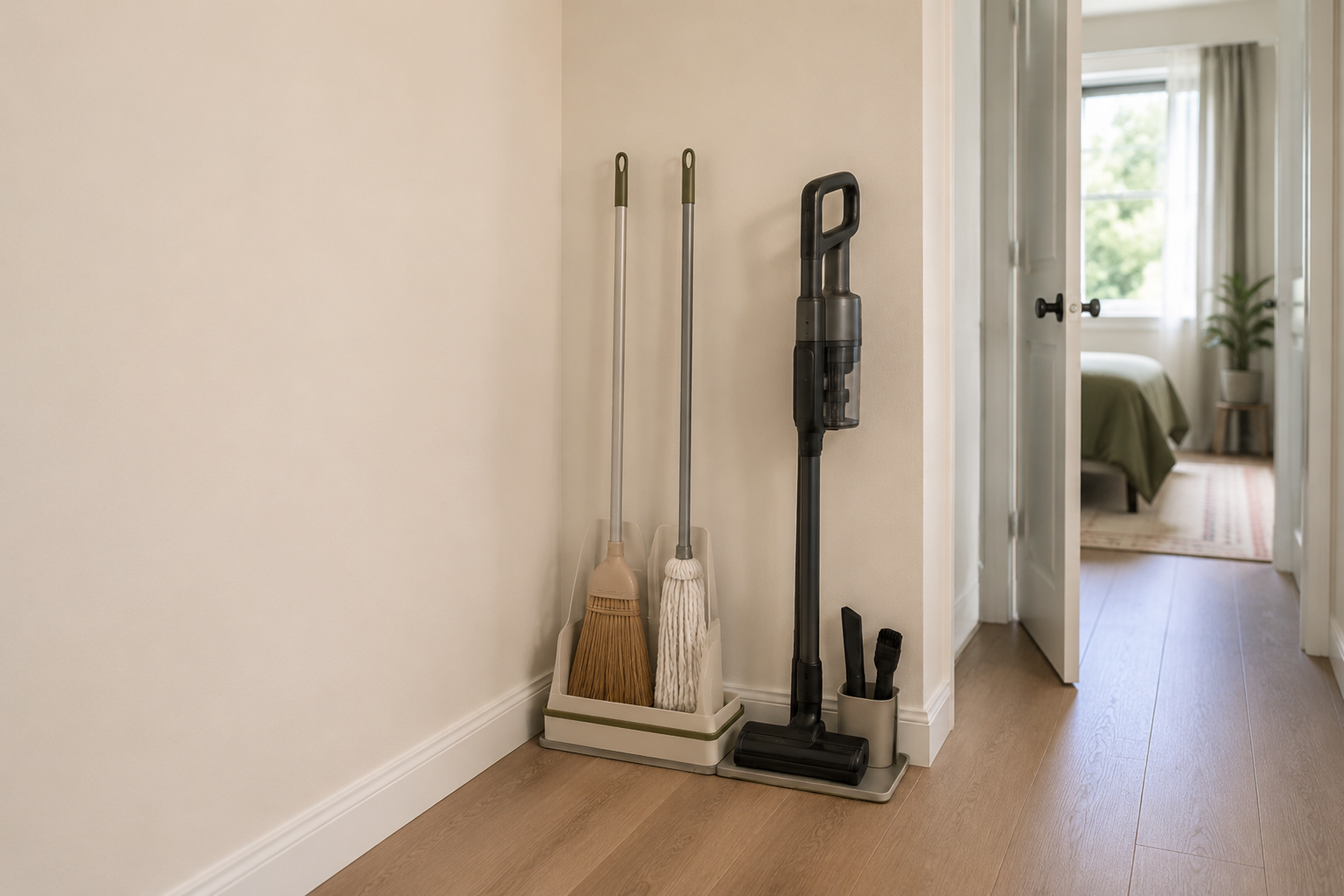
NEXT GUIDE
How to Store a Broom, Mop, and Vacuum in a Small Apartment With No Utility Closet
Use this next if the same no-utility-closet problem also leaves long cleaning tools leaning in corners; that guide focuses on awkward vertical equipment without the ironing board’s setup and heat requirements.
GUIDE
How to Store Laundry Supplies in a Small Closet With a Stacked Washer and Dryer
Use this if the ironing system shares a tight laundry zone with detergent and other supplies; it helps protect appliance access and decide what belongs in the active laundry area versus backstock elsewhere.