
Small Apartment Storage Ideas
How to Store Household Backstock in a Small Apartment With No Storage Closet
Set a physical limit for reserve supplies before you buy the biggest pack, keep only a small working reserve near each room of use, and assign the rest to storage zones that match weight, access frequency, and product-safety requirements.
In This Guide
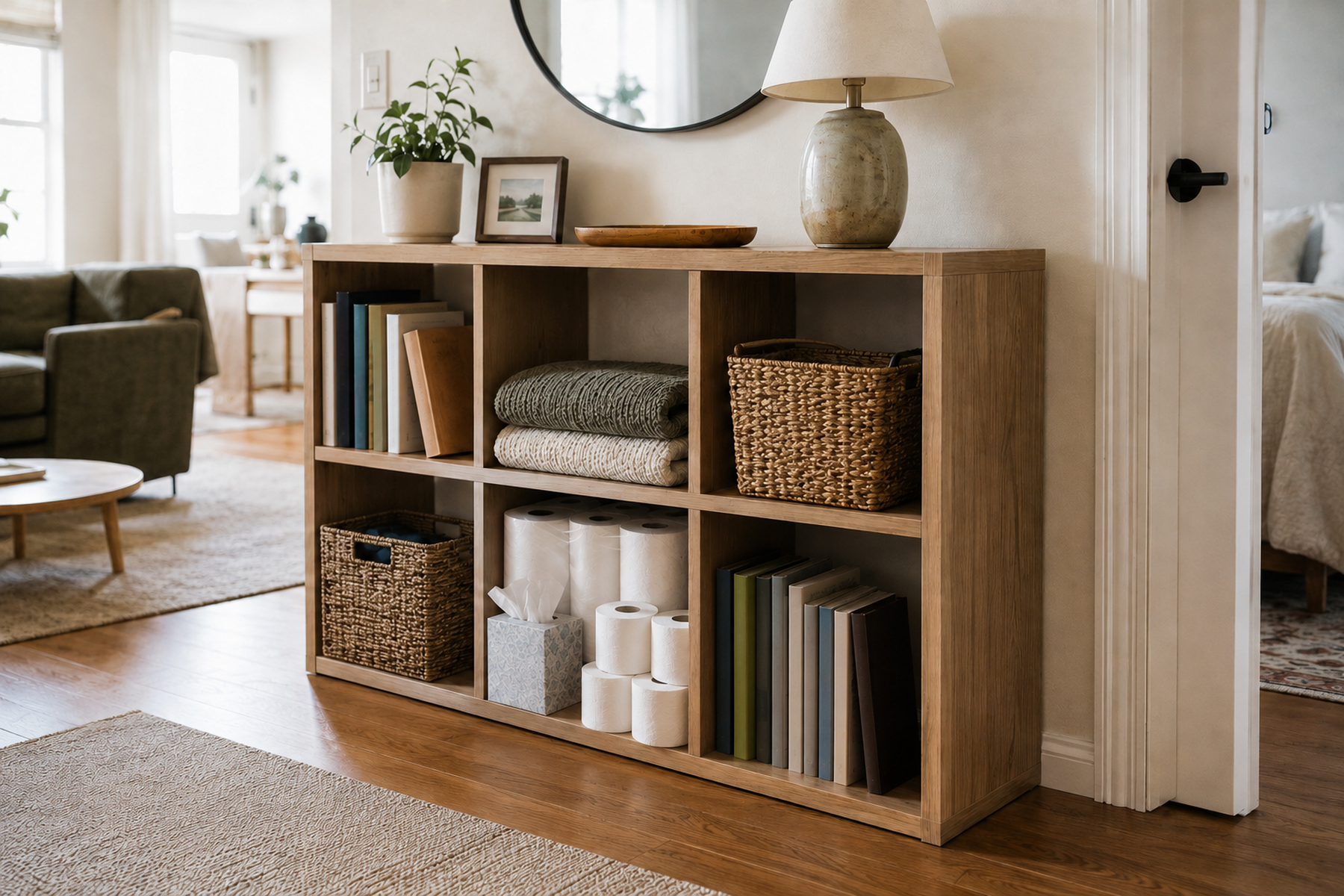
Household backstock is easy to underestimate because each item is ordinary: toilet paper, paper towels, tissues, trash bags, detergent, cleaning refills, toiletries, and other supplies that will eventually be used. In a small apartment, the combined reserve can quietly occupy the same shelves, closet volume, under-bed space, and floor area needed for everyday life.
The useful decision happens before the apartment becomes the storage plan. Decide how much reserve stock the home can actually carry, separate what is active from what is waiting, and let access frequency, weight, and category-specific storage rules determine where the reserve goes.
Quick Answer
Make the Storage Limit Part of the Buying Decision
Give household backstock one bounded physical home, keep active supplies and a small convenience reserve near the room of use, and place the remaining stock according to weight, access frequency, and product-specific storage requirements. When the reserve zone is full, let that capacity limit the next purchase instead of expanding backstock into higher-value apartment space.
01
Give backstock one physical capacity limit
Choose the shelf, cabinet section, bin footprint, or other genuine low-priority zone that reserve supplies are allowed to occupy. When that boundary is full, the default is to use what you have before expanding into another room.
02
Separate active stock from reserve stock
Keep the product currently in use and a small convenience reserve near the room of use. The remaining sealed stock can tolerate a lower-priority location if the category is appropriate for that storage environment.
03
Rank storage zones by weight, access, and suitability
Light bulky paper goods can make sense higher up; heavier liquid refills are better kept lower. Cleaning products and other sensitive categories still follow their original-container and label requirements.
01
Set the Backstock Limit Before You Buy
A sale price or warehouse package is not the only cost of reserve inventory. The apartment also carries that purchase in cubic space until the last unit is used.
Choose the backstock capacity first. That might be one high shelf, one cabinet section, two compatible bins on existing shelving, or another clearly bounded zone that does not already have a more valuable job.
Then compare the package to the space you actually own. If the full pack needs a second shelf, spills into a walkway, takes over the bathroom, or pushes daily-use items out of their best storage, the purchase is larger than the apartment’s current backstock system.
This is not a judgment about whether bulk shopping is financially worthwhile in general. It is a small-space rule: unit price and storage fit are separate variables, and the cheaper package can still be the wrong package for the home.
02
Separate Active Inventory From Reserve Stock
A product that is in use has a different access requirement from the unopened replacements behind it.
Keep active inventory where the routine happens: the current detergent near the laundry setup, the open box of trash bags where bags are changed, or the toilet paper needed for normal bathroom convenience. The full reserve package does not need the same priority.
This split protects small rooms from becoming warehouses. A bathroom can hold a practical reserve of paper goods without absorbing the entire multi-pack; a laundry zone can keep the working detergent without surrendering every nearby shelf to unopened refills.
The reserve still needs a predictable home. Moving it farther away only works when the household can find it again and replenish the room-of-use supply before buying a duplicate.
03
Create One Bounded Backstock Zone
One central reserve zone is often easier to manage than a series of accidental overflow spots.
Use an existing low-priority shelf, part of a freestanding storage unit, or a small set of compatible bins that already fits the apartment. The boundary should be visible enough that the household can tell when reserve capacity is nearly full.
Keep categories separated inside that boundary when their storage requirements differ. Dry paper goods, unopened toiletries, laundry products, and household cleaners should not be treated as interchangeable contents simply because they are all called backstock.
A physical limit can do the work of a complicated inventory system. When the allocated shelf or bin is full, finish stock before repurchasing instead of creating a second uncontrolled reserve zone.
Measure / Check First
Before a warehouse pack or new storage container enters the apartment, test the proposed reserve zone against the space, the load, and the product category.
Check the Backstock Zone Before the Pack Enters the Apartment
01
Usable volume
Measure the real shelf, cabinet, or under-bed clearance and account for doors, drawers, bed frames, closet access, and normal circulation. A package that fits only by spilling into an adjacent function does not fit the zone.
02
Weight and retrieval
Decide whether the full container can be lifted and reached safely. Reserve high storage for light, low-frequency goods; keep dense liquids and other heavy stock lower and within the limits of the shelf, bin, or furniture.
03
Category requirements
Check the product label and storage instructions before combining categories or choosing a location. Household cleaners and laundry packets should retain their original containers and labels; medicines follow their own storage instructions rather than the generic backstock plan.
If the planned zone fails any of these checks, reduce the purchase quantity or choose another legitimate storage location instead of forcing the reserve into the apartment.
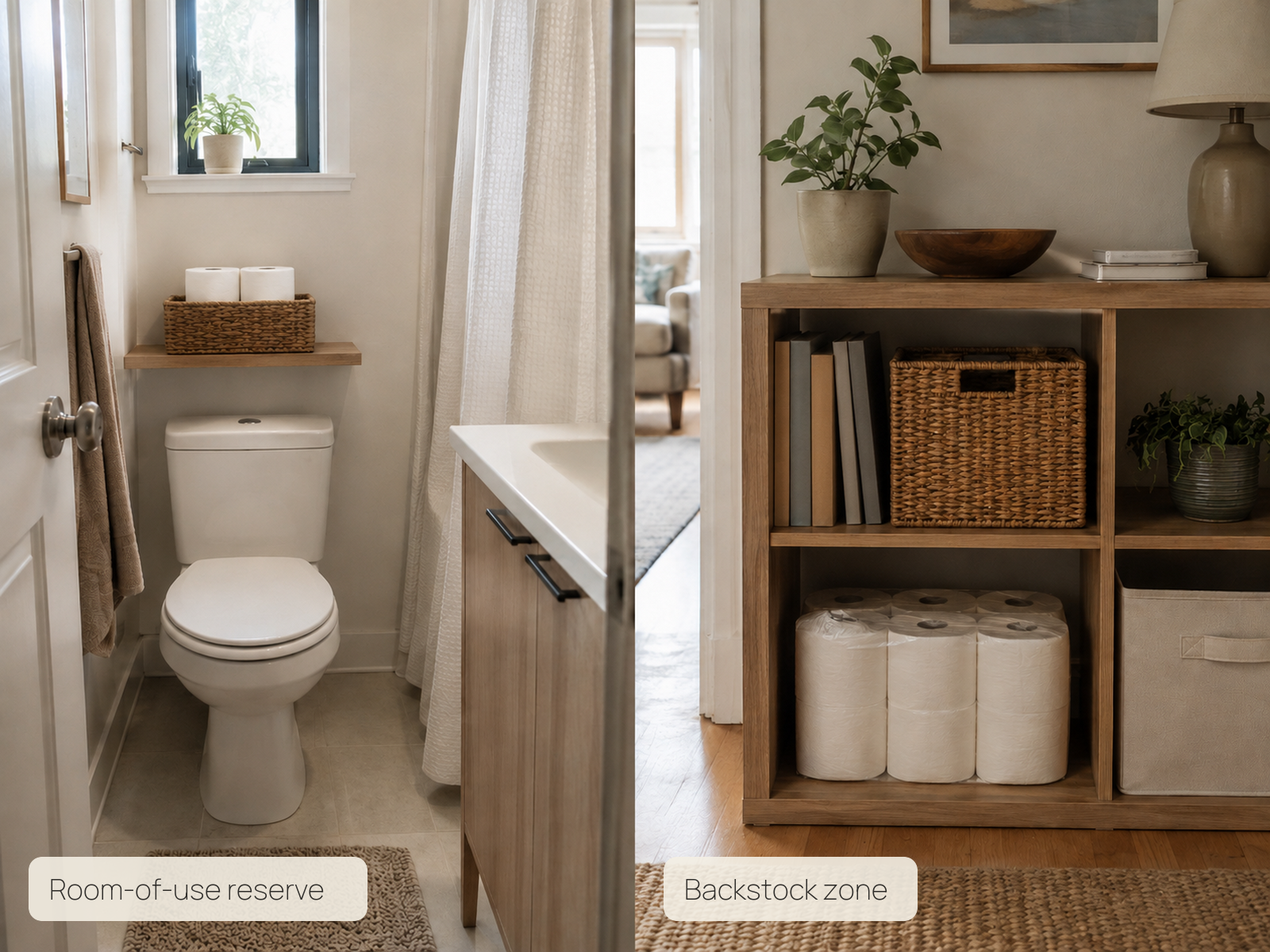
04
Keep a Small Room-of-Use Reserve
Centralizing every spare item can create its own friction, especially for products replaced often.
Use a hybrid system: keep a deliberately small reserve near the point of use, then store the rest in the main backstock zone. A few toilet-paper rolls can stay accessible in the bathroom while the unopened remainder lives elsewhere; one replacement detergent can stay near laundry while additional stock remains in reserve.
The room-of-use reserve needs a boundary too. Without one, the bathroom, laundry corner, or kitchen gradually becomes a second warehouse and the household loses track of which location is the real inventory source.
When reserve stock is distributed across more than one room, use a simple cue that prevents duplicate buying. That can be as lightweight as checking the central zone before shopping or keeping one short household note; the article does not require a spreadsheet to solve an ordinary stock problem.
05
Match Storage Height to Weight and Access
Storage height should reflect what the item weighs and how often someone needs to retrieve it.
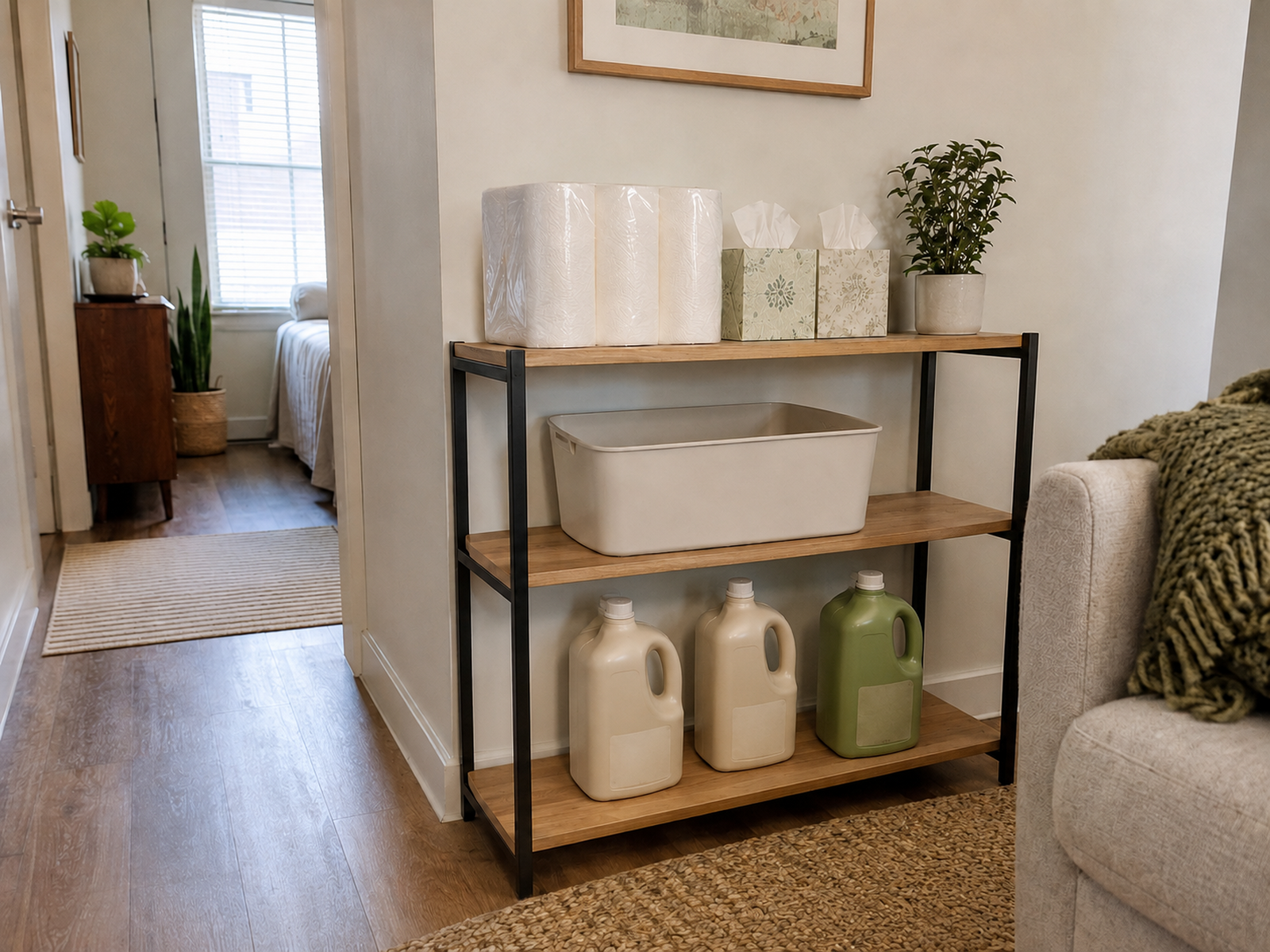
Bulky but light dry goods—such as unopened toilet paper, paper towels, or tissues—can be strong candidates for higher storage when the shelf is suitable and retrieval remains safe. They consume a lot of volume without creating the same lifting burden as heavy liquid containers.
Heavier reserve items belong lower. Large detergent containers, liquid refills, and other dense stock should not become high-shelf filler merely because the dimensions fit. Lower placement also reduces the amount of weight carried by the upper part of freestanding furniture.
If a tall freestanding unit is part of the plan, follow its manufacturer’s stability and anchoring instructions. The U.S. Consumer Product Safety Commission’s Anchor It! guidance also advises securing top-heavy furniture; “freestanding” is therefore not automatically the same as “no-install.”
06
Use Under-Bed Storage Only When It Wins the Space
Under-bed volume can hide reserve stock, but it is not free space.
Seasonal clothing, bedding, shoes, luggage, and other apartment categories may already depend on the same zone. Give the space to the category that creates the greatest functional benefit rather than automatically sending every bulky purchase under the bed.
When backstock does win the zone, keep it to appropriate dry, low-risk items in a container that clears the bed frame and can be retrieved without turning the bed perimeter into a daily obstacle. Low visibility also means the inventory is easier to forget, so check the zone before repurchasing.
Do not use under-bed storage as a generic answer for products with label-specific storage, child-resistant access, chemical-safety requirements, or environmental conditions that the location cannot guarantee.
07
Keep Cleaning Products in Their Original Containers
A uniform set of decanted bottles may save visual space, but household chemicals are not an aesthetic-storage category.
The U.S. Consumer Product Safety Commission advises keeping household chemicals and cleaning supplies in their original child-resistant containers where applicable, and the American Cleaning Institute likewise advises keeping cleaning products in original containers with labels intact and following label directions for storage.
That means the backstock system must fit the real retail container instead of assuming every refill can be poured into a narrower bottle or decorative jar. Keep chemical categories separated as required by their instructions and preserve child or pet access protections where they apply.
Medication stays outside this generic system as well. The U.S. Food and Drug Administration notes that storage instructions are medicine-specific and that a damp bathroom cabinet can be an inappropriate location for some medicines.
08
Add Bins or Furniture Only When They Improve the System
Containers should reinforce the capacity limit, not quietly increase it.
A lidded bin can define one repeatable footprint and protect dry reserve items from dust. A clear bin can make stock easier to see. An opaque bin can calm visual clutter. Choose the trade-off that solves the household’s real failure point instead of defaulting to one aesthetic.
Stacking also has limits. Follow the container manufacturer’s stacking guidance, keep heavier contents at the bottom, and avoid building a tower that must be dismantled every time the household needs one replacement item.
New freestanding furniture deserves a higher bar because it consumes permanent floor volume. If the only reason a cabinet or storage bench exists is to hold a warehouse pack that could have been bought smaller, the furniture may be solving a purchasing problem by creating an apartment-furniture problem.
09
Use the Stop Rule Before Adding More Storage
When the planned backstock zone is full, do not assume the next move is another shelf.
First use what is already in reserve. If a purchase is still needed, choose the package size that fits the available capacity after protecting daily-use storage and circulation.
For suitable individually packaged goods, splitting a warehouse pack with another household can preserve purchase convenience without forcing one apartment to carry the entire volume. Keep chemicals and other products that rely on their original retail containers out of improvised splitting or decanting schemes.
The smaller pack is also a valid organization tool. When a bulk package saves a modest amount of money but requires months of extra furniture, hidden overflow, or lost closet capacity, refusing the extra inventory can be the most efficient small-space decision.
Closing Decision
Let the Backstock Zone Set the Buying Limit
A small apartment does not need to hold the reserve inventory of a house with a garage, basement, or utility room. Keep the working supply close to the routine, give the remaining reserve one bounded home, and spend low-priority storage on the lightest and least frequently accessed items first.
When the boundary is full, use the stock before expanding the system. A smaller pack, delayed purchase, or suitable split purchase can protect the apartment better than another organizer—and cleaning products, medicines, heavy refills, and tall furniture still keep their own safety and manufacturer requirements.
RELATED GUIDES
What to Read Next
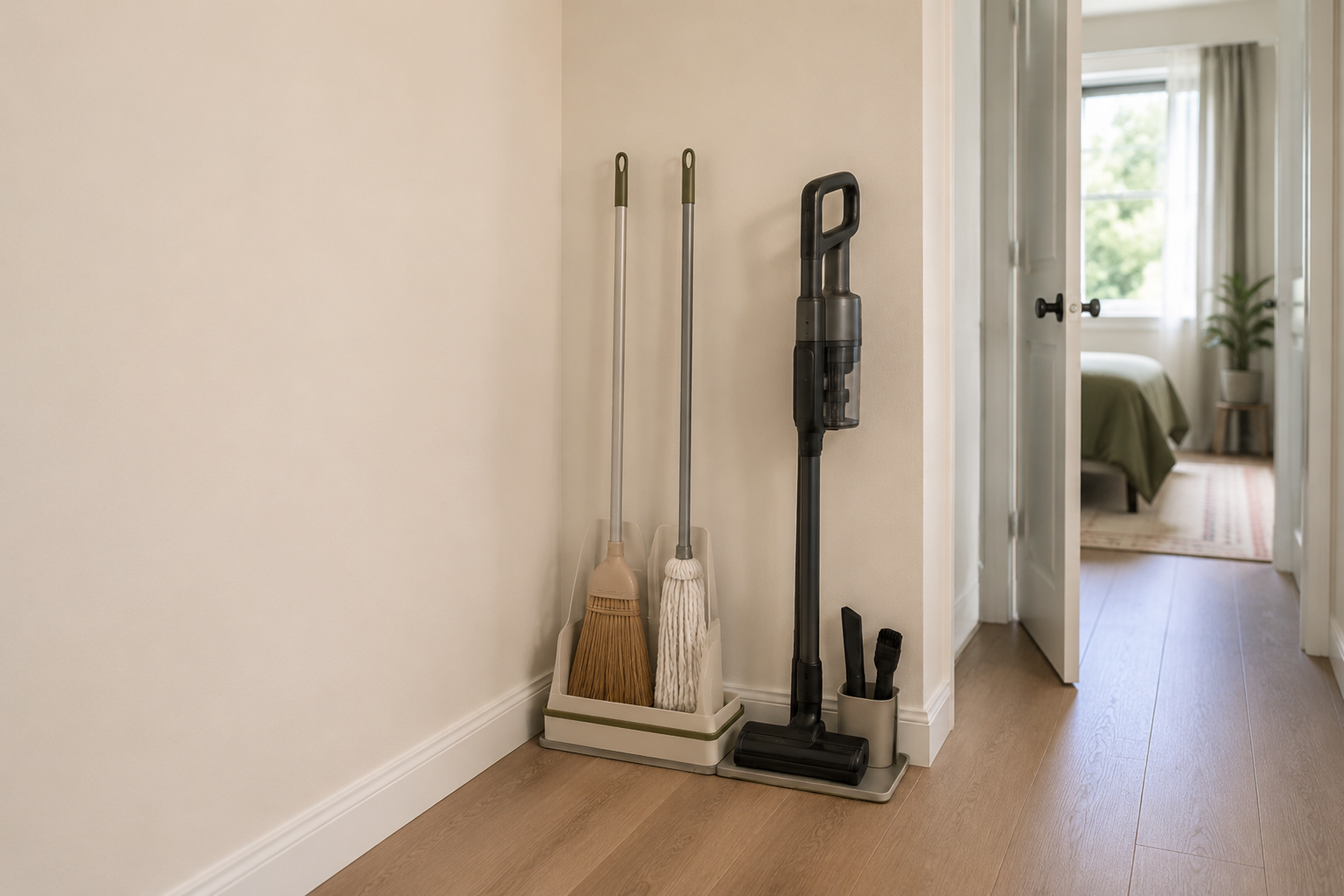
NEXT GUIDE
How to Store a Broom, Mop, and Vacuum in a Small Apartment With No Utility Closet
Use this next if the reserve cleaning products now have a safe bounded home but the broom, mop, or vacuum still has no practical storage zone.
GUIDE
How to Store Towels and Bedding in a Small Apartment With No Linen Closet
Use this if towels and bedding are competing with household backstock for the same closet-top, under-bed, or remote-storage capacity.
GUIDE
How to Organize a Small Bathroom Shared by Two People With One Sink
If bathroom reserve products are still crowding daily routines, this guide shows how to separate personal daily items, shared essentials, and lower-priority backups around one sink.