
Small Bathroom Storage
How to Organize a Small Bathroom Shared by Two People With One Sink
Give each person a reliable daily-use zone, keep genuinely shared items separate, move backups out of prime storage, and protect enough sink and counter space for the bathroom to keep working.
In This Guide
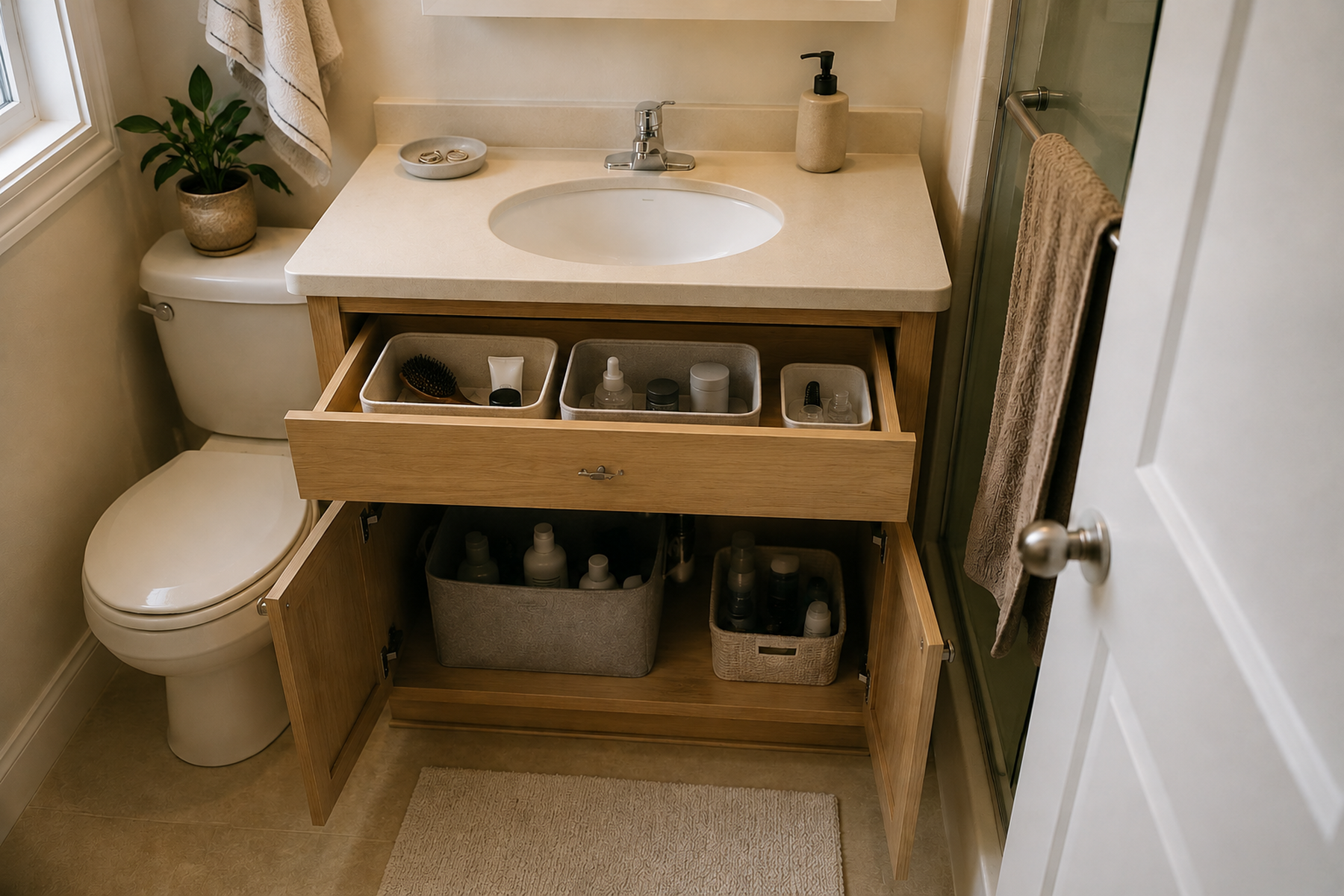
Two people can overwhelm a small bathroom without either person owning an unreasonable amount of stuff. The problem is that both routines are competing for the same sink, counter, eye-level storage, cabinet openings, shower zone, and limited floor area.
The most useful fix is not to split every shelf exactly in half or add storage until everything fits. First decide what deserves bathroom space, then separate personal daily items from shared essentials and lower-priority stock so each person can retrieve, use, and return routine items without moving the other person’s things.
Quick Answer
Give Daily Routines First Claim on the Room
Give prime bathroom storage only to the items that genuinely support daily routines, then assign each person a bounded personal zone and give truly shared essentials a separate home. Keep backups and lower-priority inventory farther out so the single sink and counter can reset as working space for whichever person is using them next.
01
Keep only bathroom-worthy inventory in prime space
Daily-use toiletries and a small number of genuinely shared essentials should get the easiest access. Occasional products, large backup quantities, and unsuitable categories can move to secondary storage or another appropriate room.
02
Give each person one bounded daily zone
Use a drawer section, shelf, bin, shallow cabinet area, or other defined home base for each person. The zones do not need identical capacity, but neither should expand silently into the other person’s space.
03
Create a separate shared zone
Shared items should not live as miscellaneous overflow inside both personal zones. Give them one clear boundary so everyone knows where they return.
01
Decide What Actually Needs to Live in the Bathroom
Before buying a cart or dividing a cabinet, reduce the number of categories competing for the room.
Sort the bathroom inventory into four working groups: personal daily, shared daily, occasional, and backup or reserve. The daily groups deserve the fastest access because they support the routines that happen at the sink, mirror, shower, and toilet every day.
Occasional products do not need to occupy the same eye-level shelf as a toothbrush or cleanser. Large reserve quantities are even easier to demote because an unopened replacement bottle usually tolerates a longer retrieval path than the product currently in use.
The room also does not have to store every item that happens to be associated with grooming or health. If another dry, easy-to-find location is more appropriate for a category, moving it one step outside the bathroom can be the most space-efficient organization decision.
02
Give Each Person a Bounded Daily Zone
Each person needs a predictable home base for the items they reach for most often. That boundary matters more than perfect visual symmetry.
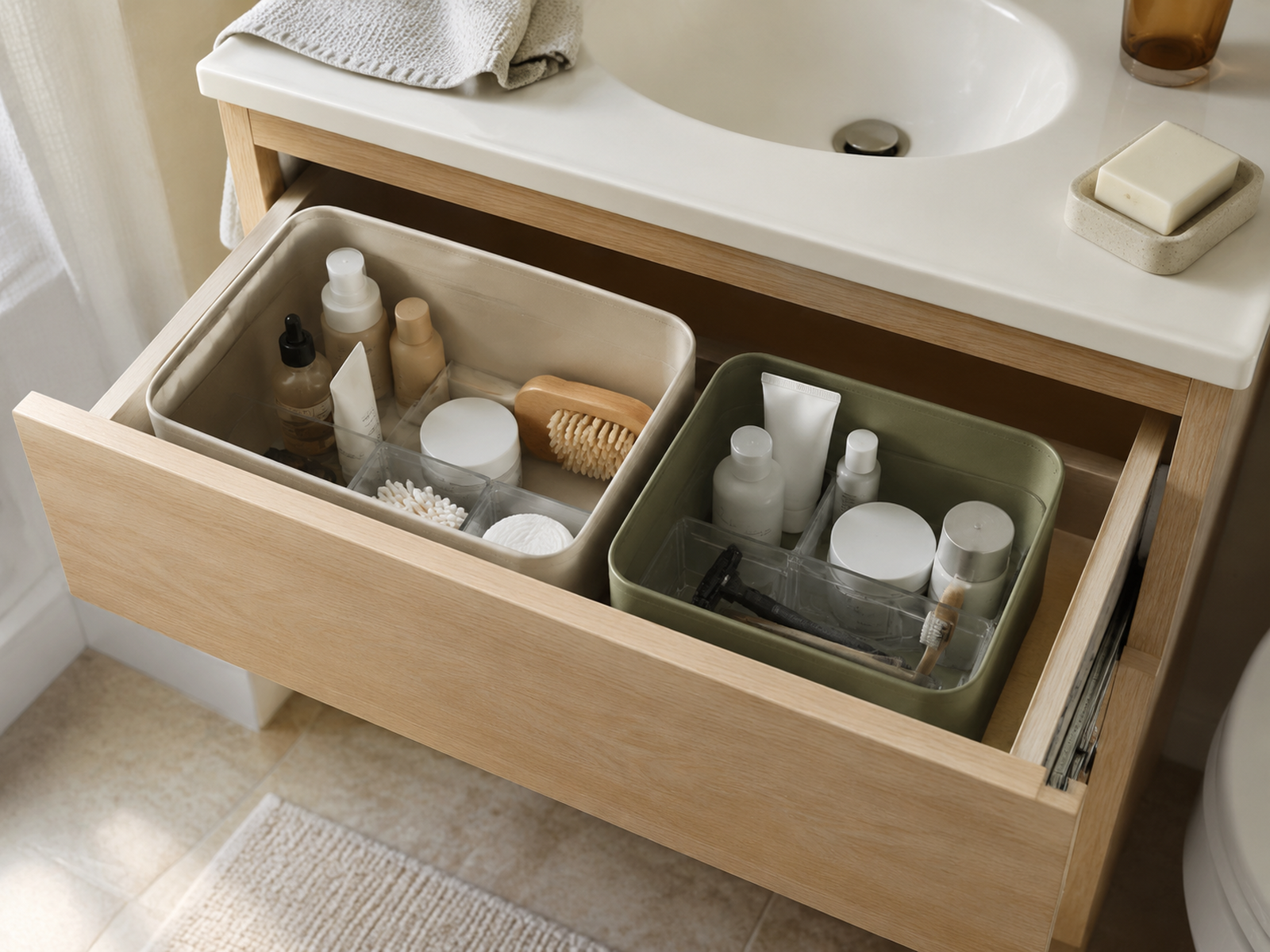
Use the storage you already have first: one drawer section each, one shallow bin each, one cabinet shelf area each, or one side of an existing medicine cabinet when the items stored there are suitable for the bathroom environment.
Do not force a strict 50/50 split when the routines are materially different. One person may need a wider daily zone and the other a smaller one. The useful rule is that both zones are defined, directly accessible, and capped so neither person’s overflow quietly becomes shared clutter.
A strong test is retrieval. Person A should be able to reach daily items without moving Person B’s products first, and vice versa. If the system requires cross-user shuffling every morning, the storage is too layered or the daily zones are too large.
03
Give Shared Items Their Own Zone
Shared products act like a third user when they have no defined home. They spill into both personal zones and make ownership boundaries meaningless.
Create one bounded area for items that are genuinely shared or household-level: for example, hand soap refills, a small toilet-paper reserve, cotton products, or another category both people actually use.
Keep the definition narrow. “Shared” should not become the category for anything nobody wants to claim. If an item belongs to one person’s routine, return it to that personal zone even if it happens to sit near the other person’s products.
When a shared category outgrows its boundary, reassess the amount stored in the bathroom before enlarging the zone. More container volume can hide the inventory problem without solving it.
04
Move Backup Stock One Step Outside
Backups have lower access value than products already in use, which makes them the first category to test for relocation.
The bathroom can keep a convenient replacement where it genuinely helps, but it does not need to become the home for every unopened bottle, bulk toilet-paper package, cleaning refill, or rarely used grooming product.
Move larger backstock to another appropriate, easy-to-find location when the apartment has one. Keep each category together so leaving the bathroom does not turn the reserve into scattered mystery storage.
There is no universal backup quantity. Shopping frequency, apartment storage, household habits, and product size all matter. The governing principle is simpler: an unopened item should not displace the daily item that is used twice a day.
05
Keep the Counter as a Resettable Work Surface
A one-sink bathroom needs counter space for use, not just display. Treat the sink surround like a small workstation.
It is reasonable for a few current-use items to come out while someone gets ready. The problem begins when temporary staging becomes permanent storage and the second person has to work around yesterday’s routine.
A small liftable tray can help when it has a real home after use. Keep it narrow enough that the sink remains usable and the counter can still be wiped without moving a dense collection of bottles one by one.
An empty-counter aesthetic is not the goal. A resettable surface is. After the routine, most items should return to their personal or shared zone so the next person can use the same sink without clearing the first person’s setup.
06
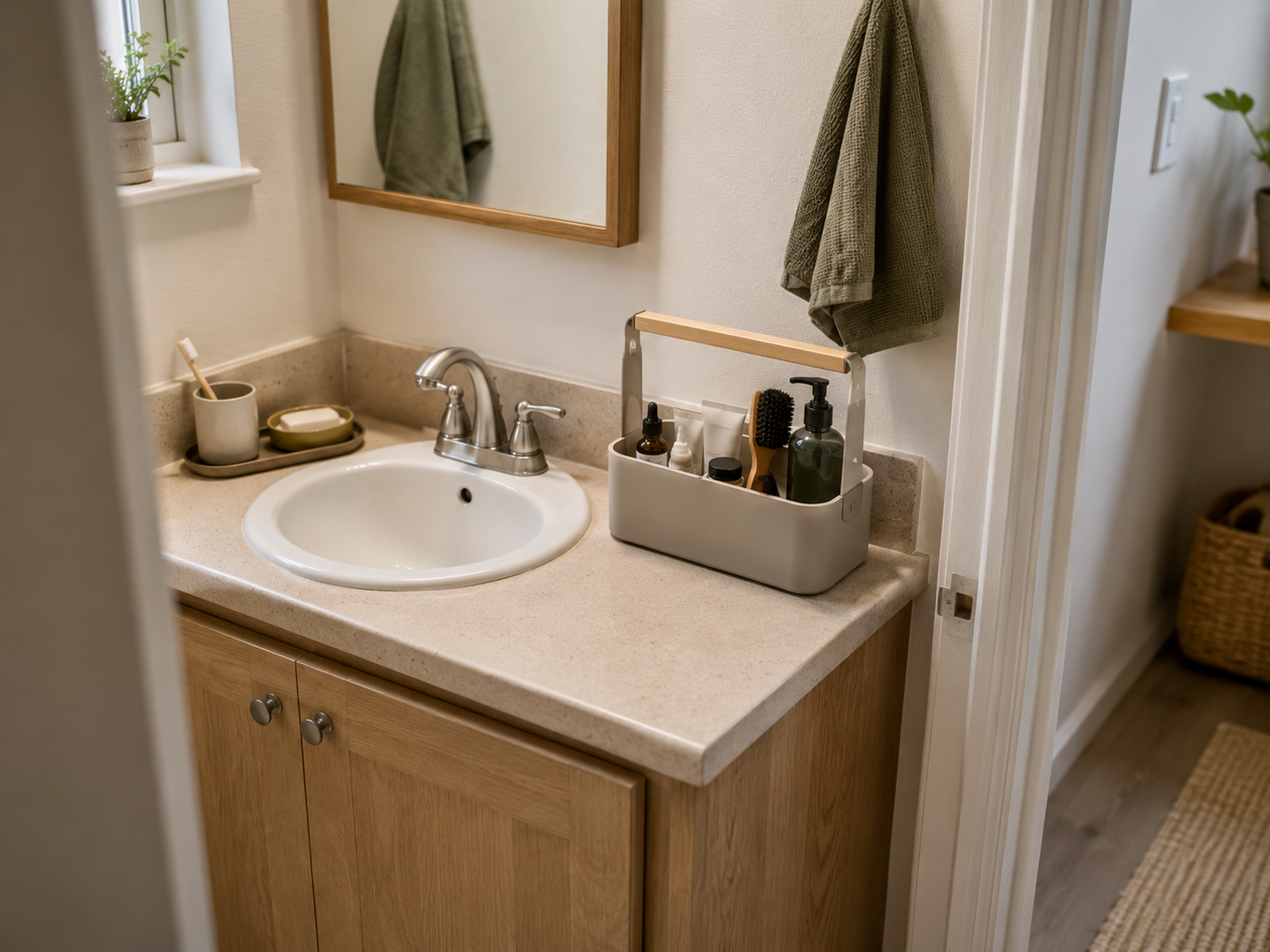
Use a Portable Caddy When One Routine Needs More Space
Two people do not always need the same amount of permanent bathroom storage. A portable caddy can absorb the difference without forcing the larger routine to occupy prime bathroom space all day.
This works best for a group of products used together once or twice a day. Store the caddy in one reliable nearby home, bring it to the sink for the routine, then return it when finished.
Keep the caddy edited. If it becomes an unsorted bucket of daily, occasional, and backup items, portability only moves the clutter from one location to another.
For very frequently used essentials, permanent bathroom storage is usually more efficient. The caddy earns its place when it replaces a larger permanent footprint without making every use feel like unpacking.
07
Add New Storage Only for a Named Job
Only after the existing inventory and ownership zones are clear should another organizer enter the bathroom.
Give the new storage a specific assignment before you buy it: Person B’s daily caddy, shared consumables, backup toilet paper, or another defined category. “Extra bathroom storage” is too vague and tends to become visible overflow.
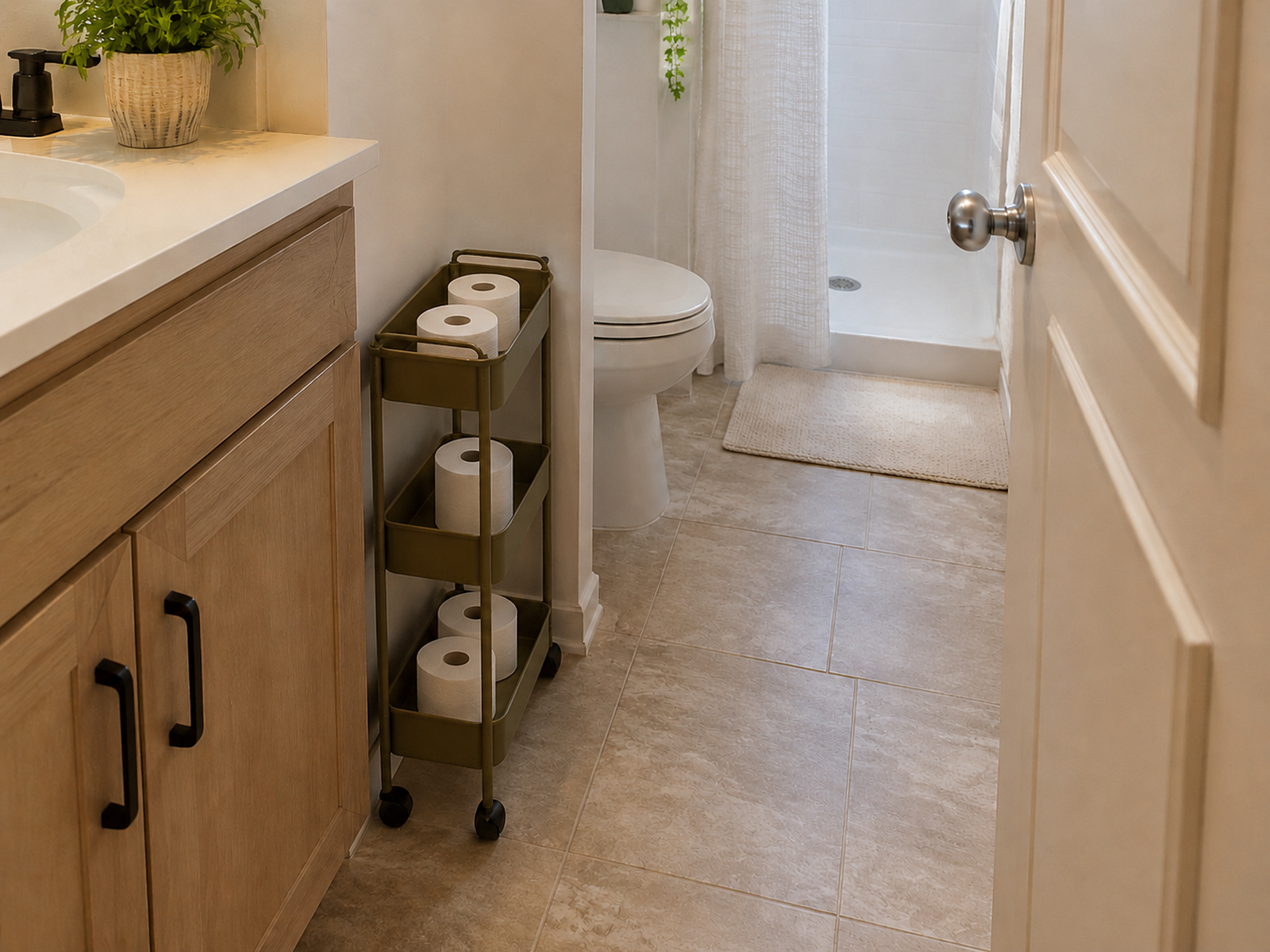
A narrow rolling cart can work in a true residual floor zone, but it still spends circulation space. Check the bathroom door, toilet approach, vanity doors and drawers, shower access, and the path used during cleaning before treating a slim footprint as free space.
Bathroom-rated removable hooks can add lightweight hanging storage when the exact product, surface, load, preparation, and removal instructions match. Do not transfer those claims to a generic adhesive hook. Tall freestanding units and over-toilet storage also need stability and manufacturer-instruction checks; freestanding does not automatically mean no-install.
Measure / Check First
When a cart, hook, over-toilet unit, or other new organizer is genuinely needed, check the room and the installation conditions before treating the product as usable capacity.
Check the New Storage Against the Real Bathroom
01
Measure the residual zone, not the empty room
Check the organizer against door swing, vanity doors and drawers, toilet approach, shower access, and the path used for cleaning. Floor storage only works when those normal movements still have space.
02
Verify the mounting surface and exact product rules
For removable bathroom hooks or similar products, use the manufacturer’s surface, load, preparation, cure, and removal instructions. A bathroom-rated adhesive product does not make every adhesive hook suitable for humid conditions.
03
Check stability before calling tall storage renter-friendly
Follow the furniture manufacturer’s installation and anchoring instructions. The U.S. Consumer Product Safety Commission advises securing top-heavy furniture; a freestanding unit may still require anchoring and therefore may not be a no-install renter solution.
If the organizer only fits by narrowing fixture access, blocking a door, exceeding the product’s mounting conditions, or skipping required stability measures, reject that storage form and keep the lower-priority inventory elsewhere.
08
Store Medicines and Sensitive Items Where Their Conditions Fit
The label “medicine cabinet” does not mean every medicine belongs in a humid bathroom.
The U.S. Food and Drug Administration advises reading medicine storage directions and notes that bathroom heat and moisture can damage many medicines. MedlinePlus similarly recommends cool, dry storage for medicines unless the product’s instructions say otherwise.
That can free valuable shallow eye-level storage for appropriate daily personal-care items, but the storage decision is medication-specific. Follow the label and pharmacist guidance rather than moving a medicine merely to make the bathroom look more organized.
Apply the same suitability logic to other categories. Paper goods, powered grooming devices, and wet shower products do not necessarily benefit from being mixed on one open shelf simply because the shelf is available.
09
Use the Reset Test Before You Add Anything Else
A shared bathroom is successful when the system survives ordinary use, not when it looks perfect in a static photo.
Run one complete routine: take items out, use the sink or mirror, temporarily stage what is needed, return everything, and wipe or reset the surface. Then repeat the same thought experiment for the other person.
If either person must move the other person’s belongings, open several containers to reach one daily item, roll furniture out of the way to use a fixture, or leave products out because their assigned home is too difficult to access, the system still has too much inventory or the wrong storage hierarchy.
Apply the stop rule before adding another shelf, cart, or tower. If every new storage object reduces circulation or fixture access, move lower-priority inventory out of the bathroom instead of making the room denser.
Closing Decision
Give Prime Bathroom Space to the Routines That Use It Most
A small shared bathroom works best when it behaves like a limited-capacity system: each person has a bounded daily home base, shared essentials have their own boundary, backups sit lower in the access hierarchy, and the sink remains available for the routine happening now.
Add a caddy, cart, hook, or taller unit only when it has a named job and passes the room’s real clearance, surface, and stability checks. If more storage would make the bathroom harder to use, reduce what lives there instead of asking the room to hold the full inventory of two adults.
RELATED GUIDES
What to Read Next
NEXT GUIDE
How to Organize a Bathroom Vanity With No Drawers—Without Filling the Counter
Use this next if the shared allocation system is clear but the vanity itself still lacks shallow storage for each person’s daily essentials.
GUIDE
How to Organize a Small Bathroom With No Medicine Cabinet
Use this if both people need more eye-level storage and the bathroom has no medicine cabinet to divide into personal or shared daily zones.
GUIDE
How to Store Hair Tools in a Small Bathroom Without Losing Counter Space
If hair tools are one of the categories crowding the shared sink area, this guide handles their cooling, access, and counter-space problem without expanding the current article.