
Small Bathroom Storage
How to Organize a Small Bathroom With No Medicine Cabinet
A medicine cabinet mainly gives small daily items shallow, easy-to-scan storage near the sink. Replace that access pattern—not the cabinet itself—with a compact active-use zone, selective shallow storage, and deeper backup space only where it earns the extra reach.
In This Guide
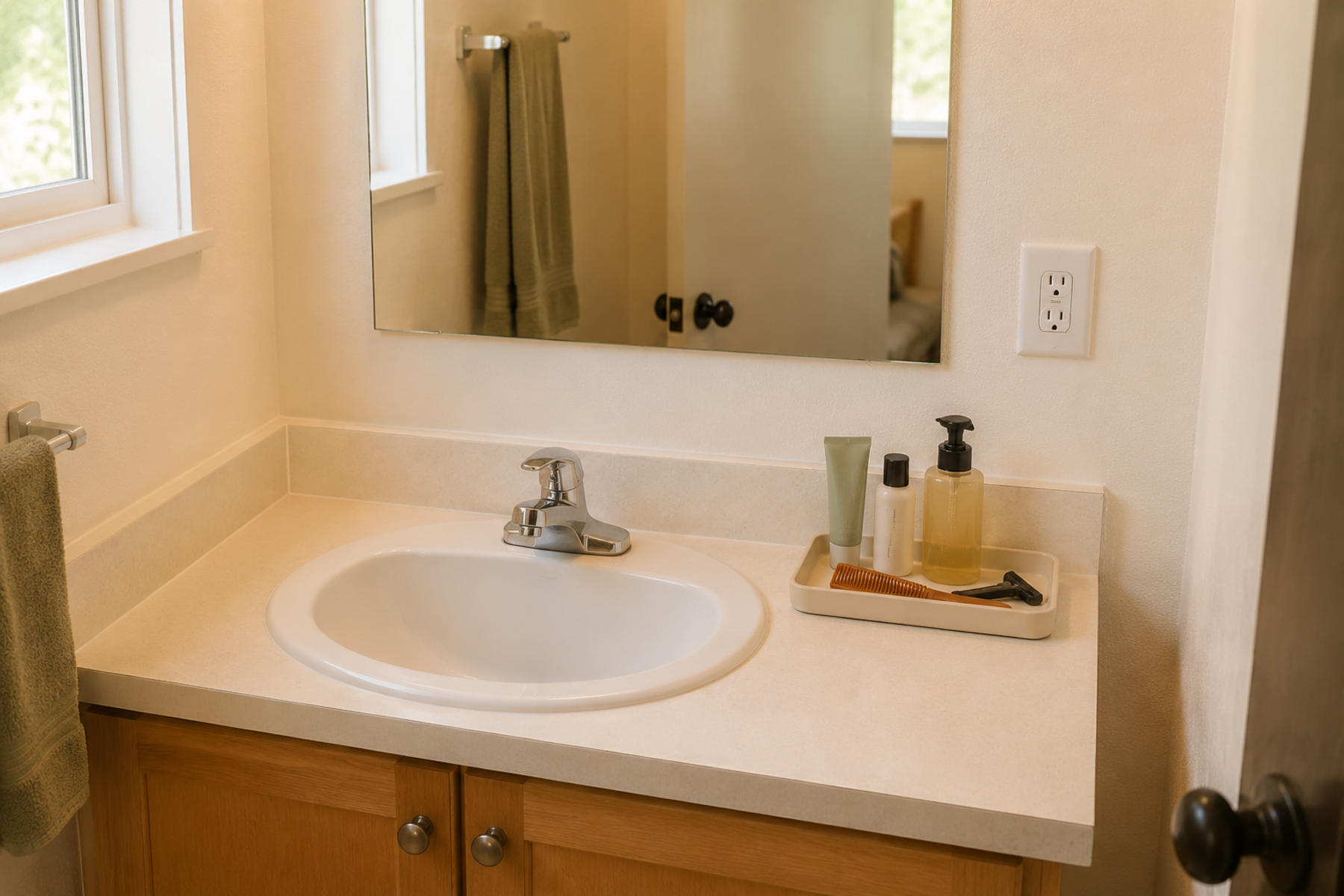
When the mirror has no cabinet behind it, toothpaste, skincare, grooming tools, contact-lens supplies, and other small items usually fall into storage that is either too exposed or too deep. The counter becomes the fastest option, while the vanity, door, cart, or wall may offer more capacity but slower retrieval or new clearance problems.
The useful replacement is a small hierarchy of access. Keep the highest-frequency set closest to the sink, move backups into deeper or farther storage, and let surface compatibility, moisture, toothbrush drying, door movement, floor space, and installation rules decide which categories stay in the bathroom at all.
Quick Answer
Rebuild Shallow Access, Not the Cabinet
Recreate the medicine cabinet’s useful function—shallow, visible, easy-to-return access—rather than its total capacity. Keep the sink-side daily set deliberately small, use the shallowest compatible storage zone first, and move backups or items with different moisture, drying, or storage requirements elsewhere.
01
Give the sink only the daily set
Keep the few items used every day or several times a week in the easiest zone; move duplicates, backups, and low-frequency grooming products out of prime sink space.
02
Use shallow storage before adding more volume
Existing narrow shelves, a compatible removable wall organizer, or a shallow top-level vanity caddy can replace some of the scan-and-grab access a medicine cabinet normally provides.
03
Separate bathroom storage from item-specific storage
Medicines, wet toothbrushes, backups, and moisture-sensitive items do not automatically belong in the same system simply because they are small.
01
Define the Active-Use Set Before You Choose an Organizer
A missing medicine cabinet feels larger when every personal-care item is competing for the same near-sink space. Separate the products used every day or several times a week from backups, travel sizes, occasional treatments, and items that do not need bathroom access.
The active-use set might include toothpaste, current skincare, a contact-lens case, a razor, or a few grooming tools, but the exact list belongs to the household routine. Research does not support a universal item count.
This first cut matters because the problem is shallow access, not maximum bathroom inventory. When the active set is small enough to scan and return quickly, the counter, a narrow shelf, or a shallow caddy can do useful work without becoming a miniature stockroom.
02
Keep a Small Counter Zone When It Beats Deep Storage
A completely empty counter is not automatically the most usable small-bathroom outcome. If toothpaste or skincare repeatedly comes back out because the only alternative is a deep cabinet or another room, one compact active-use zone can reduce friction while preserving the sink.
Keep that zone intentionally narrow: one shallow tray, a divided holder, or another compact organizer that contains the current routine without spreading toward the faucet, basin edge, or cleaning area.
The counter still has to function as a work surface. If the organizer crowds handwashing, splashes constantly, blocks a plug or fixture, or begins absorbing backups, the active set is too large for that location.
03
Use the Vanity as Supporting Storage, Not a Fake Medicine Cabinet
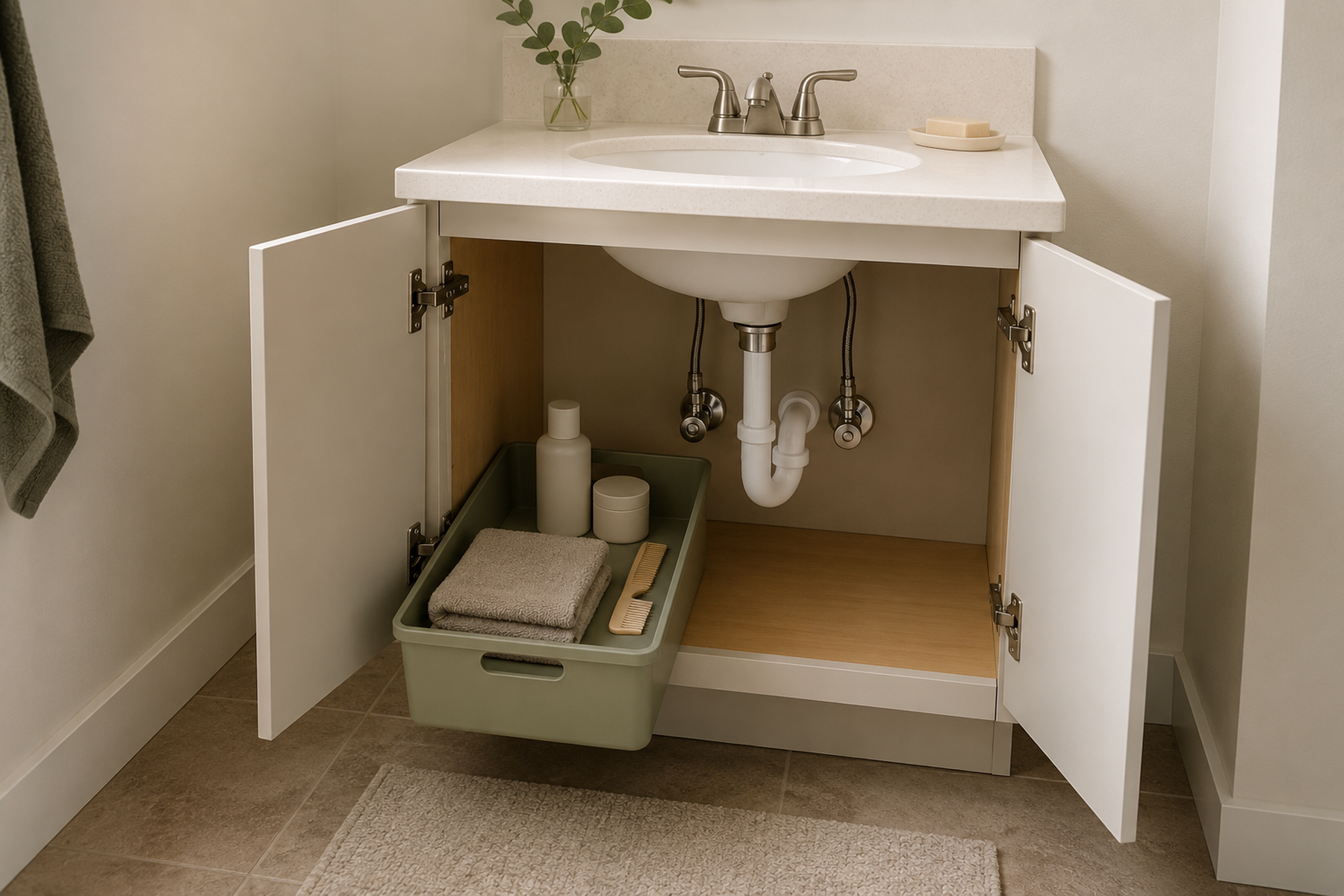
A deep vanity cabinet can hold more than a medicine cabinet and still be worse for small daily items. Use it for backups, bulkier grooming products, or a shallow top-level caddy that can be lifted out as one unit instead of forcing tiny products into the back of the cabinet.
If the vanity already has drawers, reserve the easiest shallow drawer for categories that genuinely benefit from scan-and-grab access. If it has no drawers or plumbing dominates the cabinet, avoid rebuilding the entire under-sink system here; Aptly Small’s bathroom vanity guide covers that separate constraint.
The test is simple: toothpaste, contact-lens supplies, or skincare should not require moving cleaning products, kneeling behind plumbing, or opening several nested bins. When retrieval becomes that slow, the system no longer replaces the lost shallow access.
Measure / Check First
A small bathroom may have several possible storage planes, but they do not offer the same retrieval speed or clearance. Map them with the real daily routine before choosing a product.
Map the Access Zones Around the Sink
01
Mark the true active-use area
Identify the counter, shelf, vanity, or wall zone that can hold the daily set without blocking the faucet, basin, mirror, outlet, or cleaning path.
02
Trace every moving surface
Check vanity doors and drawers, bathroom door swing, toilet access, mirror use, and any cart or over-door organizer projection in the loaded state.
03
Check the mounting and moisture conditions
Note wall texture, tile and grout, damp or splash-prone areas, ventilation, and whether a proposed adhesive or furniture solution can be used exactly as its instructions require.
A location is useful only when the item can be reached quickly and the bathroom still works normally. Capacity that blocks the sink, door, toilet, cleaning path, or drying airflow is not equivalent storage.
04
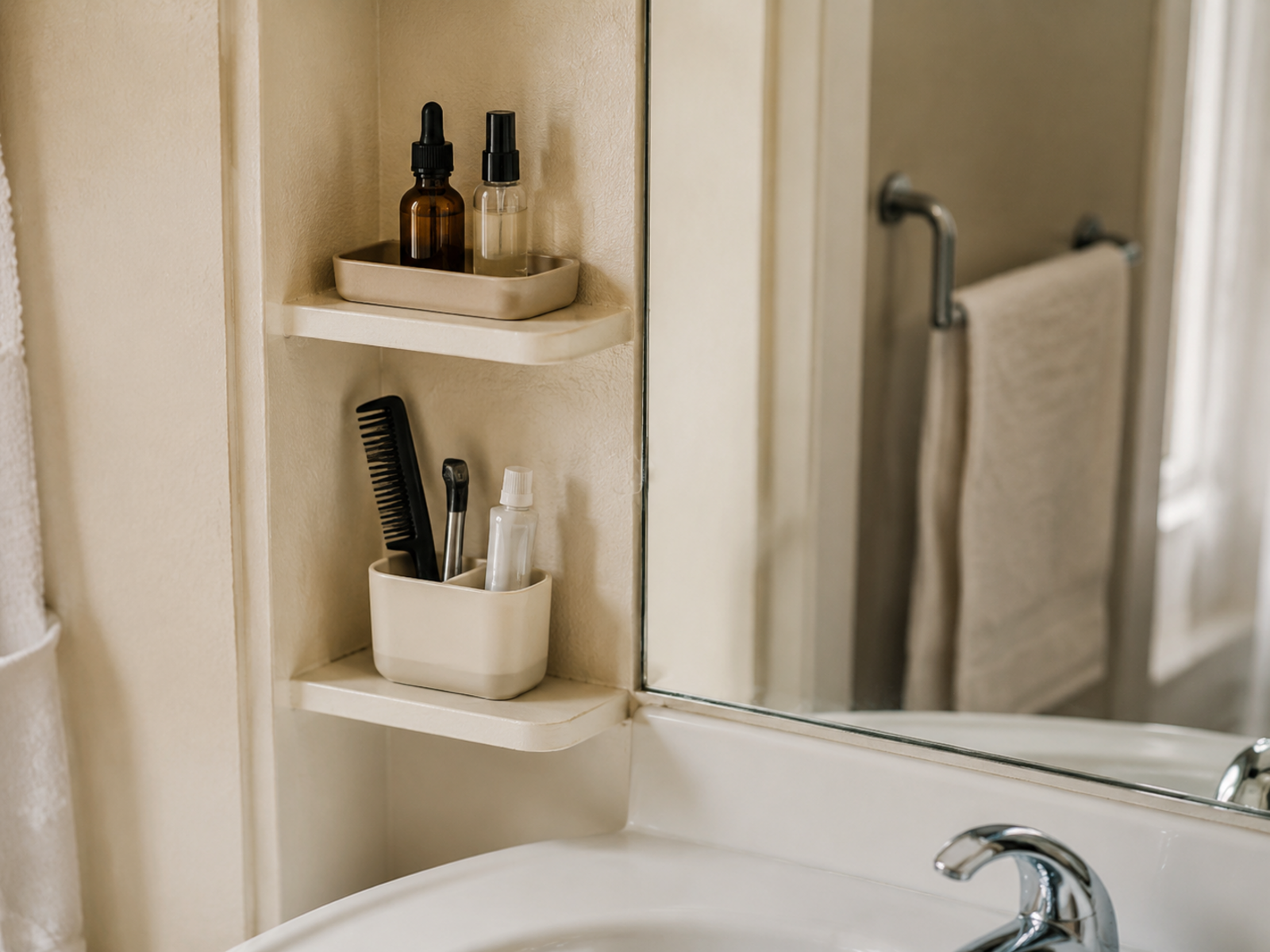
Make Existing Open Shelves Visually Quieter Without Hiding Everything
Narrow side shelves can be useful even when they expose too many labels and shapes. Group similar small items in one or two shallow containers, keep the containers sized to the actual shelf depth, and leave the most frequently handled item visible when visibility helps the routine.
Opaque containment can calm visual clutter, but it also removes visual reminders. Use it for categories you can identify instantly by location; do not turn a narrow shelf into a row of deep mystery bins that have to be opened one by one.
Open shelving should remain easy to wipe and should not become the default home for every backup bottle. Its value is shallow access, so protect that advantage.
05
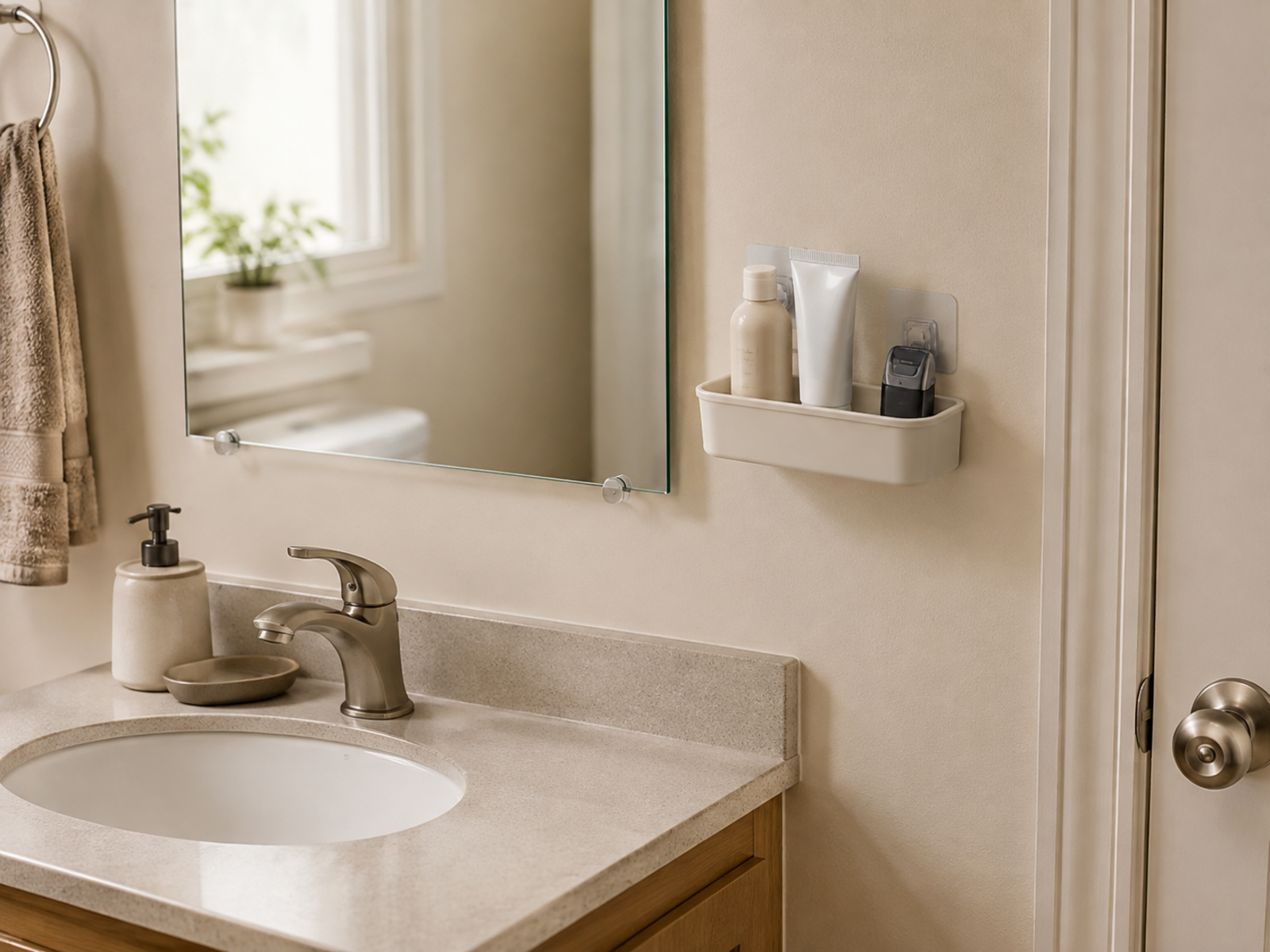
Use Removable Wall Storage Only When the Surface and Load Match
A small wall caddy beside the mirror can recreate some eye-level storage without using counter or floor space, but the mounting method is part of the product—not a generic renter promise.
3M’s current Command Bathroom Solutions instructions list specific preparation steps and excluded surfaces, including wallpaper, fabric, textured walls, brick, rough surfaces, and grout-line placement. 3M also publishes product-specific weight limits rather than one universal adhesive capacity.
Use the exact product instructions for surface, orientation, preparation, cure or build time, load, and removal. If the only available wall is outside those instructions—or the lease makes the removal risk unacceptable—choose another storage plane rather than treating adhesive as automatically damage-free.
06
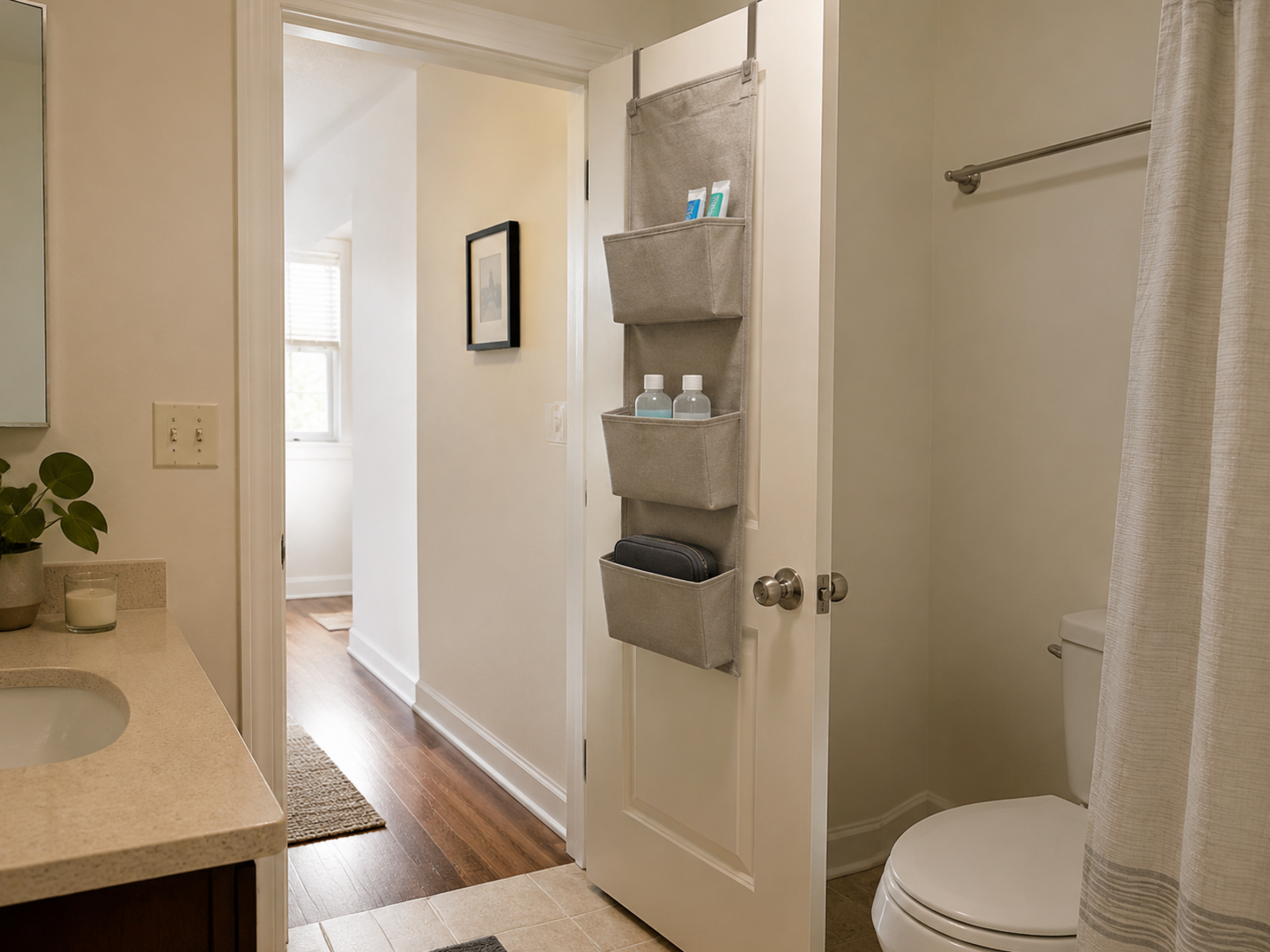
Use the Door or Floor Only When the Geometry Actually Helps
Over-door storage preserves counter and wall space, but it sits on a moving surface. Check door thickness, hook profile, trim, closure, swing, and how far the loaded organizer projects into the room before assigning it a category.
A narrow cart or freestanding unit solves a different problem: it adds segmented capacity but spends floor area. That can work when there is a real residual strip beside the vanity or toilet, but not when the cart blocks cleaning, the toilet shutoff, door movement, or the user’s standing space.
Large over-toilet towers can add even more capacity without restoring the missing sink-level access. Treat them as backup storage only when the toilet remains comfortable to use, maintenance access stays open, and the specific unit’s stability or anchoring instructions can be followed.
What Not to Do
Don’t Replace Shallow Access With the Largest Organizer That Fits
A tall cart, over-toilet tower, deep under-sink bin, or oversized counter organizer can add a lot of capacity while leaving the original problem unsolved. Daily toiletries still need a short retrieval path, and the bathroom still needs open counter, floor, fixture, and cleaning space.
Choose the smallest high-frequency zone that works, then push backups outward. Extra capacity belongs in the system only when it does not crowd the sink area or make everyday retrieval slower.
07
Move Backups and Medicines Out of the Bathroom When That Works Better
A tiny bathroom does not have to store every personal-care category. Backup shampoo, bulk packages, occasional grooming tools, and other low-frequency supplies can live in a nearby dry drawer, closet shelf, or labeled box when the extra retrieval distance is acceptable.
Medicines deserve a separate decision. The U.S. Food and Drug Administration notes that improper storage such as a damp bathroom cabinet can reduce medicine effectiveness and advises following each product’s label-specific storage instructions. Most medicines are better kept in a cool, dry place rather than assigned to the bathroom simply because the missing fixture is called a medicine cabinet.
This is one of the strongest ways to reduce counter pressure: remove categories that do not gain enough from bathroom proximity to justify occupying the smallest room.
08
Keep Wet Oral-Care Items Able to Dry
A storage system can look cleaner and still work worse if wet oral-care items are sealed immediately after use. The American Dental Association recommends rinsing a toothbrush, storing it upright, and allowing it to air-dry; ADA notes that routine storage of a moist toothbrush in a closed container promotes more microbial growth than open-air drying.
Toothbrushes need a ventilated holder or another position where water can drain and air can circulate. Do not make a closed drawer, lidded bin, or decorative box the default home for a toothbrush that is still wet.
Bathroom moisture is a broader location check as well. The U.S. Environmental Protection Agency’s mold and moisture guidance recommends controlling moisture and increasing bathroom ventilation when showering. Recurring condensation, leaks, or persistent dampness should change the storage decision instead of being hidden behind tighter containers.
Decision Sequence
Rebuild the Access Pattern in This Order
01
Define the active-use set
Give the best sink-adjacent access only to products used every day or several times a week.
02
Use the shallowest compatible zone first
Try a compact counter zone, existing narrow shelf, easy vanity layer, or compatible removable wall organizer before adding large furniture.
03
Push backups to slower storage
Use deep vanity space, door storage, a cart, over-toilet storage, or a nearby dry zone for categories that do not deserve prime sink access.
04
Apply the item-specific boundaries
Preserve toothbrush drying, follow medicine labels, respect moisture conditions, and verify exact surface, load, stability, and anchoring instructions.
Closing Decision
Replace the Missing Cabinet With Better Access
The useful part of a medicine cabinet is not the cabinet door. It is the shallow, visible, easy-to-return storage it gives small daily items. A small bathroom can rebuild that function with less hardware when the active set is kept genuinely small.
Give daily toiletries the quickest compatible zone, move backups outward, keep wet items able to dry, and let medicine, moisture, surface, floor-space, and anchoring rules remove bad options early. That approach protects the sink instead of turning every available surface into another storage project.
RELATED GUIDES
Related Guides
NEXT GUIDE
How to Organize a Bathroom Vanity With No Drawers—Without Filling the Counter
Use this when the main remaining storage is a deep vanity cabinet with no drawers.
GUIDE
How to Add Storage Around a Pedestal Sink in a Small Bathroom
Use this when the bathroom also lacks meaningful vanity storage and the sink itself creates the dominant storage constraint.
GUIDE
How to Store and Charge Electric Toothbrushes in a Small Bathroom
Use this if powered toothbrushes are one of the daily-use items competing for the limited accessible storage left outside a medicine cabinet.