
Small Apartment Storage Ideas
How to Store Towels and Bedding in a Small Apartment With No Linen Closet
Without a linen closet, towels and bedding do not need one replacement cabinet. Give current-use items the easiest zones, move bulky guest and seasonal pieces deeper, and let moisture, footprint, access, and installation limits decide the rest.
In This Guide
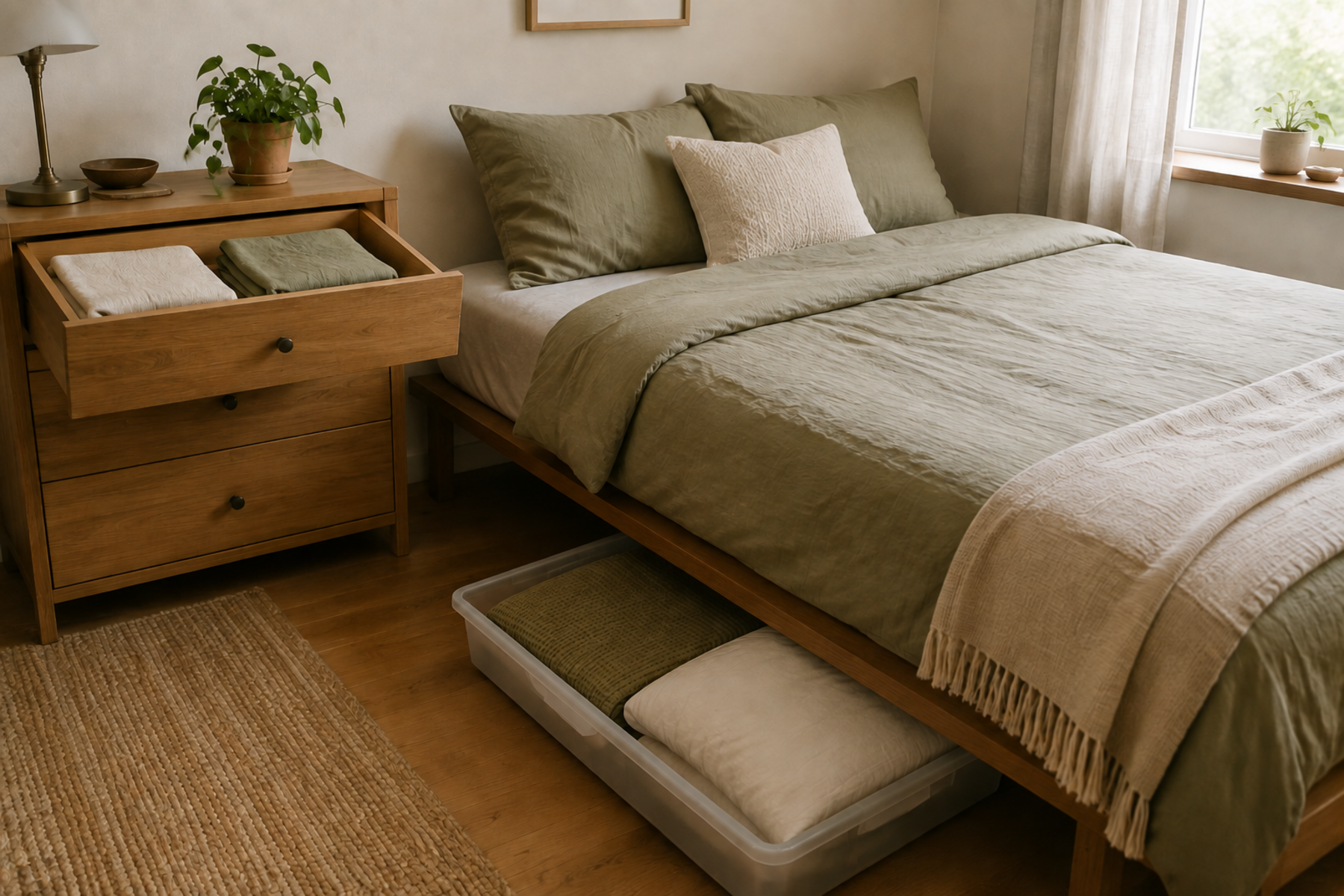
A linen closet usually does several jobs at once: it keeps towels near the bathroom, sheets easy to identify, bulky bedding out of the bedroom, and low-frequency household textiles contained until they are needed. In a small apartment, trying to rebuild all of that capacity in one new piece of furniture can create a second problem—lost floor space.
A more flexible system distributes those jobs by frequency and volume. Current towels and sheets deserve easier access; guest and seasonal bedding can live deeper; specialty textiles keep their own care rules; and any cabinet, high shelf, under-bed box, closet shelf, or door organizer has to earn the space it takes from something else.
Quick Answer
Store by Frequency Before You Store by Room
Keep current towels and bedding in the easiest compatible locations, move bulky or low-frequency linens into deeper storage, and match each category to a container and zone that fit its real size. Protect the room’s existing storage jobs, while letting moisture, textile care, retrieval, and installation requirements rule out unsuitable locations.
01
Separate current use from deep storage
Keep daily or weekly linens easy to reach and move guest, seasonal, or rarely used pieces into deeper zones that can tolerate a slower retrieval step.
02
Store by category size as well as frequency
Hand towels and sheet sets need different containment than comforters, pillows, or bulky blankets. One container type rarely suits the entire linen inventory.
03
Protect existing storage jobs
Do not let household linens automatically take over the bedroom closet, dresser, bathroom floor, or a new cabinet footprint that those rooms already need for something else.
01
Divide the Linen Inventory by Frequency and Bulk
Begin with how often each category is used. A practical first pass is current rotation, near-term backup, and guest or seasonal storage. That simple split prevents a bulky comforter that comes out twice a year from occupying the same high-value storage zone as towels used every day.
Then separate the categories by physical behavior. Sheet sets stack compactly and benefit from staying identifiable by bed or size. Towels need an easy grab-and-return path. Blankets, spare pillows, duvets, and comforters are primarily a volume problem and can justify deeper storage.
There is no evidence-based universal linen count for every household. Laundry frequency, household size, guests, health needs, and climate all change what a reasonable inventory looks like, so edit obvious excess without forcing the apartment into a fixed “two sets only” rule.
02
Keep Current Towels Near the Bathroom Without Ignoring Moisture
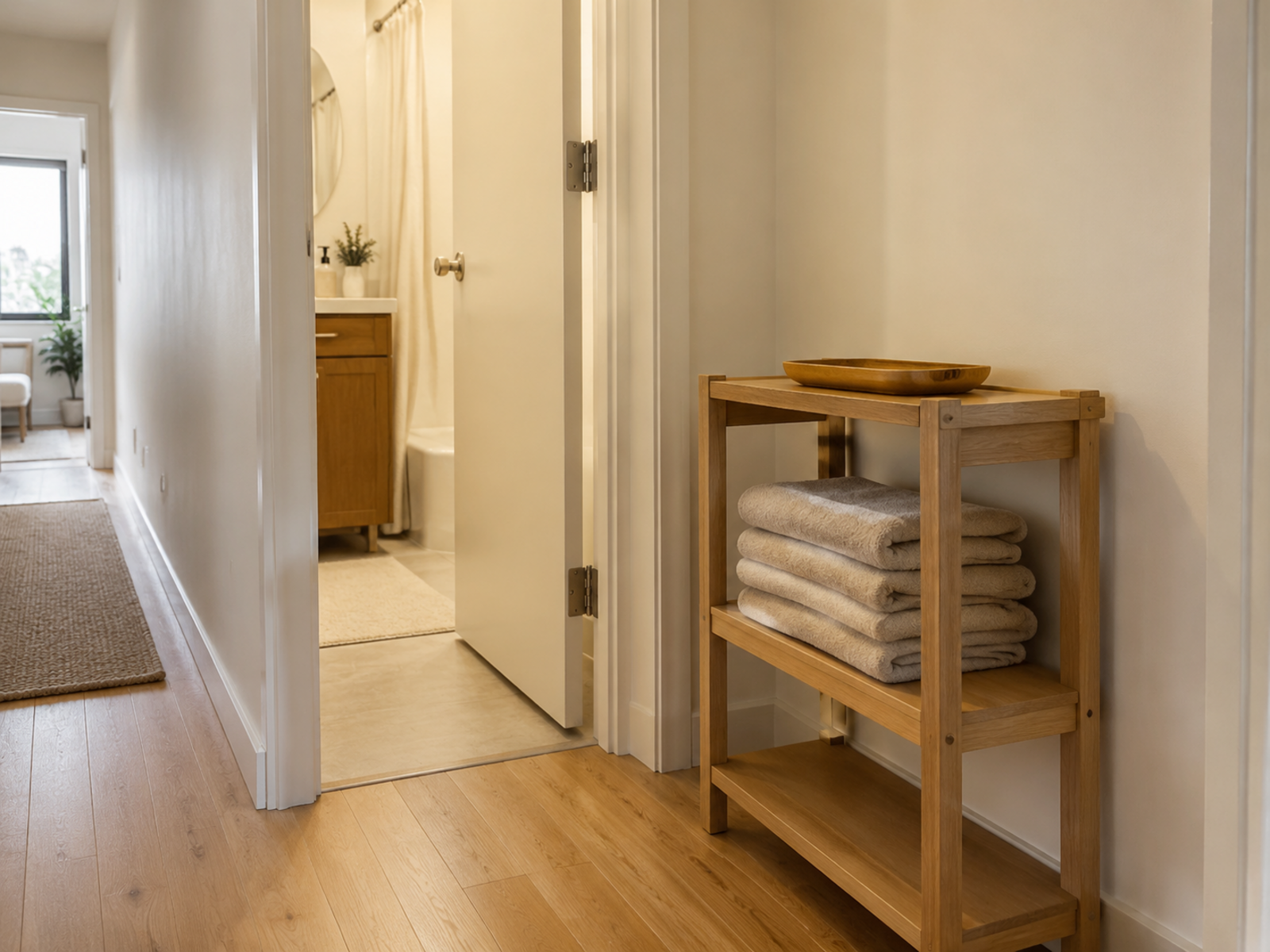
Current bath and hand towels usually earn the easiest point-of-use zone because they are retrieved often. That can be an existing vanity shelf, a shallow hallway shelf just outside the bathroom, a small basket on already-available furniture, or another nearby location that does not require crossing the apartment.
Bathroom proximity is useful only when the storage zone stays suitable for clean textiles. The U.S. Environmental Protection Agency’s mold and moisture guidance identifies moisture control as central to mold control and recommends keeping indoor relative humidity below 60% when possible, ideally 30–50%.
That guidance does not make every bathroom unsuitable. Instead, treat recurring condensation, visible dampness, leaks, or persistently humid enclosed storage as a reason to move clean towels to a drier nearby zone rather than sealing them more tightly in the same location.
03
Keep Current Sheets Near the Bed—If the Bedroom Storage Can Spare It
Current sheet sets are usually easier to manage near the bed because they are less bulky than guest bedding and benefit from staying grouped by bed or size. An existing dresser drawer, shallow closet shelf, storage bench, or low bedroom cabinet can work when it has genuine spare capacity.
The bedroom closet is not free overflow space. Aptly Small’s current library already treats clothing, folded clothes, luggage, and rod-only closet storage as competing uses of that volume. If moving sheets into the closet forces clothing into a chair pile or blocks access to the rod, the linen system has simply moved the storage problem.
Keep current sheets in one identifiable zone and resist mixing them beneath bulky guest blankets. The everyday set should come out without unloading the low-frequency category above it.
Measure / Check First
A no-linen-closet apartment usually has several partial storage opportunities rather than one empty replacement closet. Measure those opportunities as working zones, not just empty rectangles.
Map the Storage Zones Before You Buy Containers
01
List the current and deep-storage categories
Separate current towels, current sheets, near-term backups, guest bedding, seasonal blankets, and specialty textiles before deciding where each category should live.
02
Measure the real access path
Check under-bed pull-out room, closet shelf retrieval, drawer space, door swing, circulation, and how far a cabinet or organizer will project when in use.
03
Check moisture, weight, and installation
Notice damp zones, identify bulky or heavy items that should not live high, and verify any anchoring, door, surface, or care instructions tied to the storage method.
The best map may use several small zones. That is not a failure of organization; it is often the most space-efficient way to preserve easy access without building a second closet in the room.
04
Use Under-Bed Storage for Guest and Seasonal Bedding When the Bed Allows It
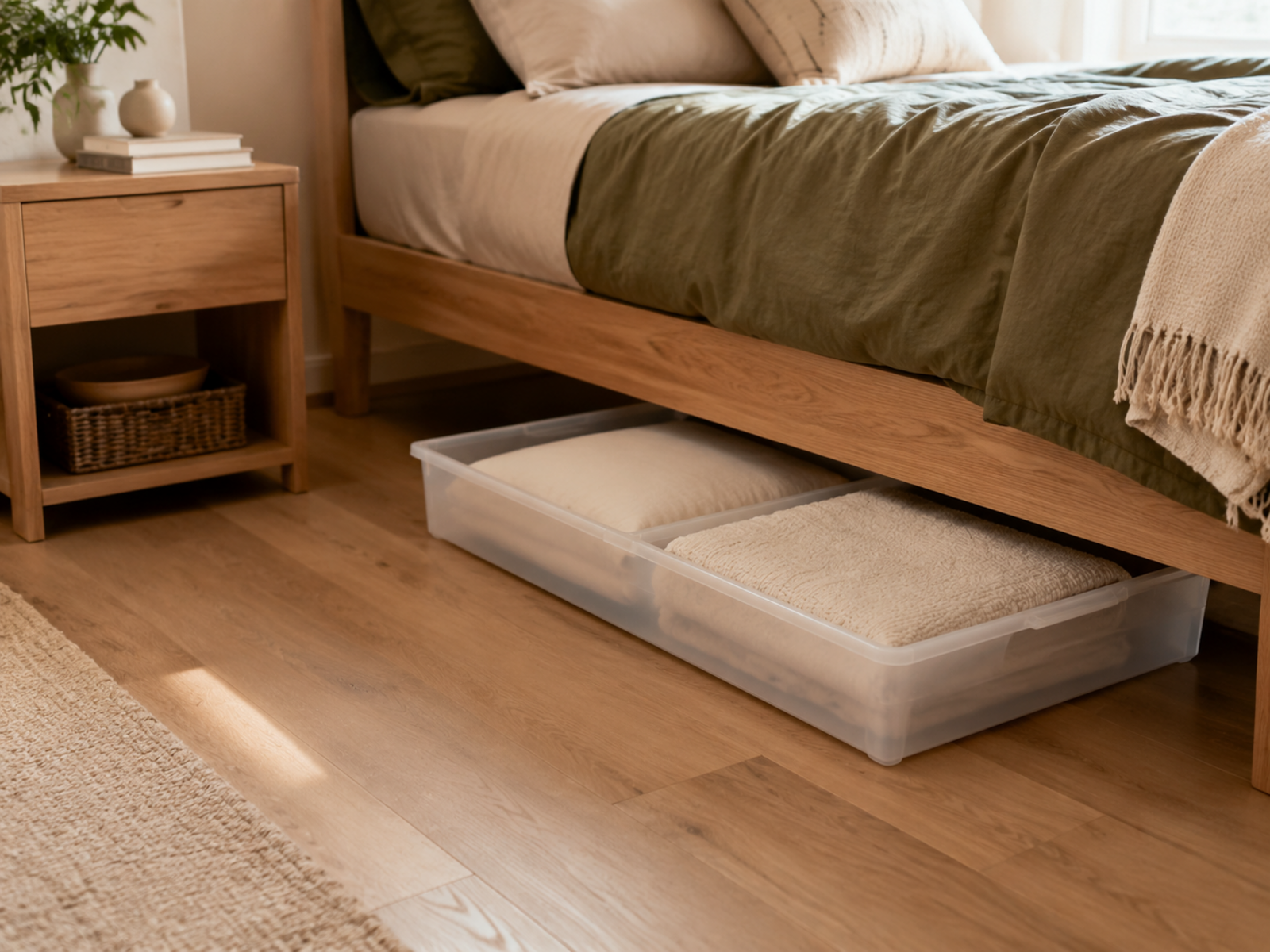
Under-bed space is valuable for guest sheets, spare blankets, and other low-frequency bedding because it uses volume that may otherwise sit empty and does not add another visible furniture footprint.
The fit still has to be real. Check the actual bed clearance, container height, pull-out path, floor condition, pets, and whether the box can be reached without moving a nightstand or lifting heavy furniture. A platform bed with almost no clearance may remove the option entirely.
Store only fully dry textiles, and keep the container appropriate to the material. Under-bed storage solves location and volume; it does not override care instructions for specialty fills or textiles.
05
Use the Bedroom Closet Only After Clothing Storage Is Protected
An existing closet shelf can hold linens without adding floor space, which makes it tempting as the default answer. The real cost is opportunity: every blanket or towel stack placed there displaces clothing, shoes, bags, luggage, or another category the closet already serves.
Reserve closet space for linens only after the clothing system still works. A small upper or side zone can be reasonable for guest sheets or a spare blanket when the items remain visible and retrievable; a tower of bedding above the rod is less useful if the stack has to be dismantled every time something changes.
The same rule applies to dresser drawers. Existing closed storage is efficient only when it is truly spare. If towels or sheets consume the drawer capacity needed to prevent clothing clutter elsewhere, choose another linen zone.
06
Add a Cabinet or Double-Duty Piece Only When the Footprint Earns It
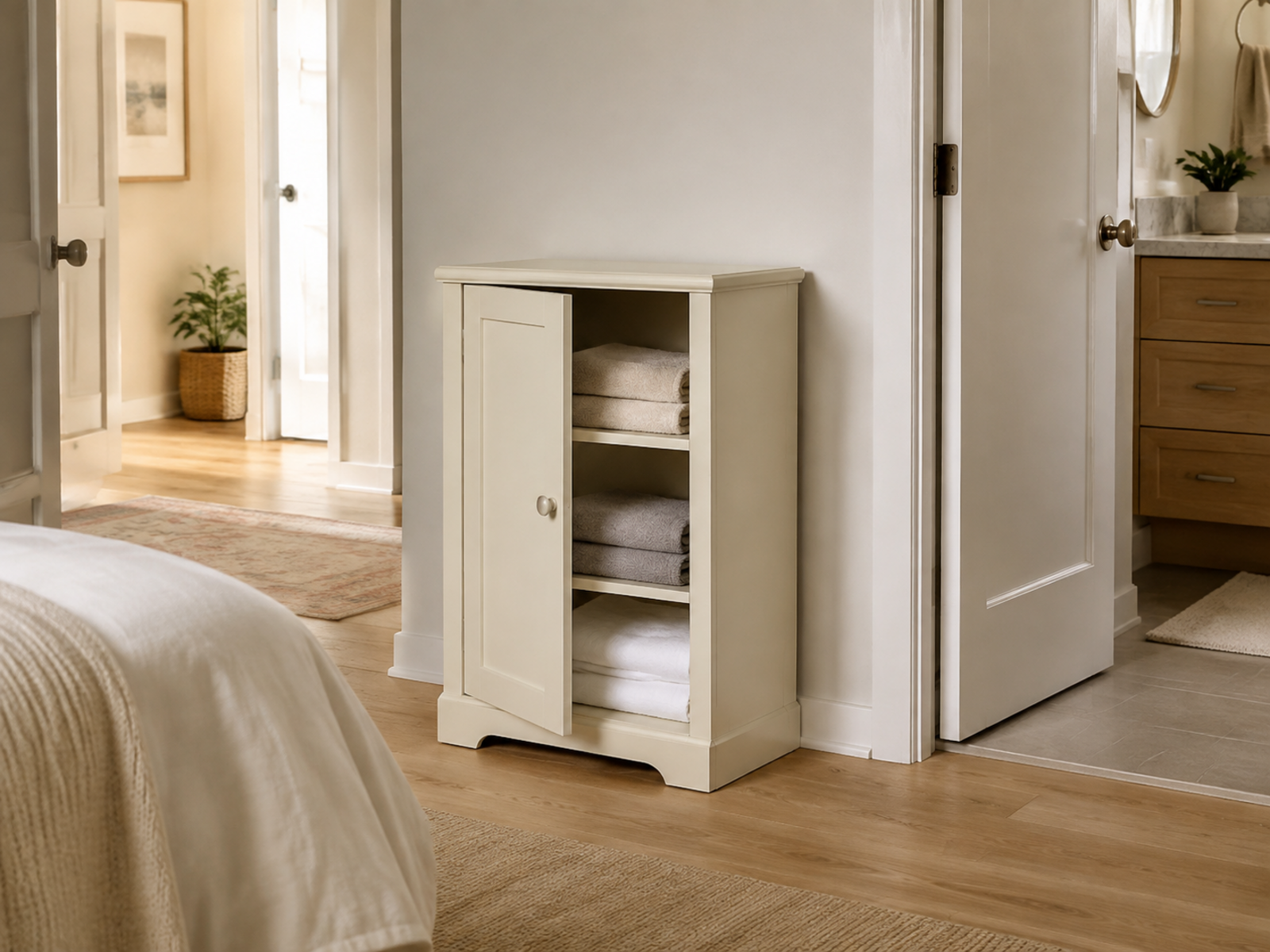
A narrow cabinet, hutch, bench, ottoman, or other freestanding piece can recreate useful linen volume, but a small apartment has to pay for that storage with floor area. Measure the deployed footprint against door swing, circulation, bed access, bathroom fixtures, and the furniture already in the room.
Double-duty furniture is strongest when it already serves another necessary function. A storage bench that is genuinely used for seating or a bed-end function can absorb blankets without creating a dedicated linen-cabinet footprint; a new cabinet squeezed into a walkway is a storage gain with a circulation loss.
Do not equate freestanding with anchor-free. The U.S. Consumer Product Safety Commission’s Anchor It! guidance advises securing top-heavy furniture and following manufacturer instructions. If a tall unit requires or recommends anchoring, respect that instruction and the lease rather than omitting the safety step to preserve a no-drill promise.
07
Reserve High and Door-Back Storage for Light, Lower-Frequency Linens
High shelves can preserve floor area, but the access cost rises with height. Use them for lighter, infrequently retrieved textiles rather than daily towels or heavy bedding that would require awkward lifting.
Over-door storage is similarly narrow in role. A compatible door can hold smaller towels, washcloths, or lightweight backups, but the organizer must preserve closure, hinge movement, trim clearance, and the path around the door. Bulky comforters are usually a poor match for this shallow operating surface.
Avoid any system that depends on climbing on a chair or furniture to retrieve linens. If a high zone is only usable through an unsafe routine, it is not useful storage.
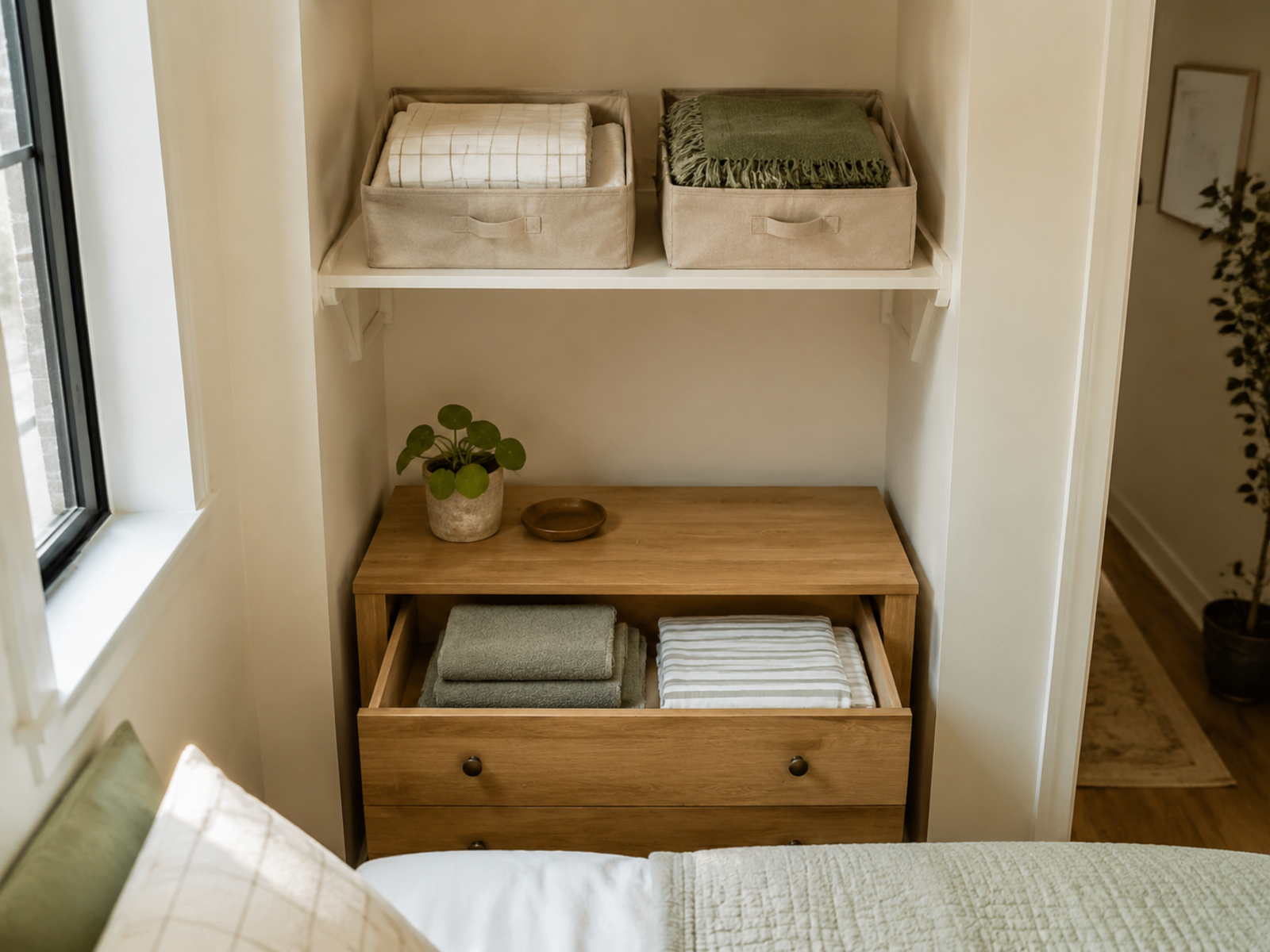
What Not to Do
Don’t Rebuild the Missing Closet in the Most Convenient Empty Corner
One tall cabinet can look like a complete answer because it puts every linen category behind one door. In a small apartment, that convenience can hide a large cost: lost circulation, a blocked furniture route, displaced clothing storage, anchoring requirements, or daily towels buried behind seasonal bedding.
Use a single replacement cabinet only when the apartment genuinely has the footprint and the category mix benefits from being together. Otherwise, distribute the work: easy-access zones for current use, deeper zones for bulky low-frequency items, and separate storage rules for moisture-sensitive or specialty categories.
08
Keep Specialty Bedding and Medicines Outside Generic Linen Rules
Generic advice such as “vacuum-pack every comforter” is too broad. Specialty fills and textiles can have their own storage requirements. The Company Store’s current down-comforter care guidance, for example, says its down comforters should be fully dry, stored in a dry ventilated closet, kept in a breathable cotton bag rather than plastic, and not crushed under heavy items.
That is manufacturer-specific guidance, not a rule for all bedding. Use the care label or manufacturer instructions for down, wool, quilts, weighted blankets, and other specialty items before choosing compression, sealed plastic, or heavy stacking.
A missing linen closet can also expose a separate medicine-storage problem, but medicines should not simply follow towels into the bathroom. The U.S. Food and Drug Administration’s medicine storage guidance notes that improper storage such as a damp bathroom cabinet can reduce medicine effectiveness and advises following label-specific storage directions, with most medicines kept in a cool, dry place.
Keep first-aid and medication decisions outside the ordinary linen-storage map unless the exact storage requirements support the chosen location.
Decision Sequence
Build the Linen System From Frequency Outward
01
Separate current use from deep storage
Give daily towels and current sheets the first claim on easy-access storage; move guest and seasonal bulk into slower zones.
02
Protect existing room functions
Reject any linen location that creates a new clothing, circulation, bathroom, door, or furniture problem.
03
Match the container to the category and zone
Use under-bed, drawer, closet, bench, cabinet, high, or door storage only where its access, footprint, moisture, and installation trade-offs suit the actual linens.
04
Apply the safety and care exceptions
Follow exact furniture-anchoring instructions, keep textiles fully dry, use safe retrieval zones, and let specialty-bedding or medicine guidance override generic storage shortcuts.
Closing Decision
Replace the Linen Closet With a Storage Map
A small apartment does not need every towel, sheet, blanket, and guest pillow to share one address. The missing closet becomes easier to replace when each category is assigned by how often it is used, how bulky it is, and which room can absorb it without losing something more important.
Keep the current rotation close, move bulky low-frequency pieces deeper, protect clothing and circulation, and let moisture, anchoring, retrieval, and textile care rule out bad locations early. The result can be more functional than forcing a full linen closet’s worth of jobs into one crowded substitute.
RELATED GUIDES
Related Guides

NEXT GUIDE
How to Store Suitcases in a Small Apartment With No Storage Closet
Use this when bulky luggage is competing with the same closet, under-bed, or furniture volume needed for linens.
GUIDE
How to Store Folded Clothes in a Small Closet With No Dresser
Use this when linen storage is taking over the drawers or closet zones needed for folded clothing.
GUIDE
How to Dry Clothes Indoors in a Small Apartment With No Dryer
Use this for the separate wet-laundry problem; clean-linen storage should begin only after textiles are fully dry.