
Small Apartment Storage Ideas
How to Store Suitcases in a Small Apartment With No Storage Closet
A suitcase is both a bulky object and an empty container between trips. Decide how often you need it, what its internal cavity should do, and how much retrieval friction the apartment can tolerate before choosing where the bag lives.
In This Guide
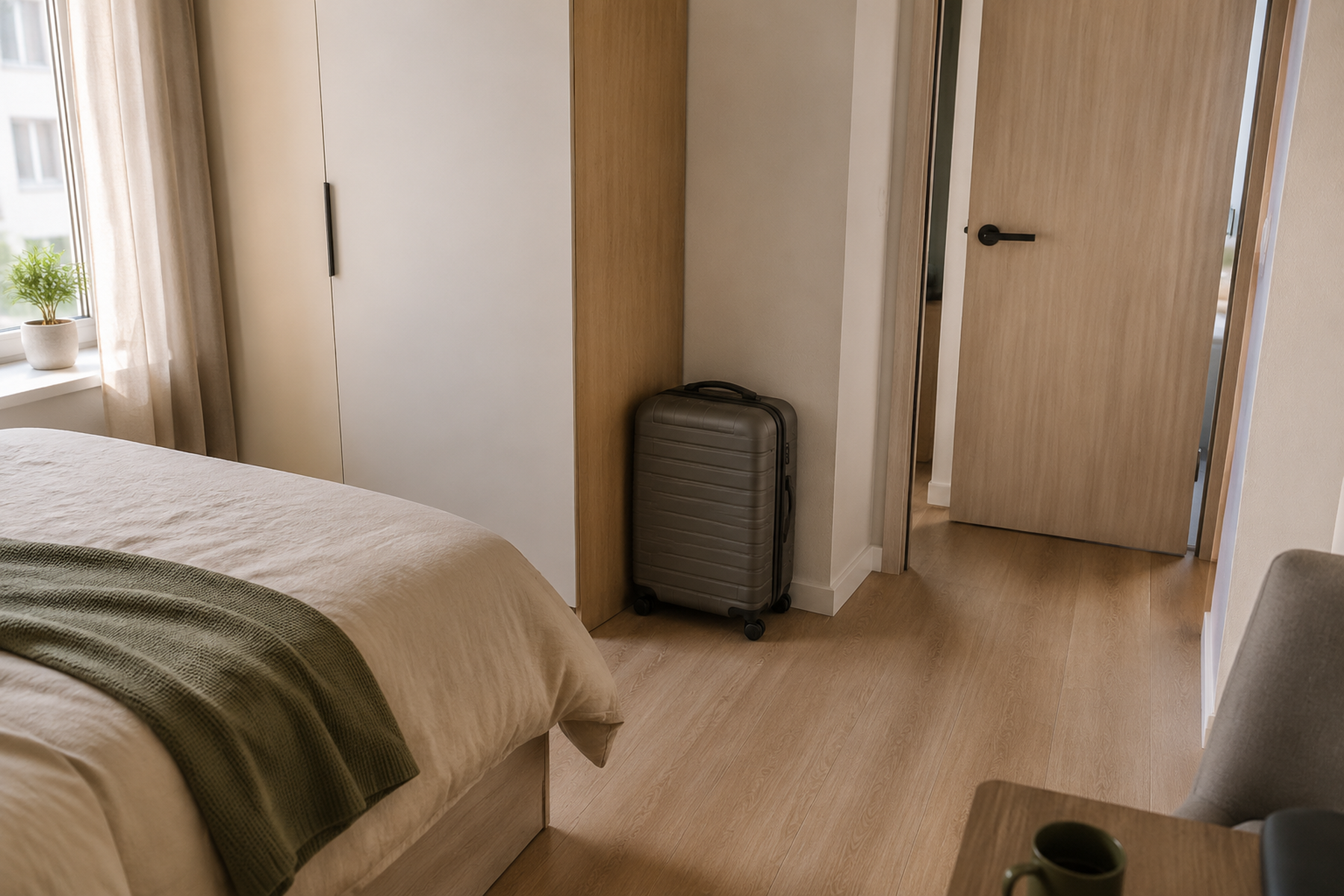
Suitcases create a different storage problem from most bulky household objects. They occupy a large outer footprint, but they also contain a hollow cavity that can stay travel-ready, hold smaller luggage, or store other low-frequency belongings.
Those uses compete with one another. A frequent traveler may value fast retrieval and an almost-empty suitcase, while an occasional traveler may gain more by nesting compatible bags or using the cavity for seasonal storage. The right setup starts with access priority, then moves to the storage zone—not the other way around.
Quick Answer
Decide Access Before You Decide the Hiding Place
The strongest suitcase-storage setup starts by deciding how soon the bag will be needed and what job its internal cavity should perform between trips.
01
Sort by travel frequency
Give the easiest storage to the suitcase you use most often. Rare-use luggage can tolerate deeper storage, nesting, and more pre-trip reset work.
02
Choose one primary cavity job
Keep the interior travel-ready, use it to nest compatible luggage, or use it for clean, dry low-frequency household storage. The same cavity cannot fully serve all three jobs at once.
03
Test fit as retrieval, not just clearance
Measure the real suitcase, the opening it must pass through, and the path needed to pull it out and return it without dismantling another storage system.
01
Match Storage Priority to How Often You Travel
Start by separating active travel luggage from occasional luggage. A work suitcase used every week or two deserves a simpler retrieval path than a large checked bag used for one or two trips a year.
This does not require a universal frequency threshold. The useful question is whether getting the bag out repeatedly would disrupt other storage. If it would, the bag is too deeply stored for its real use pattern.
Frequent-use luggage can justify a controlled visible or semi-visible parking zone when that keeps the bag easy to remove and return without blocking circulation. Infrequent luggage can move toward under-bed, upper-closet, nesting, or other lower-priority storage.
02
Decide What the Suitcase Cavity Should Do Between Trips
An empty suitcase is not automatically wasted space. For a frequent traveler, keeping the cavity mostly travel-ready can reduce the work required before the next trip. For less-used luggage, the empty cavity can become useful storage capacity.
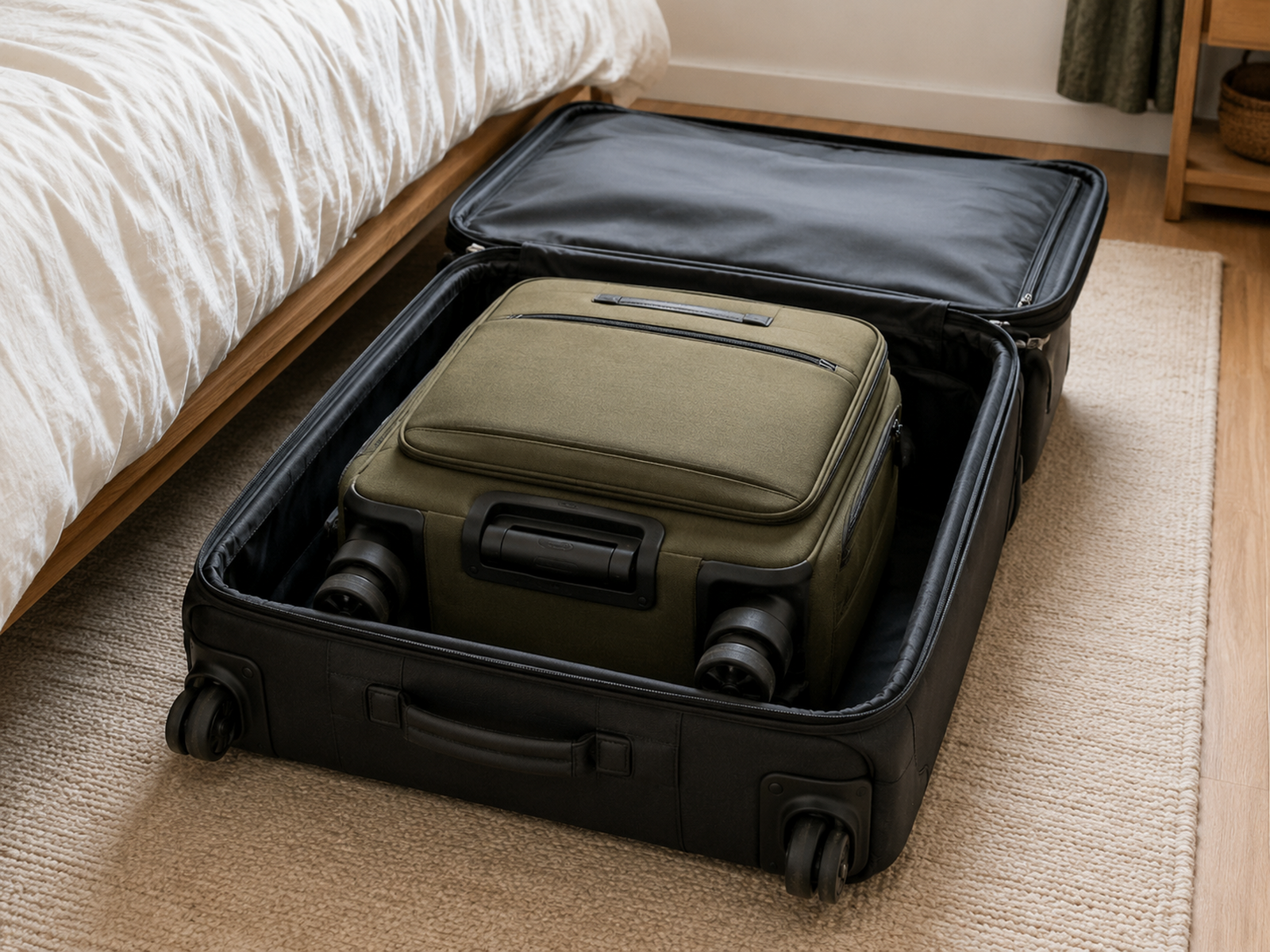
Nesting is one option when the exact bags are compatible. Samsonite’s current luggage-care guidance notes that some collections are designed to nest, and Away also provides nesting guidance for compatible suitcase sizes. Treat that as a product-specific capability, not a rule for every luggage set.
The other option is to activate the cavity with travel accessories, packing cubes, spare linens, off-season clothing, or other clean, dry, low-frequency items. The gain is real household storage; the cost is an unpack-to-pack reset when the suitcase is needed.
Measure / Check First
A suitcase can clear the storage zone and still fail if it cannot enter, leave, or survive the storage environment cleanly.
Measure the Bag, Opening, and Retrieval Path
01
Measure the actual outer shell
Include wheels, fixed handles, and other non-collapsible projections. Do not assume a generic carry-on or checked-bag label proves fit.
02
Measure the opening and extraction path
Check whether the suitcase can enter and leave the zone without rotating through an impossible angle, moving the bed, emptying the closet floor, or removing another storage system first.
03
Check the storage environment
Before deep storage, confirm that the bag is fully dry and that the location is appropriate for the exact luggage material. A hidden location is not useful if it is persistently damp or exposed to unsuitable temperature or humidity.
There is no universal suitcase size, under-bed clearance, shelf load, or retrieval distance that proves a location will work. Use the exact bag, exact opening, and exact furniture or storage zone as the fit test.
03
Use Under-Bed Space Only When the Retrieval Path Works
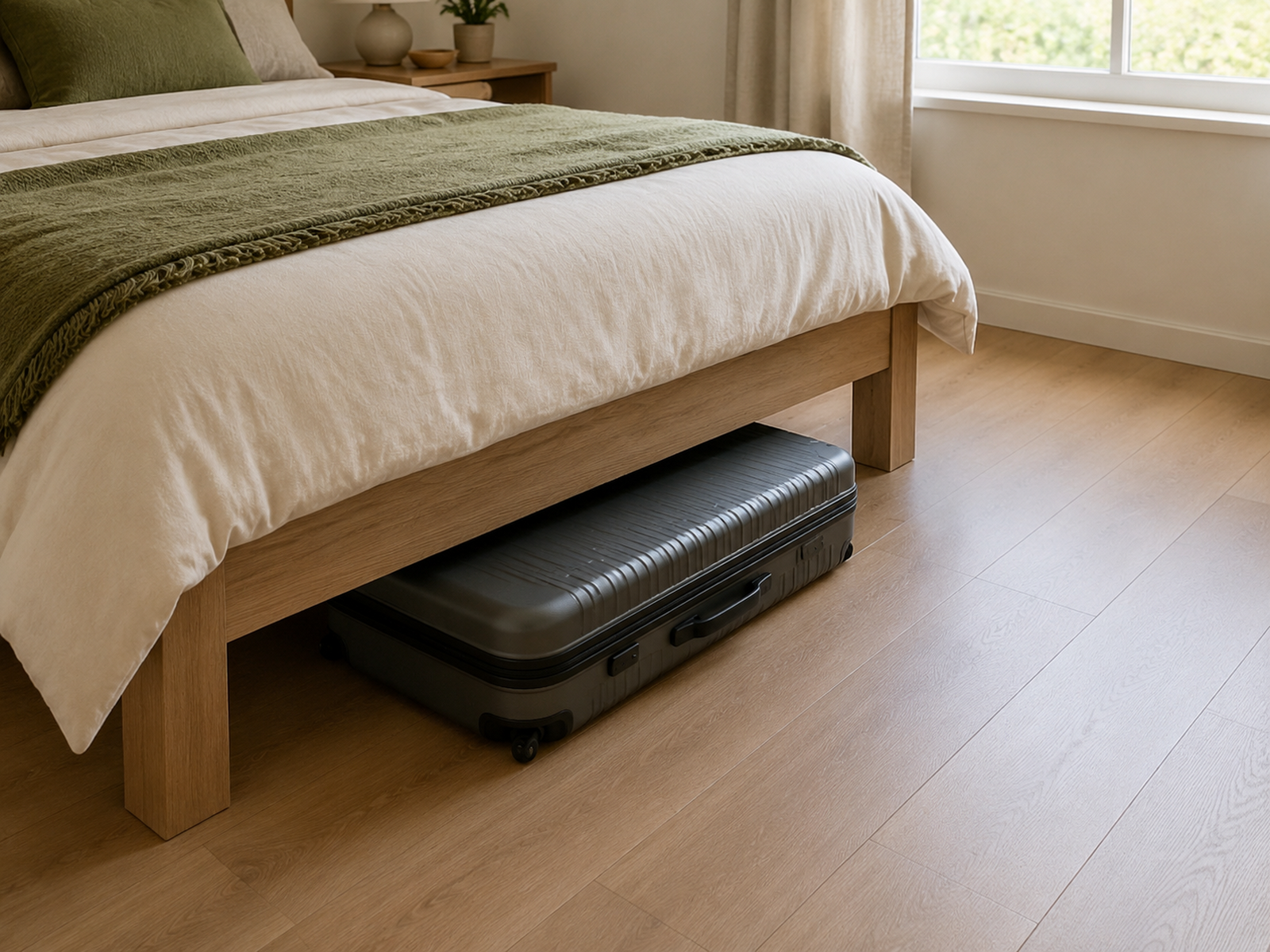
Under-bed storage can be valuable because it uses low horizontal volume that may otherwise sit empty. But the real fit test is not only whether the suitcase height clears the bed frame.
The bag also has to pass the opening and come back out. A bed tight against a wall, a storage drawer, a trundle, or other under-bed bins can turn a technically fitting suitcase into a difficult retrieval problem.
Treat the under-bed zone as strategic space. If it is the apartment’s best location for bedding, off-season clothes, or other bulky categories, compare those uses before giving the whole zone to luggage.
04
Price the Opportunity Cost of Closet and Furniture Voids
A suitcase on the closet floor can be convenient, but it may displace shoes, a hamper, long garments, drawers, or cleaning-tool storage. The bag should not receive prime enclosed storage simply because it fits.
A closet-top shelf or an existing furniture void can work better for infrequent luggage when the bag fits fully and can be retrieved in a controlled way. Use the actual shelf and furniture instructions rather than assuming every high surface can safely hold a bulky suitcase.
The useful comparison is not hidden versus visible. It is whether the suitcase is occupying a zone that another daily-use category needs more.
Use / Skip
When Suitcase-as-Storage Is Worth the Reset
Use
Use — Use the cavity when the bag is rarely needed
Seasonal clothing, spare linens, or travel accessories can make an infrequently used suitcase earn its footprint when the contents are clean, dry, easy to inventory, and have a temporary home during travel.
Skip
Skip — Keep frequent-travel luggage mostly travel-ready
If every trip starts by emptying the suitcase and finding somewhere else for its contents, the extra household storage may cost more friction than it saves.
05
Give Frequent-Travel Luggage a Controlled Parking Zone
For a suitcase that leaves the apartment often, a defined parking zone can be better than deep concealment. The goal is not to make the bag decorative; it is to make retrieval and return predictable.
Look for a residual zone near the bedroom, closet, or entry that does not narrow the primary walkway or block a door. An existing low cabinet or storage bench can also work when the full suitcase fits and the furniture still functions normally.
A controlled visible home is not a failure of organization when access is the higher priority. Repeatedly moving the suitcase from corner to corner is the stronger sign that the apartment has not assigned it a real zone.
06
Store Luggage Clean and Dry Before It Disappears
Deep storage is only useful when the environment is suitable for the bag. Away and Travelpro both advise allowing luggage to dry completely before storage, and Samsonite cautions that temperature and humidity extremes can age luggage.
That means an attic, basement, garage, sealed bench, or enclosed cabinet should not be treated as automatically correct just because it removes the suitcase from view. Follow the current care guidance for the exact luggage material and collection.
Avoid turning airtight plastic wrapping into a default rule. Manufacturer guidance places more emphasis on clean, dry, appropriate storage conditions.
What Not to Do
Don’t Turn the Top of Tall Furniture Into Automatic “Dead Space”
Putting luggage on top of a wardrobe or dresser may recover floor area, but it can raise retrieval and furniture-stability concerns. U.S. Consumer Product Safety Commission guidance says top-heavy furniture should be secured and manufacturer instructions followed. Do not add bulky overhead storage without checking the furniture, the actual load, and a controlled retrieval method.
07
Use Off-Site Storage Only After the Apartment Reaches a Real Capacity Limit
Off-site storage can remove the suitcase footprint completely, but it adds recurring cost and retrieval delay. It is better treated as capacity outsourcing than as the first organization move.
Before paying to move luggage elsewhere, check whether compatible bags can nest, whether an infrequently used suitcase can safely hold low-frequency household items, and whether a viable under-bed, closet, or existing-furniture zone is still unused.
If those in-home options have been exhausted and the luggage is rarely needed, external storage may be rational. The correct choice depends on local price, access, and travel patterns, so this guide does not recommend a provider or cost threshold.
Closing Decision
Give Each Suitcase the Access It Actually Deserves
A small apartment does not need one universal suitcase hiding place. Start with travel frequency, then decide whether each bag should stay travel-ready, consolidate other luggage, or provide secondary household storage. Measure the real shell and retrieval path before assigning under-bed or closet space, keep frequent-use bags easier to reach, and store every suitcase only when it is clean, dry, and in an appropriate environment. If the apartment has genuinely exhausted the useful in-home options, off-site storage becomes a capacity decision rather than an automatic organizing upgrade.
RELATED GUIDES
What to Read Next
NEXT GUIDE
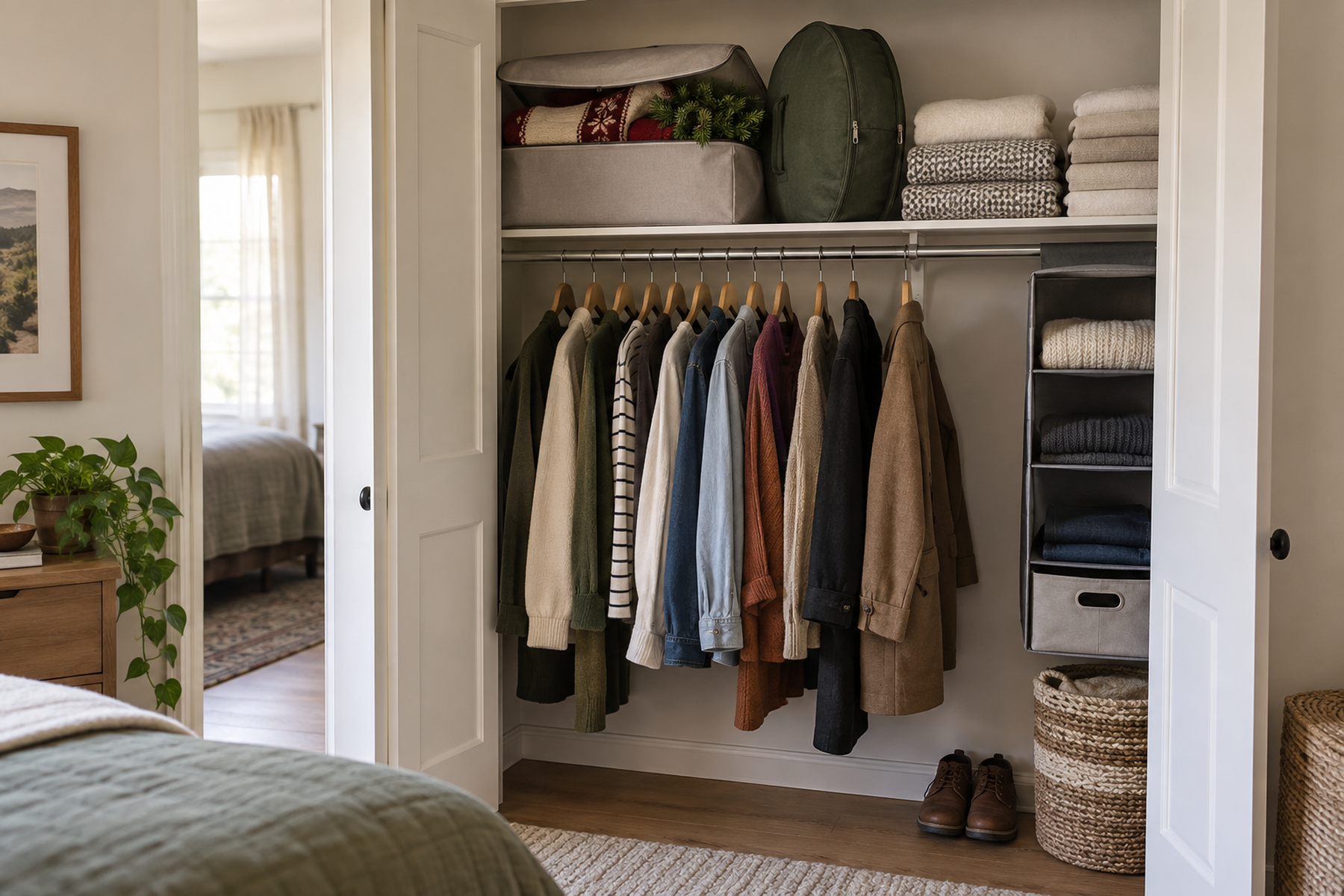
How to Store Holiday Decorations in a Small Apartment With No Storage Closet
A strong next step for another bulky, low-frequency category that needs a bounded storage zone without a dedicated closet.
GUIDE
How to Store Household Backstock in a Small Apartment With No Storage Closet
Useful for deciding where reserve household supplies belong when storage volume is already tight.
GUIDE
How to Store Workout Gear in a Small Apartment Without a Dedicated Workout Room
Continues the bulky-object problem with equipment that needs both storage and practical retrieval space.