
Small Apartment Storage Ideas
How to Store Workout Gear in a Small Apartment Without a Dedicated Workout Room
Give dense weights a verified, stable home first, then store mats, bands, and small accessories separately so the active workout kit stays easy to retrieve without turning a shared living room into a permanent gym.
In This Guide
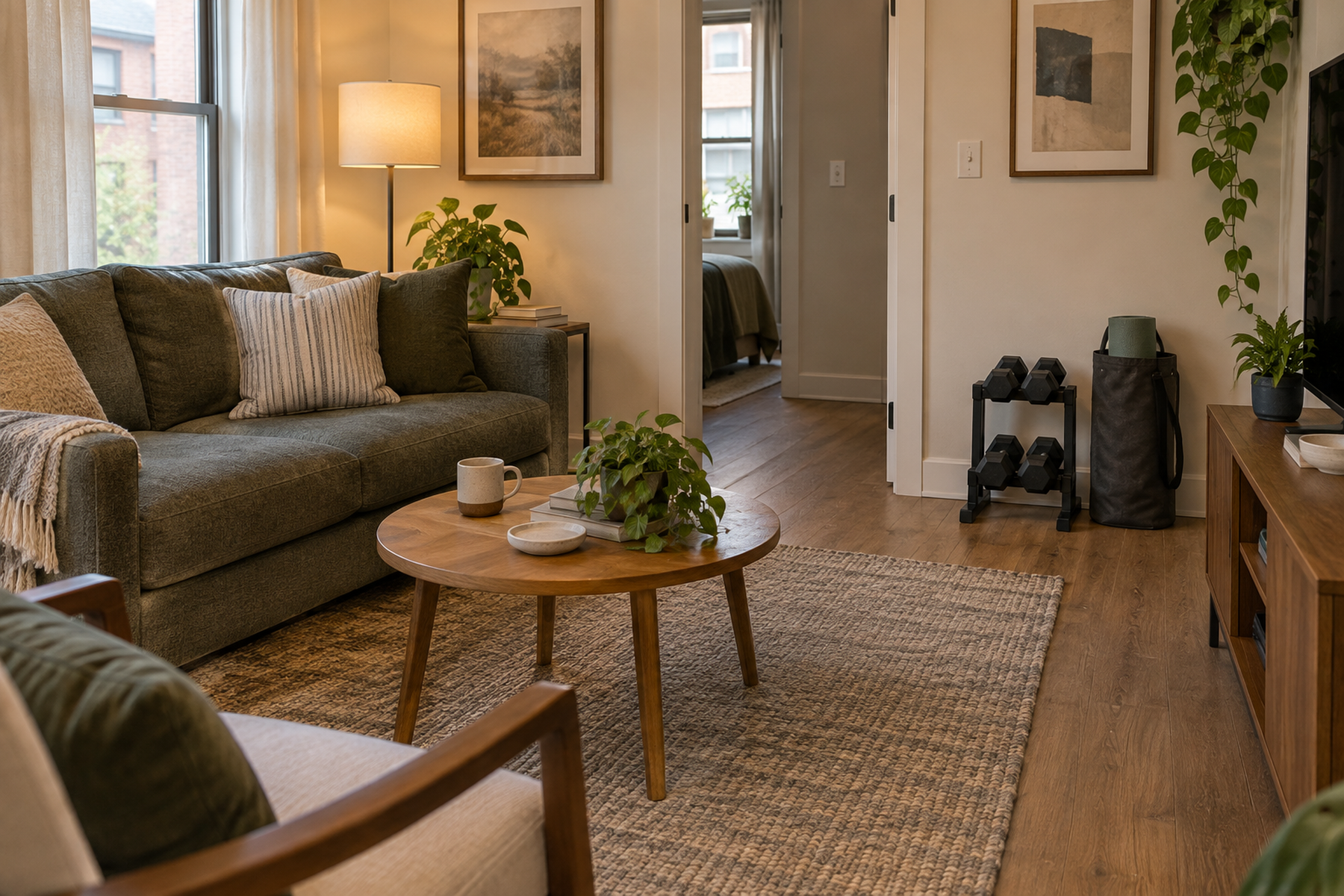
Workout gear creates an unusual storage problem because the pieces may belong to one routine while behaving very differently in storage. Dumbbells are compact but dense, a yoga mat is light but long, resistance bands are light and flexible, and blocks or sliders are small enough to disappear inside a mixed bin.
A small apartment works better when those objects are not forced into one organizer. Establish a rated, stable home for the heavy gear first, then use lower-commitment storage for the light and bulky pieces. The final system should keep the room visually calm without making every workout begin with furniture moving or a deep-storage excavation.
Quick Answer
Use the Smallest Storage System That Still Respects Weight, Shape, and Access
01
Separate heavy gear from light gear
Dumbbells and kettlebells need verified load support; mats, bands, straps, and blocks can use lighter storage forms when their own fit and access requirements are satisfied.
02
Give the weights a rated home first
Choose a purpose-built stand or another storage surface with an explicit load rating for the actual equipment instead of assuming a cart, basket, ottoman, or cube can carry concentrated weight.
03
Conceal light gear without burying the workout
A bag, bin, over-door hook, or under-furniture zone can reduce visual clutter for mats and bands, but the active kit should still come out and reset in a short, repeatable sequence.
04
Let rarely used gear leave the prime living-room zone
Daily or weekly equipment deserves the easiest access. Occasional accessories can move to a closet, under-bed zone, or secondary storage location when that lowers permanent visual and floor pressure.
01
Sort Gear by Storage Physics
Begin with the way each item behaves, not with a shopping category called “workout storage.” Put dense weights in one group, long but light items such as rolled mats and foam rollers in another, flexible gear such as bands and jump ropes in a third, and small rigid accessories such as blocks or sliders in a fourth.
This prevents a common mismatch: choosing one attractive container and then asking it to solve incompatible jobs. A basket that works well for bands may be a poor place for a heavy dumbbell. A low weight stand may be structurally appropriate for dumbbells but useless for keeping a mat from sprawling across the floor.
Frequency adds a second filter. The gear used most often should be the easiest to reach and reset. Equipment used occasionally can tolerate a more concealed or secondary location if that keeps the shared room functional between workouts.
02
Give Heavy Gear a Rated Home First
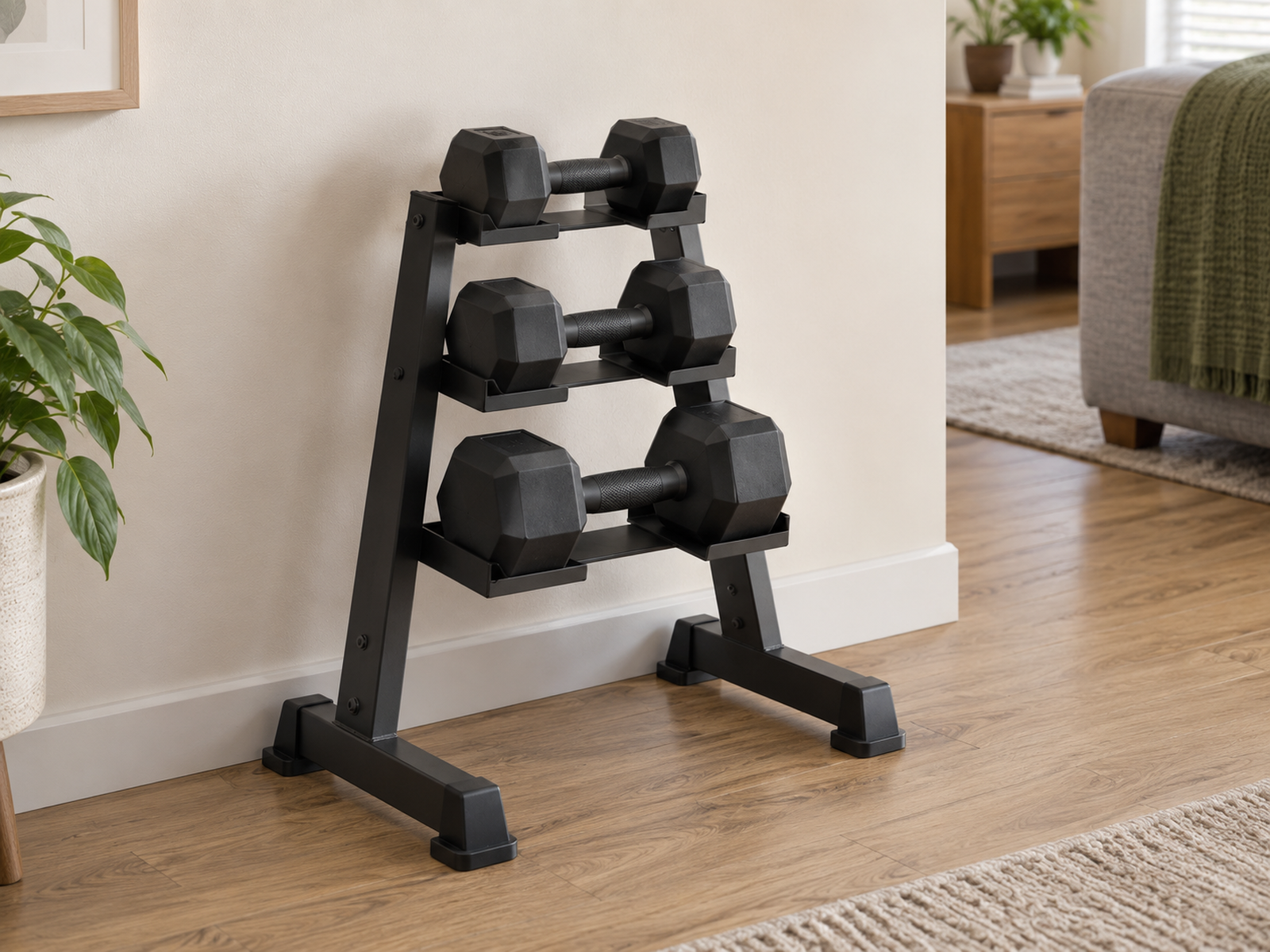
Dense weights create the hardest constraint because concentrated load can exceed an ordinary household organizer quickly. Use an explicit manufacturer load or equipment-compatibility specification rather than visual sturdiness.
Purpose-built stands show what that clarity looks like. Rogue’s current listing for the PowerBlock Compact Weight Stand gives a small version with a 16 by 14 inch footprint for compatible non-expandable PowerBlock sets up to 50 pounds and a larger 18 by 17 inch version for compatible expandable sets up to 90 pounds. Those numbers apply to those exact stands and compatible products; they are examples of verified heavy-storage design, not universal dumbbell capacities.
A full dumbbell rack solves a different problem. REP’s current Dumbbell Storage Rack is rated to 1,000 pounds, but its footprint is about 48 inches long by 23.4 inches deep. In a normal living room, that may cost far more permanent floor area than a modest equipment collection justifies.
The useful small-apartment principle is simple: establish the smallest rated heavy-gear zone that safely fits the actual equipment. Do not enlarge the furniture merely to hide the fact that the weights are weights.
Measure / Check First
Before choosing a rack, cart, bag, over-door system, under-furniture zone, or storage furniture, verify the part of the system that can fail physically rather than aesthetically.
Check Load, Footprint, and Retrieval Before You Store the Gear
01
Heavy-gear load support
Add up the actual weight that will sit on the stand, rack, shelf, cart, or furniture base and compare it with the exact manufacturer rating or equipment-compatibility specification for that storage location.
02
Full footprint and movement path
Measure the entire storage object, not only its narrowest dimension. Confirm that the gear can be lifted out, a cart can roll, a bag can slide, and normal doors, seating, and circulation still work.
03
Mounting, door, or under-furniture fit
For over-door or mounted storage, verify the exact door thickness, surface, fasteners, load, and rental permission that apply. For under-bed or under-sofa storage, verify real clearance and a retrieval path that does not require moving the furniture.
If a storage idea passes the visual test but fails the load, fit, or retrieval test, change the storage form rather than treating the equipment as an exception.
03
Keep the Active Kit Easy to Reach
Complete concealment is not automatically better organization. If a workout begins by moving a chair, opening a deep trunk, lifting several household items, and dragging out a heavy bin, the system has traded visual calm for setup friction.
Keep the active kit close to the place where it is actually used. That can mean a compact weight stand in a controlled corner, with light accessories concealed nearby rather than in another room. The heavy storage stays stable; the pieces that tolerate softer storage handle the visual cleanup.
The access test should work in both directions. Starting a workout should be quick, and the reset should be just as obvious. If the user has to improvise a different landing place after every session, the storage system is not finished.
04
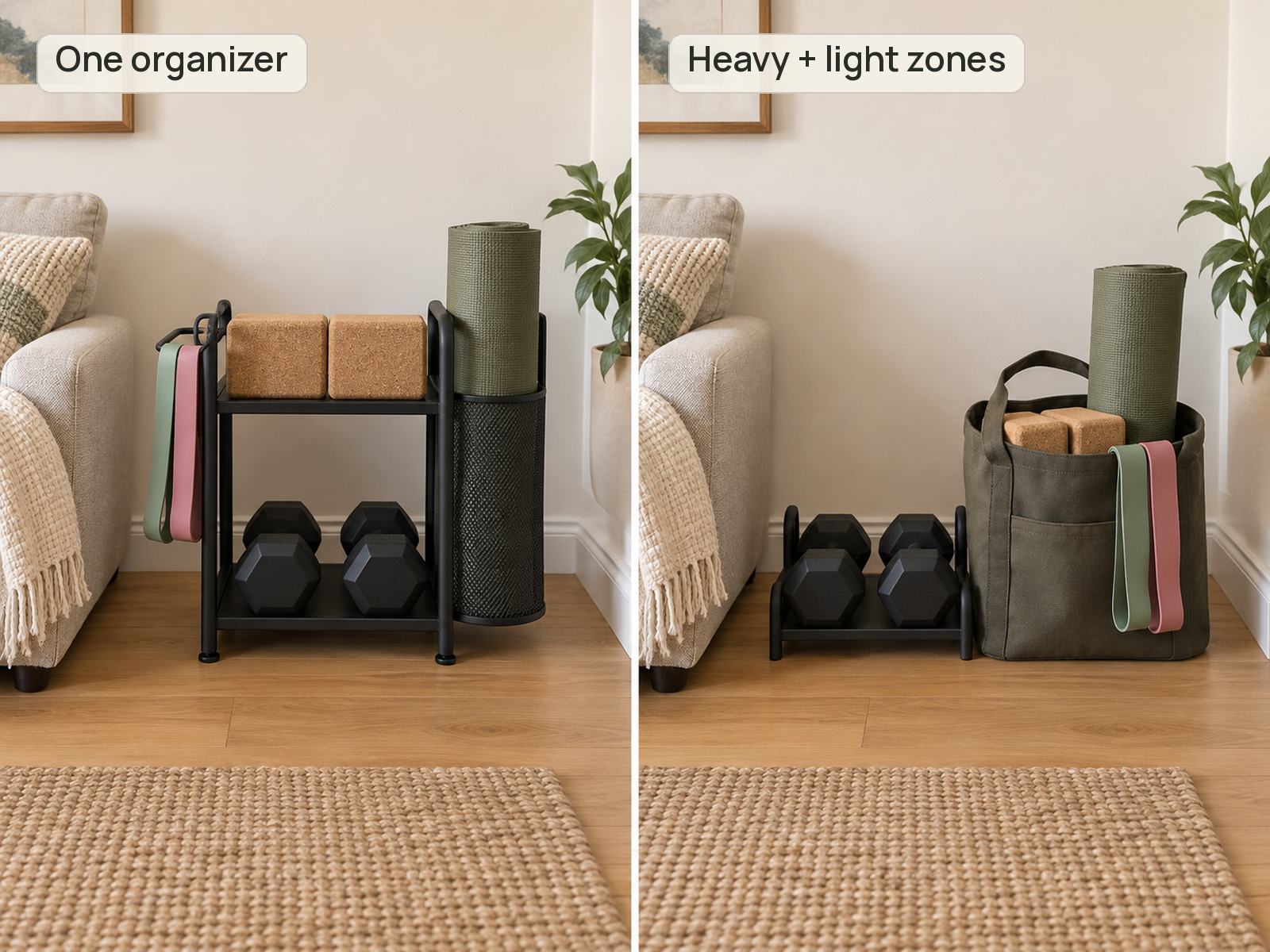
Use a Hybrid Heavy-and-Light Storage System
Trying to make one object hold dumbbells, a rolled mat, resistance bands, blocks, and small accessories creates avoidable compromises. Heavy gear pushes the system toward stronger, more visible storage; light gear benefits from concealment and flexible containment.
A two-zone system resolves that conflict. Zone one is the rated heavy home: a compact stand or another explicitly rated support. Zone two is the light-gear home: a bag, shallow bin, shelf container, over-door hook system, or other reversible form that fits the specific items.
The zones can still sit close together. The point is not to scatter the workout across the apartment; it is to prevent the light items from dictating the heavy storage and the heavy items from forcing every accessory into a gym-style rack.
This arrangement also makes future changes easier. If the workout routine changes, the light-gear zone can be resized or moved without rebuilding the load-bearing home for the weights.
05
Store Mats as a Length Problem
A rolled yoga mat or foam roller is usually more awkward than heavy. It needs a clean path for its full length, but it does not need a dumbbell rack.
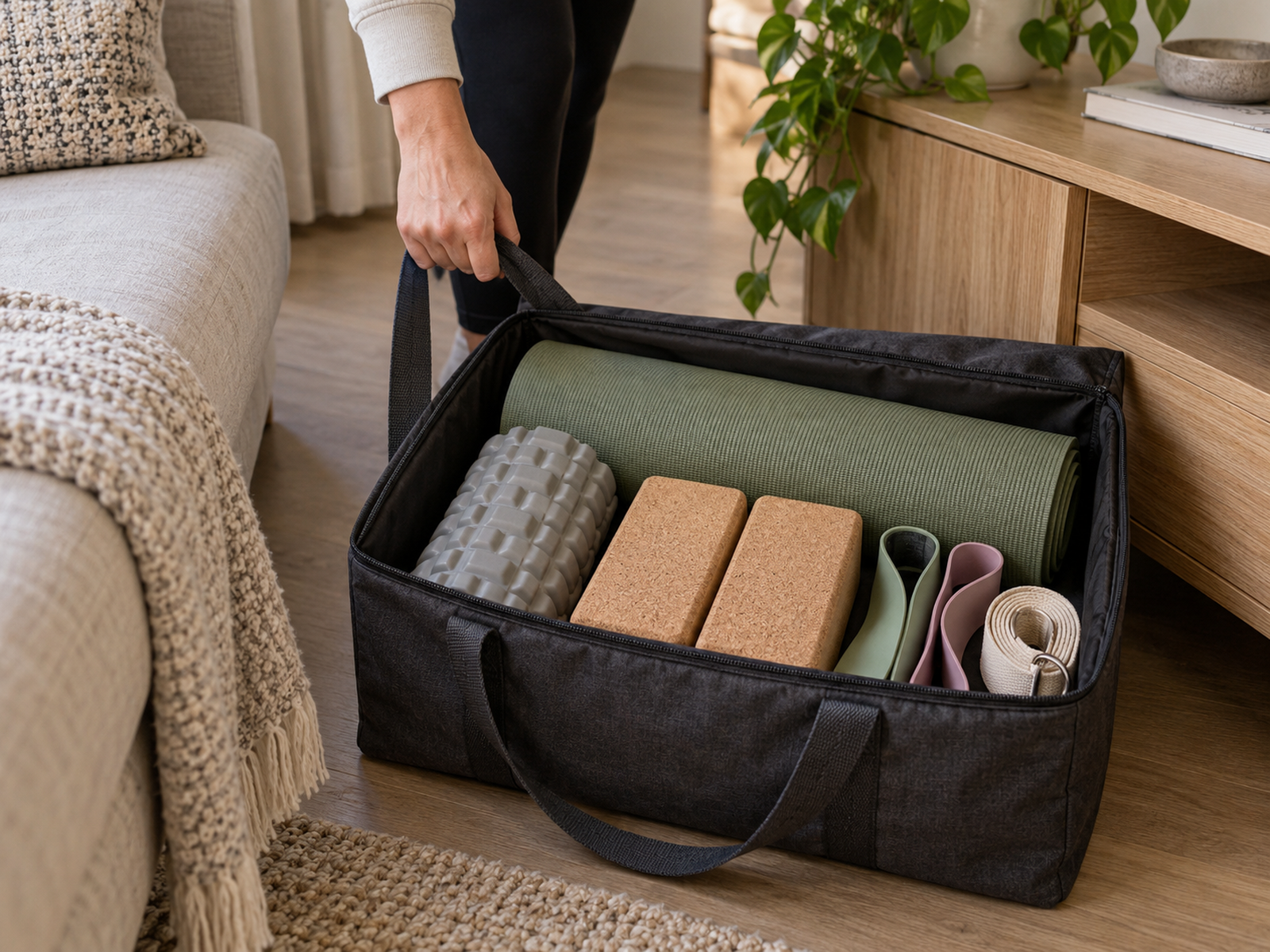
Under-sofa or under-bed storage can work when the real furniture clearance and retrieval path allow the mat to slide out without moving the furniture. A long storage bag can also conceal a mat and other light equipment in a closet or beside a console when the bag is easy to carry.
IKEA’s current DIMPA storage bag is one verified light-gear form: IKEA describes it for sports gear and other bulky storage, and it folds flat when empty. The product page does not establish a general dumbbell load rating, so its value here is the bag form for light and bulky gear rather than dense weights.
Avoid turning the mat into a permanent floor object simply because it is easy to lean against a wall. If visible storage is acceptable, that can be a deliberate choice; if the room needs to reset visually, give the rolled mat a defined horizontal or vertical parking place.
06
Contain Bands and Small Accessories Separately
Resistance bands, straps, jump ropes, sliders, and similar pieces rarely need heavy-duty furniture. Their main failure modes are tangling, visual scatter, and disappearing inside a mixed container.
Use one light container or hook zone that keeps the category visible enough to reset quickly. An over-door system can be highly reversible when the apartment has a compatible hinged door and the stored items stay within the product’s rated load.
Umbra’s current Estique 5 Over-the-Door Hook, for example, is rated to 5 pounds per hook and fits doors up to 1.5 inches thick. That supports the form as an option for light bands, ropes, or straps; it is not evidence for storing dumbbells on a door.
If the closet or door is not close to the workout area, a small lidded bin or bag may create less friction. Choose the location by the reset path, not by the existence of an empty hook.
07
Use Rolling Carts Only Within Their Real Load Rating
A rolling cart is appealing because it can hold several categories and move out of sight, but mobility does not make it a generic weight rack.
IKEA’s current VESKEN cart is a useful reality check: it is about 21 1/4 inches wide, 7 1/8 inches deep, and 28 inches high, with a 13-pound maximum total load. A few dumbbells can exceed that limit before bands, blocks, or other contents are added.
Use a lightweight cart for equipment that stays comfortably within the exact manufacturer rating. Once the load makes the cart difficult to steer, unstable to reset, or overweight, its mobility advantage has disappeared.
For heavy gear, separate rated support is usually clearer than trying to make a household cart perform two jobs.
08
Verify Concealed Furniture Before Trusting It With Weights
Storage ottomans, benches, credenzas, cubes, and side tables are attractive because they can make workout gear disappear into normal living-room furniture. That does not prove the internal base or shelf can support concentrated weight.
A published seating or user-weight capacity is not the same as an internal storage load rating. Before putting dumbbells inside furniture, verify the specification for the actual internal shelf, floor, hardware, or stated storage use that will carry the equipment.
When that evidence is missing, use the furniture for the light gear instead and keep the weights on rated support. This preserves the living-room look without asking an unverified cavity to become a dumbbell rack.
Deep concealed furniture also needs an access test. If reaching the weights requires unloading blankets, books, or other household items first, the furniture is performing too many jobs.
09
Protect the Living Room Reset
The storage system should disappear operationally even if part of it remains visible. After a workout, the main circulation path, seating area, and everyday surfaces should return to their normal jobs without equipment migrating to random corners.
Run one full setup and reset. Take out the weights, mat, and light accessories in the order they are normally used, then return them. Count the furniture moves, containers opened, and items that have to be relocated before the room is usable again.
If the system is visually elegant but too cumbersome to use several times a week, reduce the number of active pieces or bring the light-gear storage closer. If the system is quick but makes the whole room read like a gym, conceal the flexible items before adding larger furniture around the weights.
A small apartment does not need one perfect all-in-one organizer. It needs a stable home for the dense equipment and a low-friction reset for everything else.
Closing Decision
Separate What Must Be Strong From What Can Be Hidden
The easiest small-apartment workout system starts with the dense gear. Give dumbbells or kettlebells a rated, stable home that fits the room, then let lighter equipment use the more flexible storage opportunities around it.
From there, decide how much visibility the living room can tolerate and how much setup friction the routine can absorb. A compact heavy zone plus concealed light gear is often more useful than one oversized organizer trying to hide everything. When the room resets quickly and the weights remain on verified support, the storage is doing its job.
RELATED GUIDES
What to Read Next
NEXT GUIDE
How to Store a Bike in a Small Apartment With No Bike Room
Use this next if another piece of recreational equipment also has to coexist with everyday living space; the bike guide applies the same renter-first discipline to a much larger single object.
GUIDE
How to Store Household Backstock in a Small Apartment With No Storage Closet
Use this if rarely used workout accessories are competing with household reserve inventory and you need a clearer secondary-storage boundary elsewhere in the apartment.