
Small Closet Organization
How to Store Folded Clothes in a Small Closet With No Dresser
When the closet has to do the dresser’s job, every solution spends something: shelf width, hanging width, floor space, or access. Choose the containment format by category and frequency before you sacrifice the wrong closet plane.
In This Guide
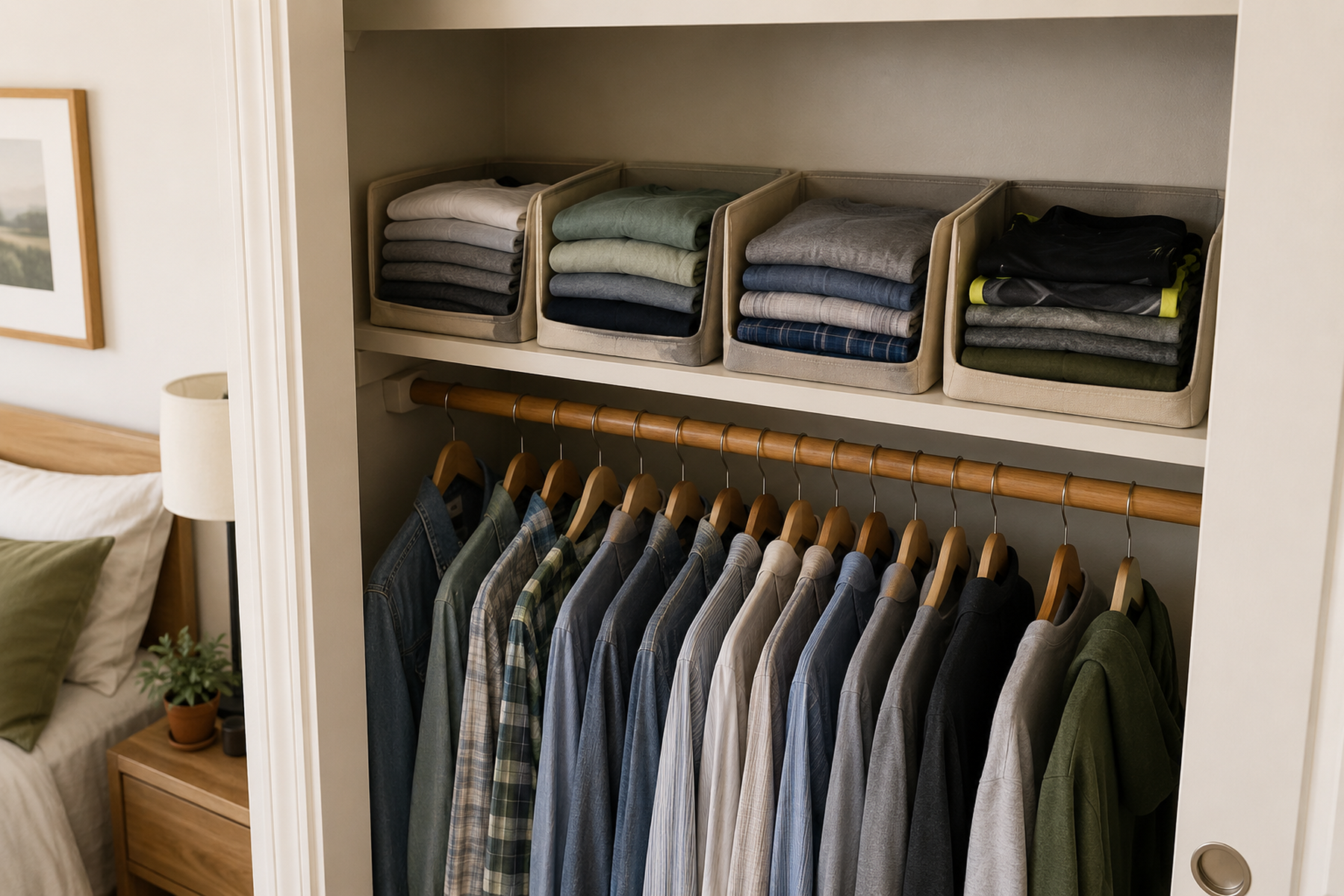
A small closet without a dresser has to do two different jobs at once: hold hanging garments and create contained homes for clothes that work better folded. The usual one-rod, one-shelf setup may have enough physical volume but still lack the drawer-like boundaries that make laundry easy to put away.
The goal is not to force every garment into the closet at maximum density. It is to decide which folded categories need daily access, which closet plane can hold them, what that choice displaces, and whether the system still works when you open the door, pull something out, and return a fresh load of laundry.
Quick Answer
Decide Which Closet Plane Becomes the Dresser
The best no-dresser setup starts with the folded categories, then matches each one to a containment style and a closet plane that the wardrobe can afford to give up.
01
Separate hanging needs from folded needs
Decide which categories truly need drawer-like containment before you buy organizers. The closet cannot price the rod-width, shelf-width, or floor-space trade until you know how much folded storage you actually need.
02
Match the container to the failure
Use dividers when stacks spread sideways, bins when soft or small categories need stronger boundaries, hanging compartments when rod width is available, and floor drawers when short-hanging clearance and pull-out access both work.
03
Test the return path, not just the fit
A solution should be easy to use after laundry day. If putting clothes away requires moving bins, rebuilding stacks, fighting a door panel, or opening several lids, the system is too friction-heavy for a daily zone.
01
Decide Which Clothes Actually Need Drawer-Like Containment
Start by separating wardrobe categories by storage behavior rather than by whatever space is currently empty. Some garments already work well on hangers; others—such as socks, underwear, sleepwear, workout clothes, T-shirts, or some knitwear—often need shallow, contained storage to stay predictable.
This is not a rule about what must be folded or hung. It is an inventory decision. The point is to identify the categories that repeatedly end up in laundry baskets, unstable shelf piles, or mixed bins because the closet never gave them a clear return location.
Once that folded inventory is visible, sort it by frequency. Daily and weekly categories deserve the lowest-friction zones. Seasonal or rarely used clothing can tolerate a secondary location if moving it protects the closet’s best rod, shelf, and floor space.
02
Fix Open-Shelf Containment Before You Add More Furniture
A wide shelf can hold folded clothes and still be a poor dresser substitute. If stacks lean into each other, pulling one shirt collapses a neighboring pile, or small categories drift across the shelf, the problem is not necessarily the folding method. The storage plane has no boundaries.
Use a shelf divider when the main failure is sideways spread and you still want every stack visible. Use a short open bin when the category is soft, small, or easier to retrieve as one pull-forward unit. Do not buy both automatically; they solve different problems.
Keep the containment shallow enough that the category does not disappear at the back. A bin that hides half its contents or has to be unloaded to reach one item has recreated the same retrieval problem in a neater-looking container.
Measure / Check First
Before you add a hanging organizer, shelf bin, or floor drawer, measure the resource it will consume and the movement required to use it.
Measure the Storage in Motion, Not Just at Rest
01
Measure the plane you plan to spend
Record the usable shelf depth and width, the rod section a hanging organizer would occupy, or the floor footprint available beneath short-hanging clothes. Measure the actual zone, not the closet’s maximum wall-to-wall dimensions.
02
Measure garment drop and pull-out travel
Check the longest garments in the proposed floor-storage zone and the full drawer or bin movement required for access. A unit that fits under the rod but catches clothing or cannot extend is not usable storage.
03
Measure the accessible opening
Test the door in its real open position. Bypass panels, hinged doors, neighboring hangers, and bedroom circulation can reduce the opening available to remove a bin or extend a drawer.
There is no universal safe rod load, shelf load, drawer size, bin depth, or folded-stack height for every closet. Use the real closet system, organizer instructions, garment lengths, and opening geometry.
03
Convert Rod Width Only When Folded Storage Is Worth More
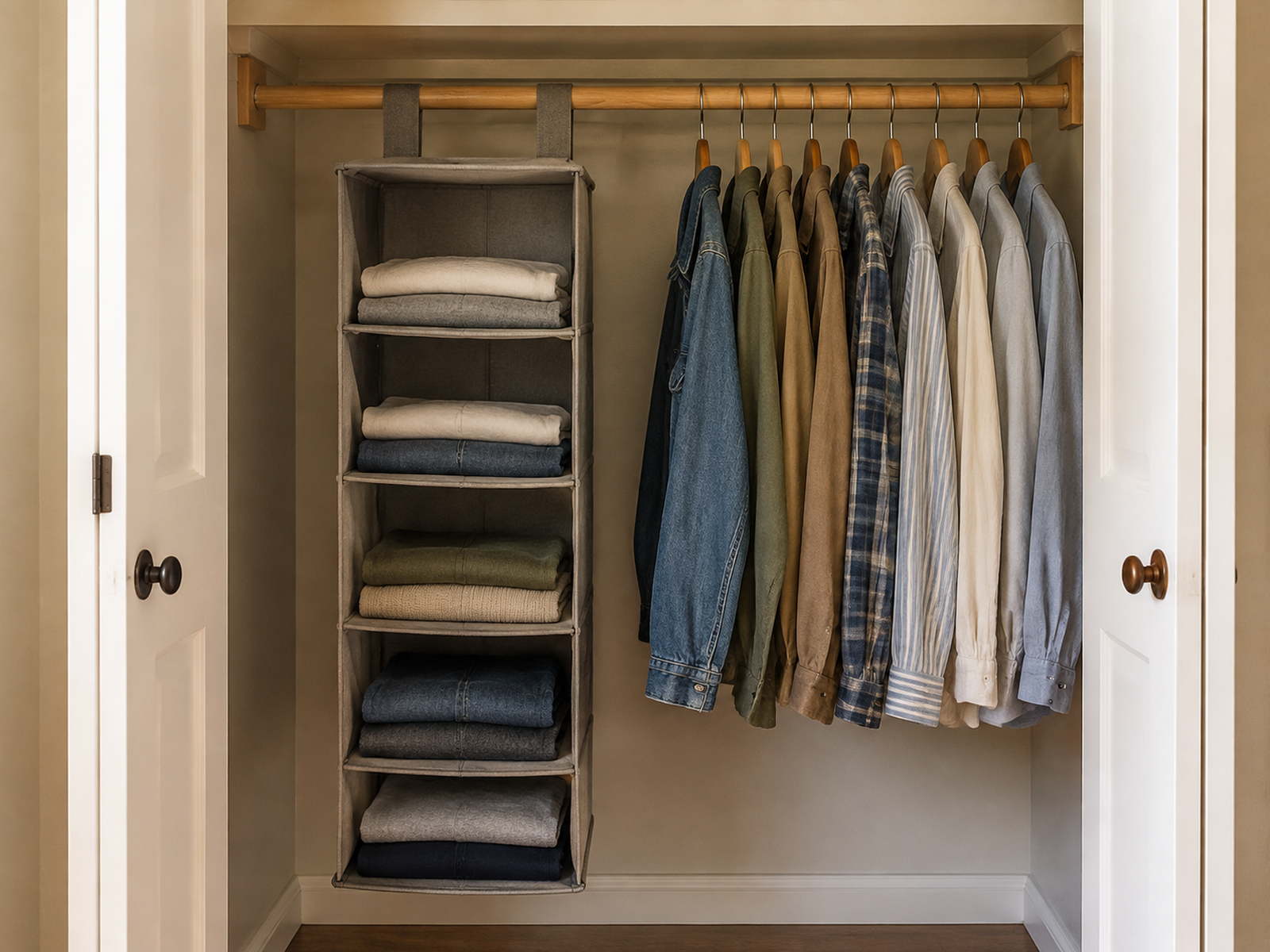
A hanging shelf organizer is not free capacity. It converts a section of hanging rod into vertical folded-storage compartments. That can be an excellent renter-friendly trade when the wardrobe has spare hanging width and lacks useful fixed shelves.
Current removable products such as IKEA’s SKUBB hanging organizer demonstrate the form: folded-clothes shelves suspended from the rod without building a permanent closet system. The exact organizer size, closet depth, and closet-system capacity still have to work together.
If the rod is already the closet’s bottleneck, hanging compartments can make the primary constraint worse. In that case, existing shelves or floor-level drawer-like storage may be the better place to create the dresser function.
Use / Skip
When a Hanging Organizer Earns the Rod Width
Use
Use — Use it when the closet can spare hanging width
A hanging compartment organizer makes sense when folded categories need vertical shelves, the rod has genuine spare width, the organizer remains visible through the opening, and the closet system can support the intended use according to its own instructions.
Skip
Skip — Skip it when the rod is already the bottleneck
If hangers are already packed edge to edge, long garments need the full drop, or the organizer would block floor storage or the door opening, converting more rod width can make the closet less functional.
04
Use Floor Drawers Only Under the Right Hanging Zone
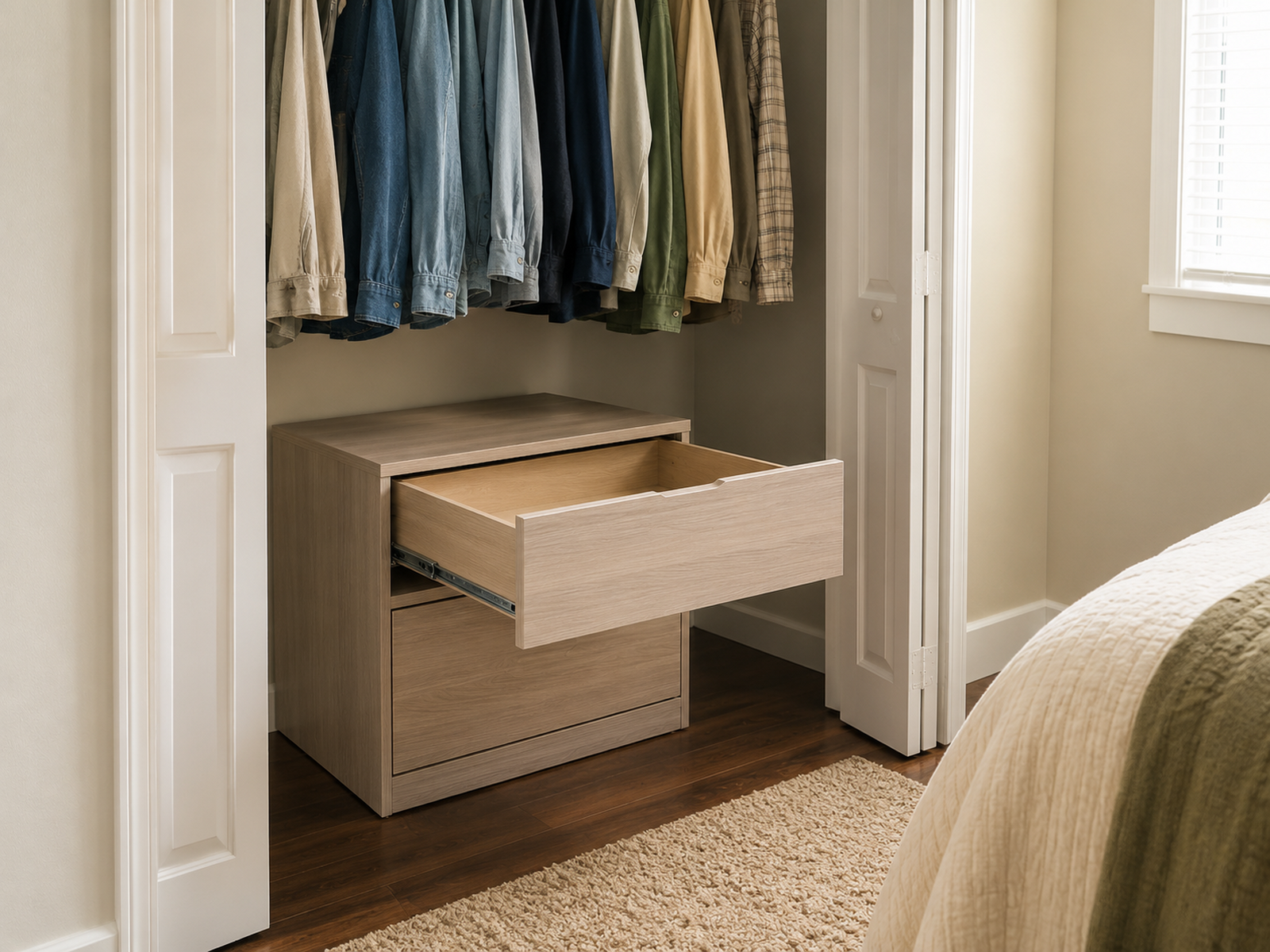
Low freestanding drawers can create the most dresser-like experience inside a closet: shallow categories stay separated, retrieval is direct, and clean laundry can return without rebuilding stacks. But the unit spends closet-floor depth and needs a full pull-out path.
Place floor drawers only beneath garments that leave enough vertical drop. A setup that works under shirts can fail under long dresses, coats, skirts, or full-length trousers. Shoes, a hamper, luggage, and cleaning access may also compete for the same floor zone.
If the closet cannot spare floor area without damaging those other functions, forcing drawers inside it is not automatically the small-space answer. The dresser function may belong on a different plane—or, in some rooms, outside the closet entirely.
05
Treat the Closet Opening as Part of the Storage Footprint
Interior width does not prove that a drawer or bin is usable. The organizer also has to pass through the real accessible opening and move through its full operating path.
This matters especially with sliding or bypass doors. A drawer unit can fit wall-to-wall inside the closet but sit behind a door panel that prevents the drawer front from extending. A shelf bin can fit the shelf yet be too wide to remove through the exposed section of the opening.
Test body fit, opening fit, and pull-out fit as three separate checks. If sliding-door access is the main constraint in your closet, the Aptly Small guide to organizing a small closet with sliding doors covers that access problem in more detail.
What Not to Do
Don’t Assume Tall Closet Furniture Is Automatically No-Drill
A freestanding drawer tower or shelf may still have anti-tip requirements. Current U.S. Consumer Product Safety Commission guidance recommends securing appropriate furniture and keeping heavier items lower. Check the exact furniture instructions and rental conditions before treating a tall unit as an installation-free solution.
06
Move Low-Frequency Clothes Out of Prime Closet Space First
Seasonal and genuinely low-frequency clothing should not consume the easiest drawer-like zones while daily underwear, sleepwear, or workout clothes live in awkward overflow. Protect the prime shelf, rod, and floor positions for the categories that return there every week.
Top-shelf cases, under-bed containers, luggage, or another appropriate household storage zone can take lower-frequency overflow when those spaces are actually available. Each option adds retrieval friction, so use it for categories that can tolerate being farther from the dressing routine.
This is not permission to scatter clothing across the apartment. The goal is a small number of predictable zones: daily folded storage in the closet, lower-frequency overflow somewhere deliberately secondary.
07
Make Laundry Return the Final Test
A closet reset can look excellent on the day it is organized and fail one laundry cycle later. The real maintenance test is whether every folded category has a one-step return path.
The strongest daily systems are boring to use: fold, place, done. A divider gives a stack a fixed lane. An open bin gives a soft category a boundary. A drawer gives small items direct access. None of those forms is automatically best; the best one is the form the household can refill without dismantling another part of the closet.
If clean clothes still collect in a basket because the assigned zone is overfilled, hidden, blocked, or annoying to reopen, revisit the category volume or the closet plane. Do not add another organizer until the return failure is clear.
Decision Sequence
Choose the Lowest-Friction Dresser Substitute
01
Name the folded categories
Identify what truly needs drawer-like containment and how often each category is used.
02
Choose the containment behavior
Decide whether the problem needs side boundaries, a pull-forward bin, hanging compartments, or actual drawers.
03
Choose the closet plane
Spend shelf width, rod width, or floor space only after you know what existing function that choice will displace.
04
Prove access and return
Test the door, pull-out path, garment clearance, and laundry return before you commit the category to that zone.
Closing Decision
Give Folded Clothes a Predictable Return Zone
A small closet can absorb much of a dresser’s function without pretending that every storage plane is free. Start with the folded categories that need containment, fix unstable shelves before adding furniture, convert rod width only when it is truly available, and use floor drawers only where garment drop and pull-out access work. Keep low-frequency overflow out of prime zones, then judge the system by the next laundry load: if clothes can go back in one step, the closet is doing the dresser’s job.
RELATED GUIDES
What to Read Next

NEXT GUIDE
How to Store Bras in a Small Closet With No Dresser
A direct next step for storing a clothing category that needs more shape protection than ordinary folded garments.
GUIDE
How to Store Jewelry in a Small Closet With No Dresser or Vanity
Useful for another small personal-item category that has to move into closet storage when furniture drawers are absent.
GUIDE
How to Organize Belts, Scarves, and Hats in a Small Closet With No Drawer Space
Continues the no-drawer problem with accessories that need visibility without taking over shelf or hanging space.