
Small Closet Organization
How to Organize Belts, Scarves, and Hats in a Small Closet With No Drawer Space
Match each accessory to the storage form its shape actually needs, then protect scarce rod and shelf capacity by giving flexible pieces, structured hats, and small soft items separate micro-zones instead of forcing everything into one bin or hanger.
In This Guide
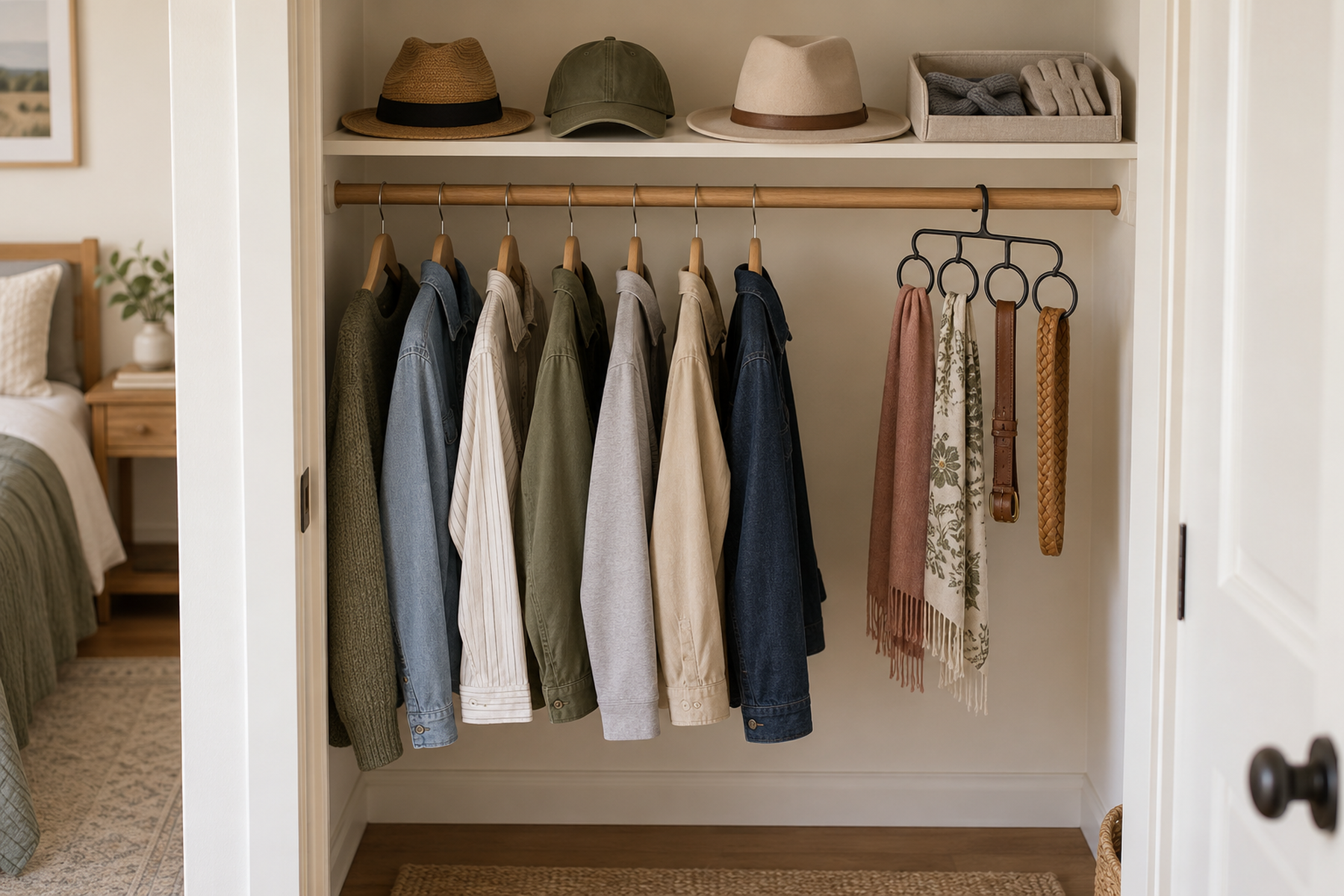
Belts, scarves, hats, ties, gloves, and other small accessories create a different closet problem from shirts, shoes, or handbags. They take up little volume individually, but they become difficult to see and retrieve when they are layered on hooks, mixed in deep bins, or allowed to occupy the same rod and shelf space as larger clothing.
The goal is not to buy one organizer that holds every accessory. Start with the item’s shape and frequency, then choose the lightest storage form that keeps one piece visible, removable, and easy to return without sacrificing more hanging or shelf capacity than the category earns.
Quick Answer
Match the Storage Form to the Accessory, Not the Product Category
01
Separate daily accessories from seasonal pieces
Keep frequently worn belts, scarves, hats, and gloves in premium reach. Seasonal or rarely worn pieces can move to a secondary closet zone so the active system stays small.
02
Use hanging loops or rails for flexible pieces
Scarves, ties, and many belts can use vertical hanging storage when some rod or side-panel capacity exists. Do not assume the organizer is free space; it still consumes hanger position, vertical drop, or wall-panel area.
03
Give structured hats and tiny soft items different homes
Hats need a visible zone that does not force them into an unsuitable shape, while gloves and other small soft accessories are usually easier to manage in shallow compartments or small bins.
04
Choose the renter path before the organizer
Ordinary-hanger, hook-and-loop, and compatible over-door systems are more reversible than adhesive or screw-mounted storage. Door type, surface, load, and lease rules can remove entire solution families.
01
Edit the Active Accessory Set
Do not size a new organizer around every accessory you own. First separate what is actively worn from what is seasonal, rarely used, duplicated, or no longer earning premium closet access.
This matters because small accessories can look harmless one by one while collectively consuming several hooks, a long stretch of rod, a deep shelf bin, and the top of the closet. A compact active set is easier to keep visible and easier to return after use.
Move truly seasonal scarves, hats, and gloves to the same secondary-storage logic used for other off-season clothing when that works for the household. Keep the everyday closet responsible for the pieces that need fast access now.
The edit is not a generic decluttering exercise. It establishes how much accessory capacity the current closet actually needs before hardware begins taking space away from clothes.
02
Sort by Shape Before Location
Accessories should not be treated as one physical category simply because they are all small.
Flexible pieces such as scarves and ties can use loops or rails. Many belts can hang vertically when the exact material and construction make that appropriate. Structured hats need open space that does not compress them into a mixed pile. Gloves and other very small soft items are easier to contain in a shallow compartment where both pieces stay together.
This shape-first step prevents a common failure: buying one deep basket, then discovering that hats disappear under scarves, belts sink to the bottom, and gloves become loose filler around everything else.
If one organizer requires several different accessory shapes to behave the same way, the organizer is solving the container problem rather than the retrieval problem.
03
Protect Hanging Space Before Adding Organizers
Rod-hung storage is reversible, but it still spends closet capacity.
IKEA’s current KOMPLEMENT Multi-use hanger illustrates the trade-off. The manufacturer says it can hold up to 18 accessories such as shawls, belts, and ties in one ordinary hanger position, but the organizer itself is about 12 1/2 inches wide and 28 1/4 inches high.
A hanging cubby uses even more space. IKEA’s current SKUBB six-compartment organizer attaches with hook-and-loop fasteners and folds flat when not in use, but it measures about 13 3/4 inches wide and 49 1/4 inches high.
Before adding either form, decide what clothing, shoes, hamper space, lower rod, or floor storage will occupy the same vertical drop. The organizer earns its place only if the accessories it consolidates are more valuable than the capacity it displaces.
Measure / Check First
Before buying a hanger, hanging cubby, over-door rack, or adhesive rail, check the exact closet geometry that the organizer will occupy.
Check the Rod, the Door, and the Secondary Surface
01
Rod width and vertical drop
Measure the hanger position, the drop below the rod, and any lower rod, shoe, hamper, or floor-storage conflict. A rod-hung organizer still consumes real volume.
02
Door type and closure path
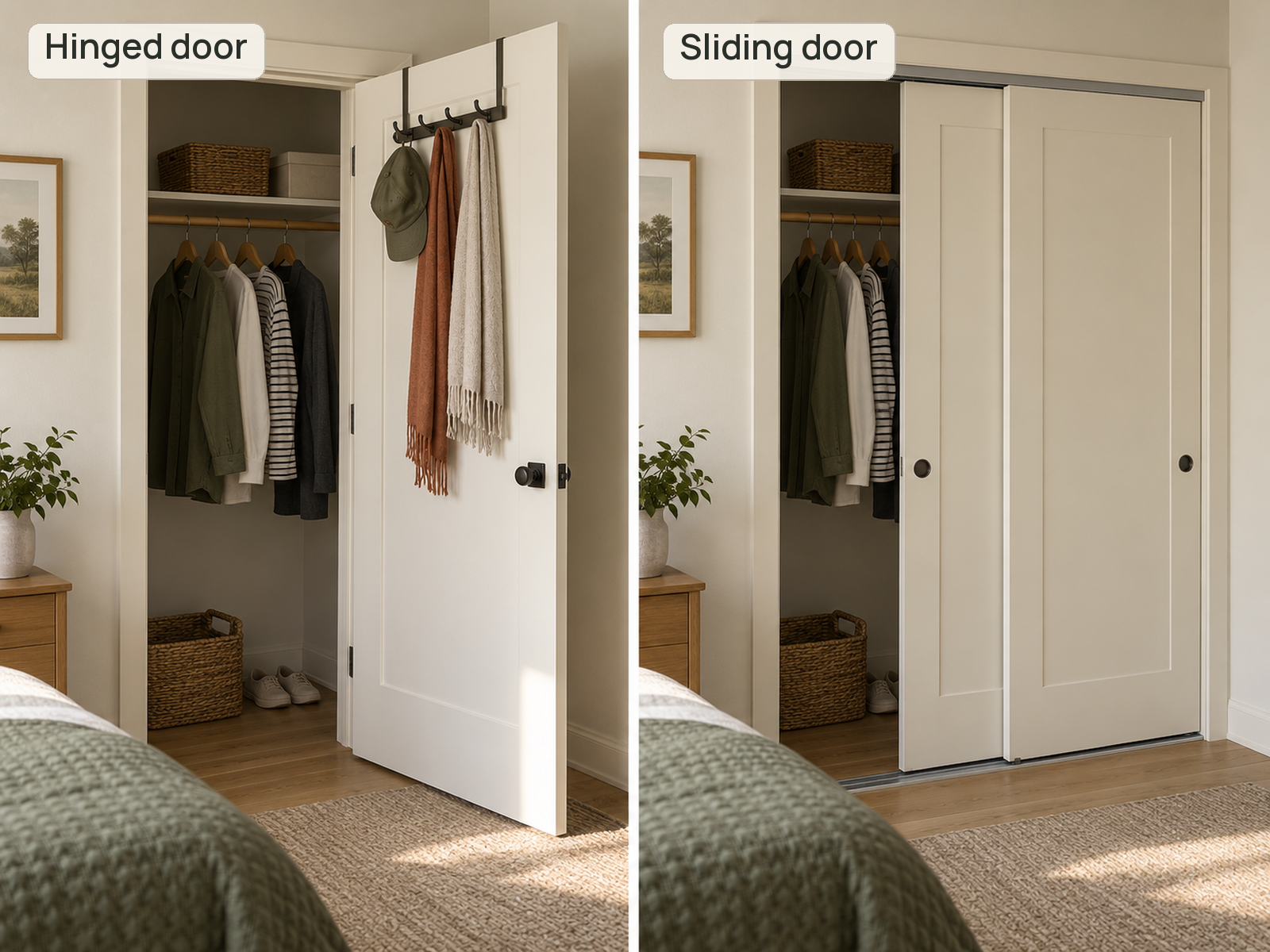
Confirm whether the closet has a compatible hinged door. Check door thickness, top/frame clearance, full closure, and whether stored accessories would collide with hanging clothes. Sliding or bypass doors remove the over-door path.
03
Shelf or side-panel fit
Check shelf depth and reach for bins, or the exact approved surface and load limit for an adhesive side-panel organizer. Tool-free mounting does not eliminate fit, finish, or removal requirements.
If the organizer only works by blocking clothing access, overloading a door or adhesive system, consuming needed floor space, or forcing several accessories to hide behind one another, choose a smaller or different storage form.
04
Use Loops and Rails for Flexible Accessories
When scarves, ties, or compatible belts are the main problem, a loop or rail keeps the category visible without needing a drawer.
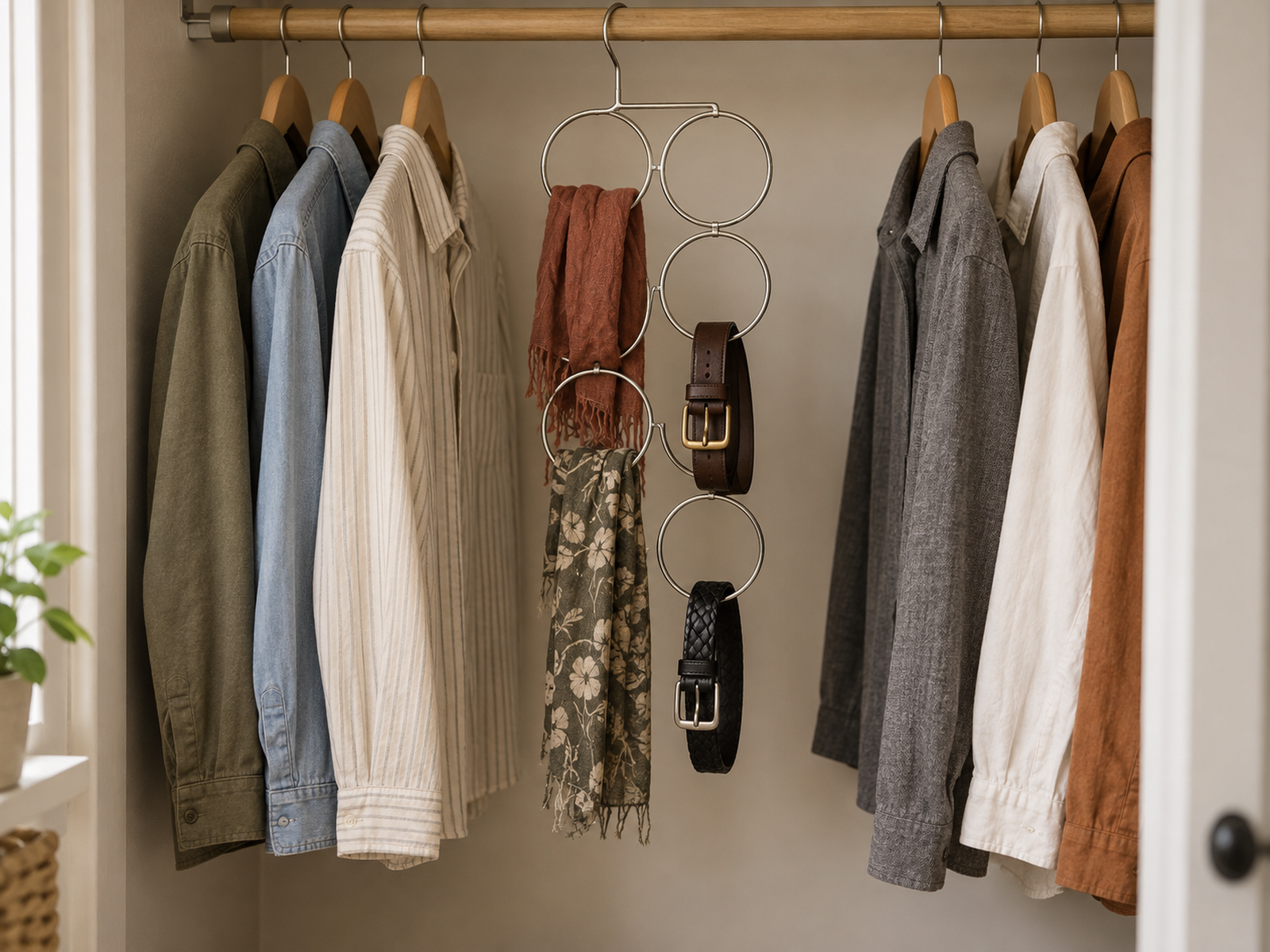
The simplest renter path is a multi-loop organizer that hangs from the existing rod. Keep the loading light enough that one item can be removed without unloading several others. When loops are packed with multiple layers, the organizer may still look tidy from a distance while becoming difficult to use.
If rod space is too valuable, a side-panel rail can move flexible accessories away from clothing. Joseph Joseph’s current Orderly belt, tie, and scarf rack demonstrates one tool-free adhesive form: it uses 3M VHB tape, folds flat against the mounting surface, and has a manufacturer-stated maximum load of 2.2 pounds.
That form is not automatically damage-free or lease-safe. Surface compatibility, preparation, weight, removal method, and landlord rules still determine whether adhesive storage belongs in the closet.
05
Use Door Storage Only When the Door Geometry Works
A hinged closet door can become a useful accessory surface when rod and shelf space are already committed.
Umbra’s current Estique over-the-door organizer is one verified form: it has 14 hooks and is designed for doors up to about 1.5 inches thick. The manufacturer states a maximum capacity of 5 pounds per hook.
Those specifications do not prove that every closet door will work. The door still has to close fully, the organizer must clear the frame, and stored hats or scarves cannot collide with hanging clothes or block circulation.
Sliding or bypass closet doors are a different geometry. They do not provide the same over-door edge, so do not buy an over-door accessory system before confirming that the closet actually has a compatible hinged door.
06
Give Hats a Visible, Shape-Compatible Zone
Hats should not be forced into the same storage form as scarves simply because both are wearable accessories.
For caps and other hook-compatible hats, a small number of visible hooks can work when the contact point is suitable for the item and the hooks do not project into the clothing path. For hats that need more support, use a shallow open shelf or compartment where the shape is not crushed by unrelated items.
Avoid a deep mixed hat bin when the main problem is visibility. It may hide visual clutter while making the user lift several hats to find one at the bottom.
Material-specific care varies, so this guide does not prescribe one universal hanging, stacking, or binning rule for leather, felt, straw, silk, or other specialty pieces. Use the storage form that preserves the actual item without turning the closet into an accessory pile.
07
Contain Gloves and Small Soft Accessories in Shallow Compartments
Very small soft accessories usually need containment more than hanging.
Use a shallow shelf bin, divided box, or one compartment in a hanging cubby for gloves, soft headbands, or similar items. The container should be shallow enough that the whole category can be scanned without digging.
IKEA currently describes its SKUBB small boxes as suitable for belts and accessories, which verifies the compartment-box form. The useful principle is not the exact product; it is giving a small category a bounded footprint that remains legible.
Do not merge several unrelated accessory categories into one deep basket merely to reduce the number of containers. A single mixed bin can recreate the same search problem that missing drawers caused in the first place.

08
Move Seasonal Accessories Out of Premium Reach
Daily and seasonal accessories should not compete equally for the easiest closet positions.
If winter hats, gloves, and heavy scarves are inactive for months, move them to a higher shelf, secondary bin, or other appropriate off-season zone. Keep the accessible loops, hooks, and shallow compartments for the pieces being worn now.
This is especially useful in a closet with one rod and one shelf because it avoids adding a second permanent accessory organizer just to hold items that are not currently active.
The secondary zone still needs a clear category and a predictable return point. Moving seasonal accessories away should reduce pressure on the main closet, not create a forgotten miscellaneous box elsewhere.
09
Use the Stop Rule When Accessories Start Blocking Clothes
The accessory system is too large when it begins to reduce the closet’s main functions.
Stop adding organizers if a hanging cubby prevents clothes from sliding on the rod, a loop hanger collides with shoes or a lower rod, door hooks prevent closure, a side-panel rail catches garments, or shelf bins must be removed before other clothes can be reached.
At that point, reduce the active accessory set, move seasonal pieces to secondary storage, or change the storage form. Do not solve a visibility problem by filling every remaining closet surface with another accessory device.
Usable capacity includes clearance around the organizer. The ability to remove one scarf, open the door, slide hangers, reach a bin, and return an item is part of the space the system must preserve.
Closing Decision
Build Small Accessory Zones That Stay Visible
A small closet does not need one universal accessory organizer. It needs a few micro-zones that respect shape: flexible pieces can use loops or rails, hats need a visible shape-compatible home, and gloves or other tiny soft items can use shallow containment.
Protect scarce rod and shelf capacity, keep daily accessories in easy reach, move seasonal pieces out of premium space, and choose the most reversible mounting class the closet actually supports. If the organizer starts blocking clothing, door movement, or one-item retrieval, the accessory system has exceeded the space it earns.
RELATED GUIDES
What to Read Next

NEXT GUIDE
How to Organize a Small Closet With No Built-In Shelves
Use this next if accessory storage is only one part of a rod-heavy closet that still needs usable shelf-like zones without permanent built-ins.
GUIDE
How to Organize a Small Closet With Sliding Doors—Without Losing Access
Use this if your closet has sliding or bypass doors, because over-door accessory storage is not available and the access geometry changes the strongest remaining options.
GUIDE
How to Store Off-Season Clothes When Your Small Closet Has No Extra Space
Use this when seasonal scarves, hats, and gloves should leave premium daily-access space but the closet has no obvious overflow zone.