
Small Closet Organization
How to Store Off-Season Clothes When Your Small Closet Has No Extra Space
Make the active closet easier to use by moving only genuinely off-season clothes into lower-priority storage—and choose each storage method around access, garment care, and the space you actually have.
In This Guide
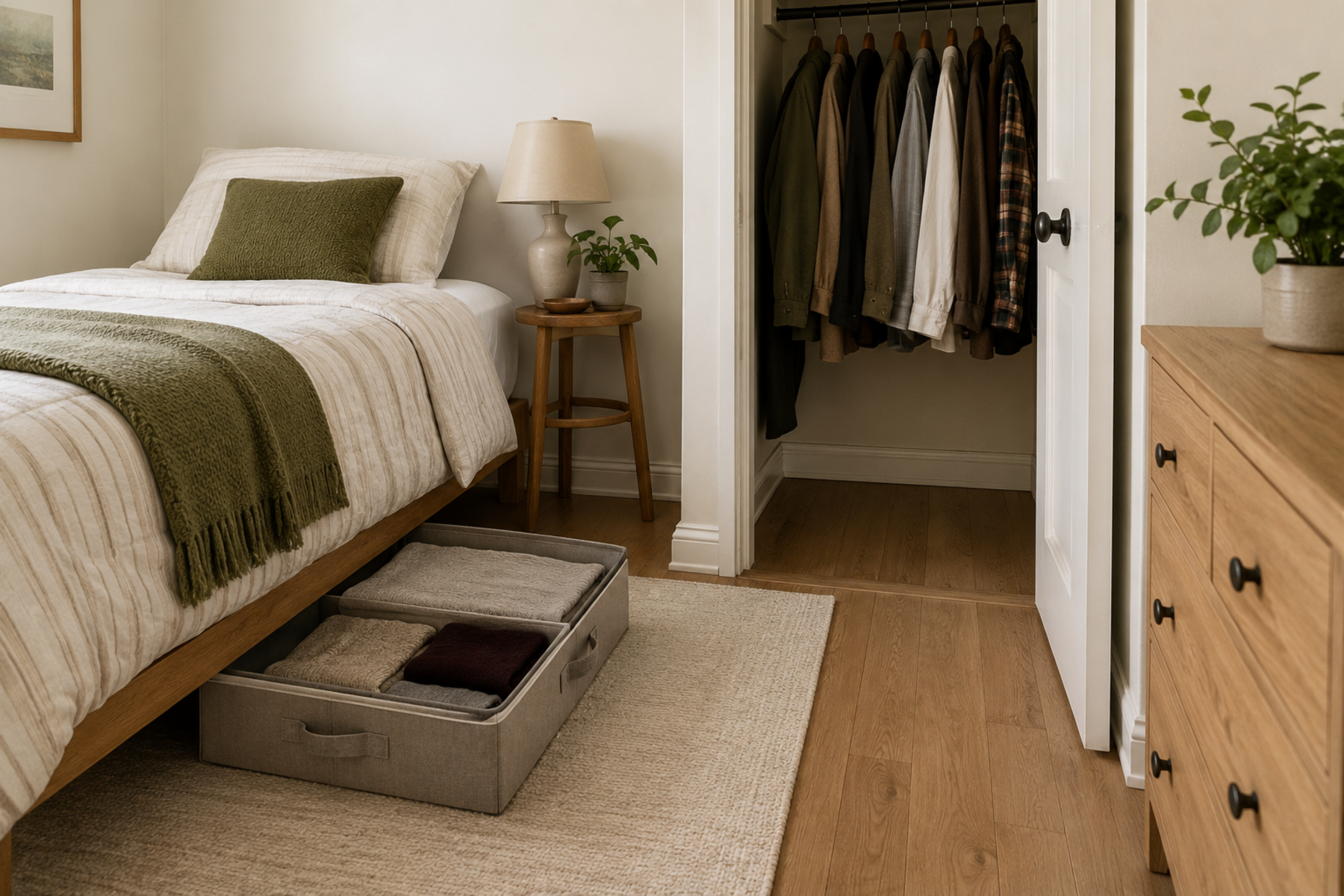
A small closet becomes harder to use when it has to hold every season at the same priority. Heavy coats, thick knits, high-summer clothes, and seasonal shoes can occupy the same easy-access zones needed by what you are wearing now.
Seasonal storage works better when it creates an access hierarchy. Keep current clothes in the easiest zones, leave uncertain transition pieces recoverable, and move only the items with a genuinely long time to next wear into deeper storage.
Quick Answer
Make Room Without Creating a Second Storage Problem
Move only true deep-off-season clothes out of prime closet space, use the lowest-conflict storage volume you already have, and let garment care and retrieval needs determine the container rather than chasing maximum compression.
01
Move only the deep-off-season group
Keep year-round basics and weather-dependent transition pieces close. Deep storage is for clothing you are unlikely to need for several months, not everything that happens to belong to another season.
02
Spend the cheapest storage zone first
Use an existing under-bed cavity, high shelf, suitcase, or other already-owned storage volume only when it costs less function than prime closet space. A hidden zone is not useful if retrieval requires moving furniture or dismantling another system.
03
Let the garment limit the container
Choose folding, hanging, compression, and enclosure after checking the garment’s care needs. The smallest package is not automatically the best storage outcome.
01
Decide What Actually Leaves the Closet
Seasonal rotation starts with time to next realistic wear, not with a storage bin.
Separate the wardrobe into three practical groups:
- Active now: clothing you are wearing regularly in the current conditions.
- Transition: layers or weather-dependent pieces you could plausibly need during a temperature swing, trip, or special occasion.
- Deep off-season: items whose next realistic use is far enough away that harder-to-reach storage makes sense.
This keeps the rotation from becoming an all-or-nothing swap. A light jacket in early fall may still deserve closet access even if the heaviest winter coat does not. Likewise, a year-round base layer should not be buried simply because it can be categorized as “winter clothing.”
Before assigning storage, remove obvious non-storage problems from the set: items that no longer fit, duplicates you no longer use, worn-out pieces, or clothing that no longer suits your climate or routine. Editing reduces the volume that needs a storage solution, but it should not be used to pretend that a four-season wardrobe can always be reduced to one tiny rail.
02
Keep Transition Clothes One Step Closer
The most compact storage location is often the least convenient one. That trade-off is reasonable for deep-season clothing, but it creates unnecessary friction for pieces you may need again in a few weeks.
Give transition clothing a shallower storage depth. That could mean the back of an existing shelf instead of under the bed, one labeled soft case instead of a fully compressed bag, or a small portion of the rod instead of moving every coat out of the closet.
The test is simple: can you retrieve one transition item without unpacking the entire seasonal set? If the answer is no, the system is too deep for uncertain weather.
03
Choose the Lowest-Cost Storage Zone
The best alternate zone is the one that preserves more important daily function than it consumes.
Under the bed
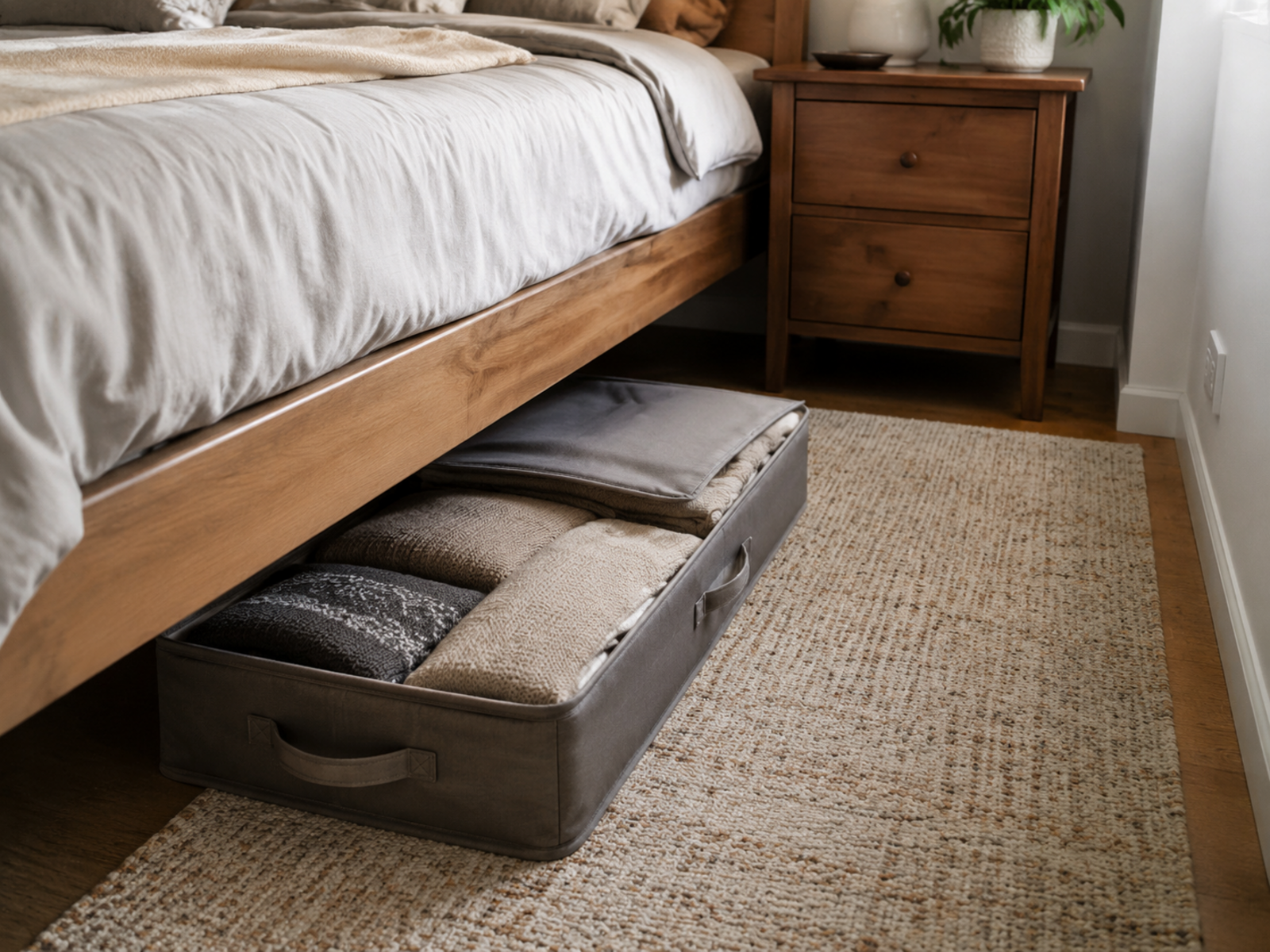
Under-bed storage can move folded seasonal clothing completely out of the closet without adding visible furniture. It works best for low-frequency soft goods when the container slides out in one normal move and the space is not already doing a more important job.
Do not treat the area under the bed as free capacity. Linens, shoes, luggage, documents, and other apartment overflow may already compete for it. Use it when seasonal clothing is the higher-value occupant.
An existing high closet shelf
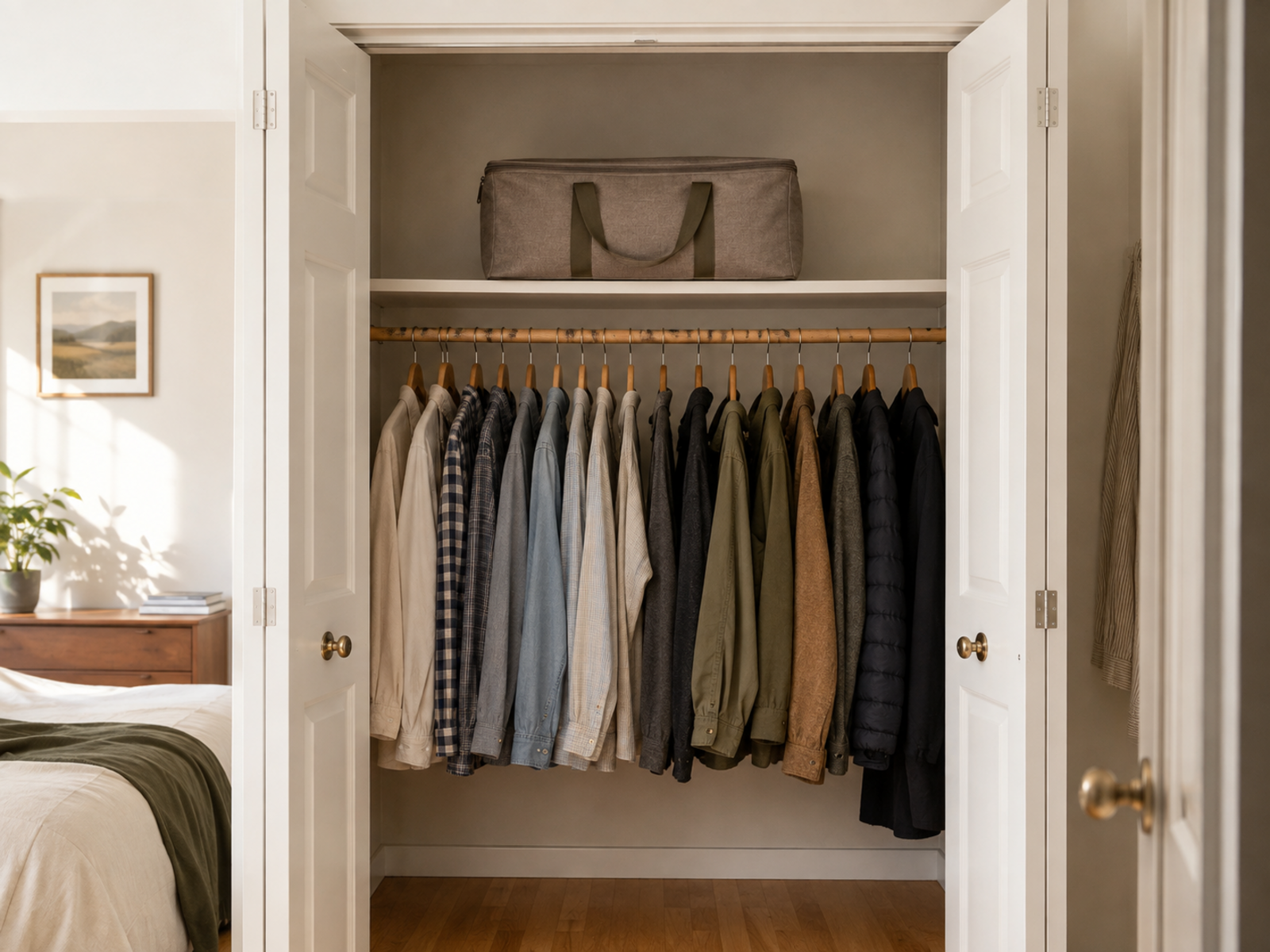
A top shelf can be a good home for light, infrequently needed seasonal clothing because it spends access rather than floor or rod width. Use smaller containers that are easy to identify and retrieve rather than one oversized box that becomes heavy and difficult to handle.
If the closet has bypass or sliding doors, also check the usable opening. A box can fit on the shelf and still be impossible to remove through the portion of the closet you can actually access.
An unused suitcase
A suitcase can be useful because its interior volume already exists in the apartment. It is most sensible when travel is infrequent and the suitcase itself already has a stable storage location.
The trade-off is nested use: the seasonal clothes must come out before the suitcase can travel. If that happens often, the apparent space saving turns into repeated handling.
A hanging garment cover
A garment cover can protect a structured hanging piece from dust, but it does not reclaim much rod width. Use it when garment protection is the priority and the closet can afford the hanging space. If rod capacity is the problem, relocating foldable off-season pieces will usually create more usable room than covering the same crowded garments.
04
Measure the Zone Before You Buy a Container
A seasonal-storage container is only useful if it can enter, leave, and operate in the intended zone.
For under-bed storage, measure from the floor to the lowest frame, rail, caster, or obstruction—not just to the mattress. Then check whether the container can be pulled out without hitting a nightstand, wall, rug edge, or another piece of furniture.
For a high shelf, measure the real shelf depth and the door opening that the container must pass through. In a small closet, usable access can be narrower than the shelf itself.
Also think about the loaded state. A deep case may fit beautifully when empty but become awkward once it is full of sweaters. Smaller modules often cost a little more container volume while making seasonal retrieval much easier.
05
Match the Storage Method to the Garment
Do not let organizer advice override garment care.
For cleaning, use the garment’s actual care label. In the United States, the Federal Trade Commission’s Care Labeling Rule requires covered apparel to carry supported instructions for regular care. That makes the label a better authority than a blanket instruction to machine-wash or dry-clean an entire seasonal wardrobe.
Storage form can also depend on construction. Woolmark’s wool-care guidance recommends hanging woven wool garments on shaped or padded hangers while folding knitted wool garments. That is a useful example of why “hang everything” and “fold everything” are both weak rules.
For other materials and specialized outerwear, follow the garment or manufacturer guidance you actually have. If an insulated coat, delicate piece, or structure-dependent garment has no verified compression guidance, do not assume maximum compression is harmless simply because the item fits in the bag.
06
Use Vacuum Compression Selectively
Vacuum bags solve a real small-space problem: they can reduce the volume of compressible soft goods enough to make under-bed, shelf, or suitcase storage possible.
But compression belongs near the end of the decision, after you know the item is truly deep-season, can be folded appropriately, and tolerates that kind of storage.
For example, Woolmark’s Merino sweater storage guidance advises that Merino sweaters be completely dry before storage and cautions against vacuum bags because tight compression can distort shape and create difficult creases. That is a material-specific warning, not proof that vacuum bags damage every type of clothing.
Use compression where it solves a volume problem and the garment can tolerate it. For material-sensitive or structure-dependent pieces, accept a little more storage volume rather than making compactness the only goal.
07
Store Clothes Clean, Dry, and Easy to Recover
Long-term storage should begin with clothing that is clean according to its care instructions and fully dry. Do not seal damp clothes into a deep-storage system.
For wool and other vulnerable animal fibers, cleanliness also matters for pest prevention. Penn State Extension notes that clothes-moth larvae can damage stored wool clothing and emphasizes cleaning, vacuuming, and appropriate containment as part of prevention and control. A general organization guide does not need to turn that into pesticide advice; it does need to avoid packing visibly soiled or suspect garments away for months and forgetting them.
Label containers by category or use a clear enough system that you can find one item without opening every case. The best seasonal storage is recoverable: it should survive a cold snap, unexpected trip, or special event without forcing you to rebuild the closet.
What Not to Do
Avoid These Seasonal-Storage Shortcuts
- Do not move half the wardrobe simply because the calendar changed. Keep year-round and transition pieces accessible when there is a realistic chance you will wear them soon.
- Do not vacuum-compress every garment by default. Material and construction determine whether aggressive compression is appropriate.
- Do not buy an under-bed box before measuring the lowest clearance and pull-out path. Nominal bed height is not the same as usable storage height.
- Do not put heavy, frequently needed containers on the highest shelf just because the space exists. Retrieval cost is part of the storage decision.
- Do not treat a garment cover as a rod-space solution. It protects clothing while continuing to consume hanging width.
08
Know When the Closet Is Carrying Too Much
Seasonal rotation can reclaim prime storage, but it cannot create unlimited apartment capacity.
If the active wardrobe is reasonable, the deep-season set has been edited, and every low-cost storage zone is already doing a more important job, adding another organizer may only move the congestion around. At that point the decision becomes broader: keep fewer low-value items, replace some ordinary items later when needed, use existing off-site storage if it is already justified, or accept the cost of dedicated storage for items valuable enough to warrant it.
Paid storage is not a default solution for ordinary clothing. Prices, access, transport, and the replacement value of the wardrobe vary too much for a universal recommendation. The important stop rule is recognizing when the apartment no longer has a low-friction zone that can absorb more retained volume.
Closing Decision
Give Prime Closet Space to the Clothes With the Nearest Next Use
A small closet works better when access follows frequency. Keep current clothing easiest to reach, keep transition pieces recoverable, and let genuinely deep-off-season items spend the harder zones: under the bed, on a high shelf, inside an infrequently used suitcase, or in another already-owned storage cavity that costs less daily function.
Then let garment care set the limits. Follow the care label, store clothing clean and dry, fold or hang according to the garment, and use compression only when it is suitable. Seasonal storage is successful when the active closet becomes easier to use and the clothing you moved remains easy to recover in good condition.
RELATED GUIDES
What to Read Next
NEXT GUIDE
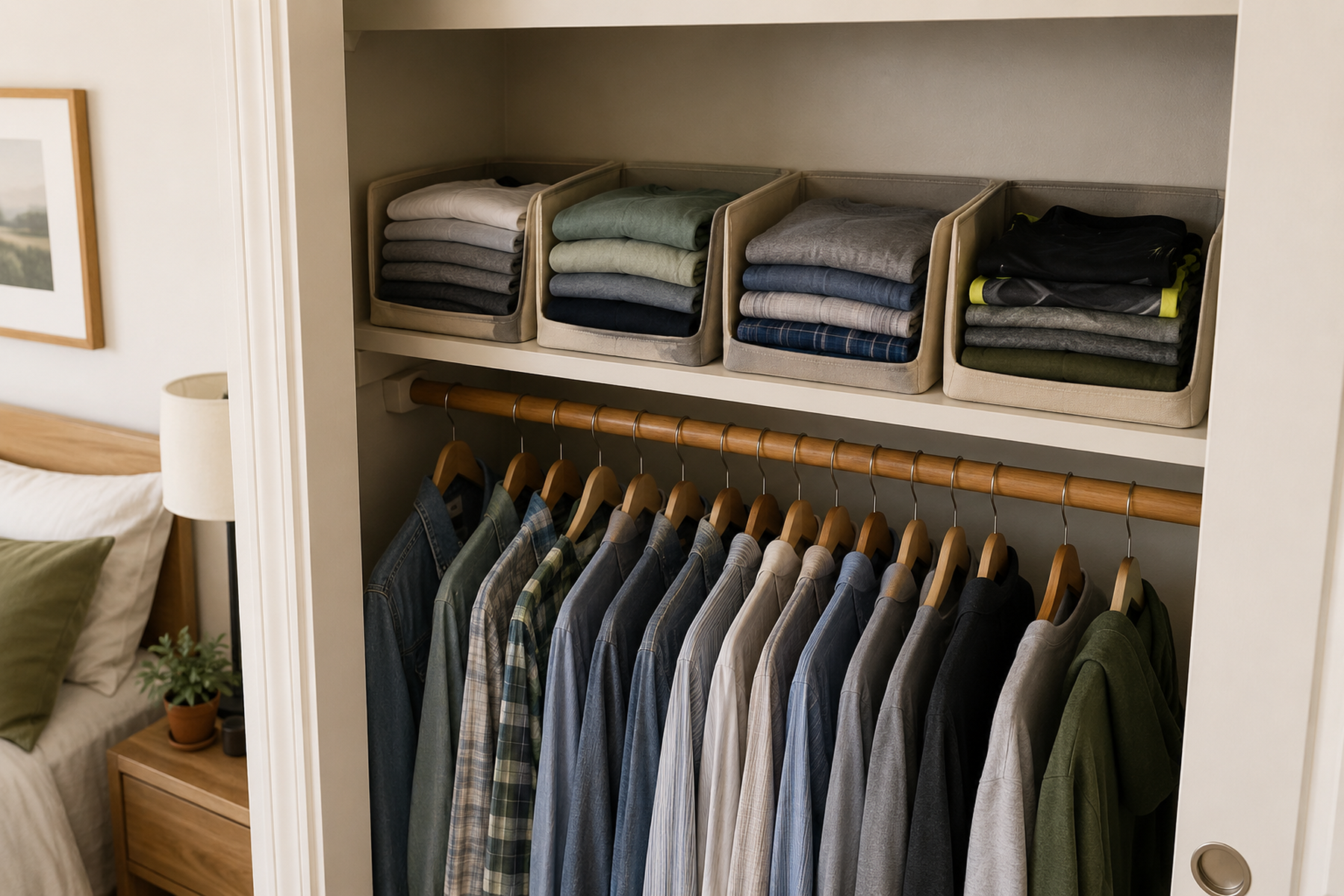
How to Store Folded Clothes in a Small Closet With No Dresser
Once off-season pieces leave prime storage, use this guide to organize the folded clothing that still needs everyday access.
GUIDE
How to Organize a Small Closet With No Built-In Shelves
Use this next if your seasonal-storage plan cannot rely on a built-in top shelf and the active closet still needs a renter-friendly structure.
GUIDE
How to Store Suitcases in a Small Apartment With No Storage Closet
If you want to use luggage as conditional off-season storage, this guide addresses the separate problem of where the suitcase itself belongs in a small apartment.