
Small Apartment Storage Ideas
How to Store Medications in a Small Apartment When the Bathroom Isn’t a Good Option
When the bathroom is humid or too small, medication storage needs a better home. Build a compact system around label instructions, household access, and direct retrieval.
In This Guide
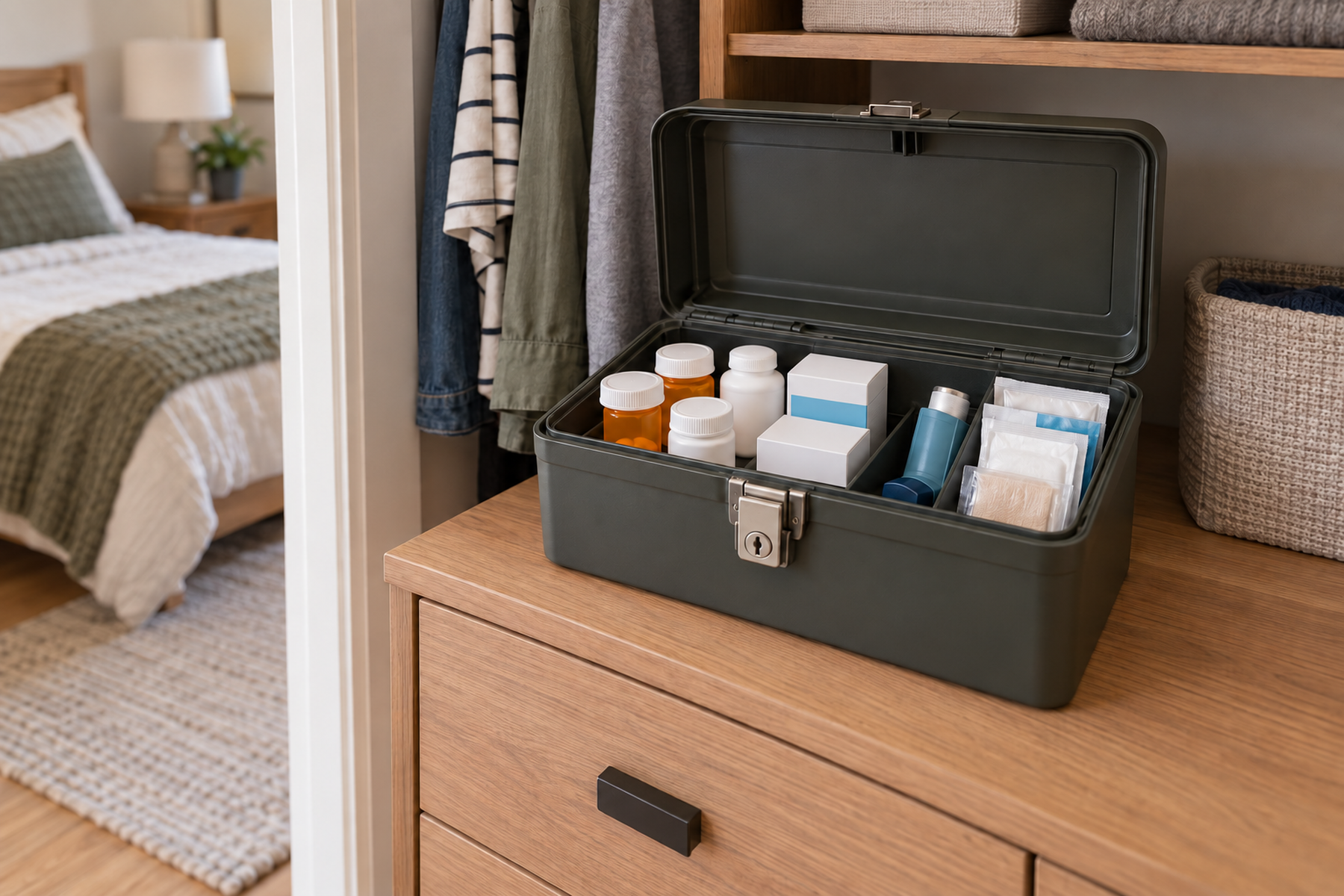
A missing medicine cabinet does not turn every empty shelf into a good medication zone. Some medicines have product-specific storage instructions, bathrooms can be humid, and the level of access control that makes sense depends on the household and the medicine.
This guide is about household storage, not treatment. Keep the medicine label or package instructions in control, and ask a pharmacist or other qualified health professional when a storage requirement is unclear. The small-space job is to make those requirements workable without burying the collection in deep, hard-to-reach storage.
Quick Answer
Use Three Filters Before You Buy an Organizer
A workable apartment system starts with the medicine’s own storage instructions, adds the level of access control the household needs, and keeps the intended user’s retrieval path simple enough to use consistently.
01
Follow the medicine instructions first
Separate anything with refrigeration, temperature, light, or other product-specific storage requirements before you choose a room or container.
02
Match access control to the household
Think about children, visitors, roommates, pets, and higher-risk medicines before deciding whether a high shelf, closed drawer, or locked compartment is appropriate.
03
Organize for direct retrieval
Use shallow, visible categories and preserve original packaging so the intended user can find the right item without digging through nested bins.
01
Sort the Collection by Storage Job
Medication storage gets harder when every bottle, box, inhaler, first-aid item, and backup supply is treated as one category. Before you choose a container, separate the collection by the kind of access and environment it actually needs.
Useful storage jobs can include:
- Active-use medicines: items the intended user reaches for regularly and needs to find reliably.
- Occasional or condition-specific medicines: items that need to remain identifiable and accessible without occupying the fastest-access position.
- Backup supply: unopened or reserve packages that still need appropriate storage but may not need prime retrieval space.
- Refrigerated medicines: only the products whose instructions specifically require refrigeration.
- First-aid items and related supplies: packaged supplies that may share the broader system without being mixed into the same bottle bin.
These are storage roles, not dosing instructions. The point is to prevent one large container from becoming the only answer to several different access problems.
This first sort also exposes what should leave the system. Expired or genuinely no-longer-needed medicine should not permanently occupy the apartment’s best dry, secure storage simply because it already has a place in the bin.
Measure / Check First
After the collection is separated by storage job, check the location itself before assigning a bedroom drawer, closet shelf, kitchen cabinet, under-bed case, or locking box.
Check the Storage Zone Before You Commit It
01
Read the storage instructions
Use the label or package directions for the exact medicine. Some medicines require refrigeration or other specific conditions, so a generic “cool, dry place” rule cannot override the product instructions.
02
Check heat, moisture, and light
Reject a location that exposes the medicine to conditions its instructions do not support. A damp bathroom cabinet is not a neutral default, and kitchen storage should stay away from heat and moisture sources when those conditions matter.
03
Check who can reach it
Decide whether the zone gives the intended user reliable access while limiting access for children or other people when that is necessary. A convenient location that is too exposed can fail just as clearly as a secure location that the intended user cannot use.
If the location fails any of these checks, change the location or the access-control method before you buy organizers for it. When a medicine’s storage requirement is unclear, ask a pharmacist or other qualified health professional rather than guessing from the room alone.
02
Choose a Storage Zone That Passes the Environment Test
The room name matters less than the actual conditions. The U.S. Food and Drug Administration notes that improper storage, including a damp bathroom cabinet, can reduce the effectiveness of medicines before their expiration date, and advises following the storage instructions for the exact product. See the FDA storage guidance.
For medicines whose instructions allow ordinary cool, dry household storage, possible apartment zones can include a dresser drawer, storage box, closet shelf, or kitchen cabinet. The same FDA guidance lists those as examples, but none is automatically right in every home.
A bedroom dresser can provide direct access without bathroom humidity. A closet shelf can use enclosed vertical storage if the intended user can reach it comfortably. A kitchen cabinet may work when it is away from sinks, hot appliances, and other heat or moisture sources and when household access is controlled.
Under-bed storage can be reasonable for lower-frequency items when the case slides out directly and the environment is appropriate. Deep nested tubs are less convincing when reaching one category means lifting several containers or unloading the whole system.
If the only apparently available option is a hot, damp, sun-exposed, or otherwise unsuitable location, the small-space answer is not to force the medicine into it. Reassign a higher-value drawer, shelf, or cabinet before treating environmental requirements as negotiable.
03
Add Security That Fits Your Household
Environmental suitability and access control are separate decisions. A cool, dry shelf can still be the wrong place if a young child can reach it; a locked box can still be the wrong place if the box sits in a damp or overheated zone.
The CDC’s Up and Away guidance says medicines, vitamins, and supplements should be stored where young children cannot reach or see them, and that safety caps do not replace safe storage. Visiting children matter too, not only permanent residents.
When stronger access control is appropriate, a portable locking box or robust locking compartment can add security without permanent installation. The EPA recommends locked storage to prevent unwanted access, while CDC guidance specifically calls for locked storage for prescription narcotics such as opioids or codeine. See the CDC prescription-safety guidance.
That does not create a universal rule that every medicine in every apartment must be locked. Household risk, medicine type, the intended user’s reach and mobility, and the exact storage instructions all affect the right level of control.
For renters, portable locking storage or an existing secured drawer can avoid wall modification. A mounted locking cabinet may still be appropriate in some homes, but drilling, anchors, wall compatibility, and lease or landlord permission become part of that separate installation decision.
04
Organize for Direct Retrieval, Not Maximum Compression
A medication system can hold a lot and still be difficult to use. The common failure is a deep bin that turns every search into a lift-and-dig routine, especially when bottles, liquids, inhalers, packets, and first-aid supplies all share the same volume.
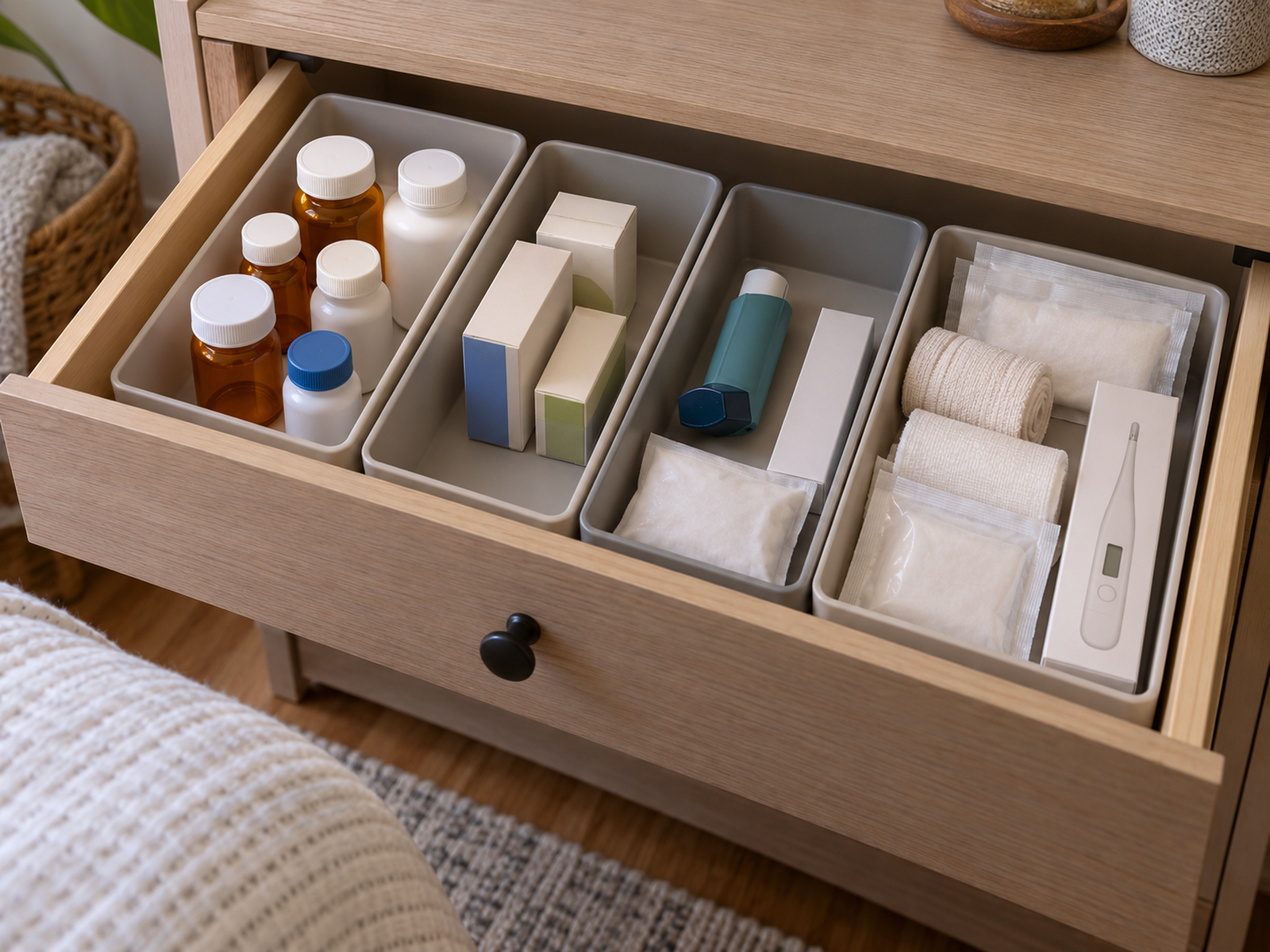
Shallow drawers, small secondary bins, and direct-access cases can make the collection easier to scan. Keep the categories broad enough to reset easily: active-use, occasional, backup, first aid, or another simple grouping that matches the household’s real retrieval pattern.
Preserve medicine identity while you organize. FDA over-the-counter guidance recommends keeping medicines in their original containers so the wrong medicine is less likely to be taken. See the FDA OTC guidance. Use secondary bins or drawer dividers around the original packages rather than turning matching decanted containers into the organizing system.
Pill organizers can be useful adherence aids in some situations, but they are not the same thing as secure whole-inventory storage. The CDC notes that many pill boxes are not child-resistant. Keep that distinction clear when children or other access risks are present.
The best small-space arrangement is the one the intended user can reset without rebuilding the system after every use. If frequently needed items keep migrating to a nightstand, counter, or open tray because the official storage is too hard to reach, the retrieval design needs another pass.
05
Keep Refrigerated Medicines on Their Own Rule Set
Refrigeration is not a general upgrade for medication storage. Some medicines require it and others do not, so only refrigerate a medicine when the exact instructions call for it.
When refrigeration is required, give those products a defined refrigerator zone that preserves the original packaging and keeps the medicine easy for the intended user to identify. Do not invent a universal temperature, door-versus-shelf rule, or out-of-refrigerator allowance unless the product instructions establish it.
If a medicine may have been stored outside its required conditions, appearance alone cannot establish whether it is still appropriate to use. Ask a pharmacist or other qualified health professional for product-specific guidance rather than using an organization rule to make that judgment.
06
Remove Expired and Unneeded Medicines From Prime Storage
In a small apartment, disposal is also a capacity decision. Expired or no-longer-needed medicines can take over the driest, most secure drawer or box even though they no longer need to compete for daily storage space.
FDA says the best disposal option for most unused or expired prescription and over-the-counter medicines is a drug take-back option. See the FDA disposal guidance. The DEA also maintains year-round take-back options.
Do not apply one blanket flush-or-trash rule to every medicine. If a take-back option is not readily available, follow the current FDA instructions for the specific product. And if you are unsure whether a prescription is actually no longer needed, resolve that with the prescriber or pharmacist rather than making a treatment decision for the sake of decluttering.
What Not to Do
Avoid These Medication-Storage Shortcuts
Convenience and visual tidiness can create new problems when they override storage conditions, identification, or access control.
- Do not default to a damp bathroom cabinet. Check the medicine instructions and the real room conditions first.
- Do not decant medicines into unlabeled matching containers for aesthetics. Preserve the identity, instructions, and expiration information that travel with the original package.
- Do not assume a high shelf, safety cap, or ordinary lockbox is automatically childproof. Access control depends on the exact household and product.
- Do not refrigerate medicines unless their instructions require it. Cold storage is product-specific, not a universal safer choice.
- Do not bury fast-access items beneath nested bins. If the intended user cannot retrieve the needed category reliably, nominal capacity is not solving the storage problem.
A storage shortcut is only useful when it preserves the medicine’s requirements and still works for the person who needs to use the system.
Closing Decision
Choose the Zone That Passes Both Tests
A good medication zone has to pass two independent tests: the environment must suit the medicine, and access must be appropriately controlled for the household. A bedroom drawer, closet shelf, kitchen cabinet, under-bed case, or locking box is only a candidate until it passes both.
Once the location works, make retrieval simple: keep original identities intact, separate storage jobs, avoid deep nested access for frequently needed items, and remove expired or no-longer-needed stock through current disposal guidance. That creates a system sized for a small apartment without asking the apartment to override the medicine’s actual requirements.
RELATED GUIDES
What to Read Next
NEXT GUIDE
How to Organize a Small Bathroom With No Medicine Cabinet
Use this next to organize toiletries and sink-side essentials after medication has been moved to a more suitable whole-home storage zone.
GUIDE
How to Store Household Backstock in a Small Apartment With No Storage Closet
This is useful when non-medication backup supplies are competing for the same drawers and closets and need their own inventory limits.