
Small Kitchen Organization
Where to Put an Air Fryer in a Small Kitchen With Limited Counter Space
Plan the air fryer around four states—park, operate, cool, reset. Measure the exact model’s body, hot-air clearance, basket or door movement, cord route, and landing space before deciding whether it deserves permanent counter space, needs to pull forward for use, or should be stored between cooking sessions.
In This Guide
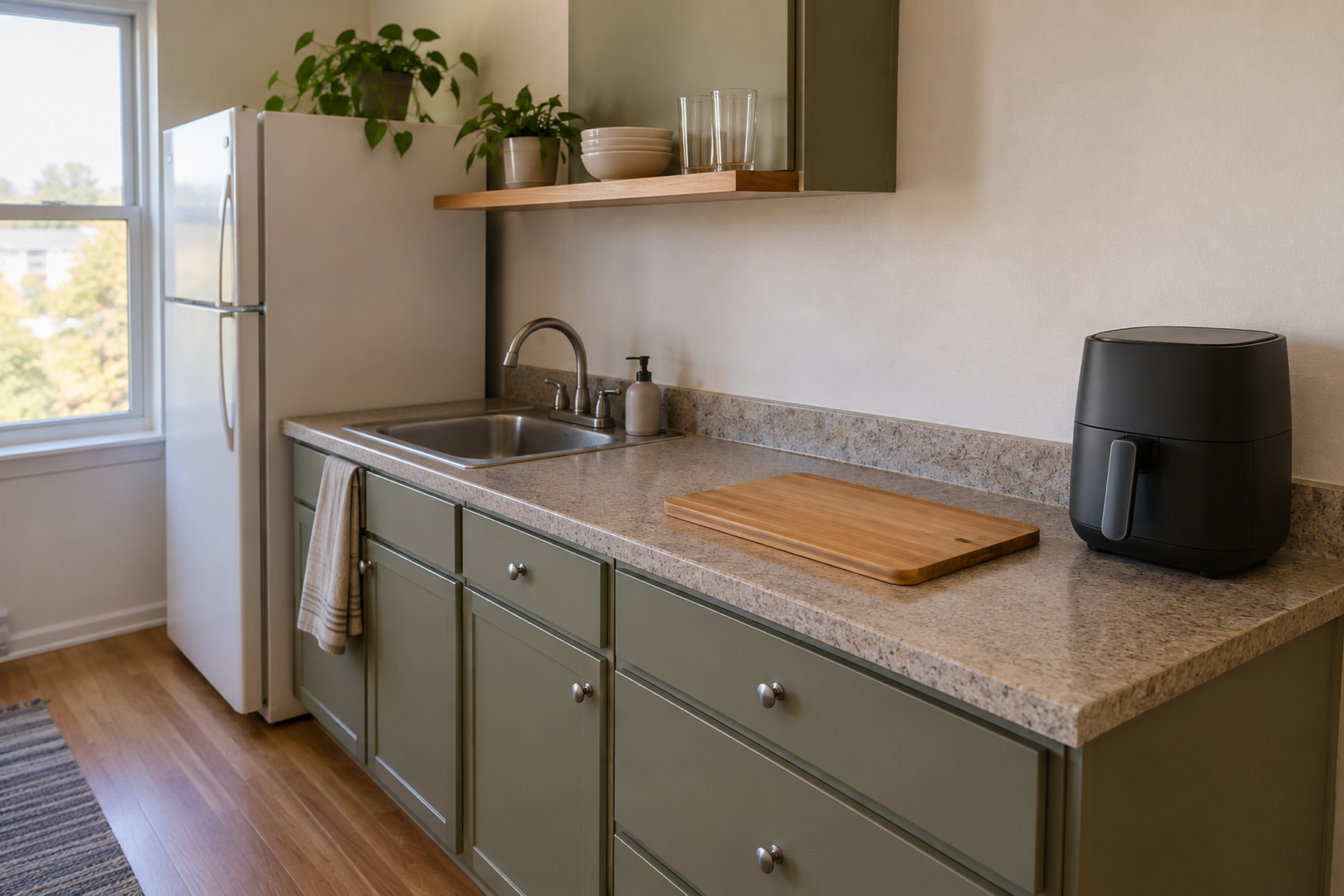
An air fryer can be compact while parked and still need much more room while cooking. Hot air has to leave the appliance, the basket or oven door needs room to open, the cord has to reach an approved outlet, and hot food needs a stable landing area after it comes out.
That makes placement a four-state problem: park → operate → cool → reset. The strongest setup works in all four states without sacrificing the kitchen’s main prep surface, blocking circulation, or relying on a clearance rule that belongs to a different model.
Quick Answer
Treat Clearance as Part of the Air Fryer’s Footprint
The correct location is the one where the exact appliance can operate according to its manual and still leave the kitchen usable afterward. A small body does not cancel heat, exhaust, basket movement, cool-down, or support requirements.
01
Follow the exact model’s clearance and surface instructions
Do not use one universal number for every air fryer. Manufacturer requirements vary by model, including rear, top, and surrounding air space, approved support surfaces, electrical use, and cooling before storage.
02
Count the basket or door as part of the work zone
A front basket has to pull out fully; an oven-style door may swing downward; hot trays or food need somewhere stable to land. The operating footprint extends beyond the appliance shell.
03
Let frequency decide whether the appliance earns permanent counter space
A compact air fryer used several times per week may justify a permanent open counter zone. A heavier or occasional-use model may be better stored if the cool-down, lifting, and retrieval routine remains realistic.
01
Measure the Operating Envelope, Not Just the Body
Start with the exact air fryer and the exact owner’s manual. Record the body width, depth, and height, but treat those dimensions as only the parked footprint.
Then identify the operating-clearance requirements. Current manufacturer guidance illustrates why this must stay model-specific: COSORI’s Dual Blaze guidance calls for a stable, level, heat-resistant surface and specifies five inches of space behind and above that product family. Instant also publishes surrounding-air-space guidance for its own relevant appliances. Those examples support a manual-first rule, not a universal five-inch standard.
Map the vent locations. A rear exhaust aimed directly at a backsplash or wall, or an upper exhaust terminating beneath a cabinet with too little clearance, can invalidate a spot that looks perfect in a static photo.
Finally, add what moves. Measure the front space needed to pull the basket completely out or to open an oven-style door without crossing an unsupported counter edge or striking another appliance.
02
Protect the Prep Surface Before the Air Fryer Claims It
A permanent air-fryer zone is useful only if the kitchen can afford the surface it consumes. Protect the most continuous prep strip before giving a hot appliance a permanent address.
If the air fryer would eliminate the only safe cutting-board or mixing zone, test a less valuable counter edge, a freestanding cart, an adjacent surface, or between-use storage instead of making prep happen around the appliance forever.
Frequency matters. An air fryer used daily can justify more prime space than one used twice a month. The goal is not to hide appliances at all costs; it is to spend counter area where it produces the most daily value.
Do not count the stovetop as generic overflow counter space. Instant currently tells users not to place its air fryers or air-fryer ovens on a stovetop even when the stovetop is not in use. Other brands may publish their own restrictions, so the safe default is to follow the exact appliance manual rather than treating the range as spare countertop.
Measure / Check First
Before buying a cart, heat mat, shelf, smaller machine, or storage cabinet solution, test the exact model in both its parked and operating states.
Check Clearance, Front Movement, and the Reset Route First
01
The hot-air and support envelope
Confirm the exact rear, top, and side clearances if specified, vent locations, approved support surface, nearby heat-sensitive materials, and whether the entire appliance base remains fully supported.
02
The basket, door, and hot-food landing zone
Pull the basket or open the oven door completely, then identify where a hot basket, tray, or food can land without blocking the sink, prep zone, counter edge, or another appliance.
03
The cord, cool-down, and storage path
Check the approved outlet and cord instructions, how the appliance will cool after cooking, and whether the user can move or store it only after the manufacturer permits. Do not design a routine that requires sliding a hot or operating air fryer around the counter.
If the appliance fits only while cold and closed, if the exhaust cannot clear surrounding surfaces, or if the basket has nowhere safe to move, the proposed location is not an operating zone.
03
Use a Permanent Open-Counter Zone When the Air Fryer Earns It
A permanent open-counter position is the lowest-friction option for a frequently used air fryer when the exact clearance, electrical, support, and basket requirements all fit.
Keep the zone visually simple. The appliance itself is already the main object; avoid adding a decorative tray, stacked accessories, paper goods, bread bags, or other items into the hot-air envelope.
Leave enough counter nearby for loading and unloading. That does not require a second permanent “air-fryer station,” but it does require a safe temporary landing area when the basket or tray comes out hot.
A compact machine can make this much easier. Current mini air fryers show that genuinely small, light models exist, but reduced body dimensions do not remove the manufacturer’s ventilation or operating-clearance requirements.
04
Use Under-Cabinet Parking Only When the Operating Position Still Works
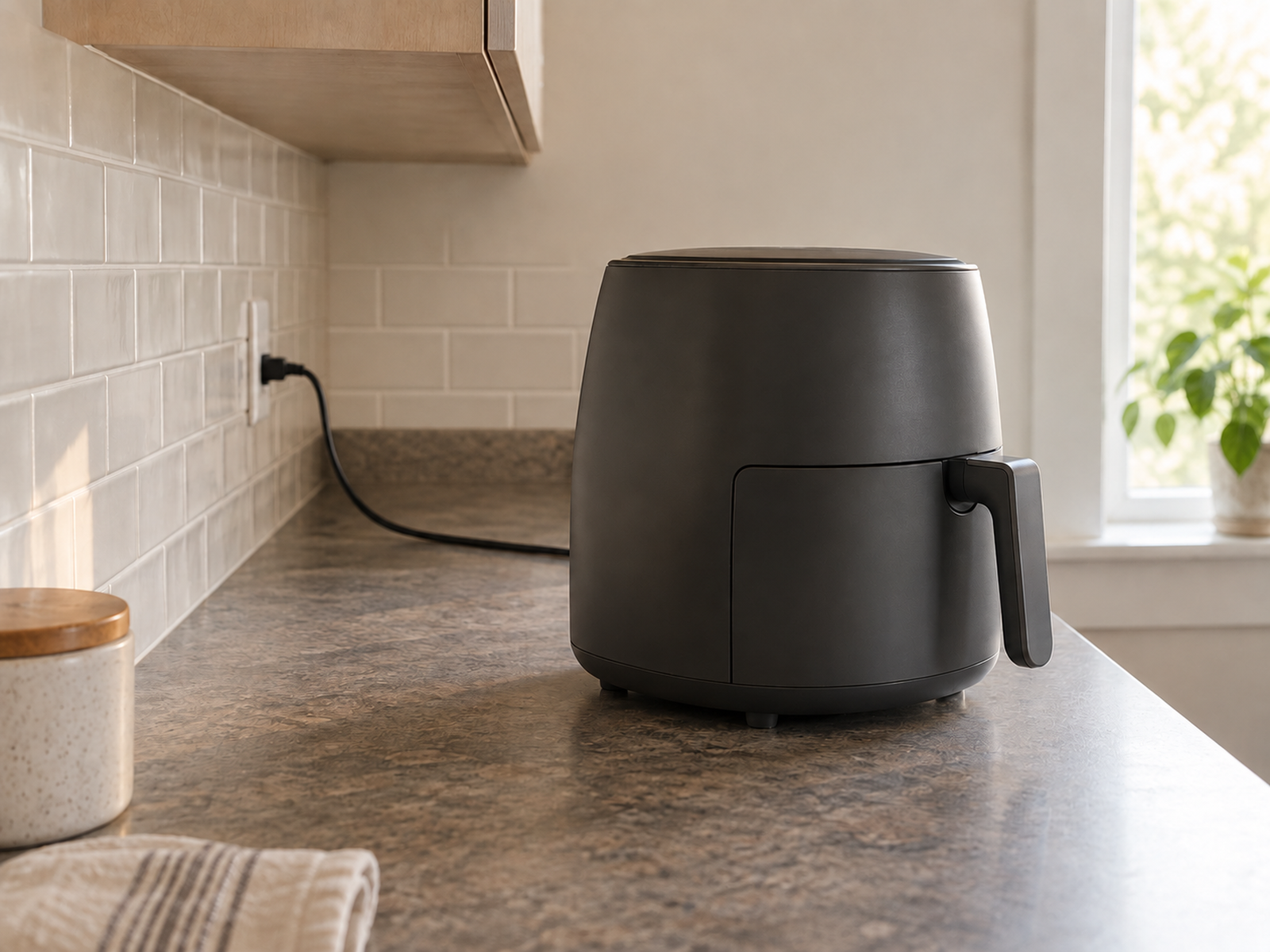
Parking an air fryer beneath an upper cabinet can reduce visual clutter and protect the main counter depth while the appliance is idle. Running it there is a separate question.
Compare the available vertical gap with the appliance height plus the exact operating clearance required by the manufacturer. Do not treat body height as the full fit test.
If the parked position lacks operating clearance, a pull-forward workflow may work only when the appliance is moved while cool and off, the pulled-forward position remains fully supported and stable, and the cord still reaches an approved outlet without strain.
At least one major manufacturer, Instant, says not to move the appliance while it is operating and to let it cool before storage. That makes the sequence explicit: park → move while cool/off → operate → cool → reset.
05
Count the Front Basket or Oven Door as Working Space
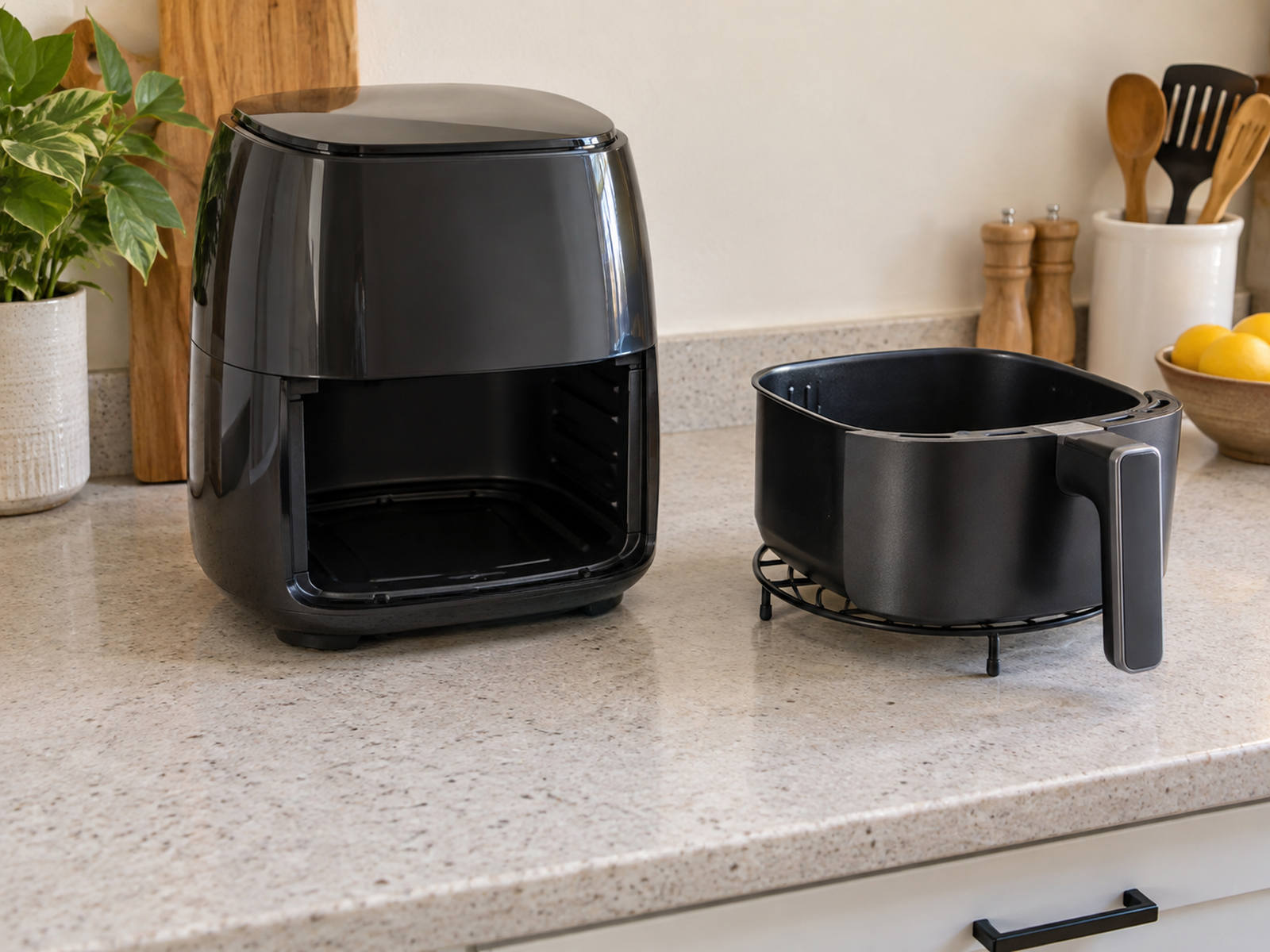
A basket-style air fryer needs clear space in front of the appliance for loading, checking food, removing the basket, and returning it.
That front movement can be the real limiting dimension on a shallow counter. A compact body pushed to the rear may still fail if the basket extends over the counter edge or collides with a sink, faucet, dish rack, or another appliance.
Oven-style air fryers create a different front envelope because the door and trays move differently. Treat the open door, tray pull, and hot-food landing area as part of the operating footprint.
This is one reason product dimensions alone are insufficient. The useful question is not “Does it fit on the counter?” but “Can I complete the cooking cycle here without improvising a hot, unsupported, or obstructed movement?”
06
Use a Cart or Adjacent Surface Only When It Passes the Appliance Test
A freestanding cart or sideboard can preserve precious counter space when the kitchen has cheaper floor or adjacent-room capacity.
Treat that furniture as an appliance operating surface, not generic storage. It needs to be stable, level, appropriate for the exact appliance, outside the main circulation path, and positioned so the hot-air clearance and basket movement still work.
Electrical fit can invalidate an otherwise perfect cart location. Instant currently tells users of its appliances to use a grounded outlet and not use adapters or extension cords. That is manufacturer-specific, but it demonstrates why a distant cart should not be recommended before checking the exact manual.
A cart that forces an unsafe cord route, rolls during loading, blocks a cabinet, or sits too close to a wall has not solved the counter-space problem; it has merely moved it.
07
Store the Air Fryer Between Uses Only When the Handling Cost Makes Sense
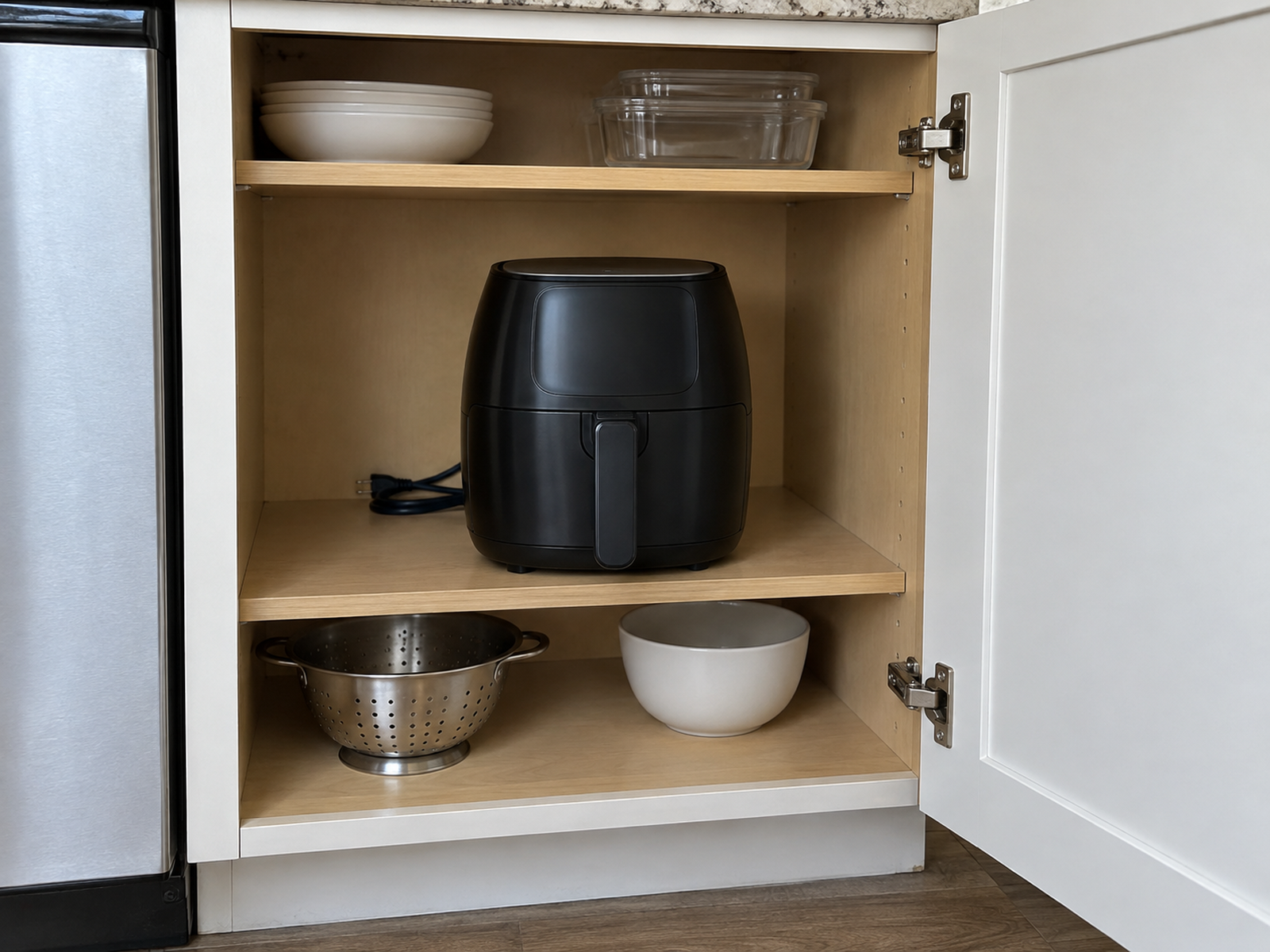
Cabinet or pantry storage can recover all permanent counter space, but the appliance has to be cool, clean enough for storage, and manageable to lift every time it is used.
Instant currently advises allowing its appliance to cool to room temperature before cleaning or storage. That makes immediate post-cooking put-away a poor default workflow.
Weight and frequency matter as much as cabinet dimensions. A lightweight compact air fryer may be realistic to retrieve several times a week, while a large dual-basket or oven-style unit can become annoying enough that it either stays out permanently or stops being used.
Check the storage opening, shelf load, carry path, and grip before committing. The best cabinet slot is one the user can reach without moving other appliances and without lifting a bulky hot appliance above shoulder height or around fragile objects.
Use / Skip
Storing the Air Fryer Between Uses
Use
Use it when the appliance is cool, manageable, and easy to retrieve
Between-use storage can work when the exact manufacturer permits the storage routine, the appliance has cooled, the cabinet or pantry shelf supports it, the route is short, and the unit is light enough that normal use does not become a lifting project.
Skip
Skip it when storage friction makes the appliance functionally permanent anyway
Give the air fryer a compliant permanent counter or cart zone when it is used frequently, heavy or awkward to move, difficult to cool and reset quickly, or trapped behind other appliances every time the household wants to cook.
08
Change the Appliance Architecture When the Existing Model Cannot Fit
If every compliant operating location takes over the kitchen, change the appliance architecture rather than trying to defeat the clearance requirements.
A genuinely compact single-basket model can reduce body footprint and handling weight, though capacity may require batch cooking. A slim or vertical-capacity model can save width while spending more height or depth.
Some products are engineered around a separate stored state. Ninja’s current Flip toaster-oven/air-fryer design, for example, is specifically made to flip up when not in use and claims a smaller stored counter footprint. That is evidence that transformable storage can be useful when the manufacturer designs it into the product.
Do not copy that behavior onto an ordinary basket air fryer. Unless the manufacturer explicitly supports a different storage orientation, keep the appliance in the orientation and storage conditions specified for that model.
Closing Decision
Make the Air Fryer Fit in All Four States
The strongest small-kitchen setup works when the air fryer is parked, operating, cooling, and resetting—not only when the machine is cold and pushed into the smallest available gap.
Follow the exact manual, preserve the prep surface, price the basket or door movement into the footprint, and move the appliance only when its instructions permit. If a compliant operating zone still costs too much counter area, change the support surface, storage routine, or appliance architecture instead of shrinking the clearance.
RELATED GUIDES
What to Read Next
NEXT GUIDE
How to Store Small Kitchen Appliances Without Losing Counter Space
Use this next if the air fryer is only one of several appliances competing for the same counter and cabinet capacity; that guide handles broader appliance residency, frequency, and retrieval decisions.
GUIDE
How to Create a Prep Surface in a Small Kitchen With Almost No Counter Space
Use this if a compliant air-fryer operating zone leaves the kitchen with no practical food-prep surface; that guide focuses on creating or recovering a stable prep plane.
GUIDE
How to Set Up a Coffee Maker in a Small Kitchen With Almost No Counter Space
Use this if the air fryer and coffee maker are competing for the same appliance strip; that guide resolves a different operating envelope built around refill access, open height, grinder space, and daily brew workflow.