
Small Kitchen Organization
How to Store Baking Sheets and Cutting Boards in a Small Kitchen
Build one flat-item zone around the largest piece you actually use, then test the cabinet opening, interior height and depth, retrieval direction, and divider spacing before choosing vertical slots, a flat stack, a deep drawer, or an installed pull-out.
In This Guide
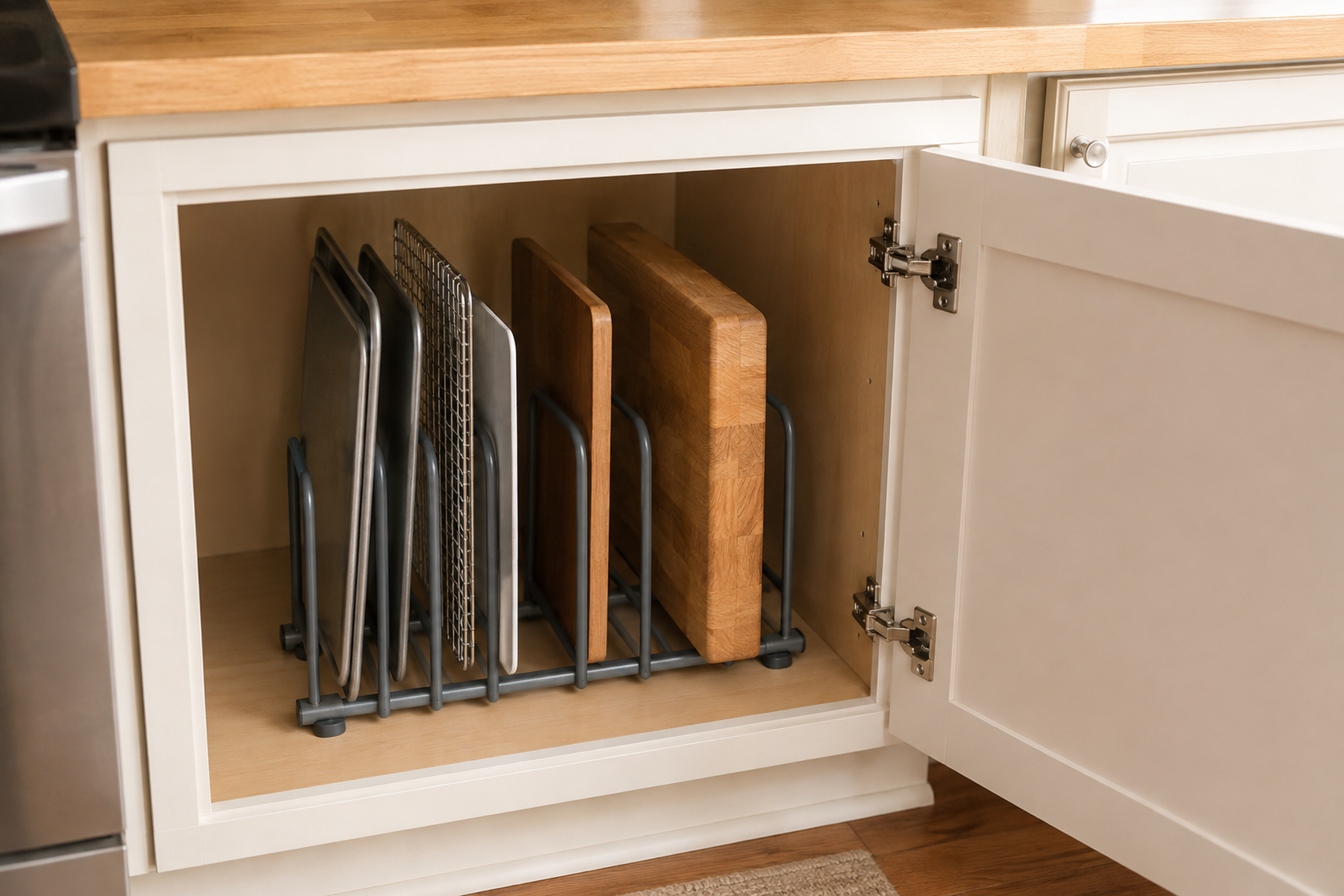
Baking sheets, cutting boards, cooling racks, muffin tins, trays, and similar pieces are thin enough to look space-efficient but large enough to fail ordinary cabinet geometry. A narrow cabinet can be ideal for them, while a much larger cabinet can still be frustrating if the opening is obstructed or every item must be unstacked to reach the one at the bottom.
Treat these pieces as one flat-item category only when they behave similarly in space. Start with the largest required item, measure the route it must pass through, then choose the orientation and support system that lets one piece come out without destabilizing or unloading the rest.
Quick Answer
Design the Zone Around Fit and Retrieval, Not Slot Count
Give prime storage only to the flat items used often, let the largest and most awkward piece test the proposed zone, and measure the real cabinet opening as well as the interior. Choose vertical slots, a flat stack, or another storage form only when it makes individual retrieval easier without forcing the cabinet geometry.
01
Keep only the active flat-item set in prime storage
Give the main zone to the baking sheets, boards, racks, trays, and pans used often enough to justify direct kitchen access. Rare holiday trays and specialty pieces can accept a lower-priority location instead of determining the daily system.
02
Let the largest outlier test the zone
Measure the longest edge, second-longest edge, thickness, rims, handles, feet, and other projections on the largest kept pieces. The awkward item often decides whether the cabinet, drawer, or organizer actually works.
03
Measure the opening separately from the interior
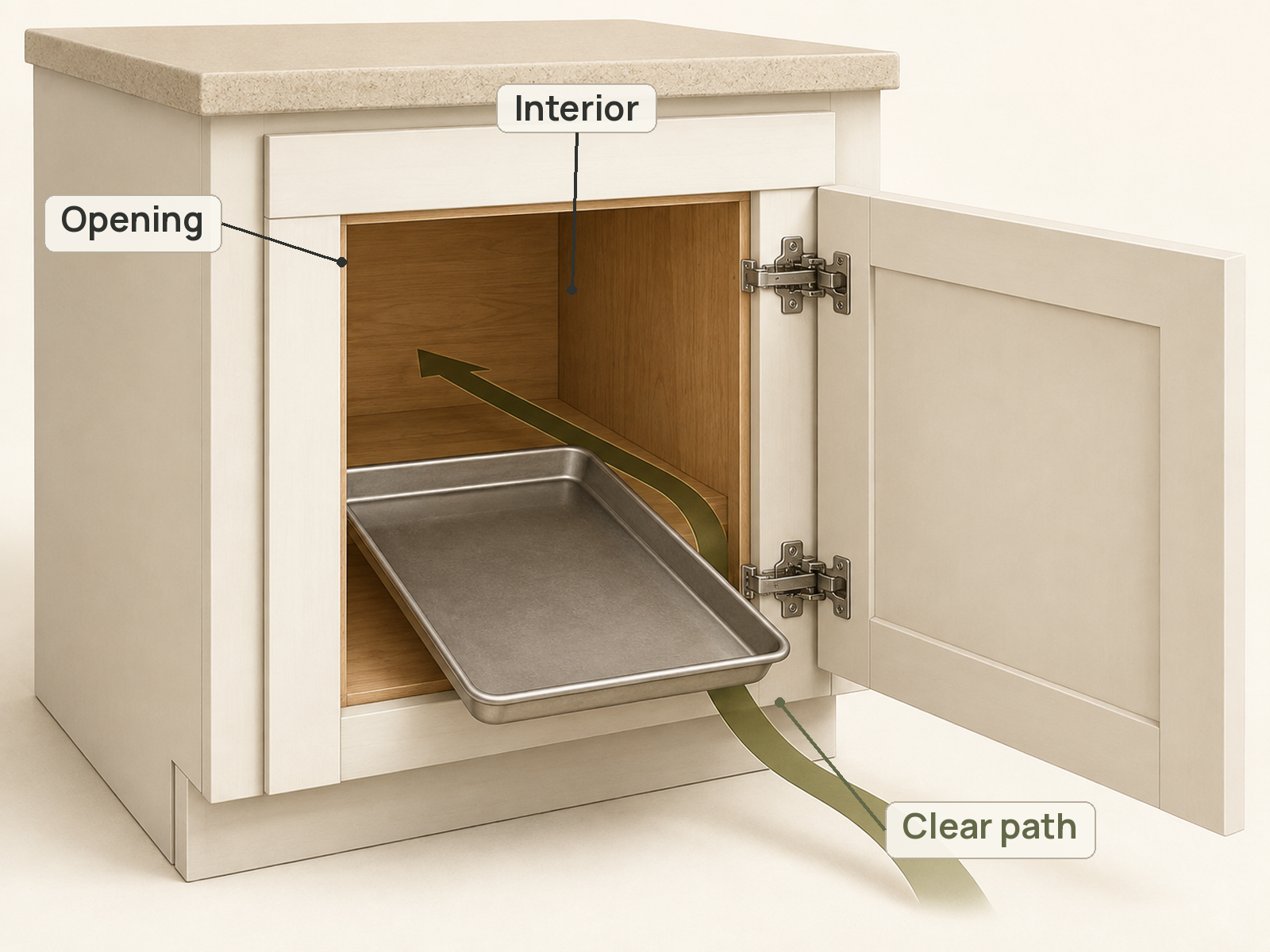
A pan can fit inside a cabinet yet fail to pass the door opening, face frame, center stile, or hinge. The item and organizer must clear the complete retrieval path, not only the interior volume.
01
Edit the Active Flat-Item Set
Start by deciding which flat kitchen pieces deserve the easiest cabinet or drawer access.
Group the items that behave similarly in storage: sheet pans, cutting boards, cooling racks, trays, pizza pans, muffin tins, and other thin or semi-flat pieces. Remove duplicates you do not use, damaged pieces, and low-frequency specialty items that do not need to control the prime zone.
This is not a rule that every flat item must leave the kitchen except a tiny core. The point is to stop a rarely used oversized platter or holiday tray from forcing a daily-use sheet pan into an awkward system.
If some low-frequency pieces still deserve to stay, give them a secondary zone rather than mixing them into the access path for the items used every week.
02
Measure the Largest Outlier
Measure the item that is most likely to break the storage plan, not the average piece.
For each important outlier, record the longest edge, the second-longest edge, total thickness, rolled rims, handles, feet, raised grids, muffin-cup depth, or any other projection that changes how the piece stands or slides.
A thick cutting board can consume the space of several sheet pans. A cooling rack with feet may need a wider slot than its wire frame suggests. A muffin tin can behave more like a shallow pan than a flat sheet.
Use these measurements to decide whether one item should receive a wider slot or a separate micro-zone instead of enlarging every divider gap around the thickest piece.
03
Measure the Cabinet Opening and Interior Separately
Cabinet capacity is not only the space behind the door.
Measure the usable opening width and height, the interior width, depth, and height, and every obstruction that affects insertion or retrieval. Face frames, hinges, door hardware, center stiles, shelf lips, and adjacent doors can make the opening materially smaller than the interior.
Current Rev-A-Shelf fit guidance for its 597 Series Tray Divider explicitly asks users to check cabinet width, depth, height, and obstructions such as hinges. That product is installation-specific, but the measurement rule applies to any storage form: the organizer and the largest item must pass through the real opening.
If the cabinet is narrow, test both vertical edge orientations. A sheet pan may clear when resting on its short edge but fail on its long edge, while a cutting board may behave the opposite way. Do not reject or approve vertical storage until both orientations have been tested.
Measure / Check First
Before choosing a rack, divider, drawer, or pull-out, test the largest active items against both the cabinet opening and the loaded retrieval path.
Check the Item, the Opening, and the Retrieval Path
01
Largest-item envelope
Measure the longest edge, second-longest edge, thickness, rims, handles, feet, or raised profiles on the largest kept sheet, board, rack, tray, or muffin tin.
02
Opening and interior geometry
Measure usable opening width and height separately from interior width, depth, and height. Include face frames, center stiles, hinges, shelves, and other obstructions that affect insertion.
03
Loaded retrieval
Place or mock up the item in its proposed orientation and test whether one piece can be removed and returned without tipping the row, lifting several items, hitting the shelf above, or twisting around the door hardware.
If the item fits only after ignoring the cabinet opening, the organizer footprint, or the normal one-item return path, the storage form does not fit the kitchen.
04
Choose Vertical or Flat Storage by Retrieval
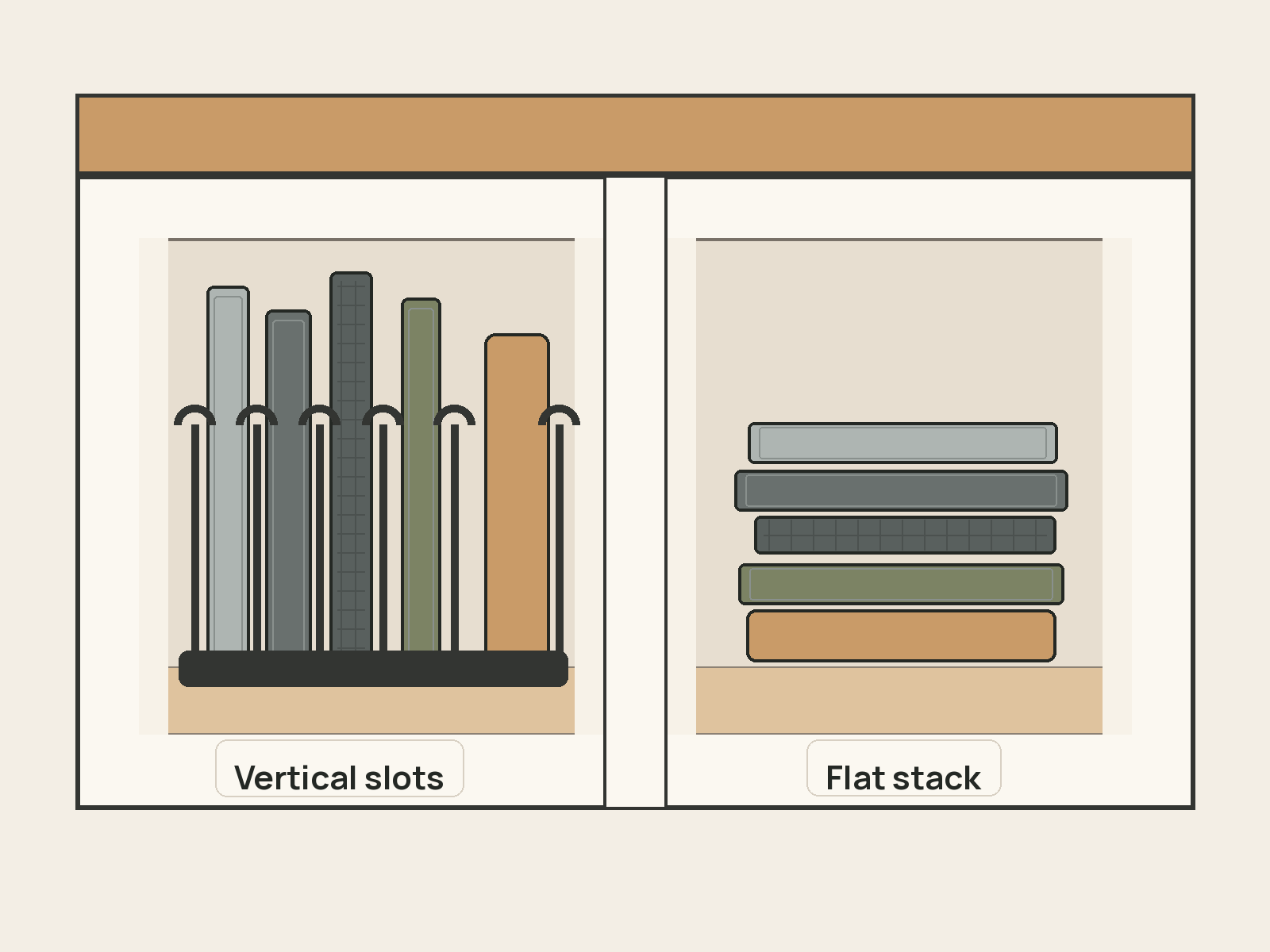
Vertical storage earns its space when it makes individual pieces easier to retrieve.
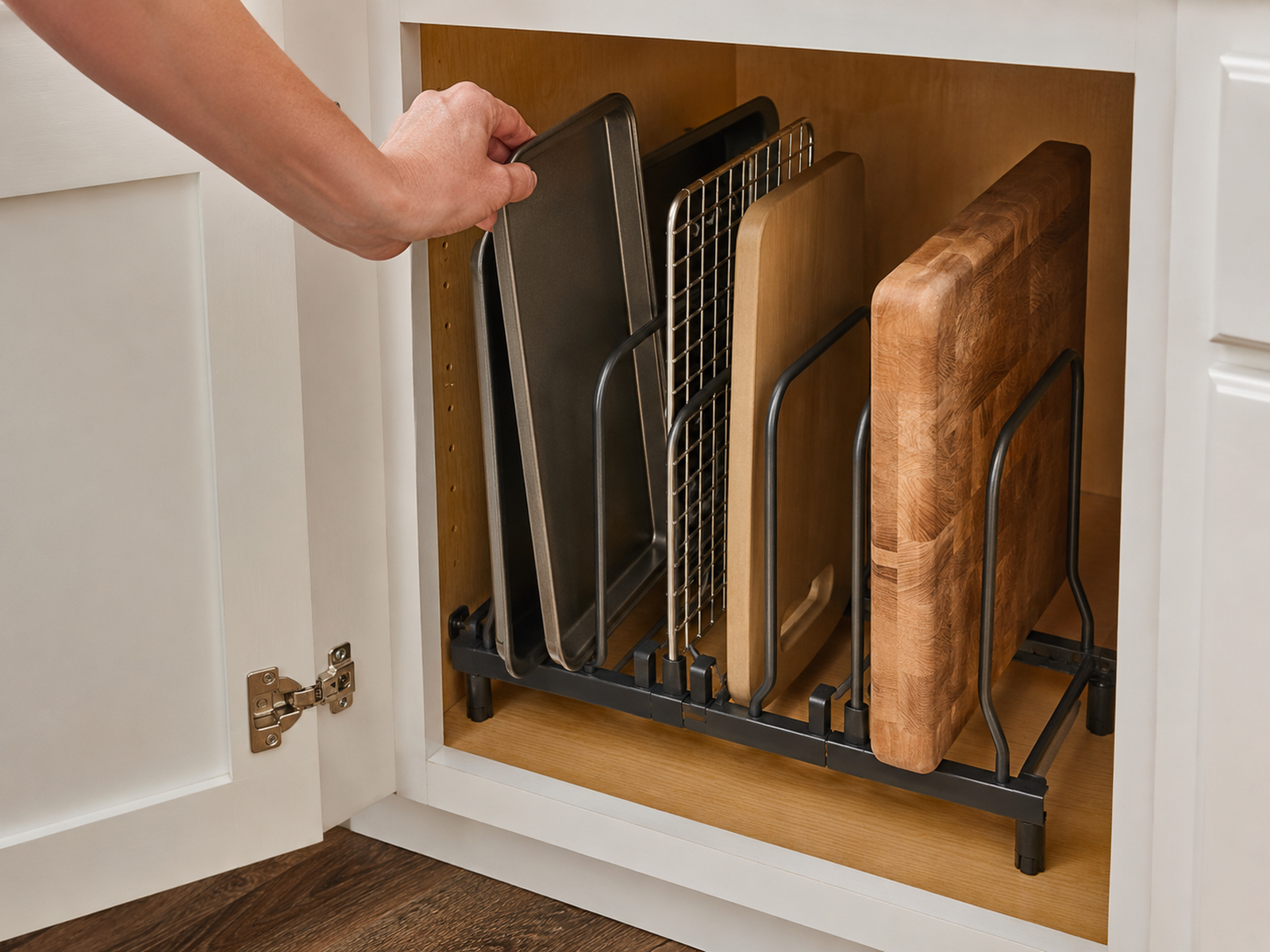
A freestanding divided rack can keep sheets, boards, and pans upright so one piece slides out independently. YouCopia’s current StoreMore Bakeware Rack, for example, uses adjustable dividers and a non-slip base and requires no mounting. The manufacturer lists the rack at approximately 11.6 inches wide, 7.4 inches deep, and 6.4 inches high with dividers installed.
Those dimensions do not prove the rack fits a particular cabinet or collection. The largest item still needs vertical clearance and the rack itself consumes part of the cabinet footprint.
A flat stack remains valid when there are only a few closely nesting pieces, the most-used item stays near the top, and reaching the bottom item does not require rebuilding the whole stack. Choose the orientation with the lower everyday retrieval cost, not the one that looks more “organized” in isolation.
05
Match Divider Spacing to the Real Item Profiles
A vertical rack works only when the dividers support the pieces without packing them so tightly that retrieval becomes difficult.
Current YouCopia documentation for the StoreMore rack says it includes seven adjustable dividers, while the manufacturer FAQ estimates about 6–8 items depending on item size. That is the correct interpretation of advertised capacity: divider count is not the same as guaranteed mixed-item capacity.
Give thin sheet pans and cooling racks closer spacing when they remain stable. Give thicker cutting boards, muffin tins, or pieces with pronounced rims more room. The goal is a stable row that can release one item without pulling its neighbors sideways.
Do not maximize slot count if the resulting gaps are too narrow to grip the edges or if one thick item bows the dividers outward. Fewer usable slots are better than a denser rack that cannot be reset normally.
06
Split Thick Boards and Bulky Profiles When One Slot Pattern Fails
Mixed flat items do not need identical slot widths simply because they share one cabinet.
Keep thin sheet pans and cooling racks together when they behave similarly, then create one wider section for a thick cutting board, muffin tin, pizza pan, or another bulky profile that would otherwise force every slot to be oversized.
This micro-zoning keeps the standard pieces dense without making the outlier hard to reach. It also prevents a heavy board from leaning across several thin pans and destabilizing the row.
If the outlier still breaks the cabinet geometry, give it a separate legitimate home rather than redesigning the entire flat-item zone around one unusual piece.
07
Use a Narrow Cabinet Only When All Three Axes Fit
A very narrow cabinet can be unusually valuable for flat items because it may be poor storage for jars, bowls, or food containers while still matching the thickness of boards and trays.
But narrow width is only one axis. The tallest kept item still has to clear the cabinet height, the longest edge still has to fit the usable depth or vertical run, and the opening still has to let the piece enter and leave without twisting around hardware.
This is why a skinny cabinet can be a high-efficiency tray zone in one kitchen and completely unusable in another. The category-space match is real only after width, height, depth, and opening geometry all pass.
When the cabinet passes those checks, keep the contents intentionally flat-item focused. Filling the remaining sliver with unrelated small objects can reintroduce the same retrieval friction the narrow cabinet originally solved.
08
Use a Deep Drawer or Pull-Out Only When It Solves a Real Access Problem
A deep drawer can provide excellent top-down access when the interior height supports the chosen orientation and the loaded pieces remain stable.
Check drawer closure, interior height, divider stability, and the exact drawer system’s load requirements. Do not assume every deep drawer can safely carry a dense set of large boards and metal bakeware.
Installed pull-outs are a different branch. Rev-A-Shelf’s current 447 Series includes tray-divider compartments for baking sheets and platters and is designed to improve access in a base cabinet, but that benefit comes with slide hardware, fit requirements, installation, cost, and renter implications.
Use a pull-out when cabinet depth is the problem that needs solving. Do not install one merely because pull-outs are convenient in general.
09
Separate No-Install and Installed Divider Systems
Freestanding and installed tray dividers solve similar storage jobs but belong to different renter paths.
A freestanding adjustable rack can sit inside a suitable cabinet without altering it. Installed systems such as Rev-A-Shelf’s current 597 Series and 596 Series use four-screw installation according to the manufacturer.
That makes the default order simple for rentals: first test inventory editing, a flat stack, a suitable existing narrow cabinet, or a removable rack. Move to screwed dividers or an installed pull-out only when the fit advantage is meaningful and the cabinet construction and lease allow the work.
Do not group every tray organizer under a generic “renter-friendly” label. Installation method is part of the storage decision.
10
Use the Stop Rule When Another Zone Is Better
Do not force the flat-item category into a cabinet simply because the category is theoretically suited to vertical storage.
Stop when the largest active item cannot clear the opening, the cabinet lacks enough vertical or depth clearance, the divider system consumes more useful footprint than it returns, or one-item retrieval still requires unloading neighboring pieces.
At that point, move the low-frequency outlier, use another cabinet or deep drawer, keep a small flat stack, or reduce the active set. A high cabinet can be appropriate for occasional pieces only when normal reach is safe and practical; Aptly Small’s high-cabinet guide owns that access decision in depth.
The successful system is the one that lets the active pieces fit, stand or stack stably, and return in one ordinary motion. Vertical storage is a tool for that outcome—not the outcome itself.
Closing Decision
Choose the Storage Form That Makes One-Item Retrieval Normal
Flat bakeware and cutting boards do not need vertical storage by default. They need one bounded zone designed around the largest active pieces, the true cabinet opening, and the retrieval motion the household repeats every time it cooks or bakes.
Use vertical slots when they keep each item stable and independently accessible; keep a simple flat stack when the collection is small; split thick boards from thin sheets when their profiles demand different spacing; and treat installed dividers or pull-outs as a separate renter and fit decision. When the cabinet geometry still fights the category, move the outlier or choose another zone instead of forcing the organizer.
RELATED GUIDES
What to Read Next
NEXT GUIDE
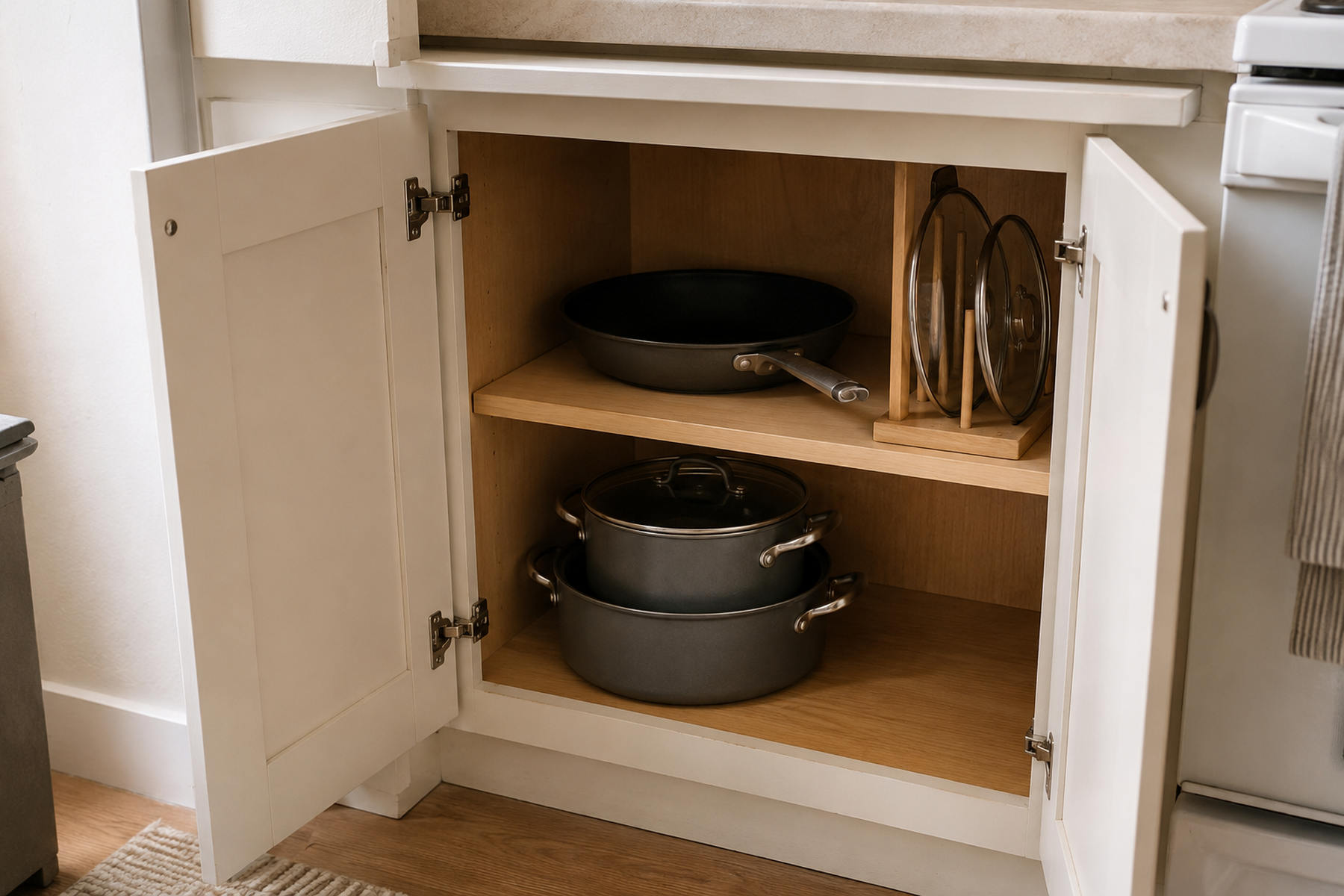
How to Organize Pots and Pans in a Small Kitchen With Limited Cabinet Space
Use this next if the flat-item zone is working but deeper cookware still needs its own cabinet-capacity and access system.
GUIDE
How to Organize a Deep Corner Kitchen Cabinet With a Narrow Opening
Use this if the largest flat pieces fit the cabinet interior but the opening, corner geometry, or retrieval path is still the part that fails.
GUIDE
How to Organize High Kitchen Cabinets When Upper Shelves Are Hard to Reach
If low-frequency trays or baking pieces move to an above-fridge or upper cabinet, this guide handles the reach and retrieval problem without expanding the current article.