
Small Kitchen Organization
How to Organize Pots and Pans in a Small Kitchen With Limited Cabinet Space
Pots and pans can technically fit in a small cabinet and still be hard to use. Sort cookware by frequency and shape, measure the usable opening, then choose protected nesting, vertical filing, or secondary storage without sacrificing easy retrieval.
In This Guide
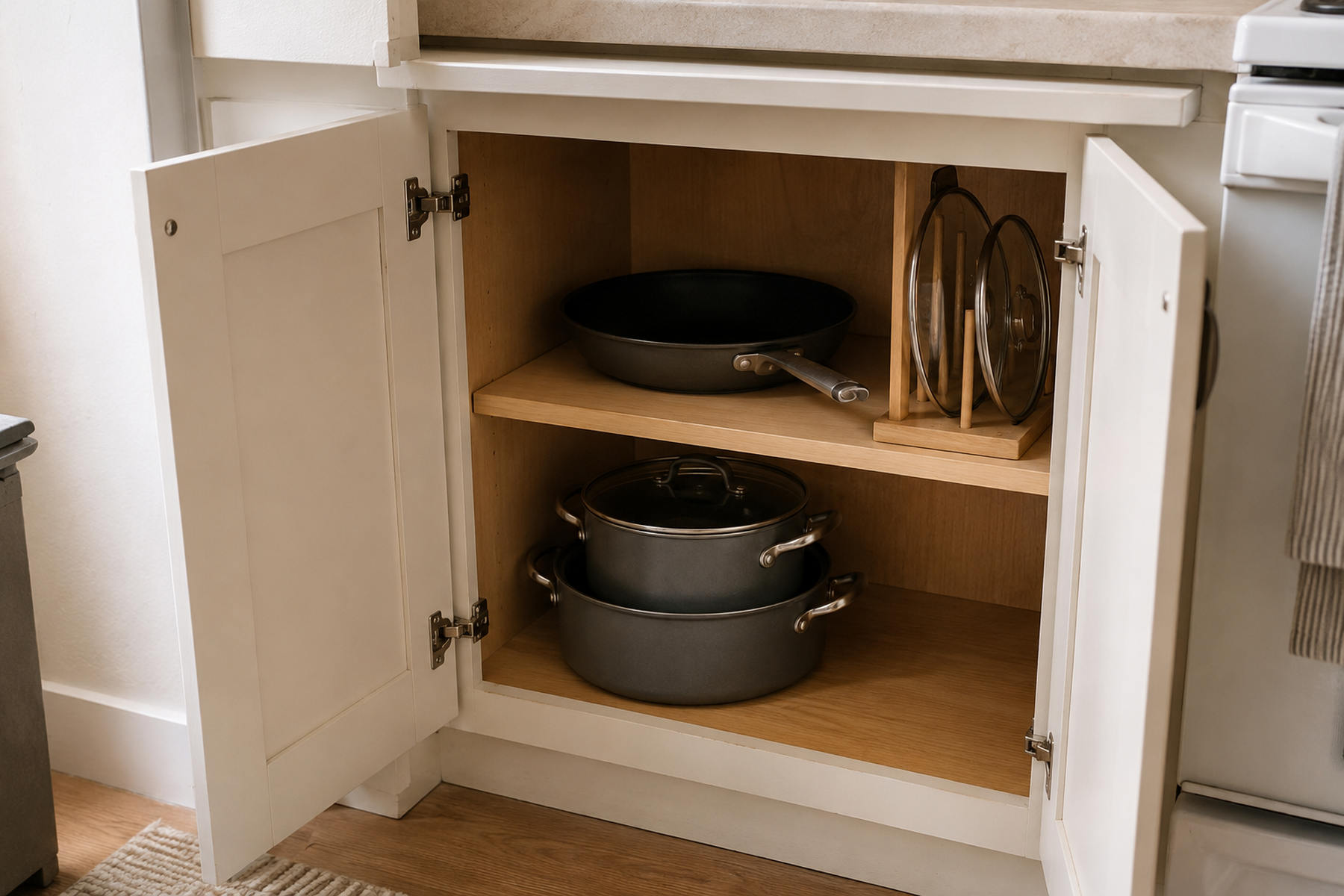
Small-kitchen cookware storage fails when capacity is treated as the only goal. A cabinet can hold every pan and still be frustrating if the daily skillet sits under a heavy stack, lids slide behind pots, or long handles cannot clear the opening without turning everything sideways.
A better system separates cookware by how often it is used and by the geometry it brings into the cabinet. Thin handled pans, bulky vessels, and lids do not need the same storage method. Measure the real opening first, then spend cabinet volume, retrieval effort, or installation freedom only where that trade actually improves everyday access.
Quick Answer
Organize for Retrieval, Not Maximum Capacity
Give the cookware you use most the easiest retrieval path, match nesting or vertical storage to the actual shape of the pieces, and measure the usable cabinet opening rather than the nominal cabinet size. Then keep cookware-care requirements and renter installation limits as separate checks before adding hardware.
01
Give daily cookware the easiest access
Put the pieces used most often where they can be removed and returned without unloading several other items first.
02
Match the storage method to the cookware shape
Thin pans and lids may benefit from vertical filing, while bulky pots can use protected nesting when that keeps the stack stable and manageable.
03
Measure the usable opening before buying an organizer
Check the door opening, hinges, fixed shelves, plumbing, handle depth, and internal height instead of relying on the cabinet’s nominal size.
01
Sort Cookware by Frequency and Shape Before You Buy Storage
Begin with the cookware you actually own, not the organizer you hope will fit it. Separate daily and weekly pieces from lower-frequency specialty cookware, then divide the active group into thin handled pans, bulky vessels, and lids.
This immediately exposes which pieces need independent access. A skillet used most evenings should not sit under a stockpot and two less-used pans just because the diameters happen to nest. A large Dutch oven used once a month can tolerate slower storage if that keeps the everyday pieces easier to reach.
There is no useful universal cookware count. Household size, cooking style, batch cooking, dietary needs, and the kinds of meals made at home all change what deserves to stay. Remove genuine duplicates or unused pieces if that helps, but let frequency and function—not an arbitrary minimalist target—decide what remains.
02
Measure the Usable Cabinet Opening, Not the Cabinet Label
The interior of a cabinet may be wider than the opening you can actually pass cookware through. Hinges, face frames, fixed shelves, plumbing, door hardware, and the angle of a long pan handle can all reduce the working dimensions.
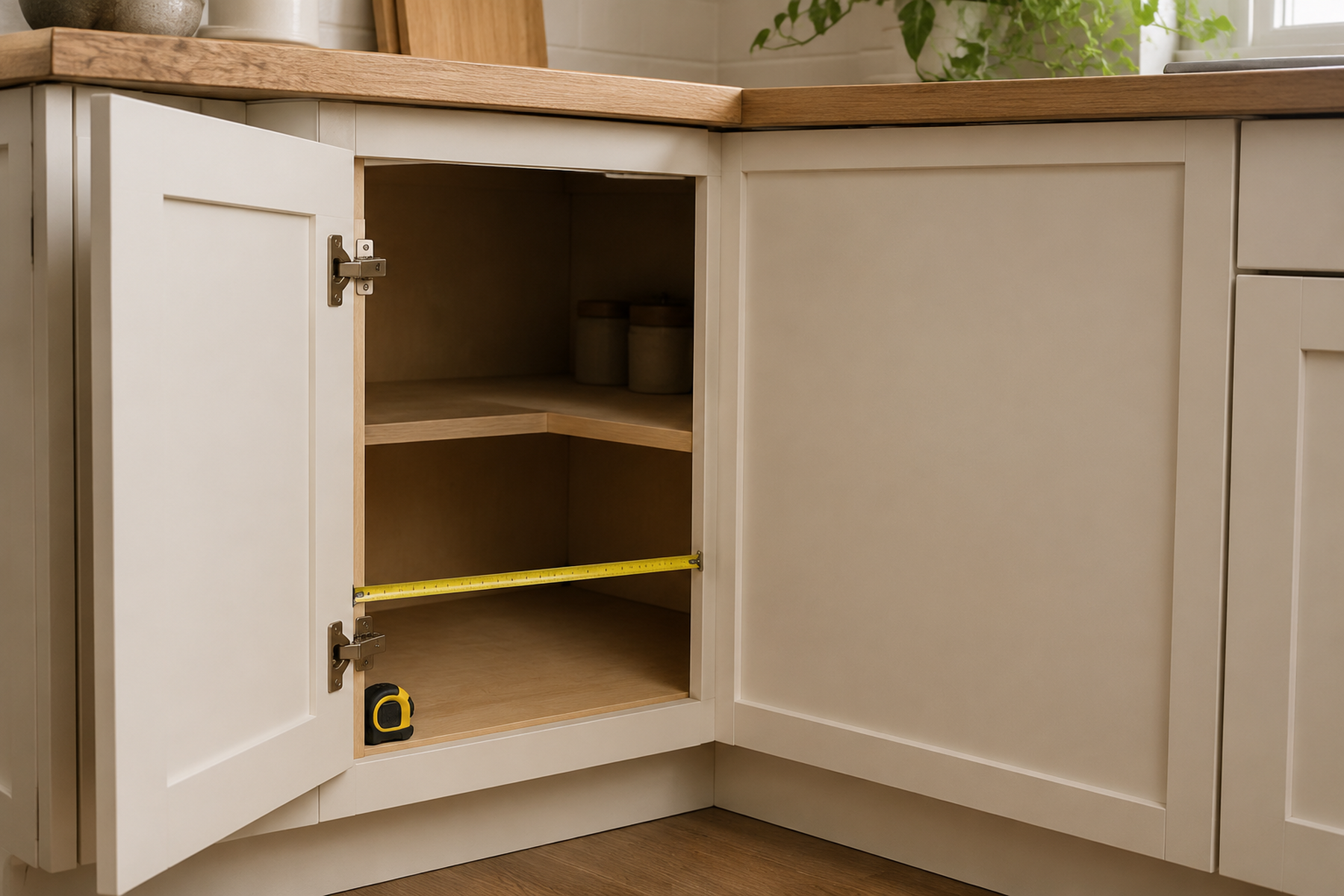
Measure side to side, front to back, and top to bottom at the location where the organizer and cookware will really move. Rev-A-Shelf’s current cookware-organizer guidance likewise tells buyers to measure the cabinet in all three directions and account for obstructions such as hinges and plumbing before selecting a system.
Test the return path as well as the storage position. If a pan fits only after another item is removed, the door is held at an awkward angle, or the handle has to thread around a hinge every time, the cabinet is still carrying too much retrieval friction.
Measure / Check First
Nominal cabinet dimensions are not enough. Check the actual path the cookware and organizer must use before you commit to a rack, divider, or pull-out.
Measure the Cabinet Before You Buy an Organizer
01
Measure the clear opening
Record the usable width, height, and depth with the door open, including any face frame, hinge, fixed shelf, plumbing, or trim that reduces the real passage.
02
Check handle and organizer clearance
Use the longest pan handle and tallest stored piece as real references. Confirm that the organizer can hold them without striking the door, shelf above, or cabinet back.
03
Test retrieval and return
Make sure a frequent-use pan can come out and go back without unloading several other pieces, twisting past hardware, or destabilizing a heavy stack.
A storage product is useful only when the complete movement works: into the cabinet, into its storage position, out for cooking, and back again. If any part of that path depends on forcing, tilting around hardware, or removing unrelated cookware, keep looking.
03
Use Protected Nesting When Density Matters More Than Independent Access
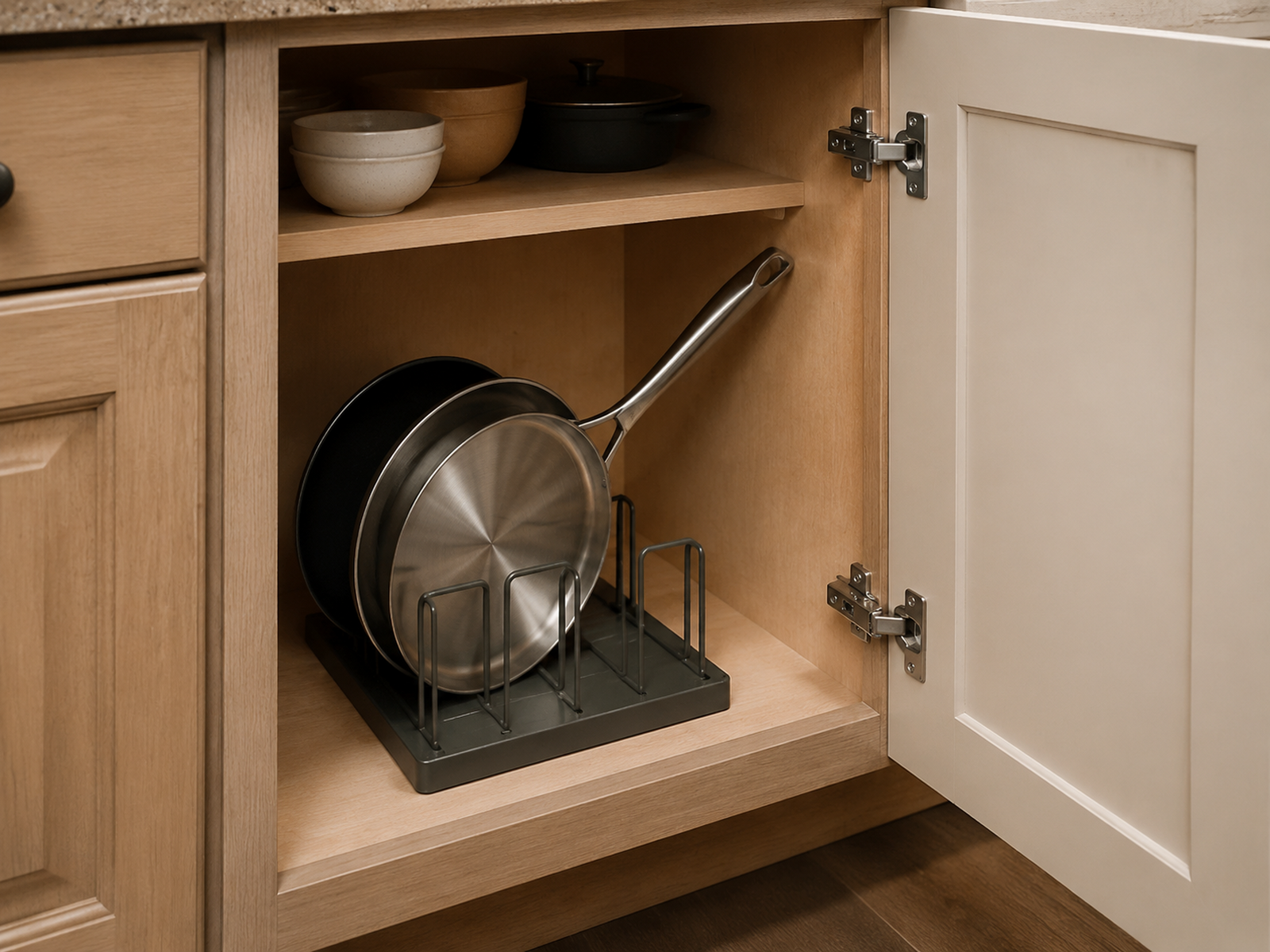
Nesting is often the densest way to store bulky cookware because several pieces can share the footprint of the largest vessel. It works best when the shapes nest cleanly, the stack stays stable, and the pans you use most are near the top or front rather than buried underneath heavier pieces.
Cookware care changes the decision. Current guidance for specific coated cookware from Made In, All-Clad, and GreenPan recommends protective material between certain stacked pans. Other cookware may have different instructions, and some sets are designed specifically for space-saving stacking.
Protected nesting is therefore not a fallback to avoid. It is a good small-kitchen choice when it preserves surface condition, keeps the frequent pieces easy to reach, and avoids a stack so deep that dinner starts with unloading the whole cabinet.
04
File Thin Pans Vertically When Independent Access Earns the Space
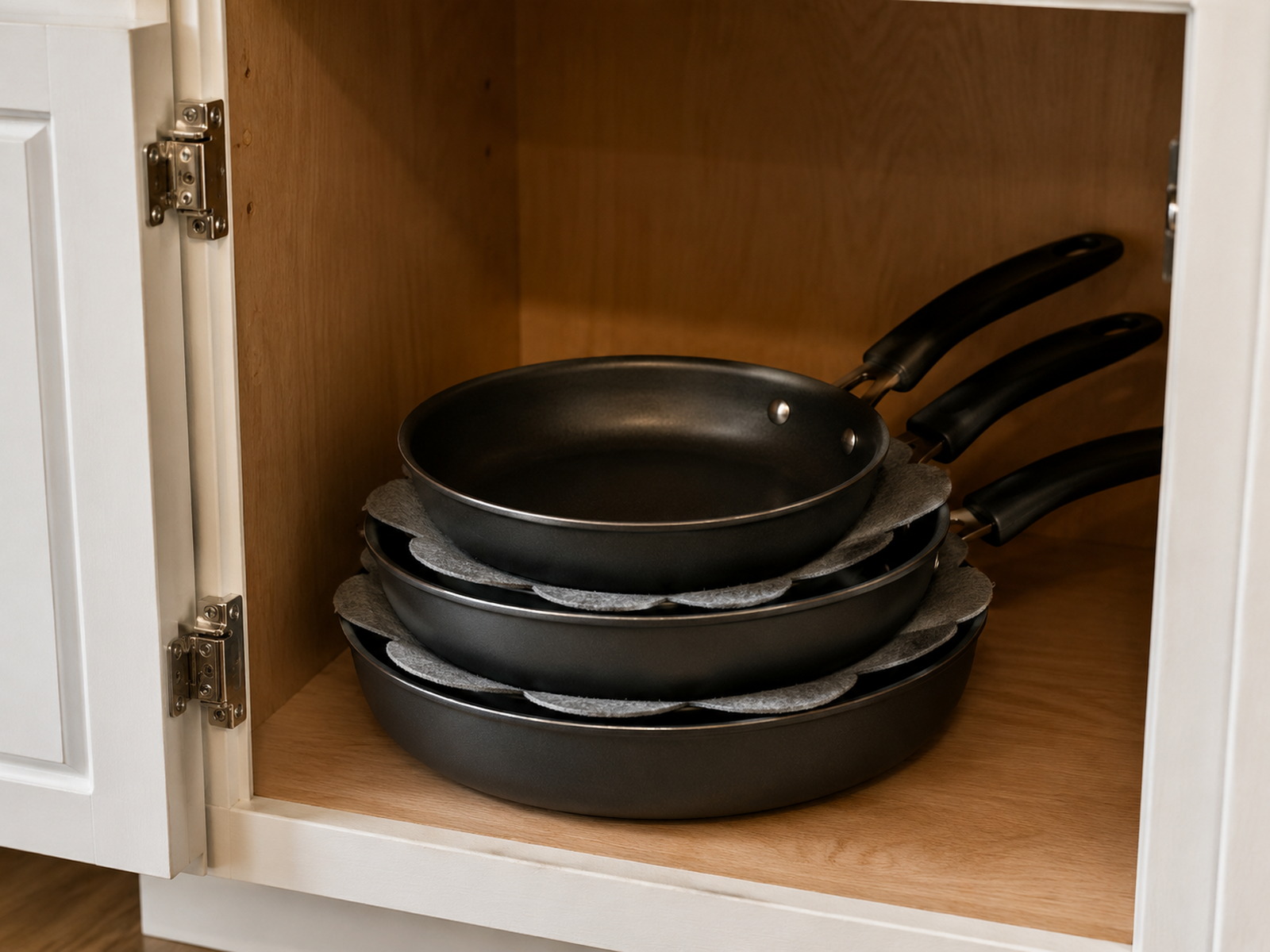
Vertical filing can turn a pile of frying pans, sauté pans, cutting boards, or thin bakeware into individually retrievable pieces. A freestanding divider rack is especially useful when the cabinet has enough height and depth for the pan bodies and handles without requiring screws.
The trade is packing density. Upright slots create air around each piece, so a rack that makes three daily skillets effortless to grab may store fewer total items than a nested stack. That can still be the better result if those are the pieces that would otherwise force repeated unloading.
Use vertical storage only where the cabinet geometry supports it. A narrow opening, low fixed shelf, long handles, or plumbing can eliminate the height or depth the rack needs. The organizer should solve retrieval inside the cabinet you have, not require the cabinet to behave like a deeper or wider one.
05
Give Lids Their Own Storage Plan
Lids are thin enough to look easy to store, yet knobs, handles, and mixed diameters can turn them into an unstable pile. Decide deliberately whether each lid stays with its pot or moves into a separate filing zone.
Keeping an inverted lid with the matching vessel simplifies pairing and can work well when the shape remains stable. Filing lids separately can save vertical room and make them easier to identify when several pots share similar sizes. A freestanding organizer such as IKEA’s current VARIERA pot lid organizer shows that a dedicated lid zone can also be removable rather than cabinet-mounted.
Do not let lid storage consume the easiest cookware position by accident. A narrow side strip, shallow shelf area, or compatible drawer can be a better use of space than placing every lid on top of the pot stack and increasing the height of everything below it.
06
Use a Pull-Out Only When the Cabinet and Installation Method Are Resolved
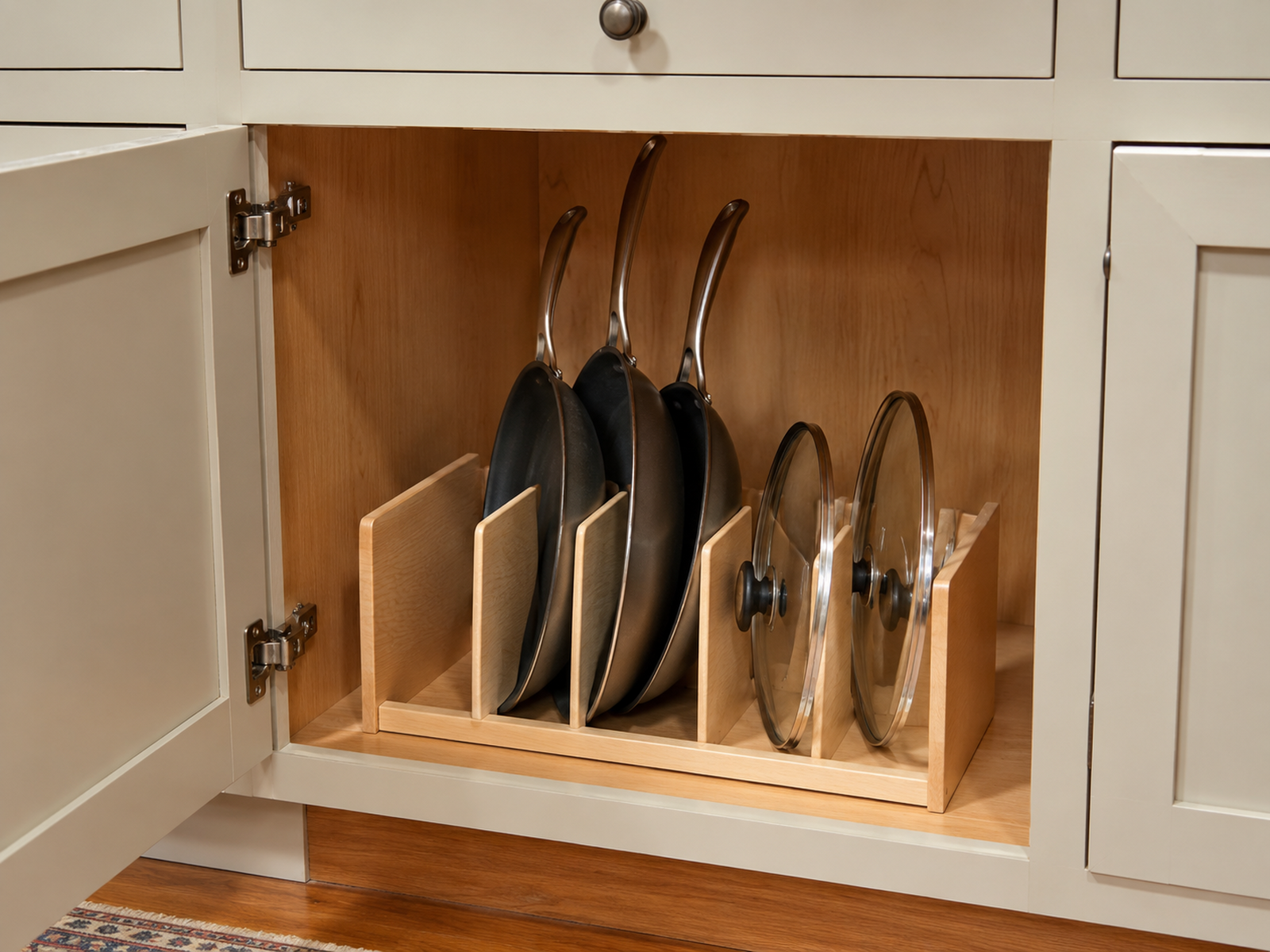
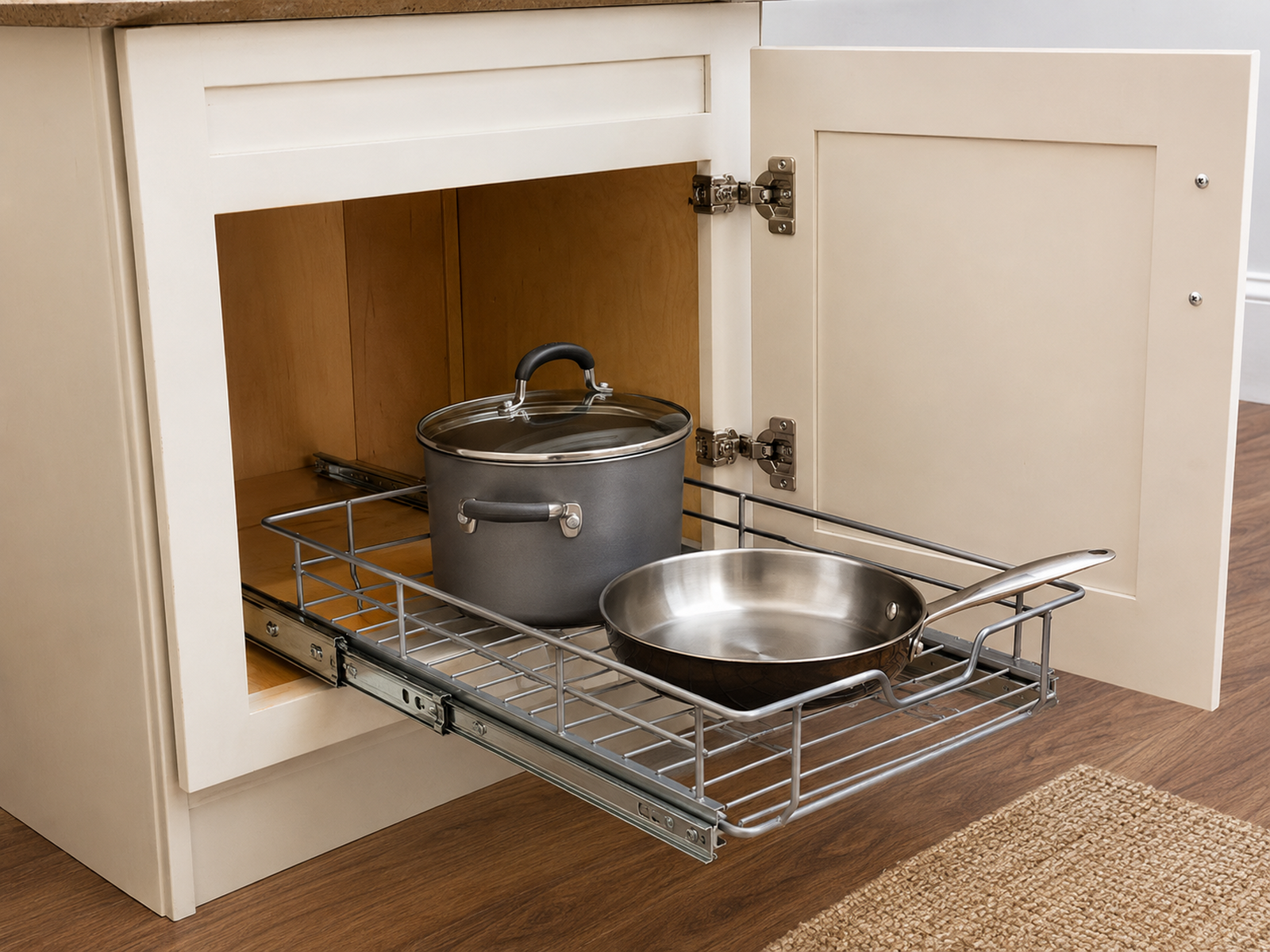
A pull-out organizer can transform a deep lower cabinet because the cookware comes toward you instead of being reached from the back. That access improvement is real, but it depends on cabinet geometry and installation rather than on the product simply being labeled for pots and pans.
Current Rev-A-Shelf cookware pull-outs require buyers to resolve opening dimensions and obstructions, and its current two-tier cookware organizer uses bottom, side, and rear mounting. That makes installed pull-outs a different renter category from a freestanding divider or lid rack.
Before considering one, verify the exact organizer dimensions, mounting points, cabinet construction, hinges, shelves, plumbing, and lease or landlord rules. The slides and frame also consume some internal volume, so the system should earn that space by making frequently used cookware meaningfully easier to retrieve.
What Not to Do
Avoid Cookware Storage That Solves Capacity but Makes Access Worse
- Buy from the cabinet’s nominal size
The real opening can be smaller than the interior. Hinges, face frames, shelves, plumbing, and handles can make a correctly labeled organizer unusable. - Assume vertical storage is always better
Vertical filing improves independent access, but it spends height and slot spacing. Protected nesting may be more efficient for bulky vessels when the stack remains easy to use. - Stack coated pans without checking care instructions
Some nonstick and ceramic cookware needs protection between pieces, while other cookware is designed to stack. Follow the instructions for the cookware you own. - Call mounted storage renter-friendly by default
Cabinet pull-outs, wall rails, and ceiling racks may require screws, cabinet modification, secure anchoring, or structural mounting. - Move heavy cookware overhead just to clear a cabinet
Overhead storage is only useful when mounting, reach, clearance, and retrieval are safe for the actual cookware and the person using it.
07
Move Low-Frequency Cookware Out of Prime Cabinet Space
Not every cooking vessel needs to live beside the daily skillet. A large stockpot, holiday roasting piece, specialty pan, or other occasional cookware can move to a nearby pantry, dining-room cabinet, or another dry interior storage zone if one already exists.
A freestanding kitchen cart can also relieve cabinet pressure when the room has genuine residual floor space, but it is not automatically a small-kitchen upgrade. Keep it out of door swings, appliance access, and the primary walking or cooking path, and avoid turning the cart top into another permanent countertop pile.
Relocation is successful when it reserves prime kitchen access for the cookware used most and keeps the slower items easy enough to find when needed. It is often more efficient than forcing every vessel into one cabinet with another layer of organizers.
08
Treat Wall and Ceiling Storage as Installation Projects
Wall rails and ceiling pot racks can free major cabinet volume and keep frequent cookware visible, but they should not be presented as casual renter hacks. Mounted systems have to support real cookware weight, stay clear of circulation and working zones, and follow the manufacturer’s installation method.
IKEA’s current KUNGSFORS rail includes a secure-anchoring warning for wall installation. Enclume’s current ceiling pot-rack guidance recommends mounting directly into ceiling joists or beams and seeking appropriate help for other ceiling types.
If drilling, structural mounting, safe reach, or landlord permission is unresolved, keep these options outside the default renter-friendly path. A freestanding cabinet solution that stores fewer pieces may be the better small-space choice when it preserves both access and installation freedom.
Decision Sequence
Choose the Cookware Storage Method in This Order
01
Keep the active cookware set honest
Identify daily and weekly pieces first, then move genuine duplicates and lower-frequency specialty cookware out of prime access.
02
Divide by geometry
Separate thin handled pans, bulky vessels, and lids so each group can use the storage form that fits it best.
03
Measure the usable opening and movement path
Resolve door clearance, hinges, shelves, plumbing, handle depth, and retrieval before selecting any organizer.
04
Choose density or independent access deliberately
Use protected nesting when compact packing works, and vertical filing when faster one-piece retrieval is worth the extra volume.
Closing Decision
Make the Daily Pan the Easiest One to Reach
A small kitchen does not need every pot, pan, and lid stored in the same way. It needs the cookware used most often to come out and go back with little disruption, while bulky and lower-frequency pieces use the slower space that remains.
Sort by frequency and geometry, measure the usable opening, protect cookware surfaces where required, and install hardware only when the real cabinet and renter conditions support it. The best system may hold fewer pieces in prime storage, but it makes the pieces you actually cook with much easier to use.
RELATED GUIDES
Related Guides
NEXT GUIDE
How to Organize a Deep Corner Kitchen Cabinet With a Narrow Opening
Use this when cookware is only one part of a deeper corner-cabinet access problem.
GUIDE
How to Organize High Kitchen Cabinets When Upper Shelves Are Hard to Reach
Use this when low-frequency kitchen items are being moved upward and reach becomes the next constraint.
GUIDE
How to Organize a Small Kitchen With No Drawers—Without Losing Counter Space
Use this when the kitchen is missing drawer storage more broadly and cookware is competing with utensils and other everyday categories.