
Small Kitchen Organization
How to Organize a Deep Corner Kitchen Cabinet With a Narrow Opening
A deep corner cabinet can hold a lot and still be frustrating if the door opening is small. Measure the clear opening first, test how items actually enter and come back out, then use the easiest path for daily storage and the deepest space for categories that can tolerate slower access.
In This Guide
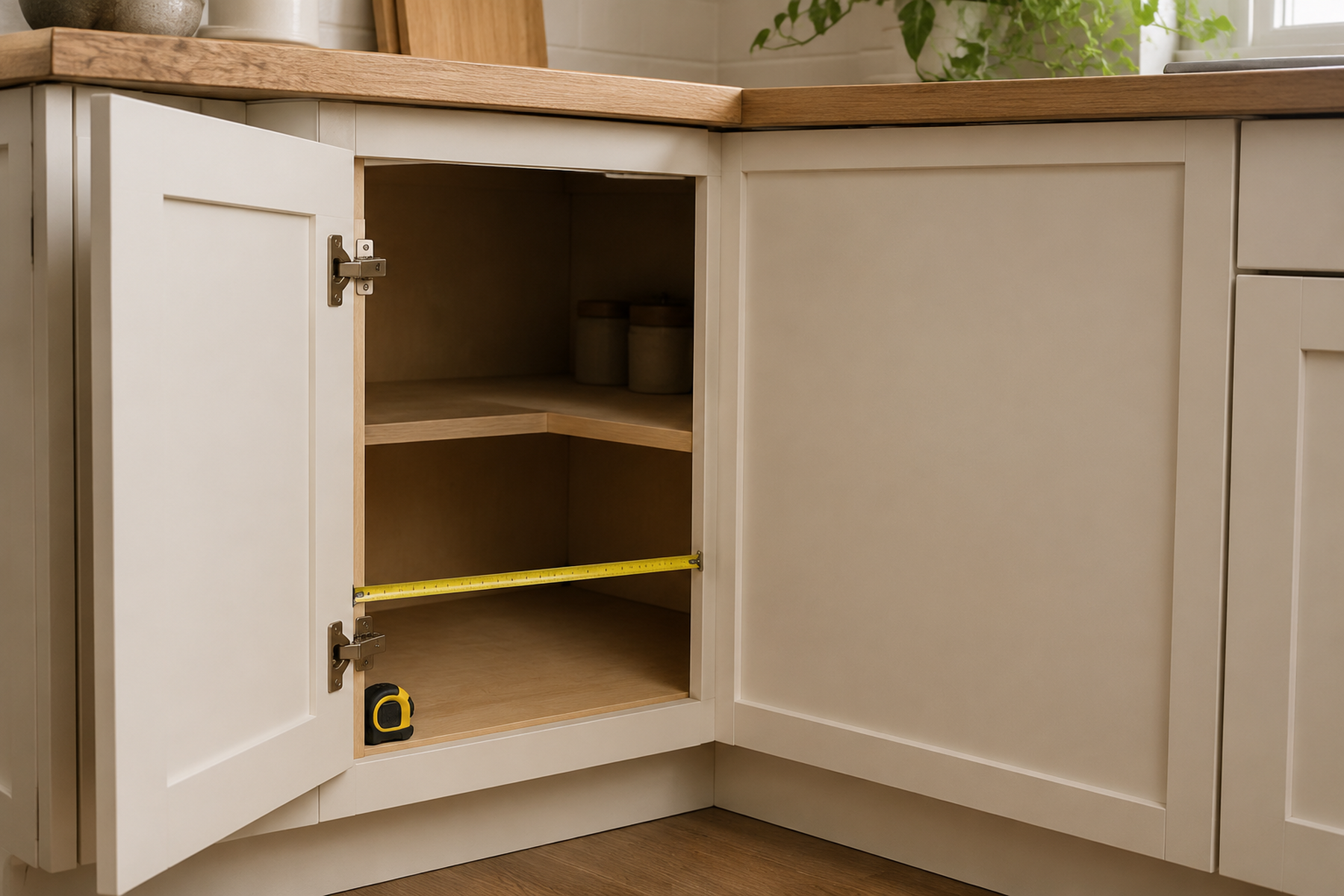
A corner cabinet can look generous on paper because the interior disappears deep into the corner. In daily use, though, you do not interact with that entire volume at once. You interact with the door opening, the hinges, the shelf edges, and the path an item has to travel before it reaches your hands.
That makes the opening—not the back wall—the first storage limit to solve. An item or organizer is a good fit only when it can enter, settle into position, come back out without unloading unrelated things, and return again without a struggle.
Quick Answer
Treat the Door Opening as the First Capacity Limit
Do not start by filling the deepest part of the cabinet or shopping for a corner organizer. Prove the opening and movement path first, then assign the cabinet according to access frequency, item shape, and the level of intervention your rental allows.
01
Measure the clear opening, not just the cabinet box
Record the usable width and height where items actually pass through, including hinge, frame, shelf-lip, or door intrusion. A large hidden cavity does not help if a rigid organizer cannot get through the opening.
02
Test the whole retrieval movement
Check entry, positioning, retrieval, and return. A pot, appliance, bin, or turntable can technically fit inside and still be a poor daily choice if it needs awkward tilting or the front zone has to be unloaded every time.
03
Match access quality to use frequency
Daily items deserve the easiest movement path. Put lower-frequency categories in the deeper, slower zones, and accept some unused volume when extra packing would make rotation or retrieval worse.
01
Identify the Cabinet Before You Choose an Organizer
A fixed blind corner, a diagonal corner shelf, an upper corner cabinet, and a cabinet with an existing built-in carousel do not behave the same way. Before choosing a solution, identify what actually moves, where the door sits, and whether the interior has one straight path or requires turning around a corner.
This matters because organizer advice often assumes a cabinet shape the reader may not have. A straight pull-forward caddy needs a straight exit path. A turntable needs a usable flat footprint and a clear rotation envelope. Installed swing-out hardware needs exact cabinet geometry and a compatible opening.
Keep the diagnosis simple: what is fixed, what already moves, and what part of the cabinet can an item reach without colliding with the door, hinge, shelf edge, cabinet wall, or another stored object?
Measure / Check First
The outside width of the cabinet and the size of the hidden cavity are not enough. Measure the path your storage actually has to use.
Measure the Real Opening Before the Interior
01
Measure the usable width and height at the door
Measure the clear passage after accounting for hinges, face frames, shelf lips, doors, or other hardware that narrows the opening. Use the smallest real passage an item has to clear, not the largest interior dimension.
02
Test the largest intended item through the full movement
Move the actual pot, appliance, bowl stack, or other bulky item through the opening. Check whether it can enter, turn or tilt if necessary, come back out, and return without hitting the cabinet or forcing you to unload the front zone.
03
Test the organizer before you count its capacity
A bin, turntable, or rigid frame has to pass through the opening too. A product can be small enough once assembled inside and still be unusable if the complete unit cannot be inserted, removed, or operated through the real access path.
There is no universal corner-cabinet opening that works for every organizer. Product requirements, hinge layouts, and cabinet shapes vary, so use the real opening and movement path as the gate for everything that follows.
02
Give the Best Movement Path to the Items You Use Most
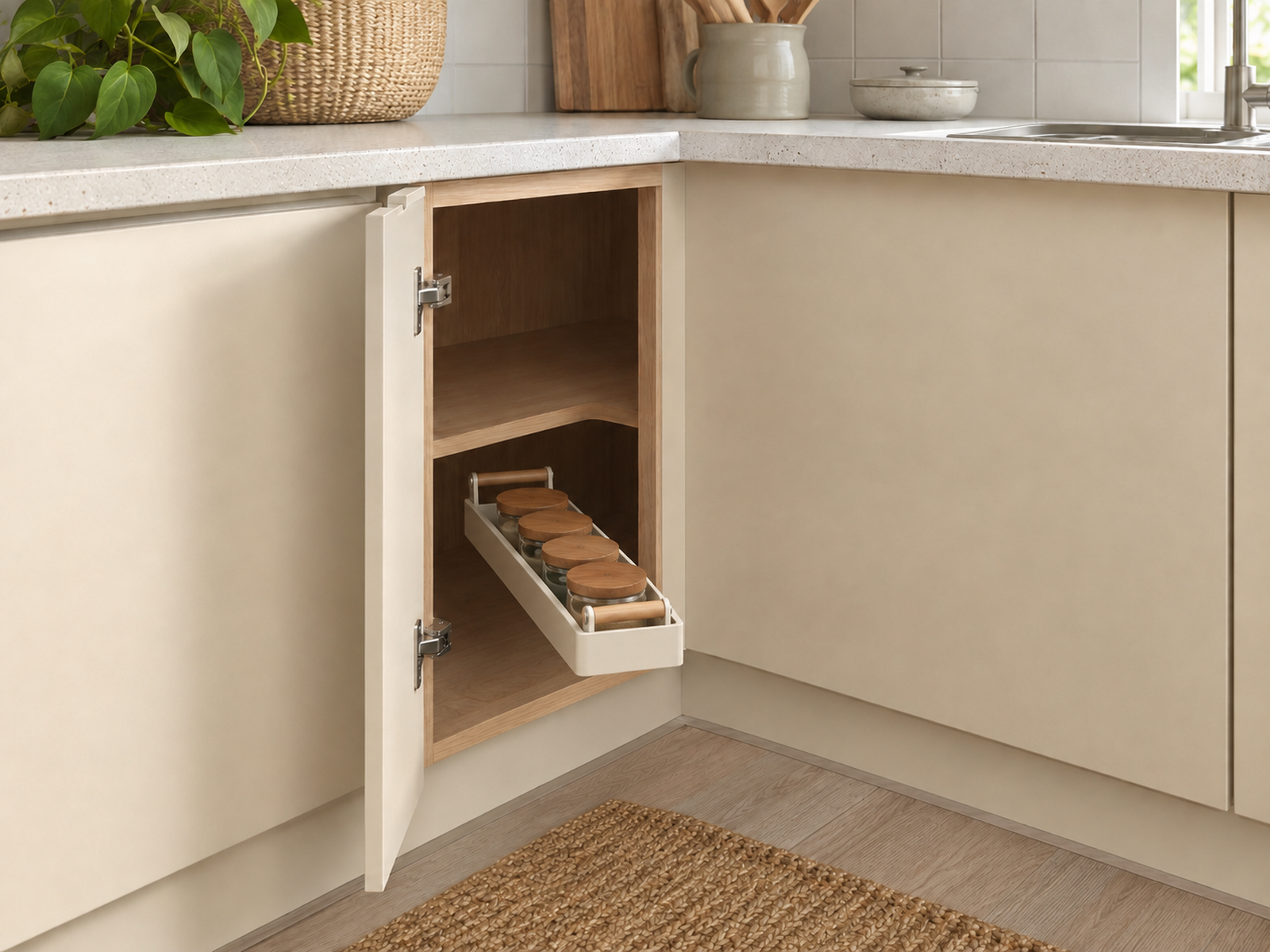
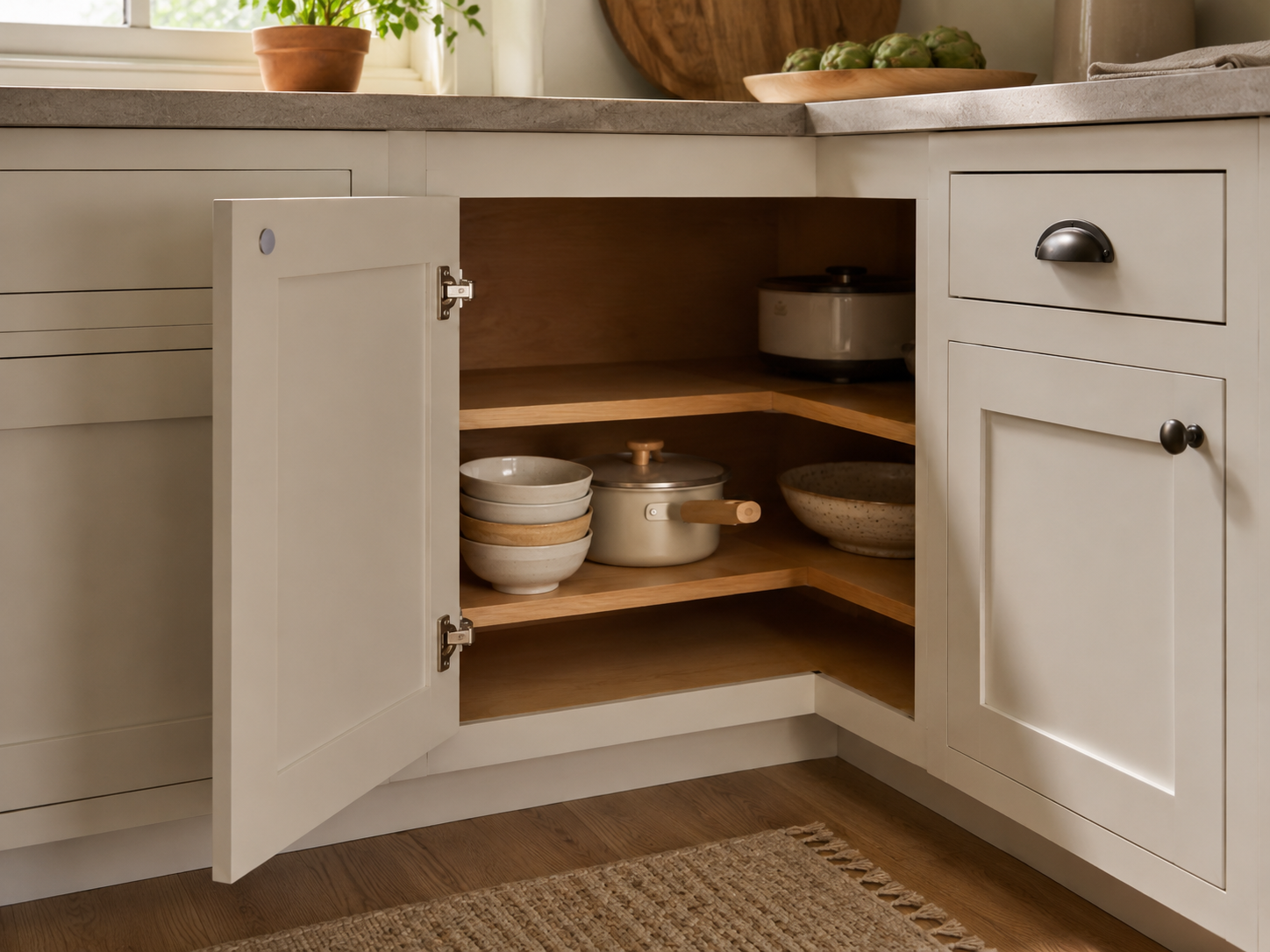
The space immediately behind the opening is premium storage. Give it to items you use often enough that retrieval speed matters: everyday bowls, frequently used pantry categories, or compact cookware that can move cleanly through the door.
The deeper part of the corner can absorb the access penalty of lower-frequency items. Seasonal serveware, backups, or occasional appliances may be reasonable there when you can still see and retrieve them without dismantling the cabinet.
This is one place where a partially empty back corner can be rational. A small kitchen gains nothing from maximum packing density if every trip into the cabinet becomes an excavation.
03
Choose Removable Storage by Its Movement Path
Handled bins and pull-forward caddies can turn depth into a category that comes toward you, but only when the container has a realistic path out. Narrow, rigid bins are strongest in zones where they can travel straight through the opening without needing to bend around a blind corner.
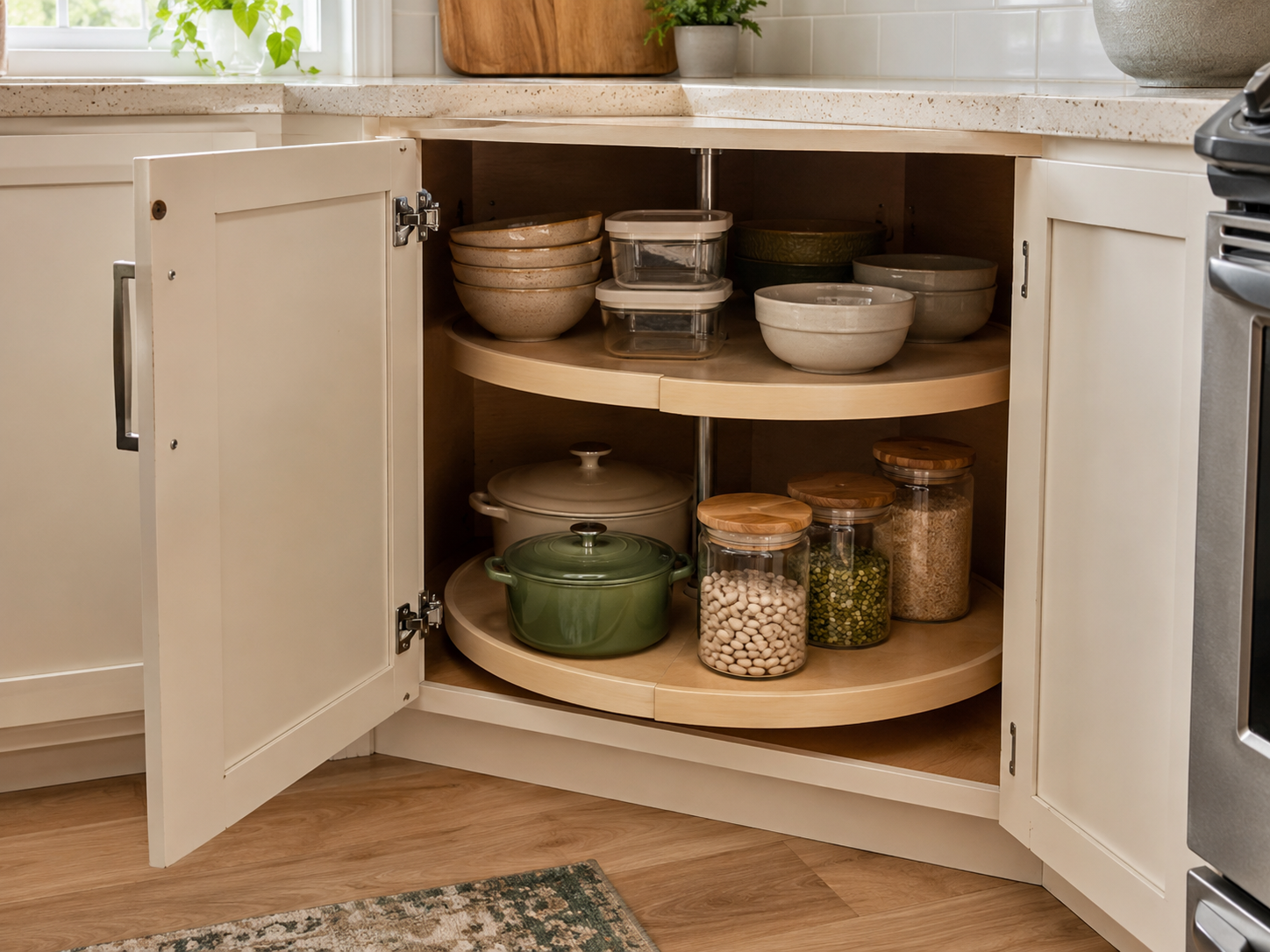
A standalone turntable solves a different movement problem. It can bring small or compact items toward the opening when the unit itself fits through the door, sits on a stable flat surface, and the contents stay inside the turning envelope.
Do not judge either form by how much it can hold. Judge it by how many retrieval steps it removes. If the organizer creates a new obstacle—blocked rotation, a frame that catches, or another layer that has to be moved first—it has not improved the cabinet.
Use / Skip
When a Turntable Actually Helps a Deep Corner Cabinet
Use
Use — Use it when rotation is the cleanest route to the opening
A removable turntable can work well for compact jars, bowls, or other shapes that stay inside the rotation envelope and can be brought to the door without snagging the cabinet walls or nearby items.
Skip
Skip — Skip it when the item shape fights the rotation
Long pan handles, oversized cookware, or containers that project beyond the usable sweep can make a technically functional carousel frustrating. If the contents repeatedly catch during rotation, move those shapes to a better cabinet instead of forcing the carousel to carry them.
04
Make an Existing Carousel Easier to Turn
If the rental already has a built-in lazy Susan or carousel, start by simplifying what rides on it rather than replacing the mechanism. Keep categories compact enough that the shelf can complete its normal movement without handles or containers projecting into the cabinet wall or door path.
This is especially important for cookware. Two pans can occupy similar shelf area while behaving very differently because one has a long handle that sweeps outside the usable circle. Item shape is part of the storage geometry, not a detail to ignore after the cabinet is loaded.
Do not borrow a load limit from another product. If the existing carousel is carrying heavy cookware or appliances, use the exact manufacturer information when it is known. An unknown rental mechanism should not inherit the rating of a different current product.
What Not to Do
Don’t Treat Every Hidden Inch as Daily Storage
The deepest corner is not automatically wasted because it is lightly used. Leaving breathing room can preserve the insertion path, rotation envelope, visibility, and the ability to retrieve one category without unloading another. Usable access is the goal; theoretical capacity is only useful when the cabinet can still be operated normally.
05
Treat Installed Corner Hardware as a Separate Branch
Installed blind-corner pull-outs and swing-out systems can bring hidden storage toward the opening, but they are exact-fit mechanisms rather than generic upgrades. Current manufacturer systems are tied to specific openings, cabinet frames, hinge or door arrangements, and installation methods.
For example, Rev-A-Shelf’s current 5370 Series Cloud shelves are offered for specific blind-corner opening sizes, while IKEA’s current UTRUSTA corner fittings are specified for particular SEKTION corner cabinets. Those are product-specific facts, not universal corner-cabinet dimensions.
In a rental, screws, shelf removal, hinge changes, or mounting plates may also make an installed mechanism permission-dependent. If you cannot verify both physical compatibility and the allowed intervention level, stay with removable storage or change what lives in the cabinet instead.
06
Relocate Bulky Daily Items When the Cabinet Keeps Fighting Them
Sometimes the best corner-cabinet solution is a better cabinet assignment. If a heavy pot, long-handled pan, or daily appliance only works when you twist it through the opening or move several unrelated items first, the corner is charging too much access cost for that category.
Move the awkward daily item to a cabinet with a cleaner path, then use the corner for shapes and frequencies that tolerate the geometry. This is not giving up storage; it is matching inventory to the way the kitchen actually moves.
The corner cabinet can remain useful without becoming the home for every bulky object that happens to fit somewhere inside it.
Closing Decision
Organize for the Path In and Out, Not the Space You Cannot Reach
A deep corner cabinet becomes more useful when you stop treating hidden volume as the main goal. Identify the cabinet type, measure the real opening, test entry and retrieval with the actual items, then reserve the easiest path for daily use. Add removable organizers only when their movement fits the geometry, simplify an existing carousel when item shape is causing snags, and treat installed hardware as an exact-fit, permission-dependent branch. If a bulky daily item still fights the opening, relocating it can be the most efficient small-kitchen decision.
RELATED GUIDES
What to Read Next
NEXT GUIDE
How to Organize Pots and Pans in a Small Kitchen With Limited Cabinet Space
A strong next step for another cabinet problem where opening width, depth, and retrieval access matter.
GUIDE
How to Store Baking Sheets and Cutting Boards in a Small Kitchen
Useful for flat cookware that often needs a narrow, easy-retrieval cabinet zone.
GUIDE
How to Organize Food Storage Containers and Lids in a Small Kitchen
Continues the cabinet-access problem with pieces that become difficult to retrieve when stacked too deeply.