
Small Kitchen Organization
How to Organize Food Storage Containers and Lids in a Small Kitchen
Balance cabinet density with fast lid matching and an easy wash-cycle reset: keep only the container families you actually use, choose attached, separate, or hybrid lid storage by the space you have, and leave enough maneuvering room that one retrieval does not disturb the whole cabinet.
In This Guide
- Audit Bases and Lids as One Inventory
- Choose Your Priority: Density, Retrieval, or Reset
- Measure the Cabinet Before Choosing an Organizer
- Use a Hybrid System for Everyday and Specialty Pieces
More
- Audit Bases and Lids as One Inventory
- Choose Your Priority: Density, Retrieval, or Reset
- Measure the Cabinet Before Choosing an Organizer
- Use Nested Bases and Separate Lids When Space Is Tight
- Use Attached Lids When Matching and Reset Matter More
- Use a Hybrid System for Everyday and Specialty Pieces
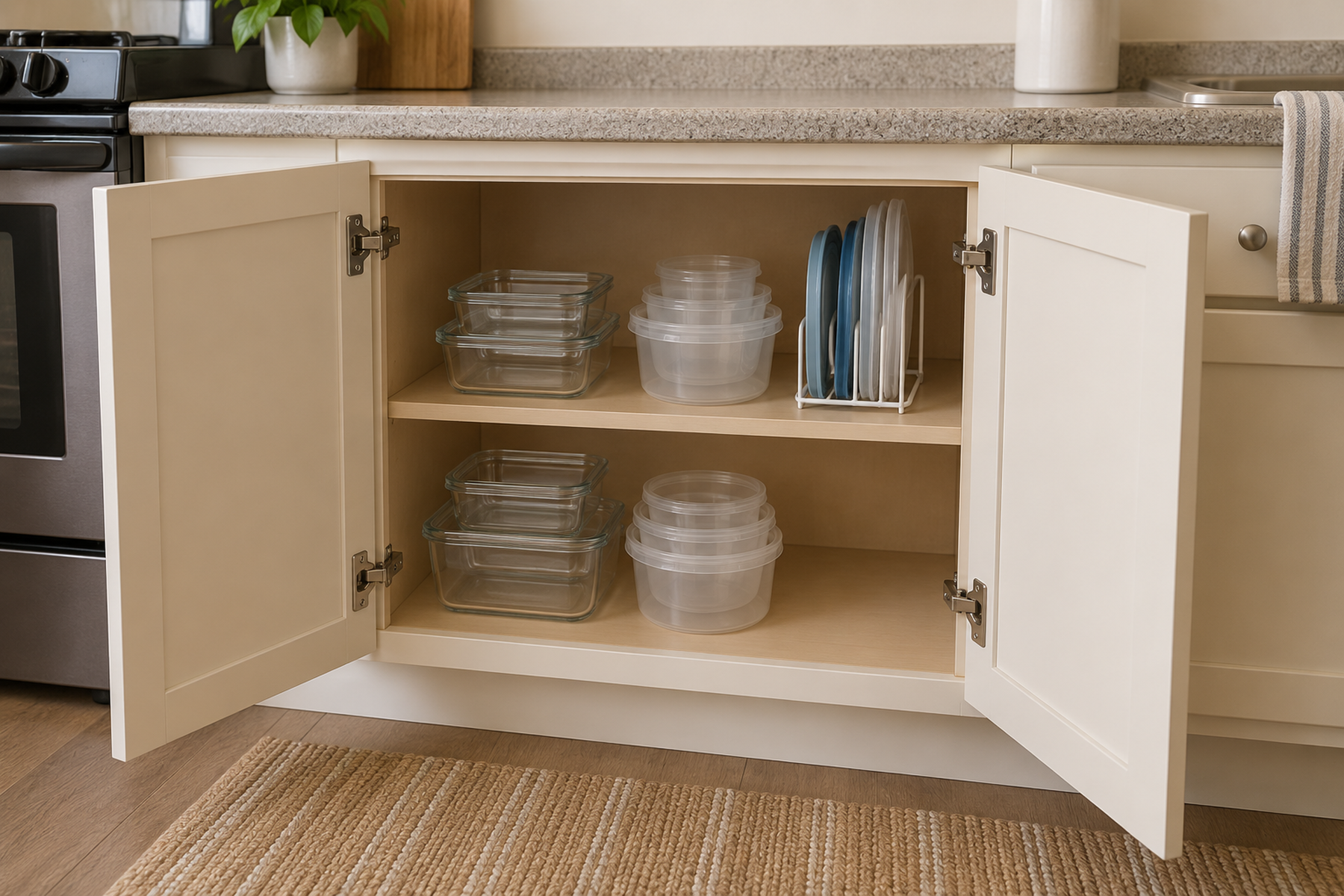
Food-storage containers create a different cabinet problem from ordinary pantry items. Bases nest, lids separate, shapes multiply, and every wash cycle can rebuild the same disorder if the return system is too precise or the cabinet is packed too tightly.
There is no single best method for every small kitchen. Nesting bases with separate lids usually protects raw capacity; keeping lids attached simplifies matching and reset; a hybrid can split the difference. The useful choice depends on the collection, the cabinet geometry, and how much daily friction the household will actually maintain.
Quick Answer
Choose the Storage Method by the Constraint You Actually Have
Audit the container collection before buying hardware, then choose the storage method by the friction that matters most. Use nesting and separate lids when cabinet volume is tight, keep lids attached when fast matching and reset are more valuable, and combine the two approaches when everyday and specialty pieces need different treatment.
01
Reduce the collection before sizing hardware
Match every base to a usable lid, remove pieces that no longer belong to the active collection, and separate specialty containers from the everyday set before buying an organizer around unnecessary volume.
02
Use nesting when cabinet volume is the tightest constraint
Nest compatible bases and keep lids visible in a shallow divider or bin when the collection is large relative to the cabinet and the household can tolerate a separate matching step.
03
Keep lids attached when reset simplicity matters more
If the collection is already small enough, attached lids can make one-item retrieval and return much easier even though the system uses more cabinet volume.
01
Audit Bases and Lids as One Inventory
Start with the collection, not the organizer.
Match bases to lids and identify pieces that no longer function as a complete storage item. Separate temporary takeout containers, rarely used specialty shapes, and duplicate sizes from the everyday set so they do not determine the permanent cabinet layout by default.
The point is not to replace every mixed container family. It is to understand how many real lid families, base shapes, and daily-use pieces the cabinet must support.
If the cabinet is overloaded because the household owns more containers than it routinely uses, a new lid rack will formalize the excess rather than solve the matching-and-reset problem.
02
Reduce Lid-Family Complexity Gradually
Mixed container systems become harder to maintain when several similar lids fit only one specific base.
When pieces are replaced over time, fewer compatible lid families can reduce the amount of sorting required after every wash cycle. Rubbermaid’s current EasyFindLids system demonstrates one product-family approach in which compatible lids attach to bases and to other lids, and specific sets share lid sizes across multiple bases.
Use that as a design example, not a reason to discard a usable collection immediately. Standardize gradually when replacement is already happening or when one incompatible family causes a disproportionate amount of matching friction.
Keep specialty containers when they solve a real job. The goal is fewer unnecessary lid families, not uniformity for its own sake.
03
Choose Your Priority: Density, Retrieval, or Reset
The strongest storage method depends on which kind of friction is costing the kitchen the most.
If cabinet volume is the limiting factor, nesting bases usually earns its place because it compresses the collection. If lid matching is the main failure, keeping a smaller everyday set with lids attached can remove the search step. If the household can find everything but never puts it back correctly, simplify the return positions before adding more dividers.
Treat these as separate performance measures: density asks how little space the system uses, retrieval asks how quickly one usable container can leave the cabinet, and reset asks how easily clean pieces return after normal use.
A system that wins one metric and fails the other two is not a strong small-kitchen system.
04
Measure the Cabinet Before Choosing an Organizer
Measure the usable cabinet, not only the nominal shelf.
Record internal width, depth, and height, then check the actual opening, hinges, shelf lips, face frames, door swing, and any neighboring item that reduces the path for a bin or lid organizer.
Measure the organizer too. YouCopia’s current StoraLid 24-lid organizer, for example, is approximately 13.2 inches wide, 10.8 inches deep, and 3.3 inches high. It uses adjustable dividers and requires no installation, but that footprint still has to earn space inside the real cabinet.
Do not call an organizer space-saving merely because it organizes lids. If its footprint forces bases into an unstable stack or blocks the cabinet opening, the cabinet may function worse than it did before.
Measure / Check First
Before buying a lid rack, bin, shelf riser, door organizer, or pull-out, test the real collection against the real cabinet and the way the household retrieves and returns pieces.
Check Fit, Access, and Reset Before You Add Hardware
01
Cabinet and opening geometry
Measure usable width, depth, height, door opening, hinges, face frames, shelf edges, and any clearance a door-mounted or pull-forward organizer would need.
02
Collection and organizer footprint
Measure the largest everyday bases and lid families plus the real footprint of the organizer. Confirm the hardware does not consume more useful capacity than the access problem justifies.
03
Loaded retrieval and return
Stage the normal collection inside the cabinet and remove one everyday base and matching lid. Then return them. If that sequence topples stacks, blocks the door, or requires exact rebuilding, simplify the system before locking it in.
If a solution fits only when the cabinet is perfectly staged, the organizer is too large, or clean pieces cannot return without re-sorting the entire collection, choose a simpler storage method or reduce the active inventory.
05
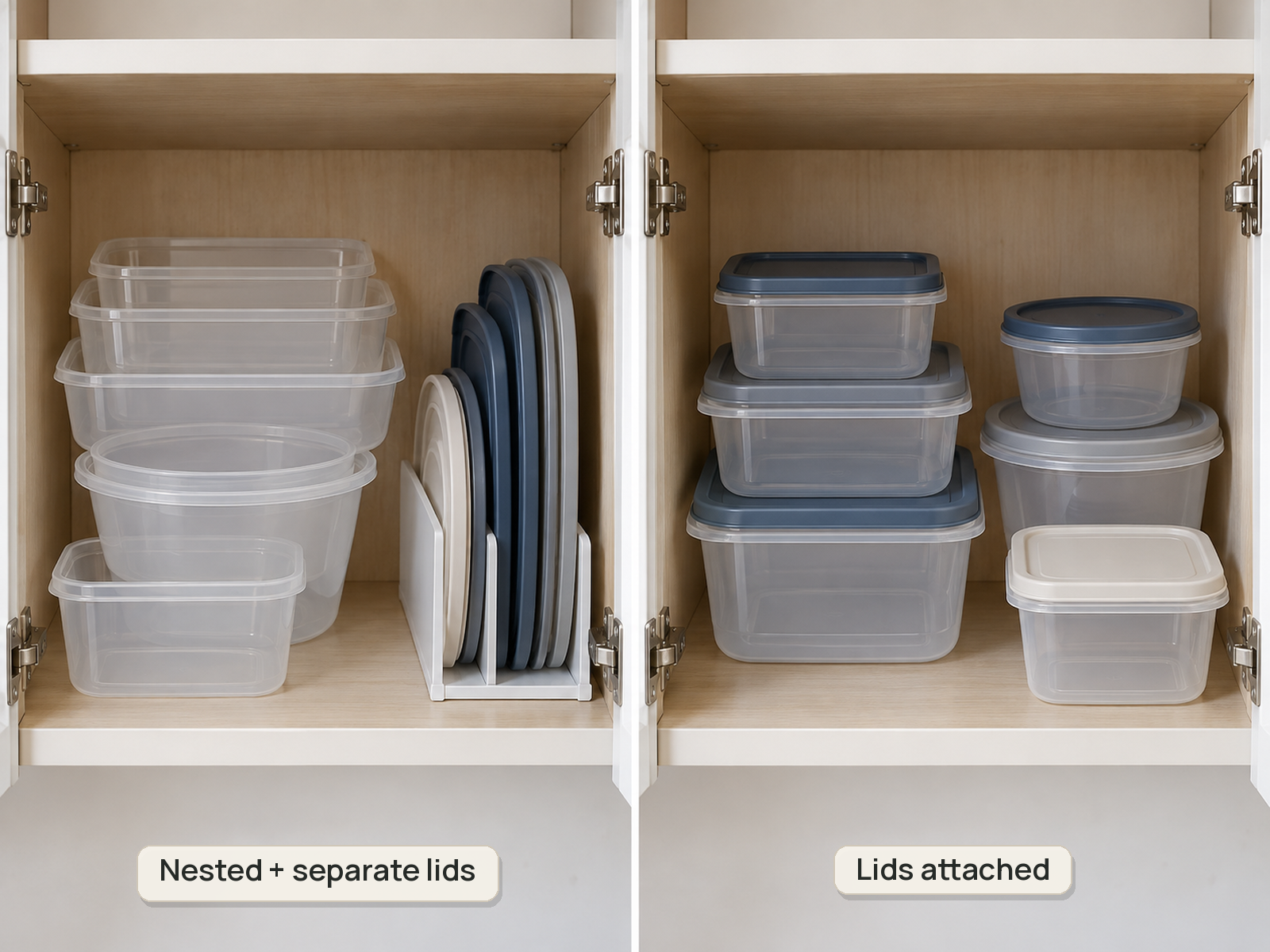
Use Nested Bases and Separate Lids When Space Is Tight
Nesting is strongest when the collection needs to compress into a limited cabinet footprint.
Group compatible bases into a small number of stable stacks and keep lids nearby in a shallow vertical divider, bin, or organizer. The lid zone should make size differences visible enough that the user can identify the right family without unloading the whole row.
Do not maximize stack depth blindly. If the smallest base is buried under several larger pieces and every lunch-container retrieval requires rebuilding a tower, the density gain is costing too much in access.
Leave enough lateral room to lift a stack or pull one lid without causing the neighboring group to fall. Empty maneuvering space can be functional capacity.
06
Use Attached Lids When Matching and Reset Matter More
Keeping lids on the containers uses more cabinet volume, but it can remove two common sources of friction at once: matching and reset.
Real Simple published a current 2026 argument for this method as a lifestyle-efficiency choice rather than a maximum-space choice. The practical boundary is simple: it works only when the retained collection is small enough that the extra volume does not crowd out the rest of the cabinet.
This approach can be especially useful for a compact everyday set used repeatedly for lunches or leftovers because one usable container leaves the cabinet as one object and returns as one object.
Do not turn the method into a universal rule. In a very tight cabinet or a large mixed collection, the volume penalty can outweigh the reset benefit.
07
Use a Hybrid System for Everyday and Specialty Pieces
A hybrid system is often the strongest compromise when one storage method forces the entire collection to accept the same trade-off.
Keep a small everyday set in the easiest-matching format—attached lids if the cabinet can absorb the volume, or a very simple nearby lid group if it cannot. Store freezer, baking, oversized, or rarely used specialty pieces more densely in a secondary section.
This protects prime access for the containers that cycle through the kitchen most often while preventing low-frequency pieces from dictating the whole cabinet design.
Keep the number of tiers small. “Everyday” and “specialty” can be enough; adding categories for every shape, meal type, and household member recreates the complexity the system is supposed to remove.
08
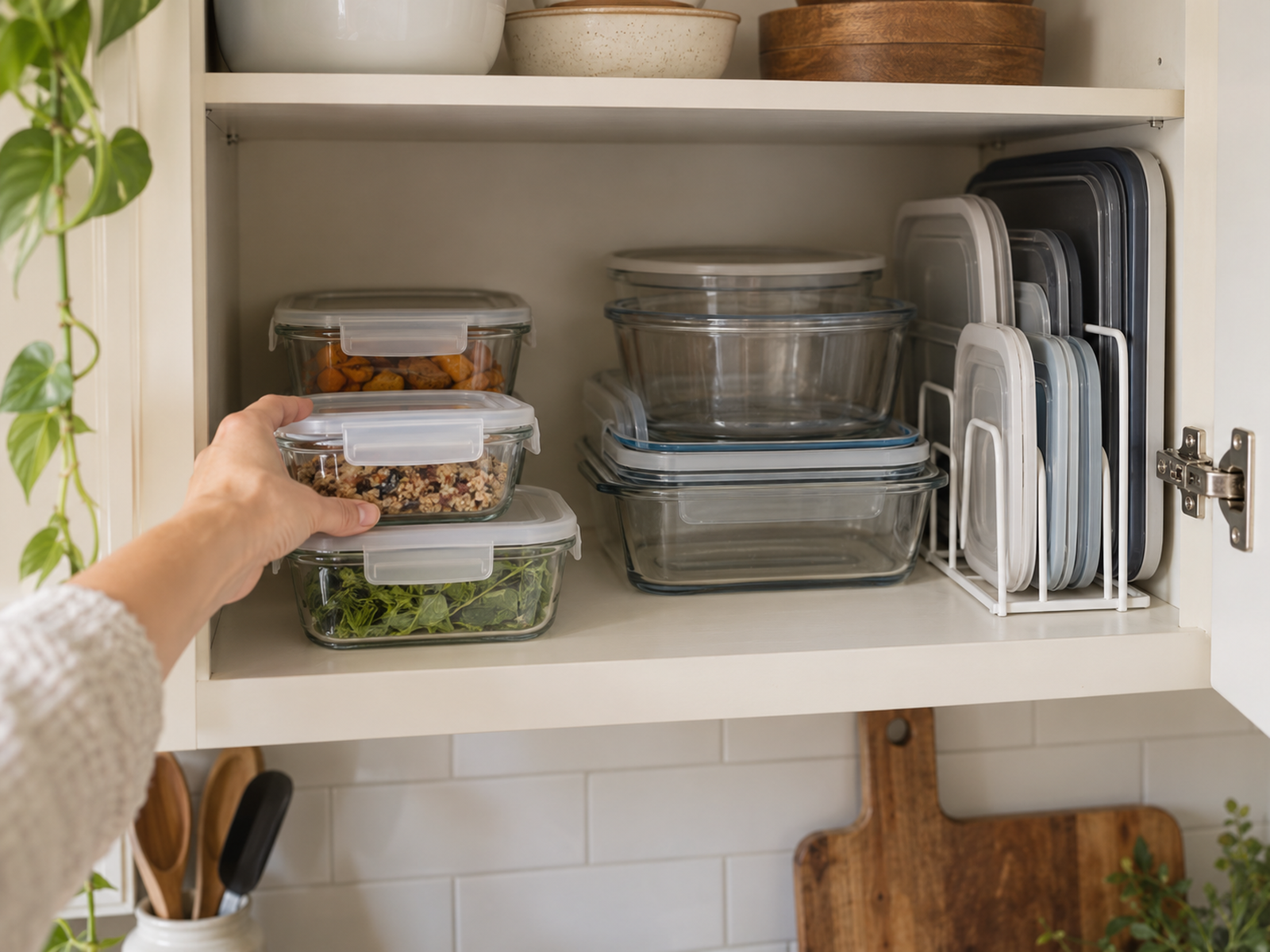
Fit Lid Organizers to the Real Lid Families
A lid organizer works only when its divider geometry matches the collection it is supposed to hold.
Adjustable dividers are useful when round, square, and rectangular lids need different spacing, but advertised lid count is not the same as real mixed-lid capacity. Thick rims, large lids, and irregular shapes can consume more than one nominal slot.
Keep the lid zone shallow enough that the fronts remain visible. If lids are stacked several layers deep, the organizer has become another search box.
Re-test the fit after the collection changes. A fixed organizer that was efficient for one container family can become dead footprint after several pieces are replaced.
09
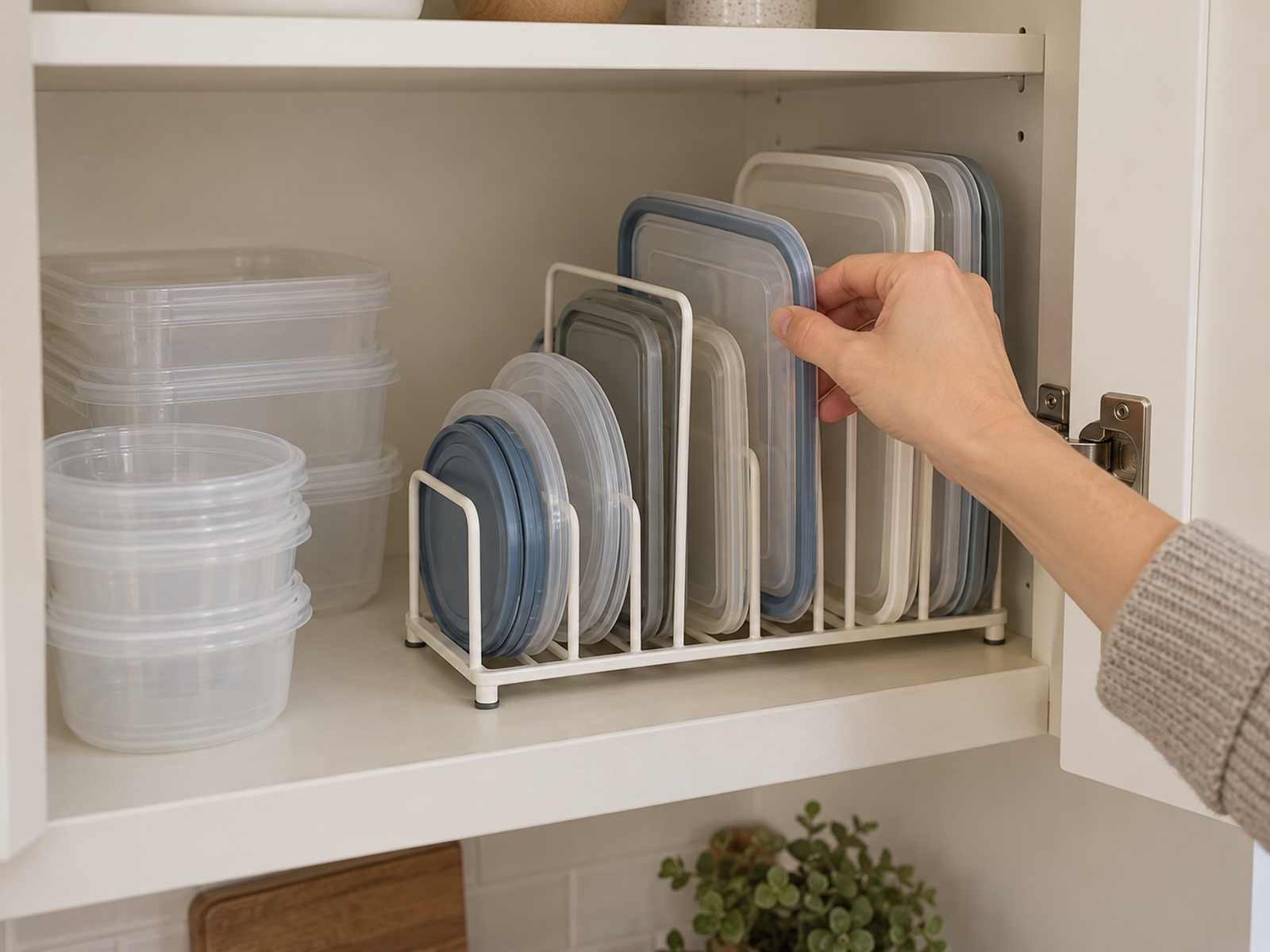
Treat Door Storage and Pull-Outs as Conditional Paths
Inside-door racks, adhesive holders, and pull-out hardware can solve a real access problem, but they are not free capacity.
Door-mounted storage has to clear shelves, hinges, and the stored containers while allowing the cabinet to close normally. Current Real Simple professional-organizer guidance specifically warns that an inside-door basket should not contact the shelf or prevent closure.
For renters, start with freestanding bins or dividers. Adhesive products depend on the exact surface, removal method, load, and lease; screw-mounted rails and pull-outs belong to the installation-dependent path.
Use installed access hardware when the cabinet depth genuinely creates a retrieval problem—not merely because a pull-out looks organized.
10
Leave Maneuvering Room and Use the Capacity Stop Rule
A container cabinet should not be packed to the point that every retrieval disturbs the neighboring stack.
Leave enough free width or depth to lift a stack, fan through lids, and return a clean item without rebuilding the whole system. That small amount of air is part of the operating space.
When the everyday set, specialty pieces, and lid system no longer fit inside the assigned cabinet without unstable stacking or counter spillover, stop adding organizers. Reduce duplicates, move genuinely low-frequency pieces to another appropriate storage zone, or simplify the number of container families.
The small-kitchen stop rule is that the container system must remain inside its assigned storage footprint. If it solves the cabinet only by creating a permanent pile on the counter, the capacity problem has not been solved.
Closing Decision
Choose the Method That Survives a Normal Wash Cycle
Food-storage organization works when the cabinet balances three things at once: enough density for a small kitchen, fast retrieval of one usable base and lid, and a reset simple enough that clean pieces return without rebuilding a puzzle.
Use nesting and separate lids when raw capacity is tight, attached lids when matching and reset matter more, or a hybrid when everyday and specialty pieces deserve different treatment. Measure every organizer, preserve maneuvering room, and stop the system before it spills onto the counter or requires another layer of hardware.
RELATED GUIDES
What to Read Next
NEXT GUIDE
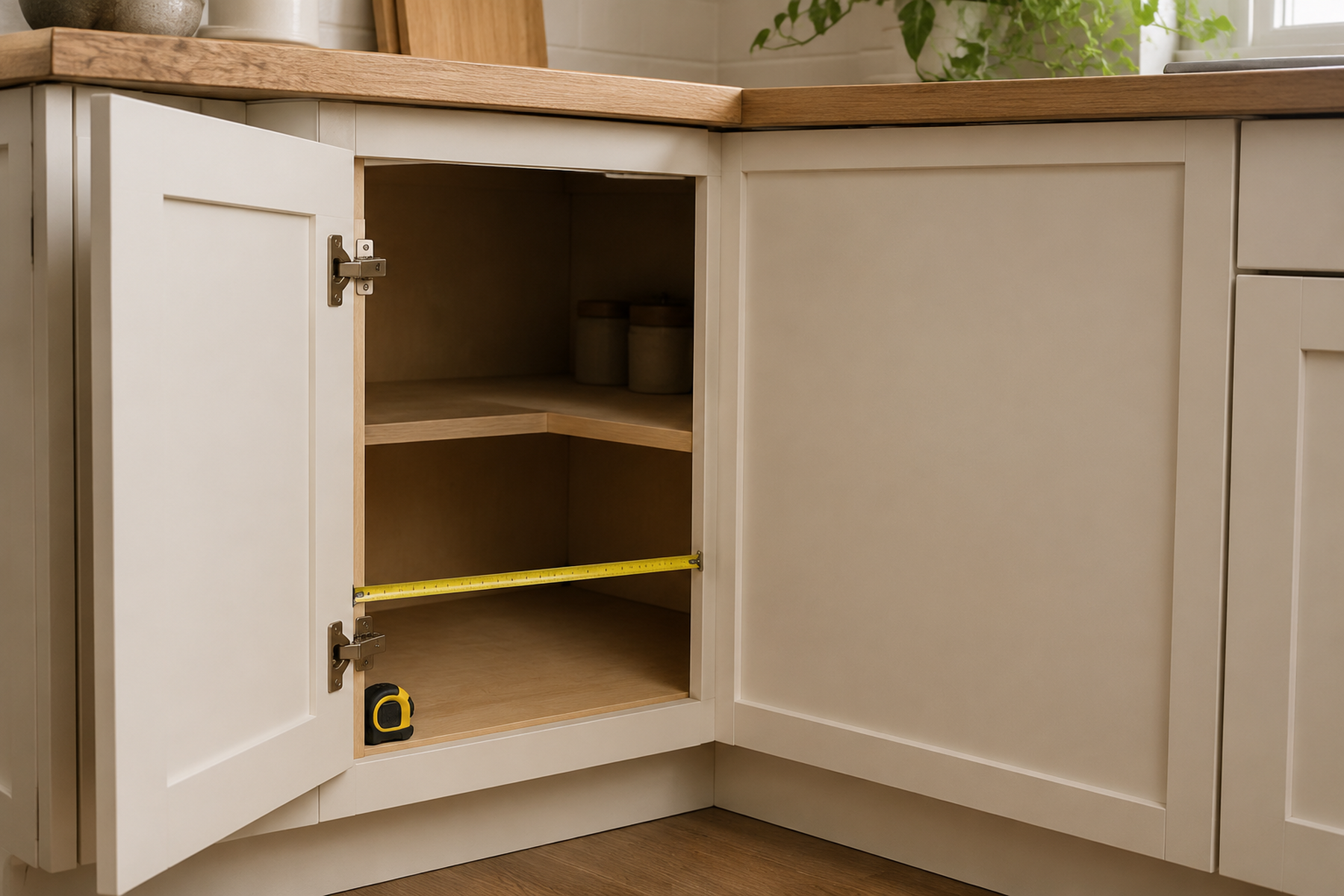
How to Organize a Deep Corner Kitchen Cabinet With a Narrow Opening
Use this next if the container system is logically sound but the cabinet itself is deep, hard to reach, or constrained by a narrow opening.
GUIDE
How to Organize Pots and Pans in a Small Kitchen With Limited Cabinet Space
Use this if another bulky kitchen category is competing for the same lower-cabinet capacity and needs its own access-first storage plan.
GUIDE
How to Store Baking Sheets and Cutting Boards in a Small Kitchen
If flat bakeware and boards are sharing cabinet space with containers, this guide handles the separate vertical-versus-flat geometry problem.