
Small Apartment Storage Ideas
Where to Put Cat Food and Water in a Small Apartment With No Good Floor Spot
A small apartment does not need one perfect “pet corner.” For cats, a better plan is often to give food, water, and litter separate workable locations, then make those small zones easy for the cat to reach and easy for you to clean without blocking the apartment’s normal walking routes.
In This Guide
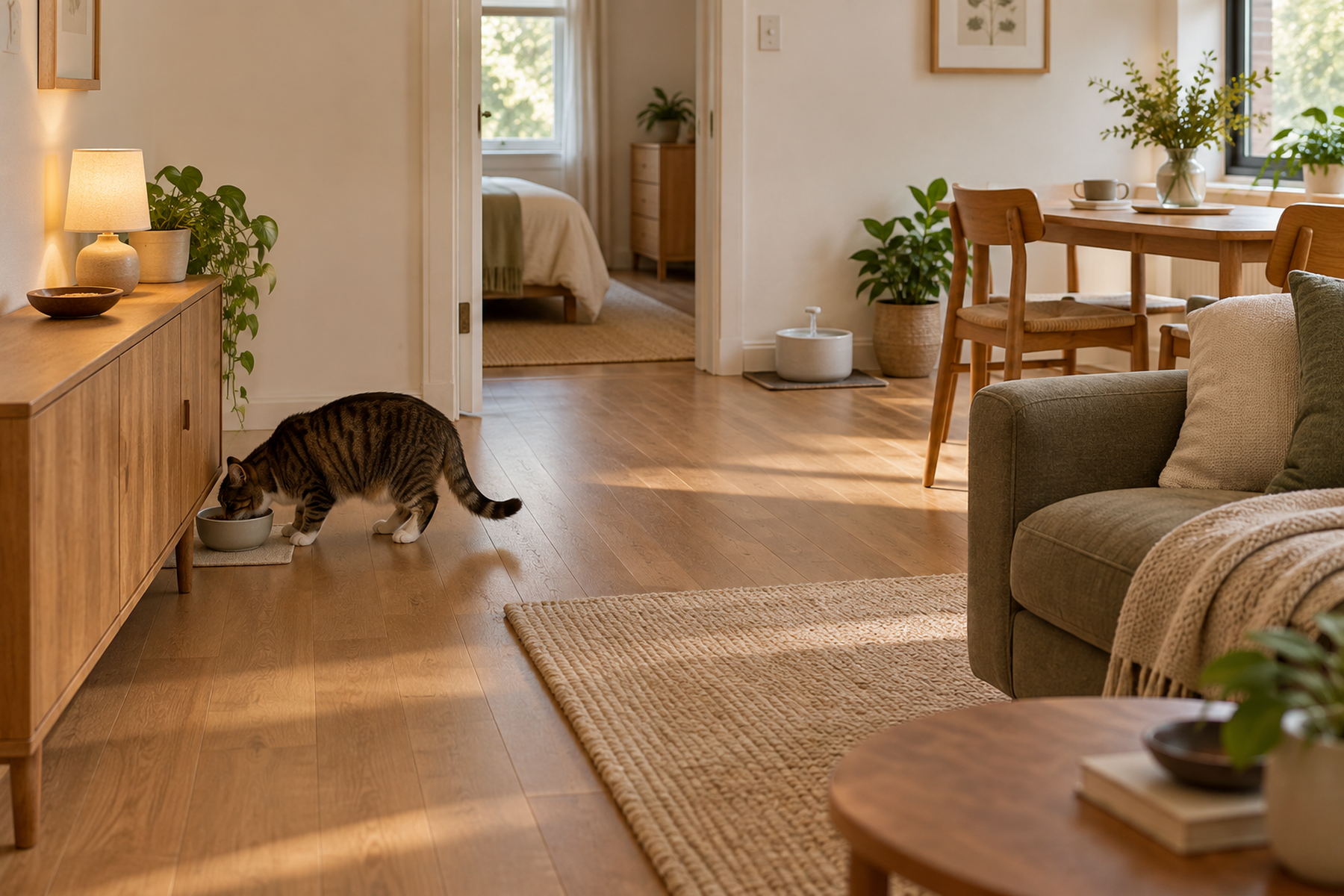
The most visually compact cat setup is not always the most functional one. Current feline environmental guidance treats food, water, and toileting as distinct resources and supports separating them rather than compressing everything into one leftover corner.
In a studio or small rental, that does not require three large pet-furniture stations. It can mean several modest micro-zones: a quiet food location, water somewhere else, litter elsewhere, and only the daily-use supplies kept close to the bowls.
Quick Answer
Separate the resources, simplify the routine
Choose food and water locations independently. Keep both outside the main human walking path, preserve a comfortable approach and exit for the cat, keep litter separate, and make bowl pickup and cleaning easy enough to happen every day.
01
Place food for calm access
Use a stable, cleanable room edge where the cat is not routinely stepped over, trapped, or startled by busy equipment.
02
Put water somewhere else
Give the water bowl or fountain another small usable zone rather than forcing it beside the food just to create a matching station.
03
Keep litter separate
Treat litter placement as its own resource decision instead of combining food, water, and toileting into one compact pet area.
Measure / Check First
The bowl diameter is not the whole feeding footprint. The cat and the human routine both need operating space around it.
Check the approach, exit, and cleaning route
01
Cat approach
Make sure the cat can reach the bowl without squeezing through a human pinch point or passing an avoidable disturbance.
02
Cat exit
Avoid a placement that leaves the cat boxed into a dead-end corner by furniture, another animal, or heavy foot traffic.
03
Human cleaning route
Check that you can pick up the bowls, reach the sink or cleaning area, wipe the mat or floor, and reset the station without moving furniture each time.
No universal food-to-water or food-to-litter distance is established here. Use physical separation and workable access rather than inventing a measurement.
01
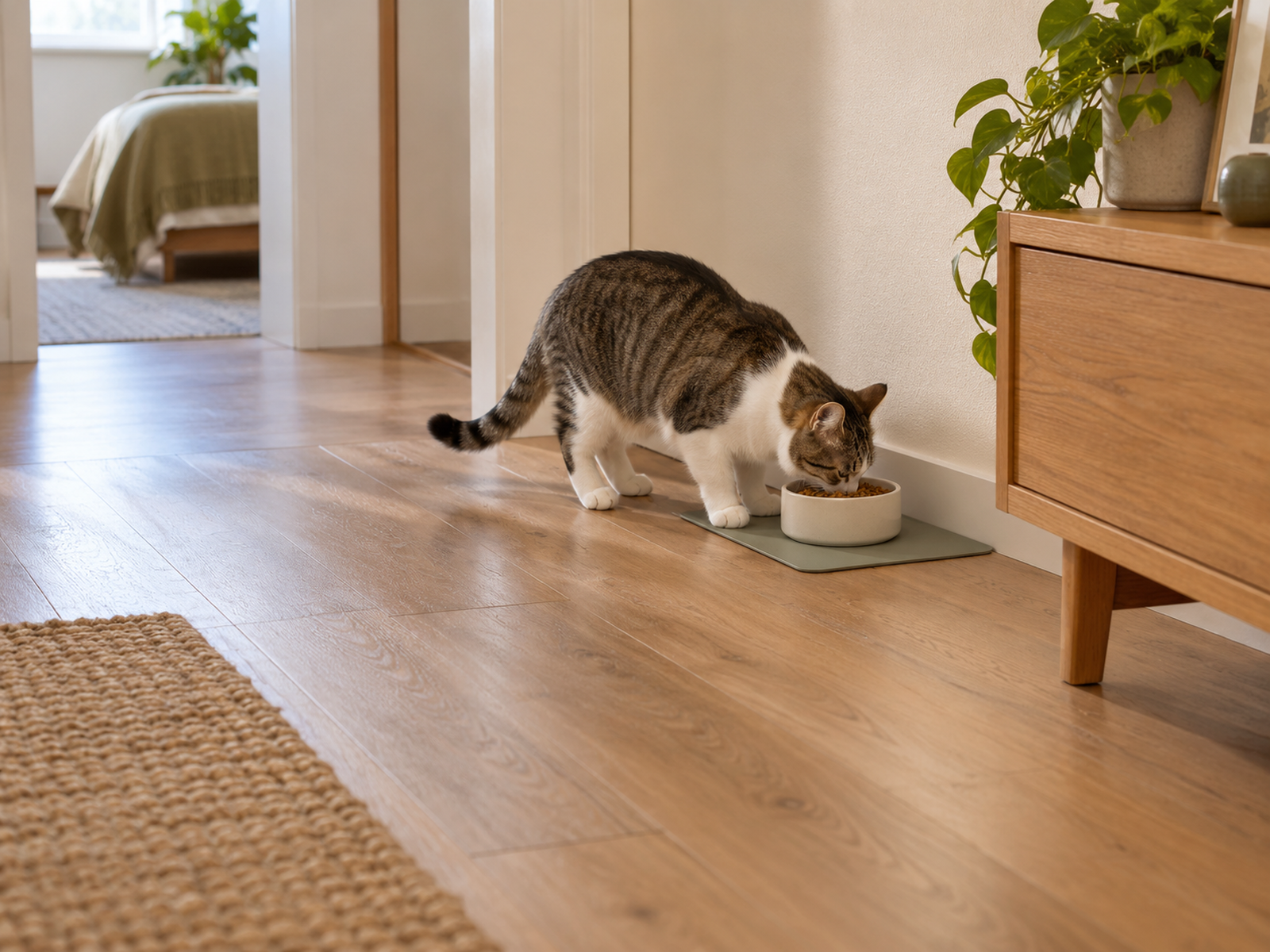
Map the cat resources before choosing a corner
Before placing bowls, mark the cat’s other recurring resources: litter, resting areas, scratching, play, and safe places. This prevents the feeding setup from claiming the only leftover spot and forcing incompatible functions together.
Current Feline Veterinary Medical Association environmental-needs guidance identifies food, water, toileting, scratching, play, and resting or sleeping areas as key resources and supports separating resources so cats can access them freely.
The practical small-space implication is not to build more furniture. It is to stop asking one tiny corner to perform every pet function.
02
Choose a quiet food zone
A good food location sits outside the main walking path while remaining easy for the cat to approach and leave. A quiet kitchen edge, dining-room edge, calm living-room wall, or small niche can work when the exact room geometry supports it.
Avoid doorway centers, kitchen pinch points, bedside step zones, or spots where noisy equipment repeatedly starts beside the bowl. Ohio State’s Indoor Pet Initiative advises providing food in a safe, quiet location.
Choose a stable, cleanable surface as well. A washable mat or tray can help with crumbs or wet-food residue when it lies flat, does not slide, and does not become a trip edge itself.
03
Give water its own micro-zone
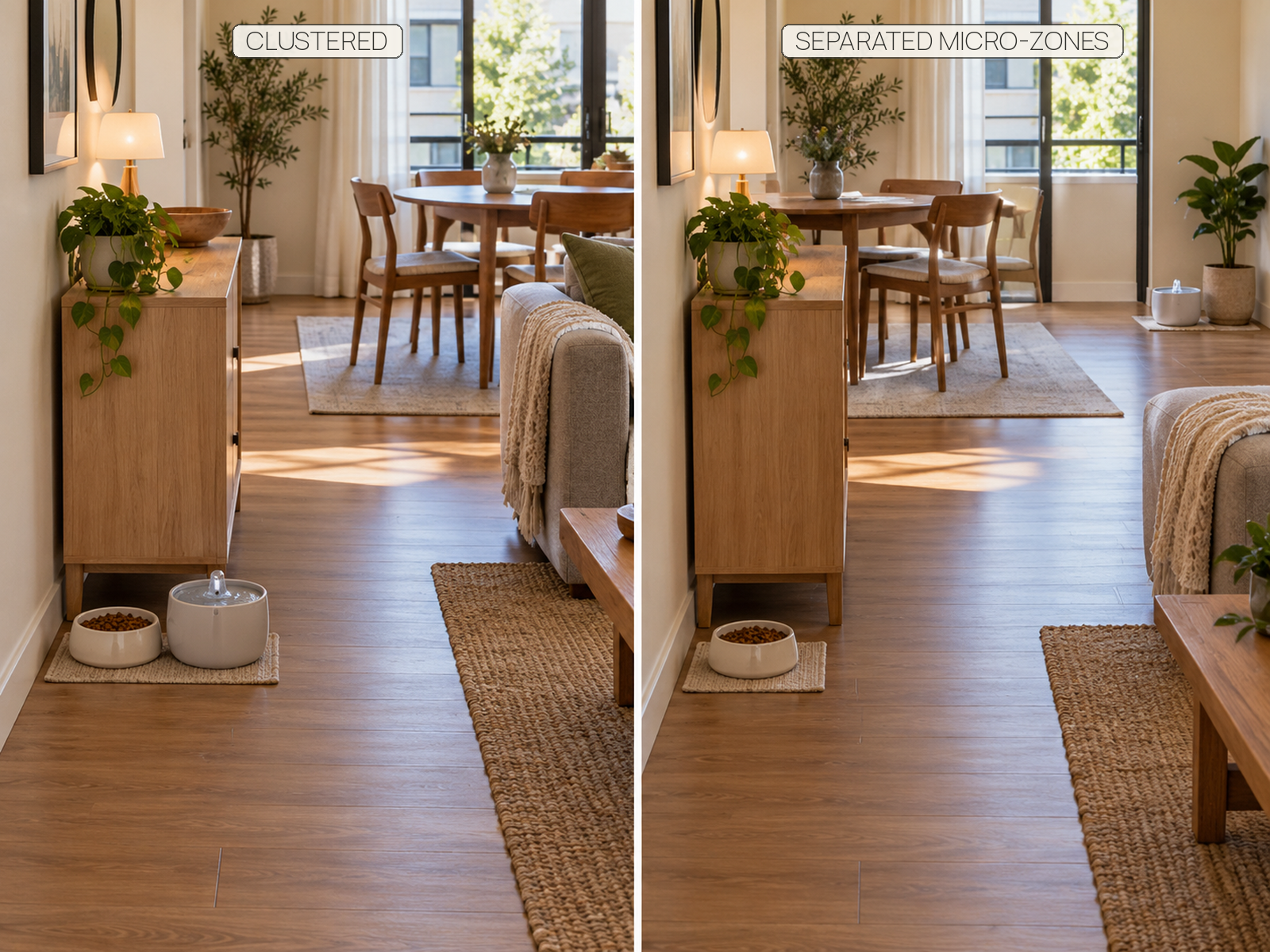
Water does not need to form a matching pair with the food bowls. A small zone on the opposite kitchen edge, along a living-room wall, in a quiet hallway nook, or in another workable room can be more useful than one larger combined station.
Feline guidance supports separating food and water resources, but this research does not establish a universal number of feet or inches between them. The goal is meaningful separation within the apartment you actually have.
Plan for spills and refilling. A water location that technically fits but sits in the only walking line or requires awkward cleanup is not a good small-space solution.
04
Keep litter out of the feeding system
Do not solve floor-space pressure by making one compact food-water-litter corner. Current feline guidance supports physical separation between toileting areas and other key resources.
Use the existing Aptly Small litter-box placement guide for the full litter decision. In this article, the boundary is simpler: the feeding plan should not consume the litter zone, and the litter solution should not be folded into the food setup merely for visual tidiness.
If the apartment has only a few workable edges, assign the resources across those edges rather than expecting one piece of pet furniture to contain everything.
Use / Skip
Decide whether a single pet station helps or hurts
Use
Use one compact food zone for the daily feeding routine
Keep the food bowl, a stable washable surface when useful, and only the daily handling items that genuinely make feeding easier.
Skip
Skip the all-in-one pet corner
Do not combine food, water, litter, bulk food storage, and every pet supply into one floor zone simply because it looks organized to the human.
05
Keep the daily routine compact
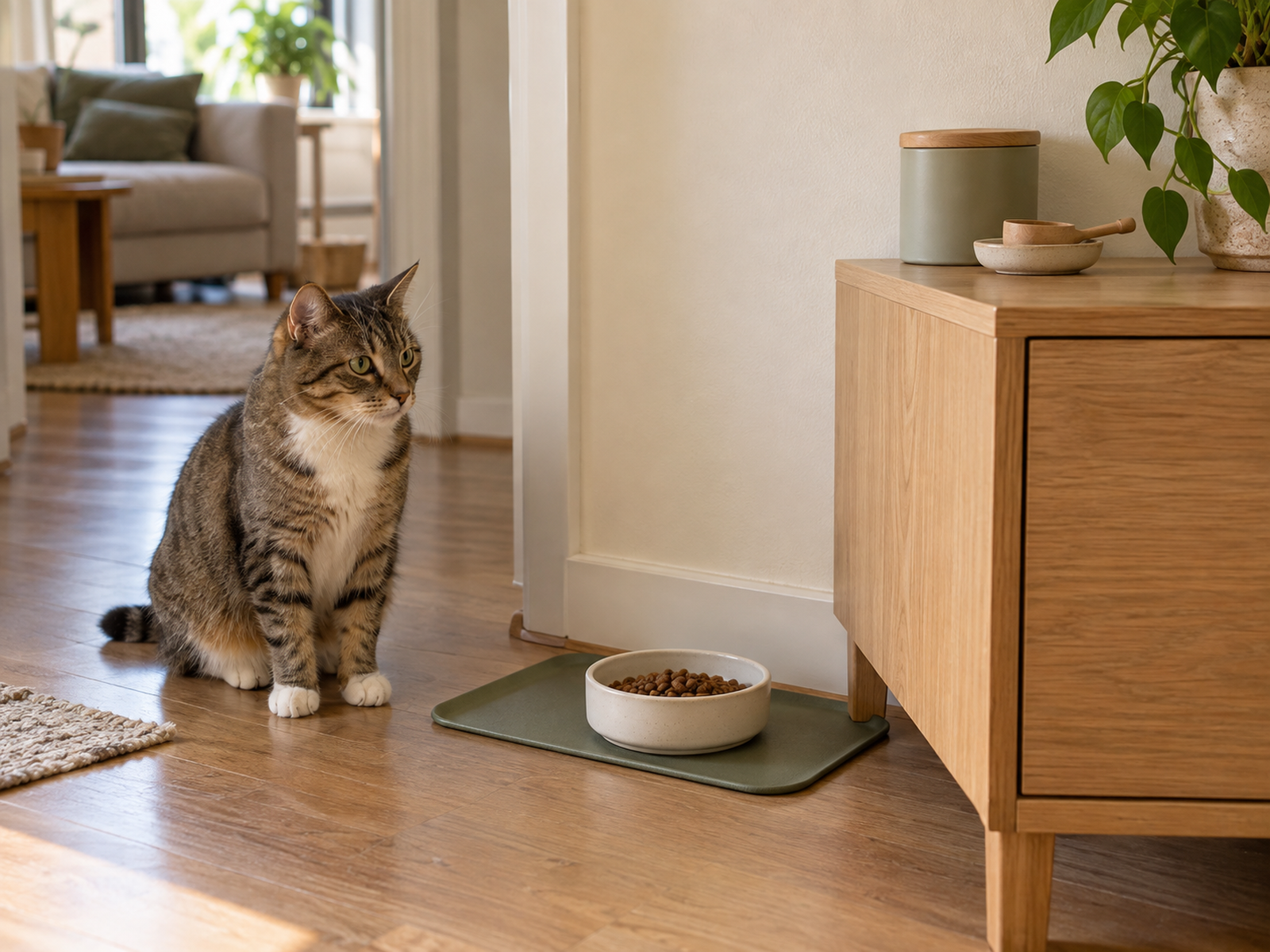
The active feeding zone does not need the entire food inventory. Keep only what supports daily serving nearby, such as the current food container and a dedicated scoop when that arrangement is practical.
Store backup or bulk food elsewhere in an appropriate secure location. That keeps the bowl area smaller and prevents the feeding footprint from expanding into a pantry substitute.
Cleaning access matters just as much as storage. FDA guidance says pet food bowls should be washed and dried after each use and water bowls washed daily; current CDC guidance likewise recommends cleaning wet-food bowls after every use and dry-food and water bowls daily. A hidden station that makes that routine difficult is not a strong long-term placement.
06
Add more feeding separation when the household needs it
Multi-cat homes can put much more pressure on a small floor plan. Current feline guidance supports multiple and separated resources, and intercat-tension guidance supports distributed feeding when competition is a concern.
Spatially, that can mean different room edges, separate rooms during meals, visual separation, or individual feeding points. The article does not diagnose food guarding or prescribe behavior treatment; it preserves the room-planning branch when one shared point is not working.
Dog or child interference can create a similar placement problem. Use a quiet protected room edge, an appropriate barrier, or another stable arrangement when needed. Elevation is not automatically the right answer for every cat.
What Not to Do
Do not make the smallest footprint the only goal
- Do not force food, water, and litter into one compact station just to save human floor area.
- Do not invent an exact separation distance that the guidance does not establish.
- Do not place bowls in doorway centers, kitchen pinch points, or other recurring trip paths.
- Do not hide bowls behind furniture or storage that must be moved for routine cleaning.
- Do not assume raised bowls, fountains, or specialized feeders are universally better.
- Do not use layout changes as a substitute for veterinary guidance when a cat suddenly eats much less, stops eating, loses weight, appears painful, vomits repeatedly, or shows other concerning changes.
The useful small-space system is distributed but simple: separate the resources that should be separate, keep each footprint modest, and make the daily human routine easy enough to maintain.
RELATED GUIDES
What to Read Next
NEXT GUIDE
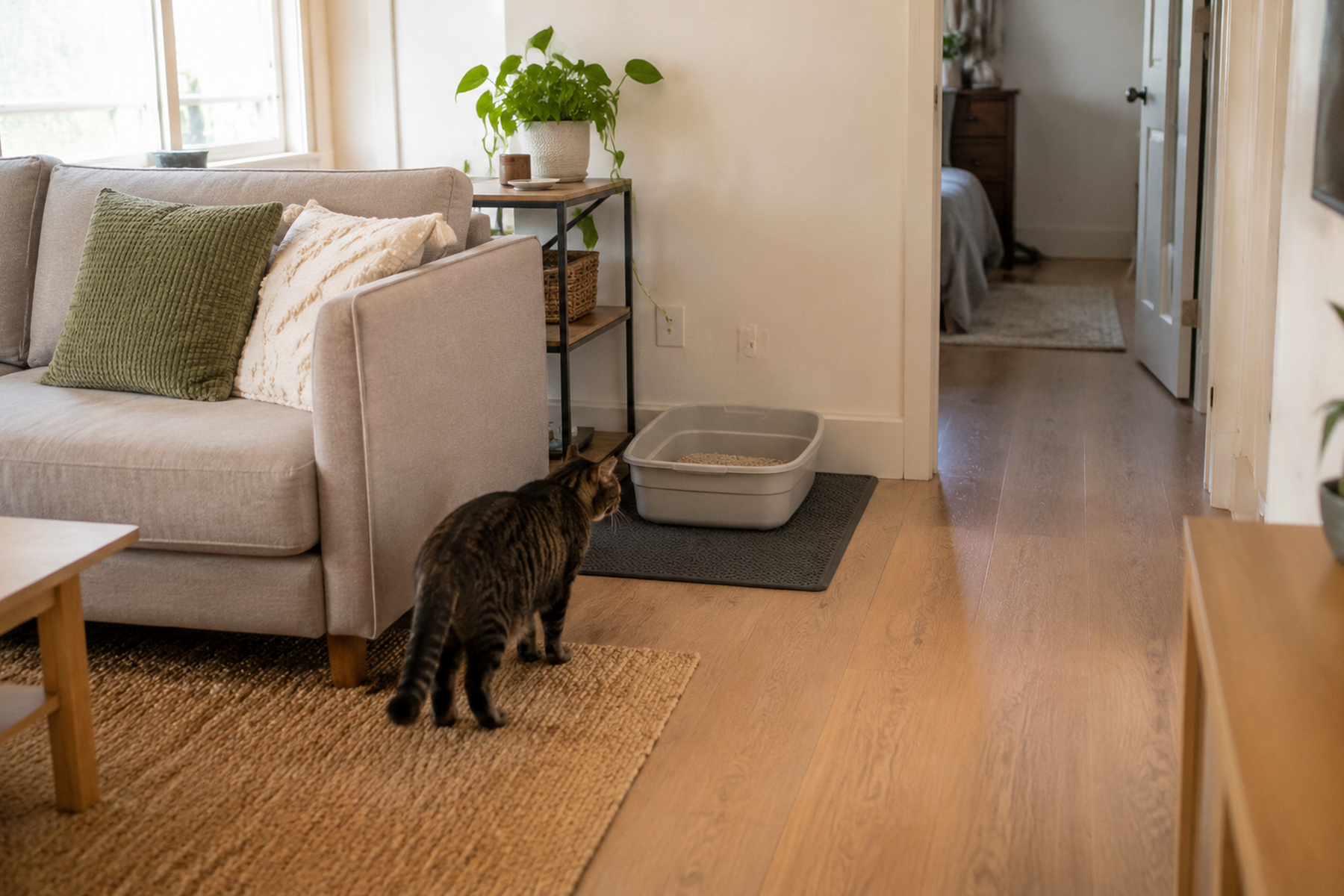
Where to Put a Cat Litter Box in a Small Apartment With No Good Spot
Use this to solve the toileting resource separately instead of letting litter placement collapse back into the feeding zone.
GUIDE
How to Store Dry Pet Food in a Small Apartment With No Pantry
Read this when bulk or backup food is expanding the feeding footprint and needs a separate secure storage system.
GUIDE
Where to Put a Dog Crate in a Small Apartment With Limited Floor Space
This is useful in mixed-pet homes where another pet resource also has to coexist with circulation and limited floor area.