
Small Apartment Storage Ideas
Where to Put a Dog Crate in a Small Apartment With Limited Floor Space
Start with the smallest crate that still fits the dog correctly, then plan the full deployed envelope—crate body, open door, human approach, and cleaning path—so the crate can share the living room or bedroom without blocking circulation or sacrificing ventilation.
In This Guide
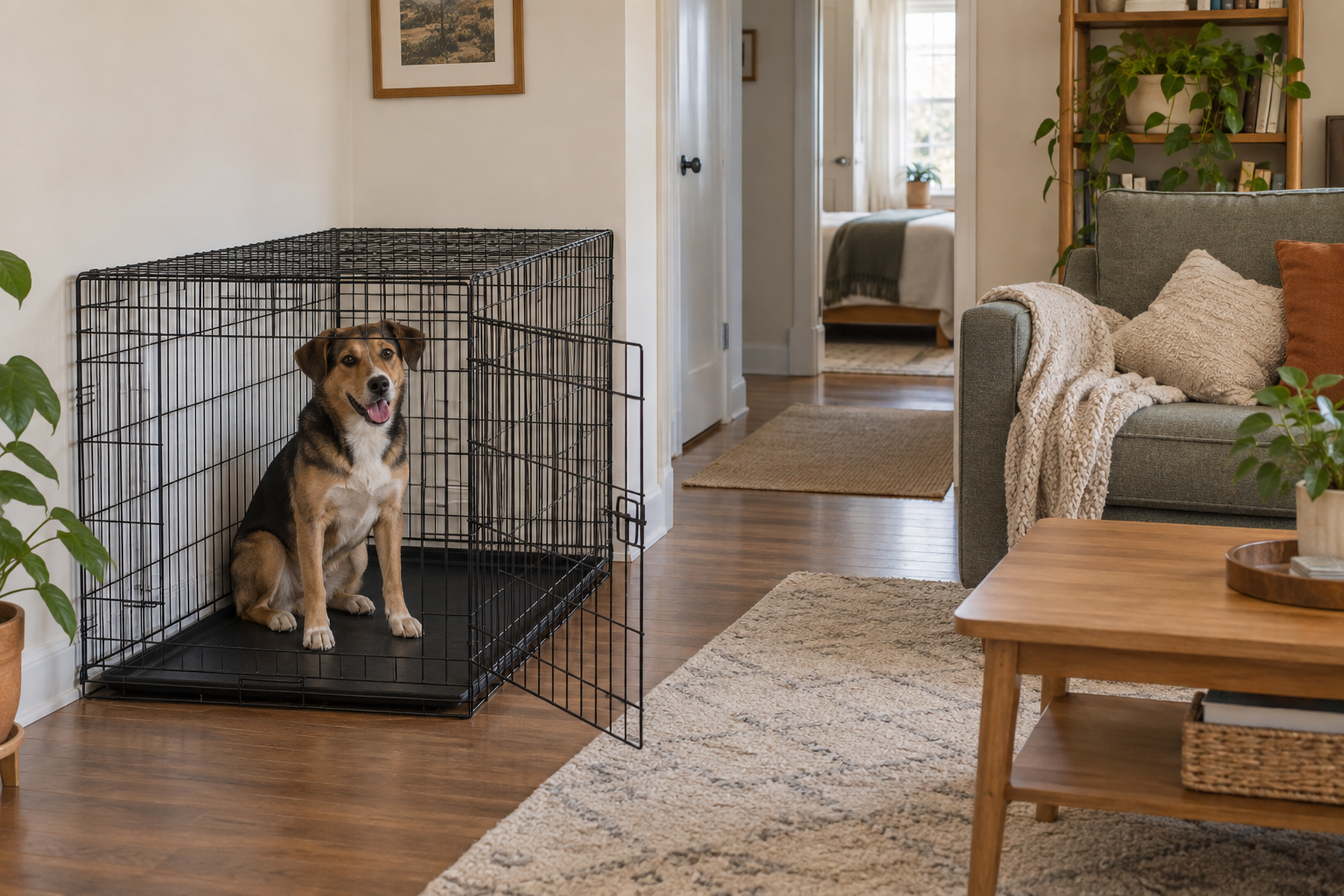
A dog crate can occupy the same kind of floor area as a small piece of furniture, but its minimum size is not negotiable in the same way. The dog still needs enough interior room to stand, turn around, and lie down comfortably, with adequate ventilation and practical access.
That means the small-space job starts after correct sizing. The useful question is where the correctly sized crate can live with the least damage to circulation, furniture use, cleaning access, and the dog’s place in everyday household activity.
Quick Answer
Fit the Dog First, Then Fit the Room
Do not shrink the crate until the apartment feels better. Establish the dog-fit minimum, then use door orientation, room placement, crate architecture, and later fold/store states to reduce the spatial cost.
01
Protect the dog-fit minimum
AKC, Humane World for Animals, and VCA all support the same basic boundary: the dog should be able to stand, turn around, and lie down or stretch out comfortably. Apartment size does not override that requirement.
02
Measure more than the crate body
Add the open door, the dog’s entry path, the human approach to the latch, and the removable-pan or cleaning route. A crate that fits only while closed can still fail the room.
03
Spend geometry before buying a smaller crate
A double-door model, different room orientation, furniture-style crate, or later fold-flat state can change how the footprint works without reducing the dog’s interior space.
01
Size the Crate for the Dog Before the Apartment
Start with the dog’s body, not the available corner. AKC says a crate should be large enough for the dog to stand, turn around, and lie down comfortably; Humane World for Animals and VCA give the same practical sizing boundary.
For a growing puppy, plan around the adult-size crate envelope when the likely adult size is known. Divider panels can reduce the usable interior area during growth without forcing the household to redesign the room around a succession of crate sizes.
Do not use weight alone as the sizing shortcut. Dogs with similar weights can differ in length, height, build, and resting posture, and individual crate manufacturers use their own sizing methods.
Once the dog-fit minimum is established, treat the outer crate rectangle as a fixed furniture-scale footprint that the apartment has to allocate honestly.
02
Measure the Full Operating Envelope
Measure the deployed crate body first, then add the space required to use it. The real apartment footprint includes the crate, the fully open door, the dog’s approach, the human reach to the latch, and the cleaning path.
Current MidWest wire-crate sizes show how quickly this becomes furniture-scale: manufacturer examples include roughly 36 × 23 inches for a 36-inch crate and about 42 × 28 inches for a 42-inch crate before door swing is added.
Protect normal circulation. Test apartment doors, sofa and chair use, desk-chair movement, bedroom routes, closet access, and the path people use at night so the crate does not become a permanent obstacle.
Include maintenance. A crate wedged precisely between furniture can still be a bad fit if the pan cannot slide out, the floor underneath cannot be cleaned, or the crate has to be dismantled for routine access.
Measure / Check First
Before committing to the room or buying a different crate style, tape or map the complete deployed envelope and test the room with the crate in normal use.
Check the Body, Door, Human Approach, and Cleaning Path First
01
The dog-fit interior and outer body
Confirm the dog can stand, turn, and lie down comfortably, then measure the crate’s actual outside width, depth, and height rather than relying only on the marketed length.
02
The door and entry envelope
Open every door the household expects to use and check dog entry, latch access, nearby furniture, walls, and the walking path. A second crate door can change placement options without changing the crate body.
03
The cleaning and room-use envelope
Test removable-pan access, vacuum or mop access, nearby furniture use, bedroom or living-room circulation, and any child or pet traffic that could make the chosen position difficult to maintain.
If the crate fits only when its door stays shut, the pan cannot be removed, or normal room movement repeatedly collides with it, change the orientation or crate architecture rather than reducing the dog’s required space.
03
Choose a Room Where the Crate Can Be Part of Normal Household Life
The emptiest room is not automatically the strongest location. VCA notes that dogs are social animals and recommends placing the crate in an area where the family spends time, such as a kitchen, den, or bedroom for nighttime sleep.
In a small apartment, that often means the living room or bedroom has to absorb the crate even when another isolated room has more spare floor area.
Choose the quietest viable edge of a regularly used room rather than the center of circulation. A wall-adjacent corner can work when the dog can enter easily, ventilation remains open, and furniture does not trap the crate.
Do not turn the article’s placement logic into behavioral or confinement-duration advice. Noise tolerance, training goals, distress, sleep arrangement, and individual dog needs belong with qualified training or veterinary guidance.
04
Use Door Orientation to Make the Same Crate Fit Better
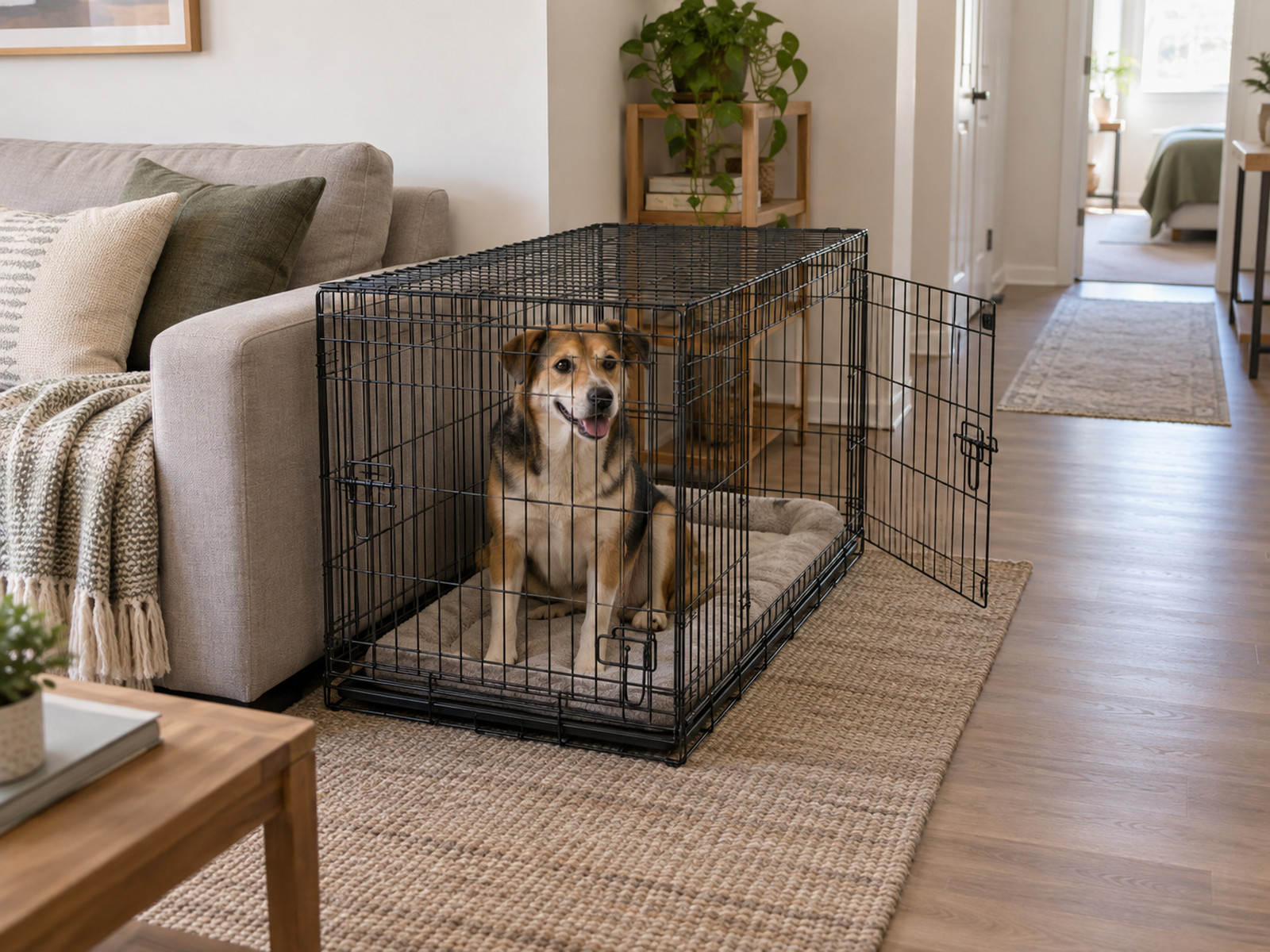
Before changing crate size, change access geometry. A second door can make the same correctly sized crate work against a different wall or beside furniture that would block a single front entrance.
MidWest explicitly markets double-door wire crates as providing more placement options in the home. The body footprint does not shrink; the benefit is choosing the entry side that costs the least room.
Test both doors in the actual floor plan. One door can face the open room for normal use while the other remains closed because it would interfere with a sofa, desk, or wall.
Keep latch access simple. A geometrically clever position is weak if the user has to reach behind furniture or climb over another object every time the crate door is opened.
05
Use a Furniture-Style Crate Only When It Earns the Footprint Safely
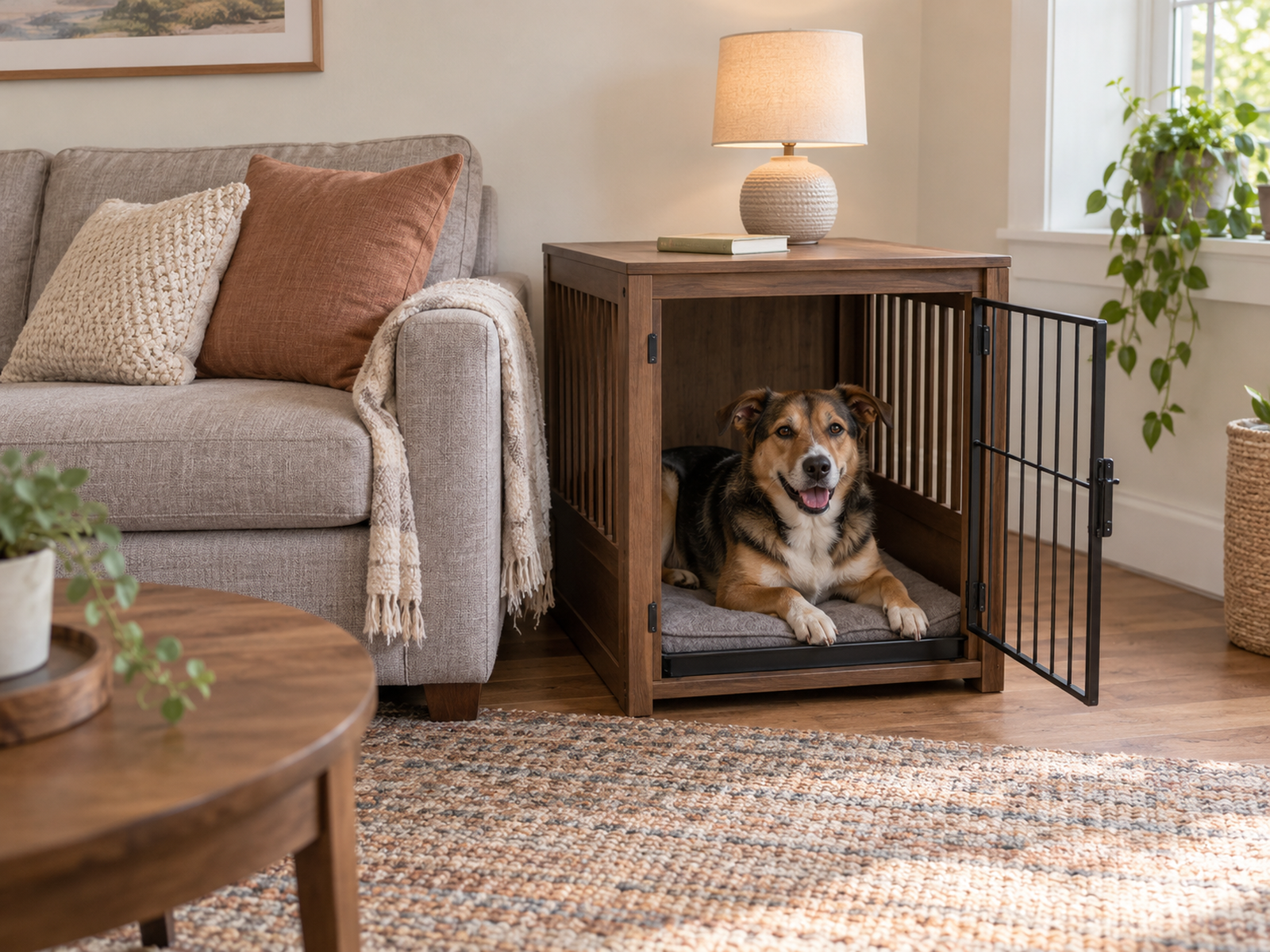
A purpose-designed furniture-style crate can make the same floor rectangle work harder by replacing an end table or another small surface in the room.
That is not the same as making the crate smaller. The dog still needs the correct interior dimensions, ventilation, door access, and cleanable surfaces.
AKC recognizes wood or furniture-like crates as a legitimate crate category but notes trade-offs including greater weight and harder cleaning compared with some other formats.
Use the top surface only as the product manufacturer allows. Do not place a tabletop over a standard wire crate or enclose a normal crate in DIY cabinetry on the assumption that the crate is a load-bearing furniture frame.
Use / Skip
A Furniture-Style Crate
Use
Use it when one correctly sized footprint can replace another piece of furniture
A furniture-style crate can be a strong shared-living-space choice when the dog fits correctly, ventilation and door access remain open, cleaning is practical, and the manufacturer actually designs the top or enclosure for furniture use.
Skip
Skip it when visual integration makes the crate harder to clean, ventilate, or move
Choose a wire, plastic, or other freestanding crate when the furniture model is too heavy, traps the crate against surrounding pieces, reduces airflow, complicates accident cleanup, or costs more floor area than the surface it replaces.
06
Choose the Crate Architecture for the Dog and the Apartment
Wire, plastic, soft-sided, and furniture-style crates solve different spatial problems. The apartment should not select a format on stored footprint alone.
AKC describes metal crates as sturdy with strong circulation and visibility, plastic crates as durable and easy to clean, soft crates as lightweight and usually foldable, and wooden crates as visually furniture-like but heavier and harder to clean.
Soft-sided crates can have an excellent stored footprint, but AKC notes they are not appropriate for every dog, particularly dogs likely to chew the fabric, and accidents can be harder to clean.
Use the dog’s actual suitability, ventilation, cleaning needs, travel needs, and frequency of deployment to decide which architecture earns the room—not the smallest product photo.
07
Fold or Store the Crate Only When Continuous Access Is No Longer Needed
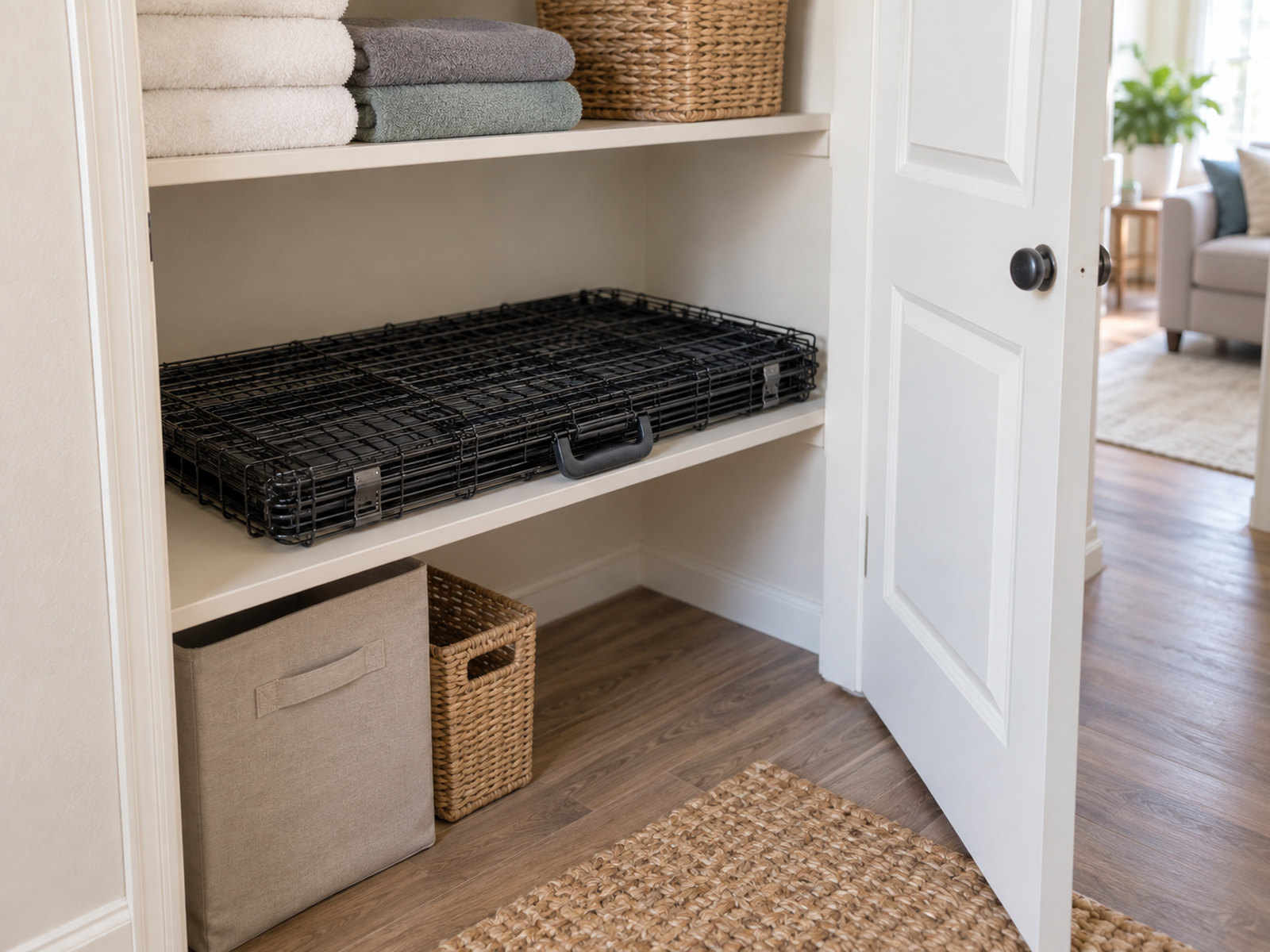
Folding wire crates can change the long-term space equation because many models collapse flat without tools. That stored state can remove most of the deployed floor rectangle when the crate is only needed occasionally.
The spatial option does not determine when a dog should lose continuous crate access. Some dogs continue to use crates voluntarily as rest zones, while other households may later need the crate only for travel, emergencies, or occasional management.
If occasional use remains, identify a real flat-storage location before folding the crate: under a bed if the dimensions work, beside a closet wall, behind appropriate furniture, or another dry zone where the crate will not tip or block circulation.
Keep setup friction honest. A crate that takes too long to retrieve or is buried behind stored items may be functionally unavailable when the household actually needs it.
08
Do Not Add a Playpen Unless the Apartment Can Afford a Second Pet Footprint
A playpen and a crate are different spatial architectures. A pen usually spends more floor area to provide more movement, while the crate creates a smaller rest or containment zone.
Current small-apartment owners explicitly report having room for one or the other rather than both. That makes the decision part of floor planning before it becomes a product purchase.
Do not treat the pen as a universal behavioral substitute for the crate, or the crate as a universal substitute for the pen. Individual training and management needs differ and are outside this storage article’s authority.
From a small-space perspective, buy only the pet zones the household has a defined use for. Two overlapping containment systems can consume a studio before either has been assigned a real daily role.
Closing Decision
Make the Crate Work Like a Room Zone, Not Leftover Floor Clutter
A successful crate setup starts with the dog’s minimum space and then makes the apartment adapt intelligently. The crate body, open door, human approach, and cleaning path all have to work before the location can be considered compact.
Use door orientation before shrinking the crate, choose a room that supports normal household life, and let furniture-style or fold-flat architectures change how the footprint is used only when dog fit, ventilation, cleanability, and practical access remain intact.
RELATED GUIDES
What to Read Next
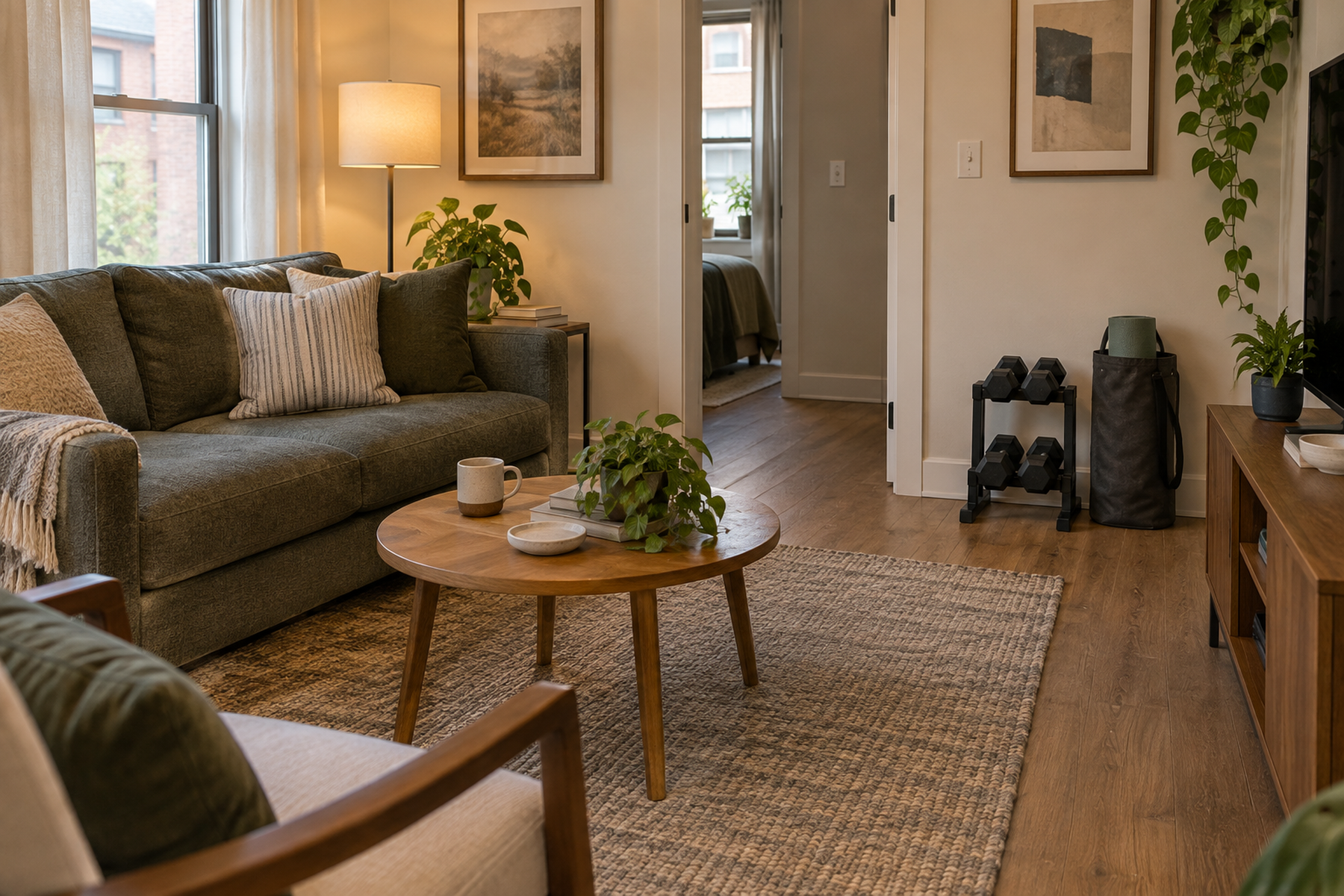
NEXT GUIDE
How to Store Workout Gear in a Small Apartment Without a Dedicated Workout Room
Use this next if the dog crate is competing with exercise equipment in the same living room or bedroom; that guide handles another large shared-room function without giving either category automatic priority.
GUIDE
Where to Put a Cat Litter Box in a Small Apartment With No Good Spot
Use this if the household also needs a cat zone; that guide applies the same principle that blank floor is not usable when access, circulation, and the animal’s functional needs already claim it.
GUIDE
How to Create Entryway Storage When Your Apartment Has No Entryway
Use this if the crate is competing with the apartment threshold; that guide protects the arrival route and circulation instead of turning the entrance into overflow storage.