
Small Apartment Storage Ideas
Where to Put a Cat Litter Box in a Small Apartment With No Good Spot
Choose the cat-acceptable floor zone first—then fit the box, cleaning route, circulation, and renter-friendly concealment around it instead of forcing the smallest tray into the most hidden gap.
In This Guide
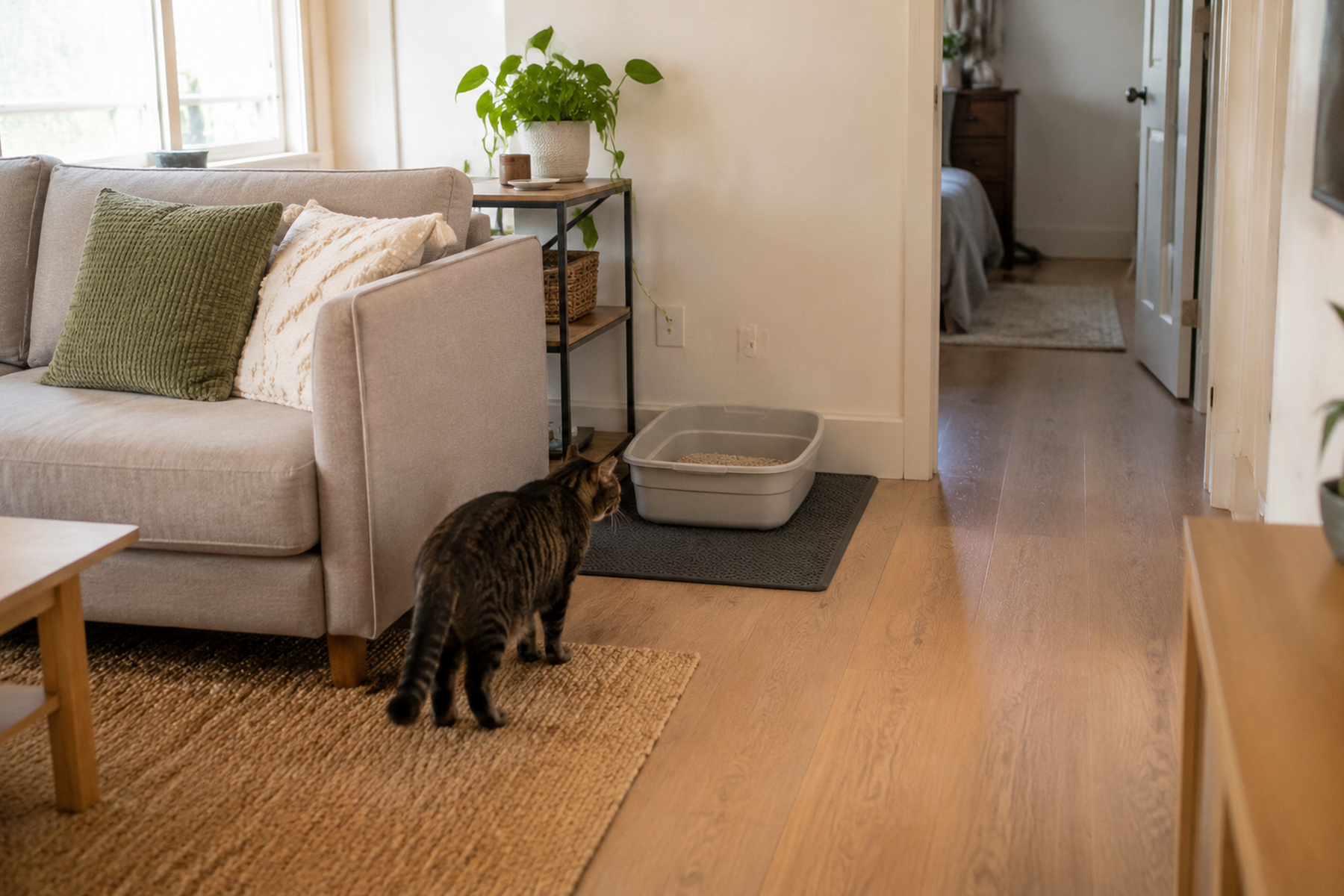
A small apartment may have no utility room, spare bathroom, or unused corner that can absorb a litter box without affecting another daily function. The remaining choices can all feel compromised: a bathroom standing zone, a living-room edge, a bedroom corner, a closet, or a piece of enclosure furniture.
The location still has to work for the cat before it works visually for the room. Reliable access, enough box space, a usable entry and exit route, separation from food and water, daily cleaning access, and human circulation are the hard constraints; concealment comes after those pass.
Quick Answer
Find a Valid Zone Before You Try to Hide the Box
Start with a location the cat can reach reliably, fit a properly sized box there, and count the full footprint needed for entry, exit, scooping, refill, and cleaning—not just the tray itself. Only after that zone works should privacy screens, furniture, or other concealment be considered.
01
Start with cat access, not concealment
Reject locations that are routinely closed off, very busy, intimidating, or easy for another pet to block. A visible low-traffic edge can be a better small-space solution than a hidden dead end.
02
Size the box before the leftover gap
Current feline guidance recommends a box large enough for normal movement and commonly uses about 1.5 times the cat’s length from nose to base of tail. If only an undersized tray fits, the location may be the problem.
03
Count the whole operating footprint
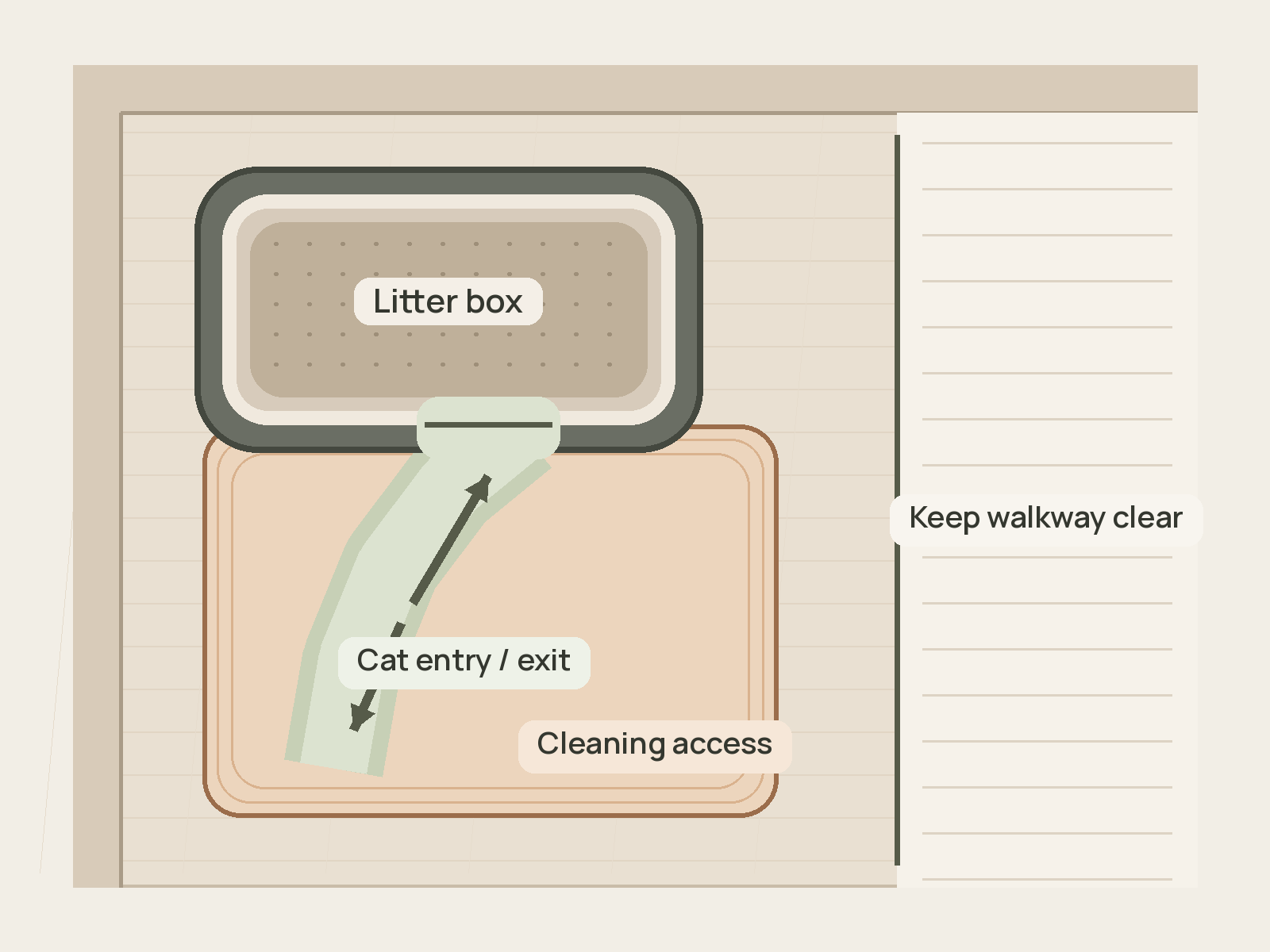
Budget for the tray, the cat’s entry and exit path, and the space a person needs to scoop, refill, remove, and clean the box. The footprint is larger than the plastic base alone.
01
Choose a Cat-Acceptable Zone Before You Hide the Box
Start by listing the floor zones the cat can reliably reach, not the places where humans would most like the litter box to disappear.
Current Cat Friendly Homes litter-box guidance prioritizes quiet or private placement, easy access, distance from food and water, and locations where the cat is not cornered or unable to leave. Its current house-soiling guidance reinforces the importance of access, escape, and multiple resource locations.
That immediately weakens some common small-apartment hiding ideas. A closet that is routinely shut, a narrow dead-end alcove, a hall edge everyone passes through, or a cabinet another pet can guard may save visual space while making the toileting zone less reliable.
Treat the room name as secondary. A living-room edge can pass these tests while a bathroom or closet fails them. The useful unit is the specific micro-location: how the cat approaches it, what happens around it during the day, and whether the route stays open.
02
Size the Box and Count the Boxes Before the Room
A leftover gap is not a valid litter-box zone simply because a compact tray can be squeezed into it.
Cat Friendly Homes currently recommends a box about 1.5 times the cat’s length from nose to base of tail and large enough for the cat to enter, turn, scratch, and eliminate. The AAFP / ISFM house-soiling guidance supports the same general size recommendation.
Box count also belongs in the space plan. Current Cat Friendly Homes and ASPCA litter-box guidance commonly uses one box per cat plus one additional box and recommends distributing boxes rather than treating several side-by-side trays as fully separate resources.
That is a behavioral guideline, not a building-code rule, but it matters in a studio or one-bedroom apartment because the spatial budget may be larger than one hidden cabinet. Do not erase the requirement from the plan merely because it is inconvenient; first understand what the household and cat actually need.
Measure / Check First
Once the required box size and likely box count are clear, test each candidate location as an operating zone rather than a tray-shaped rectangle.
Check the Whole Litter-Box Zone
01
Box + cat movement
Confirm the actual box fits with enough room for the cat to enter, turn, scratch, and leave. Do not let furniture, a wall, or a privacy screen turn the entrance into a cramped one-way slot.
02
Doors + human circulation
Open every nearby door and use the room normally. Preserve sink, toilet, bed, seating, and walkway access instead of measuring only the empty floor when nothing is moving.
03
Cleaning + always-open access
Leave enough space to scoop daily, lift or remove the tray, clean tracked litter, and keep the cat’s route available at all times. A location that requires moving heavy furniture for routine care is too expensive operationally.
If the zone passes only when the box becomes too small, the door stays open unnaturally, or normal cleaning becomes awkward, reject the zone and test the next location.
03
Use a Bathroom Edge Only When the Floor Still Works
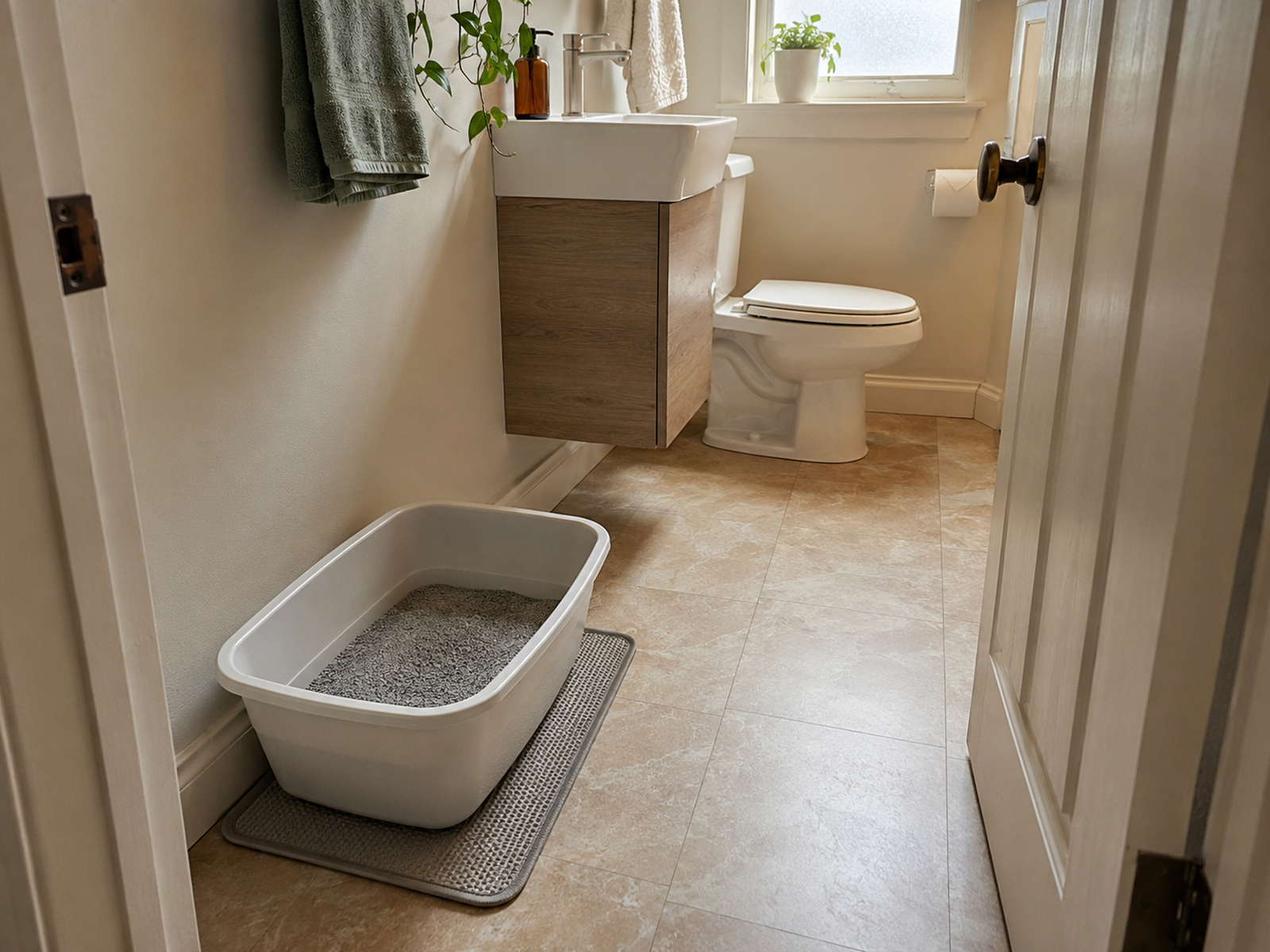
Bathrooms are attractive litter-box candidates because the floor is usually easy to clean and the box can stay out of the main living field. In a very small bathroom, though, that advantage can disappear quickly.
Test the exact edge of the room. The box should not sit in the only place a person can stand at the sink, prevent normal toilet or shower use, collide with the door swing, or leave the cat with one cramped route between fixtures.
The room also has to stay available. If people routinely close the bathroom door, the location is unreliable unless the household has another approved way to preserve cat access.
When the geometry passes, a simple open box on a removable mat can be a strong renter-friendly choice. When it does not, forcing the bathroom because it feels like the “correct” room only trades one problem for another.
04
A Low-Traffic Living-Room Edge Can Be the Right Answer
If the bathroom cannot support a usable box, a low-traffic living-room edge may be the lowest-conflict location even though the litter box is more visible.
Look for a true room edge beside existing furniture where the cat can approach and leave without crossing a feeding area or squeezing behind obstacles. Keep the box outside the main path between the entry, sofa, dining area, and other daily destinations.
Visibility is a human trade-off; access and cleanability are functional requirements. A visible box that is correctly sized, easy to scoop, and easy for the cat to use can outperform a beautiful enclosure that is cramped or hard to reach.
If litter tracking is the main objection, use a removable floor-protection or tracking zone that does not become a trip hazard or narrow the cat’s entrance. That keeps the intervention reversible and renter-friendly.
05
Use a Bedroom Edge Only If Access Stays Reliable
A bedroom can offer lower traffic and fewer sudden disturbances than the center of a living area, which may make a genuine residual corner workable.
The trade-off is human comfort and door behavior. The box should not sit in the path between the bed and the door, beside a place where bare feet repeatedly land, or in a room the cat is excluded from overnight.
Older or mobility-limited cats may need easier same-level access and a lower entry. Current Cat Friendly Homes accessibility guidance specifically recommends easy-to-reach litter boxes and lower-entry options when mobility is reduced.
A quieter room is only an advantage when the cat can actually reach it. If the bedroom door is regularly closed, choose another primary zone or maintain another reliably accessible litter-box location.
06
Add Visual Privacy Without Turning the Box Into a Trap
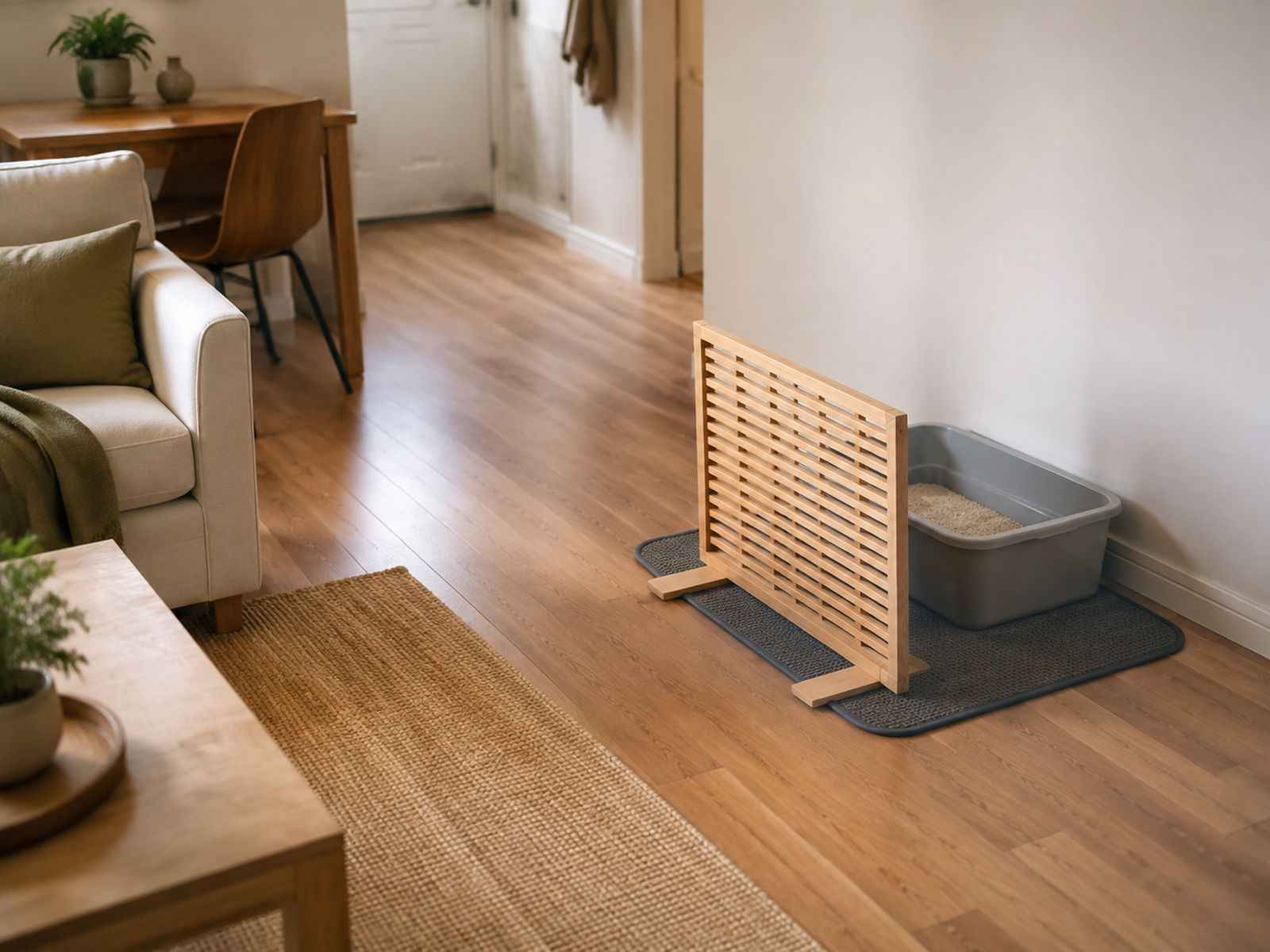
Once a location passes the cat-use and human-clearance tests, visual privacy can be added as a second layer.
A low freestanding screen can reduce the direct sightline from a sofa or entry without sealing the box inside furniture. Keep more than a narrow one-way opening, leave the cat’s approach and exit readable, and make the screen easy to move for scooping and floor cleaning.
Freestanding litter-box furniture can also combine functions, but measure the usable interior rather than trusting the exterior furniture footprint. The enclosure still has to fit the real box, preserve entry and exit, open far enough for cleaning, and remain stable.
Cat preference matters here. Cat Friendly Homes notes that many cats do not like covers or liners, while some shy cats may prefer a covered box; Cornell’s cat-care guidance similarly notes that most, but not all, cats prefer simple boxes without hoods. Concealment is therefore conditional rather than an automatic upgrade.
07
Treat Closets, Cabinets, and Automatic Boxes as Conditional
Hidden locations and specialized products can be useful, but each one introduces a new constraint that has to be paid for somewhere else.
Closet or alcove
A closet spends storage capacity and can become a narrow dead end. Use it only when the door cannot routinely lock the cat out, the box fits without being crowded by stored items, the cat can leave freely, and a person can clean the area without unloading the closet.
Built-in or under-sink cabinet
Plumbing, shelves, narrow openings, and cabinet doors can reduce usable interior space. Cutting a door, adding a pet opening, removing built-in parts, or modifying cabinetry is a real renter / property decision, not a default reversible hack.
Automatic or self-cleaning box
An automatic unit may reduce manual scooping frequency for some households, but it can require more floor area, power, and service clearance than a simple tray. Cat acceptance also varies; ASPCA guidance notes that when a cat using a self-cleaning box begins eliminating outside it, trying a traditional box is appropriate.
08
Keep Odor Control Tied to Cleaning, Not Risky Gadgets
Odor anxiety can push a small-space layout toward an overly hidden enclosure or toward devices that do not belong in occupied living space.
Start with maintenance. Current Cat Friendly Homes guidance recommends removing waste at least daily, and ASPCA general cat-care guidance similarly advises daily scooping. A location that makes that routine awkward is creating an odor problem by increasing cleaning friction.
Do not use an ozone generator as a normal litter-odor solution in an occupied apartment. The U.S. Environmental Protection Agency states that no federal agency has approved ozone generators for use in occupied spaces and that ozone can cause health problems. EPA also notes that concentrations within public-health standards have little potential to remove indoor contaminants effectively.
If odor remains unusually strong despite appropriate litter-box maintenance, do not solve it by sealing the cat into an undersized enclosure or adding unsupported air-treatment claims. Recheck cleaning, box condition, litter setup, and the broader cat-care context instead.
09
Know When the Layout Needs a Bigger Change
Some apartments genuinely have no low-conflict litter-box location in their current furniture arrangement.
If every candidate zone fails because only an undersized box fits, access is unreliable, the cat can be trapped, food separation is impossible, or the box blocks essential human circulation, the next move is not a more elaborate hiding product. Reassign another piece of furniture, move a feeding station, free a better floor edge, or reconsider how another apartment function is using the available space.
Keep the veterinary boundary clear as well. Sudden or persistent litter-box avoidance can have medical or behavioral causes; both ASPCA and current Cat Friendly Homes guidance direct owners toward veterinary evaluation when elimination behavior changes or problems persist.
Aptly Small can solve the floor-plan problem. It should not treat a new house-soiling pattern as proof that the apartment simply needs a prettier litter-box location.
Closing Decision
Choose the Lowest-Conflict Valid Zone, Not the Best Hiding Place
A small apartment does not need a perfect litter-box room; it needs a valid micro-location. Start with reliable cat access, adequate box size and distribution, a clear entry and exit path, food separation, and daily cleaning access. Then compare which candidate zone costs the least human function.
That may be a bathroom edge, a visible living-room corner, a bedroom residual zone, or a carefully measured freestanding enclosure. Keep renter modifications conditional, treat concealment as optional, and reject any setup that only works by shrinking the box or blocking normal movement.
RELATED GUIDES
What to Read Next
NEXT GUIDE
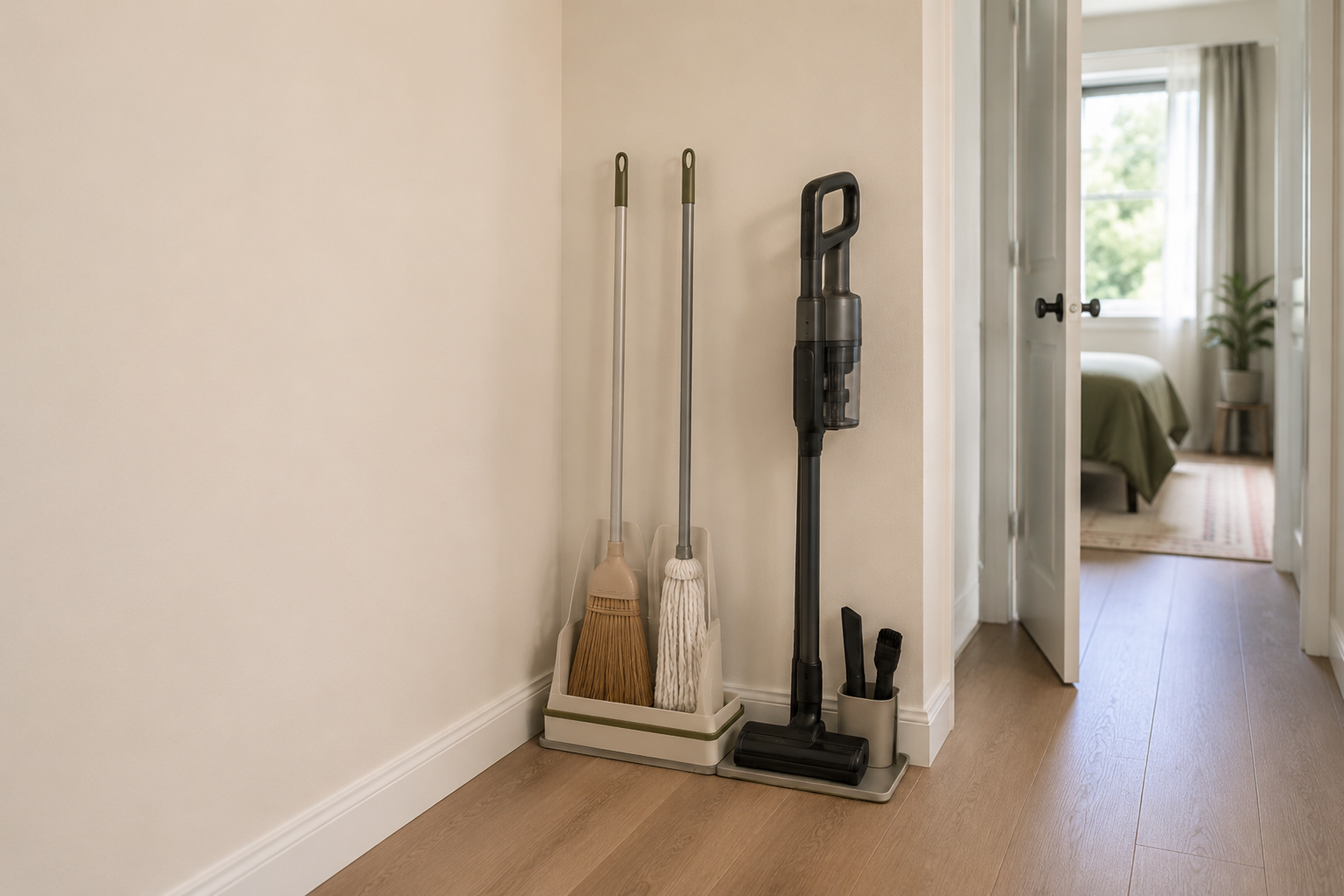
How to Store a Broom, Mop, and Vacuum in a Small Apartment With No Utility Closet
Once the litter-box zone is settled, use this guide to keep the broom, vacuum, and other cleaning tools accessible without giving up the same scarce apartment floor area.
GUIDE
How to Dry Clothes Indoors in a Small Apartment With No Dryer
Use this if indoor laundry drying also creates a recurring temporary floor zone and you need to keep drying racks out of the cat’s reliable litter-box route.
GUIDE
How to Store a Bike in a Small Apartment With No Bike Room
If a bike is another large object competing for low-traffic wall edges and circulation space, this guide helps separate that bulky storage problem from the litter-box zone.