
Small Closet Organization
What to Do When a Closet Is Too Shallow for Hangers
Measure the real hanger-and-garment collision before changing the closet. If the cavity itself is too shallow for normal side-facing hanging, change the hanging orientation, move only the garments that truly need hanging, or let the closet do a different storage job instead of forcing the doors around the clothes.
In This Guide

A shallow closet can have a perfectly real clothes rod and still fail as hanging storage. The problem is three-dimensional: hanger shoulder width, garment bulk, rod position, and the closed-door plane all have to fit inside the same cavity.
Start by identifying the exact collision. If only the rod is badly placed, normal side-facing hanging may be salvageable. If the whole cavity is too shallow, the solution has to change orientation, location, or closet function rather than simply squeezing the hangers harder.
Quick Answer
Diagnose the Depth Problem Before You Buy Special Hangers
The right fix depends on which dimension is failing. Test a representative hanger with the actual garment and close the door before deciding whether to move the rod, change hanging orientation, or stop using the closet for conventional hanging.
01
Measure a loaded hanger, not an empty closet
Use a shirt, jacket, or coat that represents what you actually hang. Garments can project beyond the hanger, so an empty hanger alone does not prove the door will close.
02
Separate hanger width from hanger thickness
“Slim” hangers usually save space along the rod. They do not automatically reduce the shoulder width that causes a shallow-closet door conflict.
03
Let the closet change jobs if the geometry is wrong
A shallow closet may be excellent for folded clothes, shoes, bags, or accessories even when ordinary side-facing hanging is impossible. Move only the garments that genuinely need full hanging depth.
01
Measure the Hanger, Garment, Rod, and Door Together
Measure the closet’s clear interior depth, the rod-to-back-wall distance, the rod-to-closed-door plane, and the way the door moves through the opening.
Then measure a representative hanger with the garment on it. IKEA’s current BUMERANG standard hanger is 16 7/8 inches wide, while its coat hanger is 18 inches wide, illustrating why one hanger dimension cannot represent every garment.
Do not stop at the hanger. A structured jacket, coat, or wide-shouldered shirt can project beyond the hanger itself and become the part that rubs the door.
Finally, close and open the actual door with the garment hanging normally. The closet is only validated for side-facing hanging when the loaded garment clears the door in normal use, not when an empty hanger happens to fit.
02
Decide Whether the Rod Is Wrong or the Closet Is Truly Too Shallow
A rod can create a shallow-closet problem even when the cavity has enough total depth. If it sits too close to the back wall, the hanger may project unnecessarily into the door plane.
Test whether a different rod position would place the loaded garment fully inside the closet while still leaving proper support, door closure, and usable access.
If the cavity itself is not deep enough, moving the rod cannot manufacture depth. Pushing the rod forward may simply move the garment farther into the door or bedroom.
This is the main diagnostic split: bad rod offset can sometimes be corrected; insufficient total depth requires a different hanging orientation or a different storage function.
Measure / Check First
Before moving hardware, removing a door, or buying another organizer, test the closet with the real garment envelope.
Check the Loaded Garment, Door Plane, and Alternative Orientation First
01
The representative hanger and garment
Measure the hanger shoulder width and the actual garment projection for the shirts, jackets, or coats that matter most. Test more than one garment type if the wardrobe is mixed.
02
The rod and closed-door geometry
Measure rod-to-back-wall distance, rod-to-door-plane distance, door thickness or track where relevant, and the full closing path for hinged, bifold, sliding, or bypass doors.
03
The front-facing width trade
If side-facing hanging fails, test whether the closet has enough width for a short front-to-back or perpendicular rail and whether layered garments would still be usable.
If the only way to close the door is to crush garments, twist hangers diagonally, or force the door against clothing, stop treating the closet as successful conventional hanging storage.
03
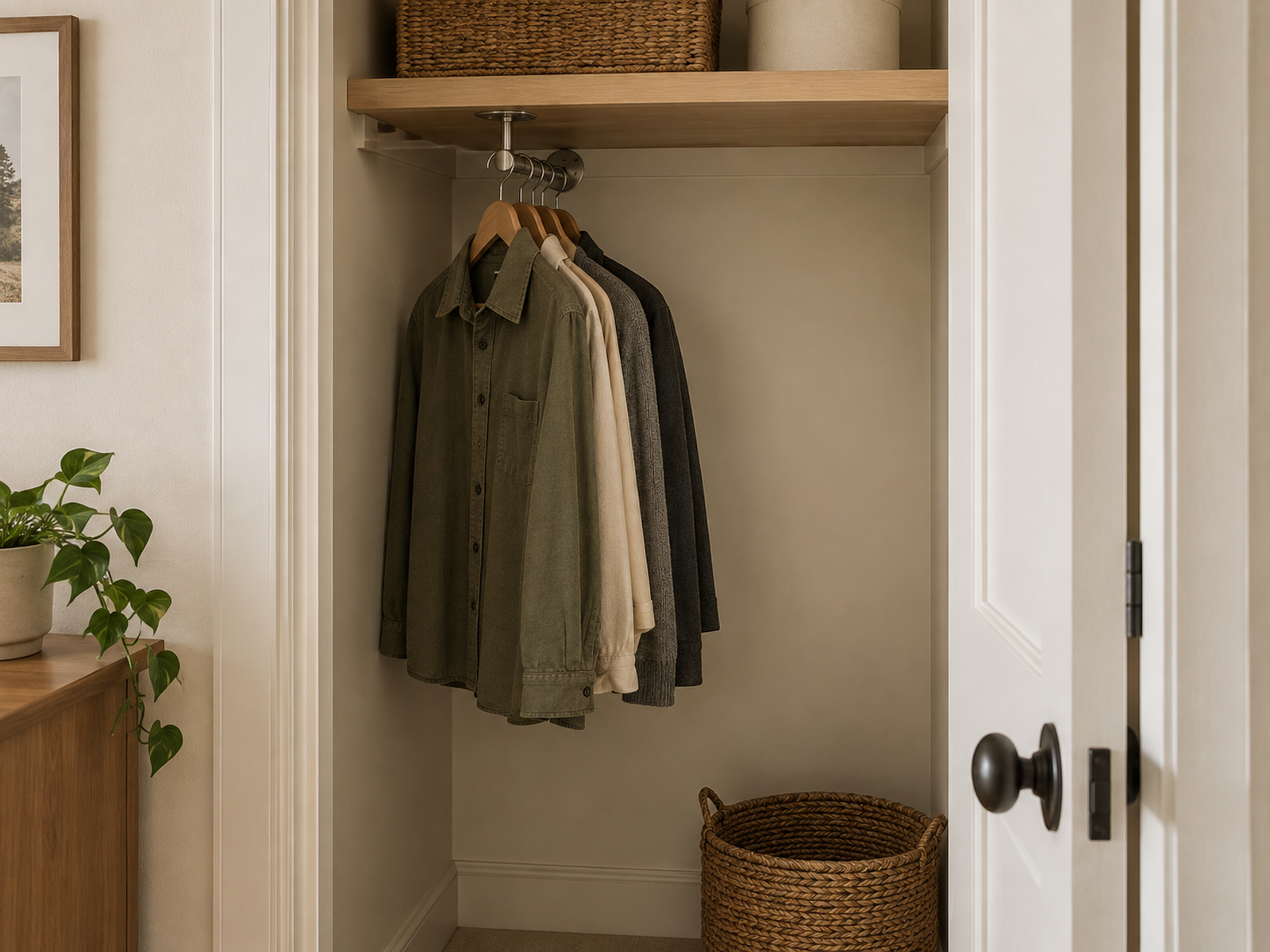
Use Front-Facing Hanging When Depth Is the Binding Constraint
Front-facing hanging rotates the hanger geometry so the shoulder width runs across the closet width instead of across the closet depth.
This is a real engineered solution, not a workaround invented for tiny apartments. IKEA’s current shallow KOMPLEMENT clothes rod is designed to let garments hang forward-facing in a 13 3/4-inch-deep wardrobe frame.
The trade-off is access. Garments sit behind one another instead of side by side, so the front item can hide the pieces behind it and the usable capacity depends on the rail length, garment bulk, and load rating.
Use this orientation for the portion of the wardrobe that truly needs hanging rather than assuming it will perform like a full conventional rod.
04
Choose Fixed, Swing, or Pull-Out Front-Facing Hardware by Access Need
A fixed perpendicular rail is the simplest form when the closet is shallow but the user can reach the layered garments comfortably.
A pivoting or swing rail can improve access by bringing the garments outward. Häfele currently sells a shallow swing wardrobe rail that pivots and uses screw-mounted installation, showing the trade between better access and more installation commitment.
Telescoping or valet-style hardware can also bring a short set of garments forward. Current Rev-A-Shelf valet products have model-specific load and mounting rules, and some in-panel versions require drilling.
Do not use selective-access valet hardware as though it automatically replaces a full wardrobe rod. Confirm the intended load, garment count, installation surface, and lease permission for the exact product.
Use / Skip
Front-Facing Hanging Inside the Shallow Closet
Use
Use it when preserving in-closet hanging matters more than side-by-side visibility
Front-facing hanging can be a strong fit when the closet is genuinely too shallow for ordinary hanger orientation, the available closet width supports a short rail, the hanging wardrobe is modest enough to layer front-to-back, and the hardware can be installed safely within the rental rules.
Skip
Skip it when layered access or installation makes the closet harder to use
Reassign the closet to folded storage and move hanging elsewhere when the front garment hides too much inventory, the rail would hold too little, screw-mounted hardware is not permitted, or the closet width is too limited for a useful front-facing run.
05
Do Not Expect Slim Hangers to Solve the Wrong Dimension
A thin hanger can increase the number of garments that fit along the rod, which is valuable when rod crowding is the problem.
That does not mean it reduces the hanger’s shoulder width enough to fix a door collision. IKEA’s BUMERANG example is only 9/16 inch thick but still 16 7/8 inches wide.
If a narrower or folding hanger is being considered, compare its actual shoulder geometry with the existing hanger and the garment it will support. Do not rely on the word “slim.”
Also avoid undersizing a hanger solely to force the door closed if the hanger no longer supports the garment correctly. The storage solution still has to respect the clothing.
06
Remove or Change the Door Only When the Door Is the Real Constraint
A door can be the binding problem even when the closet cavity itself has enough room for the garment.
Removing a hinged, bifold, or other door may eliminate the collision, but it also changes the room: clothing can project into the bedroom, visual containment disappears, and the removed door has to be stored and later reinstalled.
A curtain or open closet can be workable when the renter is permitted to make the change and the bedroom can tolerate the projection.
Do not use door removal to disguise a cavity that is fundamentally too shallow. If the clothes still extend well beyond the closet opening, the storage problem has simply moved from the closet into the room.
07
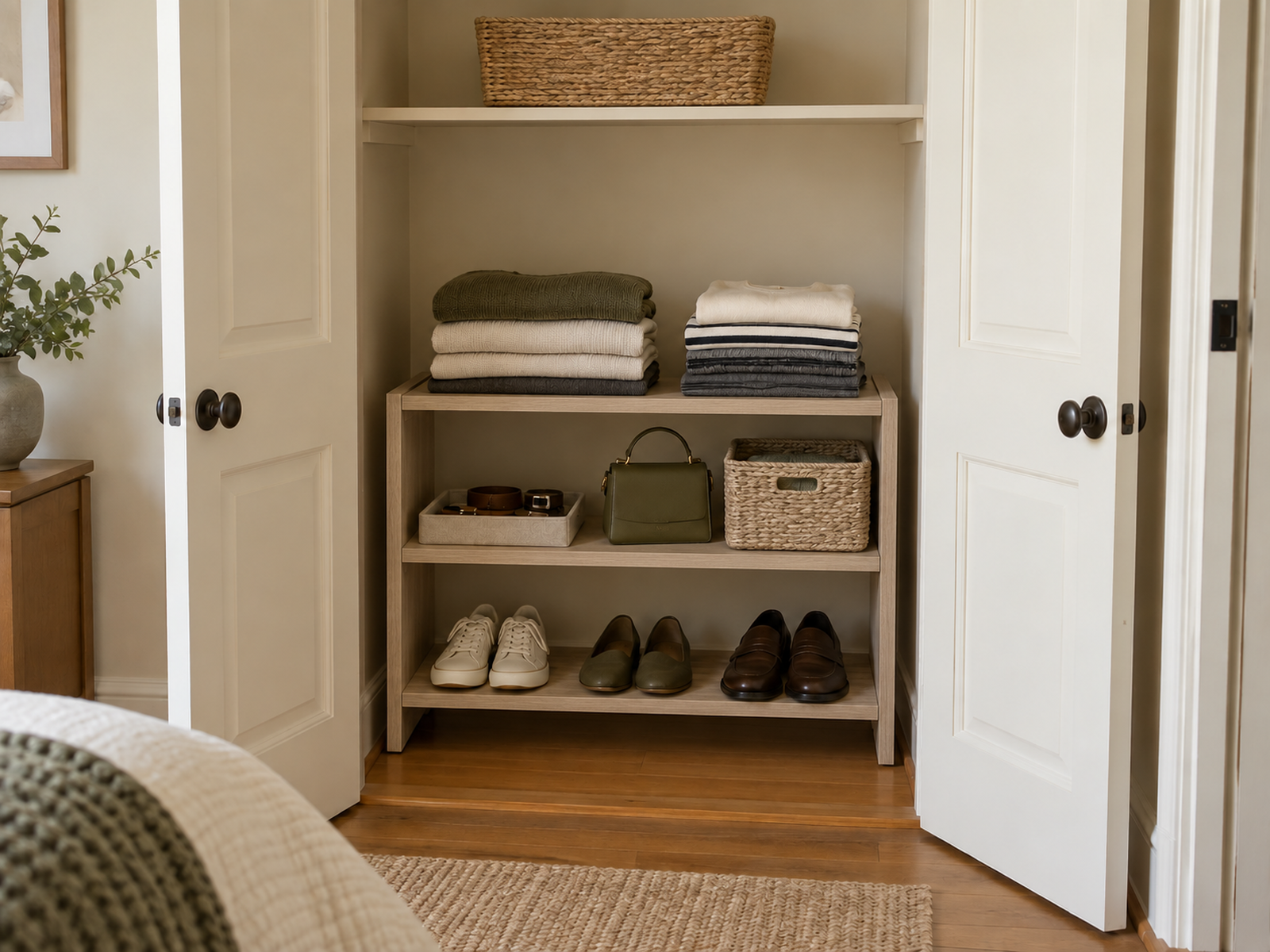
Reassign the Closet When Normal Hanging Still Does Not Fit
A shallow closet can be highly useful for storage that does not require hanger shoulder depth.
Folded clothes, shoes, handbags, hats, accessories, shallow bins, or other low-depth categories can use the cavity far more efficiently than diagonal or crushed garments.
This is often the strongest whole-room move when only part of the wardrobe truly needs hanging. Keep the shallow built-in for the categories it handles well, then create the smallest external hanging zone required for dresses, jackets, suits, or other shape-sensitive garments.
The benefit is that the bedroom does not need a second full closet. It only needs enough external hanging capacity for the garments that cannot be reassigned.

08
Move Hanging Outside the Closet Only When the Bedroom Can Afford the Footprint
A freestanding garment rack is low-commitment from a building-modification perspective, but it spends permanent bedroom floor space.
IKEA’s current RIGGA rack, for example, is 43 3/4 inches wide by 20 1/8 inches deep and carries a model-specific 77-pound maximum load. Those dimensions show why an external rack needs a real room plan, not just an empty wall.
A closed wardrobe adds visual containment and more conventional hanging depth, but it uses even more enclosure volume and may require wall anchoring. CPSC guidance supports securing top-heavy furniture, and manufacturer instructions control the exact installation.
Choose external hanging only after the room footprint, access, load, and required anchoring have been verified. Solving closet depth by creating a new circulation problem is not a small-space win.
Closing Decision
Change the Hanging Geometry Instead of Fighting the Door
A shallow closet should not be forced to behave like a conventional deep closet when the loaded hanger envelope does not fit. First determine whether the rod is simply misplaced; if the cavity itself is too shallow, change the hanging orientation or change the closet’s storage job.
Use front-facing hanging when the width-for-depth trade is acceptable, keep only true hanging garments in that system, and move hanging outside the closet only when the bedroom can absorb the real footprint safely.
RELATED GUIDES
What to Read Next

NEXT GUIDE
How to Store Clothes in a Small Bedroom With No Built-In Closet
Use this next if the shallow closet is being reassigned to folded or accessory storage and the bedroom now needs a compact external hanging system.
GUIDE
How to Organize a Small Closet With Sliding Doors—Without Losing Access
Use this if the closet is deep enough for hangers but the real problem is the door system blocking access to part of the interior.
GUIDE
How to Make Room for Long Dresses and Coats in a Small Double-Hang Closet
Use this if the closet depth is workable but long garments are failing because of vertical hanging height rather than front-to-back clearance.