
Small Closet Organization
How to Store Clothes in a Small Bedroom With No Built-In Closet
Rebuild the jobs a closet normally performs instead of searching for one perfect substitute. Give daily hanging, folded clothes, shoes and accessories, and lower-frequency overflow clearly different roles, then choose one primary storage spine that fits the room without blocking circulation or ignoring anchoring and load limits.
In This Guide
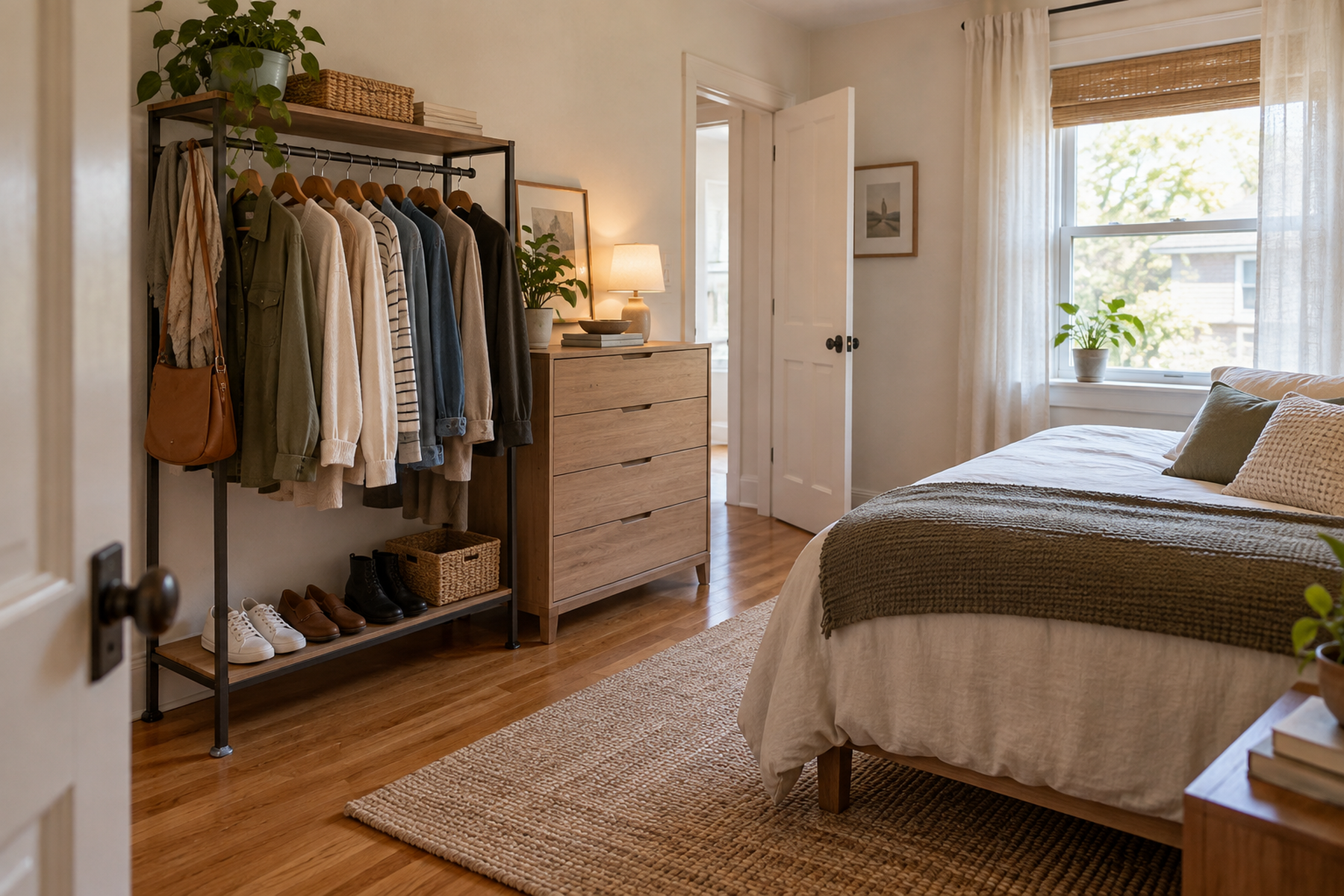
When a bedroom has no built-in closet, the problem is bigger than finding somewhere to hang shirts. A normal closet quietly combines several jobs: hanging, folded storage, shoes and accessories, daily access, visual containment, and overflow.
The most workable small-room setup recreates those functions deliberately. Start with one coherent storage zone, give the easiest access to the clothes used most often, and let lower-frequency items move to secondary storage instead of scattering racks, carts, hooks, and bins around the entire room.
Quick Answer
Build One Clothing-Storage System, Not a Collection of Organizers
The strongest no-closet setup starts with the storage jobs the room actually needs, then chooses the smallest combination of furniture and overflow storage that performs those jobs without sacrificing circulation.
01
Choose one primary storage spine
Use one main rack, wardrobe, dresser-plus-rack zone, or modular system as the center of the setup. A single coherent zone is usually easier to use and visually calmer than several unrelated organizers spread around the room.
02
Spend easy-access space on everyday clothes
Daily hanging and frequently folded clothing deserve the fastest reach. Seasonal, special-occasion, and backup items can move under the bed or into another secondary zone.
03
Verify installation and load before calling a solution renter-friendly
A garment rack may be tool-free, but a tall wardrobe can still require wall anchoring. Wall rails and adhesive hooks also have product- and surface-specific limits, so “freestanding” or “removable” is not a blanket safety conclusion.
01
List the Closet Jobs Before You Buy Furniture
Start by dividing the wardrobe into functional groups: clothes that must hang, clothes that can be folded, shoes and accessories, everyday items, and lower-frequency overflow.
This prevents a common failure mode: buying one large rack because hanging feels like the obvious missing function, then discovering that sweaters, underwear, shoes, bags, and seasonal clothing still have nowhere to go.
Estimate which category deserves prime access. If most of the wardrobe can be folded, a dresser with a smaller hanging section may use the room better than a full-width rack. If hanging garments dominate, the reverse may be true.
Do not force every category into one piece of furniture. The goal is one coherent system, not one object that performs every closet job equally well.
02
Measure One Primary Storage Zone
Choose the part of the room that can absorb clothing storage with the least damage to bed access, doors, windows, heating or HVAC, outlets, and normal dressing movement.
Measure width, depth, and height, but also record obstructions. IKEA’s current clothes-storage planning guidance specifically calls out radiators, pipes, door openings, and other physical conflicts because nominal wall length is not the same as usable storage length.
Then measure the operating space around the furniture. Wardrobe doors and dresser drawers need room to open, while a garment rack needs enough circulation that clothing and hangers do not project into the walking path.
Treat the zone as one system boundary. If the intended “closet replacement” sprawls onto three walls and across the foot of the bed, the room may need a different balance of hanging, folded storage, and overflow rather than more containers.
Measure / Check First
Before buying a wardrobe, dresser, rack, or modular system, test the room and the clothing mix against the complete storage zone.
Check the Room, Access, and Installation Requirements First
01
The usable wall and floor envelope
Measure the actual clear width, depth, and height after accounting for baseboards, windows, radiators, HVAC, outlets, existing furniture, and room doors.
02
The operating clearance
Open the bedroom door, closet-like furniture doors, and drawers on paper or with painter’s tape. Preserve the route to the bed and the area used to stand, dress, and retrieve clothing.
03
The anchoring and load boundary
Check the exact manufacturer requirements for wall anchoring, garment-rail capacity, shelf load, drawer-unit stability, wall fasteners, and any adhesive-product surface restrictions before treating the setup as safe or renter-compatible.
If a solution only fits by blocking circulation, skipping required anchoring, or loading a rack beyond its product rating, change the storage architecture before purchase.
03
Choose Open or Closed Storage Based on the Room
An open garment rack can feel lighter than a wardrobe because it removes the cabinet shell and gives fast visual access to clothing. That can be useful when the room has a narrow strip of floor space but not enough depth for a large enclosed cabinet.
The trade-off is that the clothing becomes part of the room’s visual field. A rack works best when the hanging category is intentionally limited rather than treated as a place for every garment in the home.
A closed wardrobe creates stronger visual containment and can combine hanging with shelves or drawers, but the enclosure itself uses more physical and visual volume. Hinged doors also add an operating envelope that an open rack does not need.
Do not treat the choice as style alone. Open storage spends more visual attention; closed storage spends more enclosure volume, door clearance, and often more installation effort.
04
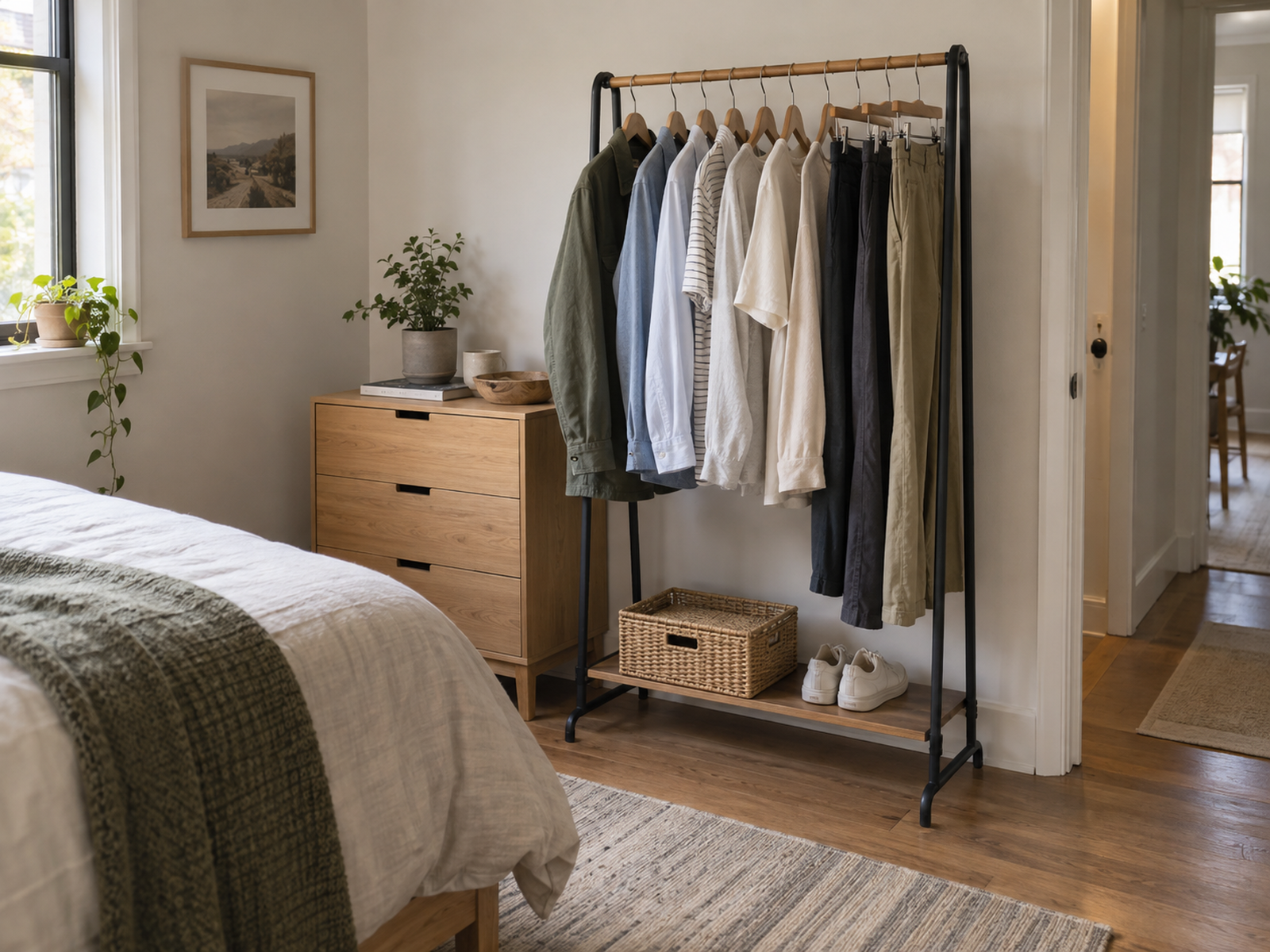
Use a Garment Rack When Hanging Is the Dominant Daily Need
A freestanding rack can be the lowest-complexity way to restore hanging space when the room has no built-in closet and the user wants a reversible solution.
Give the rack a defined role. Use it for the everyday shirts, jackets, dresses, or trousers that genuinely benefit from hanging, then direct folded categories and overflow elsewhere.
Verify the exact load rating before filling it. IKEA’s current RIGGA rack, for example, publishes a 77-pound maximum load; that number belongs to that product and demonstrates why garment-rack capacity must be checked model by model rather than assumed from appearance.
A rack that bows, twists, rolls unexpectedly, or becomes difficult to move once overloaded has not created useful closet capacity. Stability and load are part of the storage decision.
Use / Skip
An Open Garment Rack as the Primary Storage Spine
Use
Use it when hanging clothes are the main daily category and visible storage is acceptable
A garment rack can work well when the exact model has adequate rated capacity, the room has a narrow but stable floor strip, daily hanging access matters more than visual concealment, and folded/overflow categories already have a separate plan.
Skip
Skip it when the rack would become an exposed version of the entire wardrobe
Choose a closed wardrobe, dresser-plus-smaller-rack combination, or modular mixed system when visual clutter matters, the hanging volume would overload the rack, or the rack would have to expand until it blocks circulation.
05
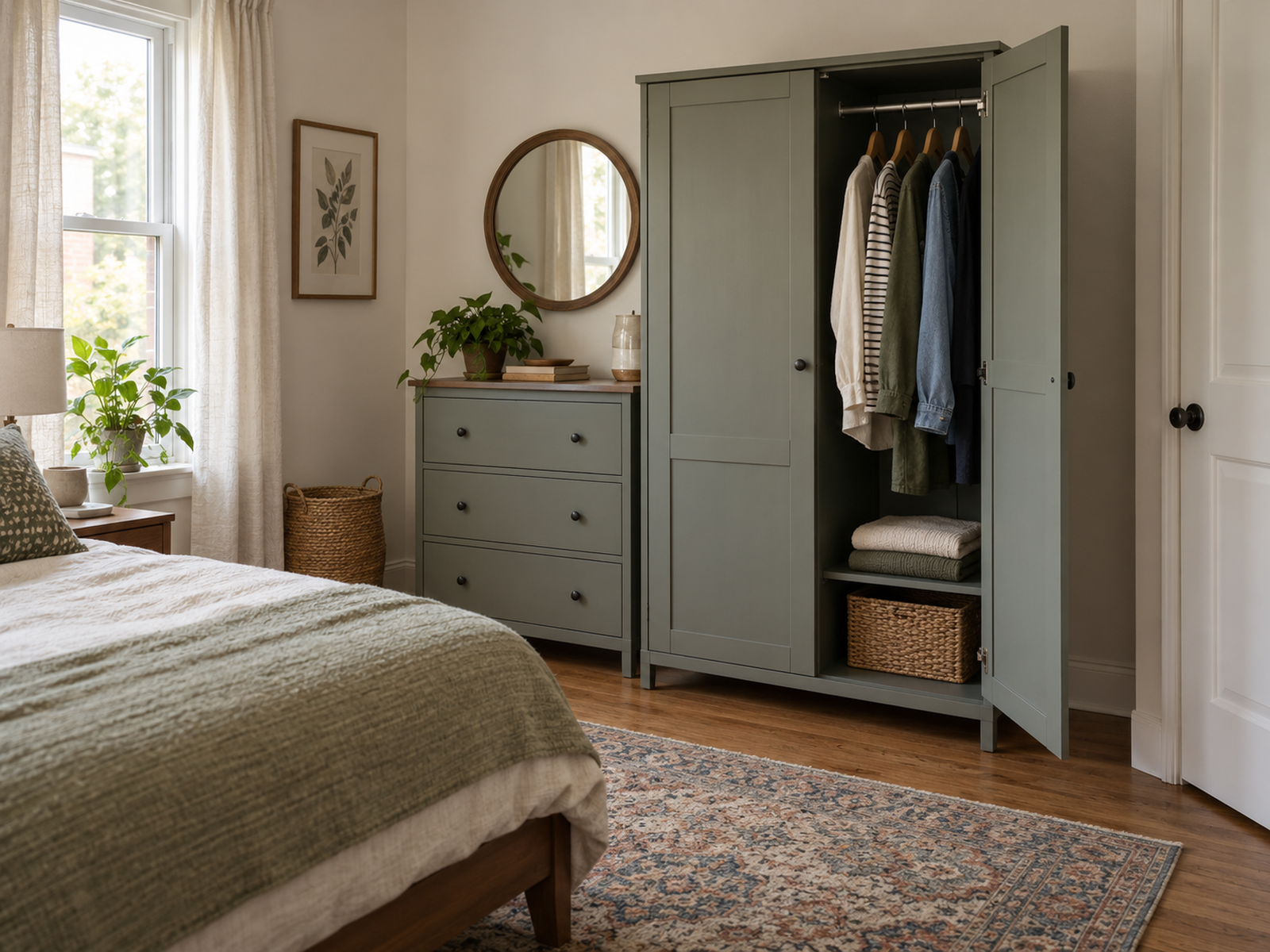
Use a Closed Wardrobe When Visual Containment Is Worth the Volume
A closed wardrobe can recreate the closet experience more directly because doors hide hanging and folded storage inside one enclosure.
This can be valuable in a small bedroom where visible clothing makes the room feel permanently busy, but the wardrobe needs enough depth, width, height, and door clearance to operate without dominating the room.
Freestanding appearance does not guarantee a no-drill installation. IKEA’s current PAX/FORSAND wardrobe combination, for example, states that the furniture must be secured to the wall with the included anchoring device.
If required anchoring conflicts with the lease or wall type, do not simply skip the anchoring step. Resolve the installation properly or choose another storage architecture whose safe setup matches the apartment.
06
Give Folded Clothes Their Own Closed Storage Base
A dresser or drawer chest can reduce pressure on the hanging zone by giving T-shirts, underwear, sleepwear, workout clothes, and other foldable items a contained home.
This is especially useful when the room has enough floor depth for drawers but not enough width for a large wardrobe. A smaller hanging rail plus a dresser can sometimes perform the closet jobs more efficiently than one oversized cabinet.
Account for drawer opening and anti-tip requirements. A dresser that technically fits between the bed and wall can still fail if the drawers open into the only walking route.
Use the top surface intentionally. It can support a legitimate bedroom function, but it should not become the overflow shelf for every accessory that did not receive a real home inside the system.
07
Move Seasonal and Low-Frequency Clothes Out of Prime Space
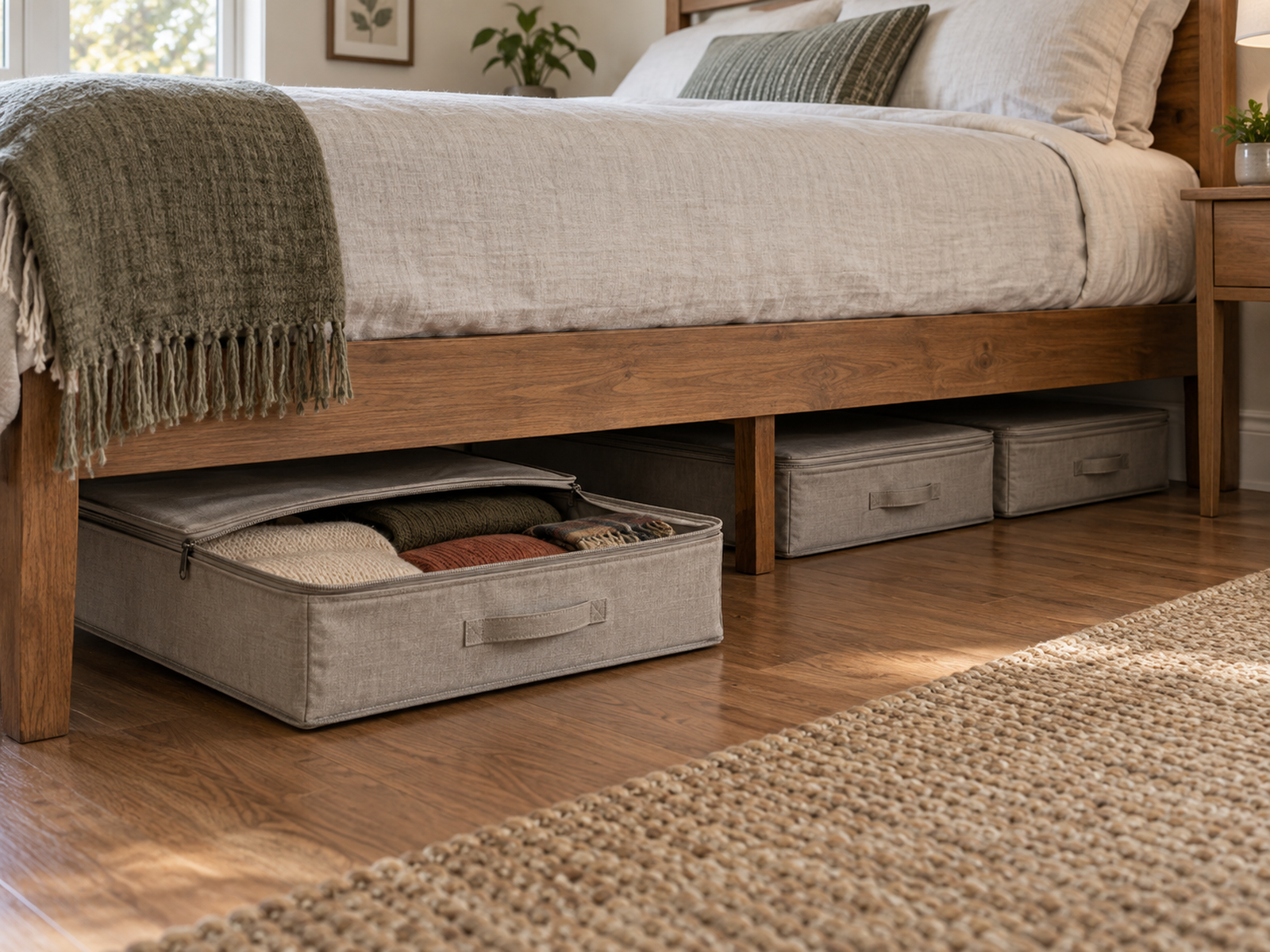
Under-bed storage is most useful when it protects daily-access capacity rather than becoming the only place the wardrobe can function.
Move off-season clothing, special-occasion items, spare bedding-adjacent garments, or other low-frequency categories into containers that fit the actual under-bed clearance.
Keep daily items out of awkward storage whenever possible. Repeatedly lifting the bed, dragging deep bins, or moving other containers to retrieve everyday clothes turns hidden storage into daily friction.
If under-bed space is already full, use the same principle elsewhere: reserve the hardest-to-reach safe storage for the lowest-frequency clothing rather than adding another rack to the room.
08
Add Wall or Adhesive Storage Only for the Jobs It Can Safely Carry
Wall rails and shelves can recover floor space, but they are installation systems, not automatic renter solutions.
Check the exact product, fasteners, wall substrate, load, and lease conditions. A rail carrying clothes may need materially different support than a lightweight accessory hook.
Adhesive hooks belong in an even narrower role. 3M’s current Command utility-hook documentation lists compatible and incompatible surfaces, which is a useful reminder that “removable” depends on the product, wall finish, preparation, load, and removal procedure.
Use these solutions for the specific jobs they can safely carry. Do not turn light-duty hooks into a substitute for a clothing rail, and do not skip manufacturer-required anchoring simply because the goal is a no-drill room.
Closing Decision
Rebuild the Closet Functions in the Fewest Coherent Zones
A successful no-closet bedroom does not need to imitate a built-in closet perfectly. It needs one primary storage spine for everyday clothing, a secondary mode for folded or accessory storage, and a deliberate overflow zone for lower-frequency items.
Choose open or closed storage based on the room’s real geometry and visual tolerance, keep daily access in the easiest zone, and verify every load, anchoring, and mounting requirement at the product level. If the system preserves circulation and makes getting dressed easier, it is doing the job the missing closet would have done.
RELATED GUIDES
What to Read Next
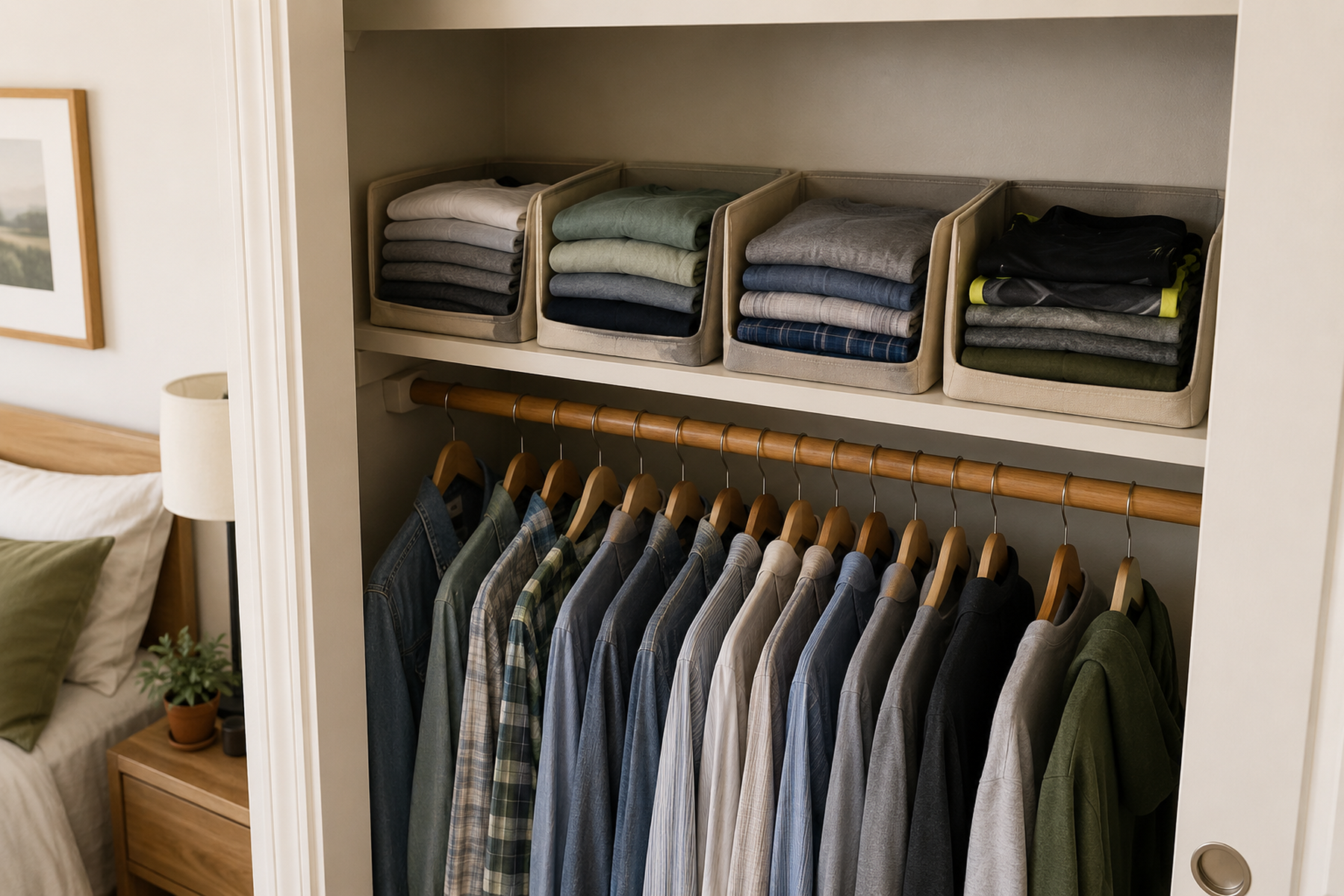
NEXT GUIDE
How to Store Folded Clothes in a Small Closet With No Dresser
Use this next if folded clothing is the category that still has no clear home after the primary no-closet system is established; that guide focuses on drawer-equivalent storage for folded garments.
GUIDE
How to Store Off-Season Clothes When Your Small Closet Has No Extra Space
Use this if seasonal volume is consuming prime daily-access capacity; that guide handles moving lower-frequency clothing out of the everyday zone.
GUIDE
How to Organize a Small Closet Shared by Two People
Use this if the no-closet system must serve two wardrobes; that guide adds allocation and shared-capacity logic once the primary storage spine has been established.