
Small Kitchen Organization
How to Use a Countertop Dishwasher in a Small Kitchen With No Built-In Dishwasher
Choose the water system before the machine: verify faucet compatibility or tank-filling access, map the drain and outlet route, then test the open door, loading path, real dish capacity, and prep-surface cost before a countertop dishwasher earns permanent space.
In This Guide
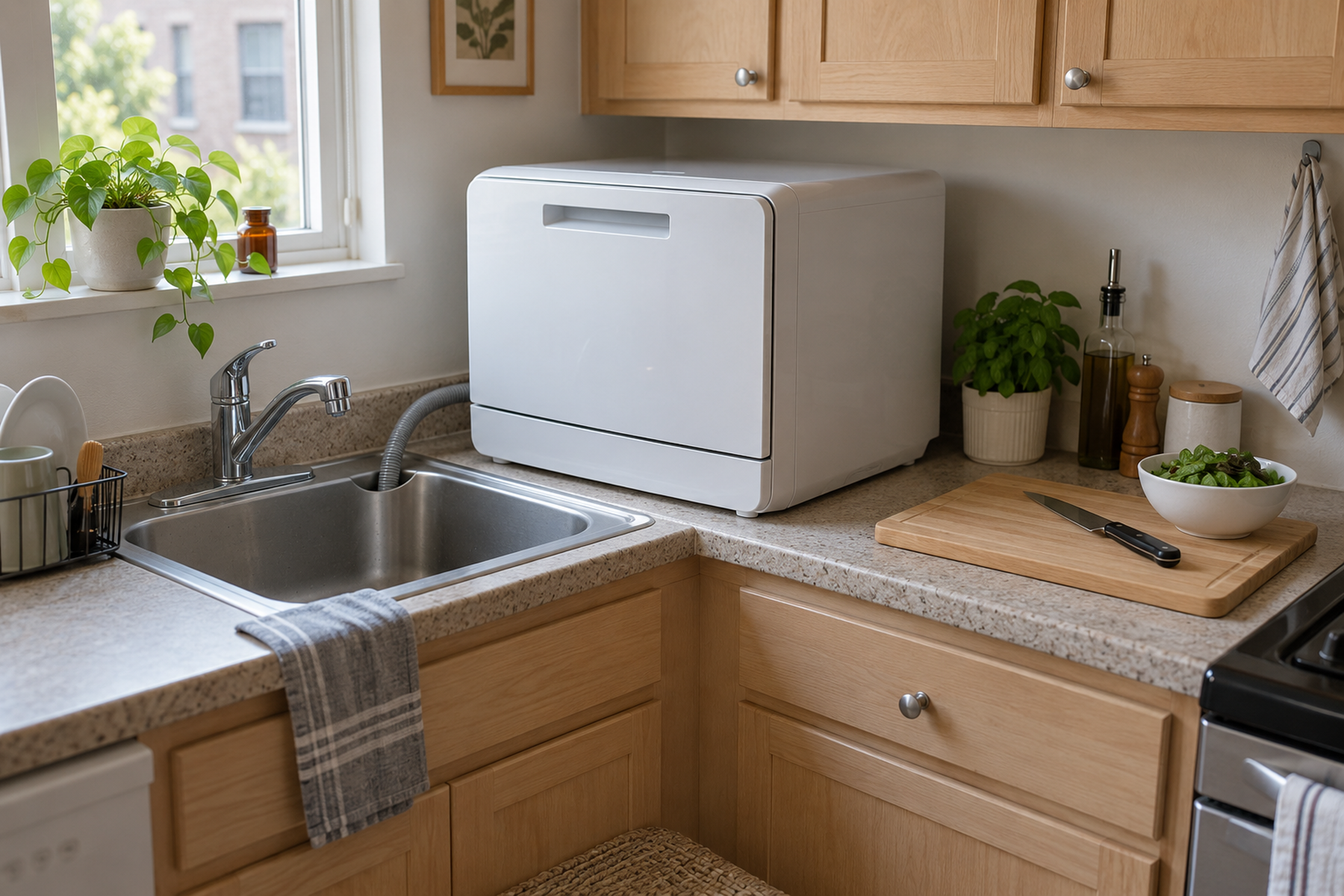
A countertop dishwasher can solve daily handwashing while creating a new infrastructure problem in a small kitchen. The machine needs a stable support surface, a water-supply method, a drain route, an approved electrical connection, and enough room to open, load, unload, and move dishes between the sink and rack.
Treat it as a compact utility system rather than a normal countertop appliance. The right setup works with the actual faucet or water tank, keeps hoses controlled, preserves a usable prep surface, and handles the household’s real weekday dish load without turning every cycle into a setup project.
Quick Answer
Choose Water Architecture Before You Give Up the Counter
A countertop dishwasher makes sense only after the kitchen passes four tests: water in, water out, safe power, and enough working room to load the machine without erasing the kitchen’s prep function.
01
Decide faucet-connected or built-in tank first
A faucet-connected model makes faucet compatibility a hard gate. A tank model avoids that connection but still needs manual filling, drainage, a grounded outlet, and practical access to the reservoir.
02
Map the full utility route
Check the approved inlet or fill method, drain-hose destination, outlet location, hose reach, leak-check routine, and any manufacturer-specific restrictions before choosing the appliance location.
03
Test the real dish load and prep-surface cost
Open the door, load the household’s normal plates and bowls, trace the sink-to-rack path, and decide whether the machine’s permanent or temporary counter footprint is worth the handwashing it replaces.
01
Choose the Water System Before the Dishwasher
Start with water architecture, not brand or capacity. Countertop dishwashers commonly use either a faucet connection, a built-in water tank, or a model that supports both.
A faucet-connected machine can reduce manual filling but only when the exact faucet, adapter, hose, and water-supply requirements are compatible. Danby’s current countertop documentation, for example, uses a Quick Connect system designed around standard threaded faucet connections and does not promise compatibility with every spray head, pull-down faucet, or proprietary aerator.
A built-in-tank machine avoids the faucet-connection gate, but it does not eliminate infrastructure. HAVA’s current R01 documentation still requires filling a 5-liter tank, routing a drain hose, using a grounded outlet, and giving the machine enough counter and loading space.
Choose the water architecture that the kitchen can repeat every day. A theoretically flexible machine is not a good fit if refilling, connecting, or draining turns each wash cycle into a complicated reset.
02
Verify the Utility Route Before You Buy
Trace water, drainage, and electricity as one connected route. A dishwasher can fit the counter and still fail because one hose cannot reach cleanly, the outlet location is wrong for the exact manual, or the sink connection conflicts with normal kitchen use.
For faucet-connected models, verify the exact faucet geometry and adapter instructions before assuming that “fits most faucets” includes your sink. Current Danby and GE guidance centers on standard threaded faucet spouts, and GE separately warns about certain sink-sprayer arrangements for its portable-dishwasher system.
For tank models, decide where the fill water comes from and where the drain hose will end. A tank is not a self-contained water system; the dirty water still needs a secure manufacturer-approved route out.
Keep electrical guidance model-specific. Both the researched Danby DDW621WDB1 and HAVA R01 manuals call for grounded connections and prohibit extension cords, which is enough to make outlet location a pre-purchase check rather than an afterthought.
Measure / Check First
Before choosing a permanent counter spot or planning to move the machine between uses, test the complete utility and loading cycle in the real kitchen.
Check Faucet or Fill Access, Drainage, and Loading Clearance First
01
The exact water-supply method
Verify faucet thread and adapter compatibility for a connected model, or confirm that a tank model can be filled comfortably in place without hitting an upper cabinet or requiring an awkward water-carry routine.
02
The drain and electrical route
Confirm the manufacturer-approved drain destination, hose reach and security, grounded outlet location, and any extension-cord or adapter restrictions in the exact manual.
03
The open-door and dish-transfer envelope
Open the dishwasher fully, access the rack, stand where loading will happen, and move normal dishes between sink and machine. Include hose space, detergent access, and a usable prep strip that remains afterward.
If the machine fits only with a questionable faucet connection, an improvised drain, an unsupported electrical workaround, or a door that consumes the whole work zone, reject the location before comparing wash cycles or features.
03
Test Faucet Compatibility as a Hard Gate
A faucet-connected countertop dishwasher is useful only if the sink can accept the exact connection system without improvisation.
Danby’s researched manual uses a supplied faucet adapter and Quick Connect assembly designed for male or female threaded faucet spouts. Danby’s current FAQ frames compatibility around standard North American faucets, which is a useful boundary—not a guarantee for every faucet style.
Check pull-down heads, spray attachments, fixed aerators, proprietary threads, and damaged fittings before purchase. GE’s portable-dishwasher guidance also documents a separate concern with certain sink sprayer arrangements, reinforcing the need to follow the exact manufacturer rather than rely on a generic adapter claim.
Treat leak testing and disconnection as part of the routine. Danby instructs users to tighten connections, test for leaks, shut off the water, relieve pressure, and drain residual hose water before storage or disconnection.
04
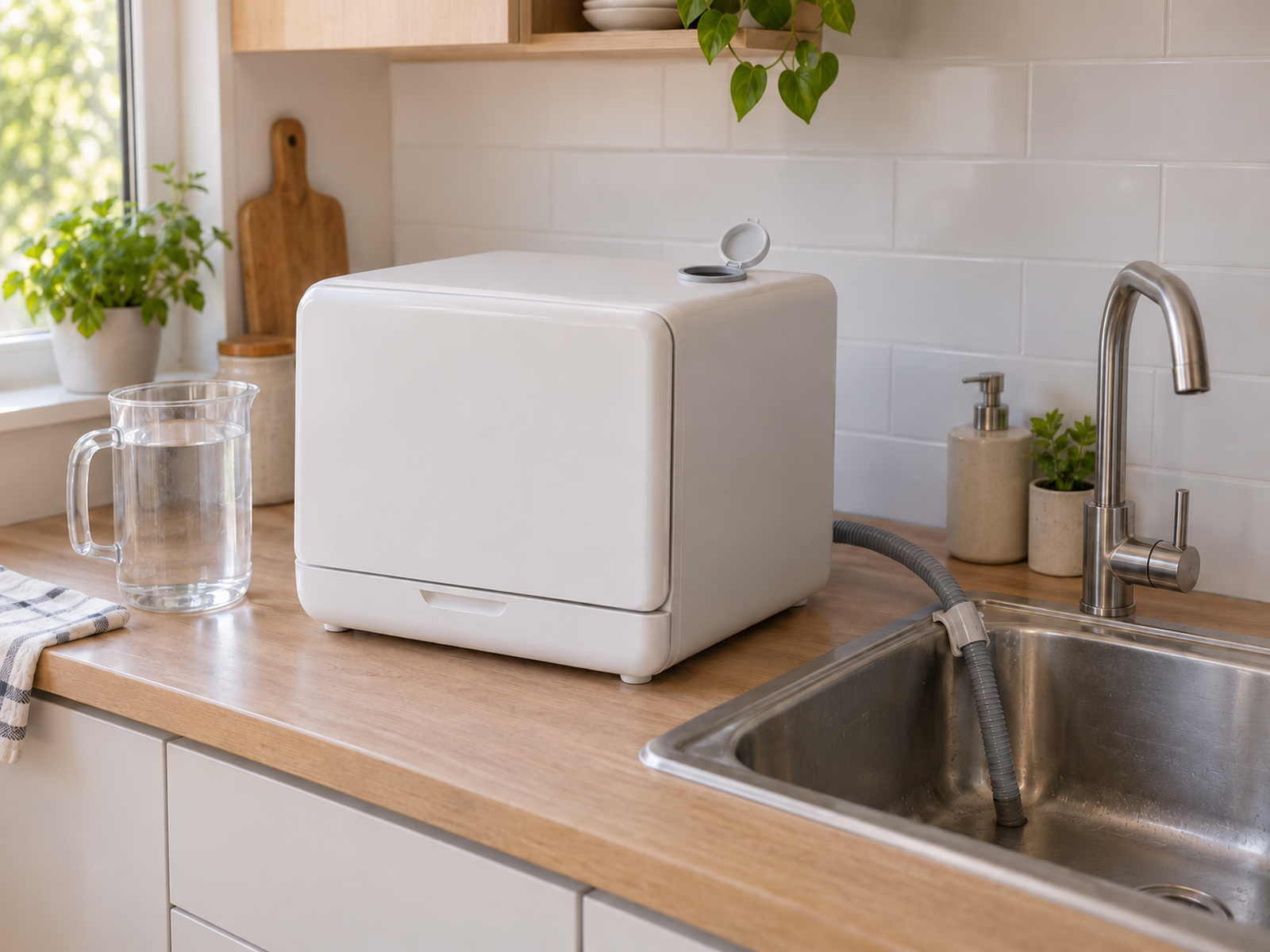
Use a Built-In Tank When Faucet Connection Is the Wrong Constraint
A built-in water tank can be the stronger renter branch when the faucet is incompatible, frequently needed for other tasks, or simply too awkward to connect for every cycle.
The trade is manual water handling. HAVA’s current R01 example uses a 5-liter tank, so the user must still fill the appliance before washing and plan where that water comes from.
Vertical access matters. A tank model that physically fits beneath an upper cabinet can still be frustrating if the fill opening is difficult to reach or requires pulling a heavy machine forward for every cycle.
Drainage remains mandatory. Route the supplied hose exactly as the manual permits and treat drilled drainpipe configurations as a different installation class from a reversible sink-drain setup.
05
Count the Open Door and Loading Path as Part of the Footprint
The published width and depth describe the machine body, not the full dishwashing workspace.
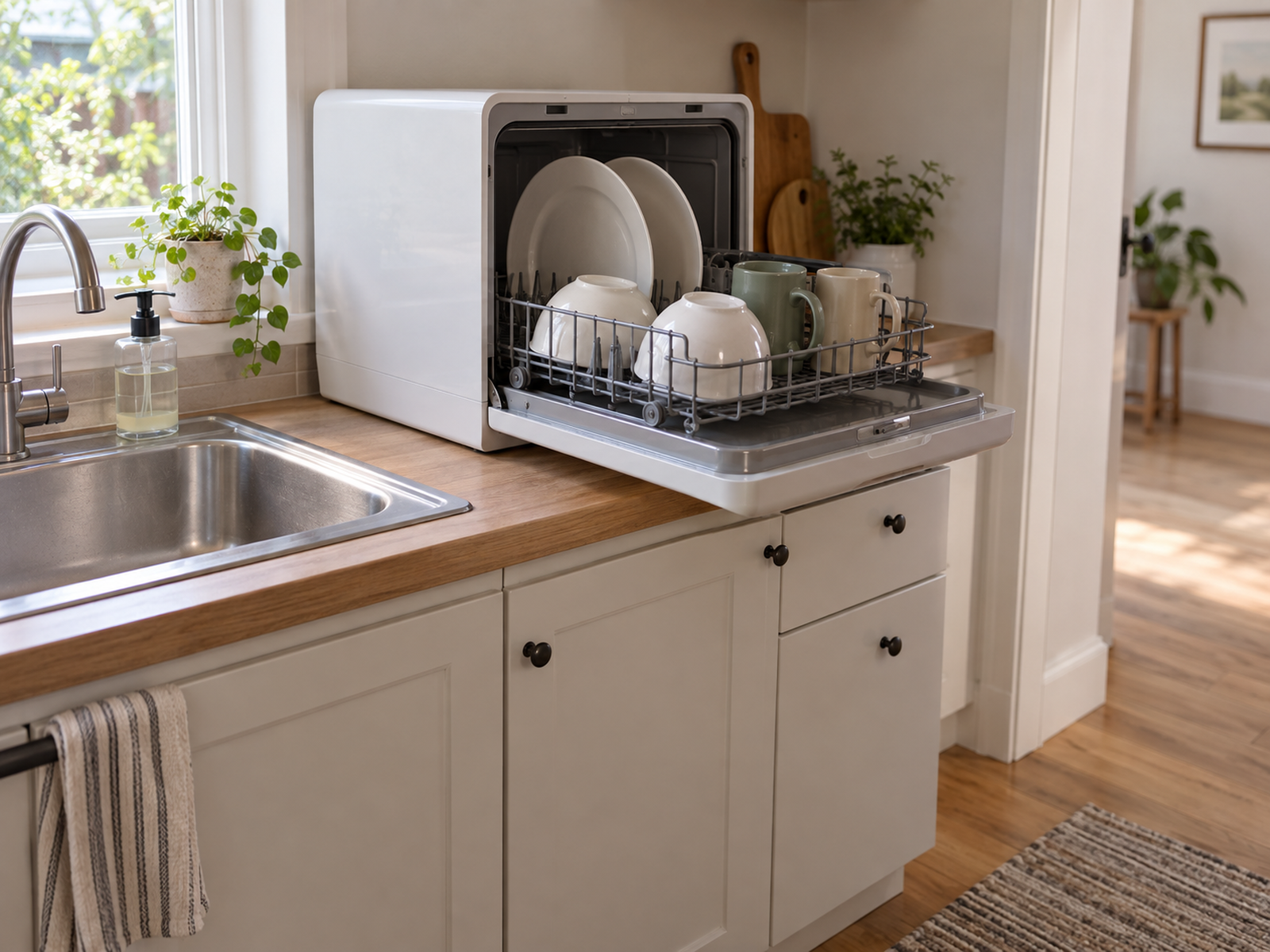
Open the door completely and account for the rack, the user’s standing position, and the transfer path from sink to dishwasher. A unit that fits neatly under upper cabinets can still make the counter unusable every time it is loaded.
Keep a real prep strip available. A countertop dishwasher should not be considered successful simply because it automates washing if the remaining kitchen no longer has a practical place to cut, mix, plate, or set down hot cookware.
Use the household’s actual dishes for the fit test. Place-setting ratings are useful comparison data, but plate diameter, bowl shape, mugs, cookware, and cutting boards determine whether the rack supports the household’s normal weekday load.
06
Decide Whether the Dishwasher Stays Out or Moves Between Uses
Permanent counter residency has the lowest setup friction but the highest work-surface cost. It is strongest when the dishwasher runs often enough to earn that permanent zone and the kitchen still has a viable prep surface.
Moving the dishwasher after each cycle can recover the counter, but manufacturer examples show that these are not lightweight appliances. The researched Danby model is about 46 pounds, while HAVA’s R01 is about 29 pounds before accounting for residual water, hoses, or awkward grip.
A faucet-connected machine adds connection-reset work to the lifting. Hoses may need to be drained, pressure released, and fittings rechecked according to the manual before the machine is parked elsewhere.
Do not call between-use storage space-efficient unless the user can realistically repeat the entire move, disconnect, drain, store, retrieve, reconnect, and leak-check sequence at the expected wash frequency.
Use / Skip
Moving the Countertop Dishwasher Between Uses
Use
Use it when the machine is manageable and the reset routine is simple
Temporary counter use can recover valuable prep space when the appliance weight is realistic for the user, the storage route is short, hoses can be disconnected and drained exactly as instructed, and setup does not create repeated leak or lifting friction.
Skip
Skip it when the dishwasher is effectively a permanent utility appliance
Give the machine a permanent compliant counter or adjacent-work-surface zone when it runs frequently, is heavy or awkward to lift, requires repeated connection checks, or would be trapped behind other appliances every time dishes need washing.
07
Compare Counter Space With Floor Space Before You Commit
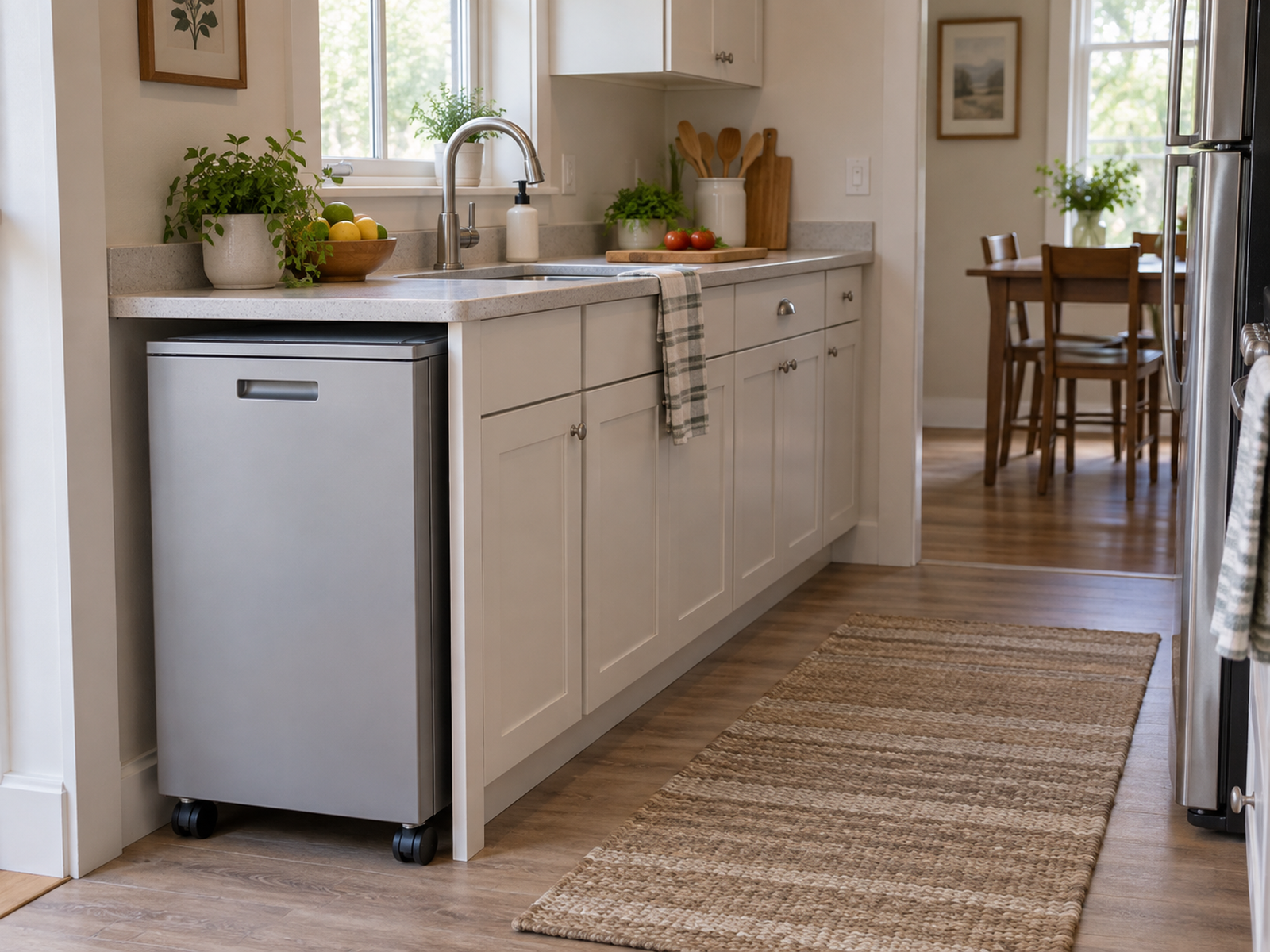
If the countertop format consumes the only usable work surface, compare that cost with a rolling portable dishwasher before assuming the smaller-looking appliance is the better small-space choice.
Rolling portable dishwashers spend floor and maneuvering space instead of counter space. Current GE and Whirlpool guidance treats them as a distinct apartment format that moves to the sink for use and parks elsewhere between cycles.
The trade is route complexity. The kitchen needs enough floor area to store the unit, roll it to the sink, connect it, open it, and still move around cabinets and doors.
Choose the resource the apartment can actually spare. A kitchen with one precious prep counter but a nearby floor alcove may prefer rolling capacity; a narrow galley with no spare floor may still favor a countertop machine.
08
Use the Real Dish Load as the Final Go-or-No-Go Test
Before purchase, compare the rack with the dishes the household actually uses most evenings rather than relying on place-setting language alone.
Check the largest everyday plate, common bowls and mugs, and the cookware that is most annoying to hand-wash. If the machine handles only the easy items while pots, pans, cutting boards, and oversized dishes still dominate the sink, the labor savings may be smaller than expected.
Estimate realistic cycle frequency. A small two-place-setting tank unit can be a strong fit for one household and an endless queue for another; a larger six-place-setting machine can reduce cycles but demand far more permanent counter area.
If faucet compatibility, utility routing, prep-surface cost, dish fit, or lease rules fail, return to the optimized hand-wash and dish-drying system rather than forcing an appliance into a kitchen that cannot support it.
Closing Decision
Make the Dishwasher Fit the Kitchen System, Not Just the Counter
A countertop dishwasher is successful only when water supply, drainage, power, loading space, dish capacity, and prep-surface cost all work together. The first decision is faucet versus tank; the second is whether the kitchen can afford counter space or should spend floor space on a rolling portable instead.
Verify the exact faucet and manual before purchase, count the open door and hoses as part of the footprint, and price machine weight into any between-use storage plan. If the utility route or daily dish load does not work, keeping a strong hand-wash system is better than turning the kitchen into a permanent appliance workaround.
RELATED GUIDES
What to Read Next
NEXT GUIDE
How to Create a Dish-Drying Zone in a Small Kitchen With No Dishwasher
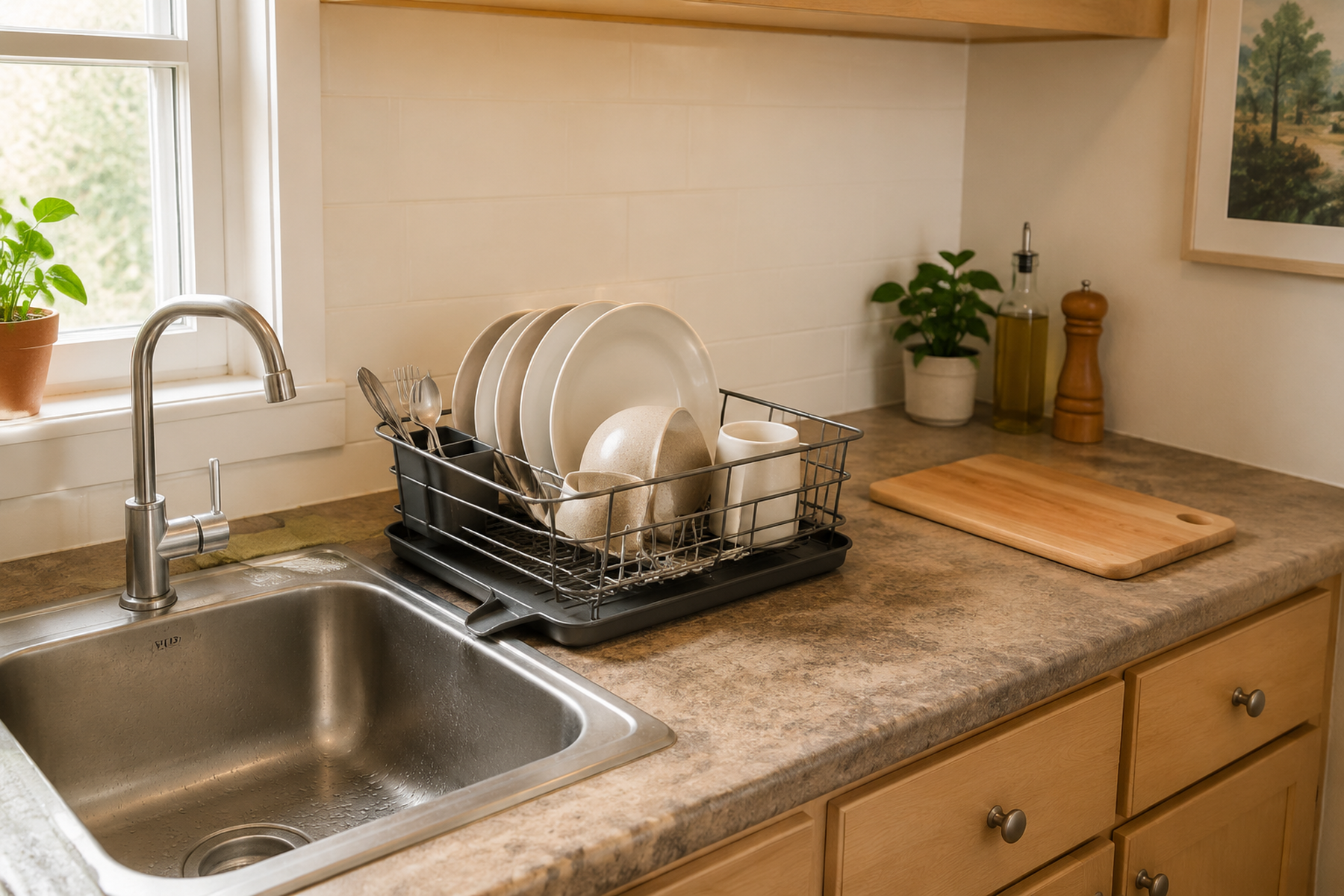
Use this next if the appliance feasibility test fails or if cookware still needs hand washing; that guide handles the sink-side wash-and-dry workflow without adding another appliance.
GUIDE
How to Store Small Kitchen Appliances Without Losing Counter Space
Use this if the countertop dishwasher is competing with several other appliances for permanent residency; that guide helps decide which appliances deserve the counter and which should move to secondary storage.
GUIDE
How to Create a Prep Surface in a Small Kitchen With Almost No Counter Space
Use this if the dishwasher fits technically but erases the kitchen’s only useful work surface; that guide evaluates ways to create or recover a stable prep plane.