
Small Bathroom Storage
Where to Put Dirty Laundry in a Small Bathroom With No Floor Space
Treat wet-state handling and dry-laundry capture as two different jobs: air damp towels or clothing before they enter the hamper, then place dry dirty laundry in the least disruptive floor, door, hook, or nearby-room zone that preserves the bathroom and the route to washing.
In This Guide
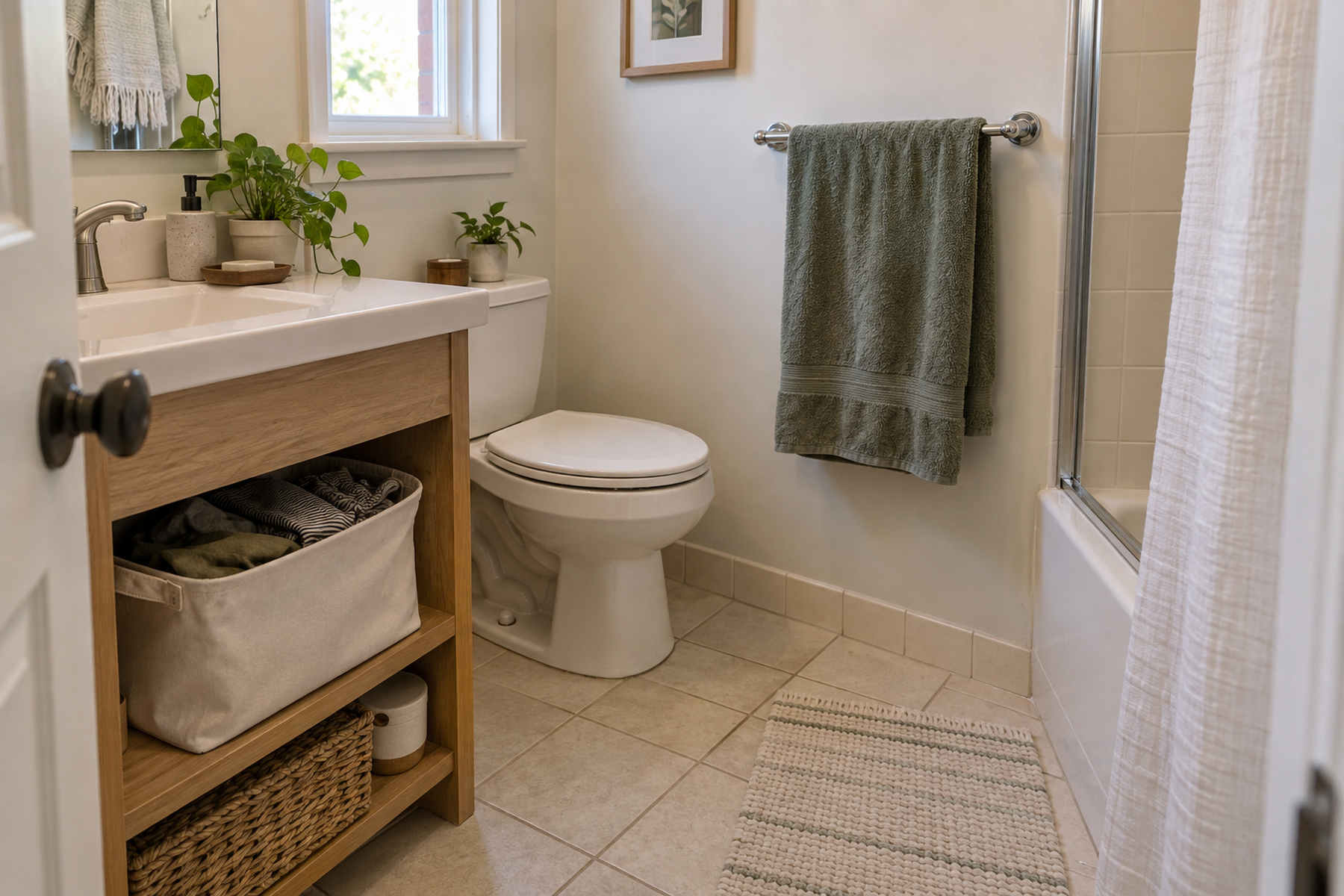
A tiny bathroom can generate laundry without having a safe place to store it. A basket that fits on the floor may still block the door, shower, toilet approach, vanity drawers, or the narrow path through the room once it is full.
Bathroom laundry also changes state. Dry dirty clothing can enter the hamper stream, while a wet towel, washcloth, swimsuit, or damp garment may need to dry or air first. The strongest system solves those two states separately before it chooses the container.
Quick Answer
Dry Damp Items First, Then Capture Dry Dirty Laundry
Do not start with hamper dimensions. First decide whether the item is still damp, then identify which spatial resource the bathroom can actually afford to spend without compromising normal room use.
01
Keep wet or meaningfully damp items out of the closed laundry pile
EPA moisture guidance supports drying damp or wet materials promptly, and older official EPA healthy-home guidance explicitly advises not leaving clothes and towels wet in a laundry basket.
02
Test the full operating footprint, not the catalog footprint
Include rim, lid, handles, wheels, soft-side bulge, door and shower swing, toilet and vanity access, loading space, and the path required to remove the full hamper.
03
Let the bathroom lose the hamper when another zone works better
A bedroom, closet edge, hall niche, or laundry-adjacent location can be the better bathroom-laundry solution when the room has no safe floor, door, or hanging capacity.
01
Separate Damp Items Before They Enter the Hamper
Start with laundry state. Ordinary dry dirty clothing can go directly into the capture system; a towel, washcloth, swimsuit, workout garment, or other item that is still wet or meaningfully damp should not simply disappear into the bottom of a closed pile.
EPA identifies moisture control as central to mold control and recommends drying damp or wet materials promptly. Older official EPA healthy-home guidance makes the laundry point directly: store clothes and towels clean and dry and do not leave them wet in a laundry basket or washing machine.
This does not establish one universal drying time. The practical rule is narrower: give the damp item an airing or drying state first, then move it into the dirty-laundry stream after it is no longer being stored wet.
Use Aptly Small’s existing towel- and bath-mat-drying systems for the drying job instead of making the hamper perform two incompatible functions.
02
Map the Bathroom Operating Envelope
Measure the bathroom while it is operating, not while every door and fixture is closed. Open the bathroom door, shower or tub door, vanity drawers, and cabinet doors and protect the normal toilet approach and walking path.
Then measure the hamper in all of its relevant states. The base may fit while the rim, lid, handles, wheels, or bulging soft sides project into a door arc or circulation lane.
Add the loading and removal path. A tall narrow hamper can work in a corner when empty but become impossible to lift out once full because the lid, wall, vanity, or shower glass blocks the vertical exit.
No universal bathroom clearance for a hamper was established in this research. The test is whether the real room still works safely and comfortably with the real container in its empty, filling, full, and removal states.
Measure / Check First
Before buying a slim hamper, over-door system, or hanging bag, test the complete laundry cycle from undressing to full-load removal.
Check the Five Hamper Footprints and the Laundry Route First
01
Empty, full, and loading footprint
Measure the base, widest rim, lid swing, handles, wheels, soft-side bulge, and the space needed to drop laundry in without blocking the sink, toilet, shower, or door.
02
Door, hook, and hanging projection
For door or hook storage, measure the loaded bag’s depth, the door top gap and thickness where relevant, wall or trim contact, latch operation, and the support’s verified load capacity.
03
Full-load removal and transport
Lift or simulate the filled container and check the bathroom doorway, hall, stairs, laundry-closet access, handles or straps, and the route to the washer, building laundry room, basement, or laundromat.
If the hamper fits only when empty, blocks a fixture when full, or becomes awkward to carry out of the room, its listed dimensions have not solved the actual storage problem.
03
Use a Slim Floor Hamper Only When a Real Residual Strip Exists
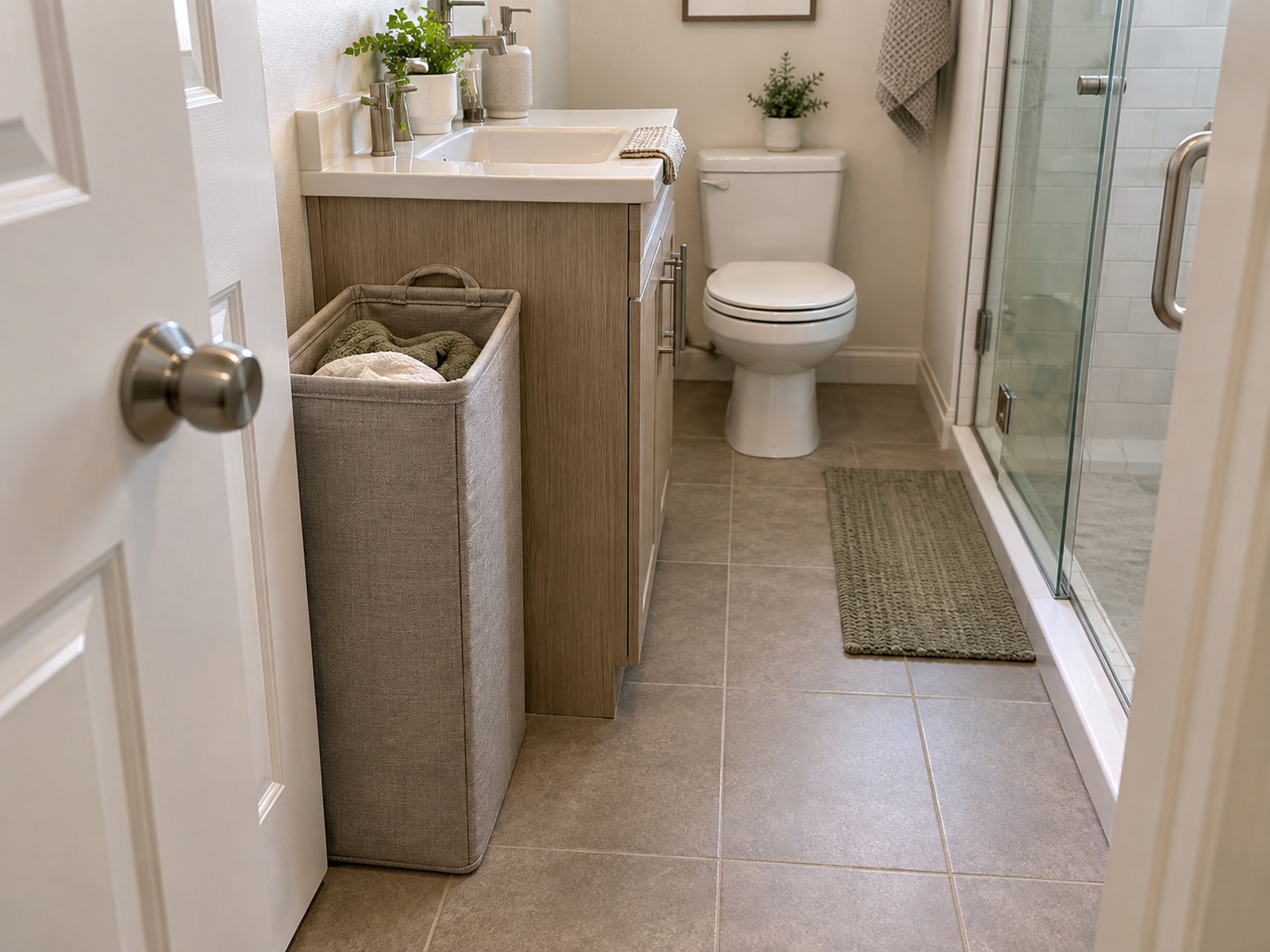
A tall slim hamper is the simplest zero-install option when the bathroom truly has a narrow floor rectangle that is not already needed for circulation, shower operation, toilet access, vanity access, or a bath mat.
Current manufacturer products verify that very narrow freestanding forms exist. IKEA’s PURRPINGLA laundry bag with stand, for example, is currently listed at 8 inches wide, but that product dimension is evidence of the category—not a universal clearance target.
Keep the widest active dimension in the test. Soft bags can bulge, lids need room to operate, and handles or frames can extend beyond the nominal base.
Do not place a slim hamper beside the shower merely because the gap is narrow. Splash exposure, room ventilation, shower-door movement, and the full removal path can make that leftover strip unusable.
04
Let Smaller Capacity Support a Shorter Laundry Cycle
A smaller basket or foldable bag can be an advantage when the bathroom cannot support a week-sized container. Less capacity can preserve circulation and make a filled load easier to carry through a small apartment.
Current products also verify perforated baskets and folding stands as real architectures. IKEA’s SLIBB uses a perforated form intended to allow air circulation, while JÄLL folds for carrying and storage.
Keep the evidence boundary clear: ventilation does not turn a hamper into a drying system. Damp items still need to dry or air before they disappear into the dirty-laundry pile.
Match capacity to the actual wash rhythm rather than inventing one correct hamper size. A small capture point can be successful when it corresponds to a practical wash load and the household is willing to empty it more often.
05
Use Door Capacity Only When the Loaded Door Still Works
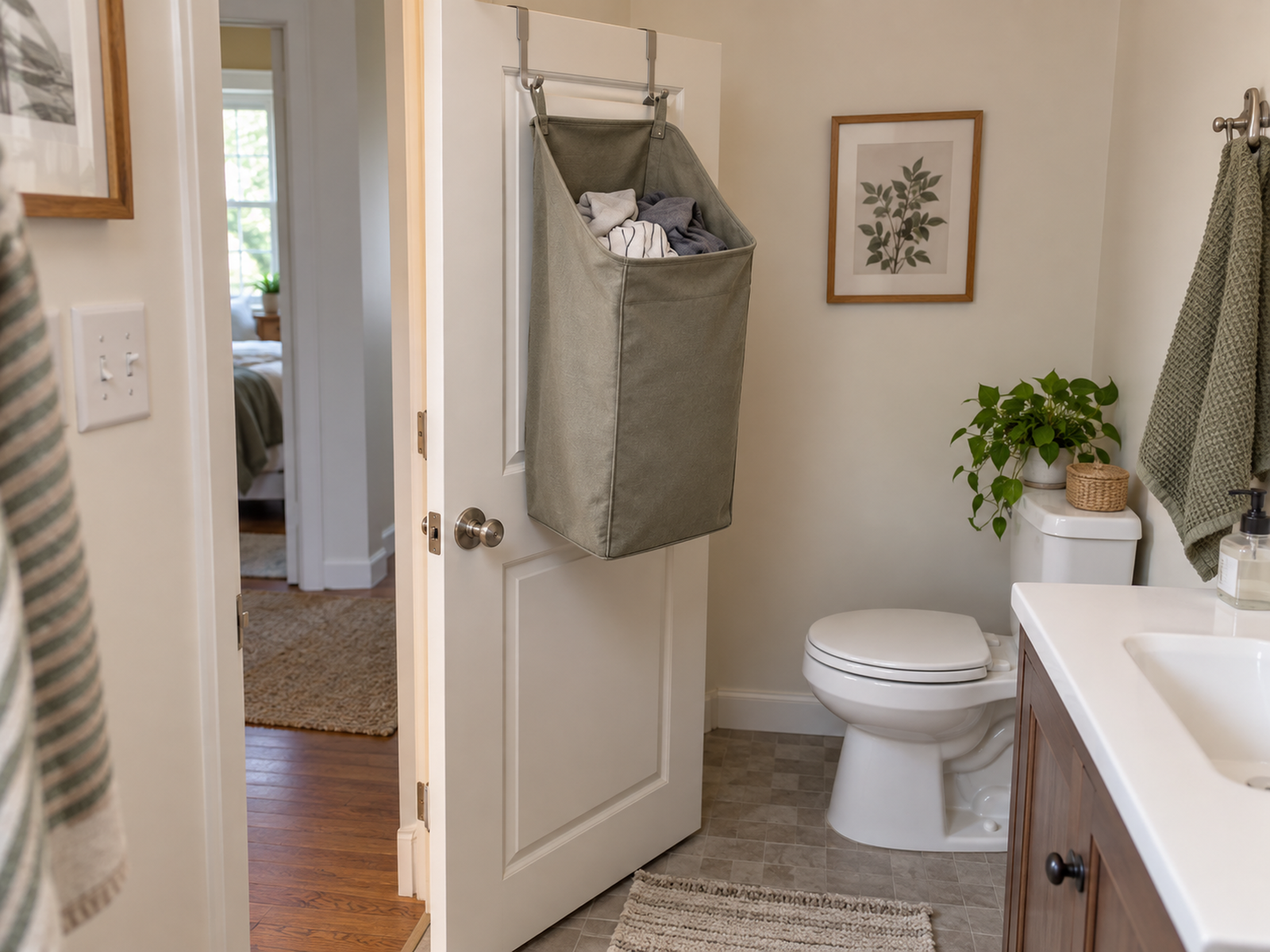
An over-door hamper can recover every inch of bathroom floor, but it converts the door into a loaded moving part of the laundry system.
Product-specific fit matters. CleverMade’s current over-door hamper, for example, publishes its own door-thickness and load limits. Those specifications verify the solution family but should not be generalized to other products or doors.
Test the door with the bag loaded. The hamper must clear the wall, trim, toilet, towel hardware, and user traffic; the door should still latch and open normally; and the hooks should not create an unverified damage or fit problem at the top edge.
Pocket, sliding, bifold, unusually thick, narrow-gap, or delicate-finish doors may be poor candidates even when the bathroom has no floor space.
Use / Skip
An Over-the-Door Hamper
Use
Use it when the door can carry the full system without losing its normal function
An over-door hamper can be a strong no-floor-space solution when the exact product matches the door thickness and top gap, the loaded bag stays within the published limit, the door still opens and latches normally, and the hamper clears walls, fixtures, and traffic.
Skip
Skip it when the door becomes crowded, damaged, or hard to operate
Choose a floor, existing-hook, or outside-room capture point when hooks scrape the finish, the loaded bag hits the wall or toilet, the door cannot open fully, the latch changes, or the door type is incompatible with an over-door system.
06
Use an Existing Verified Hook Before Adding New Hardware
A portable laundry bag can remove the floor footprint when the bathroom already has a suitable hook or rail with a known load capacity. Current products such as IKEA’s PÄRKLA verify that some laundry bags are designed to hang as well as stand.
Treat the full bag as the load, not the empty fabric. Laundry becomes heavier and projects farther from the wall as the bag fills, which can interfere with circulation or the bathroom door even when the empty bag looks harmless.
Do not infer hook strength from appearance. Capacity depends on the exact hook, fastener, substrate, installation, and loaded bag.
If no suitable existing support exists, a bathroom-rated adhesive hook is a conditional next branch, not an automatic renter-safe fix. Verify the exact product’s wet-area compatibility, surface guidance, wait or cure time, load limit, removal method, and lease conditions.
07
Move the Hamper Outside the Bathroom When the Room Cannot Spare It
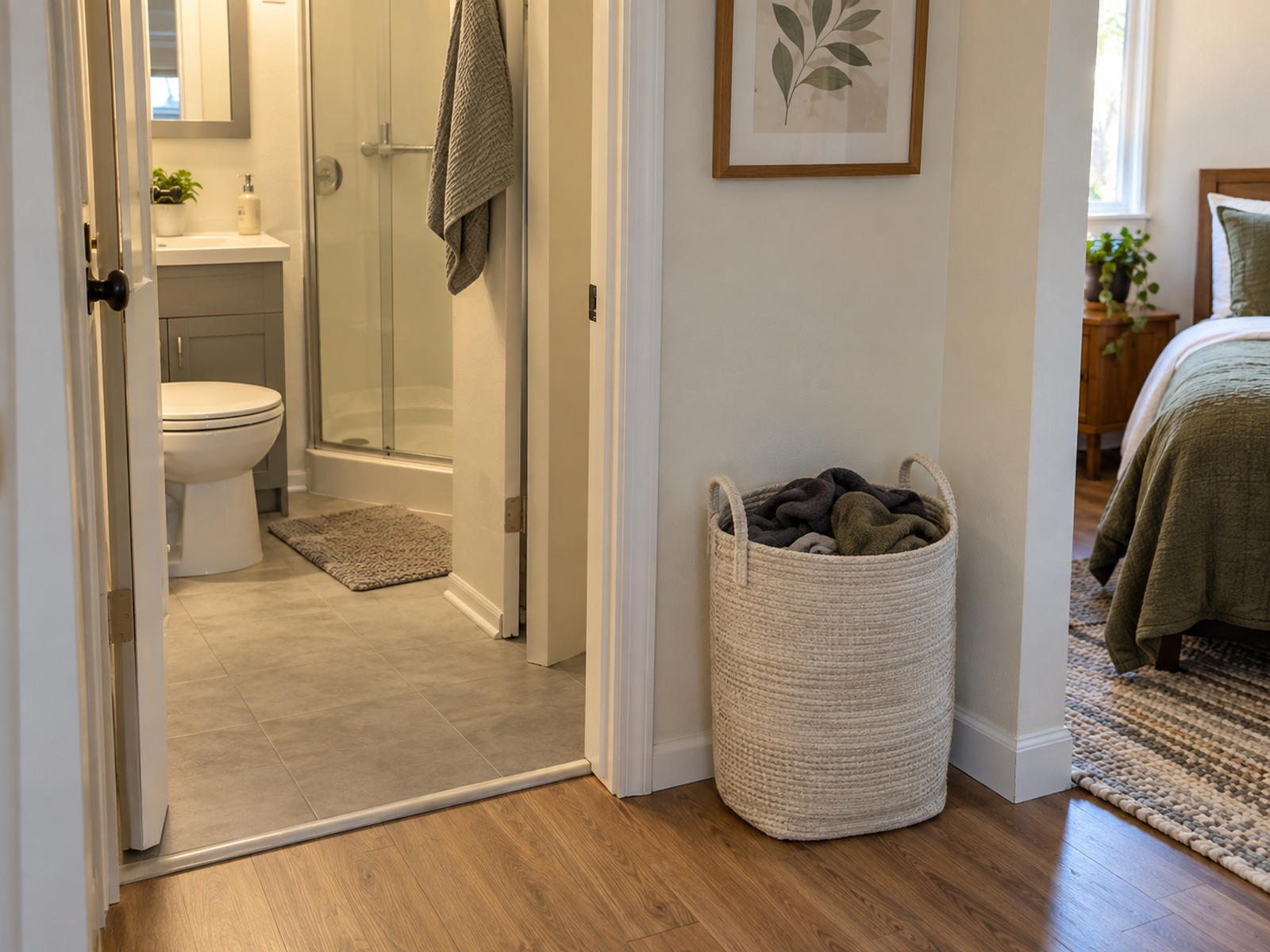
The bathroom does not have to contain the final dry-laundry capture point. If every floor, door, and hanging option compromises normal room use, move the hamper a short distance away instead of forcing another object into the bathroom.
A bedroom corner, closet edge, hallway niche, laundry-adjacent spot, or other dry location can work when the route from bathroom to hamper is simple enough that laundry does not accumulate on the floor.
This can also separate the wet and dry stages cleanly: towels or damp clothing dry in the bathroom, then join the main clothing hamper outside the room.
The trade is behavioral distance. The farther the capture point is from where clothing comes off, the more important the route and habit become; choose the closest outside location that does not create a new circulation or clean-clothes conflict.
08
Make Sorting and Transport Earn Their Footprint
Pre-sorting lights, darks, towels, or household members can make laundry day faster, but every extra category usually needs another bag, compartment, or container.
In a tiny bathroom, one dry-laundry capture point plus sorting at wash time can be more space-efficient than a multi-bin sorter that consumes the only usable wall or floor zone.
A bathroom towel-only capture point can still make sense when towels and washcloths are a distinct household laundry stream—provided damp items are aired first rather than stored wet in the container.
The final test is the full route. If a system is easy to fill but awkward to carry through the doorway, stairs, laundry closet, or building, reduce the container size, change the carry method, or relocate the capture point before adding more sorting.
Closing Decision
Protect the Bathroom First, Then Choose the Laundry Container
A tiny bathroom does not need to win the hamper-location contest. It needs a reliable wet-to-dry laundry sequence, a dry-laundry capture point that does not block the room, and a transport route that still works when the container is full.
Use a slim floor hamper only when a true residual strip exists, spend door or hook capacity only when the loaded system remains compatible, and move the hamper outside the bathroom when that is the lower-cost spatial choice. Smaller capacity and more frequent emptying can be a feature when they preserve the room.
RELATED GUIDES
What to Read Next
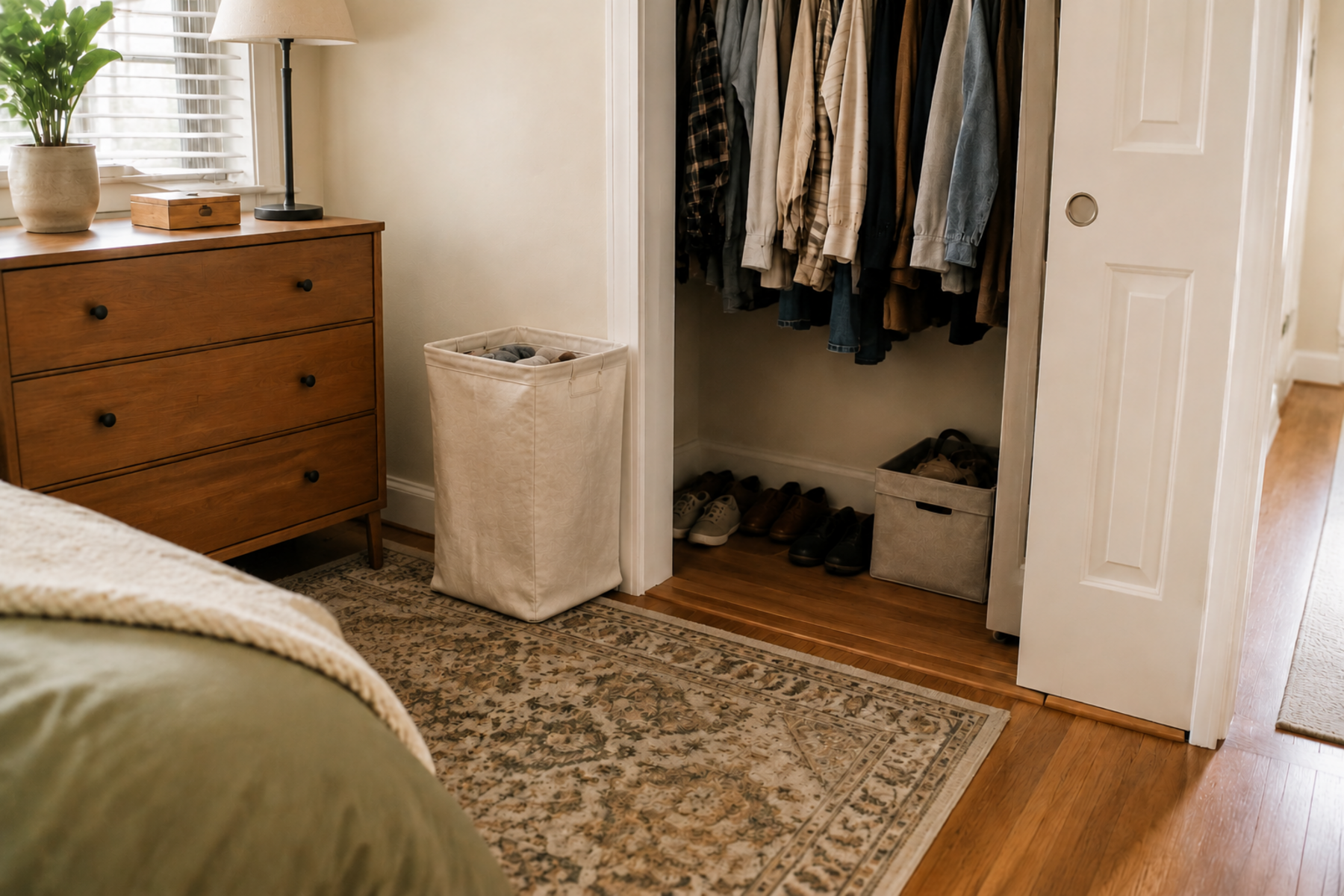
NEXT GUIDE
Where to Put a Laundry Hamper When Your Small Closet Has No Floor Space
Use this next if the bathroom cannot spare any capture point and the hamper needs to move into or beside the closet; that guide handles the broader floor, rod, door, wall, and outside-closet trade-offs.
GUIDE
How to Hang and Dry Bath Towels in a Small Bathroom With No Towel Bar
Use this if towels are entering the laundry stream while still damp; that guide focuses on creating a daily towel-drying zone before the towels become hamper-ready.
GUIDE
How to Use and Dry a Bath Mat in a Small Bathroom With No Good Drying Spot
Use this if another wet textile is competing for the same tiny floor and drying resources; that guide separates the bath mat’s use state from its drying state.