
Small Closet Organization
Where to Put a Laundry Hamper When Your Small Closet Has No Floor Space
When the closet floor is already spoken for, the right hamper may be narrow, hanging, over-door—or not in the closet at all. Choose the capture point by wash cadence, sorting need, transport route, and the floor, rod, door, wall, or room space you can actually spare.
In This Guide
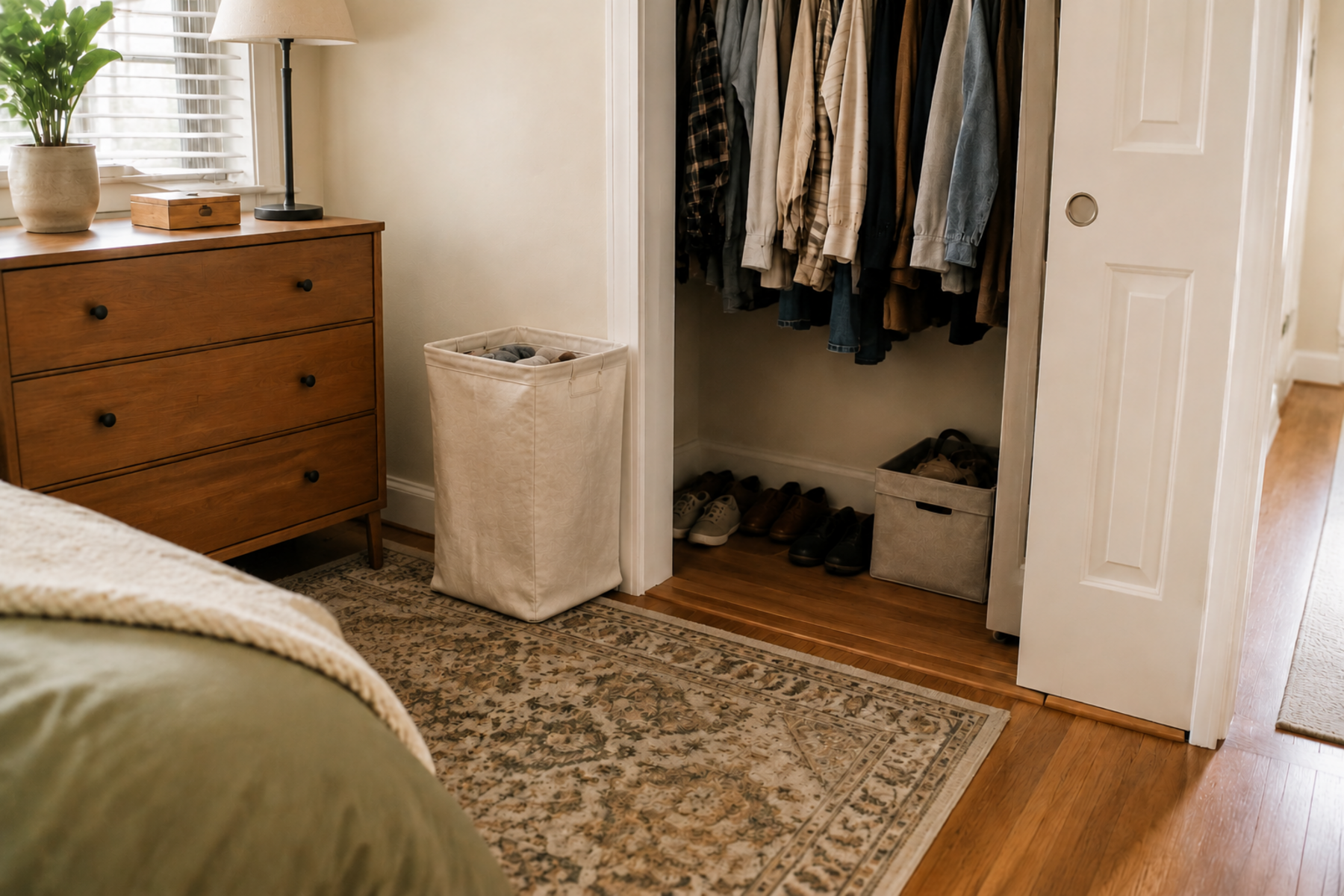
Dirty laundry is not just another closet category. It appears repeatedly, grows between wash days, and eventually has to leave the room. A hamper that looks compact while empty can become the wrong choice once it is full, blocks a closet opening, steals hanging space, or becomes awkward to carry.
The most workable small-space setup treats the hamper as one stage in a laundry route. Decide where clothes actually become dirty laundry, how much accumulates before washing, whether pre-sorting is worth the space, and how the load travels to the washer. Then choose the container form that spends the least valuable space without breaking another daily function.
Quick Answer
Build the Laundry Route Before You Buy the Hamper
Choose the dirty-laundry capture point from the real undressing routine, size it for the amount that accumulates between washes, and place it in the room or storage zone that spends the least useful floor, rod, or door space. When it helps, let the everyday hamper handle collection while a larger portable container appears only for wash-day transport.
01
Put the capture point where dirty clothes actually appear
The closet is only one candidate. A bedroom, bathroom, or laundry-adjacent zone can be better when it is closer to the undressing routine and costs less useful space.
02
Size the system to the time between washes
The smallest hamper is not automatically the best small-space choice. Capacity has to survive the real amount of laundry that accumulates before the next wash without overflowing into the room.
03
Spend the least valuable space
A floor hamper spends floor area, a hanging bag spends rod capacity, and an over-door hamper spends door clearance. Use the resource the room can genuinely spare.
01
Choose the Capture Point Before the Hamper Form
Begin with behavior, not with a product. Notice where clothes are usually taken off and where dirty items already tend to land. A capture point placed far from that routine creates a daily detour, which is why a technically perfect closet hamper can still fail.
The closet makes sense when it has a real residual zone and the hamper can be reached without moving shoes, bins, or hanging clothes. A bedroom corner may be better when that is where clothes come off. A bathroom can work for ordinary dry laundry when the room has suitable space, while a laundry-adjacent location can reduce transport when the washer is nearby.
Do not force the closet to win. The right location is the one that catches dirty laundry reliably while preserving the more important function of every space it touches.
Keep worn-once clothing out of this stream. If a garment is intentionally being saved to wear again, it needs a rewear system rather than being mixed into the dirty-laundry capture point.
02
Match Hamper Capacity to Your Wash Cadence
A slim hamper only solves the problem if it holds enough laundry for the household’s real wash rhythm. If it fills halfway through the week and the overflow returns to the floor, its narrow footprint has not produced a smaller system.
Estimate capacity from the time between washes and the amount of laundry generated during that interval. A household that washes every few days may tolerate a smaller permanent container than one that carries laundry to a shared room or laundromat once a week.
Current products show how sharply footprint and capacity can trade off. IKEA’s U.S. PURRPINGLA laundry bag with stand, for example, is specified at 8 inches wide and 11 gallons, with two compartments. That proves a narrow two-compartment form exists; it does not establish 8 inches or 11 gallons as a target for other households: IKEA PURRPINGLA Laundry Bag with Stand.
A useful capacity is the smallest one that still reaches wash day without routine overflow and can still be emptied or carried comfortably.
03
Only Pre-Sort Laundry When the Categories Earn Their Footprint
Every sorting category is also a storage lane. Two compartments can save time later, but they require more internal volume and only help when both categories are used consistently.
If one category fills much faster than another, a divided hamper can waste usable capacity. If several people or wash types genuinely benefit from separate collection, the extra structure may be worth it. If sorting takes seconds at the washer, one capture point may be the more efficient use of a tiny room.
Do not reproduce a larger home’s laundry system in miniature simply because it once used several baskets. Start with the fewest collection lanes that match the way laundry is actually washed.
The decision is operational rather than aesthetic: pre-sort only when the wash-day benefit is large enough to justify the permanent footprint.
Measure / Check First
Measure the hamper as a loaded part of the room and laundry route, not as an empty rectangle in a product photo.
Measure the Loaded Route Before You Choose the Hamper
01
Check the real floor and garment clearance
Measure the usable width and depth of the proposed zone, then include low-hanging clothes, shoes, bins, the place you stand, and the extra bulge or projection that appears when the hamper is full.
02
Check the rod or door in operation
For hanging bags, confirm rod width, garment drop, support method, and full-bag removal. For over-door systems, check door type, top gap, thickness, trim, hinges, latch, swing, and loaded projection.
03
Check the trip to the washer
Lift or move the expected load through the real route. Include handles, stairs, hallways, shared-laundry doors, chair or bed clearance, and the working space needed in front of the washer or dryer.
The hamper should still work at the point of maximum friction: full, ready to move, and surrounded by the furniture, doors, clothes, and people that use the space every day.
04
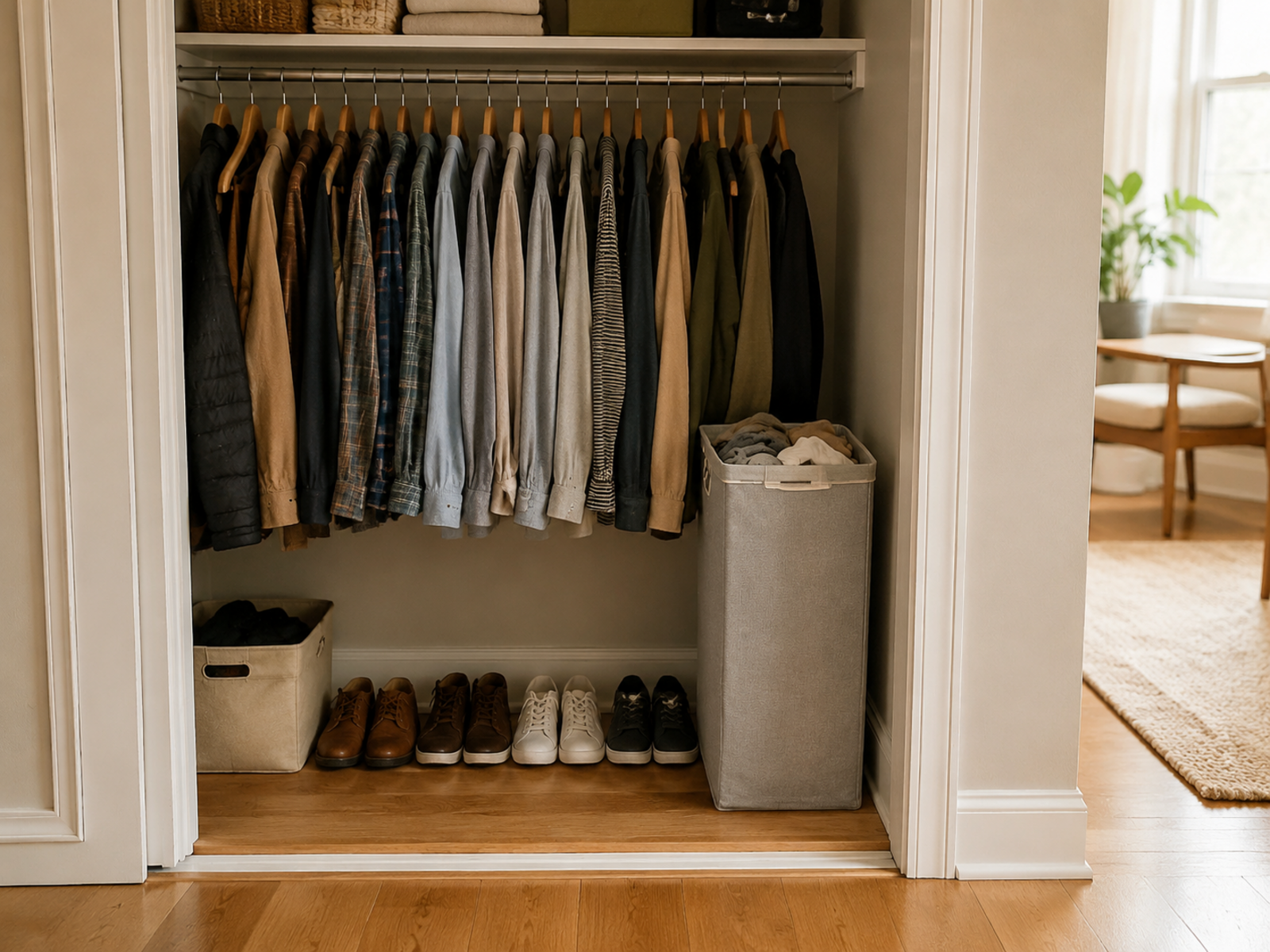
Use a Slim Floor Hamper Only in a True Residual Zone
A narrow freestanding hamper is the most direct substitute for a conventional basket, but it still claims floor space continuously. The useful test is whether the strip of floor is genuinely spare after the hamper is full.
Check low-hanging shirts, dresses, shoes, closet bins, sliding-door openings, and the place where you stand to retrieve clothing. The hamper should not force garments to drape over dirty laundry or make another storage zone harder to reach.
A soft freestanding bag can reduce furniture-like bulk and may double as a carry container, but a round or flexible bag can still occupy more floor diameter than expected. Handles, liner removal, and the route out of the room matter as much as the empty silhouette.
If the only available floor position is also the place your feet, shoes, door, or chair need to use, it is not residual space.
05
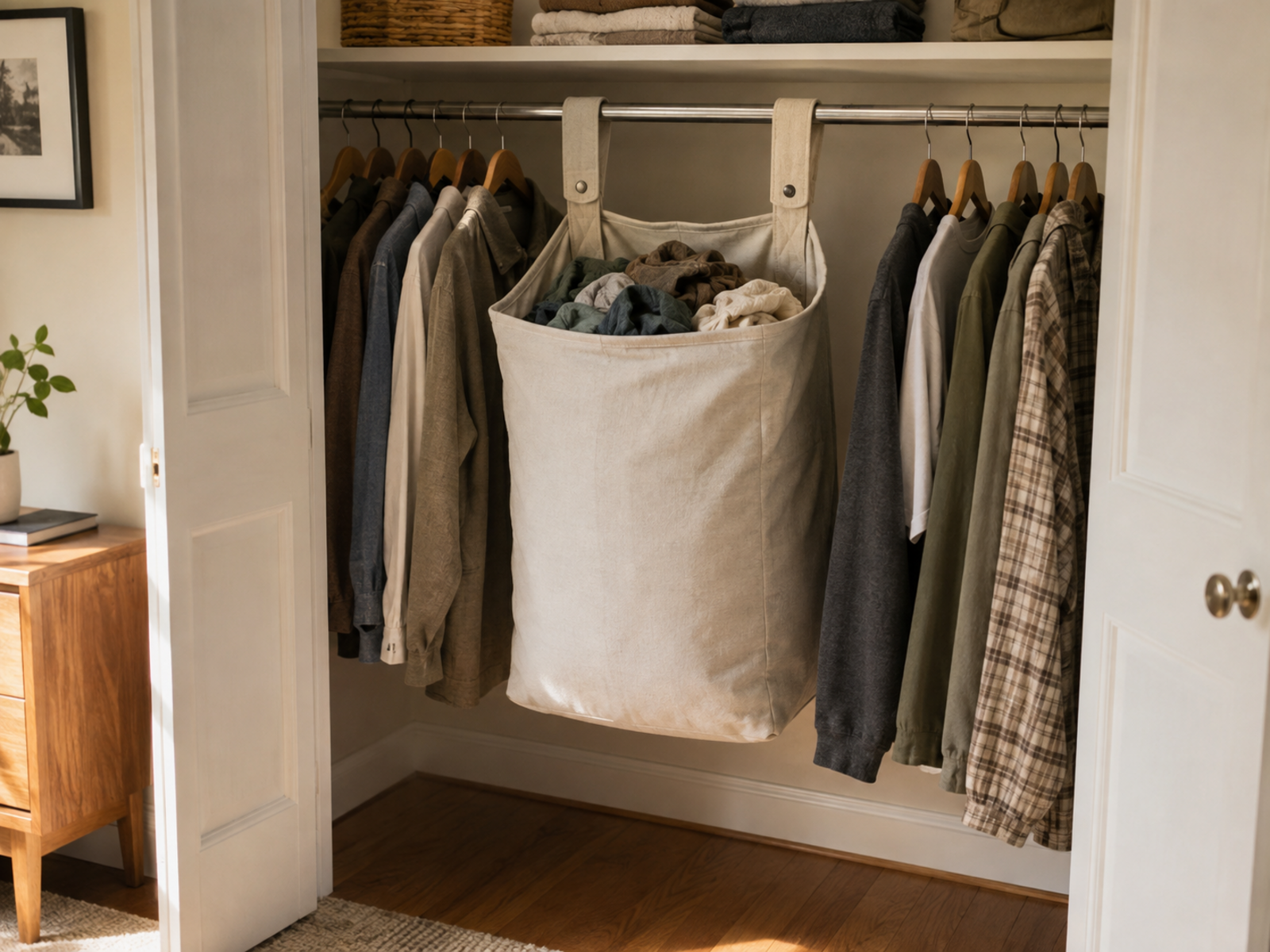
Use a Hanging Laundry Bag Only When the Rod Can Spare It
Hanging a laundry bag can eliminate the permanent floor footprint, but it converts a laundry problem into a hanging-capacity decision.
A rod-mounted or existing-hook bag occupies width, drops into the garment zone, and gets heavier as laundry accumulates. In a closet already short on hanging space, that trade can cost more than a narrow floor hamper would.
Check the existing clothing load, the support method, garment drop, and the path for removing a full bag. Do not invent a universal closet-rod capacity or assume that an existing hook is appropriate for a load that changes every day.
Hanging storage works best when the closet has genuinely spare vertical or rod capacity and the full bag remains easy to remove without disturbing the clothes beside it.
06
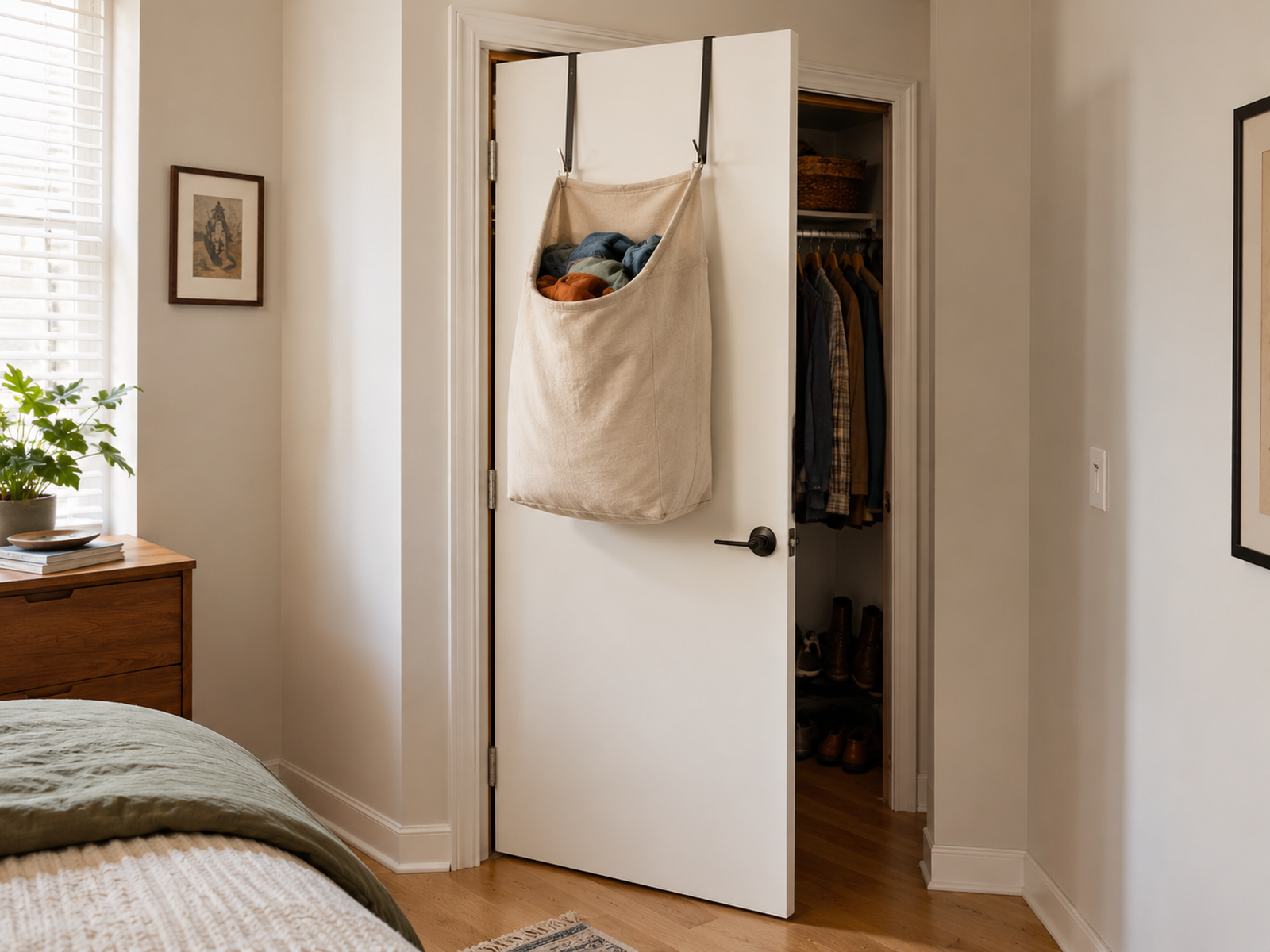
Treat an Over-the-Door Hamper as a Loaded Door Test
An over-door hamper can protect both closet floor and rod space, but the door becomes part of the storage system. Fit while empty is not enough.
Verify the door type first. A hinged door may support some over-door products; sliding or bypass closet doors do not provide the same back-of-door opportunity, and bifold doors introduce different track, hinge, and folding constraints.
Then test the real loaded condition: top gap, door thickness, trim, latch, wall contact, swing, bag projection, and the room path around the moving door. Product limits vary. One current CleverMade over-door hamper, for example, specifies a 20-pound limit and hooks for most doors up to 2 inches thick—useful evidence that door and load limits belong to the exact product rather than the category: CleverMade Over The Door Hamper.
The setup passes only when the loaded door can still close, latch, open normally, and move without turning the hanging laundry into an obstacle.
07
Move the Hamper Outside the Closet When Another Zone Costs Less
A closet with no spare floor, rod, or compatible door does not need another workaround inside the closet. Move the capture point to the nearest lower-cost zone.
A bedroom corner beside existing furniture may be cheaper than sacrificing the closet opening. A bathroom may work when dry laundry can be collected without crowding fixtures. A laundry-area hamper can simplify the route when the washer is close and the machine-access zone remains clear.
Under-bed dirty-laundry storage is a conditional fallback rather than a default. It can remove visible footprint, but it adds bending, pulling, low visibility, and a poor fit for damp items. Use it only when the bed clearance and retrieval pattern genuinely make sense.
Keep the route short enough that dirty clothes actually reach the hamper. A visually perfect location that requires an inconvenient detour every day tends to create a second pile closer to where clothes come off.
08
Separate Dirty-Laundry Capture From Clean-Laundry Transport
The container that lives in the room every day does not have to be the same object that moves clean laundry back from the washer.
A compact permanent hamper can handle dirty-laundry capture, while a larger collapsible basket or portable bag appears only on wash day. That reduces the continuous footprint without forcing the daily hamper to perform every part of the route.
This split can be especially useful with shared laundry rooms or laundromats, where transport matters more. Current products such as IKEA’s PÄRKLA laundry bag are explicitly positioned for carrying laundry to shared washing rooms or laundromats, confirming that transport-first forms are a real category rather than a workaround: IKEA PÄRKLA Laundry Bag.
Store the temporary transport container flat, folded, nested, or otherwise out of the way only when its actual design supports that. The system earns its space savings when the larger transport object is not occupying the room all week.
09
Give Damp Items a Transition Before the Hamper
A damp towel or wet garment is a different state from ordinary dry dirty laundry. Do not make a closed hamper the automatic next stop simply because it hides the item.
IKEA’s current U.S. laundry-basket guidance advises allowing damp articles to dry completely before loading them into a hamper to reduce mildew risk and notes that breathable forms allow air circulation: IKEA U.S. Laundry Baskets. This is manufacturer / retailer practical guidance, not a universal public-health rule.
In a small home, the transition can be simple: use the existing towel or drying setup until the item is dry enough for ordinary dirty-laundry storage, then move it into the hamper. Do not turn this article into a separate indoor-drying system.
The distinction keeps the hamper’s job clear: it stores dirty laundry between washes; it does not replace the drying step for items that are still damp.
10
Treat Wall and Adhesive Hanging as Product-Specific
Wall-hung or adhesive-supported laundry bags can remove the floor footprint when door and rod options fail, but mounting becomes the main constraint.
Dirty-laundry weight changes as the bag fills. Verify the exact hook or rail, the loaded weight, the wall or surface, installation instructions, removal method, and any lease restrictions. Do not describe a generic adhesive solution as damage-free or renter-safe.
3M’s current Command guidance lists different weight limits across products and includes surface and application restrictions, including a warning against wallpaper under the cited general hook instructions: Command Product Weight Limits and Command Hook Usage Guidance. Those rules apply to the relevant Command products, not to every adhesive laundry system.
When a freestanding, existing-hook, over-door, or portable option solves the problem with less mounting uncertainty, it is often the cleaner renter path.
RELATED GUIDES
What to Read Next
NEXT GUIDE
How to Organize a Small Closet With No Built-In Shelves
Read this next if hanging a laundry bag would consume rod space you already need for clothing; it helps you protect scarce hanging capacity without relying on built-in shelving.
GUIDE
How to Organize a Small Closet With Sliding Doors—Without Losing Access
Use this guide when sliding or bypass doors are the main reason an over-door hamper is not viable and access geometry is shaping the rest of the closet.
GUIDE
How to Store Shoes in a Small Closet Without Losing Floor Space
If shoes and dirty laundry are competing for the same lower closet zone, this guide helps you decide which floor-space problem should move elsewhere.