
Small Kitchen Organization
What to Do When a Dishwasher Door Blocks the Walkway or Hits a Cabinet
Measure the dishwasher in its fully open state, not just inside the cabinet opening. Check the door, adjacent handles, corner clearance, rack extension, sink loading position, and the remaining aisle before deciding whether the fix is alignment, cabinet hardware, appliance choice, or a larger layout change.
In This Guide
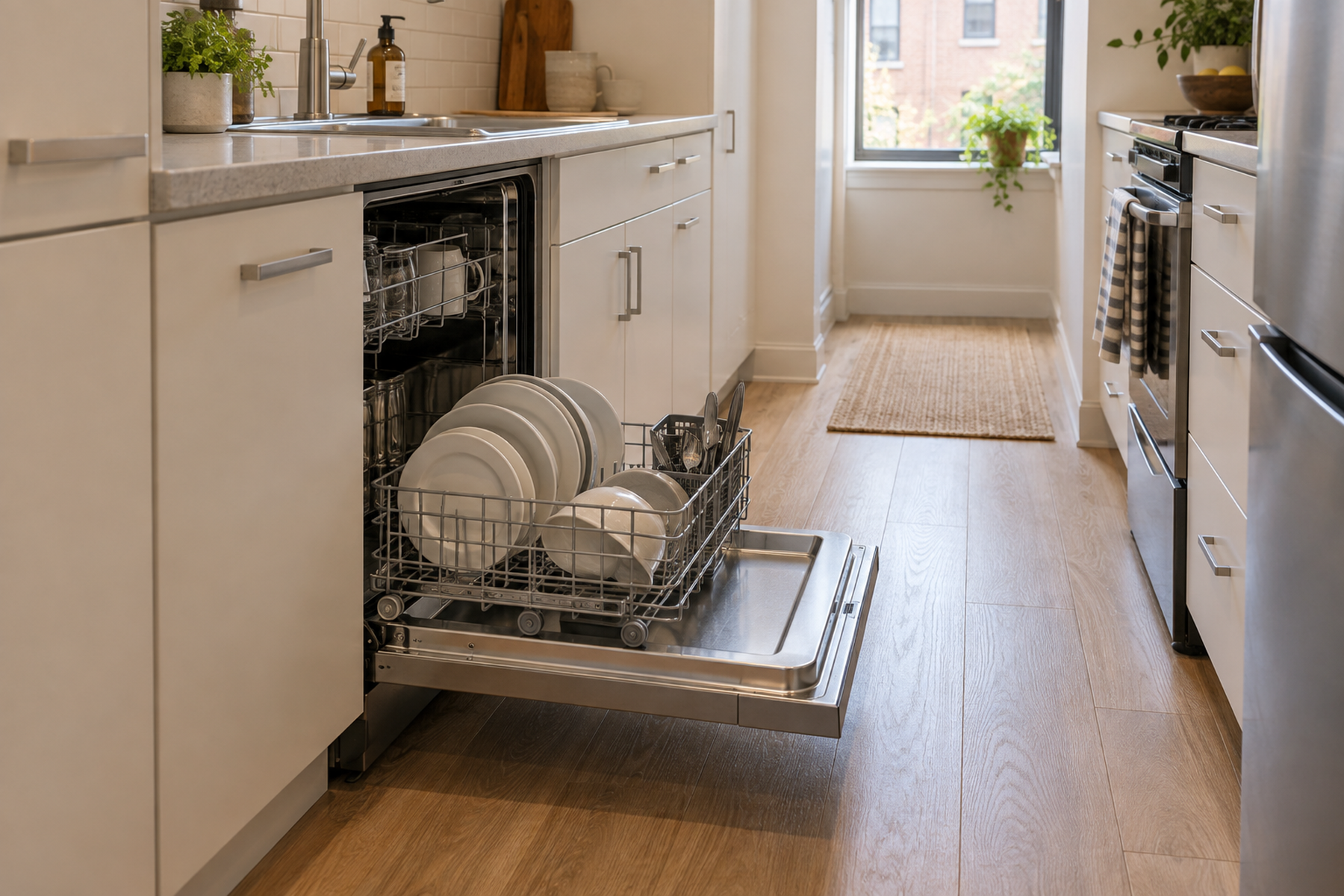
A built-in dishwasher can fit its cabinet opening perfectly and still be a poor fit for a small kitchen. The failure often appears only after the door drops: a cabinet pull stops it short, the horizontal door consumes most of a galley aisle, a nearby pantry door collides, or the person loading from the sink has nowhere comfortable to stand.
The useful fit test has three states: installed fit, open-door fit, and loading/circulation fit. A dishwasher works in the room only when all three states succeed together.
Quick Answer
Measure the Kitchen With the Dishwasher Fully Open
Do not choose or approve a dishwasher from cabinet-opening dimensions alone. Map the full door and rack envelope, adjacent moving parts, and the person loading the machine before deciding that the appliance fits the kitchen.
01
Treat cabinet handles as part of the appliance clearance
A cabinet box may clear the dishwasher while a projecting pull or knob enters the door path. Measure the hardware, not just the cabinet face.
02
Add the person and rack extension to the open-door test
The horizontal door is only part of the operating footprint. The user also needs room to stand, pull racks out, move dishes from the sink, and avoid blocking the kitchen’s essential route.
03
Re-measure replacement models from scratch
A new dishwasher can differ in hinge position, panel geometry, depth, handle style, and door projection even when it fits the same nominal opening. “The old one fit” is not proof that the replacement will.
01
Measure the Dishwasher in All Three Fit States
Start with the installed or closed state: opening width and height, appliance depth, cabinet-front alignment, handle projection, and the surrounding cabinet or wall geometry.
Then measure the door at the fully open position using the exact model specifications where available. Record how far the horizontal door projects into the aisle and where its side edges travel relative to adjacent cabinet fronts, pulls, walls, appliances, and doors.
Finally, extend the racks and include a person in the plan. The dishwasher must allow normal loading and unloading rather than merely reaching 90 degrees with no one standing nearby.
This three-state test separates a true appliance fit from a cabinet-opening fit. In a small kitchen, the operating footprint can matter more than the closed footprint.
02
Check Cabinet Hardware and Corner Clearance Separately
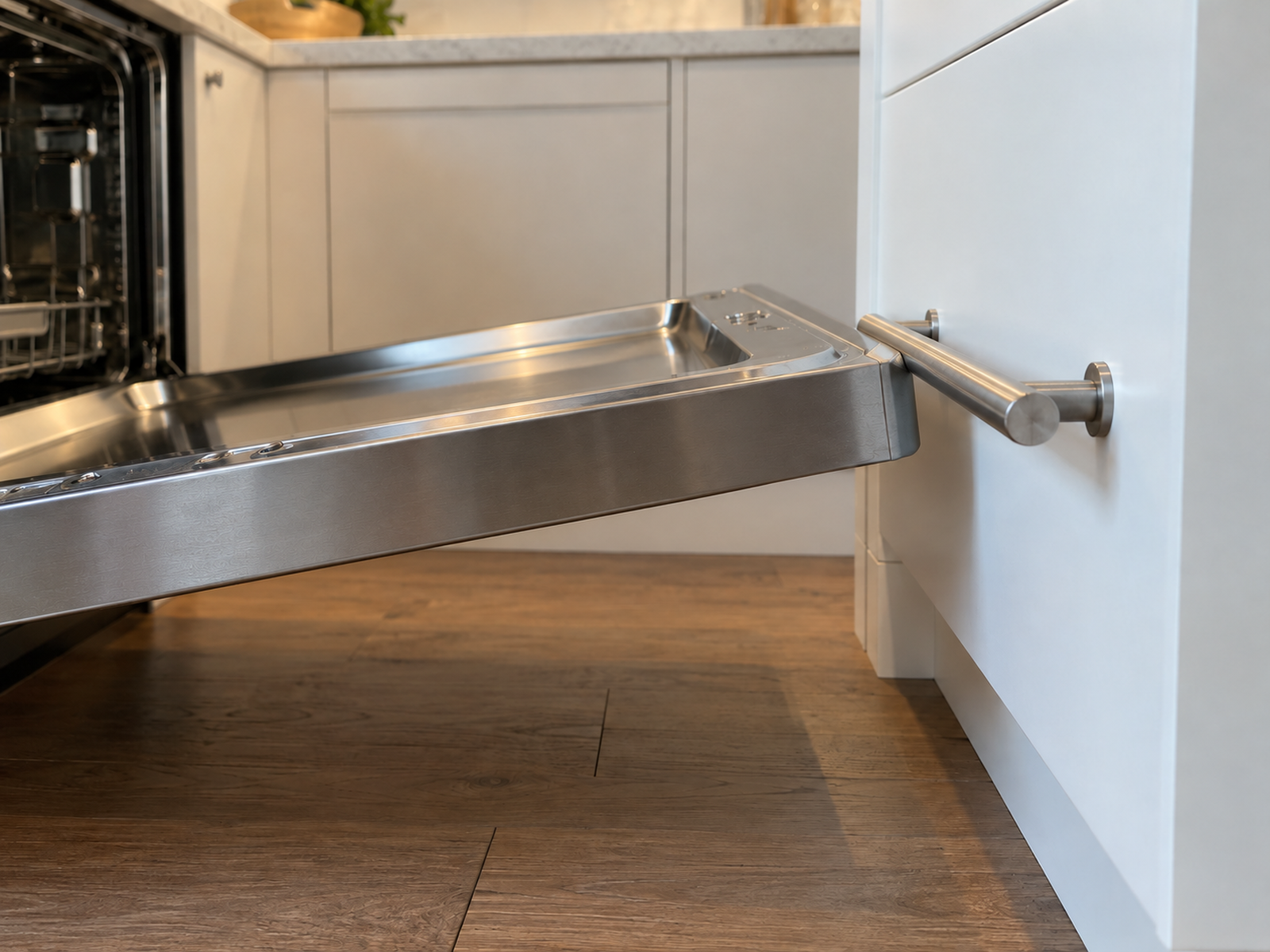
A dishwasher beside a corner cabinet can clear the cabinet boxes and still strike a handle or drawer pull.
Current Whirlpool and Maytag planning guidance treats corner side clearance as a separate condition from front loading space. Some manufacturer guidance uses about 2 inches for covered corner conditions, but the exact model instructions control and projecting cabinet hardware can require more.
Measure from the actual dishwasher door path to the most projecting part of the neighboring cabinet, including knobs, bar pulls, drawer fronts, and face-frame details.
Also check whether a nearby pantry, side door, refrigerator, oven, or corner cabinet opens into the same zone. Two moving parts that work independently can still fail when they need the same space.
Measure / Check First
Before accepting the installation or shopping for a replacement, test the kitchen in its operating state.
Check the Open Door, Adjacent Moving Parts, and Loading Zone First
01
The dishwasher operating envelope
Record the exact model’s closed depth, depth with the door open, handle projection, side clearance, rack-extension path, and any installation-specific front-clearance guidance.
02
The neighboring hardware and doors
Measure cabinet pulls, drawer handles, corner doors, pantry doors, refrigerator or oven doors, and any wall or island edge that can enter the dishwasher’s swing or open-door zone.
03
The human loading and circulation zone
Open the dishwasher fully, extend a rack, and test where a person stands between the sink and appliance. Check whether another person must pass and whether the only kitchen route remains usable.
If the dishwasher can technically open but cannot be loaded normally or repeatedly collides with another moving part, the installation has not passed the full fit test.
03
Test the Sink Loading Zone and Remaining Walkway
Dishwasher placement is a workflow problem as well as a geometry problem.
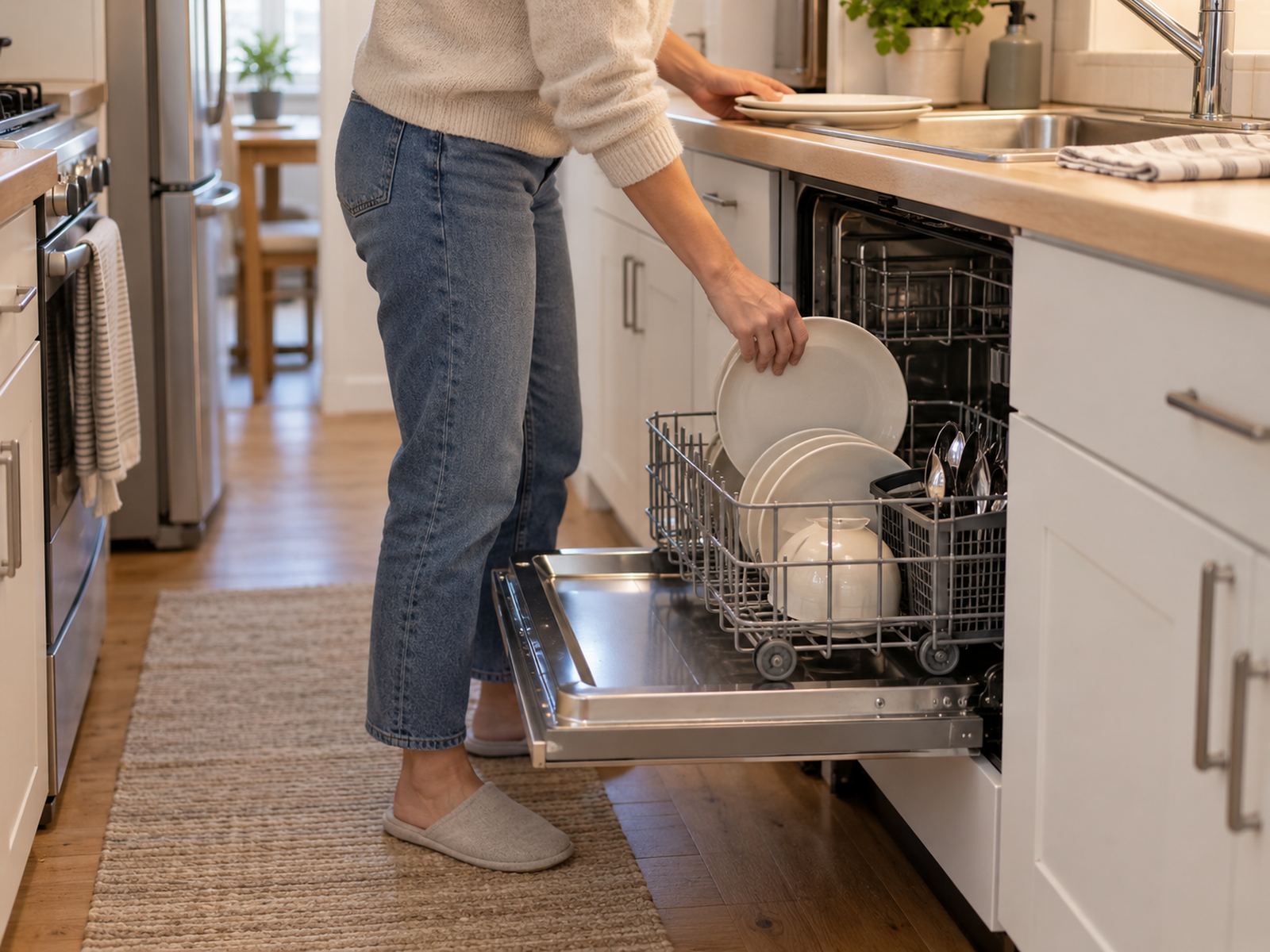
Stand where dishes are actually rinsed or scraped at the sink, open the dishwasher, and pull out the lower rack. The user should be able to turn or step between sink and rack without balancing over the open door or reaching awkwardly across it.
Then test the rest of the kitchen. In a narrow galley, the open door may temporarily block most or all through-traffic; current Whirlpool apartment-size guidance specifically warns that an open dishwasher can block the walkway in tight layouts.
A temporary blockage can still be workable in some one-person or low-traffic kitchens, but it is different from a layout where the open door blocks the only exit, creates repeated trip exposure, or prevents normal access to an essential appliance or cabinet.
04
Ask the Installer or Maintenance Team to Verify Alignment Before You Alter Cabinets
A recently installed or landlord-provided dishwasher may sit slightly too far forward, off-center, or otherwise misaligned relative to the surrounding cabinetry.
Do not loosen, remount, or reposition a built-in dishwasher casually. The appliance is secured and connected to power, water, and drain, so alignment belongs with the installer, property maintenance, or another qualified service path.
Document the collision with the door fully open and photograph the adjacent handle, cabinet front, or wall that stops it. Include the appliance model and the difference between the old and new installation if this is a replacement.
If the unit can be corrected within its approved installation position, that is preferable to changing cabinet hardware or redesigning the kitchen around an avoidable installation error.
Use / Skip
Changing the Adjacent Cabinet Hardware
Use
Use it when the projecting pull is the only remaining collision
A lower-profile knob, pull, recessed solution, or approved hardware position can be a small intervention when the dishwasher door, cabinet boxes, aisle, loading zone, and appliance alignment already work and only the existing cabinet hardware enters the door path.
Skip
Skip it when removing the handle only hides a larger fit problem
Keep the existing hardware and move to an appliance, installation, or layout solution when the dishwasher door still blocks the walkway, hits the cabinet itself, conflicts with another door, or leaves too little room for loading even after the pull is removed.
05
Re-Measure Every Replacement Dishwasher
Replacement risk is highest when the old appliance barely cleared the surrounding kitchen.
Two dishwashers can fit the same nominal cabinet width while using different hinge geometry, front-panel position, handle projection, and fully open depth. Re-measure the exact model rather than assuming the new machine inherits the old one’s operating envelope.
This is especially important in a corner or beside projecting hardware. A small change in door edge or fore-aft position can turn a barely successful installation into a repeated collision.
Treat the existing kitchen as fixed geometry first: cabinet faces, pulls, opposite run, island, sink, and nearby doors. Then test the replacement appliance against that geometry in closed, open, and loading states.
06
Do Not Assume an 18-Inch Dishwasher Has a Much Shorter Open Door
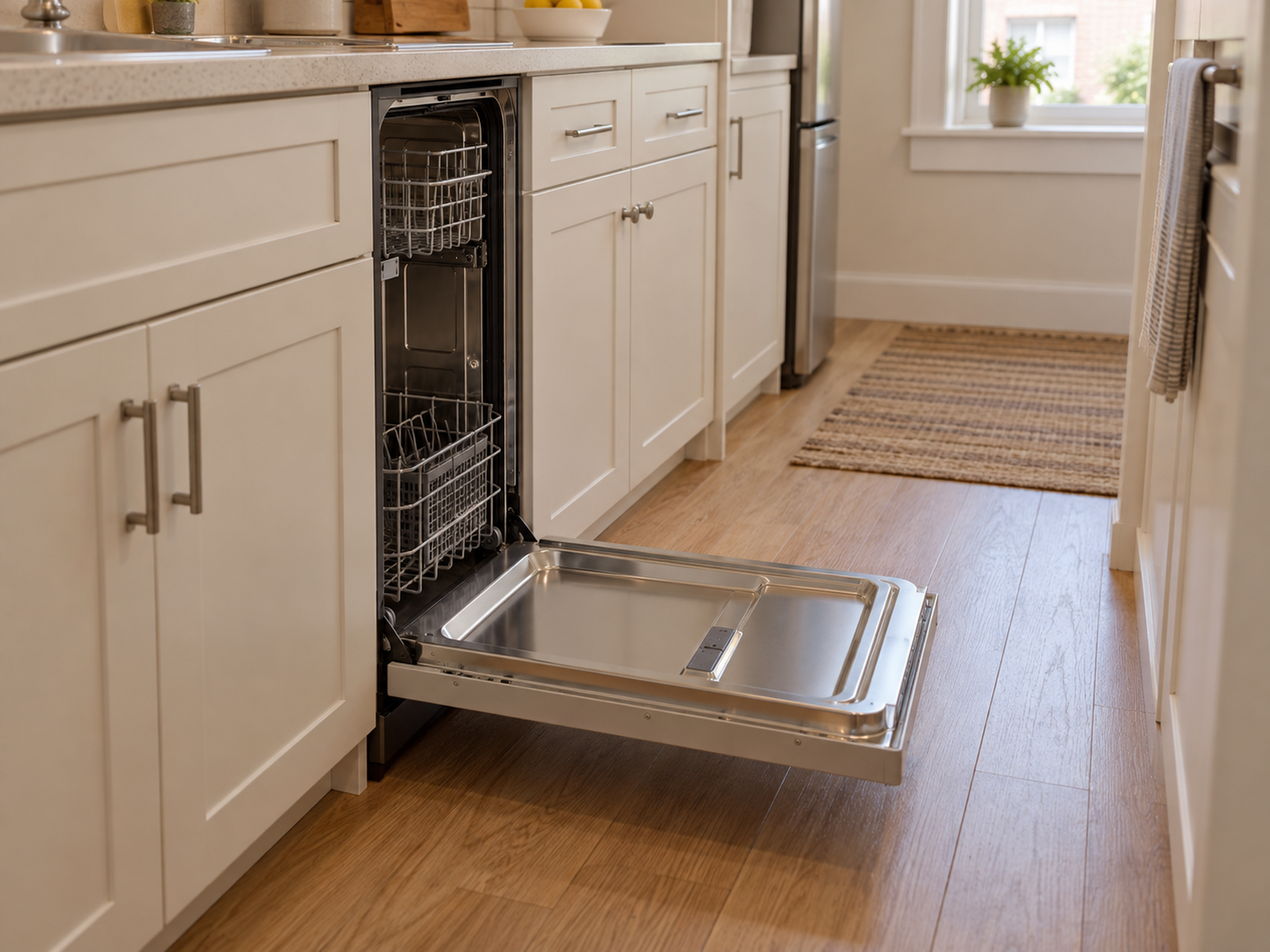
An 18-inch built-in can recover valuable cabinet-run width when the kitchen cannot accommodate a standard-width machine.
That does not mean it automatically solves a narrow aisle. Current Bosch examples cited in the Research show an 18-inch model family and a 24-inch model family with nearly identical overall depth when their doors are open to 90 degrees.
The width reduction therefore solves a side-to-side cabinet problem, not necessarily the front-to-back operating footprint.
Choose an 18-inch model when cabinet-run width or capacity trade-offs make sense, but verify the exact open-door projection and loading zone independently.
07
Accept Temporary Aisle Blockage Only When the Kitchen Still Functions
A horizontal dishwasher door will occupy floor circulation while the machine is being loaded or unloaded.
That can be acceptable when the appliance opens fully, the person loading has a stable standing zone, the blockage is brief, and no essential exit or repeated household route depends on passing through that exact space.
Also check what the open door traps behind it. Clean-dish cabinets, trash, pots and pans, drawers, or another appliance can make unloading inefficient even when the walkway issue itself is tolerable.
Do not normalize a door that can only open partway or a setup that requires stepping over the appliance. Temporary inconvenience is different from functional incompatibility.
08
Replace or Relocate the Dishwasher When the Operating Envelope Is Fundamentally Wrong
Some kitchens cannot make the existing dishwasher position work cleanly with a different handle or minor alignment correction.
A different dishwasher can help when another hinge, panel, or handle configuration clears the surrounding cabinetry, but every replacement still needs the three-state fit test. A pocket or recessed handle can reduce closed-front projection without shortening the main drop-down door.
Relocating the dishwasher or adding a cabinet filler can create better long-term geometry, but those are owner-level kitchen interventions because they can affect cabinet width, plumbing, drain, electrical supply, and sink workflow.
For renters, a landlord-provided appliance that cannot open or load normally should be documented and escalated rather than modified. If built-in geometry is fundamentally unavailable, a countertop dishwasher is a separate lower-commitment fallback with its own counter-space trade.
Closing Decision
Judge the Dishwasher by the Kitchen With the Door Open
A built-in dishwasher is a fit only when the cabinet opening, fully open door, neighboring hardware, racks, person-loading zone, and circulation path all work together.
Measure the kitchen in the operating state before changing hardware or choosing a replacement. Fix a small handle collision only when it is truly the last problem; when the open-door envelope itself is incompatible, change the appliance or layout branch instead.
RELATED GUIDES
What to Read Next
NEXT GUIDE
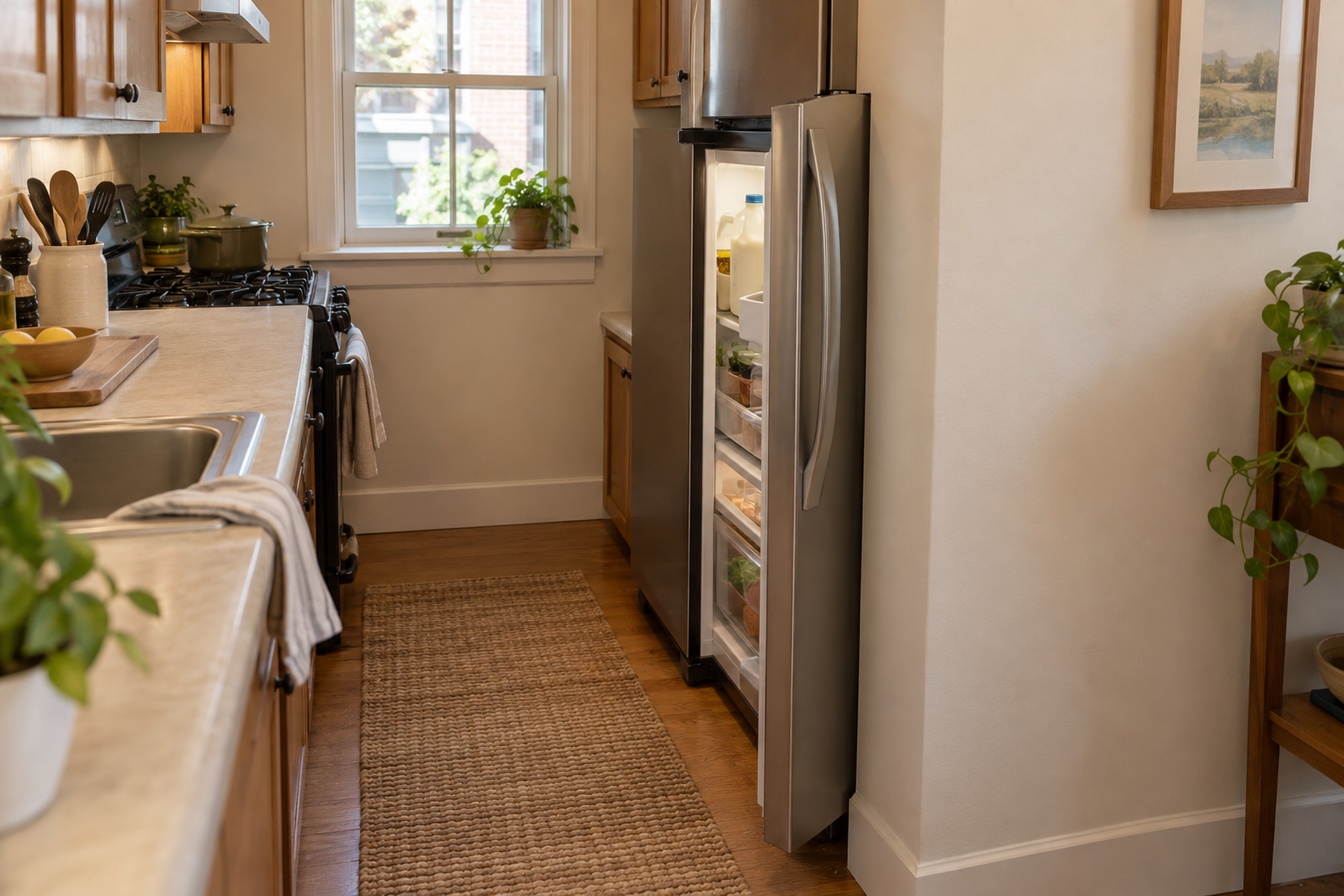
What to Do When a Refrigerator Door Will Not Open Fully Next to a Wall
Use this next if another built-in appliance fits while closed but fails when its door enters the kitchen’s operating space.
GUIDE
How to Use a Countertop Dishwasher in a Small Kitchen With No Built-In Dishwasher
Use this if the built-in opening or circulation geometry is fundamentally incompatible and a renter-friendly countertop alternative needs to be evaluated.
GUIDE
How to Create a Dish-Drying Zone in a Small Kitchen With No Dishwasher
Use this if the kitchen cannot support a functional dishwasher installation and dishwashing needs to fall back to the sink without losing the remaining counter area.