
Small Kitchen Organization
What to Do When a Refrigerator Door Will Not Open Fully Next to a Wall
Measure the refrigerator while it is open, not just while it is closed. Identify the exact hinge-side obstruction, test drawer and cleaning access, then compare approved repositioning, door-swing changes, tighter-clearance refrigerator designs, and renter escalation before sacrificing aisle space or remodeling the kitchen.
In This Guide
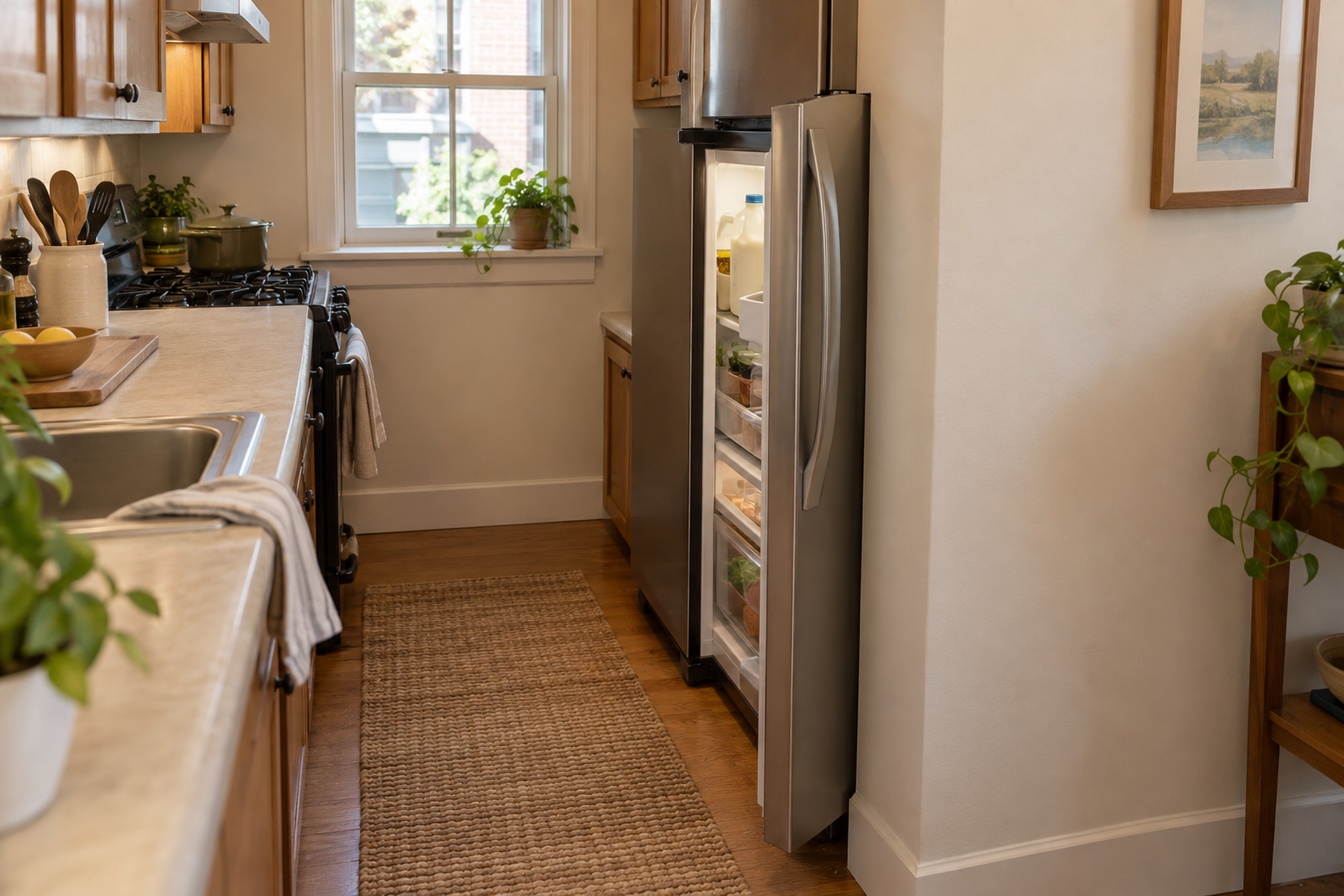
A refrigerator can fit perfectly between cabinets and still be the wrong appliance for the opening. The closed box may clear the walls, while the door hits a return wall, trim, or cabinet before the shelves, crispers, door bins, and cleaning surfaces become fully usable.
That makes refrigerator fit a two-state problem: closed footprint and operating footprint. The second state includes door swing, handle sweep, internal drawers, freezer drawers, a person standing in front, and the aisle that remains while the appliance is open.
Quick Answer
Measure the Refrigerator Open Before You Change the Kitchen
The correct fix depends on the exact model and the exact obstruction. Use the manufacturer’s installation and specification drawings first, then test whether the refrigerator can function—not merely fit—inside the current kitchen geometry.
01
Confirm the exact model and hinge-side requirement
Do not borrow a wall-clearance number from another refrigerator. Current manufacturer documents show materially different hinge-side requirements across models, including specialized tight-clearance hinge systems.
02
Test doors, drawers, and cleaning access separately
A door reaching 90 degrees does not automatically prove that crispers, deli drawers, shelves, or deep cleaning access will work. Test the internal components the exact model is designed to use and remove.
03
Treat every fix as a space trade
Pulling the refrigerator forward can improve wall clearance but spend aisle depth. A narrower refrigerator spends capacity. A filler spends cabinet or counter width. A wall change spends renovation scope.
01
Identify the Exact Refrigerator and Operating Envelope
Find the brand and model number before changing the appliance position or shopping for a replacement.
Use the model’s installation instructions or specification drawing to record the closed width, depth, and height; hinge-side wall clearance; ventilation and rear-service requirements; door-open width and depth; handle projection; and freezer-drawer projection when applicable.
Also look for model-specific information about internal drawer removal. Whirlpool documentation for some refrigerator families explicitly links hinge-side clearance with door swing and crisper removal, which is why everyday access and service access should not be assumed to require the same angle.
Treat the specification sheet as the controlling source for the appliance. Samsung, Whirlpool, LG, and GE all publish open-door or wall-side fit guidance, but their numbers are not interchangeable across models.
02
Separate Closed Fit From Operating Fit
The refrigerator’s closed footprint answers whether the appliance can occupy the opening. It does not answer whether the kitchen can use it.
Map the door sweep and handle path into the room. Then open the refrigerator to the angle the wall actually allows and test normal loading, lower-shelf access, door-bin access, crisper use, and cleaning.
Include the person in the measurement. A door and freezer drawer may technically open while leaving too little standing or passing space in a narrow galley or apartment kitchen.
This is the small-space test that matters: door open + drawer open + person standing + aisle remaining.
Measure / Check First
Before moving the refrigerator, requesting a replacement, or changing cabinetry, record the complete operating geometry.
Check the Wall, Open Door, Internal Drawers, and Aisle First
01
The hinge-side obstruction
Measure the side gap, wall or cabinet return, baseboard or trim projection, handle collision point, and how far the obstruction extends forward relative to the refrigerator case.
02
The real door and drawer envelope
Open the door as far as the kitchen allows, then test the refrigerator shelves, door bins, crispers or deli drawers, freezer drawer, and any component that should be removable for cleaning or service.
03
The kitchen path with the appliance open
Measure the remaining aisle and loading zone with the refrigerator door or freezer drawer open. Also preserve the model’s required rear ventilation, leveling, water-line, and electrical conditions.
If a change solves door swing only by making the aisle unusable or violating the model’s installation requirements, it is not a complete fix.
03
Test the Hinge-Side Wall and Internal Drawer Access
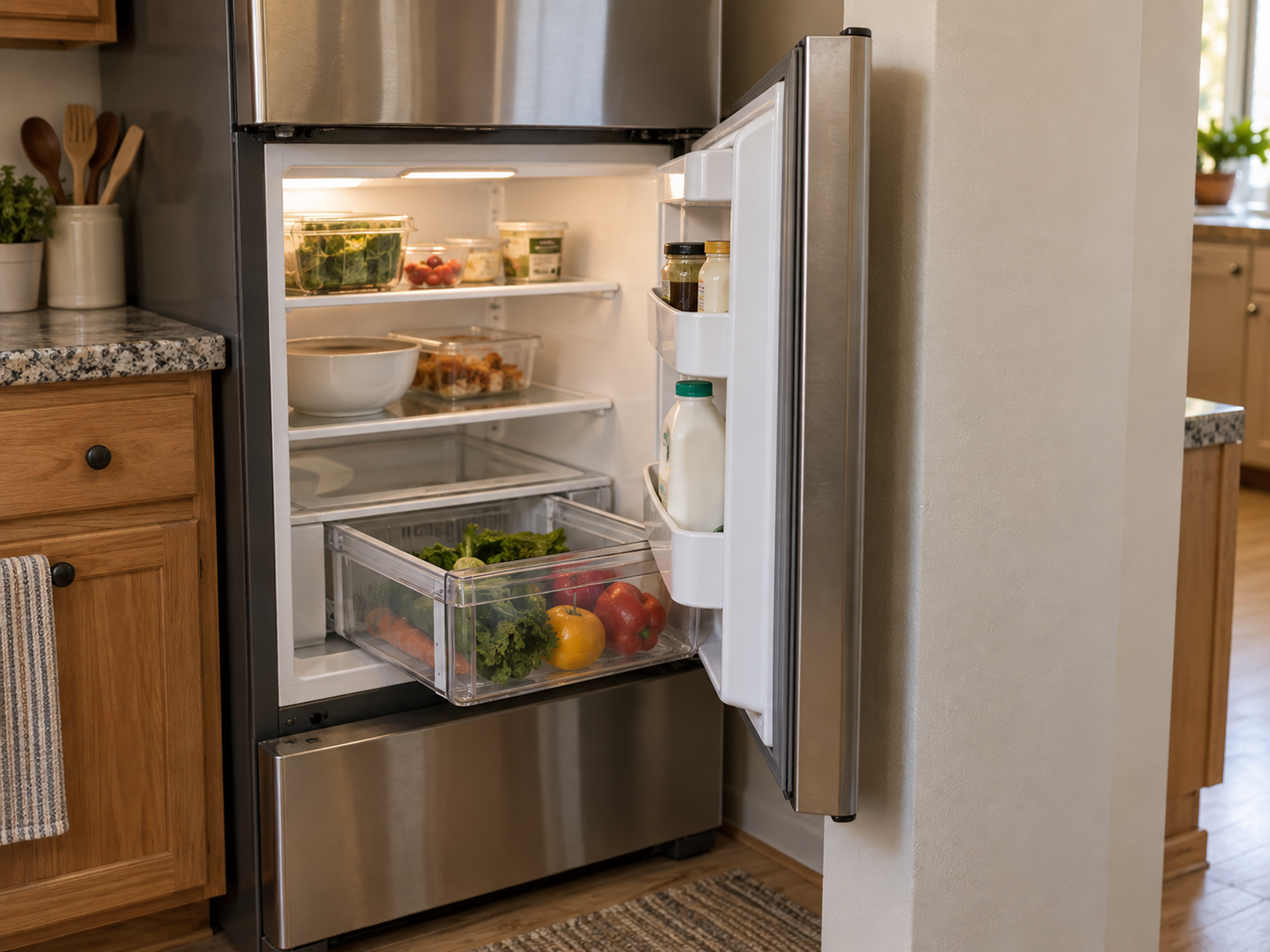
Do not treat the wall as a simple side-clearance problem. The wall may extend forward beyond the refrigerator case, while trim or a pantry side panel can create the same collision even when the nominal gap looks adequate.
Check where the hinge and door need to travel relative to that fixed plane. On some conventional designs, a few inches of hinge-side clearance may be required; other models use materially different geometry.
Current LG Zero Clearance™ models show how different the hinge architecture can be. LG markets current refrigerators for tight wall or cabinet adjacency and still recommends a small model-specific side gap rather than literal zero space.
The practical pass condition is not a universal angle. It is whether the exact refrigerator can provide the intended food, drawer, cleaning, and service access at the available opening angle.
04
Pull the Refrigerator Forward Only Within the Approved Installation Envelope
Moving the refrigerator slightly forward can sometimes let the hinge or door move beyond a projecting wall return.
That can be a low-construction solution, but it trades wall clearance for aisle projection. The appliance may sit farther into a galley path or become visually proud of the adjacent cabinets.
Do not improvise heavy-appliance movement around a water line, power cord, flooring, leveling feet, or rear ventilation. In a rental, a property-provided refrigerator is better evaluated or repositioned by maintenance or an appliance service professional.
After repositioning, retest the open door, internal drawers, freezer drawer, standing zone, and remaining aisle. The new position has to pass both appliance and room geometry.
Use / Skip
Pulling the Refrigerator Forward
Use
Use it when the hinge clears the wall and the kitchen still passes the open-state test
A forward adjustment can work when the exact model permits the position, rear service and ventilation remain correct, water and power connections are not strained, leveling remains stable, and the resulting projection still leaves a practical aisle and loading zone.
Skip
Skip it when the wall problem simply becomes an aisle problem
Move to a different appliance or layout branch when the refrigerator would project too far into circulation, connections limit safe movement, required rear clearances cannot be maintained, or the door and drawers still do not become fully usable.
05
Do Not Assume Counter-Depth Will Fix the Wall-Side Door
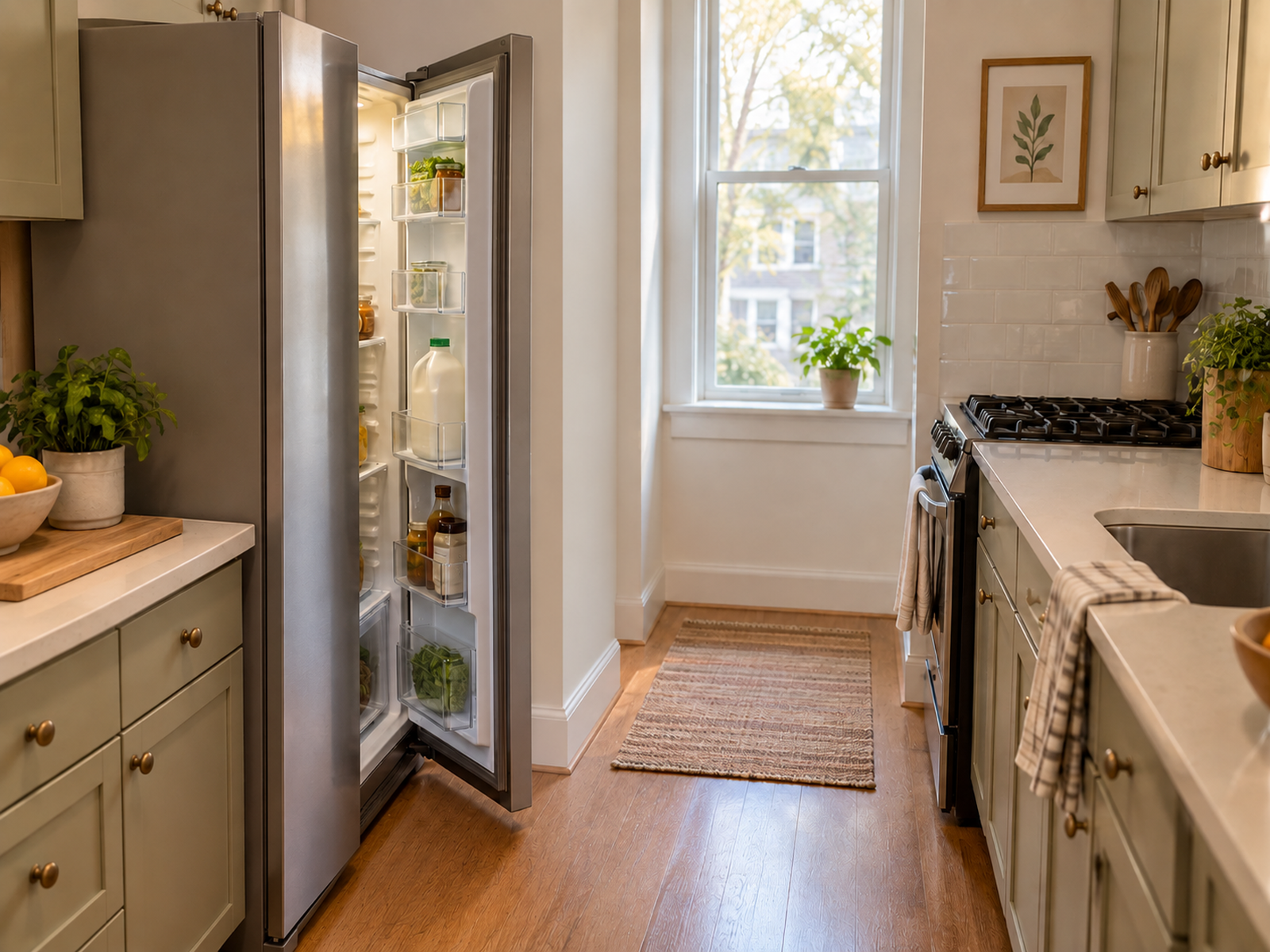
Counter-depth refrigerators primarily reduce how far the cabinet projects into the aisle.
That can be valuable in a narrow kitchen, but it does not automatically change the hinge-side sweep that causes the wall collision. A shallower refrigerator can still have a door that needs meaningful side clearance.
Use counter-depth as an aisle solution only after checking the replacement model’s hinge geometry and open-door dimensions against the wall.
If the existing problem is both aisle projection and wall-side access, the replacement has to solve both dimensions rather than trading one for the other.
06
Compare Door Reversal, Narrower Width, and Tight-Clearance Hinge Designs
A reversible single-door refrigerator can be a high-value branch when opening the door away from the wall improves the working path. GE and LG both document reversal as model-specific rather than universal.
A narrower refrigerator can create the side gap the current appliance lacks, but that clearance is purchased with refrigerator capacity. The replacement door geometry still needs to be verified.
A different door configuration can also change the problem. French doors reduce individual door width, while side-by-side, top-freezer, bottom-freezer, and four-door designs create different swing and interior-access trade-offs.
Current LG Zero Clearance™ and Samsung Zero Clearance Fit product families add a newer 2026 branch for fixed tight-wall conditions. Treat those terms as model features, not permission to ignore the installation drawing.
07
Use an Evidence-First Renter Branch for a Property-Provided Refrigerator
If the refrigerator belongs to the landlord or property, document the problem before proposing a renovation or buying an appliance yourself.
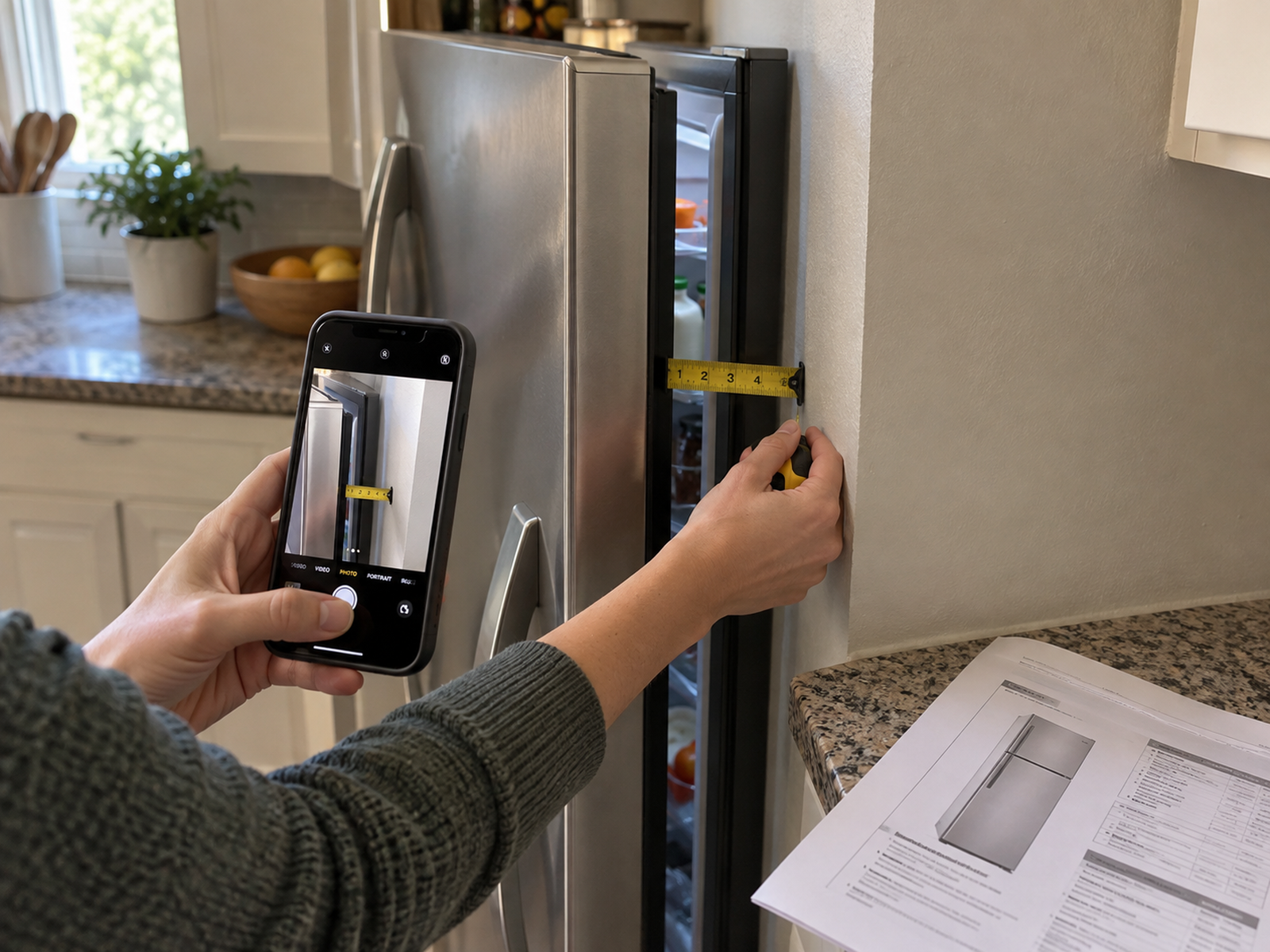
Record the exact model, photograph or film the wall collision, measure the hinge-side gap, and save the manufacturer page showing the relevant open-door or wall-clearance requirements.
Also document the functional result: a crisper that cannot open, a wall-side door that opens only a few inches, cleaning access that is blocked, or an aisle that becomes unusable when the appliance is repositioned.
That turns the request into a specific appliance-layout fit issue. This article does not make a universal legal claim that management must replace the refrigerator; lease terms and local housing rules vary.
08
Replace the Appliance or Change the Layout When the Format Is Fundamentally Wrong
Some refrigerator-and-wall combinations cannot be corrected cleanly with position alone.
A replacement may be the better long-term answer when another width, door orientation, hinge design, or tight-clearance model can provide normal access without sacrificing the aisle.
Owner or renovation branches can also include a filler beside the refrigerator, cabinet-run changes, refrigerator relocation, or alteration of a nonstructural wall or return. Those options trade cabinet width, counter width, utilities, flooring, or construction scope for better appliance access.
Do not normalize permanent workarounds around an appliance that is fundamentally incompatible with the opening. The goal is a refrigerator that can be loaded, cleaned, and serviced as intended while the small kitchen still functions around it.
Closing Decision
Judge the Refrigerator by Its Open Footprint
A refrigerator is not a functional fit because the closed box fits between cabinets. The hinge-side obstruction, open door, internal drawers, freezer drawer, loading position, ventilation, and remaining aisle all belong in the fit test.
Start with the exact model and the lowest-commitment correction the kitchen can support. If approved repositioning or door orientation cannot restore normal use, a different refrigerator format can be the more space-efficient answer than living permanently with blocked access.
RELATED GUIDES
What to Read Next
NEXT GUIDE
How to Organize a Small Refrigerator Without Overpacking It
Use this next once the door and drawer geometry work and the remaining problem is making the refrigerator’s interior storage easier to see and use.
GUIDE
Where to Put a Microwave in a Small Kitchen With No Counter Space
Use this if changing the refrigerator position or width forces another appliance-placement decision in the same compact kitchen.
GUIDE
How to Use a Countertop Dishwasher in a Small Kitchen With No Built-In Dishwasher
Use this if the kitchen’s appliance layout is being re-evaluated more broadly and countertop appliance operating zones are also competing for limited space.