
Small Kitchen Organization
How to Organize a Small Refrigerator Without Overpacking It
Protect temperature and airflow before you chase maximum density: reduce the refrigerated load, keep leftovers and ready-to-eat food visible, contain raw foods deliberately, use the refrigerator’s actual drawers and door bins well, and add organizers only where they solve a real retrieval problem.
In This Guide
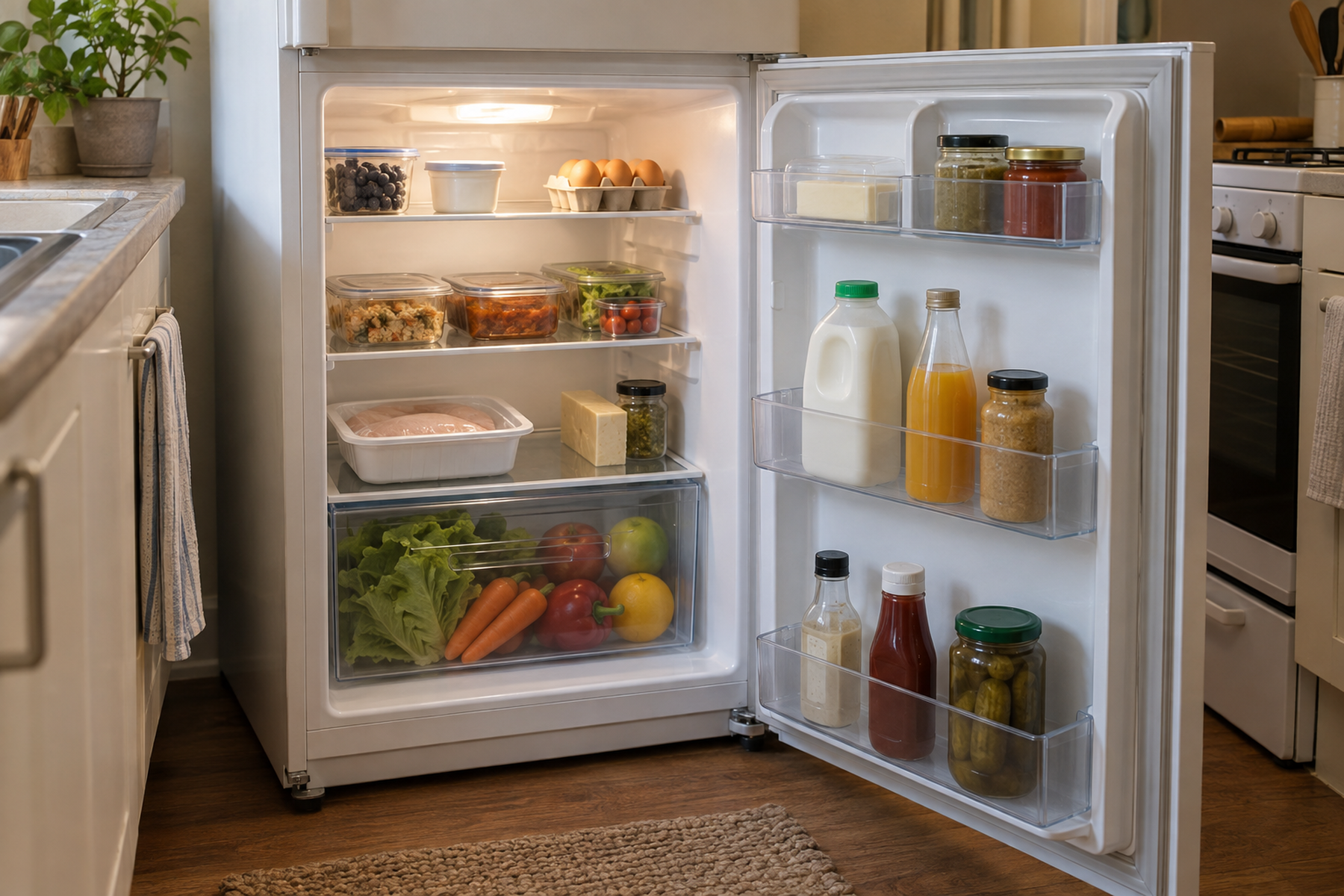
A small refrigerator can look full long before it is organized. When every shelf, crisper, and door bin is packed tightly, leftovers disappear, produce gets buried, raw-food leaks become harder to spot, and the refrigerator loses the open space it needs for cold air to circulate.
The useful goal is not maximum density. It is a refrigerator that stays at a safe temperature, keeps high-priority food visible, prevents cross-contamination, and leaves enough flexibility for the next grocery trip without turning every shelf into a rigid set of bins.
Quick Answer
Protect Cold Storage Before You Optimize Every Inch
A small refrigerator works best when food-safety and turnover rules set the capacity limit. Start by reducing what does not need to be there, then make the food most likely to be eaten easy to see and retrieve.
01
Keep the refrigerator at 40°F or below and leave room for air
Use the appliance’s controls and an appliance thermometer if needed, and avoid packing shelves so tightly that cold air cannot circulate around the food.
02
Give visible space to food that needs action
Keep leftovers, opened foods, meal-prep items, and other high-turnover categories toward the front or in one small use-first zone instead of letting newer groceries bury them.
03
Use containers for safety or access, not decoration
Contain raw meat, poultry, and seafood securely, and add bins, risers, or other organizers only when they improve retrieval, stacking, leakage control, or category visibility without crowding the compartment.
01
Protect Temperature and Airflow Before You Add Zones
USDA and FDA guidance sets the first boundary: the refrigerator should be kept at 40°F or below. Organization is secondary to maintaining safe cold storage.
The second boundary is circulation. FDA and USDA both warn against crowding the refrigerator so tightly that cold air cannot move properly around the compartment.
That makes some empty space functional rather than wasted. A visible gap can support airflow, make labels easier to see, let containers slide forward, and give the next grocery trip somewhere to land without immediately burying older food.
Do not judge the refrigerator by how completely every cubic inch is filled. Judge it by whether food stays cold, shelves remain usable, and the household can still see and retrieve what is already inside.
02
Reduce the Load Before You Reorganize
Take inventory before buying organizers. Remove expired or abandoned food, duplicate condiments the household does not realistically need open at the same time, and leftovers that are already outside the household’s safe-use plan.
USDA guidance says refrigerated leftovers are generally used within three to four days. That makes old leftovers a turnover problem as well as a space problem.
Also protect cold storage from pantry overflow. If a food does not require refrigeration, test it against the kitchen’s cabinet, cart, shelf, or no-pantry storage system before spending premium refrigerator volume on it.
A small refrigerator often needs a smaller grocery load rather than a more elaborate organizer system. If the shelves return to gridlock immediately after every shopping trip, change quantity or shopping cadence before adding more internal hardware.
03
Make High-Turnover Food the Easiest to See
Visibility is one of the most valuable resources in a small refrigerator. Food that disappears behind tall bottles or newer groceries is harder to use before quality or safe-storage windows run out.
Create one small use-first area for leftovers, opened foods, meal-prep components, or produce that needs to be eaten soon. This is an organization behavior, not a USDA-defined refrigerator zone.
Keep the system broad rather than creating a labeled micro-zone for every ingredient. One leftovers area, one produce area, one raw-food containment area, and a few household-specific categories are easier to reset than a refrigerator divided into a dozen rigid boxes.
If the fridge is shared, visibility alone may not solve conflict. Assigned shelf or bin areas, a common-food zone, and a clear leftover-reset routine can make ownership predictable without pretending everyone needs exactly the same amount of volume.
Measure / Check First
Before buying any bin, riser, turntable, or extra container, check the refrigerator’s real temperature, open air, and shelf geometry with the normal grocery load inside.
Check Temperature, Air Space, and Real Shelf Dimensions First
01
Temperature and obvious airflow paths
Confirm the refrigerator can hold 40°F or below and do not cover obvious vents or pack shelves into solid walls of food and organizers.
02
Shelf, drawer, and door geometry
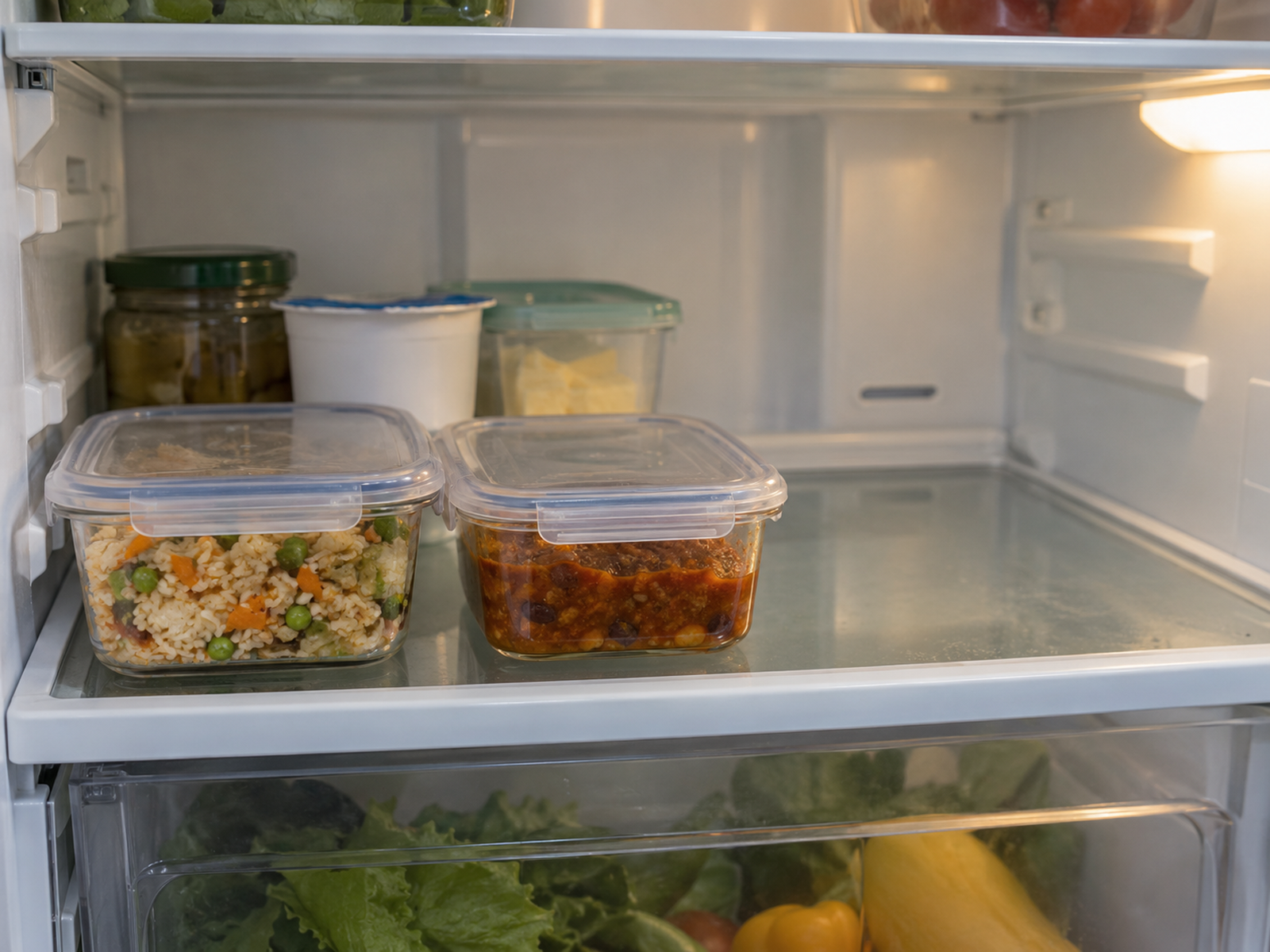
Measure usable width, depth, height, crisper travel, and door clearance instead of assuming a standard organizer set will fit a compact appliance.
03
The household’s actual grocery pattern
Measure around the food you repeatedly buy—leftover containers, milk or alternatives, produce, meal-prep boxes, condiments, and shared items—rather than around an empty staged refrigerator.
If the refrigerator can only fit the organizer after food is pushed tightly around it, the organizer has not increased usable capacity.
04
Contain Raw Foods Without Relying on a Universal Shelf Map
USDA says raw meat, poultry, and seafood should be sealed or wrapped securely so juices do not contaminate other foods. FDA separately advises keeping ready-to-eat produce away from raw meat, poultry, and seafood.
A lower shelf can be a practical containment choice in many refrigerators because a leak has fewer foods beneath it, but the research does not support turning that into a universal federal bottom-shelf rule for every appliance.
Use the actual refrigerator geometry. The raw-food zone should keep packages contained, easy to inspect, and physically separated from ready-to-eat food without blocking vents, preventing drawer movement, or making the door difficult to close.
A shallow washable tray or appropriately sized container can be useful when it adds leakage control. It is weak when the tray is so large that it consumes an entire shelf or encourages raw packages to pile up beyond what the household can use.
05
Let Crispers and Door Bins Do the Jobs They Actually Fit
Crisper drawers are specialized storage rather than generic deep bins. USDA notes that vegetables generally benefit from higher humidity, fruits generally benefit from lower humidity, and some refrigerators let the user adjust that environment.
Not every small refrigerator has two crispers or adjustable humidity, so use the hardware the appliance actually provides instead of forcing a generic produce diagram onto it.
Treat the door the same way. The strongest USDA source reviewed for this article does not support a blanket rule that one particular food can never use the door as long as the refrigerator maintains safe temperature and the product is stored appropriately.
Use door bins for categories that fit the actual dimensions, remain safely cold in that appliance, and do not interfere with closure. Condiments and small bottles are common candidates, but the door should solve real shelf pressure rather than become a dumping zone.
06
Give Leftovers a Front-Row Cooling and Turnover Path
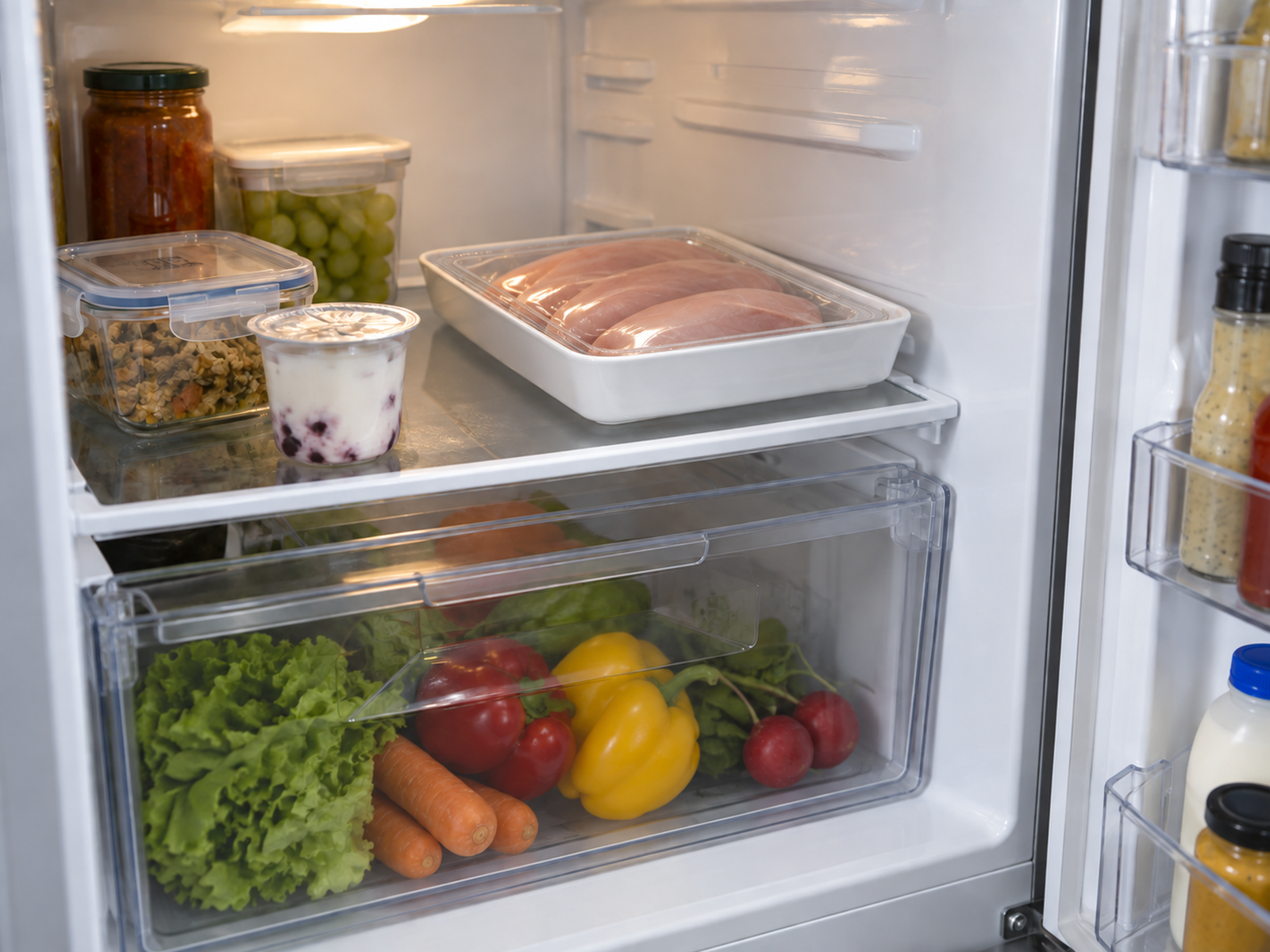
Leftovers have two jobs to perform well in a small refrigerator: cool safely and remain visible enough to be eaten. USDA recommends dividing large amounts of hot food into smaller portions and shallow containers for quicker cooling.
Shallow containers can also fit small-fridge geometry well because they stack more predictably and let the contents remain easier to see than one deep container with several meals hidden inside.
Do not standardize every container simply for visual uniformity. Use shapes that fit the actual shelf height and food, and keep one front-facing area where leftovers do not disappear behind unopened groceries.
A date label or simple use-first cue can help when the household needs it. The important behavior is turnover: refrigerated leftovers are generally used within three to four days, not stored indefinitely because a bin makes the shelf look tidy.
07
Add Organizers Only When They Earn the Space
Every organizer consumes some refrigerator volume. Bin walls, handles, turntable edges, shelf-riser legs, and required clearance can reduce flexibility even when the finished shelf looks more orderly.
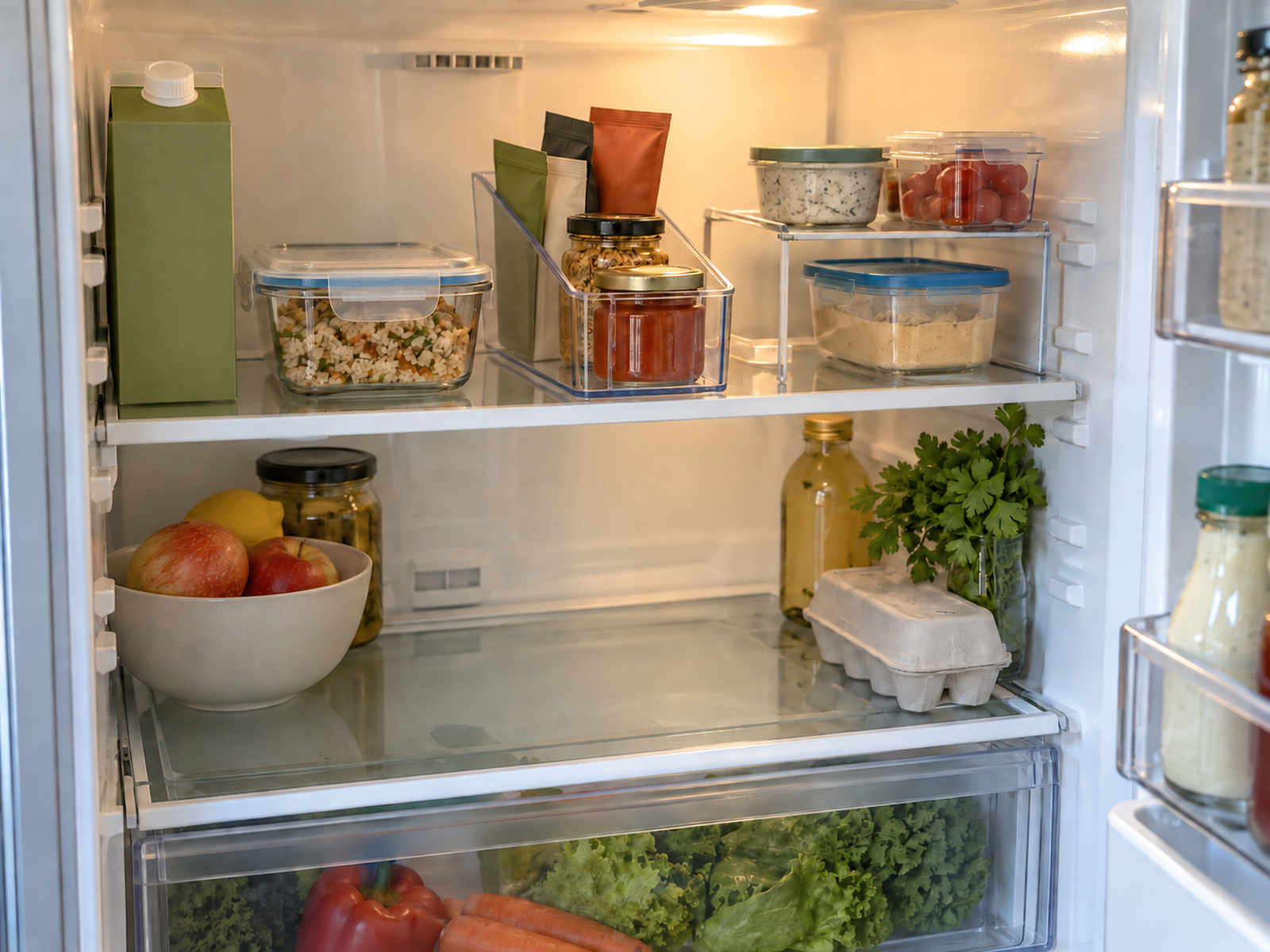
Use one organizer to solve one identifiable problem. A narrow clear bin can stop small snack packets from drifting; a turntable can improve access to several small jars; a shelf riser can use a tall gap when short containers otherwise waste the vertical space.
Measure shelf width, depth, vertical clearance, door swing, drawer travel, and the containers already used by the household before buying anything. A bin that is slightly too deep can block the door or waste the back of the shelf.
Do not build a full matching-bin system by default. If the refrigerator is consistently over capacity, more rigid containers can make the space less adaptable and hide the real issue: too much refrigerated inventory at once.
Use / Skip
Removable Refrigerator Organizers
Use
Use them when one organizer fixes one recurring access problem
Choose a removable bin, turntable, riser, or other accessory when it fits the measured compartment and clearly improves retrieval, containment, stacking, or category visibility without blocking airflow, drawers, vents, or door closure.
Skip
Skip them when the organizer is mostly consuming flexibility
Keep the shelf open when rigid bins waste height or depth, force real grocery containers into awkward shapes, block the back of the shelf, or make an already-full refrigerator even harder for cold air and people to navigate.
08
Change Grocery Cadence When the Refrigerator Is Still Always Full
A refrigerator that returns to total saturation after every reset has reached a behavioral capacity limit. At that point, rearranging the same food cannot create the open air, visibility, and retrieval the compartment needs.
Reduce the refrigerated load in the way that fits the household: buy smaller quantities of produce, avoid bulk refrigerated packages that cannot be used in time, plan leftover nights, freeze appropriate items when freezer capacity allows, or shop more often if the schedule makes that realistic.
Shared households may also need explicit rules for abandoned leftovers, duplicate condiments, and personal shelf boundaries. The goal is predictable turnover and access, not perfectly equal cubic inches for every person.
The stop rule is simple: if food is buried, airflow is compromised, and every shelf is permanently full, do not solve the problem with another organizer. Lower the amount of refrigerated inventory competing for the same cold-storage budget.
Closing Decision
Leave Enough Capacity for Cold Air, Visibility, and the Next Grocery Trip
A well-organized small refrigerator does not look maximally full. It keeps the appliance safely cold, gives raw food deliberate containment, lets produce use the hardware that actually exists, and keeps high-turnover food easy to see.
Use organizers only after the inventory and shelf geometry are understood. When the compartment still has no breathing room, reduce the refrigerated load instead of converting every remaining inch into another bin.
RELATED GUIDES
What to Read Next
NEXT GUIDE
How to Organize Food Storage in a Small Kitchen With No Pantry
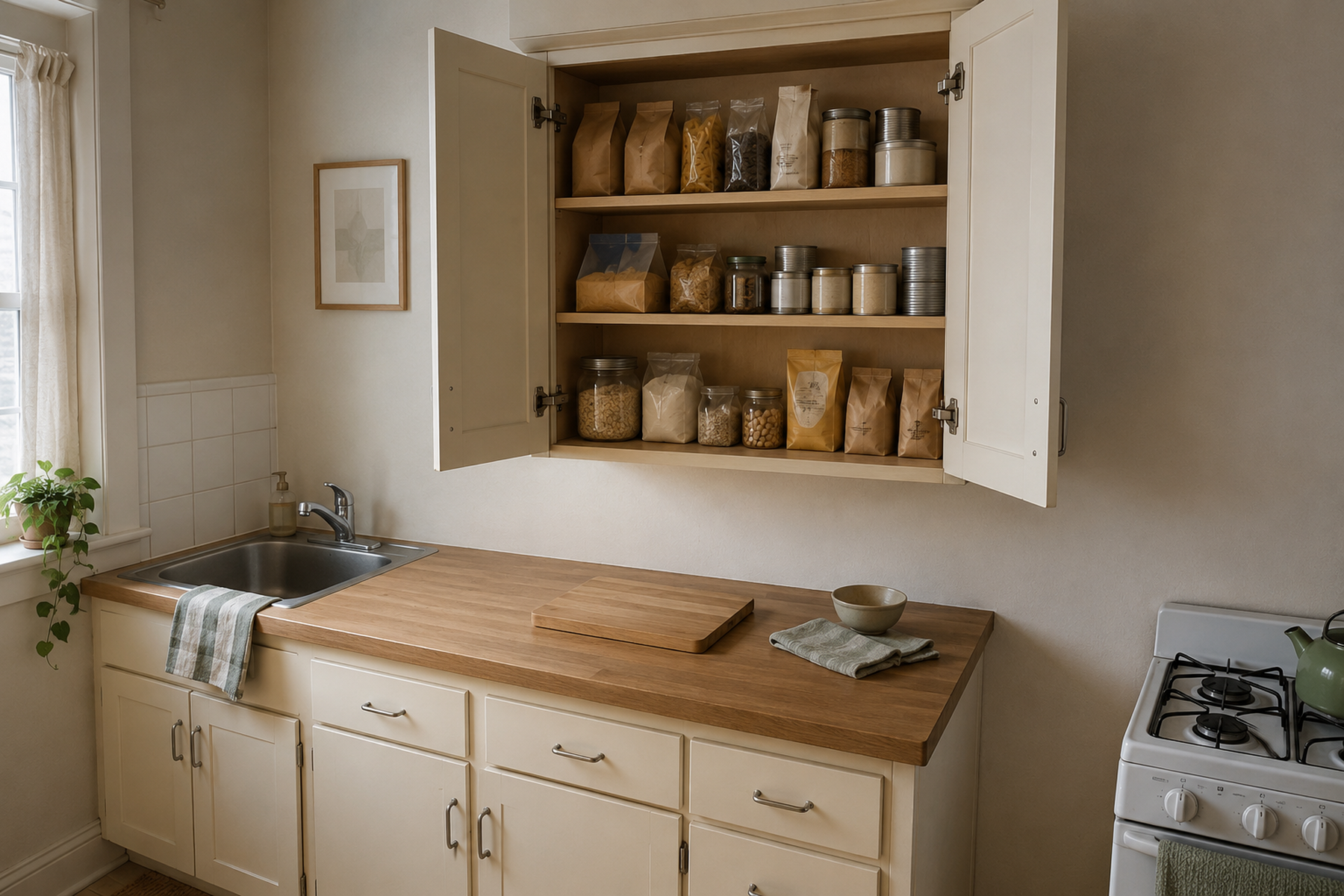
Use this next if dry-food overflow is stealing refrigerator volume; that guide helps move shelf-stable categories back into cabinets, carts, and other dry-storage zones so cold space remains reserved for food that actually needs refrigeration.
GUIDE
How to Organize Food Storage Containers and Lids in a Small Kitchen
Use this if the refrigerator system depends on shallow leftovers and meal-prep containers but the empty containers are difficult to store; that guide solves the cabinet-side container and lid problem.
GUIDE
How to Store Potatoes, Onions, and Garlic in a Small Kitchen With No Pantry
Use this if pantry pressure is pushing produce into the refrigerator by default; that guide separates storage decisions for common pantry staples that should not automatically consume premium cold-storage volume.