
Small Apartment Storage Ideas
Where to Store and Charge an Electric Scooter in a Small Apartment
Treat the scooter as a three-state object—arrive, park, charge—then give each state a location that preserves the apartment’s exit path, fits the real folded scooter, follows building rules, and matches the exact manufacturer’s battery and charging instructions.
In This Guide
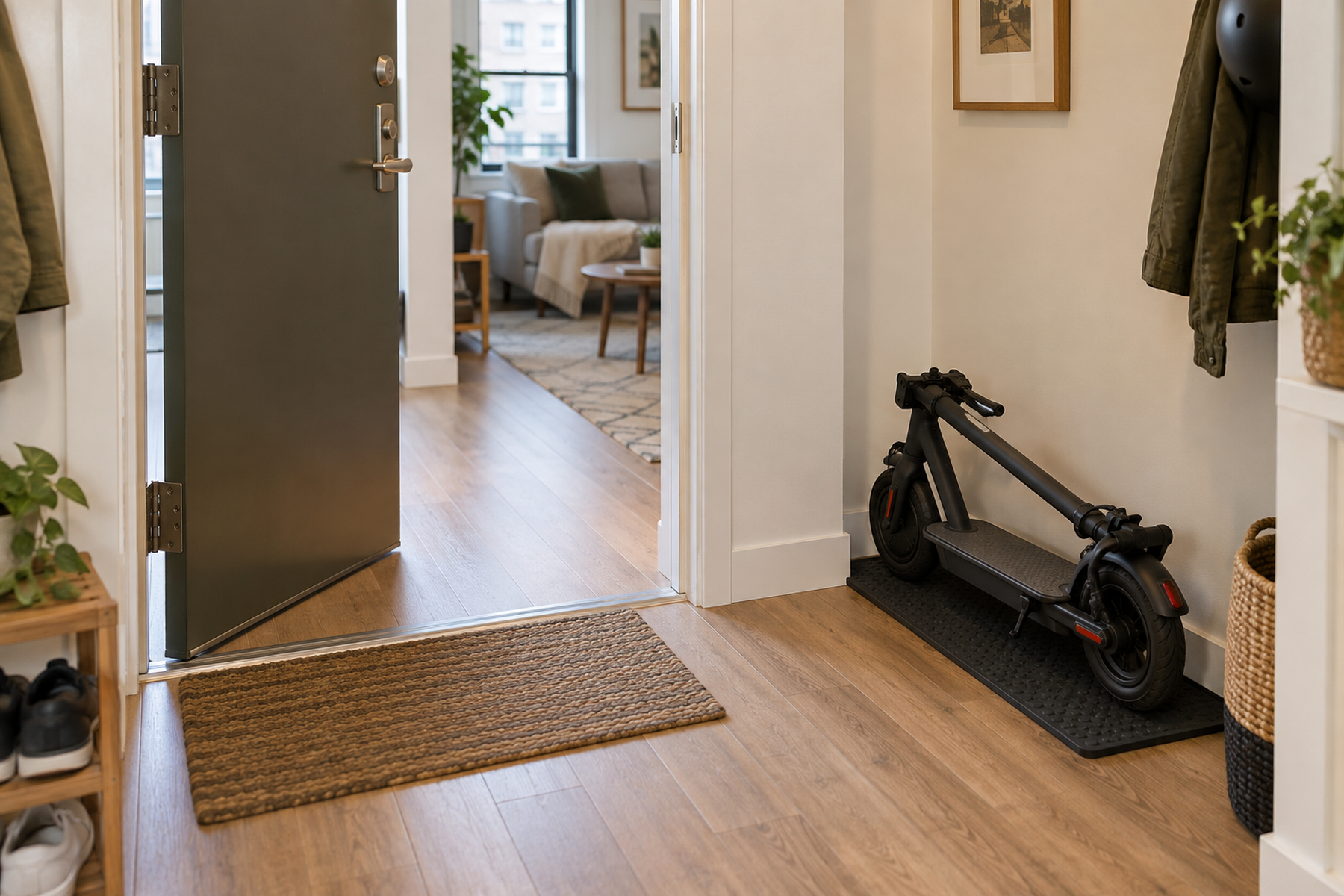
An electric scooter can solve transportation in a small apartment while creating a storage problem that is part furniture geometry and part lithium-ion battery management. A scooter that folds may still be heavy, long, difficult to lift, or awkward enough that leaning it near the front door blocks the very path that has to remain clear.
The stronger system gives the scooter a repeatable route. It arrives, sheds dirt or moisture as needed, moves into a stable parked zone, charges only where the device, building rules, charger, battery, and exit path all allow it, and then resets for the next ride.
Quick Answer
Treat Parking and Charging as Separate Decisions
The smallest empty corner is not automatically the best scooter location. Start with building permission and egress, then solve the parked footprint and the charging routine as separate fit tests.
01
Keep the primary exit clear
Do not park or charge the scooter where the deck, handlebar, stem, charger cable, or storage stand blocks the apartment’s primary way out. Convenience near the door does not outrank egress.
02
Verify the real scooter and support geometry
Measure the folded length, deck width, handlebar width, weight, stable resting position, and the route into the apartment. A vertical stand or wall solution must match the scooter’s actual load and geometry, not merely the wheel size.
03
Follow the exact charger, battery, and model instructions
CPSC advises users to follow manufacturer charging instructions, remain present while charging, avoid charging while asleep or away, and use the charger provided with or recommended by the manufacturer.
01
Check Building Rules and the Exit Path First
Before buying a stand, rack, or charging accessory, check the lease, house rules, building notices, and any applicable local requirements for micromobility storage and charging.
A storage idea can be physically perfect and still be unusable if the property prohibits bringing scooters into the unit, restricts lithium-ion battery charging, requires a designated storage area, or limits wall mounting.
Then protect the primary apartment exit. FDNY’s July 2026 lithium-ion safety messaging specifically warns against blocking exits. That is New York City fire-safety guidance rather than a nationwide statute, but the egress principle is strong and directly relevant to small apartments.
Do not treat the entryway as automatically available just because it is the shortest route from the street. Test the full handlebar, deck, stem, stand, and cable projection with the door operating normally and the escape path fully open.
02
Measure the Scooter in Its Real Parked State
Measure the scooter after it is folded into the position you would actually use every day. Include overall length, widest handlebar or stem projection, deck width, wheel position, folded latch geometry, and any accessory that changes the parked envelope.
Weight matters just as much as dimensions. A scooter that can technically hang on a rated wall system may still be a poor daily solution if lifting it after every ride is difficult or unsafe for the user.
Trace the route from the apartment entrance to the proposed parking zone. Check door widths, turns, rugs, thresholds, furniture edges, elevator or stair access, and whether the scooter can be rolled rather than carried for most of the trip.
Treat dirty or wet arrival as a separate state too. A simple floor-protection or wheel-cleaning routine may be useful before the scooter reaches its parked zone, but do not turn the front-door path into permanent scooter storage.
Measure / Check First
Before choosing a stand, wall mount, closet, or charging corner, test the full apartment route and the device-specific charging requirements.
Check Egress, Support Fit, and Charging Compatibility First
01
The parked and movement envelope
Measure the scooter folded and unfolded where relevant, including handlebar width, deck length, support-stand footprint, turning room, wall contact, and the space needed to retrieve it without moving furniture.
02
The support and handling load
Verify the scooter’s actual weight, the stand or mount’s published rating, the contact geometry, center of mass, wall substrate and fasteners if installed, and whether the user can repeat the lift or tilt comfortably.
03
The charger, battery, and charging zone
Confirm the manufacturer-approved charger and battery, the model’s charging instructions and temperature limits, building permission, cable route, user presence during charging, and that the charge zone remains clear of the primary exit.
If a storage idea works only by blocking egress, hiding an active charge behind furniture, improvising a charger, or relying on unverified support hardware, reject that setup before optimizing appearance.
03
Use Folded Floor Parking When It Preserves the Room
Folded floor parking is the lowest-intervention option when the scooter becomes materially smaller, rests stably in the manufacturer-supported position, and the apartment has a private-room corner that is not part of the main walking or exit path.
Choose a location that does not require furniture to be moved every morning. A theoretically hidden position behind a sofa or table can become a poor daily system if retrieval involves lifting, twisting, or dragging the scooter through a narrow gap.
Protect walls and floors from repeated tire or handlebar contact without surrounding the scooter with clutter. The goal is a clean parking boundary, not a concealed charging nook.
If the scooter stays long or wide when folded, the floor-parking test has failed even though the marketing says “foldable.” Move to a different support architecture instead of forcing the device into circulation space.
04
Use a Freestanding Upright System Only When the Scooter Is Stable
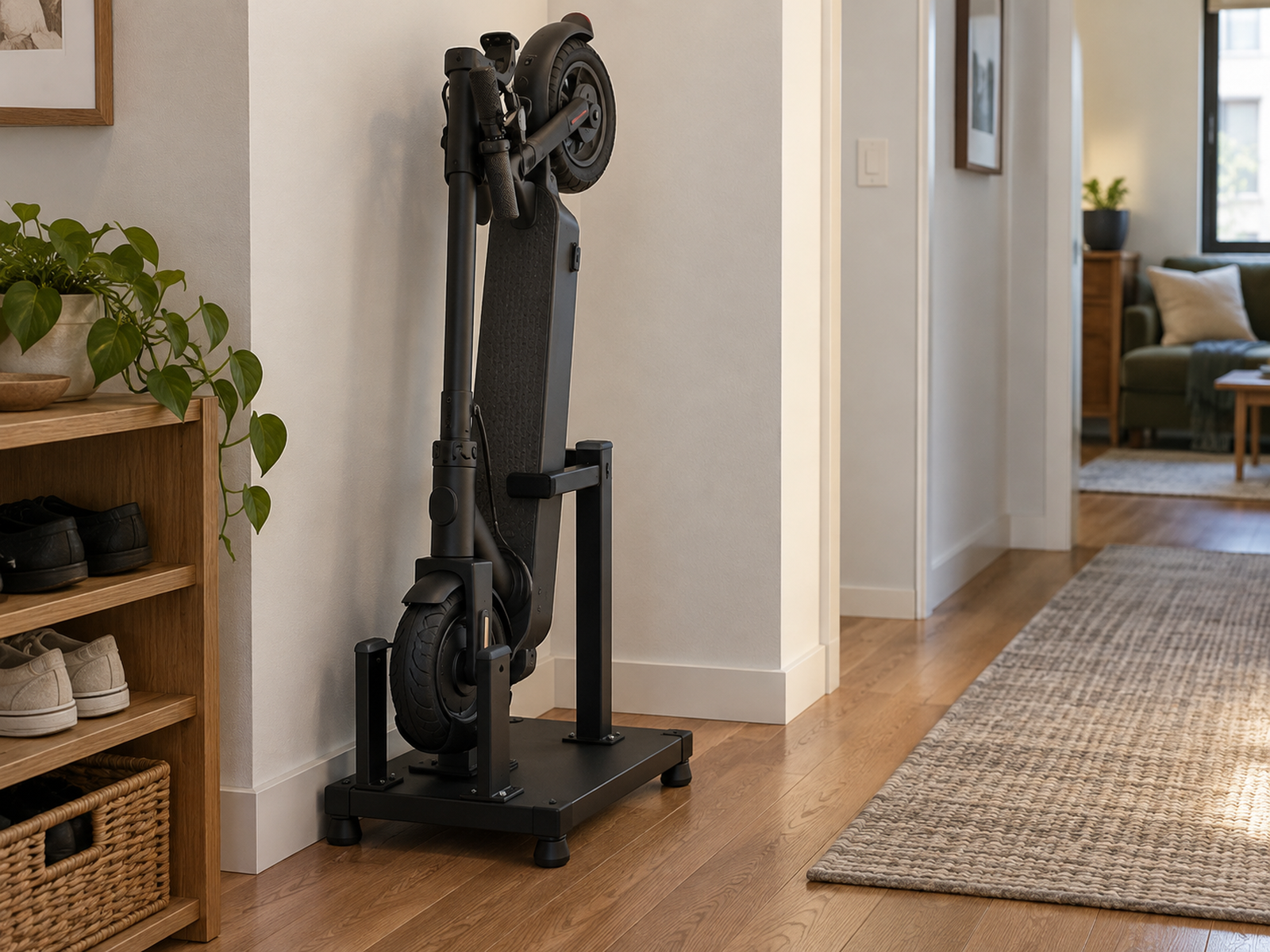
A freestanding upright or vertical stand can reduce the scooter’s horizontal parked length without drilling into a rental wall, which makes it one of the most interesting small-apartment solution families.
Compatibility is the hard part. Verify the scooter weight, wheel or deck geometry, stem position, stand rating, base footprint, center of mass, and the amount of lifting or tilting required to place the scooter into the stand.
Heavy dual-motor or long-range scooters can make vertical handling unrealistic even when a stand is structurally rated. A solution is not renter-friendly merely because it uses no screws if the user has to perform an awkward heavy lift after every ride.
Keep the stand outside the exit and circulation path. A tall parked scooter can also project at handlebar height, so measure the upper footprint as carefully as the base.
05
Treat Wall Mounting as an Installation Project
A wall-mounted rack or hook can recover the most floor area, but it has the highest structural, handling, and renter burden.
Verify the exact mount rating, scooter weight, contact points, wall material, anchors or fasteners, stored projection, and the user’s ability to lift the scooter repeatedly. A bicycle hook should not be assumed to suit a heavy electric scooter because the wheel appears to fit.
Wall mounting can also become a lease decision. Drilling, anchors, custom closet hardware, and repair at move-out may require landlord approval even when the mount itself is marketed as removable hardware.
If the wall system fits structurally but puts the scooter into a hallway or exit path, it still fails. Floor recovery is not useful when it converts circulation into a collision or egress problem.
06
Separate the Parked Zone From the Charging Zone When Needed
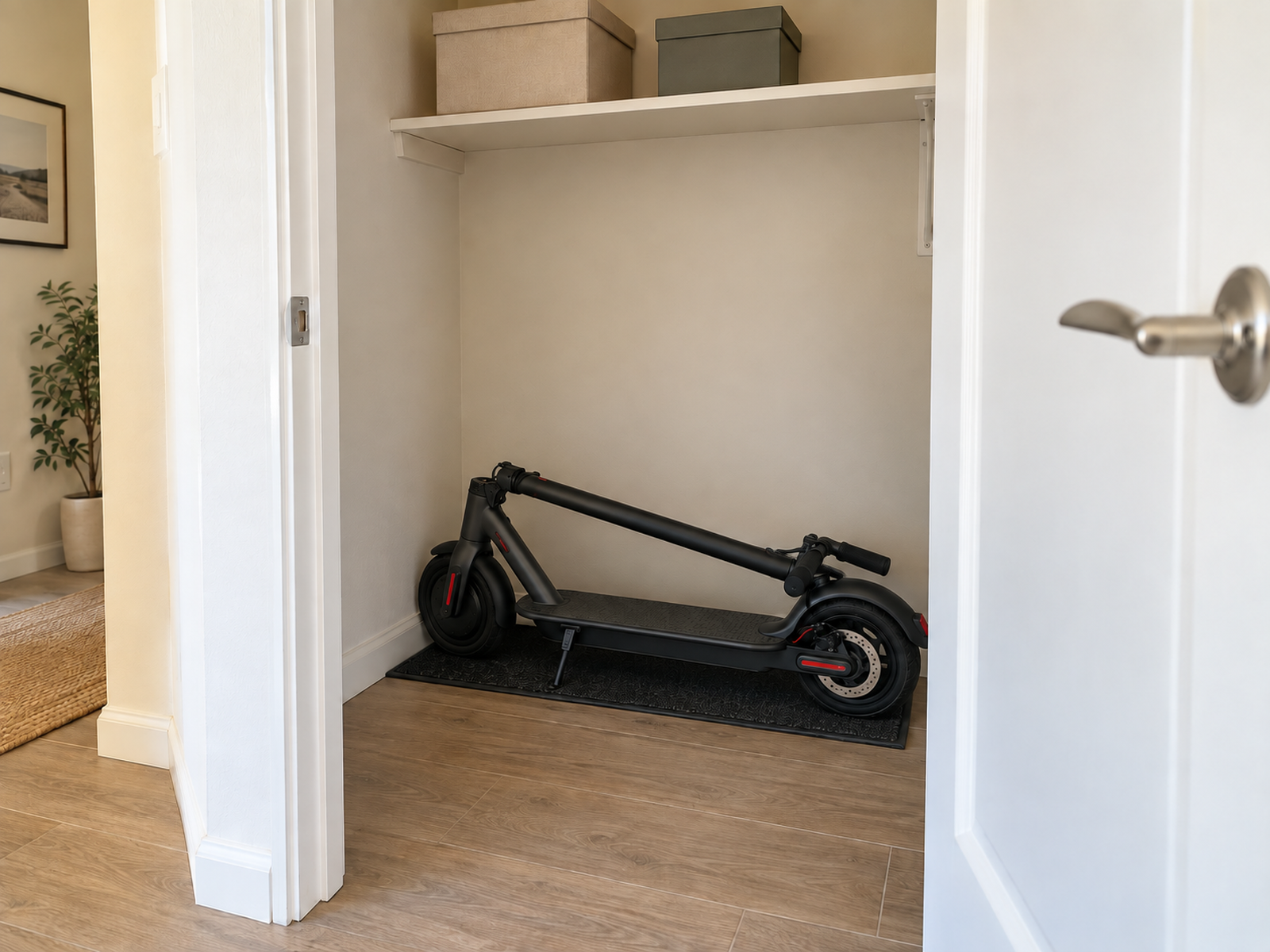
The best parking corner may not be the best charging corner. A closet can hide the scooter visually, for example, but can also make charging harder to observe and may place the device beside clothing or other combustibles.
CPSC says to be present while charging micromobility products, not charge while sleeping or away from home, follow the manufacturer’s charging instructions, and use only the charger provided with or recommended by the manufacturer.
CPSC has also warned specifically about “universal” micromobility chargers because a connector can fit while the electrical combination is incompatible. Do not substitute a generic charger merely because it plugs into the scooter.
If the model has a removable battery, separate charging is only an option when the manufacturer explicitly permits that battery-removal and charging method. Do not build the apartment system around a battery behavior the exact scooter does not support.
07
Keep the Charging Zone Visible, Clear, and Temporary
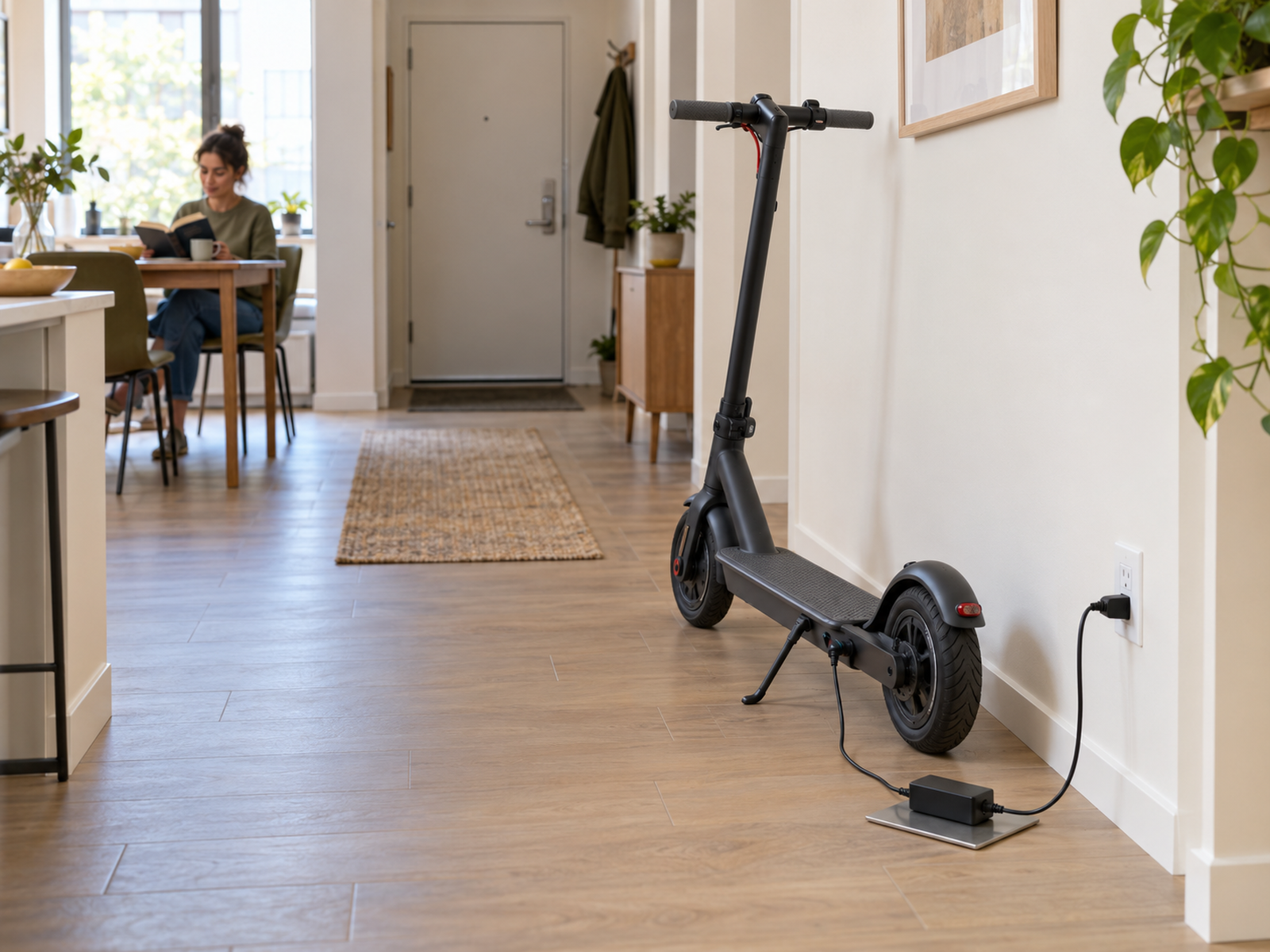
A charging zone should support supervision rather than hide the scooter. Keep the device where the user can remain present, where the cable does not create a trip path, and where the scooter does not block the apartment’s way out.
Do not optimize charging by surrounding the scooter with clothing, curtains, upholstery, paper, or other combustible clutter. A behind-furniture parking gap can be acceptable for storage and still be a poor place to charge.
Unplug when the charge cycle is complete according to the manufacturer’s instructions. Charging should be an operating state, not the scooter’s permanent storage condition by default.
If the device or battery shows abnormal heat, swelling, leaking, unusual smell, strange noises, smoke, fire, or other damage, stop using or charging it and follow the manufacturer and fire-safety guidance. That is not an organization problem.
Use / Skip
Charging Where the Scooter Parks
Use
Use it when the parking zone also passes every charging check
The same zone can serve both jobs when building rules permit charging there, the manufacturer allows the setup, the approved charger and battery are used, the user can remain present, the cable is controlled, the area stays clear of the exit, and the scooter is not hidden among combustibles.
Skip
Skip it when parking convenience creates a worse charging environment
Create a separate charging zone when the parked scooter sits near the primary exit, inside a crowded closet, behind upholstered furniture, far from observation, or where the cable would cross circulation. Parking and charging do not have to share one location.
08
Use Long-Term Storage Instructions From the Exact Manufacturer
Seasonal or winter storage is a different operating mode from daily parking. Retrieval speed becomes less important, while storage temperature, charge state, periodic recharge, moisture, and long-term battery guidance become more important.
Do not publish or follow one universal “store at 50–60%” rule. Current manufacturer guidance varies. NIU and Segway publish model- or brand-specific temperature and long-term charging instructions, so the exact owner’s manual should control the routine.
A secure building garage, separate structure, or other off-unit storage can recover apartment space, but only when building rules allow it, theft risk is acceptable, and temperature and weather exposure remain inside the manufacturer’s requirements.
If the building requires off-unit storage but provides no authorized charging option, treat that as a property-management constraint rather than improvising an extension, unauthorized outlet, or incompatible charger.
Closing Decision
Give the Scooter a Route, Not Just a Hiding Place
The strongest small-apartment setup separates the scooter’s states: arrive without blocking the entry, park in a stable zone that the apartment can afford, charge only under the exact device and building rules, then unplug and reset for the next ride.
Keep the primary exit clear, measure the folded scooter instead of trusting the word “foldable,” and treat heavy vertical or wall storage as a handling-and-load problem as well as a space problem. When one location cannot safely perform both parking and charging, let the two jobs live in different zones.
RELATED GUIDES
What to Read Next

NEXT GUIDE
How to Store a Bike in a Small Apartment With No Bike Room
Use this next if the household also stores a conventional bicycle or e-bike indoors; that guide handles bicycle-specific parked-envelope and support decisions without repeating the scooter charging system.
GUIDE
How to Create Entryway Storage When Your Apartment Has No Entryway
Use this if helmets, bags, shoes, and other ride-arrival items are collecting around the front door; that guide organizes the threshold without turning the escape path into permanent storage.
GUIDE
How to Manage Cables on a Small Desk Without Drilling
Use the cable-management principles only after the scooter charging zone itself is approved and safe; charger routing should reduce trip hazards without hiding active charging or overriding manufacturer instructions.