
Small Apartment Storage Ideas
How to Add Extra Guest Seating in a Small Apartment Without Permanent Clutter
Count the guests you actually host before you buy chairs: match the seat to the activity, measure the whole group in use and in storage, and choose the cheapest geometry—fold, stack, dual-purpose, or borrowed—that preserves everyday circulation.
In This Guide
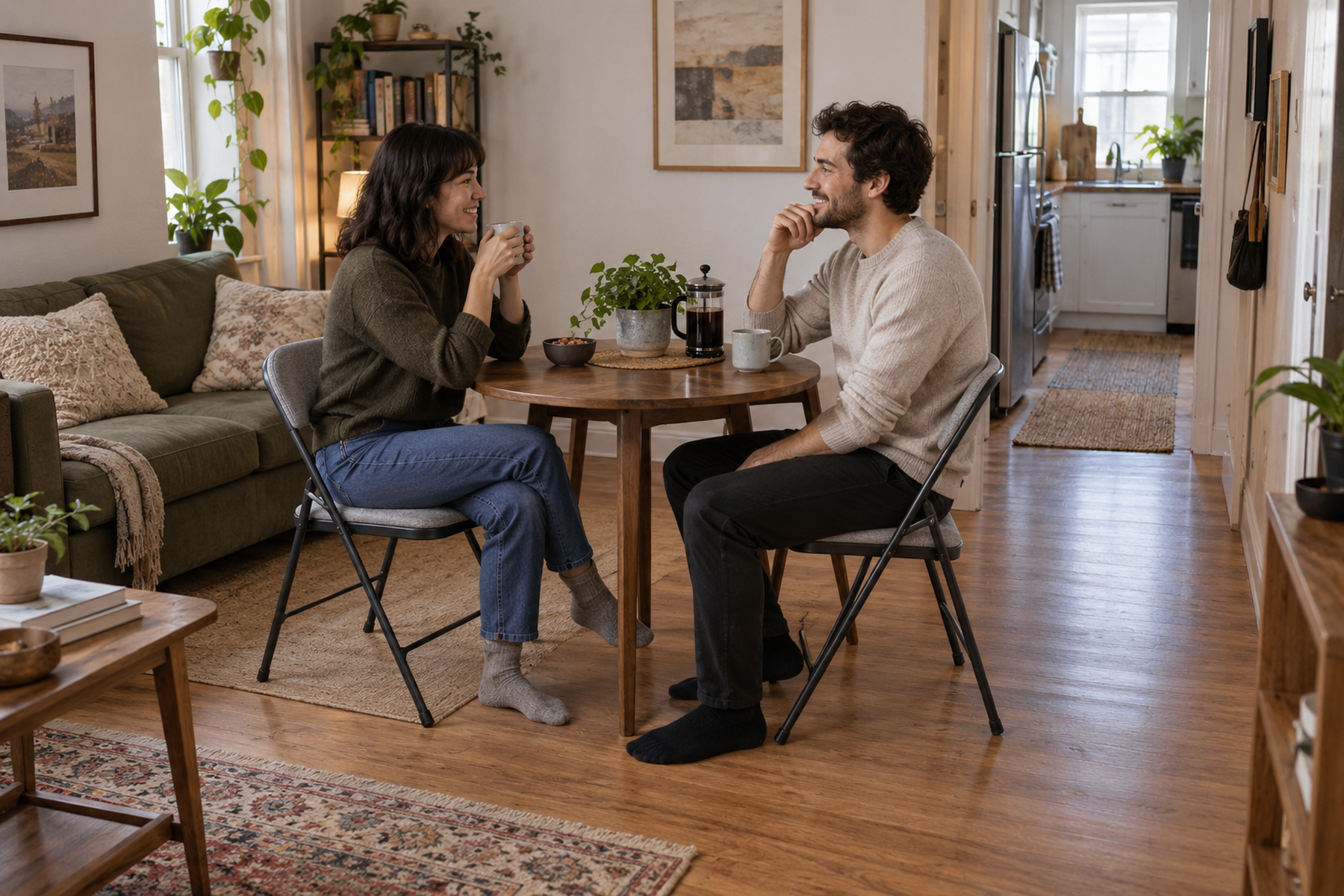
A small apartment can have exactly the right amount of seating every day and still come up short when friends visit. The obvious fix—buy more chairs—solves the gathering and can create a second problem for the rest of the year: unused seats occupying the only open floor, closet depth, under-bed space, or wall area.
Extra seating is therefore a two-state capacity problem. The chair group has to work when people are sitting in it and also have a believable home when nobody needs it, without turning setup, carrying, hanging, or closet unloading into such a chore that the chairs simply stay out.
Quick Answer
Own the Seats for Your Normal Hosting Peak
Start with the number of extra seats you use repeatedly, not the largest party you can imagine. Then match those seats to the activity and choose a storage form that fits the apartment’s cheapest available resource.
01
Count the seats you actually use
Separate everyday seating from the normal guest peak. If two extra seats solve most visits, do not permanently store four or six just because one larger gathering might happen.
02
Match the chair to how guests sit
Dining, studying, and card games usually need upright seating at a compatible height, while a shorter movie night may tolerate a stool, pouf, or other lower occasional seat when the specific product is intended for sitting.
03
Measure the full group twice
Check the open chairs plus seated bodies and circulation, then measure the entire folded, stacked, or stored group. One chair that fits easily can become a different storage problem when multiplied.
01
Count the Extra Seats You Actually Need
Begin with the apartment’s baseline: how many people live there, and how many usable seats already exist across the sofa, dining area, desk, vanity, bench, or other furniture intended for sitting. Guest capacity starts after that inventory, not at zero.
Then identify the normal hosting peak. Weekly study sessions with one friend, monthly dinners with two guests, and a once-a-year holiday crowd do not justify the same ownership level.
Do not furnish permanently for the largest theoretical party. The rarer the seating demand, the less permanent floor or storage space it should usually claim unless the object earns another daily role.
For an unusually large gathering, borrowing, renting, asking a guest to bring a chair, or hosting elsewhere can be more spatially rational than storing a stack sized for an event that happens once a year.
02
Match the Seat to the Activity
Guest seating is not one category. A study session, dinner, movie night, and short conversation ask different things from the chair, and storage efficiency should not erase the activity the seat is supposed to support.
Upright dining, studying, and card games usually benefit from a seat height and posture that work with the table. A current 2026 tiny-flat discussion makes the distinction clear: the user rejected lounge-style ideas because the extra chair was meant for a study buddy.
Casual conversation or a short movie night can sometimes use a stackable stool, pouf, or ottoman instead. Only treat an ottoman, stool, or other multipurpose object as a seat when the specific product is intended or rated for sitting.
Before buying anything, reassign existing furniture on paper. A desk chair that can move to the dining table or a seating-rated ottoman already used as a footrest may solve occasional capacity without creating another object to store.
03
Measure the Open Chair and the Person Using It
A folding chair still takes up normal chair space when it is open. IKEA’s current GUNDE example measures about 16 1/8 inches wide by 17 3/4 inches deep, which is useful product-specific evidence that folding changes storage geometry, not the basic need for floor area during use.
The empty chair rectangle is not the whole guest footprint. Add the person sitting down, the chair pull-out or approach movement, table access when relevant, and enough room behind or beside the seat for people to circulate.
Open every nearby door and test the apartment’s main route while all guest seats are deployed. A chair that technically fits can still become the object everyone squeezes around to reach the kitchen, bathroom, balcony, or exit.
Test the full guest count at once. Two chairs placed comfortably one at a time do not prove that four chairs plus four people can coexist around the same small table or living-room zone.
04
Measure the Whole Chair Group in Both States
The stored state deserves the same attention as the gathering. “Folds flat” is not a complete specification because folding chairs can remain very different in height, width, depth, weight, and how tightly several chairs actually sit together.
Linon’s current Claire folding-chair example lists folded dimensions of 17 inches wide, 8 inches deep, and 32.68 inches high. IKEA’s current U.S. GUNDE page confirms that the chair folds, but it does not publish a dedicated folded-depth dimension, so that thickness should not be inferred from packaging.
Multiply the storage test by the number of chairs you intend to own. Four folded chairs may not behave like four perfect 8-inch slabs, and their handles, frames, upholstery, or feet may prevent tight nesting.
Carry friction is part of stored fit too. Current folding-chair listings vary meaningfully in weight and construction, so a storage spot across the apartment, above shoulder height, or behind other household items can make a technically compact chair annoying enough that it never gets put away.
Measure / Check First
Before buying extra seating, test the entire chair group in guest mode and in storage mode rather than checking one chair in isolation.
Check Deployed Space, Stored Space, and Retrieval Together
01
Open chairs plus seated circulation
Place the full number of seats you plan to use, then include people, table access, pull-out movement, door swing, and the main route through the room.
02
The complete folded or stacked group
Measure the real height, width, depth, and quantity in the way the chairs will actually be stored. Do not assume several folding chairs nest perfectly flat.
03
Carry and retrieval friction
Walk the setup route from storage to the hosting zone. Check bed clearance, closet opening, door swing, reach height, weight, and whether another household item has to move first.
If the seats are easy to deploy but difficult to store, or easy to hide but unpleasant to retrieve, the system has not actually solved occasional seating.
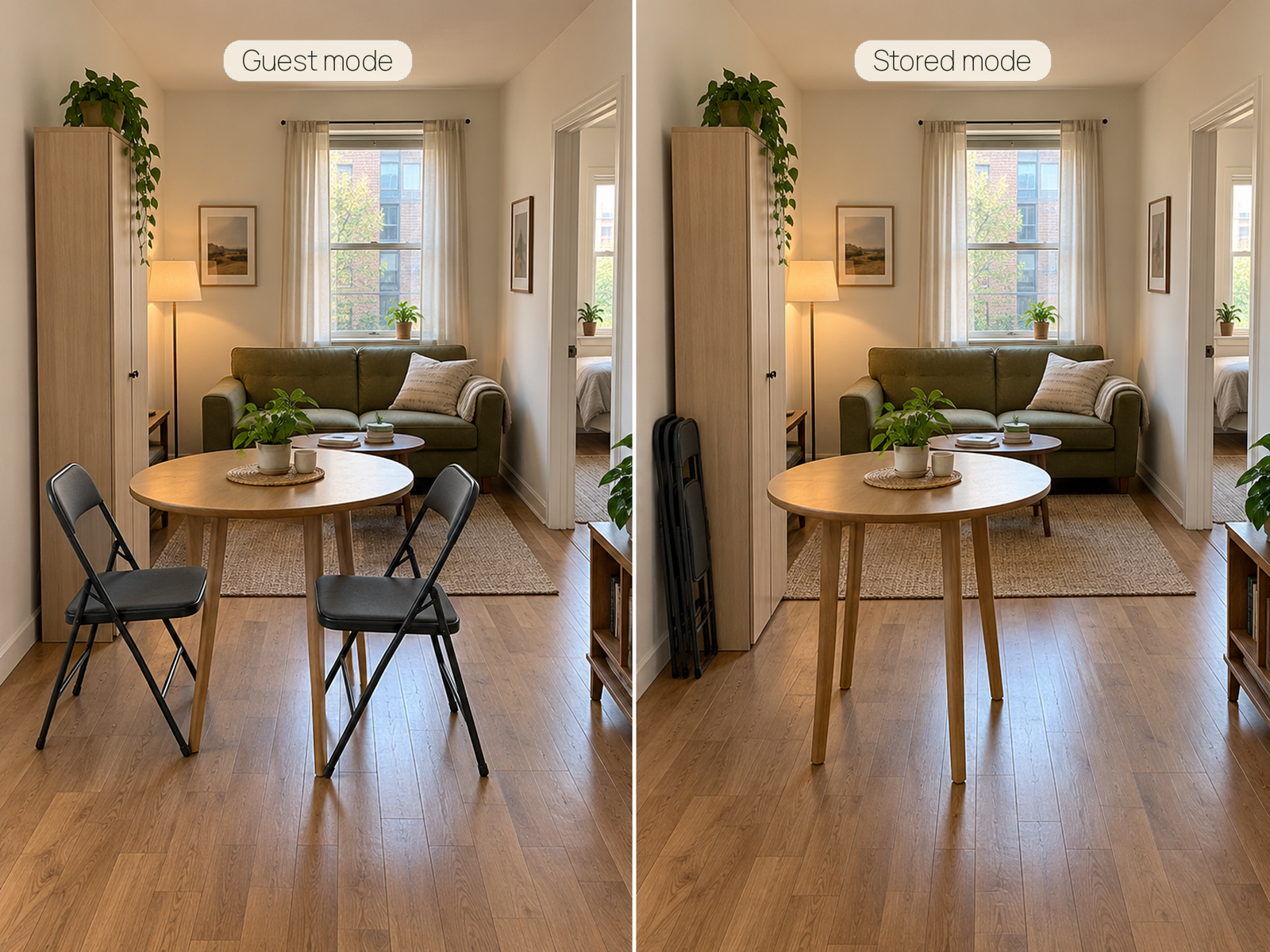
05
Choose the Cheapest Storage Geometry
Folding and stacking solve different space problems. Folding chairs compress one dimension and can spend wall area, under-bed clearance, or narrow-gap depth instead of permanent floor area.
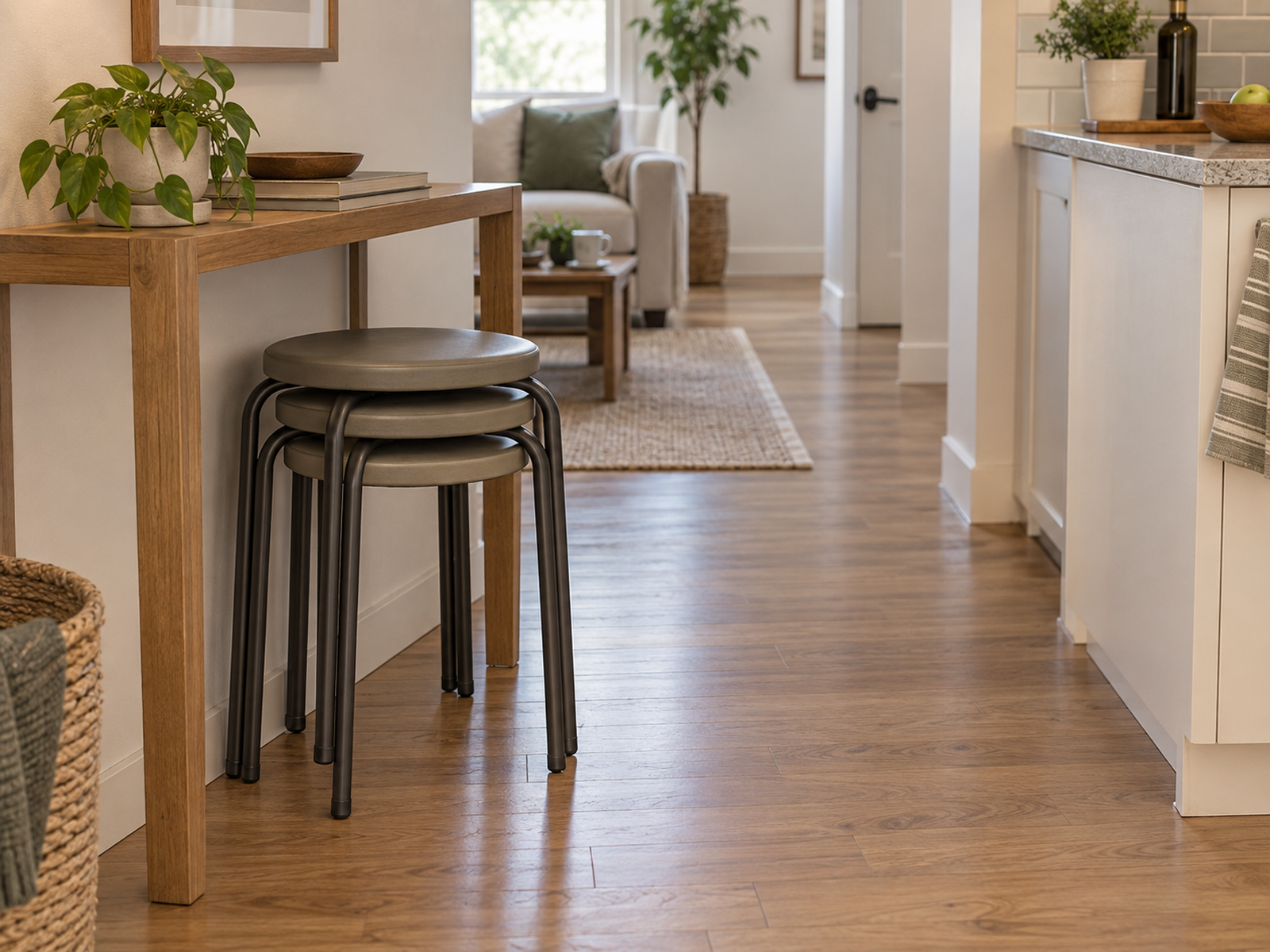
Stackable stools compress the combined footprint of several seats instead. IKEA’s current MARIUS example says two or three stools can be stacked in about the floor area of one, which can be useful when the apartment has one cheap corner but almost no flat storage depth.
Dual-purpose seating spends permanent floor area but may avoid a separate storage problem. A seating-rated ottoman, pouf, bench, or existing chair can be efficient when it already earns its place every day as a footrest, storage piece, desk chair, or normal seat.
Choose the resource the apartment has more cheaply. A home with generous under-bed clearance may favor folding chairs; a home with one spare corner may favor stacking; a home with neither may be better served by repurposing existing seats or borrowing capacity.
06
Use Under-Bed, Narrow-Gap, or Closet Storage Only When Retrieval Is Easy
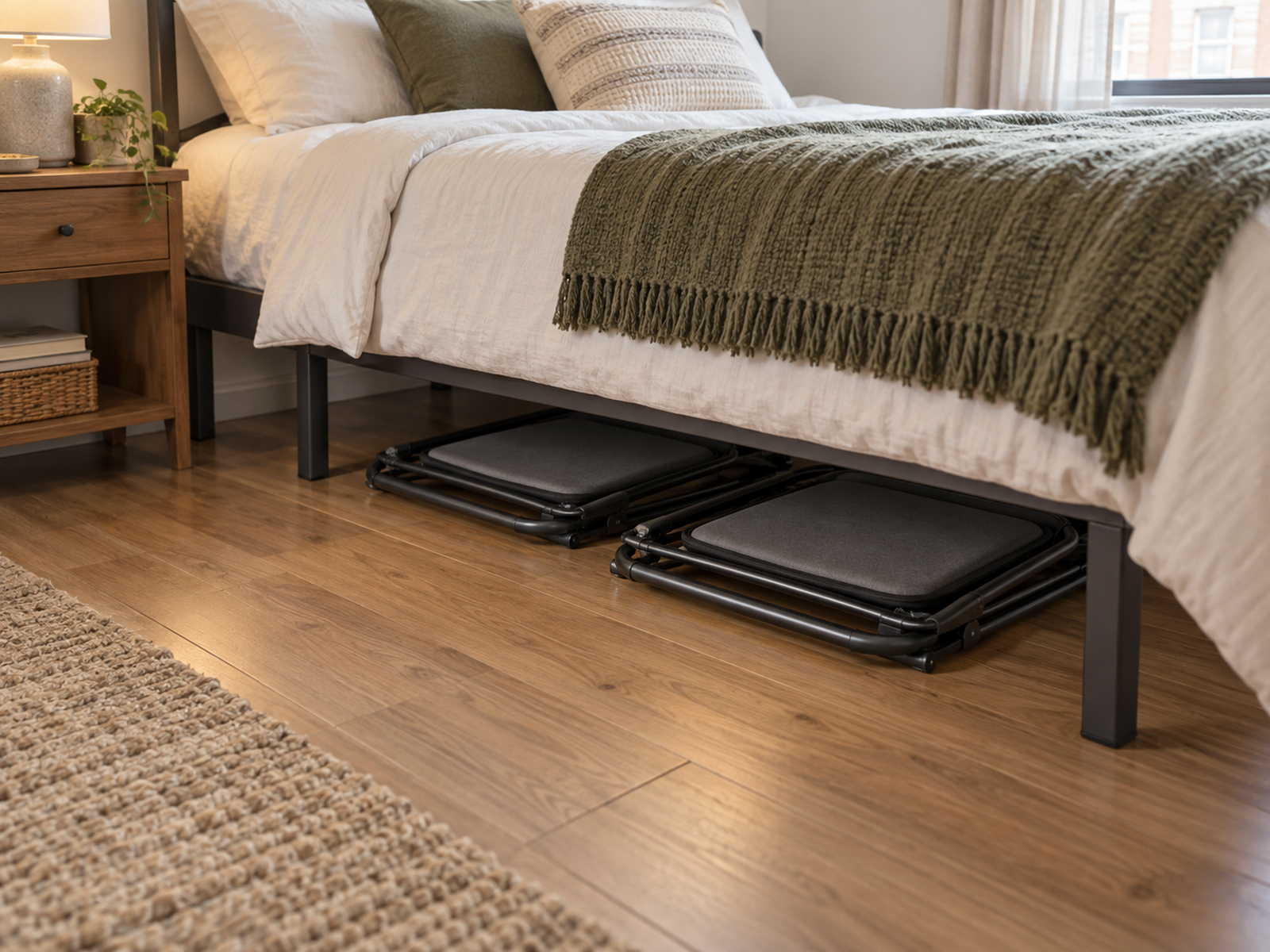
Under-bed storage is attractive because current 2026 small-space users explicitly look for guest chairs that can disappear there. It only works when the folded height fits the real bed clearance and the chair can slide past center supports, drawers, rugs, and nearby furniture.
A narrow gap beside a wardrobe or behind a door can work for one or two slim chairs, but door swing still controls the geometry. The chair should not stop the door from opening fully, scrape the wall, fall into the walkway, or become a pinch point.
Closet storage is only efficient when the chairs do not consume high-value space needed every day or require unloading clothing and shoes before every visit. A hidden chair that is difficult to retrieve is likely to become a visible chair.
When there is no useful storage closet, prioritize the spaces the apartment already has: under-bed clearance, a verified narrow vertical gap, a small permanent stack footprint, dual-purpose seating, or ownership of fewer chairs.
07
Treat Wall-Hanging as a Mounting Decision, Not a Decorating Trick
Wall storage can recover floor area, and current IKEA GUNDE and FRÖSVI product pages explicitly describe their chair openings as suitable for hanging. That verifies the furniture form, not the safety of a generic hook or adhesive strip.
The mounting system has to match the actual chair or chair group, total weight, hook or rack rating, wall substrate, and the lease. Several chairs create a different load from one lightweight chair.
Do not prescribe an adhesive hook just because the chair itself is designed to hang. Unknown wall material, unknown hardware capacity, removal damage, and door or walkway conflicts can turn vertical storage into a worse renter trade-off.
If wall hanging adds drilling, uncertain load, difficult reach, or visual clutter that the resident dislikes, choose another storage geometry. Saving floor area is not a win when the wall solution becomes the new maintenance or lease problem.
Use / Skip
Wall-Hanging Folding Chairs
Use
Use it when the chair, hardware, wall, and lease all support the load
Wall hanging can work when the chair is designed for hanging, the verified rack or hook supports the full stored weight, the wall substrate is suitable, the lease allows the attachment, and the chairs remain outside door swings and circulation.
Skip
Skip it when the mounting method is improvised or the wall becomes the new constraint
Choose under-bed, narrow-gap, stackable, dual-purpose, or borrowed seating instead when the plan depends on an unverified adhesive hook, unknown wall material, awkward reach, removal damage, or a row of chairs that interferes with a door or walkway.
08
Borrow the Capacity You Need Only Once in a While
Ownership is only one way to create seating capacity. For rare large gatherings, borrowing or renting can eliminate the annual storage cost of chairs that exist mainly for one event.
Current community discussions support both sides of the problem: some small-apartment users search for one or two hidden seats, while others describe rooms overwhelmed by permanent chairs even though they rarely host.
That makes “no extra chairs” a valid decision when the apartment already supports the people who live there and occasional visitors can use existing seating, smaller gatherings, borrowed capacity, or another venue.
The resident’s everyday circulation should remain the baseline. Guest seating is successful when it expands the apartment temporarily and then gives the space back.
Closing Decision
Own the Normal Hosting Peak, Not the Largest Possible Party
The most space-efficient guest chair is not automatically the thinnest one. It is the seat that fits the activity, appears only in the quantity the household actually uses, and disappears into a storage system the resident will realistically operate.
Use existing seats first, own the extra capacity that earns repeated use, and outsource the rare peak. A small apartment does not need to carry the furniture burden of every possible gathering all year.
RELATED GUIDES
What to Read Next
NEXT GUIDE
How to Host Overnight Guests in a Small Apartment With No Guest Room
Use this next if daytime guest capacity turns into overnight hosting; that guide applies the same everyday-versus-guest-state logic to sleep surfaces, privacy, bedding, luggage, and multi-night reset.
GUIDE
How to Work From a Dining Table Without Letting It Become a Permanent Office
Use this if the same dining or living zone changes roles during the week; that guide focuses on letting a temporary function appear when needed without permanently taking over shared space.
GUIDE
How to Create Entryway Storage When Your Apartment Has No Entryway
Use this if folding-chair storage is competing with a door, narrow wall, or arrival path; that guide focuses on protecting door swing and circulation while using limited perimeter space.