
Small Apartment Storage Ideas
Where to Put a Fire Extinguisher in a Small Apartment
Start with the escape route, not the most hidden cabinet: keep the extinguisher obvious and reachable, away from high heat and likely fire blockage, then choose the least intrusive bracket, shelf, or stable surface that preserves fast adult access.
In This Guide
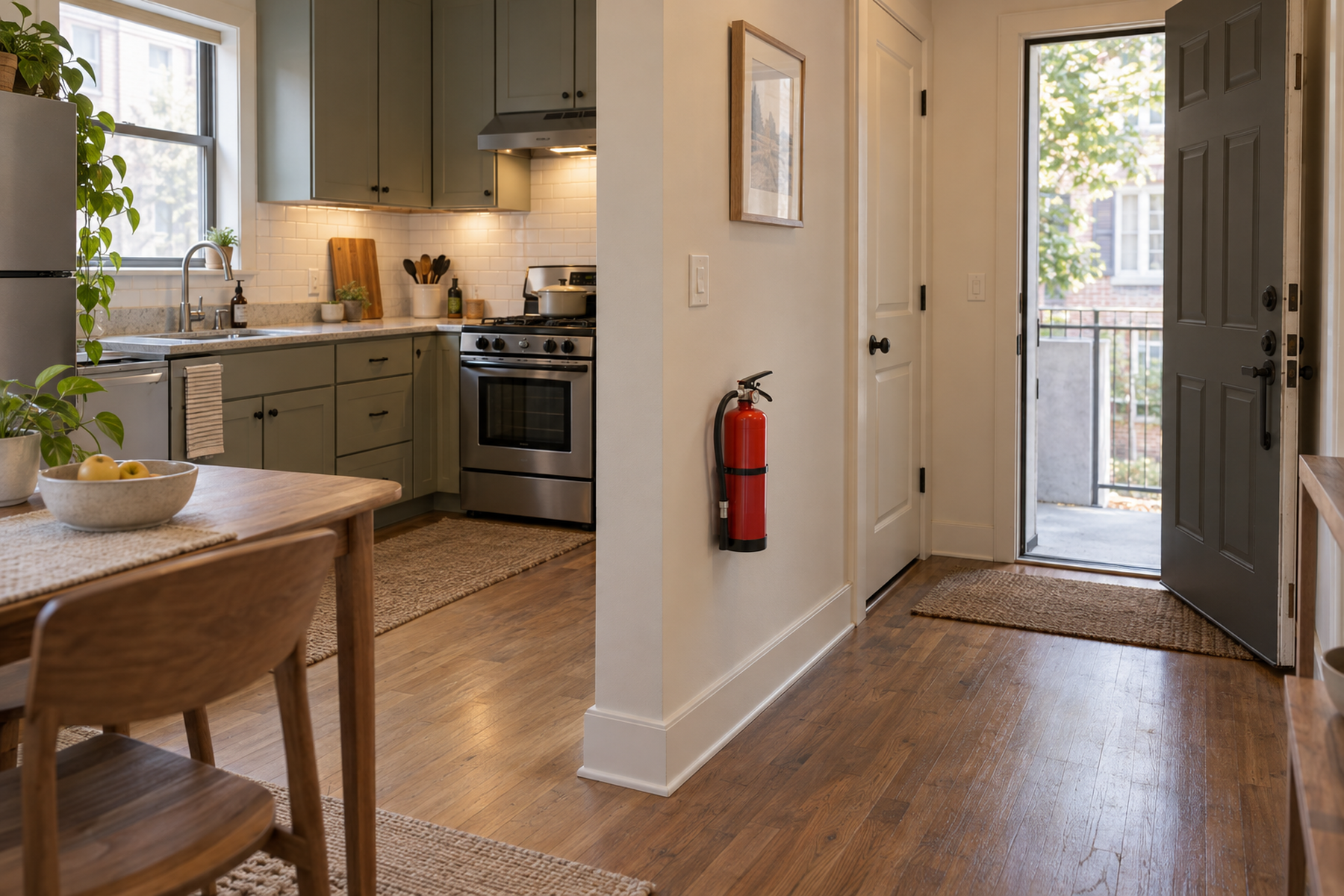
A fire extinguisher is one of the few apartment objects that should not be organized primarily for visual disappearance. Its location has to support a safer decision first: if a fire is not small and contained, smoke conditions are unsafe, emergency help has not been called, or there is no clear escape route, U.S. Fire Administration and Red Cross guidance is to leave rather than make extinguisher use the priority.
For placement, that means the extinguisher should be obvious enough to find, clear enough to grab, and positioned so a likely kitchen fire is less likely to block the route to it. Only after those conditions work should the apartment optimize drilling, countertop space, cabinet use, child access, or visual integration.
Quick Answer
Put Access and Escape Ahead of Concealment
A good location has to work in the apartment’s normal lived state, not just on installation day. The extinguisher needs a clear retrieval envelope, a usable path toward an exit, and a support method the intended adult users can actually release and lift.
01
Start on the exit side of the likely hazard
Favor a location along a normal path of travel or near a usable exit rather than directly beside the stove or another likely heat source. The resident should not have to move deeper toward a fire to retrieve it.
02
Keep the retrieval path protected
Do not let bags, cleaners, furniture, doors, or decorative storage occupy the space needed to see, grasp, release, and lift the extinguisher.
03
Choose the mount or surface after access passes
Use the exact extinguisher and its approved bracket or a manufacturer-supported stable surface, then verify lease, wall, child-access, heat, and adult-reach constraints without inventing a universal mounting height.
01
Check What the Building Already Provides Before You Add a New Location
Before buying or mounting anything, identify whether the apartment or building already provides an extinguisher, where it is located, and who is responsible for inspection or replacement. A renter can otherwise create duplicate equipment while still misunderstanding the location that management expects residents to use.
Do not assume a common-area extinguisher automatically answers the in-unit question, and do not assume every U.S. apartment has the same legal requirement. Local code adoption, building type, occupancy, and landlord responsibility vary.
If management provides an in-unit extinguisher, treat its location as part of the apartment’s safety system rather than ordinary storage. If the assigned position is obstructed, unknown to occupants, or being used as overflow storage, raise that condition with management instead of silently relocating building equipment.
If the apartment does not have a clear provided solution, use manufacturer guidance plus building or local fire-authority requirements to choose the next location. Placement can be renter-aware without pretending that no-drill convenience is more important than the safety function.
02
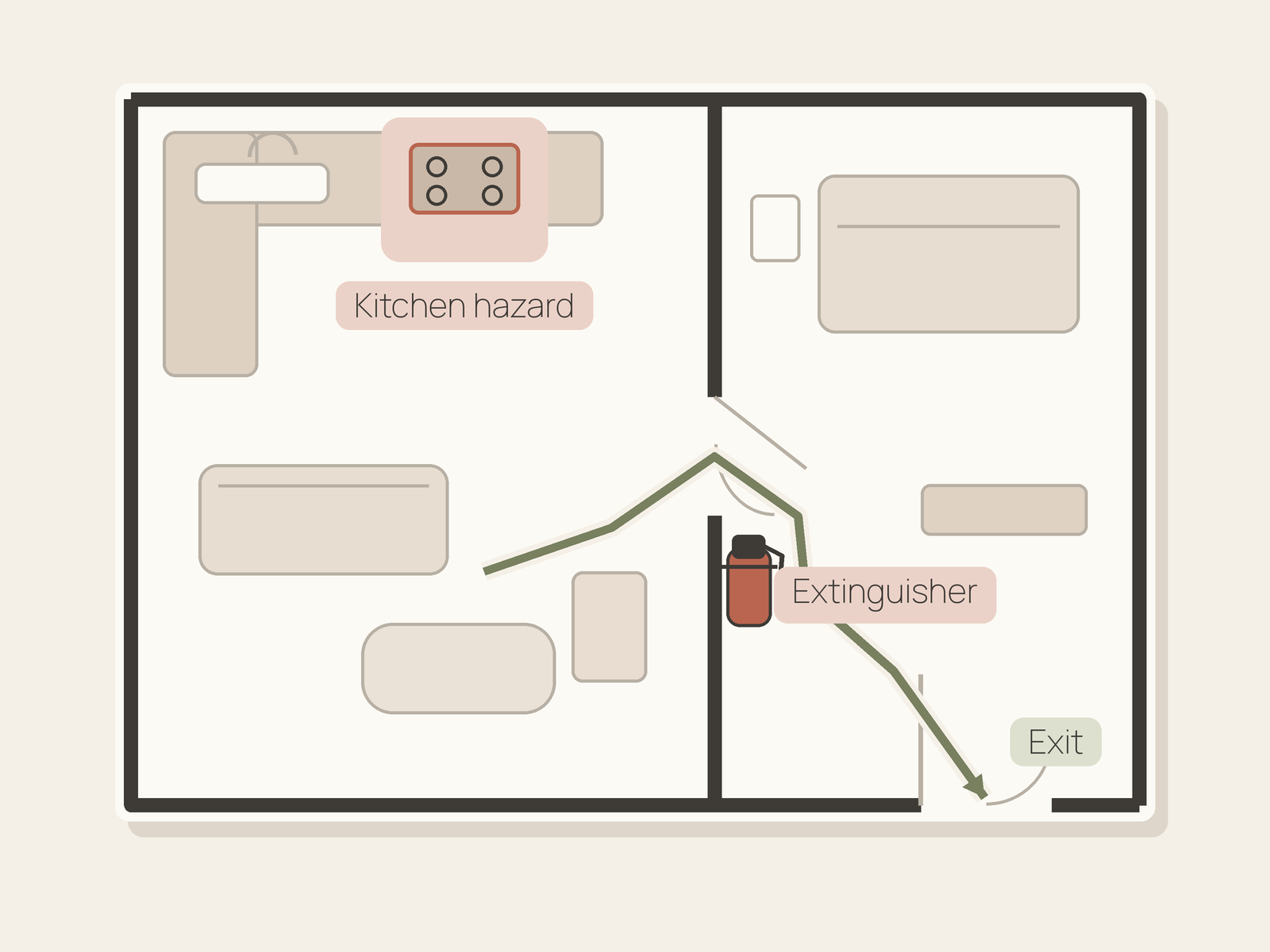
Start With the Exit, Not the Stove
USFA and Red Cross guidance makes the escape route the controlling safety boundary. Extinguisher use is only considered when the fire is small and contained, conditions are safe enough, emergency help has been called, and the user has a clear way out.
That makes an exit-side kitchen wall, a hall position just outside an open-plan kitchen, or another normal travel path stronger candidates than a location chosen only because it sits closest to the burner.
Kidde and Red Cross guidance also support keeping household extinguishers away from high heat and in accessible locations near an exit. A cylinder directly beside, above, or behind the likely fire area can become impossible to reach when it is actually needed.
The goal is not maximum distance from the kitchen. It is a location close enough to find quickly while preserving the ability to reach it without moving toward the fire or away from the escape path.
Measure / Check First
Before drilling a bracket or assigning cabinet space, test the actual extinguisher against the exit path, the real room geometry, and the people expected to reach it.
Check Escape Access, Release Space, and Building Rules Before You Commit
01
Exit-side access and heat separation
Stand in the normal kitchen or living area and trace the path to the extinguisher and the usable exit. Reject locations that require moving closer to the stove or another likely fire area, or that expose the unit to high heat.
02
Grasp, release, and lift
Use the actual extinguisher and its intended support. Confirm that intended adults can see it, reach the handle, release it from the bracket or surface, and lift it without moving bags, cleaners, furniture, or décor.
03
Mounting, door swing, and building constraints
Open nearby doors, drawers, appliances, and furniture, then confirm the lease, wall material, exact bracket instructions, and any building or local requirements before drilling or relocating provided equipment.
If the location is attractive but hidden, blocked in the apartment’s normal state, too close to heat, difficult for intended adults to release, or dependent on unverified wall work, choose another access zone before optimizing appearance.
03
Keep It Visible in the Apartment’s Normal Lived State
For ordinary clutter, a closed cabinet can be a visual improvement. For a fire extinguisher, concealment adds a second question: will every capable household member still know exactly where it is and reach it immediately?
NFPA technical guidance emphasizes readily accessible, visible or otherwise clearly identified extinguisher locations along normal travel paths. The exact legal application depends on local adoption and occupancy, but the organizing principle is useful even in a small rental.
Test the location after the apartment is fully lived in. Grocery bags, recycling overflow, pet supplies, cleaning products, folding chairs, coats, and seasonal storage can gradually occupy a retrieval zone that looked clear when the extinguisher first arrived.
A designated safety location should not function as casual overflow storage. Protect enough clear space to see the extinguisher, grasp it, release it from the support, and lift it without moving unrelated household items first.
04
Use a Wall Bracket When the Location and Lease Support It
A proper wall bracket can be the most space-efficient small-apartment solution because it preserves floor and counter area while keeping the extinguisher in one visible designated location.
NFPA technical material recognizes hangers, brackets, cabinets, and recesses designed for extinguisher installations, while Kidde says mounting on the correct bracket helps keep the unit in its intended position. Use the exact extinguisher’s supplied or approved mounting method rather than improvising hooks, straps, or adhesives.
For renters, the wall still has to pass. Check the lease or building rules, wall material, exact bracket instructions, and any repair expectations before drilling. Tile, unknown fire-rated assemblies, hidden wiring, and uncertain substrates are reasons to involve management or a qualified installer rather than guess.
Then test the mounted object as part of the room. The extinguisher should not become a door stop, project into a narrow galley path, interfere with a refrigerator or cabinet door, or sit at a height the intended adult users cannot comfortably release and lift.
Use / Skip
Wall-Bracket Placement
Use
Use it when the wall gives the extinguisher a permanent clear access zone
Choose an approved bracket when the location stays visible and exit-oriented, the exact wall and fasteners can support the installation, the lease or building permits it, and intended adults can release and lift the extinguisher without door or furniture conflicts.
Skip
Skip it when installation uncertainty creates a new safety problem
Use another approved accessible location or involve management when the substrate is unknown, drilling is not permitted, the mount would project into the exit path, or the only available height would make the extinguisher hard for intended adults to reach or too easy for young children to access.
05
Use an Open Counter or Shelf Only When the Space Truly Earns It
Kidde currently identifies countertop placement as one possible accessible storage form, which can be useful when drilling is not allowed. The trade-off is that a loose extinguisher now occupies one of the apartment’s most valuable open surfaces.
A countertop location should be stable, away from stove or oven heat, outside the main cutting and landing zone, and unlikely to be shifted every time the kitchen needs more prep space.
An open shelf can preserve counter space, but it has to behave like a safety location rather than décor storage. The shelf must support the actual extinguisher, the unit should remain visible, and decorative objects should not migrate in front of the handle, pin, gauge, or release path.
If the surface location is constantly moved, blocked, or repurposed, it is not functioning as a designated extinguisher location. A more visible approved mount or another exit-side zone may be less visually subtle but better organized.
06
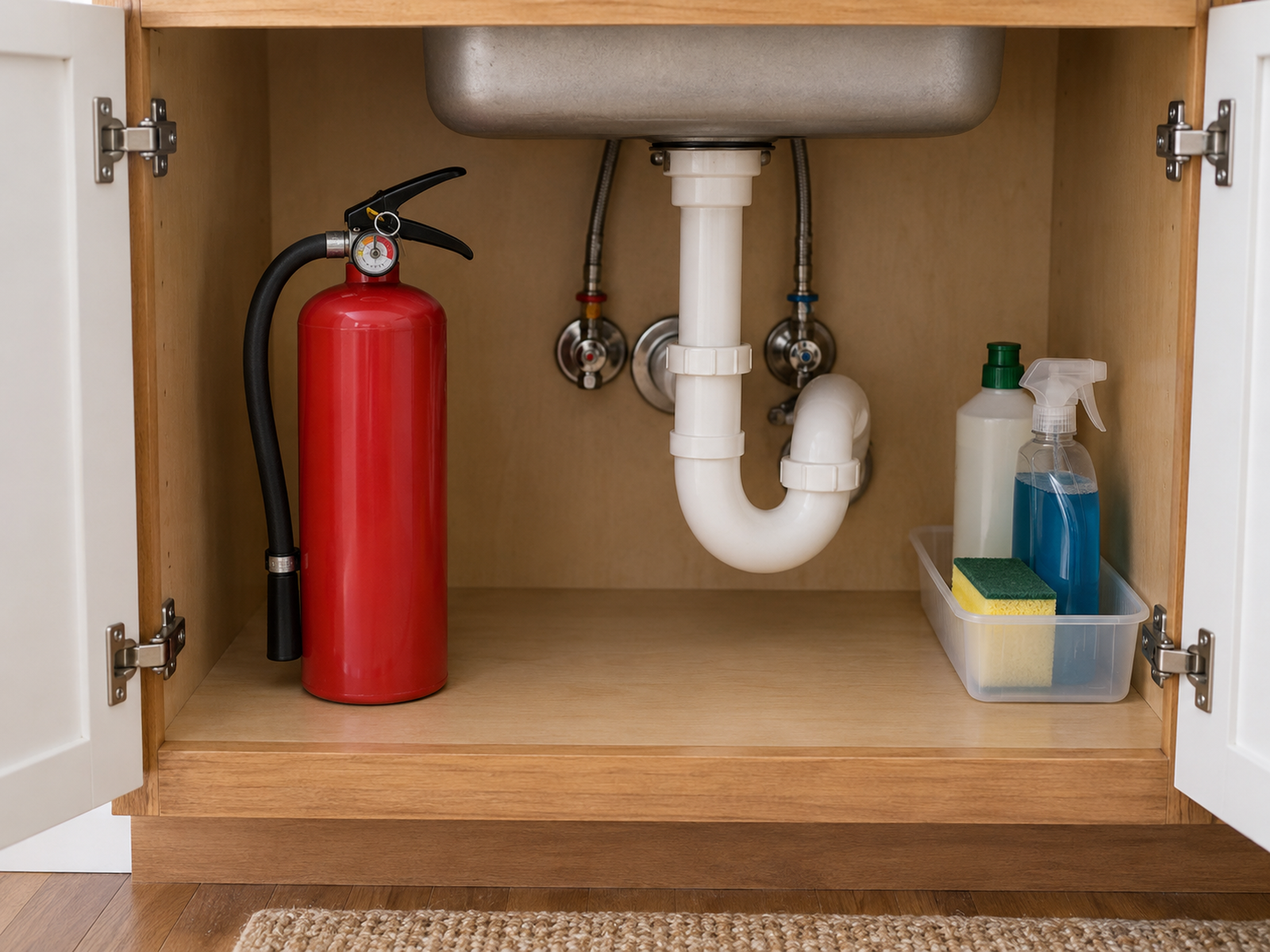
Make Under-Sink Storage Prove Immediate Access
Under-sink storage is attractive because it creates no new wall damage or visible footprint, but the cabinet can hide the extinguisher from memory as effectively as it hides it from view.
Current apartment discussions show residents discovering that an extinguisher had been stored under the sink without them realizing it was there. That is qualitative user evidence, not a universal legal judgment, but it exposes a real organization failure: the safety object can become invisible to the household.
Do not automatically reject every under-sink location. Instead, make it prove access. The extinguisher should be immediately visible when the cabinet opens, nothing should sit in front of it, every capable adult should know the location, and the approach should not require moving toward a likely fire.
If cleaning products, trash bags, recycling, plumbing access, or other stored items repeatedly accumulate in the same zone, choose another location. A cabinet that requires sorting before retrieval has failed the emergency-access job even if the cylinder technically fits.
07
Test Adult Reach, Child Access, Door Swing, and Real Movement
Mounting height should not be reduced to one universal apartment number. NFPA placement material includes code-oriented height parameters, while Kidde’s consumer guidance focuses on keeping units out of young children’s reach while remaining comfortable for the intended adult users.
Use the actual extinguisher in the test. USFA recommends choosing a unit the intended user can safely and comfortably operate, so a mount that feels convenient with an empty bracket can still be functionally poor when the real cylinder must be released and lifted.
Open every nearby door, drawer, refrigerator, cabinet, and folding furniture item that could cross the extinguisher zone. In a small apartment, a few inches of wall projection can turn a visible mount into a collision point or narrow the same exit route the location is supposed to protect.
Also check ordinary movement: carrying groceries, moving past the dining table, opening the apartment door, and cleaning the wall or floor below. The extinguisher should stay protected from bumps without being hidden behind furniture.
08
Make the Storage Location Support Readiness Checks
A good location should make readiness easier to notice, not easier to forget. USFA maintenance guidance includes checking that the extinguisher remains accessible, that the pressure indication is normal for the unit, and that the extinguisher is not damaged, corroded, or dirty.
Keep enough visual access to notice when the cylinder has been moved, blocked, damaged, or covered by household storage. If the product has a gauge, pin, seal, label, or other manufacturer-defined indicators, the location should not make routine inspection awkward.
Do not turn the placement article into a firefighting routine. Smoke alarms, escape planning, evacuation, emergency calls, and professional fire response remain more important than making an extinguisher easy to grab.
The storage decision is successful when every intended adult knows the location, the path remains clear, the unit can be released and lifted, and the apartment can still preserve its normal doors, furniture, and exit circulation.
Closing Decision
Choose the Location Everyone Can Find Before You Choose the One That Disappears
In a small apartment, the best fire-extinguisher location may be more visible than the resident would choose for ordinary storage. That is acceptable. Exit-oriented access, clear retrieval, adult reach, heat separation, and a stable approved support are more important than making a safety object blend into the room.
Use the apartment’s existing surfaces and vertical space where they genuinely pass those tests, but protect the extinguisher from storage creep. If the location becomes blocked, forgotten, difficult to inspect, or dependent on unsafe wall work, the organizing system has failed even if the cylinder is neatly hidden.
RELATED GUIDES
What to Read Next
NEXT GUIDE
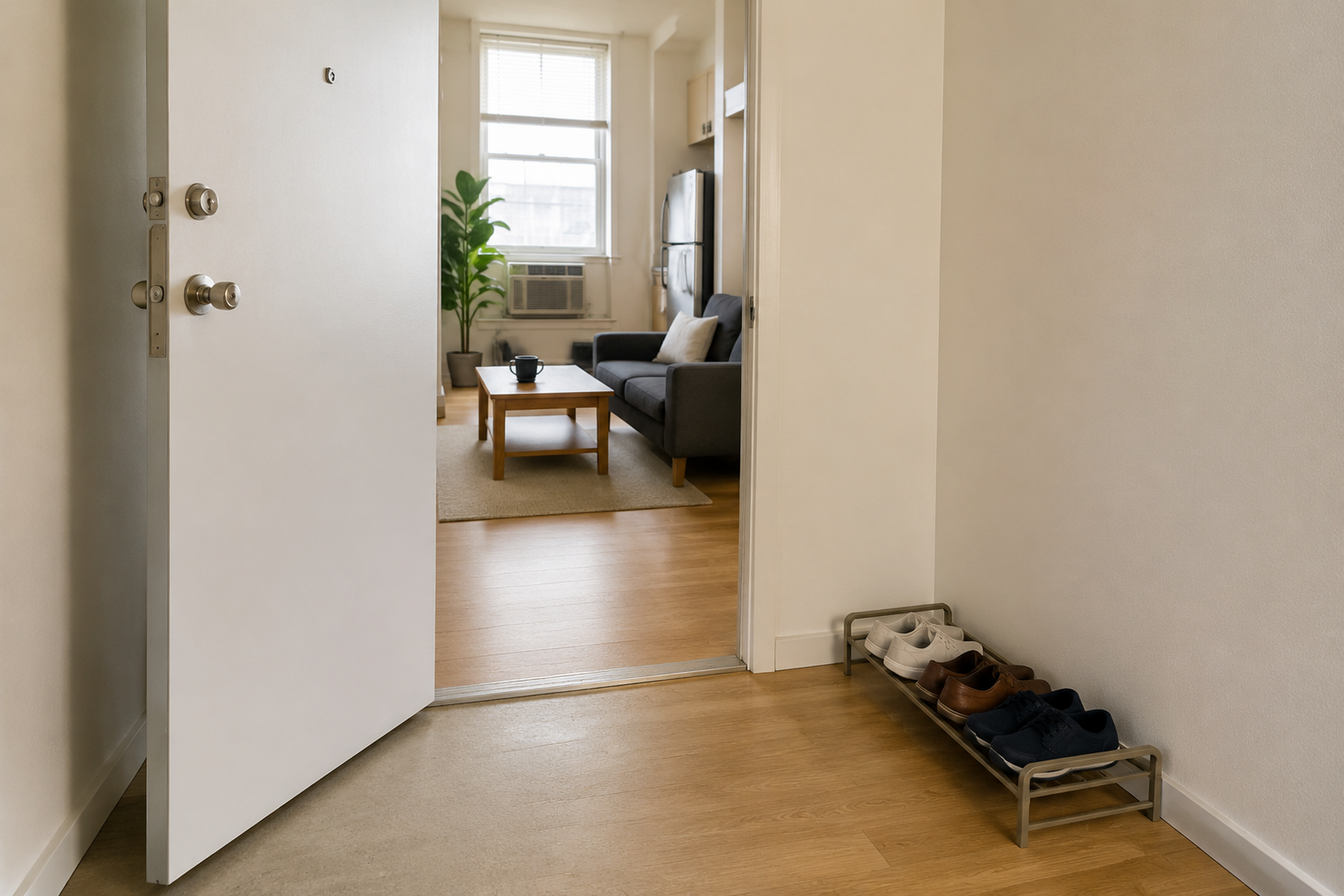
How to Create Entryway Storage When Your Apartment Has No Entryway
Use this next if an exit-side extinguisher has to coexist with shoes, bags, coats, and a narrow door path; that guide focuses on keeping the arrival zone functional without losing circulation.
GUIDE
How to Create a Trash and Recycling Zone in a Small Kitchen
Use this if waste bins and under-sink storage are competing with the extinguisher for the same kitchen footprint; that guide handles bin access, cabinet trade-offs, and removal paths.
GUIDE
Where to Put Paper Towels in a Small Kitchen With No Counter Space
Use this if the same limited wall, cabinet, or counter planes are carrying everyday kitchen items; that guide helps move a high-frequency object without sacrificing the safer extinguisher location.