
Small Closet Organization
How to Store Handbags in a Small Closet Without Taking Over Shelf or Hanging Space
A small closet can hold handbags without turning every shelf, rod, and door into bag storage. Sort by use frequency and bag structure first, then choose the shelf, hanging, door, upper-closet, or outside-the-closet zone that costs you the least useful space.
In This Guide
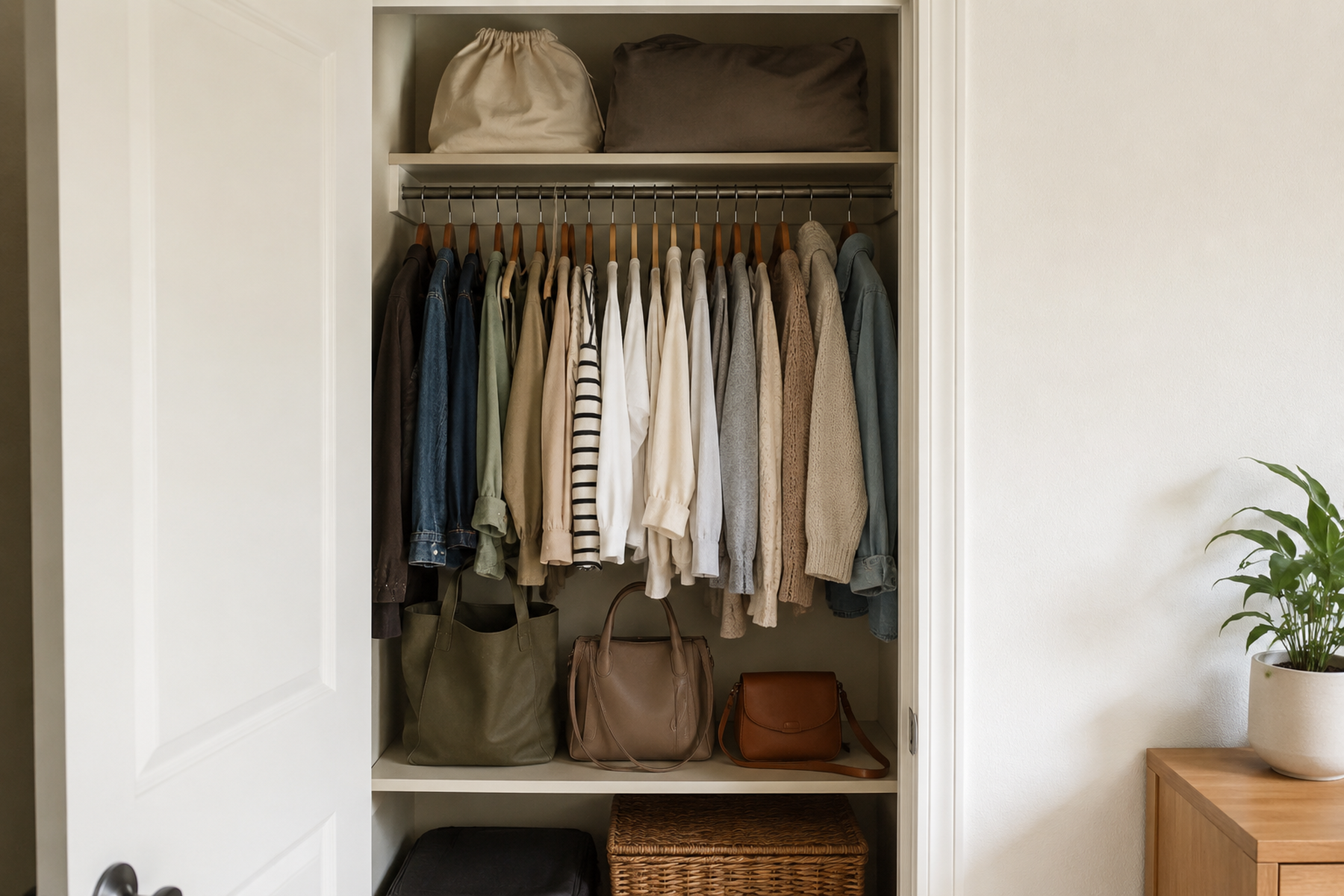
Handbags are awkward closet objects because they do not share one useful size or one safe storage method. A tall tote, a structured shoulder bag, a soft crossbody, and a clutch can all demand different shelf height, depth, support, strap treatment, and access—even when they belong to the same person.
A workable small-closet system separates access needs from capacity. Regular-use bags deserve easier reach; occasional bags can move higher or deeper; structured or care-sensitive bags may need more support; and a storage method only earns its place if the shelf, rod, door, or room still works normally after the bags are actually loaded.
Quick Answer
Give Each Bag the Cheapest Suitable Storage Zone
Sort handbags by access frequency and by the support or care they actually need, then give regular-rotation bags the easiest suitable storage. Spend shelf, rod, door, or floor space only when that closet resource can genuinely be spared, and confirm the loaded organizer still leaves clothing, doors, and circulation working normally.
01
Separate current, regular, and occasional bags
Keep the bag you are using now out of the collection if that reduces daily closet friction. Give regular-rotation bags the easiest shelf or organizer access, and let occasional bags use less convenient storage.
02
Sort by structure and care tolerance
Before hanging or nesting a bag, consider whether its shape, straps, hardware, and maker guidance support that treatment. The most space-efficient method is not automatically the best method for every bag.
03
Spend shelf, rod, door, and floor space deliberately
A hanging organizer spends garment-rod width. An over-door holder spends door clearance. A freestanding unit spends floor area. Choose the resource your closet can actually spare.
01
Zone Bags by Use and Structure
Bag count is a weak starting point in a small closet. Five tiny crossbody bags can use less space than two tall totes, while one rigid bag may need more protected room than several soft ones.
Begin with three access groups:
- Current-use bag: the one in active rotation now.
- Regular-rotation bags: the bags you want visible and easy to return.
- Occasional bags: seasonal, event-specific, or infrequently used bags that can tolerate a less convenient location.
Then add a second filter: structure and care tolerance. A soft tote that can safely collapse a little may be easier to place than a rigid bag that needs upright support. A bag that should not be hung by its strap needs a shelf-style home even when a hook would save more width.
This two-part sort keeps the closet from giving equal real estate to bags with very different needs.
02
Protect Prime Shelf Space for Regular Rotation
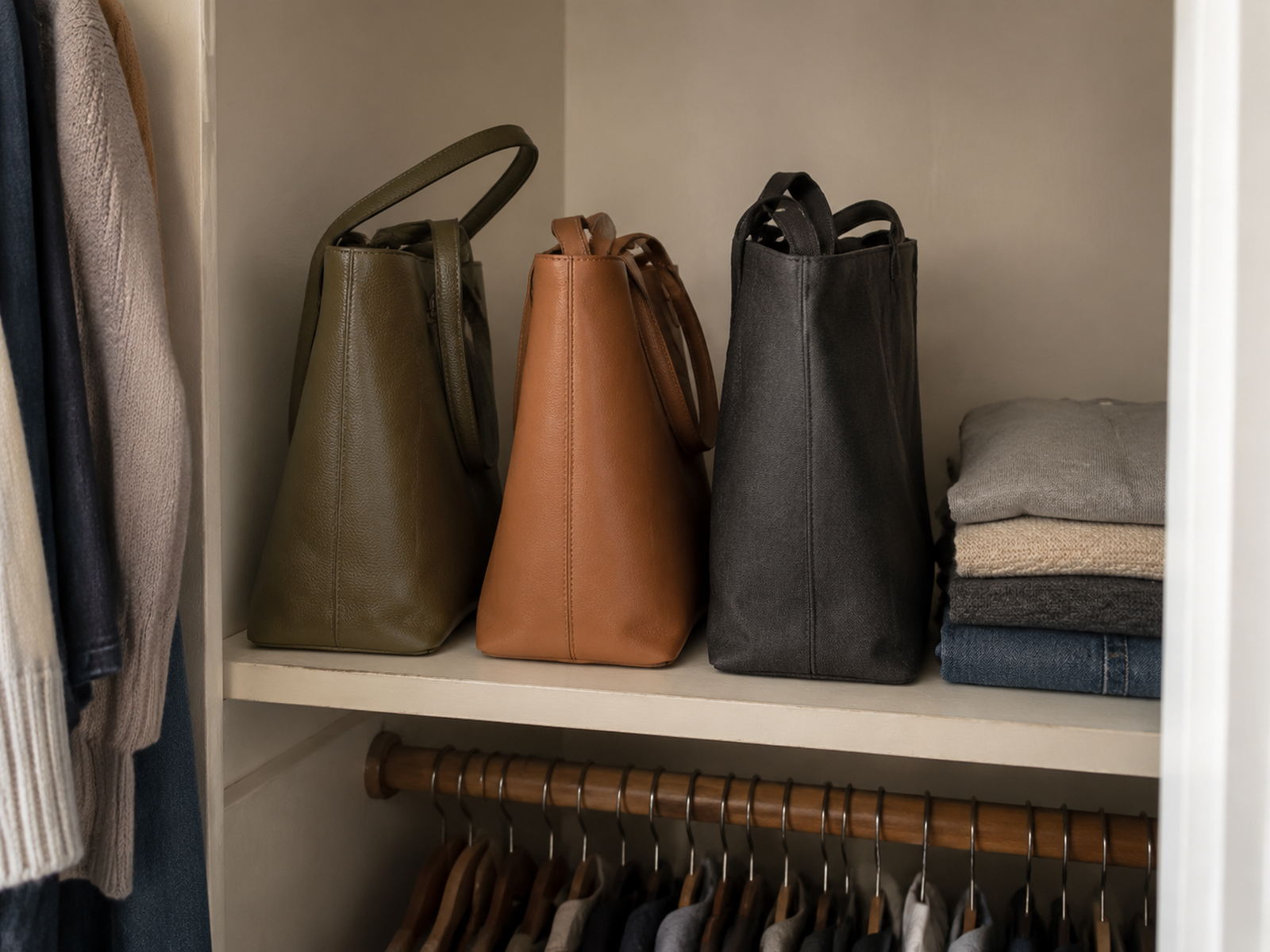
A shelf is often the simplest place to keep handbags visible and supported, but it is also one of the most valuable zones in a small closet. Use prime shelf space for the bags that benefit most from fast access and upright storage.
Arrange regular-rotation bags so each one can be removed without unloading a pile. If a divider or cubby helps bags stay upright, use it only when the compartments fit the actual bag width, depth, and height. Dividers improve order; they do not create extra shelf width.
Avoid building a hidden second row unless the back row truly contains occasional bags. Deep shelf capacity is not useful if the front row has to be dismantled every time you want a bag behind it.
The practical shelf rule is simple: easy-access shelf space should serve easy-access bags.
03
Use Hanging Organizers Only When the Rod Can Spare the Width
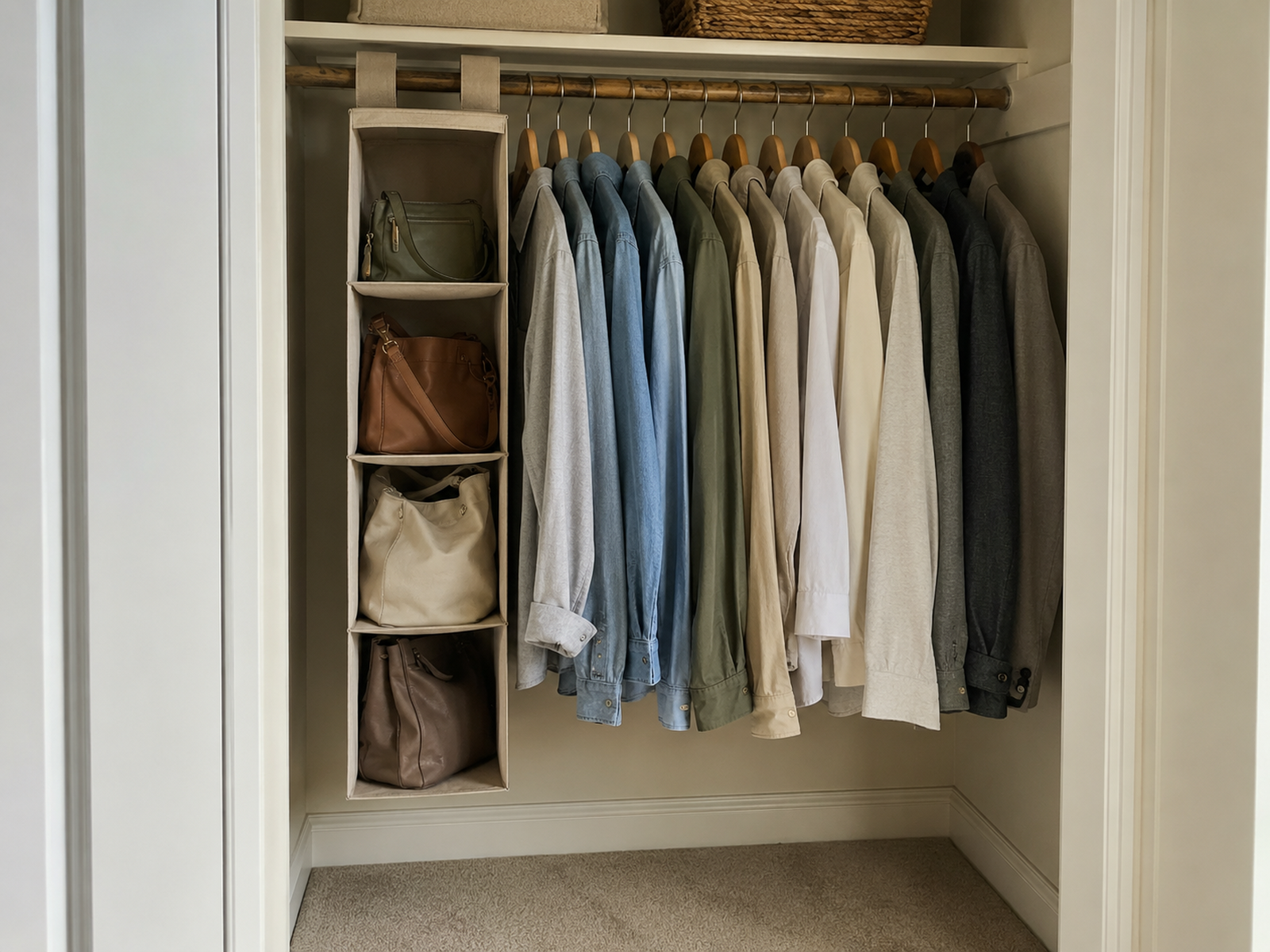
A hanging fabric organizer can turn vertical space into shelf-like compartments without drilling or adding floor furniture. That can be useful in a rental, but the space is not free.
Every inch of organizer width is an inch of garment rod that no longer holds clothes. The organizer also drops into the vertical zone below the rod, where it can collide with dresses, coats, drawers, shoes, or other closet storage.
Check the bags against the organizer rather than assuming “six compartments” means six useful handbag spaces. Tall totes may not fit. Deep bags may bulge. Heavy loading can make a lightweight organizer less stable. IKEA’s U.S. SKUBB organizer, for example, verifies that a removable hook-and-loop hanging form factor exists, but that does not establish universal handbag fit or a universal load limit.
A hanging organizer works best when the closet has spare rod width, enough vertical drop, and bags that fit the real compartments without forcing the clothing zone to absorb the cost.
Measure / Check First
Before adding a shelf insert, hanging organizer, or door system, measure the storage zone as it will actually be used—not only the organizer listing.
Measure the Space the Organizer Will Consume
01
Check the shelf opening, not just the shelf board
Measure usable width, depth, and clear height at the actual opening. Include shelf brackets, trim, doors, and the tallest or deepest bag that needs to pass through the opening without being crushed or tilted excessively.
02
Check rod width and vertical drop together
Measure how much garment-rod width a hanging organizer will take and how far it drops into the clothing zone. Confirm that nearby clothes can still hang and slide normally.
03
Check the door with the organizer loaded
For over-door storage, verify door type, top gap, thickness, trim, hinges, latch movement, loaded bag projection, and the room path through the full swing. One current Joseph Joseph U.S. handbag holder, for example, specifies a maximum door thickness of 1.7 inches; that number belongs to that product, not to over-door storage in general.
Use the exact organizer instructions when a fit or load claim matters. A “standard door,” generic rod-capacity assumption, or empty test does not prove that the final loaded setup will work.
04
Test Over-the-Door Storage as a Moving System
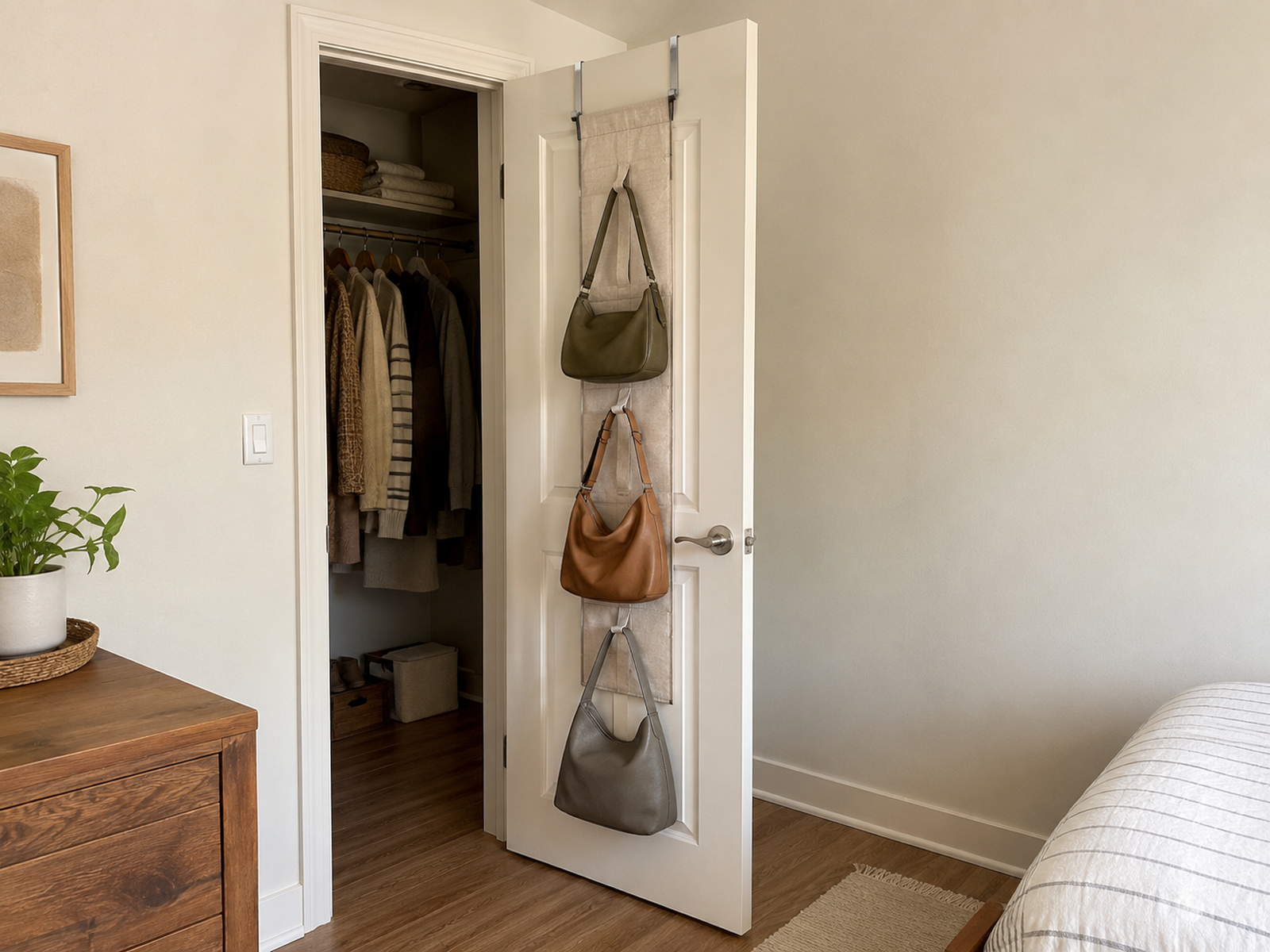
A compatible hinged closet door can hold bags without consuming shelf, rod, or floor space, which makes over-door storage appealing in a small closet. The trade-off is that the door becomes part of the storage system.
Load the organizer with the bags you actually intend to store, then open and close the door through its normal range. The hooks or straps should not scrape trim, prevent latching, strike adjacent shelving, or make the door feel awkward to move. Bags should not swing into the main circulation path or collide with furniture behind the door.
Door type matters. A sliding or bypass closet door has a very different movement pattern from a hinged door, and many over-door systems are a poor match for it. Bifold doors introduce their own folding and top-clearance constraints.
Over-door storage is useful only when the loaded door still behaves like a door.
05
Treat Adhesive Hooks as Product-Specific, Not Automatically Renter-Safe
Adhesive hooks can be tempting when there is no shelf space and drilling is off-limits, but removable mounting does not eliminate the need for a fit check.
3M’s current Command guidance lists different weight limits for different products rather than one universal capacity. Its general hook instructions also exclude wallpaper and warn against hanging valuable or irreplaceable items. That is enough to reject broad claims such as “adhesive hooks are damage-free” or “any purse can hang here.”
If you consider an adhesive hook, verify:
- the exact product rating;
- the approved surface;
- the bag’s real loaded weight;
- the installation and removal instructions;
- whether the bag is appropriate to suspend from that point.
For a valuable or strap-sensitive handbag, choose the bag-care requirement first and the mounting convenience second.
06
Give Structured or Care-Sensitive Bags More Support
The closet-efficient answer can be the wrong answer for the bag.
For Coach bags specifically, the brand’s May 2026 storage guidance recommends maintaining shape with tissue, avoiding hanging by straps, using breathable cloth rather than plastic, and storing in a cool, dry place away from direct sunlight. Coach also separates care guidance by material. Those are manufacturer-specific instructions, not universal rules for every handbag.
The broader decision is to check the maker’s guidance before using a storage method that loads straps, compresses the body, traps the bag tightly, or changes its shape. A structured bag may deserve more shelf width than a soft tote because support is part of the storage requirement.
Do not make a valuable bag adapt to the organizer simply because the organizer saves space.
07
Use Upper Shelves and Selective Nesting for Occasional Bags
Occasional bags do not need the closet’s fastest access. An upper shelf can work well when retrieval is comfortable and the storage method suits the bag.
Keep less-used bags identifiable so the upper zone does not become a forgotten stack. Breathable covers may be appropriate for selected bags when their maker recommends them; avoid universal material-care claims.
Nesting can recover real capacity, especially with selected soft bags or totes, but it should remain an optimization rather than the default. Do not place a rigid, embellished, or care-sensitive bag inside another bag unless the materials, hardware, shape, and manufacturer guidance make that reasonable. Nesting also creates a retrieval cost: the inner bag becomes harder to see and reach.
Use nesting only when it saves space without turning the collection into a hidden puzzle.
08
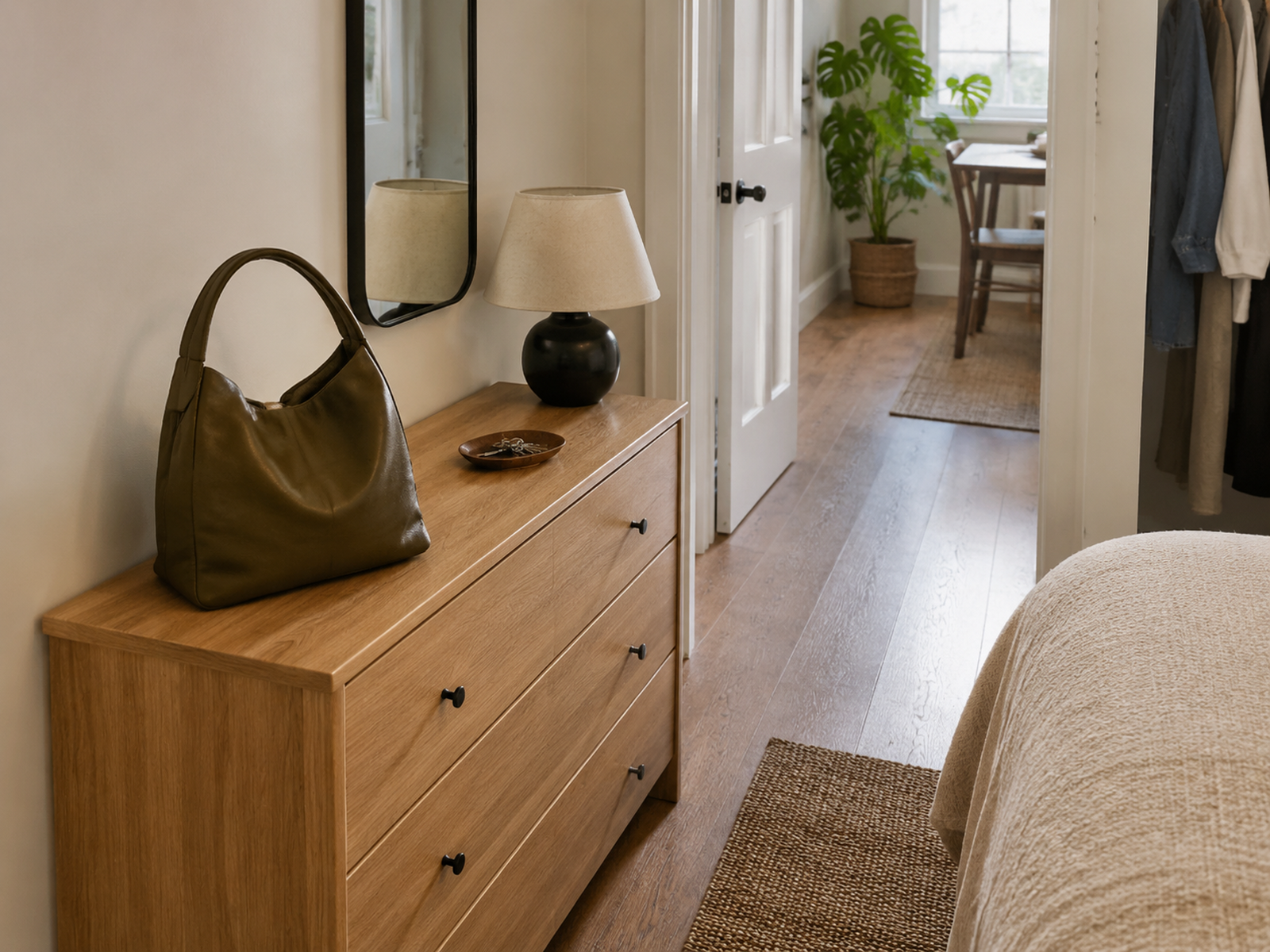
Let the Current-Use Bag Live Outside the Closet When That Works Better
The bag you are actively carrying does not always need to return to the closet after every trip.
A defined grab-and-go spot on existing bedroom or entry furniture can keep one current bag from repeatedly disrupting the stored collection. The boundary matters: one active bag is a system; several bags accumulating there is a second clutter zone.
This can also protect prime closet space for the bags that actually need structured storage. When the active bag changes, return the previous one to its regular home and move the new current bag into the grab-and-go spot.
The closet becomes easier to maintain when it stores the collection rather than acting as the only legal location for every bag at every moment.
What Not to Do
Avoid Fixes That Save One Closet Resource by Breaking Another
- Do not organize by bag count alone when the bags have very different widths, heights, depths, and structures.
- Do not fill the garment rod with hanging shelves and then treat the lost clothing space as free.
- Do not hang every bag by its straps simply because hooks are compact.
- Do not assume over-door or adhesive mounting is automatically renter-safe, damage-free, or suitable for valuable bags.
- Do not nest structured or care-sensitive bags by default.
- Do not keep adding organizers after the closet has reached a clear physical capacity limit.
Decision Sequence
Choose a Handbag Storage Zone in This Order
01
Pull the current-use bag out of the collection
Decide whether one active bag can live in a defined grab-and-go zone outside the closet. This immediately reduces the number of bags competing for prime closet access.
02
Divide the remaining bags by access frequency
Keep regular-rotation bags easy to see and retrieve. Move occasional bags to upper, deeper, or otherwise less convenient storage when that remains practical.
03
Separate bags by support and care needs
Identify structured, strap-sensitive, valuable, or material-specific bags before assigning hanging or nesting methods.
04
Measure the closet resource each solution spends
Compare shelf width and height, rod width and drop, door movement, and any residual floor area. Choose the zone that solves the handbag problem without disabling a more important closet function.
Closing Decision
Build a Rotation, Not a Display Closet
A small closet does not need to display every handbag equally. It needs a dependable home for regular-rotation bags, a lower-friction place for occasional bags, and enough flexibility to respect the bags that need more support or different care.
When you choose storage by frequency, geometry, care tolerance, and the closet resource being spent, the trade-offs become visible. Shelf storage, hanging organizers, door systems, hooks, nesting, and outside-the-closet storage can all be useful—but only when the rest of the closet still works after the bags move in.
RELATED GUIDES
What to Read Next
NEXT GUIDE
How to Organize a Small Closet With No Built-In Shelves
If handbag storage is exposing a bigger shelf shortage, this guide helps you build removable storage zones without pretending that garment-rod space is free.
GUIDE
How to Organize a Small Closet With Sliding Doors—Without Losing Access
Use this next when door geometry, partial openings, or blocked reach are limiting where handbag storage can go inside the closet.
GUIDE
How to Store Shoes in a Small Closet Without Losing Floor Space
If shoes and handbags are competing for the same lower closet zone, this guide helps protect floor access before clutter is simply pushed upward.