
Small Kitchen Organization
How to Hang and Dry Dish Towels in a Small Kitchen With No Towel Bar
Separate clean backstock from the damp towel that is actually in use, then give each active towel a safe drying spot near its job—using an existing handle, magnetic bar, over-cabinet hanger, or verified removable mount without sacrificing prep space or defaulting to the oven handle.
In This Guide
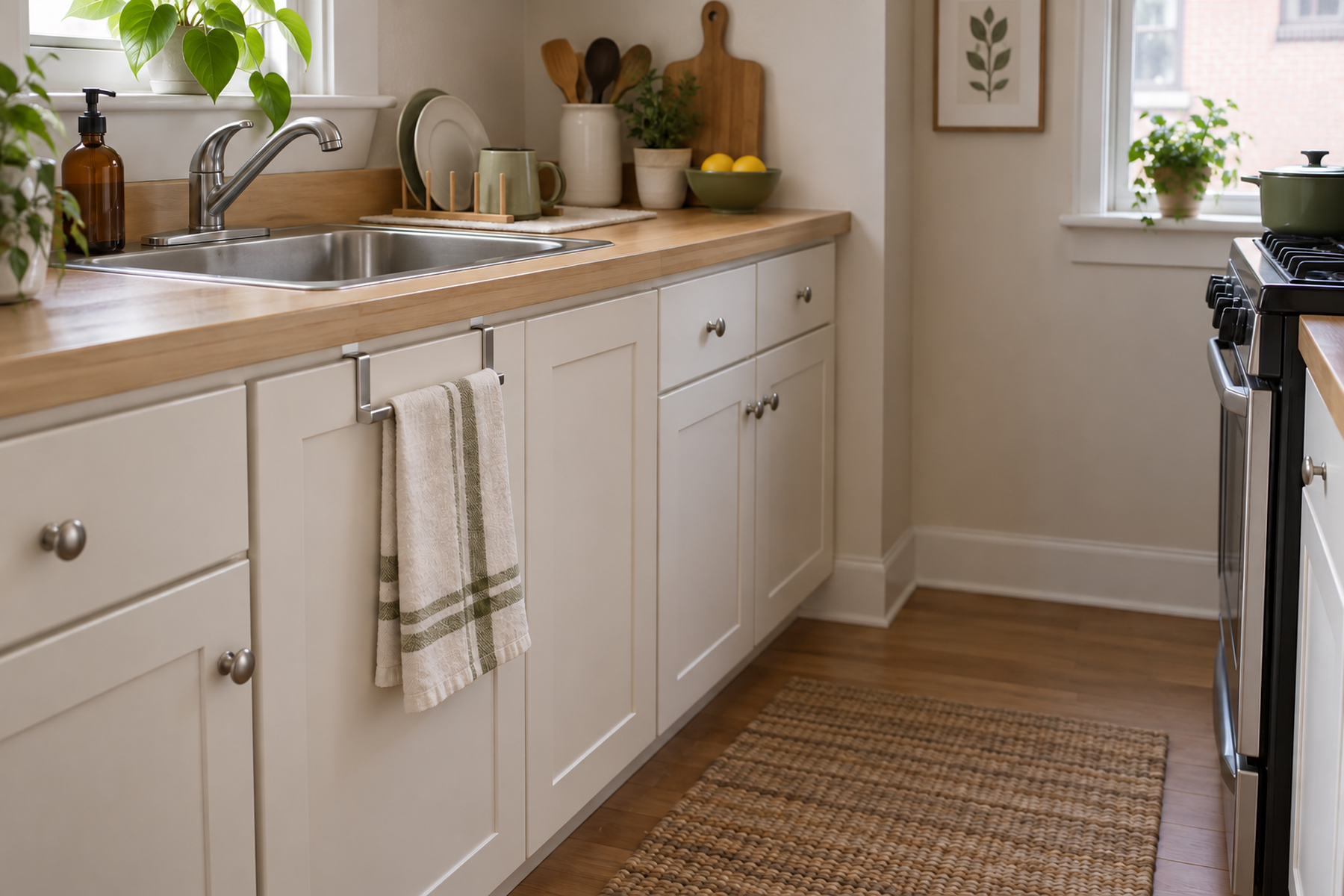
The hard part of kitchen-towel organization is usually not where the clean stack lives. It is what happens to the towel after it has been used, is still damp, and may be appropriate for another low-risk use before it goes to the laundry.
That makes the active towel a workflow problem rather than a linen-storage problem. Decide what the towel is for, remove it from normal reuse when contamination calls for a reset, then choose a drying zone that is close to the sink, away from cooking heat, open enough for the towel to hang rather than sit crumpled, and compatible with the rental.
Quick Answer
Solve the Active Towel Before You Store the Clean Stack
01
Give towels separate jobs when the kitchen needs them
Current extension guidance supports separating cloth or towel roles such as hand drying, dish drying, and counter cleaning instead of asking one reusable towel to handle every kitchen task.
02
Move higher-risk towels out of active reuse
If a towel or cloth contacts raw meat, poultry, or seafood juices, do not return it to the normal active towel cycle. Reset with a clean towel or the appropriate disposable method.
03
Choose the safe sink-adjacent drying zone
The best location is close enough to use without dripping across the kitchen, but only after the spot passes the stovetop, hot-surface, appliance, door-swing, and clearance checks.
04
Use the least permanent hanger that gives enough towel spread
An existing safe handle or magnetic bar needs no installation; an over-cabinet hanger spends door-edge clearance; a removable clip uses less hardware but may bunch a thick towel more than a wider bar.
01
Give Each Active Towel One Job
Before choosing a hook or bar, decide what the active towel is supposed to do. A clean-hand towel, a dish-drying towel, and a cloth used for counters or spills have different contamination histories even when they look identical.
Current Iowa State University Extension guidance recommends separate cloths for jobs such as wiping counters, drying dishes, and drying hands. That is a useful organization rule because the location itself can reinforce the job: one towel returns to the hand-drying zone, another to the dish-drying zone, while a cleaning cloth follows a faster laundry/reset path.
The system does not need a complicated label set. Different locations, colors, or towel styles can be enough if everyone in the kitchen can tell which towel belongs to which job.
Avoid building the article around one “everything towel.” Food-safety history matters as much as drying. A towel that was appropriate for drying clean hands can stop being appropriate for that job after it is used on a dirty spill or higher-risk food contact.
02
Build a Clean-to-Active-to-Laundry Reset
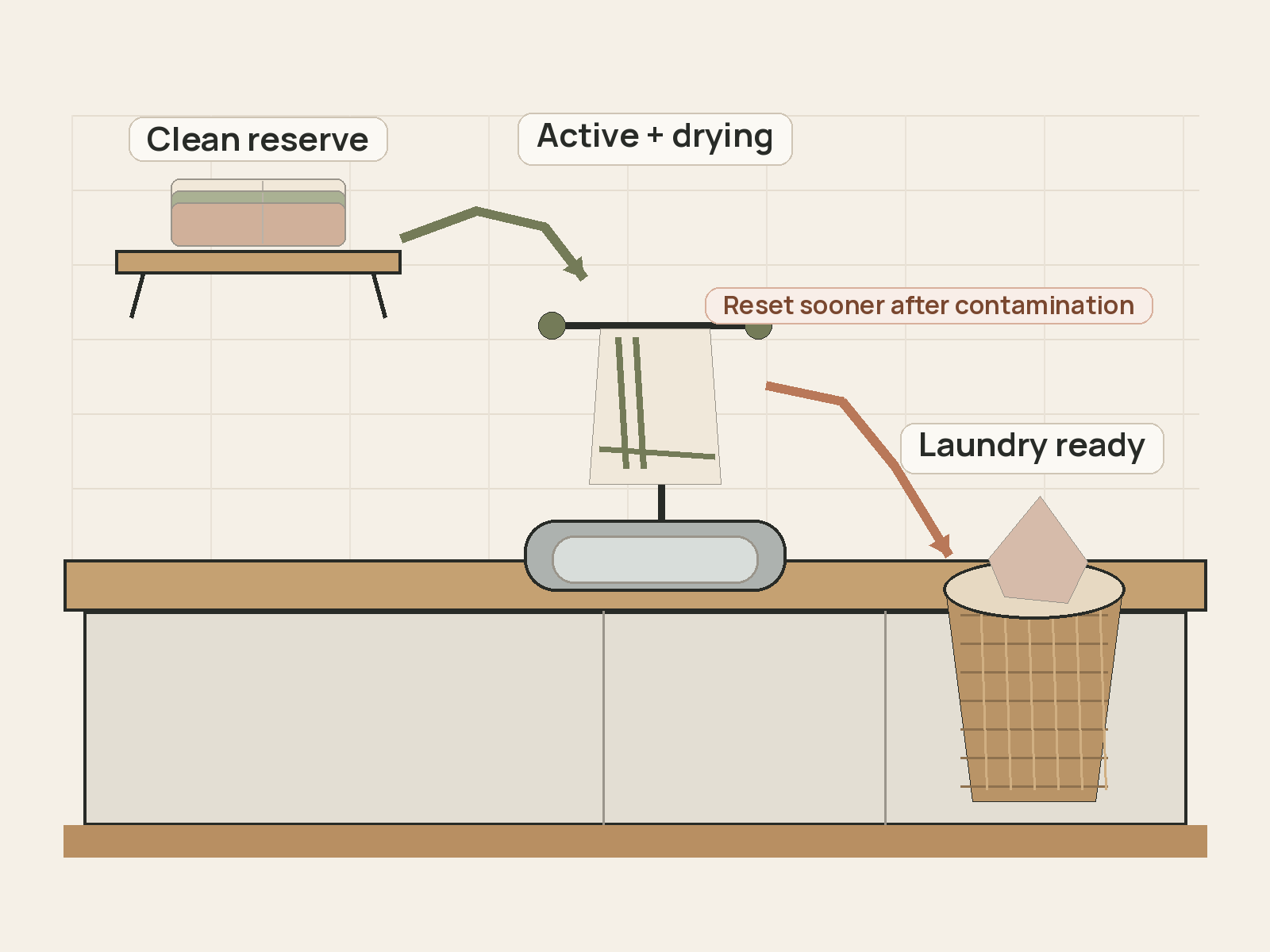
Separate three storage states: clean backstock, the active towel that needs to hang and dry, and the towel that is ready for laundry. Trying to make one drawer, basket, or hook solve all three usually creates either damp hidden fabric or unnecessary sink-zone clutter.
Clean backup towels do not need premium sink access. Store them in the nearest dry drawer, shelf, or linen zone that is easy enough to restock from. Reserve the best sink-adjacent location for the one or two towels currently in use.
Current U.S. extension guidance consistently supports frequent towel changes and an earlier reset after raw meat, poultry, or seafood contamination. Iowa State’s September 8, 2026 guidance gives a 1–3 day range for swapping and washing kitchen cloths and towels, while other extension guidance commonly recommends daily changes depending on use.
Treat those numbers as context rather than one universal schedule. The stronger rule is: change towels frequently, reset sooner after higher-risk contact, and do not keep a towel in the active cycle simply because it has dried.
Measure / Check First
Before buying a magnetic bar, over-cabinet hanger, adhesive clip, or installed towel bar, test the towel job and the exact location together.
Check Heat, Clearance, and Mounting Before You Commit
01
Cooking-heat boundary
Eliminate locations that conflict with NFPA’s keep-combustibles-away-from-the-stovetop guidance or the exact range / oven manufacturer instructions. Do not make the oven handle the automatic fallback.
02
Door, appliance, and towel clearance
Open the dishwasher, refrigerator, cabinet doors, drawers, and trash pullout through their full paths with the towel in place. Check towel length, hanger projection, adjacent collisions, and whether the towel gets pinched or falls.
03
Mounting surface and towel spread
Verify that a magnetic surface actually holds, an over-door product fits the real door thickness, or an adhesive product is approved for the exact surface. Then confirm that the towel can hang openly enough for the chosen geometry rather than sitting crumpled on the counter.
If a hanger is convenient but sits in the cooking heat zone, blocks a door, relies on an unsupported surface, or leaves the towel trapped and bunched, move the drying job to another location before adding hardware.
03
Keep the Drying Zone Out of the Cooking Heat Area
Convenience does not override cooking safety. NFPA guidance says towels and other combustible items should be kept away from the stovetop, so the closest available bar is not automatically the right drying zone.
The oven handle is especially weak as a generic recommendation. Current KUCHT range documentation explicitly warns users not to hang articles such as dish towels from the oven handle because some fabrics may ignite or melt from heat.
That warning is product-specific, and the exact range or oven manual governs each kitchen. The practical editorial rule is simpler: do not present the oven handle as the default towel bar, and keep active towels outside cooking heat and manufacturer-prohibited locations.
A dishwasher handle, refrigerator handle, or cabinet rail is a different location class, but it still has to pass door movement, towel-fall, aisle, and sink-proximity checks.
04
Audit Existing Safe Handles and Bars Before Buying Anything
The cheapest solution may already be in the kitchen. A non-heated dishwasher handle, refrigerator handle, or existing cabinet rail can work if it sits near the sink, lets the towel hang without touching the floor, and does not create a collision when the door opens.
Test the full movement rather than the static photo. Open the dishwasher completely, pull the adjacent drawer, and swing the nearby cabinet door. A towel that falls, gets trapped, or blocks normal appliance use has not earned the zero-cost advantage.
Also check how much of the towel can hang open. A broad handle can support more spread than a narrow knob, but the article should not promise a universal drying speed. Textile thickness, folds, room humidity, and airflow all affect the result.
If the existing handle is safe and functional but the visible towel bothers the household, decide whether that aesthetic cost is actually greater than adding another organizer. Visual calm should not push a damp active towel back onto the counter or into a closed pile.
05
Use a Magnetic Bar When the Surface and Location Work
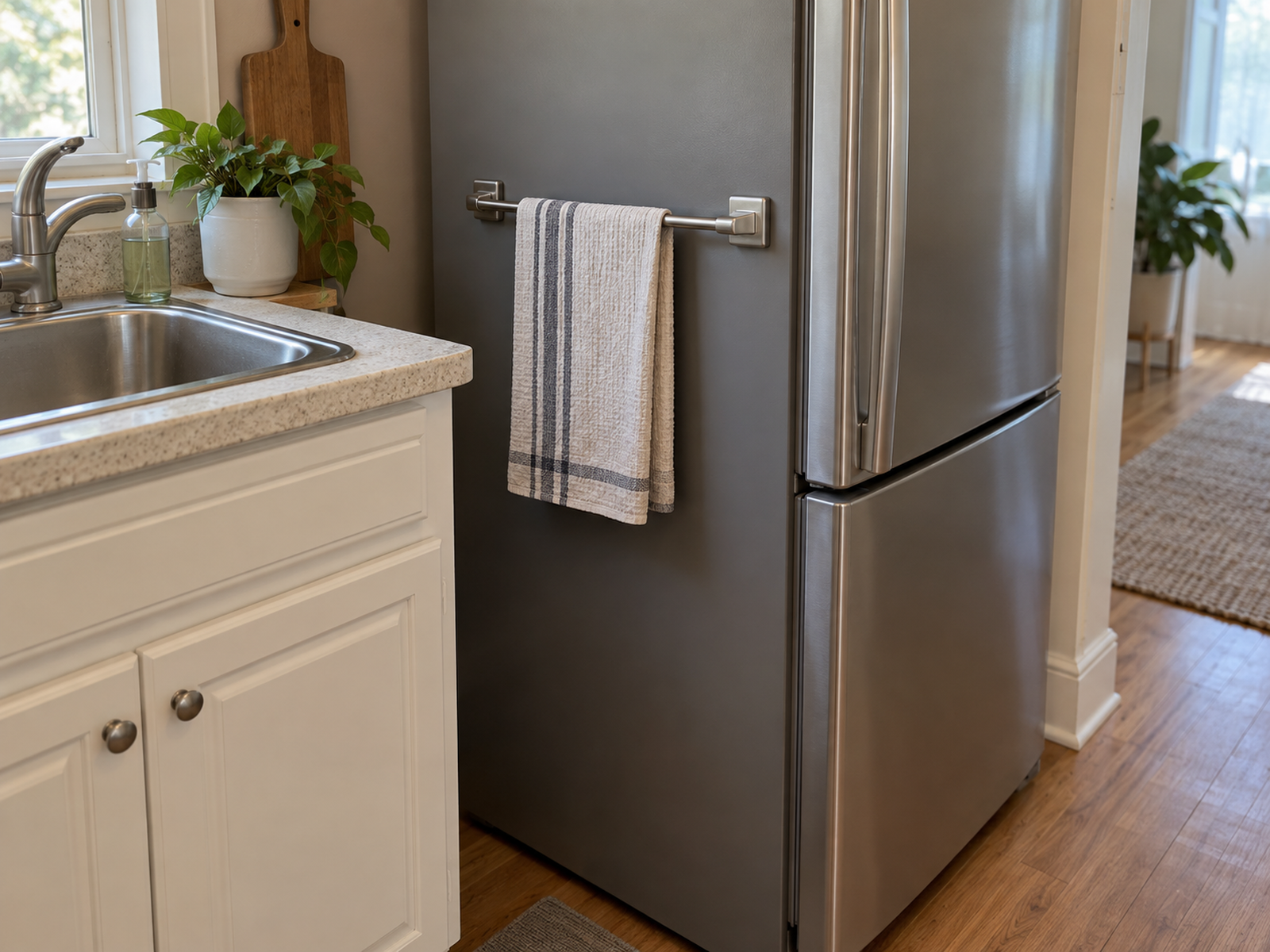
A magnetic towel bar is one of the strongest renter solutions when the refrigerator or another nearby appliance surface is genuinely magnetic. It gives the towel a wider hanging surface without holes, adhesive, or counter footprint, and it can be repositioned as the kitchen changes.
Yamazaki’s current Tower magnetic kitchen towel hanger is one example of the form at roughly 11.02 inches wide, 1.77 inches deep, and 1.97 inches high with a 3-pound load rating. The manufacturer describes it as magnetic-only rather than wall-mounted.
The surface check is real. Not every stainless refrigerator exterior is magnetic, and the best magnetic surface may be useless if it faces a wall, sits across the kitchen from the sink, or projects into a narrow aisle.
Test the actual location with the towel hanging. The refrigerator door should still open normally, the towel should not brush the floor or adjacent cabinetry, and the path from wet hands or dishes to the bar should remain short.
06
Use an Over-Cabinet Hanger When the Door Geometry Works
An over-cabinet hanger can place the towel directly on an under-sink door without drilling, adhesive, or counter use. For many rental kitchens, that is a very efficient conversion of door-edge clearance into active towel space.
Yamazaki’s current Tosca cabinet-door dish towel hanger is designed for an under-sink cabinet and fits doors up to about 1 inch thick. The manufacturer lists a dowel width of roughly 7.5 inches and about 2 inches of projection from the door.
Those numbers show why the fit check needs more than towel width. Verify the door thickness, the hanger projection, adjacent drawer or door movement, and whether the towel gets pinched inside the cabinet when the door closes.
Check the finish as well. The exact product should have the padding or contact protection required by its instructions; do not assume every over-door hanger is harmless to every painted, veneered, or laminate cabinet.
07
Use Adhesive Clips or Bars Only on Verified Surfaces
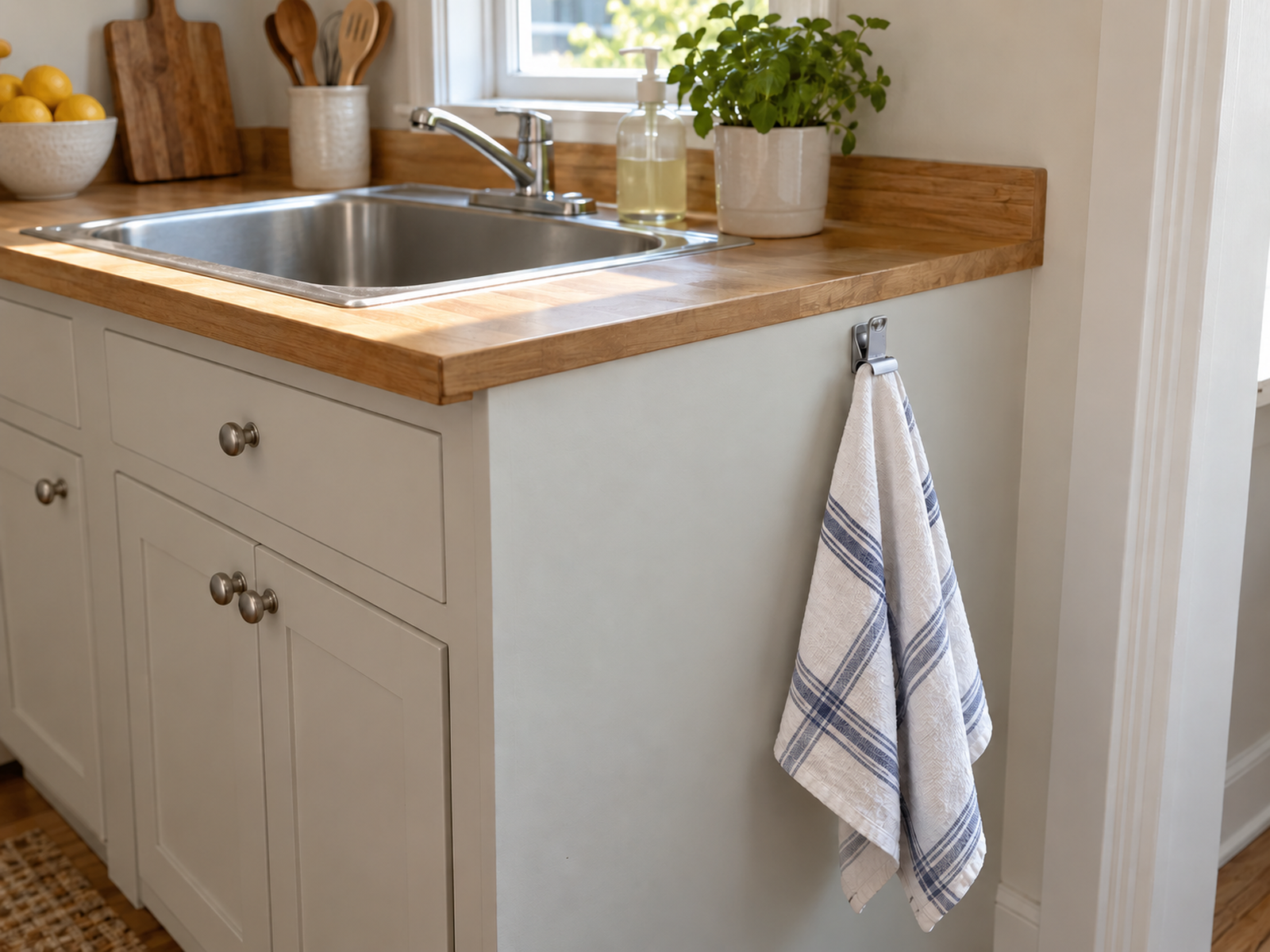
Removable adhesive hardware becomes useful when the kitchen has no magnetic surface and no cabinet door that accepts an over-door hanger. A small clip uses very little visual and physical space; a wider removable bar gives the towel more room to spread.
3M currently markets Command Spring Clips for dish towels and other light household items and lists supported indoor surface classes including painted drywall, finished wood, tile, metal, and glass. The manufacturer also allows placements such as under a sink or inside a cabinet when its installation instructions are followed.
That does not make every rental surface suitable. Surface preparation, waiting or cure time, load, and removal method remain product-specific. A bath-rated removable towel bar also proves the broader no-tool mounting class, but bathroom-market documentation should not be treated as proof that every kitchen wall or warm backsplash location is appropriate.
Choose the hardware geometry intentionally. A single-point clip can minimize the mount footprint but may leave a thick towel more bunched than a bar. A larger bar uses more wall or cabinet-side area but can spread the towel more fully.
08
Use Inside-Cabinet Placement as a Concealment-First Branch
An inside-cabinet clip or bar can hide the active towel when visual calm is the priority, especially on an under-sink door close to the washing zone. That is a legitimate branch, but concealment and drying are not the same job.
The towel still needs to hang freely enough that it is not tightly folded or trapped when the door closes. It should not sit against leaking plumbing, wet cabinet surfaces, or cleaning-product spills.
Access also changes. Wet hands now have to open the cabinet, and the towel may move with the door rather than staying in a fixed grab position. If that extra step causes the towel to land back on the counter, the hidden location is too costly in reset friction.
There is no single cabinet-airflow threshold or universal drying comparison that applies to every setup. Treat inside-cabinet storage as a concealment-first option that must still work in the actual cabinet.
09
Keep Clean Backstock and Laundry-Ready Towels Out of the Active Zone
Once the active drying spot works, simplify the rest of the towel category. Keep clean backups in a dry drawer, shelf bin, or linen zone where they can be restocked without occupying the sink edge or counter.
Give laundry-ready towels a predictable exit path as well. A towel that is soiled, has reached the household’s change point, or has been used for higher-risk contamination should leave the active hanger rather than compete with the clean replacement.
The system can be compact because only the active towel needs the highest-value location. A dozen clean towels do not all need to live beside the sink simply because one towel is used there.
Run the full reset once: remove the used towel, replace it with a clean one, and put the used towel into the laundry path. If that swap takes only a few seconds and the new towel returns to a safe open drying zone, the organization system is doing more than hiding fabric.
Closing Decision
Give the Damp Towel a Real Job and a Real Place to Dry
A small kitchen does not need a large towel-storage system beside the sink. It needs a clear active-towel workflow: the correct towel for the job, a safe place to hang it between appropriate uses, and a quick exit to laundry when contamination or change frequency calls for a reset.
Start with an existing safe handle or bar, then move to a magnetic holder, over-cabinet hanger, or verified removable mount only when the kitchen geometry requires it. Keep the towel out of the cooking heat zone, keep clean backstock elsewhere, and judge the final setup by four things: reach, drying geometry, safety, and a reset simple enough to repeat.
RELATED GUIDES
What to Read Next
NEXT GUIDE
How to Create a Dish-Drying Zone in a Small Kitchen With No Dishwasher
Use this next if the towel problem is part of a larger sink-zone drying bottleneck and dishes, racks, and wet counter space still need a compact workflow.
GUIDE
How to Organize a Small Kitchen With No Drawers—Without Losing Counter Space
Use this if the towel system is solved but utensils and other everyday kitchen tools still need renter-friendly storage without taking over the work surface.