
Small Apartment Storage Ideas
How to Fit a High Chair Into a Small Apartment Dining Area
Choose the feeding-seat architecture before the brand: measure the chair while deployed, add caregiver and tray access, then plan the between-meals state so the dining area can return to normal without compromising restraints, stability, or table compatibility.
In This Guide
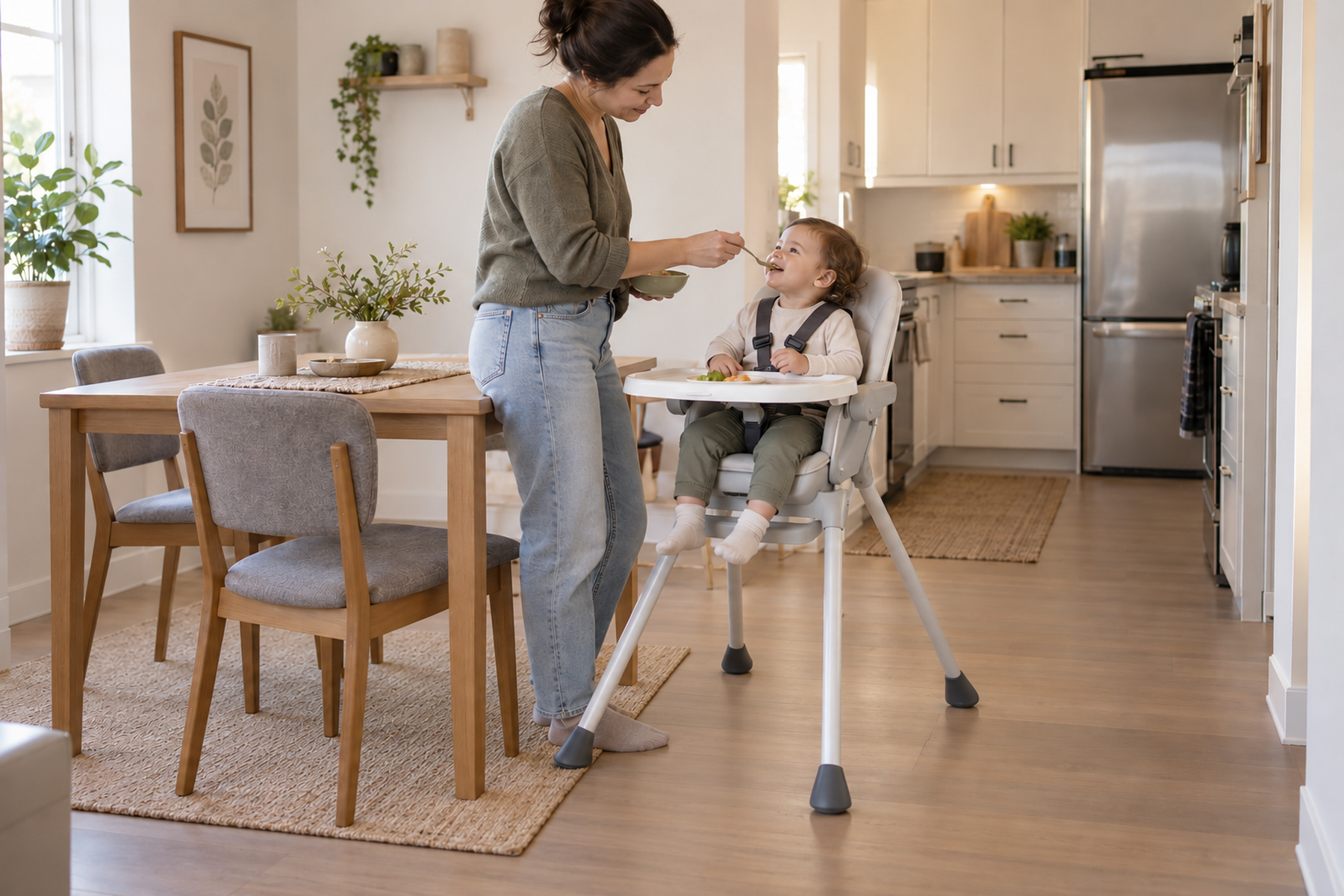
A high chair can look compact in a product photo and still dominate a small dining area once its legs, tray, child access, caregiver stance, and neighboring chairs are in use. The seat has to work safely during meals and then coexist with the apartment when the meal is over.
Treat the decision as three footprints rather than one: the deployed chair, the meal-and-access envelope around it, and the folded or stored state between meals. The best architecture is the one that fits the child and the household table first, then spends the least valuable space in the actual apartment.
Quick Answer
Choose the Chair Class Before You Chase the Smallest Footprint
Freestanding, foldable, hook-on, and later-stage booster architectures solve different space problems. Eliminate any class that fails the child, table, stability, or restraint requirements before comparing dimensions.
01
Measure the chair while it is actually in use
Add leg spread, tray projection, the child’s entry and exit path, caregiver stance, nearby dining chairs, cabinet doors, and the route through the kitchen or dining area. Seat width alone is not the apartment footprint.
02
Treat folded size as a second measurement
A foldable chair can free the room between meals, but only if the folded object has a real storage slot and the household will actually fold, carry, and reset it every day.
03
Treat the table as a compatibility gate for hook-on seats
A portable hook-on chair can recover floor space only when the exact table thickness, edge, underside geometry, material, and manufacturer restrictions all pass. A sturdy-looking table is not enough.
01
Choose the Feeding-Seat Class Before the Product
First decide which support architecture the apartment can use: a freestanding high chair, a folding or self-standing high chair, a chair designed to pull close to the dining table, a portable hook-on chair, or a later-stage seat that uses an existing dining chair when the exact product and child requirements permit it.
CPSC regulates freestanding high chairs and portable hook-on chairs as separate product classes. The difference matters because one stands on the floor while the other is supported by the table, so their stability checks, spatial costs, and failure modes are not interchangeable.
Do not let the apartment choose a product class the child is not ready to use. Age, weight, sitting readiness, restraint use, and approved configurations belong to the exact product instructions rather than to a generic small-space rule.
The fastest way to narrow the field is to eliminate architectures that fail the household before comparing brands: no compatible table means no hook-on chair; no realistic folded-storage slot weakens a fold-every-meal plan; a permanently deployed chair is weak if it blocks the only circulation path.
02
Measure the Deployed, Meal-Access, and Stored Footprints
The deployed footprint is the floor polygon while the chair is open and ready for a meal. Include the full leg spread rather than measuring only the seat or tray.
The meal-access envelope adds the tray, child entry and exit, caregiver stance, the pull-out space for nearby dining chairs, and any cabinet, refrigerator, or appliance door that still needs to open around the seat.
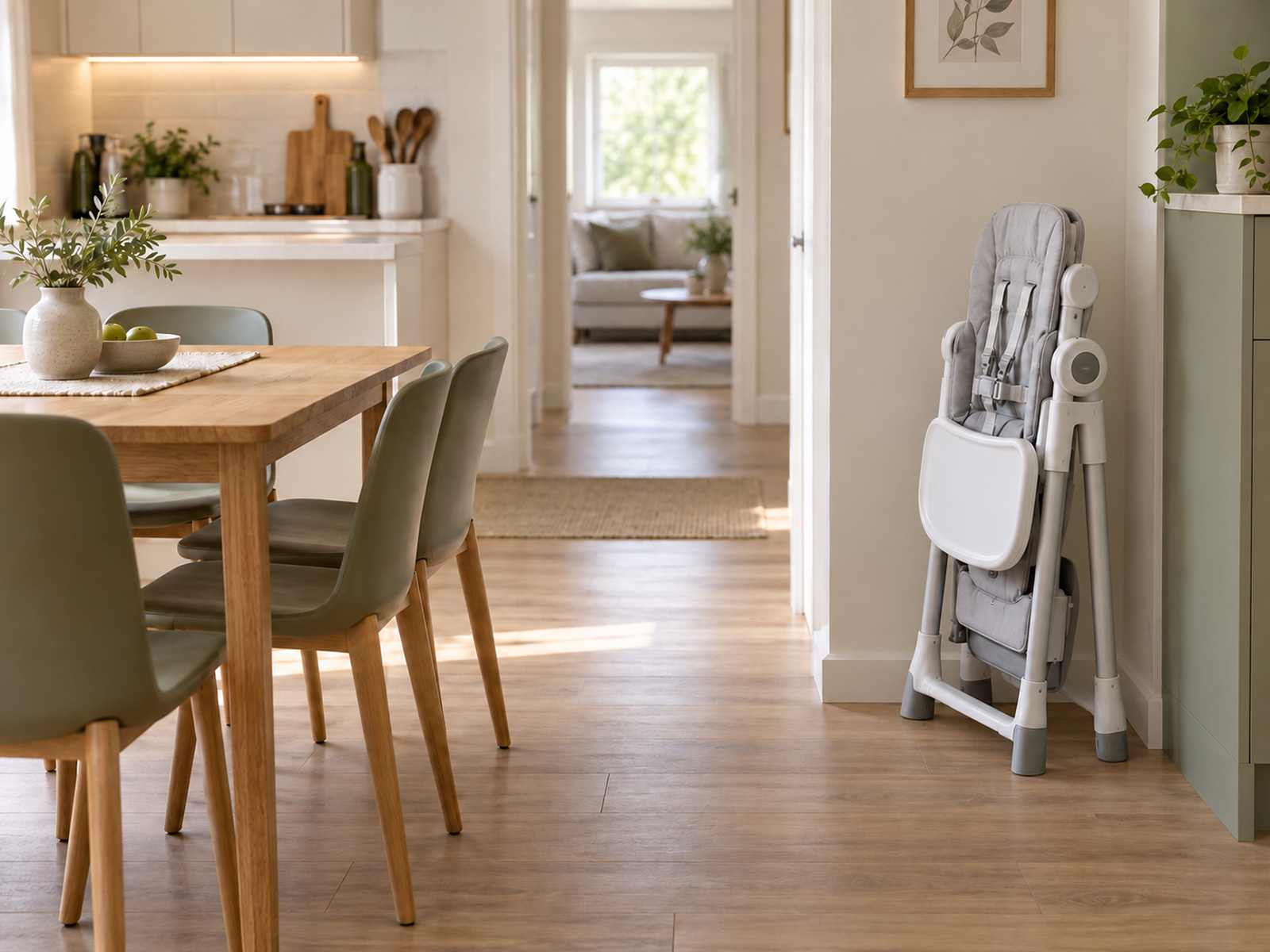
The stored footprint is what remains between meals: a chair left open, a chair tucked under the table, a self-standing folded chair against a wall, a flat folded chair in a closet, or a detached hook-on chair stored elsewhere.
Current manufacturer examples show why the three measurements can diverge. A chair may fold to a thin profile yet still deploy at furniture scale, while a simple non-folding chair can have a smaller meal setup but no reduced storage state at all.
Measure / Check First
Before buying a chair, map the dining area with the feeding seat in its meal state and its between-meals state.
Check the Floor Polygon, Table Geometry, and Reset Route First
01
The deployed meal envelope
Mark the full leg spread or support area, tray projection, caregiver stance, child entry and exit, nearby dining-chair movement, and any cabinet or appliance doors that must still open.
02
The table or chair compatibility gate
For hook-on or existing-chair products, verify the exact manufacturer limits for table thickness, edge and underside geometry, table material or structure, dining-chair shape, and required attachment points.
03
The between-meals storage state
Fold, tuck, detach, or park the chair as intended and measure the real stored object, including tray storage, retrieval path, and whether the household can reset the dining area without creating a second obstruction.
If the chair only fits when nobody else can use the table, the walkway is blocked, the table is outside the product’s compatibility rules, or the folded chair has nowhere to go, reject that architecture before choosing a brand.
03
Keep a Freestanding Chair Only When the Dining Path Still Works
A conventional freestanding high chair is the lowest-friction option when the apartment can leave it open without blocking the room. There is no daily clamping, unfolding, or storage trip before a meal.
The cost is permanent floor area. IKEA’s current ANTILOP example is about 24 inches wide by 26 inches deep, which is a useful reminder that even a visually simple high chair can occupy a substantial rectangle once its legs are included.
Test the chair with the room in its busiest state: dining chairs pulled out, tray installed if used, caregiver standing at the child, cabinet or refrigerator doors opening, and another person walking through the space.
If people repeatedly step around the legs or the chair has to be dragged into a doorway after every meal, the architecture is not functioning as a permanent dining-zone object even if the seat itself is compact.
04
Use a Foldable Chair Only When the Folded State Has a Real Home
Foldability can be valuable when the dining area needs to return to adult use between meals, but the folded chair still needs a destination. Measure the folded width, depth, and height against the actual wall niche, closet, pantry edge, or other storage zone.
Current products illustrate the difference between deployed and folded geometry. Joovy’s Nook, for example, remains more than two feet wide while folded even though its depth is reduced substantially; other self-standing models may be easy to park but still occupy a tall vertical object in the room.
Include the tray in the reset plan. If the tray must be removed before folding, decide where it goes while wet or dirty and whether that creates a second piece of baby gear leaning against the wall.
The fold only saves space when the household will use it. A chair that is technically easy to fold but heavy, awkward, or inconvenient to clean first may remain open in practice, making the deployed footprint the only number that matters.
05
Use a Hook-On Chair Only When the Table Passes
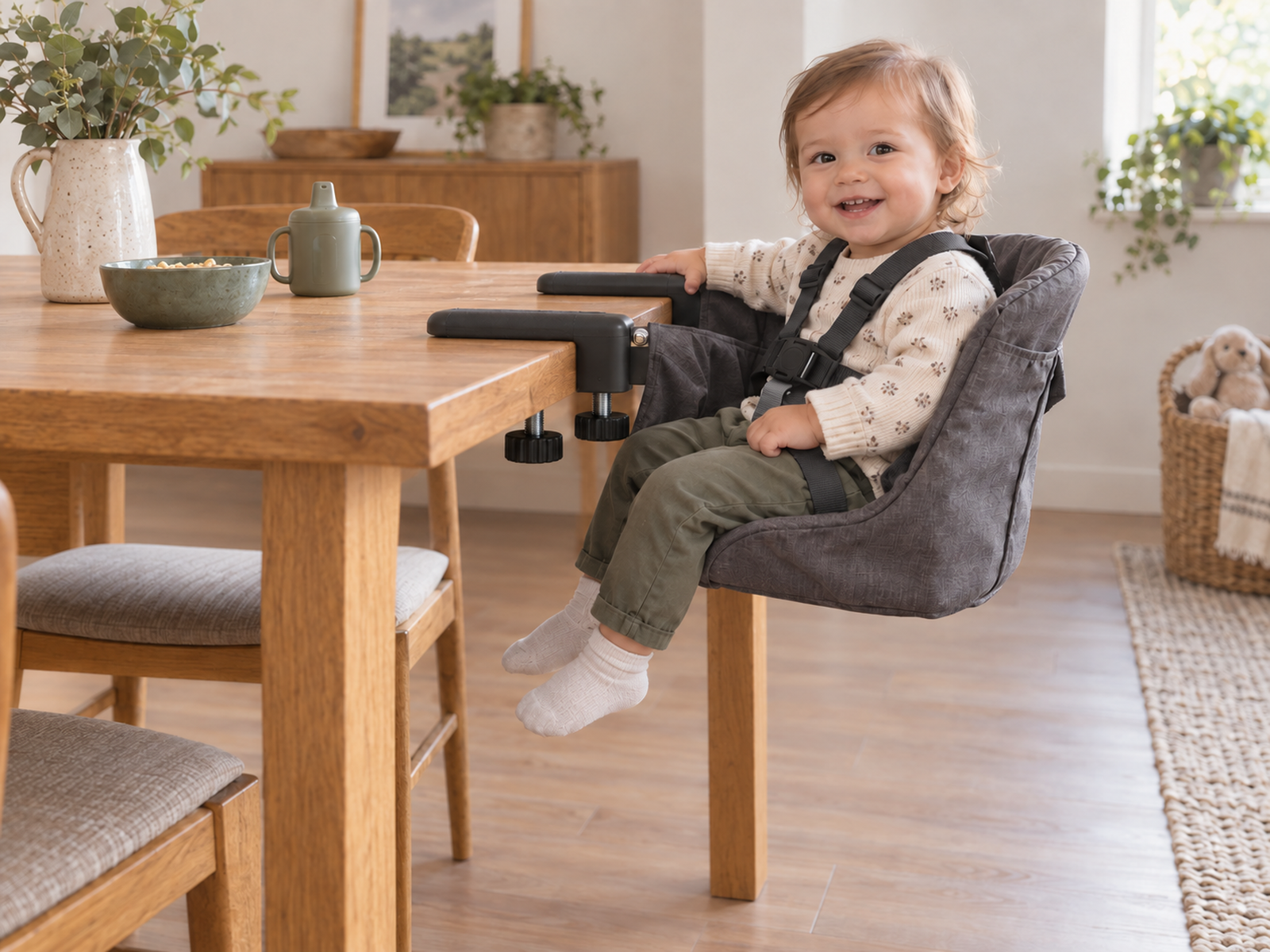
A portable hook-on chair can recover nearly all dedicated floor area during meals, but it does so by making the dining table part of the support system. That makes table compatibility a hard safety gate rather than a style preference.
Current Chicco and Inglesina products publish different table-thickness ranges and structural exclusions. Depending on the exact model, glass tops, loose leaves, card tables, single-pedestal tables, deep skirts, tablecloths, placemats, or other edge conditions can make the table incompatible.
Inspect both the top and underside of the table where the clamps or arms land. The chair should attach exactly as the manufacturer requires, without spacers, improvised pads, trim interference, or a clamp only partly contacting the surface.
Then consider the shared-table cost. A hook-on chair can occupy the same table edge used for work, homework, meal prep, or adult seating, so zero floor footprint does not mean zero impact on the apartment.
Use / Skip
A Portable Hook-On Chair
Use
Use it when the child and the exact table both pass the product requirements
A hook-on chair can be a strong floor-space solution when the child meets the product’s use limits, the table thickness and construction are explicitly compatible, the clamps or arms seat exactly as designed, the required restraint is used, and the occupied table edge does not break the household’s other dining or work routines.
Skip
Skip it when the table is incompatible or the shared surface cannot spare the edge
Choose a freestanding, foldable, tuck-under, or later-stage existing-chair solution when the table is glass, loose, leafed, pedestal-supported, outside the thickness range, blocked by a deep skirt, or otherwise excluded by the manufacturer—or when attaching the seat makes the dining/work surface impractical between meals.
06
Let Cleaning and Reset Friction Influence the Chair Architecture
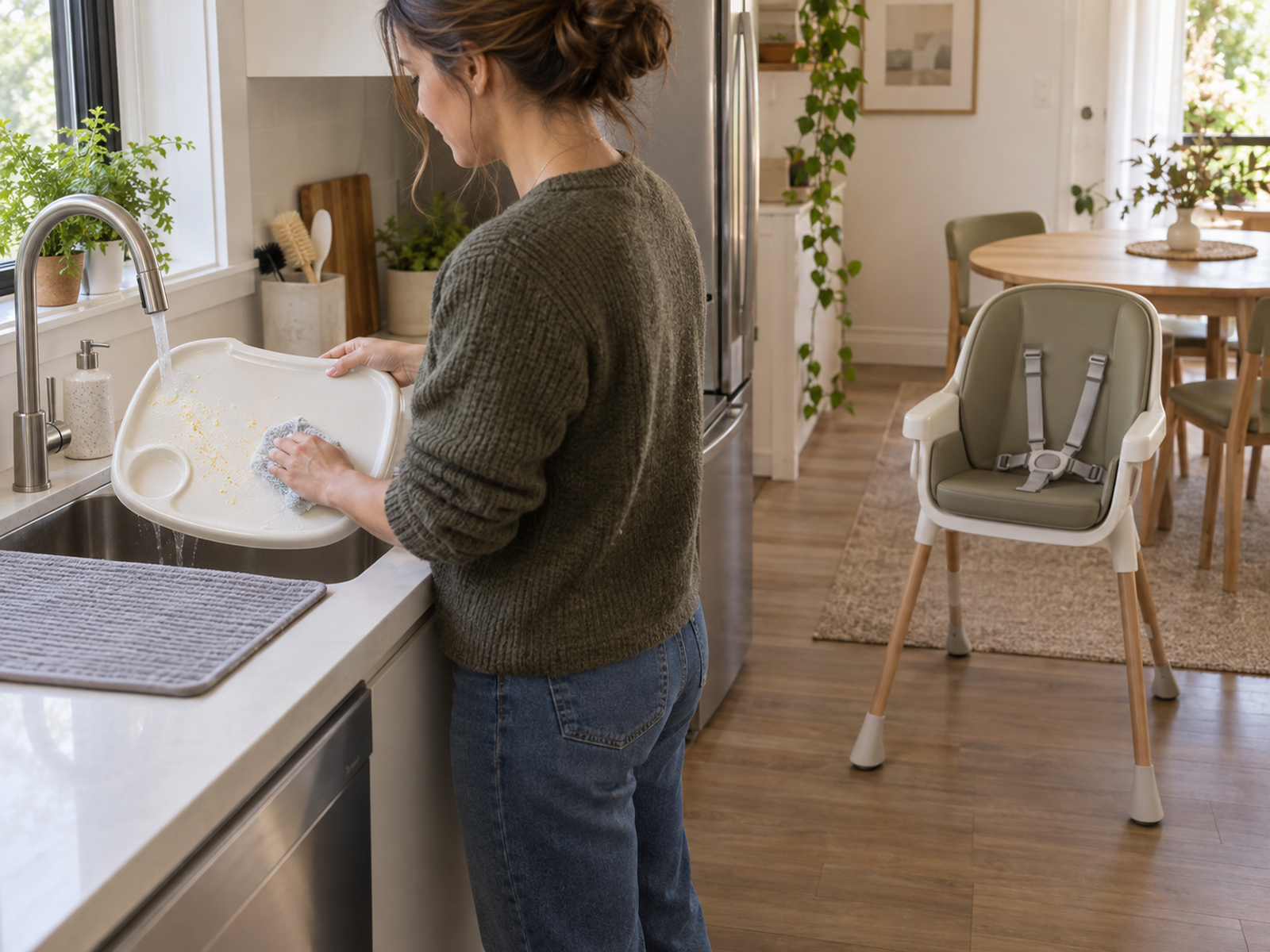
Solids turn the chair into a daily cleaning zone. Food can land on the tray, seat, straps, floor, and nearby table, so cleanability affects how long the feeding setup remains spread through the dining area after the meal ends.
A chair that requires complex fabric removal or several accessories may create more temporary kitchen clutter than a slightly larger chair that wipes down quickly. The small-space question is how much equipment remains out while the seat is being cleaned and dried.
If the tray goes to the sink or dishwasher, include that transfer and drying location in the reset routine. If the chair folds only after the tray is cleaned and removed, the fold state cannot begin until that step is complete.
Keep the required restraint system part of the chair, not an optional item removed for easier wiping. CPSC identifies falls, restraint failures, tip-overs, and related hazards in current high-chair requirements and recalls.
07
Use the Dining Table as Shared Infrastructure, Not Free Space
In many small apartments the dining table is also a desk, homework surface, prep overflow, or general landing zone. Feeding-seat architecture can change how that surface works outside the child’s meal.
A chair designed to pull close to the table may reduce tray bulk and behave more like another dining chair between meals when the exact product supports that configuration. A hook-on chair may recover the floor but claim a section of the table edge until it is detached.
Decide which reset is cheaper in the household: leaving one freestanding chair deployed, folding it after meals, tucking it under the table, or removing a hook-on seat. The answer depends on how often the table changes jobs during the day.
A multi-stage or convertible chair is not automatically better for a shared dining area. Longevity can reduce future purchases, but it does not shrink the square footage the product uses today.
08
Make the Between-Meals State Part of the Decision
The best small-apartment feeding seat is the one whose between-meals state fits the household as well as its meal state. That may mean staying open, tucking close to the table, folding and self-standing, folding into a closet, or detaching from the table.
Measure the route to that state before purchase. A closet solution fails if the folded chair cannot clear the door, a wall-niche solution fails if it blocks another cabinet, and a hook-on solution fails if the chair has no clean place to land after it is removed.
Use a later-stage booster or space-saver seat only when the child and exact product are appropriate and the dining chair itself is compatible and stable. Do not treat booster use as an automatic space upgrade that every child can move into on the same schedule.
If every approved architecture blocks circulation, depends on an incompatible table, or creates a reset routine the household will not sustain, keep comparing chair classes rather than forcing the smallest-looking product into the room.
Closing Decision
Choose the Smallest Feeding System, Not the Smallest-Looking Chair
A strong small-apartment high-chair setup fits three states at once: safe meal use, workable circulation around the dining area, and a realistic reset after the meal. Deployed dimensions, access space, and folded or detached storage all belong in the decision.
Choose the product class first, verify the child and support surface, and then spend the least valuable resource the apartment can afford—floor area, table edge, an existing dining chair, or repeated folding effort—without compromising the chair’s approved configuration or restraint system.
RELATED GUIDES
What to Read Next
NEXT GUIDE
How to Work From a Dining Table Without Letting It Become a Permanent Office
Use this next if the same dining table also functions as a desk; that guide helps the surface reset back to dining use instead of leaving work equipment in conflict with the feeding zone.
GUIDE
How to Set Up a Baby Changing Station in a Small Apartment With No Nursery
Use this if baby care is competing for the same bedroom or living-space floor area; that guide applies a similar operating-footprint approach to the changing routine.
GUIDE
How to Organize Baby Bottles and Pump Parts in a Small Kitchen With Limited Counter Space
Use this if feeding cleanup is also crowding the kitchen; that guide handles the clean-dry-store workflow for bottles and pump parts rather than the child’s seating footprint.