
Small Apartment Storage Ideas
How to Store Household Tools in a Small Apartment With No Garage
A small apartment does not need a miniature workshop. Build a compact maintenance system that keeps everyday tools easy to reach, separates small hardware, and packs away when the job is done.
In This Guide
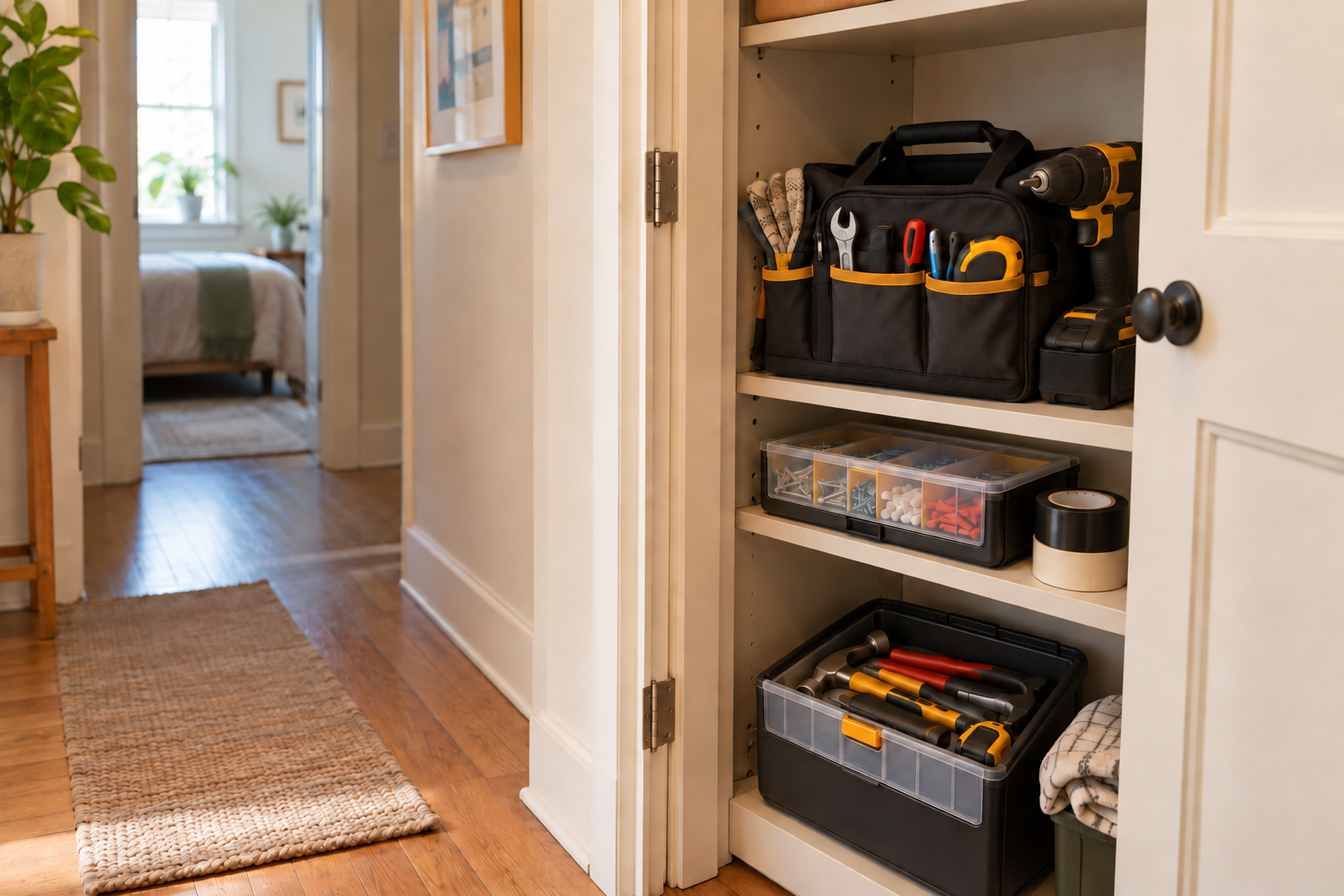
Household repairs still happen when you rent a small apartment: furniture needs assembling, a loose handle needs tightening, and permitted hanging or adjustment jobs still require real tools. The storage problem is that hand tools, bits, fasteners, batteries, chargers, and project leftovers do not behave well when they are all dropped into one deep box.
A better system gives each part of the collection a storage job and gives the whole setup one defined home. It should travel to the task, make small parts easy to find, and return to storage without leaving the dining table, desk, floor, or closet permanently occupied.
Quick Answer
Build a Compact Maintenance System, Not a Mini Garage
The most useful apartment setup is usually a small household-core kit, separate containment for small parts, and one parking zone that the full system can return to after a project.
01
Keep the household core close
Group the basic hand tools you reach for during ordinary home repairs in one portable container or direct-access drawer zone.
02
Separate hardware from full-size tools
Give screws, anchors, bits, blades, hooks, tape, and other small consumables their own compartments instead of burying them under larger tools.
03
Give the system one parking zone
Choose a closet, cabinet, low furniture void, or compact mobile footprint that can hold the stored setup without taking over an active surface or circulation path.
01
Decide What Deserves Apartment Space
A tool collection becomes difficult to store when every item is treated as equally important. In a small apartment, access should reflect how often the tool earns its space.
A practical first pass is to sort the collection into three tiers:
- Household core: basic hand tools used for routine repairs, adjustments, measuring, furniture assembly, and other ordinary home tasks.
- Project support: a compact drill/driver, specialty attachments, clamps, chargers, or other equipment that comes out for specific projects.
- Archive or rare specialty: tools kept for occasional hobbies, former work, or uncommon jobs that do not deserve prime apartment access.
This is also the point to question duplicates. Two similar tools can be justified when they belong to genuinely different task kits, but backups, worn tools, leftover project gear, and specialist items can quietly become permanent inventory.
If the rare-specialty tier keeps growing, the storage decision may need to become a collection decision. Selling, donating, borrowing, renting, or moving some equipment to genuinely secure and appropriate off-site storage can be more sensible than adding another organizer to the apartment.
02
Separate Tools From Small Parts Before You Add Capacity
A deep toolbox can feel too small even when the real problem is category mixing. A hammer, pliers, drill bits, screws, wall anchors, zip ties, tape, and leftover hardware may all support the same repair, but they do not need the same kind of storage.
Keep the storage jobs distinct:
Full-size hand tools
Use a portable toolbox, tool bag, shallow drawer, or other container that lets you see and retrieve the tools without emptying the entire collection.
Small hardware and consumables
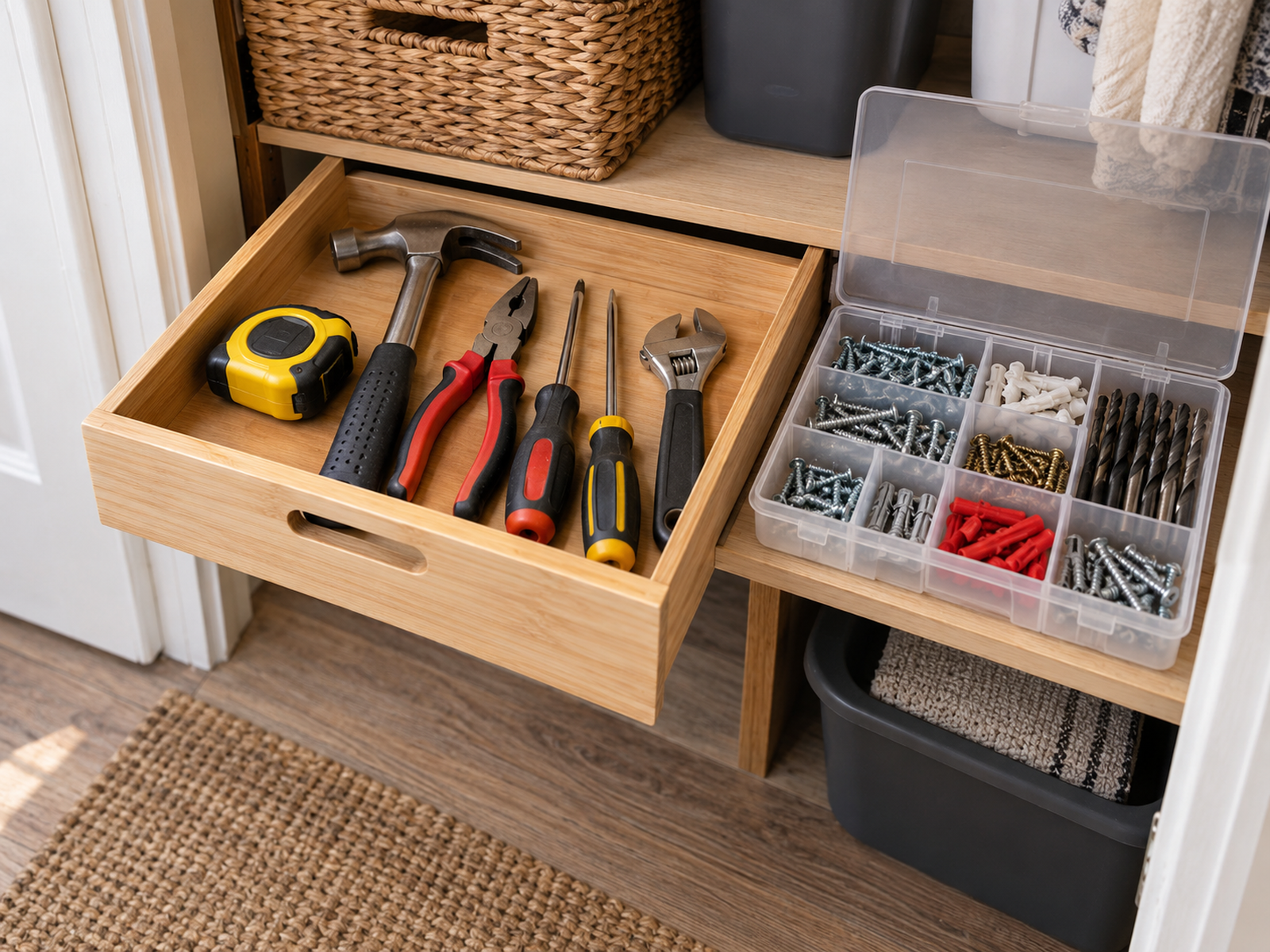
Use divided containment for screws, anchors, hooks, washers, bits, blades, fittings, and similar pieces. The number of compartments should follow your real categories, not the maximum number a box can offer.
Project and power-tool support
Keep the drill/driver, larger accessories, clamps, and project-specific pieces together enough that they can move to the work area without scattering across several rooms.
When one container is doing all three jobs, buying a larger version can simply create a larger black hole. Separating the categories first often improves access without increasing the total storage footprint.
Measure / Check First
Once you know what the system needs to hold, check the space that will store it before choosing a toolbox, drawer unit, cart, or modular stack.
Check the Parking Space and Retrieval Path
01
Measure the full stored footprint
Use the real width, depth, and height of the parking zone and compare them with the full external dimensions of the storage system, including handles, latches, or wheels that affect fit.
02
Trace the route to the repair
Make sure the loaded case, drawer unit, or cart can move through the actual doorway and around furniture without turning every retrieval into a furniture-moving project.
03
Test access in the stored state
Check whether you can reach the category you need without unloading the whole system. Stacked boxes, deep shelves, and high shelves can fit physically while still creating frustrating access.
A storage system that fits only when everything is perfectly stacked, lifted overhead, or unpacked in sequence will tend to migrate back onto the floor or a shared surface.
03
Choose the Storage Form by Retrieval Frequency
Maximum cubic capacity is not the same as useful capacity. In a small apartment, the best form is the one that matches how you retrieve the tools.
Portable toolbox or tool bag
Best for a modest household-core kit that needs to travel directly to the repair. It keeps the essentials together, but a large undivided interior can become difficult to search as the collection grows.
Compact drawer storage
Useful when direct access matters more than portability. Shallow drawers let you reach one category without unstacking boxes, which can work well in a closet, cabinet zone, or small freestanding footprint.
Modular portable boxes
Useful when different project categories need to travel separately. They work best when the stack has a real parking location and lower modules remain practical to reach. A modular system that keeps expanding can become garage-scale furniture inside the apartment.
Under-bed or low-furniture storage
Better for lower-frequency tools when a case can slide fully in and out without moving furniture. It is less convincing for the household-core kit if every five-minute repair starts with crawling under the bed.
Small mobile cart or rolling drawer unit
Useful when projects regularly take over a table or desk and the cart can support the work, then return to a legitimate parking position. The cart should not become permanent floor clutter simply because it has wheels.
Wall-mounted rails and pegboards can provide direct access, but they belong to a separate installation-required branch because renter permission, wall material, and fastening method can change the answer.
Whichever form you choose, leave some capacity for the actual categories you own rather than planning around a future unlimited collection.
04
Design for Two States: Working and Stored
In a compact home, the same dining table or desk may serve as a work surface for an hour and need to return to normal immediately afterward. That makes reset friction part of the storage problem.
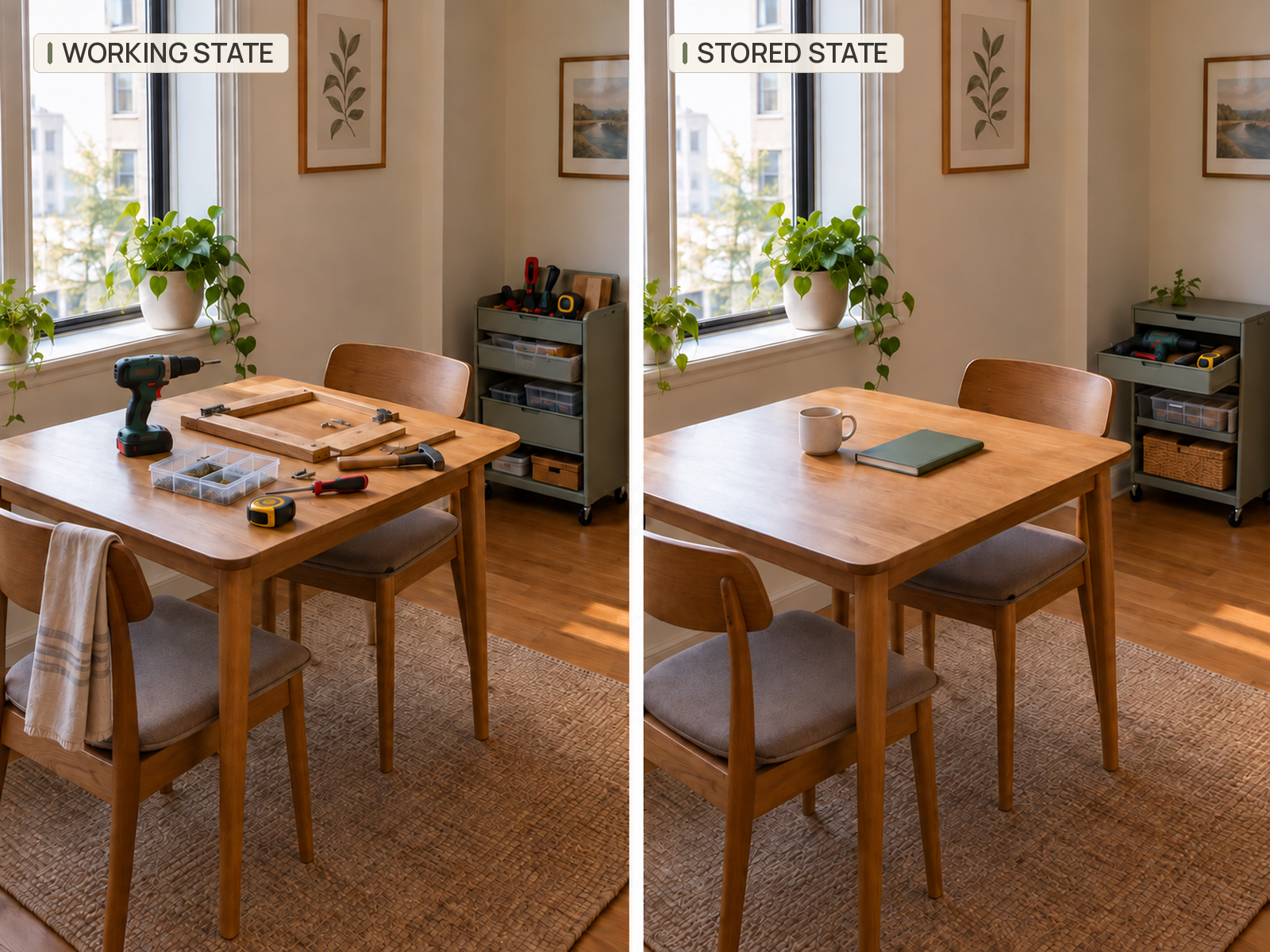
A useful system has two clear states:
- Working state: the core tools, project tool, and small-parts container can move to the task without opening every storage box in the apartment.
- Stored state: the tools return to their assigned containers, leftovers are either categorized or released, and the shared surface is usable again.
Keep small hardware contained during the job instead of letting screws, bits, and offcuts spread across the room. When the project ends, return tools directly to their storage categories rather than creating a temporary pile to sort later.
If a five-minute repair routinely leaves twenty minutes of cleanup, the storage system is adding friction instead of removing it. The return path should be almost as easy as the retrieval path.
05
Store Batteries and Chargers as a Separate Condition
Cordless-tool batteries change what counts as an acceptable storage location. The U.S. Consumer Product Safety Commission notes that battery and charger incidents can occur during use, storage, and charging, so battery care should not be treated as an afterthought. See the CPSC battery safety guidance.
Follow the current instructions for the battery platform you actually own rather than applying one generic rule to every lithium-ion pack. For example, DEWALT’s current battery guidance calls for cool, dry storage, avoiding liquids and extreme temperatures, checking for visible damage, and separating the battery from the tool for extended storage. Milwaukee likewise recommends storing its batteries at room temperature away from moisture when they are not in use.
That makes a dry indoor storage zone materially different from a damp balcony or wet utility area, even if the latter has more spare space. Keep chargers and batteries within the compatible system specified by the manufacturer, and check current recall information when relevant to the exact equipment you own.
Use / Skip
Should You Use Wall-Mounted Tool Storage?
Use
Use It When Installation Is Permitted and the Wall Earns the Job
A rail, pegboard, or mounted cabinet can provide excellent direct access when the lease or landlord permits the installation, the wall material is known, and the system can be mounted exactly as the manufacturer requires. It is most defensible when that wall area is genuinely better used for tools than for another high-value apartment function.
Skip
Skip It When the Mounting Method Is Uncertain
Vertical storage is not automatically renter-friendly. Serious wall systems commonly rely on screws, anchors, studs, or other structural fastening. For example, DEWALT’s current 48-inch metal rail is a fastened wall system, not a no-drill hack. If permission or mounting conditions are uncertain, keep the tool system portable, freestanding, or inside existing storage instead.
Closing Decision
Give Every Tool a Reason to Earn Apartment Space
A strong apartment tool system is easy to retrieve, easy to carry to the task, and easy to reset. If you have to unstack several boxes, dig through mixed hardware, or leave the kit on the dining table because putting it away is too difficult, the storage problem is still active.
Keep the household core close, separate small parts, give project tools a defined layer, and treat batteries and mounted systems according to their real requirements. When the collection no longer fits that compact maintenance system, reducing or relocating some of it may solve the apartment problem better than adding another organizer.
RELATED GUIDES
What to Read Next
NEXT GUIDE
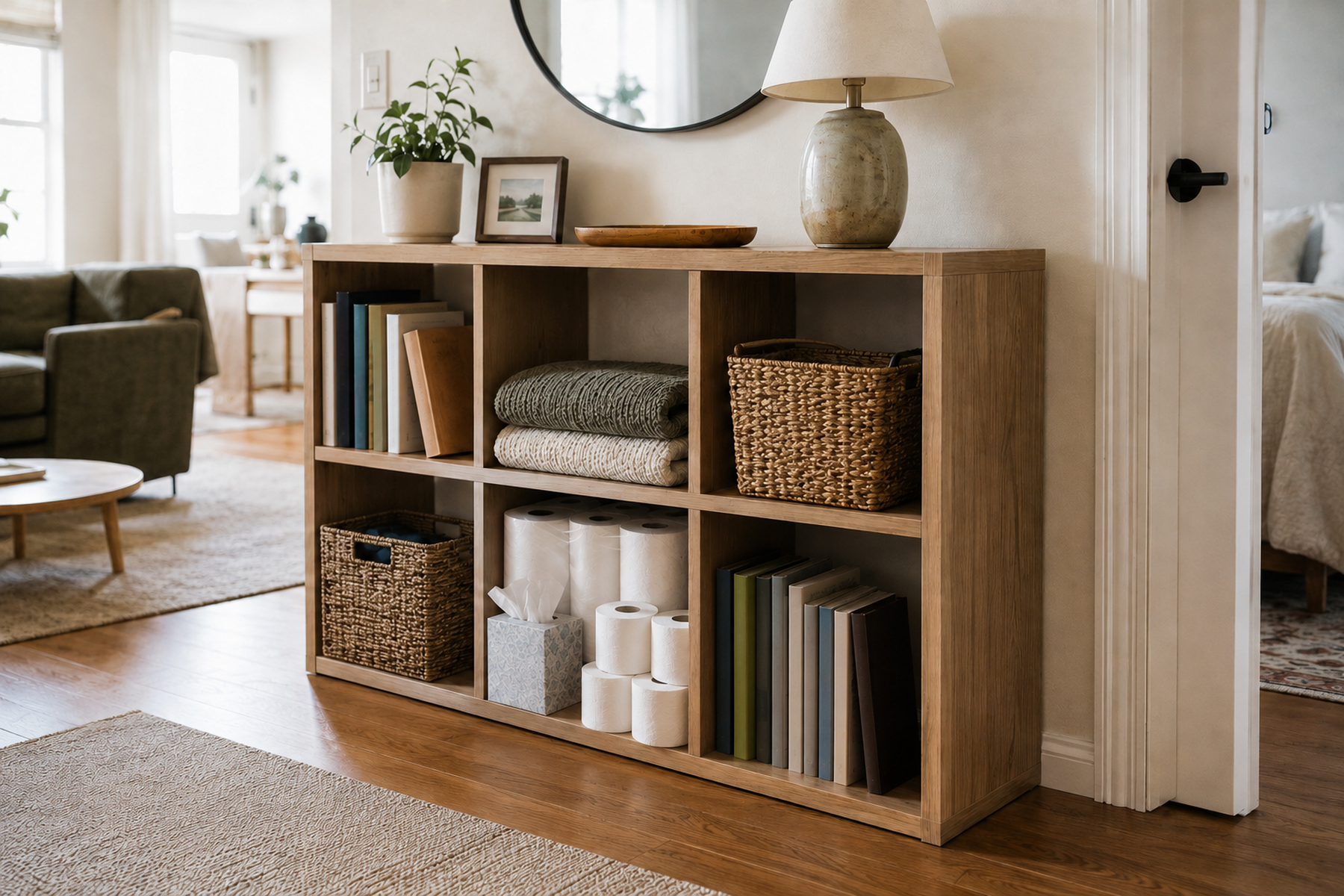
How to Store Household Backstock in a Small Apartment With No Storage Closet
Use this next if spare household supplies are competing with the same closets and cabinets; it helps assign backstock without letting one category take over scarce storage.
GUIDE
How to Store a Broom, Mop, and Vacuum in a Small Apartment With No Utility Closet
This is useful when cleaning equipment shares the same limited storage zone and needs its own access, shape, and reset logic.
GUIDE
How to Organize Miscellaneous Small Items When You Have No Junk Drawer
Use this for the separate overflow of everyday small items that can otherwise drift into the tool box and turn it back into miscellaneous storage.