
Small Apartment Storage Ideas
How to Organize Miscellaneous Small Items When You Have No Junk Drawer
Treat the junk drawer as a utility function rather than a piece of furniture: remove items that already belong to another system, group the true one-offs by next-use context, and keep the remainder inside one small, bounded storage zone that is easy to find and hard to overfill.
In This Guide
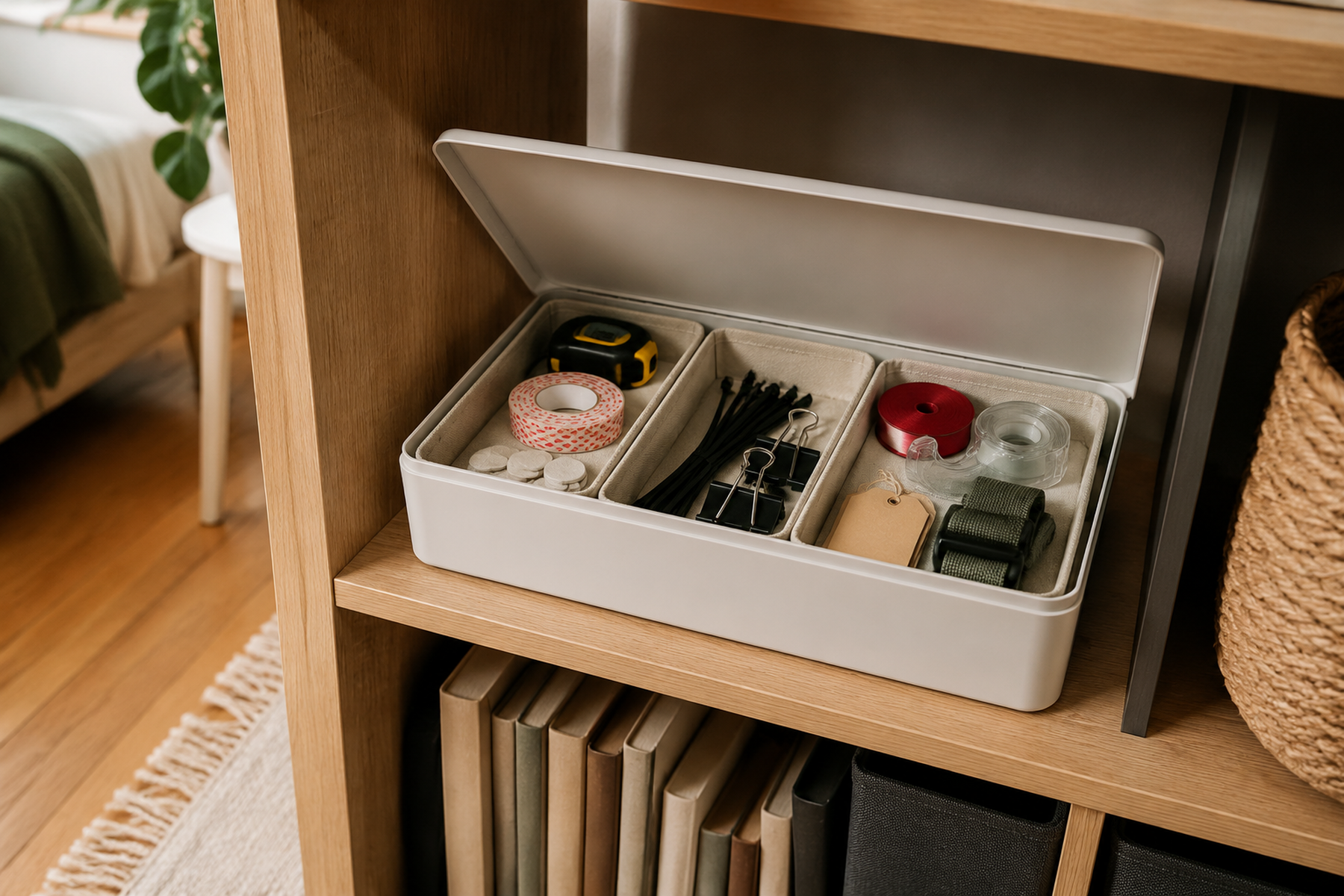
A junk drawer is useful because it gives small, legitimate household odds and ends one bounded utility zone. The problem in a small apartment is that there may be no spare drawer—and copying the drawer with a large tote or dozens of tiny containers can use more space than the objects themselves.
The better approach is to keep miscellany as a small exception. First remove anything that already belongs to paper, charging, bathroom, travel, backstock, or another established system. Then organize the true remainder by the next situation in which it will be used, not by forcing every one-off object into its own named category.
Quick Answer
Keep Miscellaneous Storage Small, Contextual, and Bounded
Remove anything that already belongs to a real category, group the true one-offs by the task or next use that connects them, and keep the result inside one shallow parent container before adding smaller organizers. If you need a temporary catch zone for undecided objects, keep it tiny and resolve it when it fills rather than letting it become a new junk drawer.
01
Remove misplaced category items first
Papers, active charging cables, toiletries, cleaning refills, and other known categories should return to their existing systems before a miscellaneous box is created.
02
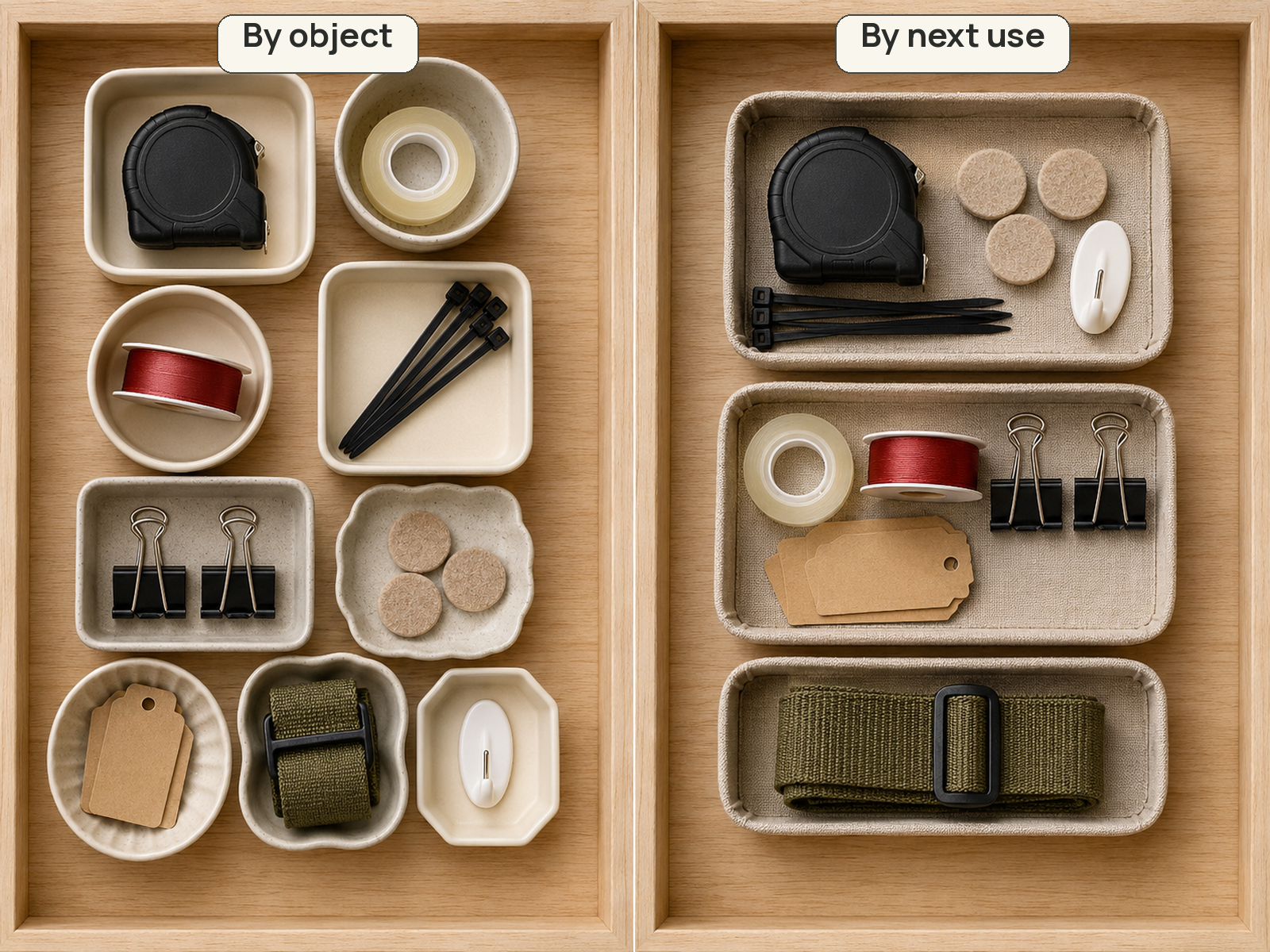
Group the real one-offs by next use
A measuring tape and furniture felt pads may belong together because they are used during household setup, even though they are not the same object type.
03
Use one parent container before many tiny organizers
A shallow box, caddy, or shelf bin can hold a few compact micro-kits without letting the organizers outgrow the items.
01
Remove Items That Already Have a Real Home
The miscellaneous zone should be the remainder after obvious categories have been removed—not the first destination for anything that is small.
Move papers into the paper system, active charging cables into the charging zone, persistent workstation cables into cable management, toiletries into bathroom storage, and replacement supplies into backstock when those systems already exist.
This keeps the utility box from becoming a place where unfinished organizing decisions disappear. The goal is not zero miscellany; it is bounded miscellany.
If an item already has a credible category elsewhere in the apartment, using that category is usually more space-efficient than creating a second duplicate home inside a catch-all.
02
Group True One-Offs by Next Use
One-off objects are often hard to organize because the object type is too specific to create a useful category.
Instead, ask what you will be doing the next time you need the item. Furniture felt pads, a small measuring tape, and the spare fasteners for a known piece of furniture can form a household setup or adjustment group. A travel adapter, luggage accessory, and empty travel bottle can form a travel group.
This works because the items share a future task even when they do not share a shape, material, or product category.
Do not force weak relationships. A travel adapter, spare button, furniture pad, and roll of tape do not become a useful kit simply because they all fit in one pouch.
03
Build Micro-Kits Only Around Real Tasks
A micro-kit is useful when several small items are likely to be retrieved together or during the same routine.
Good examples include a compact travel-accessory pouch, a furniture-care pouch, a gift-wrap accessory pouch, or a small tech-spares pouch for adapters that are not part of the active charging setup.
Keep the kit physically small and give it one clear purpose. The moment a pouch starts accepting unrelated items merely because there is room, it has become another junk container.
Repeated one-offs are also a signal. If the same kind of future task keeps producing new small pieces, graduate that group into a named micro-kit instead of adding more items under the label “misc.”
04
Choose Visibility by Frequency
Not every small item benefits from being hidden, and not every useful object needs to remain on display.
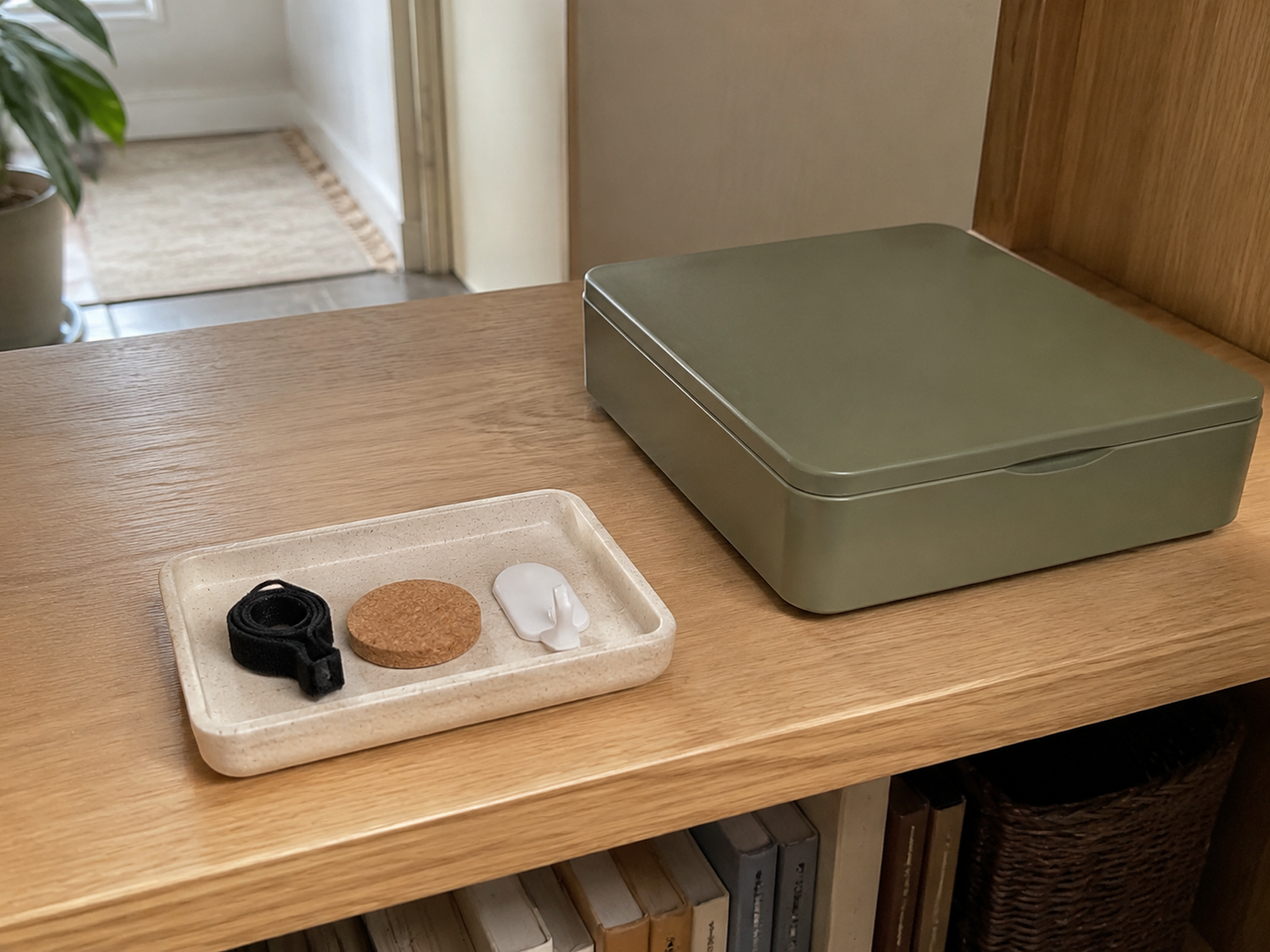
Frequently used utility items can live in an open caddy, a shallow visible tray, or an easy-reach shelf. Rare but legitimate one-offs can live in a labeled lidded box or a closed cabinet where they do not create visual noise.
If hidden storage makes a household repeatedly forget what it owns, use a more visible form or clearer labels. If open storage makes the apartment feel busy, use a closed parent box while keeping the internal groups easy to identify.
Visibility is a resource. Spend it on items that benefit from fast access or reminder value rather than treating transparent or open storage as universally better.
05
Use One Shallow Parent Container
Small miscellaneous objects are easy to lose in deep storage, so the strongest parent container is usually shallow enough to scan without digging.
Current IKEA KUGGIS boxes verify the form: one small version is 5 × 7 × 3 1/4 inches, and a larger shallow version is 7 × 10 1/4 × 3 1/4 inches. Those dimensions are product-specific; the useful general principle is shallow, bounded, and shelf-compatible.
Inside one parent box, a few pouches or a compartment insert can separate genuine micro-kits without requiring a shelf full of standalone organizers. IKEA also currently sells a five-compartment KUGGIS insert that demonstrates this one-footprint approach.
Do not maximize capacity simply because the box can stack or hold more dividers. Frequently used utility storage should be easy to open and return; low-frequency boxes can tolerate an extra retrieval step.
06
Reuse Existing Pouches and Boxes Before Buying Organizers
This category has unusually strong no-buy potential because the items themselves are small.
Before buying matching containers, test a toiletry pouch, small gift box, spare zip pouch, existing drawer insert, or another clean container already in the apartment. Assign it to one real context and see whether the contents remain stable and findable.
A portable caddy can also work when the items are used in several rooms. IKEA’s current STACKSTOD organizer is one verified example of the form, with an integrated handle and multiple compartments; the point is portability, not that this exact product is required.
Portability should follow a routine. A caddy for light household setup items or hobby accessories can make sense. A caddy that accepts every random small object in the apartment simply becomes a wandering junk bucket.
07
Keep the Catch Zone Temporary
Undecided small objects still need somewhere to land while you decide whether they belong to an existing system, a micro-kit, or nowhere at all.
Create one tiny catch zone: a shallow tray, a small open box, or one open pocket in the utility caddy. Its job is intake, not permanent storage.
Do not invent a universal review schedule. Use the physical boundary instead. When the catch zone is full enough that new items no longer have a clear landing place, resolve the contents before anything else is added.
If the same kind of item repeatedly lands there, that repetition is useful information. Graduate the pattern into a real micro-kit or existing category instead of allowing the catch zone to become a permanent archive.
08
Separate Shared Utility Items From Personal One-Offs
In a shared apartment, ownership can be the first split when searching becomes a recurring problem.
Shared household tape, a measuring tape, or furniture setup accessories do not necessarily need to live with one person’s travel accessories, hair items, or personal pouches.
Keep the total system compact: one shared utility parent box plus small personal pouches can be enough. Do not duplicate the same general-purpose supplies in several rooms simply to make ownership visually symmetrical.
Safety-sensitive categories should remain outside this general system. Medications, household chemicals, batteries, important documents, and other items with their own storage, labeling, or access requirements should not be folded into a miscellaneous catch-all merely because they are small.
09
Use the Container as the Capacity Stop Rule
The miscellaneous system should remain physically small enough that it does not become a substitute storage room.
Use the parent box, caddy, or small shelf zone as the capacity signal. When it is full, do not automatically add a second misc box, a larger tote, or another shelf.
Instead, reclassify the contents. A recurring group may deserve its own real storage job; a duplicate may belong in backstock; an object may already have a better existing home; an item that no longer earns space may leave the system.
If miscellaneous storage starts requiring several large bins, multiple shelves, or its own piece of furniture, the problem is no longer true miscellany. The contents need new categories, not more miscellaneous capacity.
Closing Decision
Replace the Junk Drawer With a Small Utility System
A junk drawer is a useful function, but it does not have to be a literal drawer. In a small apartment, one shallow parent box, a few purposeful micro-kits, and one tiny temporary catch zone can give legitimate one-off items a reliable home without turning the organizers into the largest part of the system.
Remove obvious category items first, group the real remainder by next use, choose visibility by frequency, and let the container itself set the capacity boundary. When the utility zone keeps expanding, stop adding boxes and reclassify what is inside.
RELATED GUIDES
What to Read Next

NEXT GUIDE
How to Store Household Backstock in a Small Apartment With No Storage Closet
Use this next if the miscellaneous box is filling with duplicate refills or replacement supplies; those items are reserve inventory and usually need a separate backstock system.
GUIDE
How to Organize Paper on a Small Desk Without a Filing Cabinet
Use this if warranties, receipts, instructions, or loose documents are drifting into the utility box even though they belong in a paper system.
GUIDE
How to Create a Multi-Device Charging Zone on a Small Desk
If active charging cables and adapters are taking over the miscellaneous zone, this guide separates the daily charging workflow from true tech spares.