
Small Kitchen Organization
How to Store Kitchen Knives in a Small Kitchen With No Drawer Space
Start with who needs access to the knives, then choose between a small countertop footprint, secure wall storage, or protected cabinet storage so the prep surface stays usable without treating sharp tools like ordinary utensils.
In This Guide
- Decide Household Access Before Storage Surface
- Reduce the Prime Knife Set Before Adding Storage
- Keep Specialty Knives Out of the Prime Access Zone
More
- Decide Household Access Before Storage Surface
- Reduce the Prime Knife Set Before Adding Storage
- Use Protected Cabinet Storage When Counter and Wall Space Are Off-Limits
- Use a Slim Counter Block When a Small Footprint Is Acceptable
- Use a Wall Magnetic Strip Only When Mounting and Access Both Work
- Keep Specialty Knives Out of the Prime Access Zone
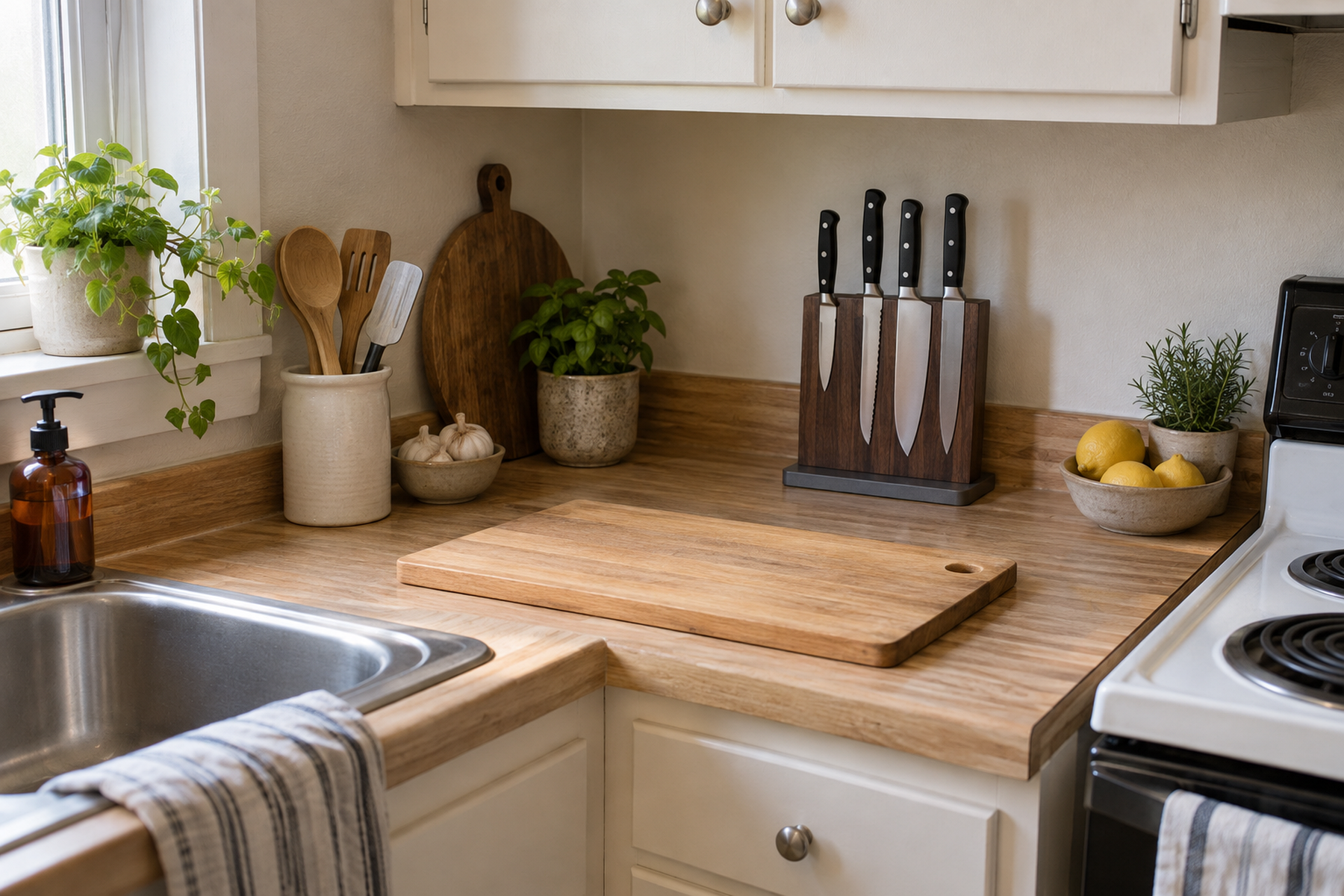
Kitchen knives are not ordinary utensils. A storage system has to reclaim scarce space while also keeping blades separated or protected, keeping the knives stable in their intended holder, and matching the access needs of the household.
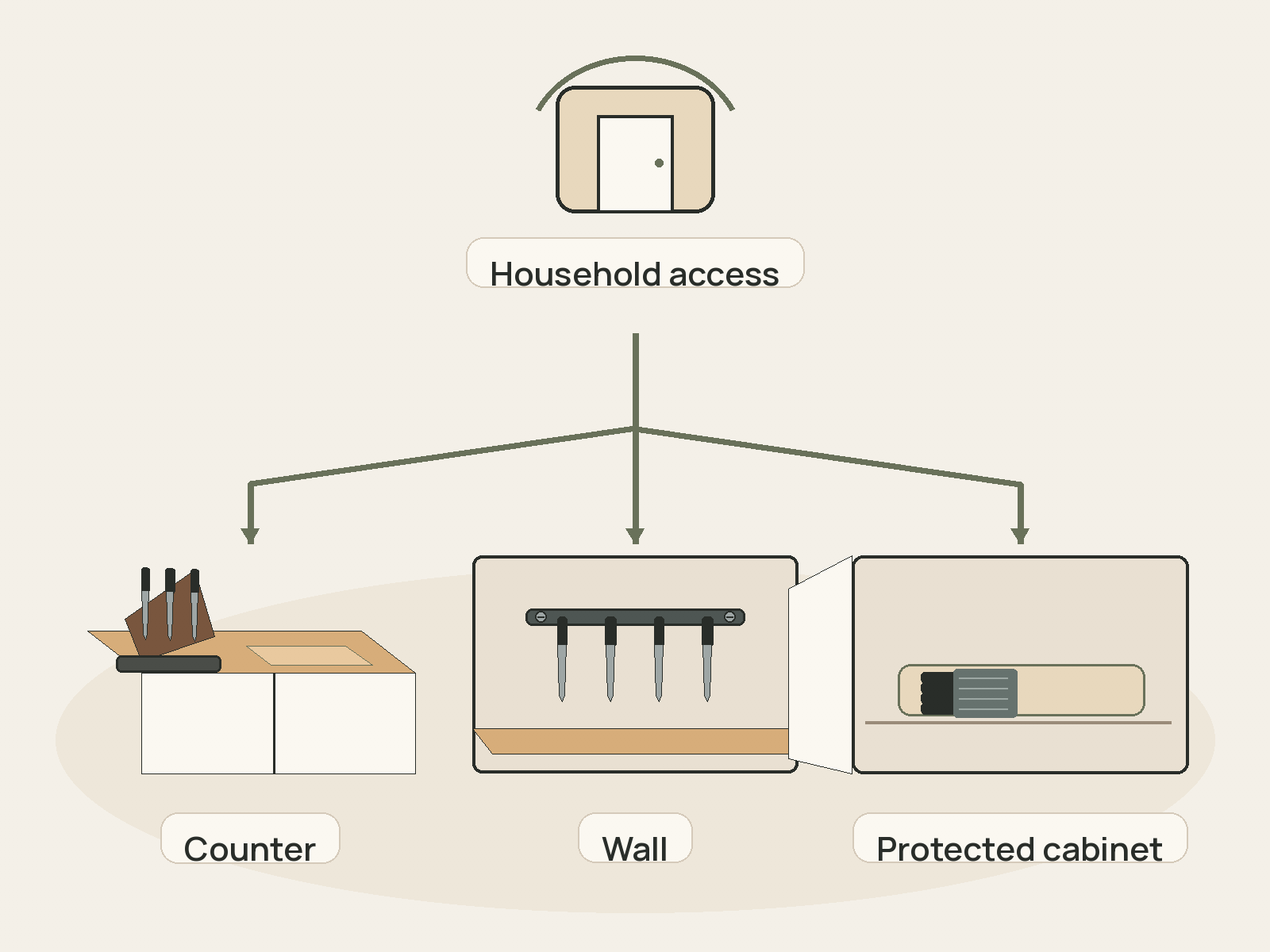
That changes the order of the decision. Instead of starting with the organizer that saves the most counter space, start with household access, then identify which surface is actually available: counter, wall, or protected cabinet. Only after that should you compare blade fit, mounting burden, and everyday retrieval.
Quick Answer
Choose the Knife Storage Surface by Access, Space, and Installation
01
Put household access first
If young children are present, prioritize controlled cabinet or drawer access with appropriate safety devices rather than assuming exposed knife storage is acceptable because it is high or visually tidy.
02
Use the wall only when secure mounting is realistic
A magnetic strip can recover both drawer and counter space, but it needs a compatible wall, secure installation, knife compatibility, and an appropriate removal and return path.
03
Use protected cabinet storage when you have no safe wall or counter zone
Fitted blade guards or another designed blade-separation system can turn cabinet space into a renter-friendly knife zone without leaving bare blades loose in a mixed bin.
04
Keep only the daily set in premium reach
Rarely used or specialty knives can move to a protected secondary case, roll, or cabinet zone so the main storage system is sized around the knives the household actually uses.
01
Decide Household Access Before Storage Surface
The first question is not whether a magnetic bar looks cleaner than a knife block. It is who should and should not be able to reach the knives. That household constraint can eliminate an otherwise efficient storage method before space planning even begins.
For households with young children, current U.S. Consumer Product Safety Commission guidance recommends safety latches and locks on cabinets and drawers to help prevent access to knives and other sharp objects. CPSC also notes that these devices need correct installation and re-engagement and that no device is completely childproof.
That means an exposed wall strip should not be described as child-safe simply because it is mounted high. If controlled access is necessary, start with an appropriate cabinet or drawer zone and build blade protection inside that zone.
In an adult-only household with appropriate access conditions, exposed magnetic or countertop storage can remain in the decision set. The correct path depends on the actual home rather than one universal ranking.
02
Reduce the Prime Knife Set Before Adding Storage
Separate the knives used routinely from specialty or occasional pieces before sizing a block, strip, sheath system, or cabinet container. The goal is not to prescribe a minimalist knife count; it is to stop rarely used knives from dictating the footprint of the everyday storage zone.
A bulky block can feel unavoidable when it is sized around every knife in the collection. The same household may need only a smaller daily-access system if carving, specialty, or backup knives are stored safely elsewhere.
This split also improves reset clarity. Each daily knife has a known home, while the secondary group can tolerate slower access because it is not part of every meal-prep cycle.
Measure / Check First
Before buying a knife block, magnetic strip, sheath set, or drawer organizer, verify the storage surface and the actual knives together.
Check Access, Fit, and Installation Before You Commit
01
Household access
Decide whether exposed knife storage is appropriate for the household. If young children are present, prioritize controlled cabinet or drawer access with properly installed safety devices rather than inventing a universal safe wall height.
02
Knife and holder compatibility
Check blade length, width, material, and the exact fit rules of the block, sheath, bar, or organizer. Do not assume every knife is magnetic or that every guard fits every blade.
03
Storage surface and mounting method
Measure the real counter, cabinet, drawer, or wall zone and verify the exact installation instructions, support, clear hand path, and renter limitations. A wall-mounted bar and an adhesive product are separate evidence classes.
If the storage method saves space only by weakening access control, leaving blades unprotected, relying on unverified mounting, or consuming another scarce zone the kitchen needs more, choose a different surface.
03
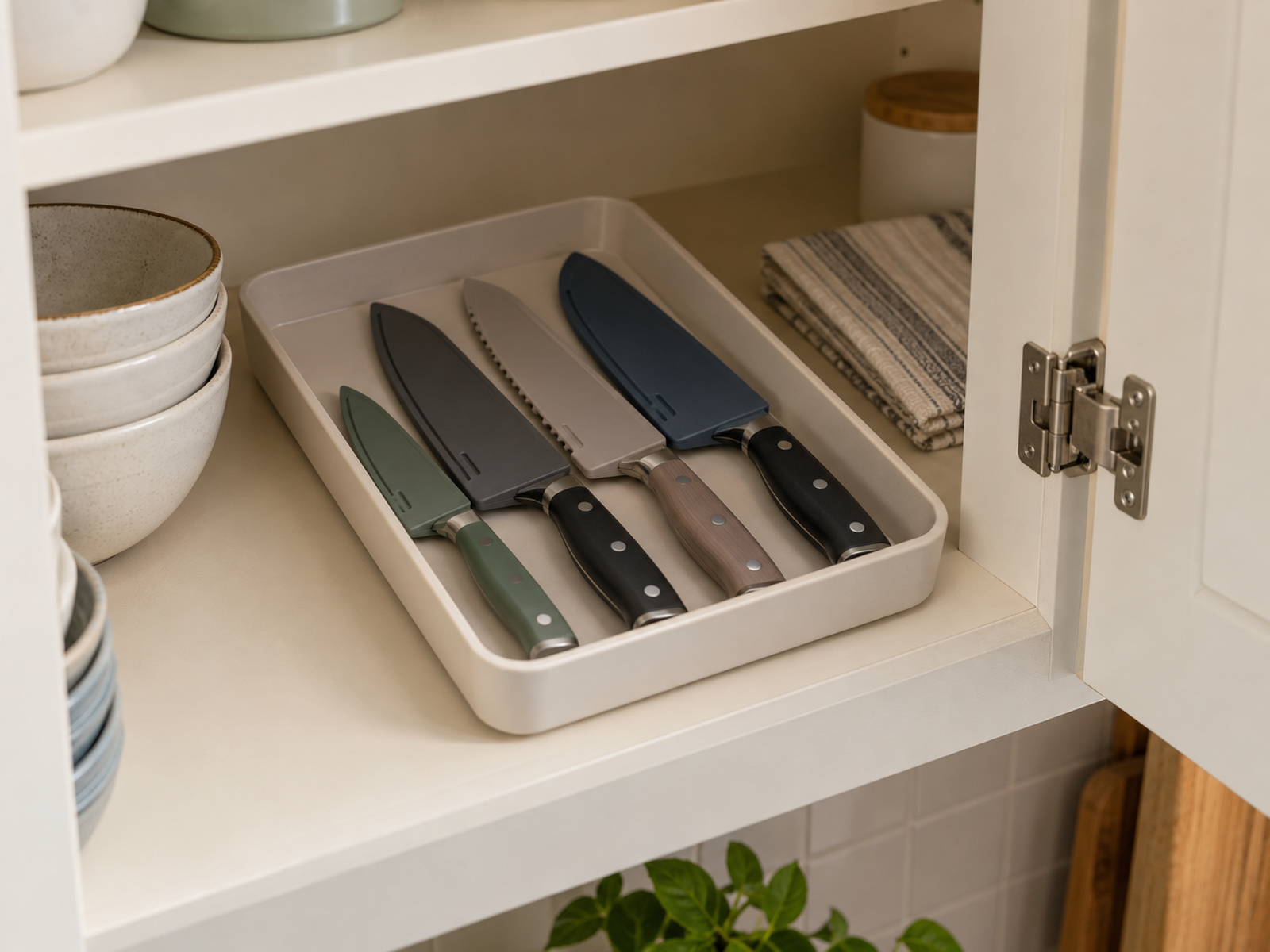
Use Protected Cabinet Storage When Counter and Wall Space Are Off-Limits
When there is no usable knife drawer, no acceptable wall installation, and no counter space worth sacrificing, an existing cabinet can become the primary knife zone—but only if the blades are deliberately protected or separated.
Individual sheaths are one practical form. ZWILLING currently sells fitted knife sheaths and describes them as providing added safety and helping prevent blade scratching. The important word is fitted: a guard has to match the actual blade length and profile rather than act as a one-size-fits-all sleeve.
Store protected knives in one defined container, rack, or shelf position instead of dropping them into a mixed utensil bin. The user should be able to identify and remove one knife without blindly handling several other blades.
If young children are present, this cabinet branch can be paired with an appropriate latch or lock according to the product instructions and CPSC guidance. Blade protection and access control solve different problems; one does not replace the other.
04
Use a Slim Counter Block When a Small Footprint Is Acceptable
A countertop block is not automatically a poor small-kitchen choice. Its weakness is permanent counter footprint, so the useful question is whether a much smaller footprint can fit without cutting into the prep zone.
ZWILLING’s current Birch magnetic block is one example of the compact form. It measures about 9.06 inches long, 3.94 inches wide, and 10.83 inches high and is designed for up to eight knives as specified by the manufacturer.
That does not make this exact product the default recommendation. It shows that countertop knife storage can be materially slimmer than a large traditional block while remaining fully freestanding and avoiding wall modification.
Check the full base, not only the narrowest dimension. The block should sit completely supported, stay stable during knife removal, and occupy a counter strip that the kitchen can genuinely spare without narrowing the main prep area.
05
Use a Wall Magnetic Strip Only When Mounting and Access Both Work
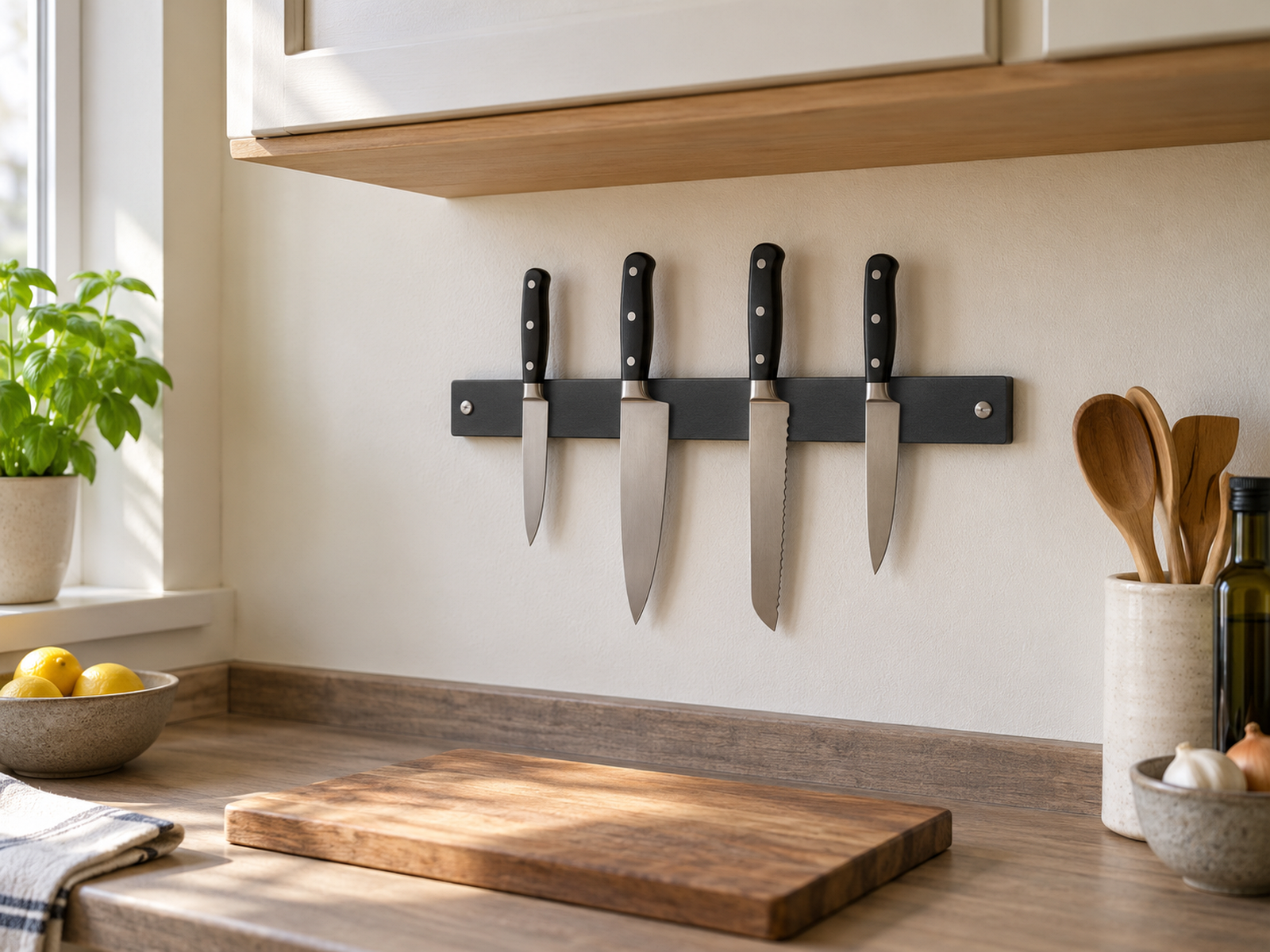
A securely mounted magnetic knife strip can recover the most counter space because it moves daily knives onto the wall and keeps them visible. It is also the solution with the clearest installation and household-access burden.
IKEA’s current HULTARP magnetic knife rack is a useful example of that distinction. IKEA lists the bar at 15 inches long and specifies wall mounting with suitable screws or fittings, with screws sold separately. IKEA also warns that the product must be securely anchored to reduce the risk of it falling.
That is why a wall strip should not be described as a generic renter-friendly hack. The wall material, fasteners, lease or landlord rules, exact knife compatibility, and clear hand path all need to work.
Do not assume every knife belongs on a magnetic bar. Blade materials vary, and some ceramic or otherwise non-magnetic knives will not work with ordinary magnetic storage. The exact knife and storage-system guidance control.
06
Reassign a Drawer Only When the Trade Is Worth It
The target kitchen may have no usable drawer space, but sometimes that means every drawer is occupied rather than no drawer exists at all. In that case, deliberately moving a lower-priority category can create a valid knife drawer.
An in-drawer organizer can recover the entire counter footprint and keep knives out of view, but it consumes premium shallow storage. ZWILLING’s current wooden in-drawer organizer, for example, is about 15.94 inches long, 6.14 inches wide, and 1.85 inches high and is designed for up to 12 knives within its specified blade-length ranges.
Use this branch only when the drawer can be reassigned without creating a worse storage problem elsewhere. A kitchen that truly has no appropriate drawer should not be told to buy a drawer organizer simply because it is a common knife-storage category.
07
Keep Adhesive, Cabinet-Door, and Refrigerator Ideas Product-Specific
No-drill knife storage is attractive because it appears to solve both renter restrictions and counter pressure at once. The failure consequence is higher than with a lightweight utensil hook, so generic adhesive advice is not enough.
Only consider adhesive mounting when an exact manufacturer verifies that the product is intended for knives, supports the relevant load, is compatible with the exact surface, and provides current installation and removal instructions.
Treat cabinet-door, cabinet-side, and refrigerator-side magnetic ideas the same way. Door motion, hinge load, collisions, surface material, release path, and secure mounting all vary. An empty surface is not evidence that it is a safe knife-storage surface.
If that product-specific evidence is missing, return to a freestanding or protected-cabinet solution rather than improvising an exposed-blade mount.
08
Keep Specialty Knives Out of the Prime Access Zone
A knife used once a month does not need the same premium location as the chef’s knife or utility knife used every day. Moving specialty pieces can reduce the size of the block, strip, or cabinet holder required in the main kitchen zone.
A fitted sheath, knife case, or roll can support that secondary storage strategy when the exact product fits the knives and the storage location itself remains appropriate. Current manufacturer knife-storage ranges include all of these forms.
The secondary zone should still be bounded and intentional. Moving rarely used knives into an unstructured cabinet pile only trades counter clutter for hidden handling risk.
When the active set changes over time, resize the premium storage around actual use rather than letting every knife automatically migrate back into the daily zone.
09
Test One-Hand Retrieval and a Deliberate Reset
Before calling the system finished, retrieve each daily knife and return it once. The motion should be deliberate, visible, and free of contact with other exposed blades.
Check that cabinet doors, upper cabinets, backsplashes, and nearby appliances do not force an awkward removal angle. Avoid locations that require reaching over an active cooking surface or handling knives blindly behind other stored items.
The return step matters as much as retrieval. If a sheath is difficult to match, a block slot is too tight, or a wall strip encourages knives to be left on the counter because the return motion is awkward, the system will not hold up in daily use.
The best small-kitchen knife system is not the one with the smallest theoretical footprint. It is the one that protects the prep surface, keeps each blade in a stable or protected home, matches household access needs, and is simple enough to reset every time.
Closing Decision
Choose the Safest Useful Surface, Not the Most Impressive Organizer
A small kitchen with no knife drawer has three practical storage surfaces: counter, wall, and protected cabinet. The right one depends first on household access, then on how much prep space the kitchen can spare, how the blades are separated or protected, and what installation the rental can support.
A slim freestanding block can be the cleanest no-install compromise when a narrow counter strip is available. A securely mounted magnetic bar can recover the most surface when the wall and household allow it. Protected cabinet storage with fitted guards can eliminate both counter and wall demands. Keep specialty knives out of prime reach, and judge the final system by safe access, usable prep space, and an easy return path.
RELATED GUIDES
What to Read Next
NEXT GUIDE
How to Organize a Small Kitchen With No Drawers—Without Losing Counter Space
Use this next if knives are only one part of a broader drawerless-kitchen problem and utensils, tools, and other everyday items still need renter-friendly homes without taking over the counter.
GUIDE
How to Store Small Kitchen Appliances Without Losing Counter Space
Use this if the knife system is solved but appliances are still consuming the prep surface; that guide handles which larger items deserve permanent counter space and which should move elsewhere.