
Small Kitchen Organization
How to Organize Spices in a Small Kitchen With Limited Cabinet and Drawer Space
Give prime space to the spices you actually reach for, check the storage conditions on the products you keep, then choose a drawer, cabinet, riser, turntable, bin, or small open zone that fits the real jar and packet geometry without taking over prep space.
In This Guide
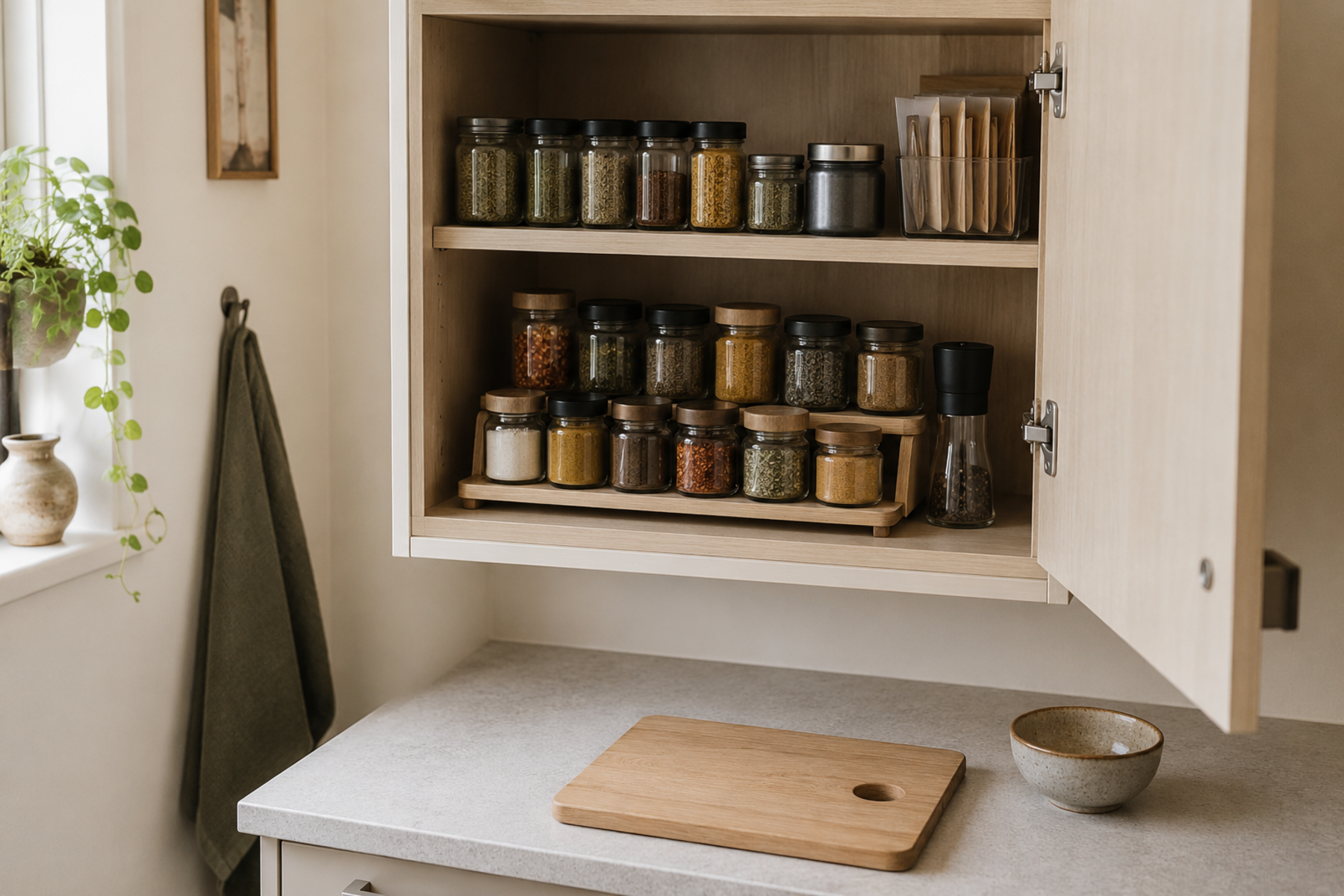
Spices can overwhelm a small kitchen without occupying much volume individually. The problem is the combination of high item count, mixed jar sizes, grinders, packets, duplicate refills, and the need to identify one product quickly while cooking.
The useful question is not which organizer holds the most jars. Decide which seasonings deserve the kitchen’s easiest access, rule out locations that conflict with the actual product’s storage directions, then match the remaining collection to the cabinet, drawer, or other bounded zone that makes retrieval and return easy.
Quick Answer
Give Prime Space to the Spices You Actually Use
Give frequent-use spices the best compatible access, move occasional and refill stock to secondary storage, and let the products’ actual storage directions rule out convenient but unsuitable locations. Measure the real jars, grinders, packets, drawer clearance, and cabinet opening first, then choose risers, turntables, bins, or inserts only when they genuinely improve loaded retrieval.
01
Split the collection by access frequency
Keep frequent and regular-use spices closest to the normal cooking workflow. Occasional, specialty, and refill stock can accept a secondary zone instead of consuming the same prime drawer or cabinet space.
02
Let product storage directions veto a convenient location
The closest spot to the stove is not automatically the best spot. Follow the exact package or manufacturer directions for heat, humidity, light, dryness, and closure before choosing the location.
03
Measure the awkward containers before buying hardware
Use the tallest grinder, widest jar, deepest tin, packet format, drawer closure height, and real cabinet opening to test the system. Advertised jar count does not prove loaded fit.
01
Decide Which Spices Deserve Prime Access
A small kitchen does not need every spice at the same access level.
Divide the active collection into frequent, regular, occasional or specialty, and refill or duplicate stock. The exact names do not matter; the point is to stop a rarely used jar from receiving the same prime storage as the seasonings used several times a week.
A broad spice collection can still be legitimate. This is not a minimalist-spice rule. It is a kitchen-capacity rule: the easiest drawer, cabinet shelf, or open zone should primarily serve the products that benefit most from fast retrieval.
Within each access tier, alphabetical order can be useful, especially in a shared kitchen. Frequency comes first because it determines which storage resource the tier deserves; alphabetical or cuisine-based grouping can then make that tier easier to scan.
02
Check Storage Conditions Before Choosing the Location
Convenience only matters after the location is appropriate for the product.
Current McCormick Culinary pages for Shaker Grind Black Pepper, Crushed Red Pepper, and Cinnamon Sticks specify cool, dry, tightly closed storage and direct users away from heat, humidity, direct sunlight, and fluorescent light. Those directions are product-specific, but they establish the correct planning rule: check the products you actually own before choosing the zone.
That can rule out an otherwise attractive spot beside the cooktop, in direct sun, or in a humid location. A counter rack is not automatically wrong, but it must pass both the product-storage test and the small-kitchen prep-space test.
Do not replace package or manufacturer guidance with a universal spice-storage rule or a generic shelf-life claim. The article’s job is to allocate kitchen space after the products’ actual storage conditions are respected.
03
Separate Jars, Grinders, Packets, and Refills by Geometry
One spice collection is usually several storage geometries disguised as one category.
Standard jars can stand in rows or on risers. Tall grinders may need more shelf or drawer clearance. Tins spend width differently. Flexible packets slump behind rigid containers. Large refill bags or bottles do not need the same prime access as the working jar.
Keep the categories together conceptually while allowing them to use different physical forms. Forcing packets into a jar rack or forcing a tall grinder into a low drawer creates wasted space and retrieval friction.
This also makes decanting easier to evaluate later. If mixed retail packaging is the only reason the collection cannot fit a strong storage zone, standardizing a subset may be useful. If the existing containers already fit and remain easy to identify, matching jars are optional maintenance rather than an organization requirement.
04
Measure the Real Containers and Storage Zone
Measure the loaded system before choosing the organizer.
Record the tallest active container, the widest or deepest jar, any grinder or packet that breaks the standard shape, and the real usable cabinet or drawer dimensions. Include shelf spacing, cabinet depth, opening width, hinges, face frames, drawer closure height, and the hand clearance needed to grip a jar.
A product can technically fit while still being difficult to use. A rear jar on a riser may be visible but impossible to grip because the shelf above sits too low. A drawer insert may fit the empty drawer but fail when the jar shoulders or lids hit the drawer above.
Use the largest common container to test the main system, then decide whether one unusual outlier deserves its own small zone instead of redesigning the entire spice storage around it.
Measure / Check First
After the active spice tiers are clear, test the real containers and the real kitchen zone before buying a drawer insert, riser, turntable, bin, or mounted rack.
Check the Loaded Fit, Not the Empty Organizer
01
Container envelope
Measure the tallest grinder, widest or deepest jar, and packet format that will live in the zone. Include lids, shoulders, and the grip space needed to pick the container up.
02
Usable kitchen geometry
Measure cabinet depth, opening width, shelf spacing, drawer closure height, hinges, face frames, and the clear path needed to remove the loaded organizer or rear jar.
03
Installation and location conditions
For mounted systems, verify screws, cabinet construction, door movement, shelf interference, and lease permission. For every location, confirm the actual spices can be stored there under their package or manufacturer directions.
If the system only fits when the rear jars cannot be gripped, the drawer cannot close, the cabinet door is overloaded, or the location conflicts with product storage directions, reject that form and use another kitchen resource.
05
Use a Drawer Only for the Tier That Earns It
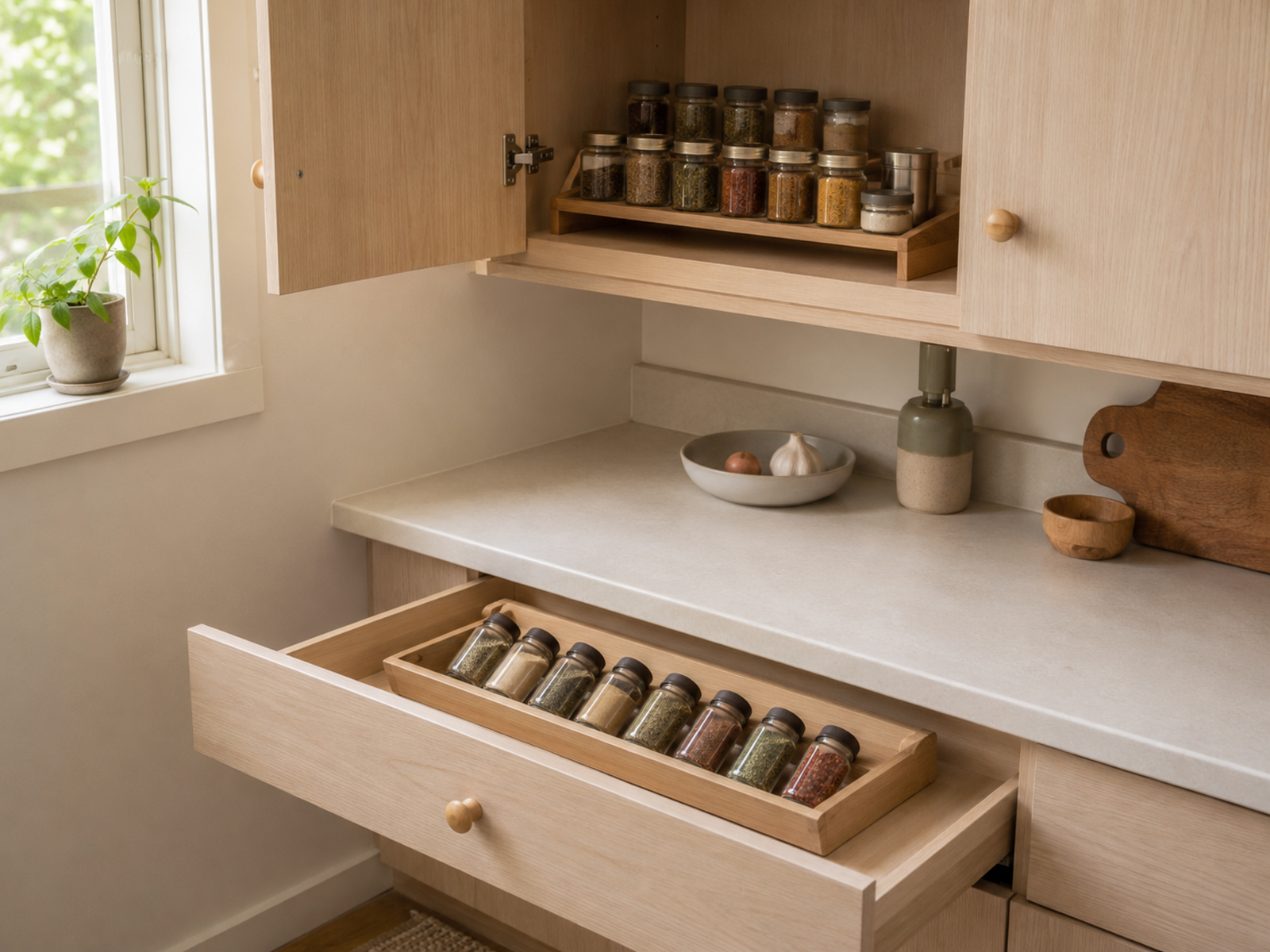
A shallow kitchen drawer can give excellent top-down visibility, but it is also one of the kitchen’s highest-value storage resources.
Use a spice drawer when the active jars fit below the real closure height and the household reaches for them often enough to justify spending that drawer on spices. A split system can be stronger than putting the entire collection there: frequent spices in the drawer, occasional spices in a cabinet or pull-forward bin.
Low-profile inserts can stabilize jars, but the insert dimensions are only one part of fit. IKEA’s current UPPDATERA spice rack is 3/4 inch high, 19 5/8 inches long, and 3 7/8 inches wide. Those dimensions verify the form factor, not whether a particular jar-and-drawer combination will close.
If the drawer is more valuable for utensils, prep tools, or another daily category, the spice collection has not failed. It simply needs to use a cabinet, bin, or other storage form that spends a less valuable kitchen resource.
06
Choose Risers, Turntables, or Bins by Retrieval
Visibility and retrieval are separate tests.
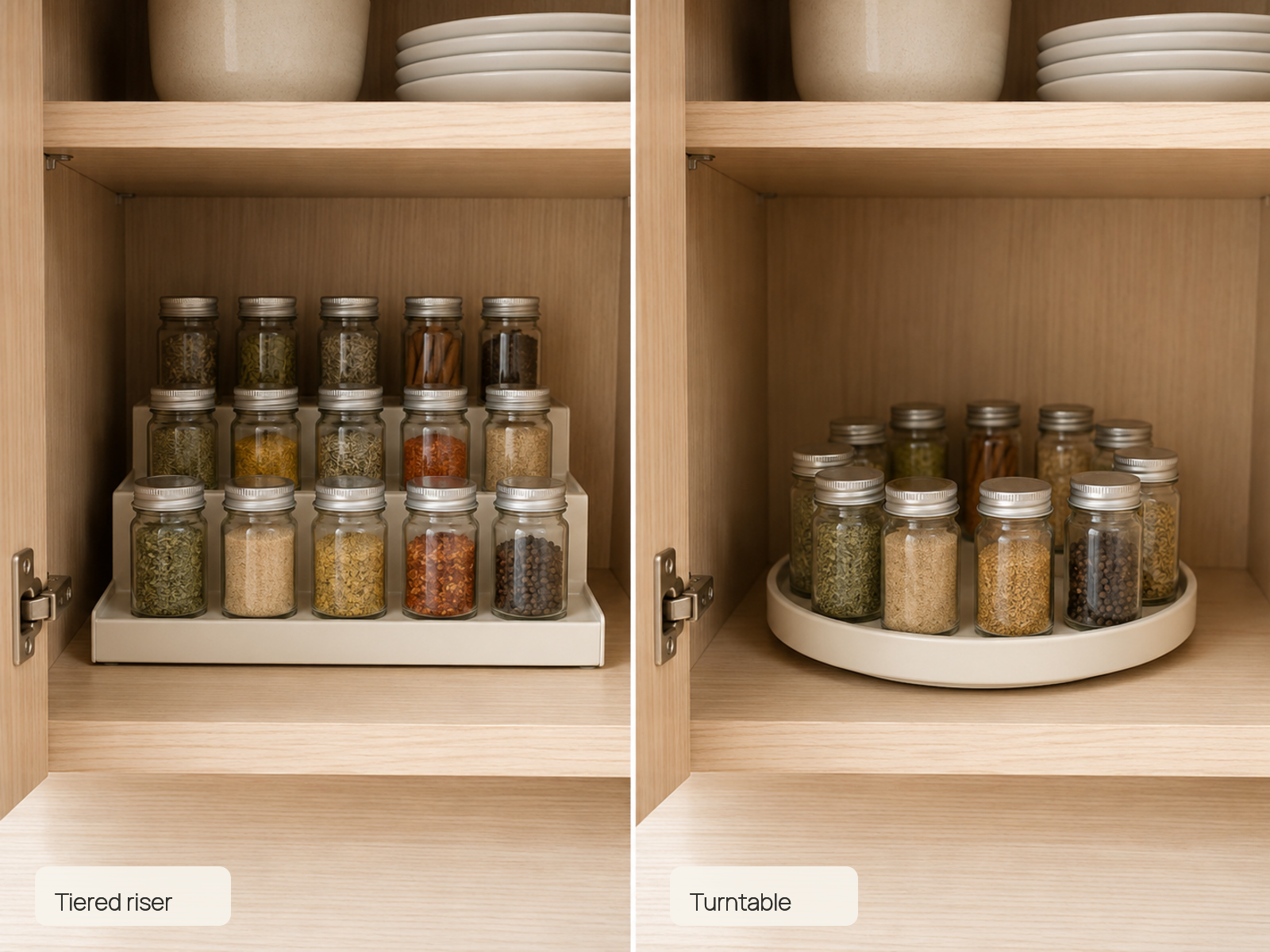
A tiered riser can expose labels across several rows, but it also spends vertical clearance. It works best when the shelf above leaves enough room to grip and remove the rear jars without knocking the front row.
A turntable can improve access when cabinet depth is the main problem because the rear items rotate forward. The trade-off is footprint: a circle sits inside a rectangular cabinet and may leave corner volume unused. A turntable is an access tool, not automatically the densest storage form.
Pull-forward shallow bins are stronger when the household wants to retrieve a whole category—such as baking spices, regional blends, or occasional seasonings—rather than scan every label at once. Keep the bin shallow enough that it does not become a rummage box.
07
Give Spice Packets Their Own Micro-Zone
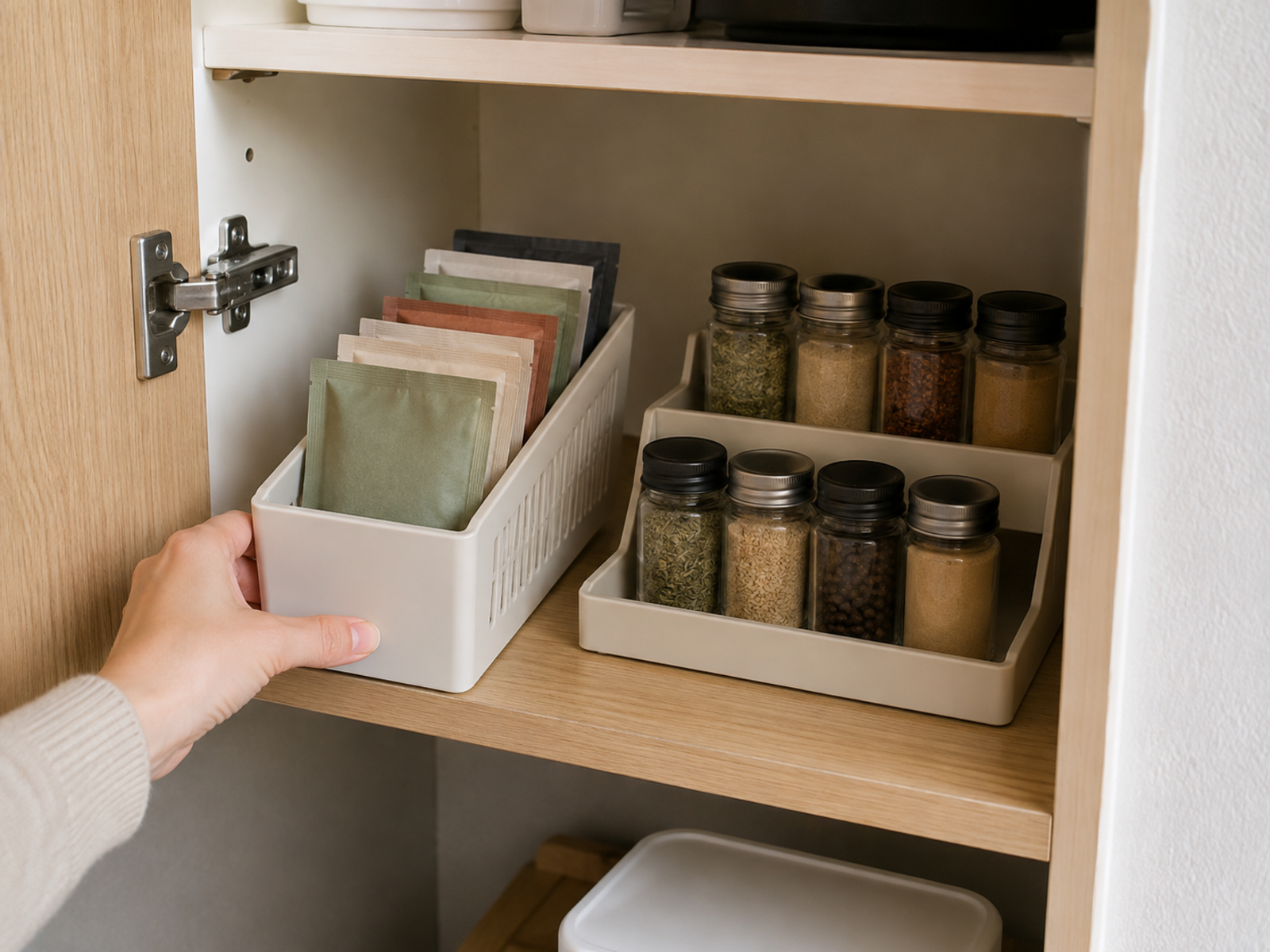
Packets fail jar systems because they bend, slump, and disappear behind rigid containers.
Give packets one shallow upright file, narrow bin, or divided section near the rest of the spice collection. The goal is to keep the packet faces visible enough to identify without spreading them across the shelf.
Keep the packet zone bounded. If the bin becomes deep enough to hold several layers, the access problem returns in a different form.
Treat packets as a geometry family, not as an exception that must be converted into jars. Decanting a packet can be useful when it solves fit and identity, but it is not required simply to make the collection look uniform.
08
Keep Counter Storage to a Truly Active Subset
The counter is a valid storage location only when it still works as a counter.
A very small set of frequently used seasonings can live on a shallow freestanding rack if the location meets the products’ storage conditions and does not take over the kitchen’s useful prep surface.
For scale, IKEA’s current HUNDHAJ spice rack is 7 3/4 inches wide, 2 1/4 inches deep, and 2 1/2 inches high. A small form like this demonstrates how narrow an active subset can be, but it does not make every counter location appropriate.
Set a hard physical ceiling for visible spices. Once the rack or designated strip is full, additional jars should return to the cabinet or drawer rather than expanding across the chopping zone.
09
Decant Only When Standard Geometry Improves the System
Matching jars can make a mixed collection easier to fit, but they add ongoing work.
Decanting means transferring the product, labeling the new container clearly, managing refills, and preserving any information the household needs from the original package. That effort is worthwhile only when consistent jar geometry materially improves drawer closure, shelf density, labeling, or retrieval.
Do not decant simply because a uniform row photographs well. If original jars already fit the assigned zone and are easy to identify, the simpler system may be the better small-kitchen system.
When only a few awkward packages cause the problem, standardize that subset instead of rebuilding the entire spice collection around matching containers.
10
Keep Refills Secondary and Use the Capacity Stop Rule
The working spice collection and refill stock do not need the same access priority.
Keep active jars or packages in the main spice zone and move refill or bulk stock to one bounded secondary location that meets the product’s storage conditions. That prevents duplicate containers from consuming the same prime cabinet or drawer space.
When the active tier has been edited, the product-storage conditions are satisfied, and the chosen organizer has passed the loaded retrieval test, treat the assigned zone as the capacity boundary.
If the collection still exceeds that boundary, move the occasional tier to a secondary zone, choose a smaller package for rarely used products, or reduce duplicate inventory. Do not solve a prime-space problem by adding endless organizers to the counter, cabinet doors, or adjacent walls.
Closing Decision
Give Spices Prime Space Only When the System Earns It
A small kitchen does not need one perfect spice organizer. It needs a bounded active collection in a location that suits the products, with the most-used seasonings easy to retrieve and the occasional, packet, and refill tiers using storage forms that match their geometry.
Measure loaded clearance, treat drawers and counters as premium resources, and choose risers, turntables, bins, or inserts by the retrieval problem they actually solve. When the assigned zone is full, move the occasional tier or reduce duplicate and refill stock instead of letting spices take over another high-value part of the kitchen.
RELATED GUIDES
What to Read Next
NEXT GUIDE
How to Organize a Deep Corner Kitchen Cabinet With a Narrow Opening
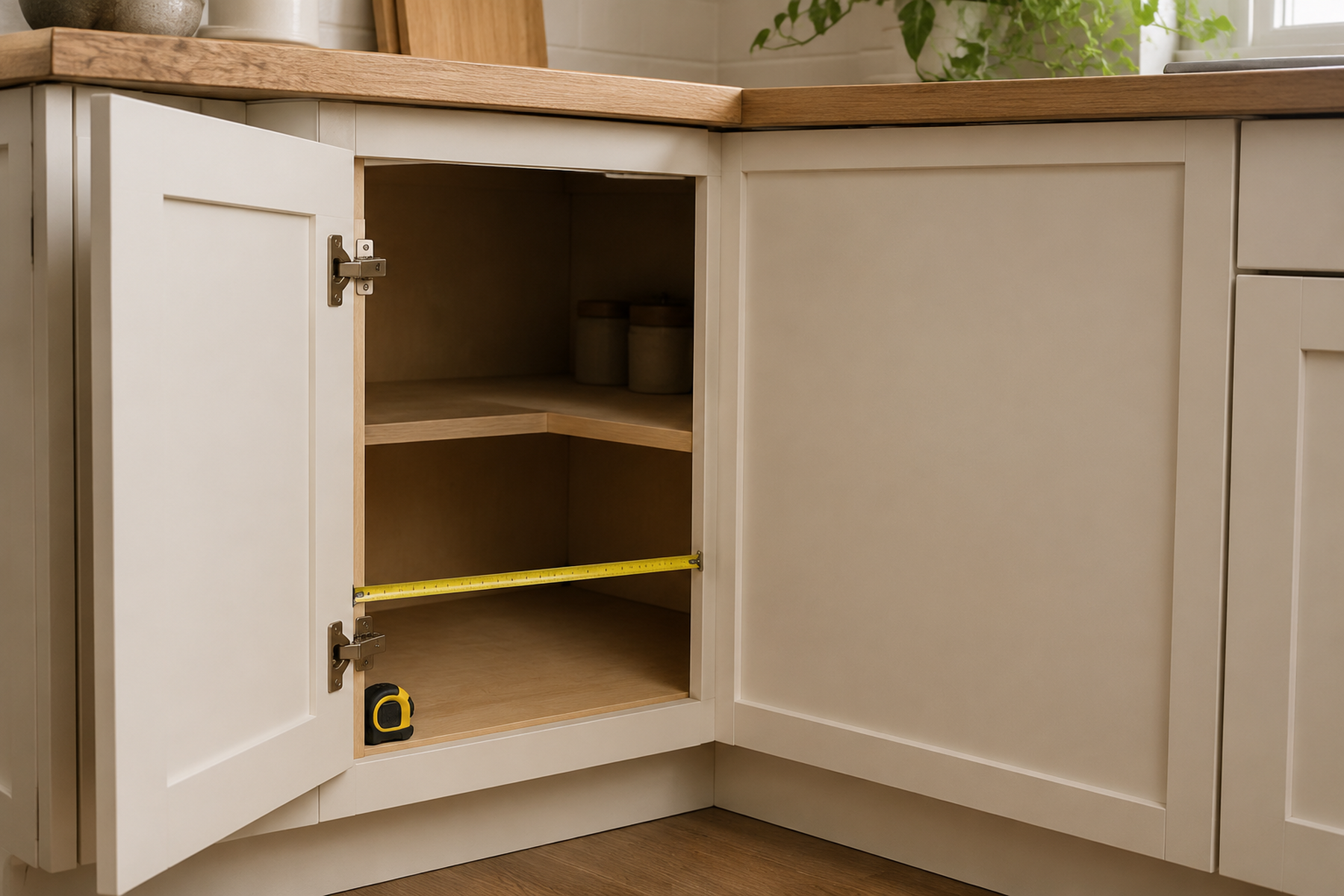
Use this next if the spice collection fits the cabinet in theory but depth, corners, or a narrow opening still make the rear jars hard to retrieve.
GUIDE
How to Organize a Small Kitchen With No Drawers—Without Losing Counter Space
Use this if a frequent-use spice drawer would be ideal but the kitchen has no usable drawers and the alternative must not spill onto the prep counter.
GUIDE
How to Organize Water Bottles and Tumblers in a Small Kitchen Cabinet
If spices now have a clear capacity boundary but mixed drinkware is still consuming an outsized share of cabinet space, this guide applies the same geometry-first logic to bottles and tumblers.