
Small Kitchen Organization
How to Organize a Deep Pantry Cabinet So Food Does Not Get Lost in the Back
Treat pantry depth as an access problem, not a capacity advantage. Give the back of each shelf a simple path to the front, separate everyday stock from backstock, and choose bins, turntables, risers, or installed pull-outs based on how the category actually needs to move.
In This Guide
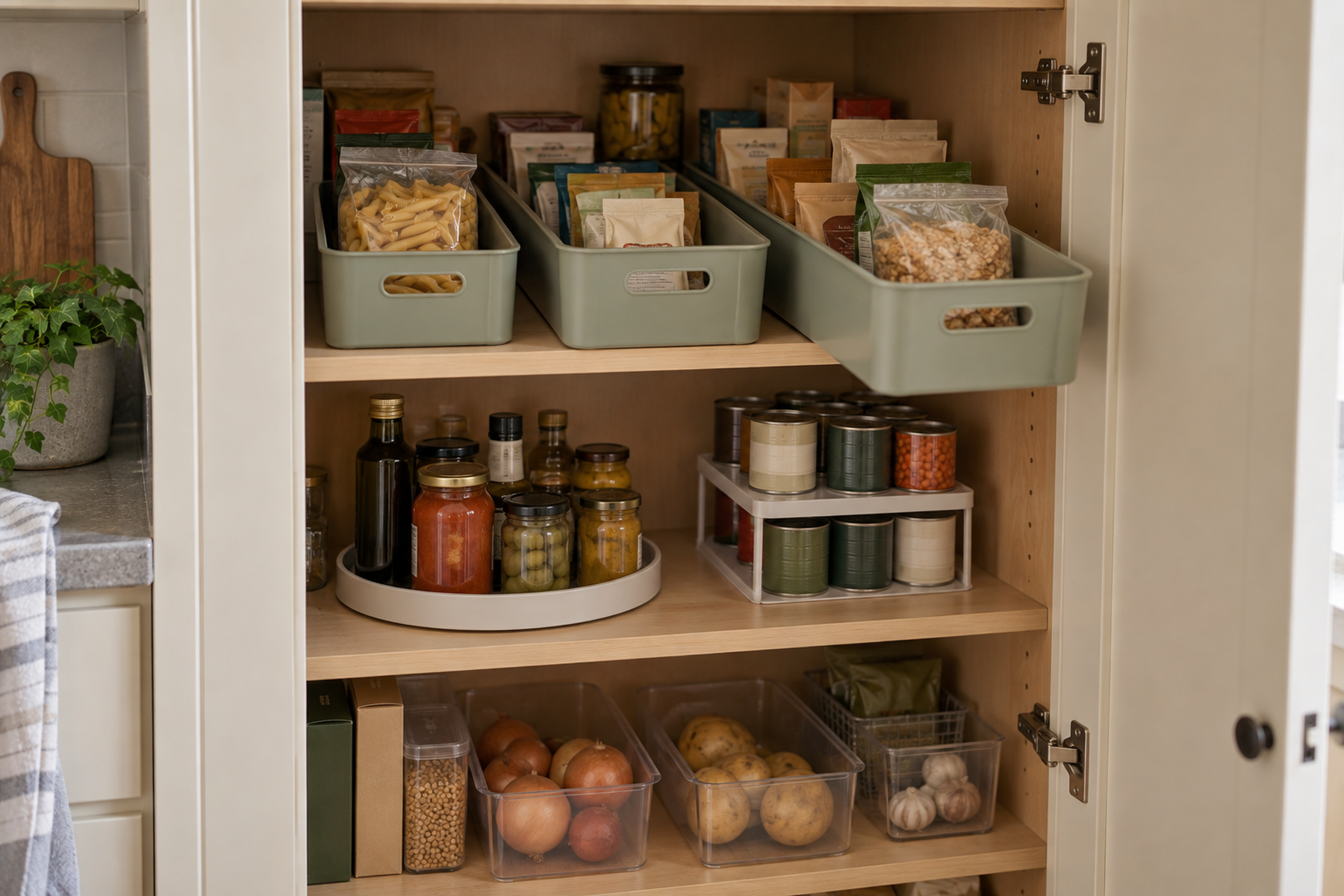
A deep pantry can hold a large amount of food and still function badly. The problem starts when the front row blocks the rear row: food disappears, duplicate products are bought, older stock stays buried, and the pantry becomes harder to use as it gets fuller.
The strongest fix is to redesign the retrieval path. Every category stored in the rear half should either pull forward, rotate into view, rise high enough to stay visible, or live in a clearly defined backstock lane that can still be reached without unloading unrelated food.
Quick Answer
Make the Back Come Forward
The goal is not to fill every inch. It is to make every category visible enough to inventory and easy enough to retrieve in one simple action.
01
Build category lanes instead of deep mixed rows
Group food by how it is used, then give each category a front-to-back lane or removable container. A deep shelf works better when one category moves together rather than forcing the user to reach around unrelated products.
02
Use the organizer that matches the movement
Long bins are useful when a whole category should pull forward. Turntables are useful when jars or bottles need to rotate into view. Risers help when visibility is the main problem but the rear remains physically reachable.
03
Leave enough clearance for retrieval
A pantry can be less densely packed and still hold more usable food. Leave enough space to pull a bin out, rotate a turntable, read labels, and reset the shelf without unloading neighboring categories.
01
Organize the Pantry Around Retrieval, Not Maximum Filling
Start by identifying where access actually fails. Some shelves are too deep to scan, some are difficult to reach, and some have a wide opening but become blocked by the first row of products.
Group the pantry into useful categories before adding organizers: canned goods, sauces, snacks, breakfast food, baking ingredients, pasta and grains, oils and condiments, and backstock or duplicates.
Then ask what has to move before one item can be retrieved. If reaching one jar requires shifting six unrelated products, the problem is not the jar; it is the access path.
Do not use every cubic inch simply because it exists. Clearance around a category can create more practical capacity than another tightly packed row that hides the food behind it.
02
Give the Back of the Shelf One Simple Path Forward
The rear half of a deep pantry is useful only when it has a predictable route to the front.
For many categories, the simplest renter-friendly solution is a long removable bin used like a drawer. Pull the bin forward, scan the entire category, take the item, and return the category as one unit.
The bin must fit the cabinet opening, not only the shelf depth. Door hinges, face frames, shelf lips, and a narrow cabinet opening can stop a perfectly sized container from sliding out.
Also consider loaded weight. A very long bin filled with cans or bottles can become harder to handle than the original pantry. The system works only when the full category can be pulled forward comfortably and predictably.
Measure / Check First
Before buying bins, turntables, risers, or pull-out hardware, test the actual cabinet opening and the way each food category needs to move.
Check the Opening, Retrieval Motion, and Loaded Category First
01
The usable opening and shelf depth
Measure clear opening width, shelf width, usable depth, shelf spacing, hinges, face frames, door swing, and any lip or obstruction that affects how an organizer can enter and leave the cabinet.
02
The one-step retrieval motion
Decide whether the category should pull forward, rotate, rise into view, or remain in a known rear backstock lane. The organizer should reduce the number of unrelated items that must move.
03
The loaded organizer
Estimate how heavy the category becomes when the bin, tray, or turntable is full. A system that fits empty but becomes awkward when loaded has not solved the access problem.
If the back of the shelf still requires blind reaching or unloading another category, change the retrieval method before adding more containers.
03
Separate Visibility Tools From Retrieval Tools
Visibility and reach are related, but they are not the same problem.
Tiered risers can make a rear row of cans or short jars easier to see because the labels are raised above the front row. They work best when the user can still comfortably reach the back tier.
Lighting can help scan a dark pantry, but it does not remove the front row or shorten the reach. Use lighting as a support tool when darkness is contributing to the problem, not as the primary access fix.
A useful test is simple: Can I see it, and can I get it out? If the answer to only one of those questions is yes, the shelf still needs a better system.
04
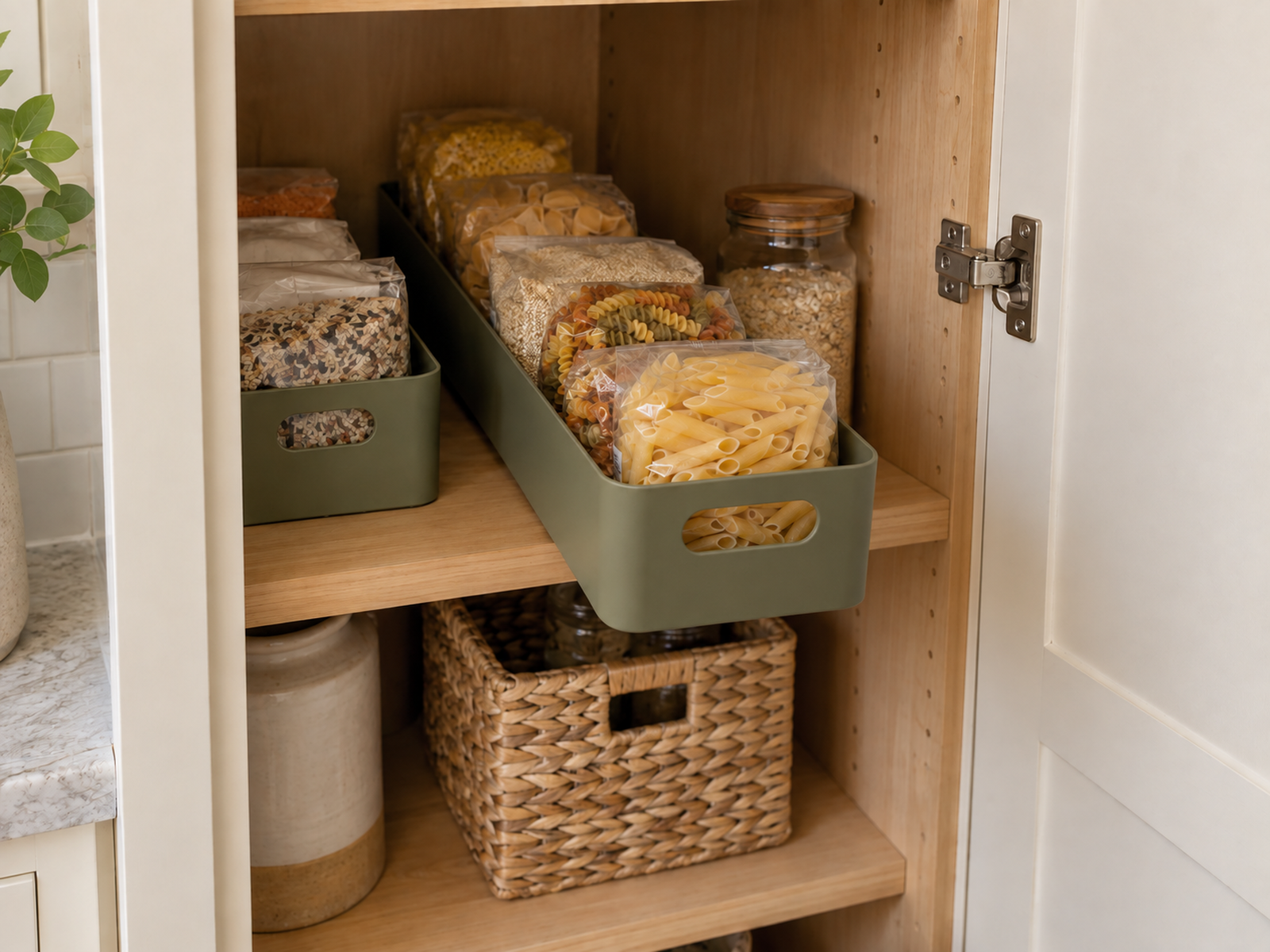
Use Long Pull-Forward Bins for Categories That Need Linear Access
Long bins are strongest when the category naturally forms a lane: snack bags, pasta packets, baking supplies, sauces, breakfast items, or other products that can move forward together.
Keep each bin narrow enough that it behaves like a drawer rather than a deep box. The user should be able to pull it forward and see the category without digging through layers.
Avoid turning a long bin into a miniature version of the original pantry. If products are stacked randomly inside it, food can still disappear at the back of the container.
Use more than one bin when one category becomes too broad or too heavy. The purpose is to reduce remembering and reaching, not to maximize how much weight one container can carry.
Use / Skip
Long Pull-Forward Category Bins
Use
Use them when one whole category can move to the front in one action
A long bin can work well when it clears the cabinet opening, stays manageable when loaded, keeps one coherent category together, and lets the user pull the rear inventory into view without moving neighboring food.
Skip
Skip them when the container becomes another deep black hole
Choose a turntable, riser, shorter bins, or another category split when products still stack invisibly inside the bin, the loaded container is too heavy, or the cabinet opening makes pull-out access awkward.
05
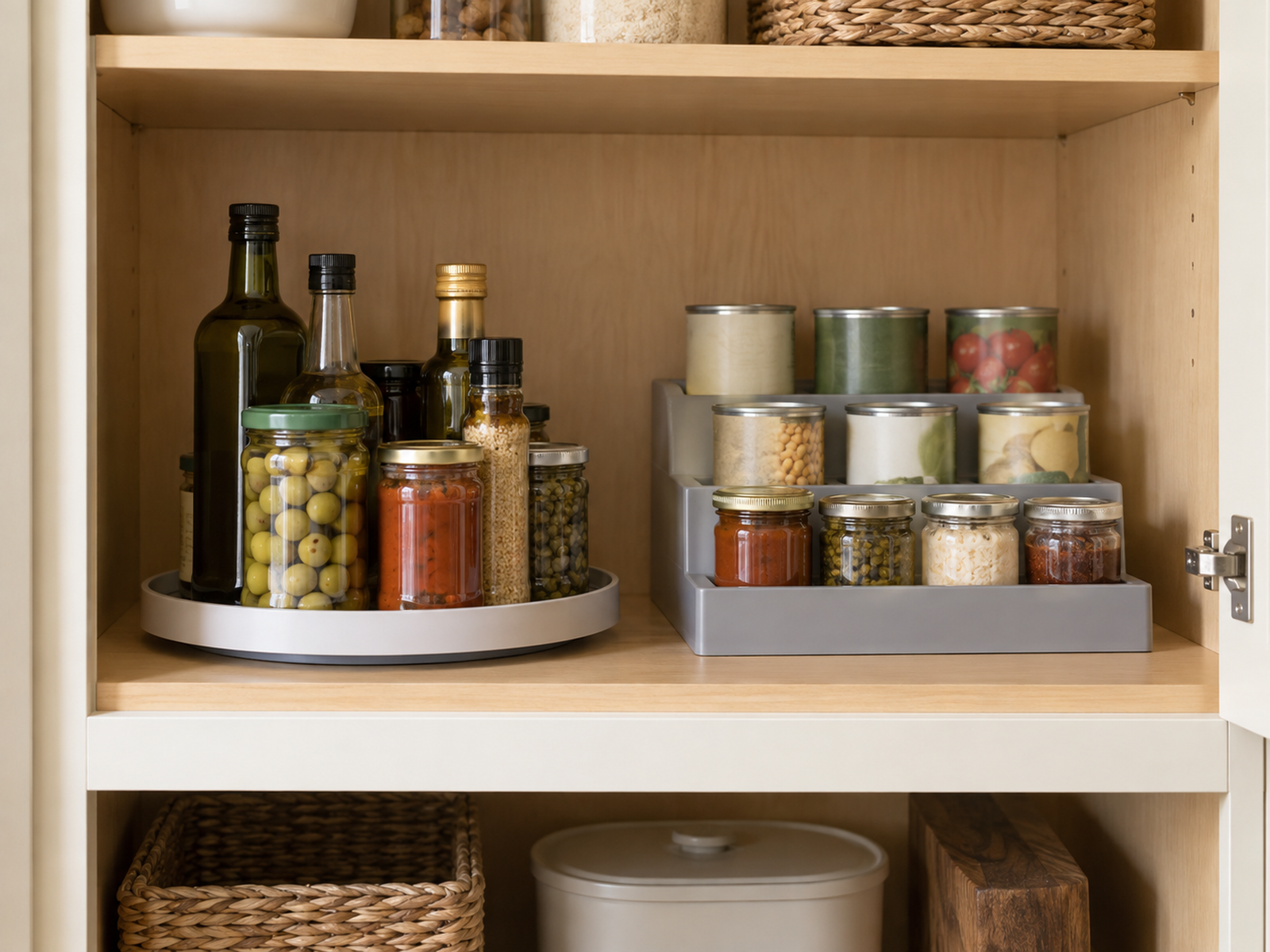
Use Turntables for Jars and Bottles That Benefit From Rotation
Turntables are useful for upright jars, bottles, condiments, oils, spreads, and similar categories because the rear items can rotate to the front without removing the front row.
Check the diameter against the real shelf and cabinet opening, and leave enough clearance around the edge for the turntable to rotate freely.
Do not use a circular organizer merely because the pantry is deep. Boxes, flat packets, large bags, and long packages often use a rectangular shelf more effectively in bins or lanes.
The strongest turntable category is one that remains readable and stable while rotating. If tall bottles collide with the shelf above or neighboring products block the rotation, the organizer has not earned the space.
06
Use Risers When the Rear Is Reachable but Hard to See
A riser changes the sightline rather than the retrieval path.
Use it for cans, jars, spices, or similarly sized containers when the rear row is physically reachable but visually blocked by the row in front.
Check vertical clearance before adding levels. A riser that raises the back row into the shelf above or creates unstable stacking simply converts one access problem into another.
For a very deep shelf, a riser may still need to be paired with a pull-forward lane or a shallower category. Better visibility does not solve an uncomfortable or impossible reach.
07
Use Front Stock and Rear Backstock Only With a Rotation Rule
Depth can support a useful active-stock and backstock system when the two zones are intentional.
Keep the item currently in use or the oldest package in the front-access zone, and place newer duplicates behind or after it. Utah State University Extension and Penn State Extension both recommend a first-in, first-out approach so older food is used before newer purchases.
Do not treat the rear as an unstructured overflow dump. Backstock should remain contained, known, and retrievable in one movement so the household can see what it already owns before buying more.
When dates or storage times matter, use the product label and an authoritative reference such as FoodSafety.gov’s FoodKeeper rather than assuming every pantry date means the same thing.
08
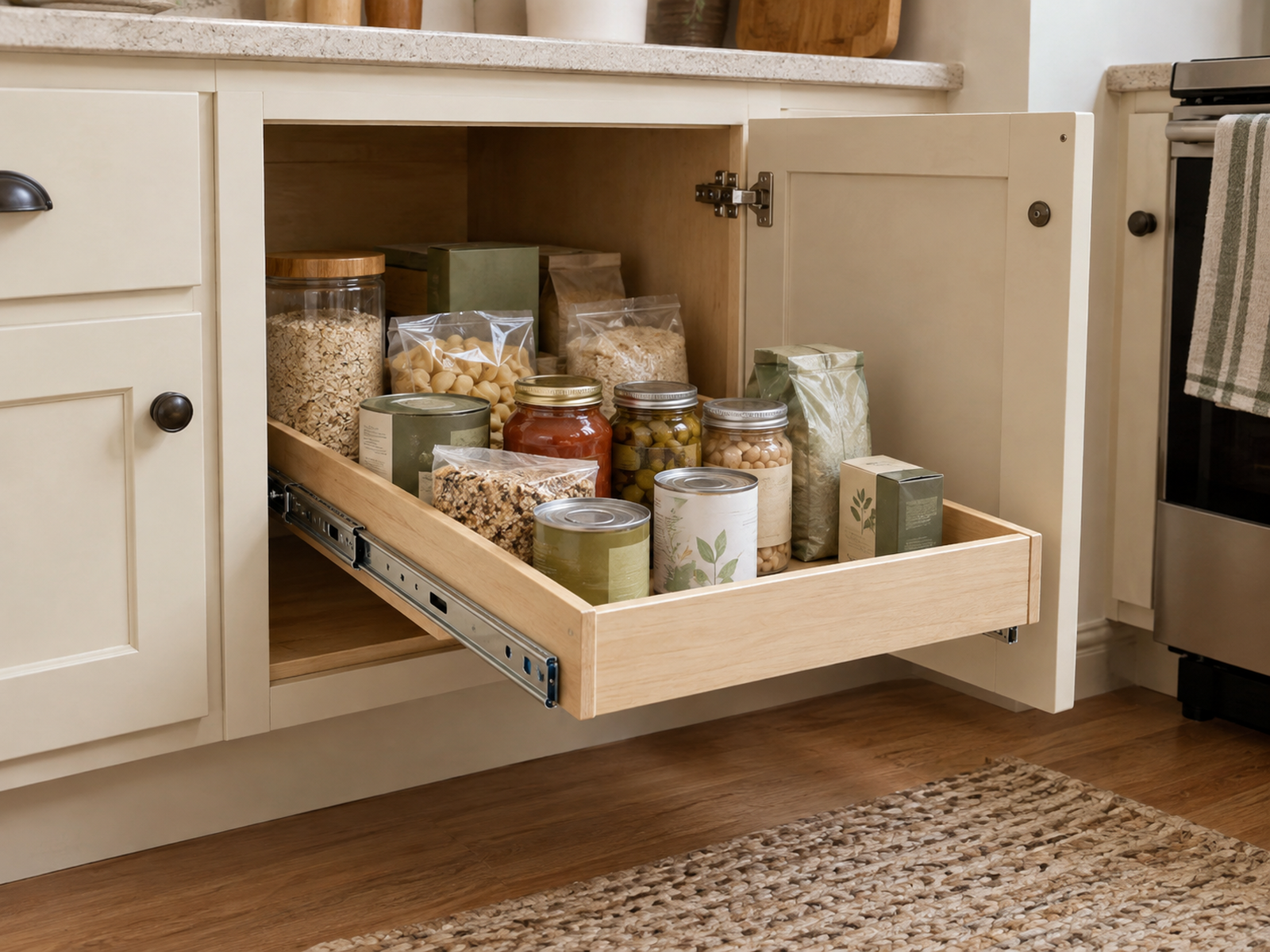
Escalate to Installed Pull-Out Hardware Only When Removable Systems Still Fail
Full-extension trays and pantry pull-out mechanisms can convert deep fixed storage into mechanically accessible storage, but they are a cabinet retrofit rather than a generic organizer.
Current Rev-A-Shelf guidance requires measuring cabinet width, depth, height, construction type, hinges, and other obstructions. IKEA’s UTRUSTA pull-out pantry organizer is likewise designed for a specific cabinet system and publishes its own dimensions and load limits.
That makes installed hardware a later branch for households that use the pantry heavily and still cannot achieve reliable access with removable bins, turntables, or risers.
In a rental, confirm cabinet compatibility and landlord or lease permission before drilling or fastening hardware. Reversible retrieval methods should be the default starting point when they solve the access problem adequately.
Closing Decision
Make Every Rear Zone Easy to Reveal
A deep pantry becomes usable when the back is no longer a hidden second pantry. Give each category a predictable way to move forward, rotate into view, rise above the front row, or remain in a controlled backstock lane.
Prioritize visibility and retrieval over maximum packing density, keep older stock moving forward, and use installed pull-outs only when the access problem truly justifies the added commitment.
RELATED GUIDES
What to Read Next
NEXT GUIDE
How to Organize Food Storage in a Small Kitchen With No Pantry
Use this next if the deeper problem is not access but the absence of enough dedicated pantry infrastructure; that guide focuses on creating a workable food-storage system when no pantry exists.
GUIDE
How to Organize a Deep Corner Kitchen Cabinet With a Narrow Opening
Use this if the access problem is driven by cabinet geometry and a narrow opening rather than shelf-stable food visibility and rotation.
GUIDE
How to Organize a Small Freezer Without Burying Frozen Food
Use this if the same visibility-and-rotation problem is happening with frozen food; that guide applies similar inventory principles in a different storage environment.