
Small Kitchen Organization
How to Organize a Small Freezer Without Burying Frozen Food
Treat the freezer as a rotating food system, not a packed archive: verify the temperature, leave temporary room for newly added food to freeze, shape and label packages for future use, keep broad categories visible, and eat down inventory before the next batch takes over the compartment.
In This Guide
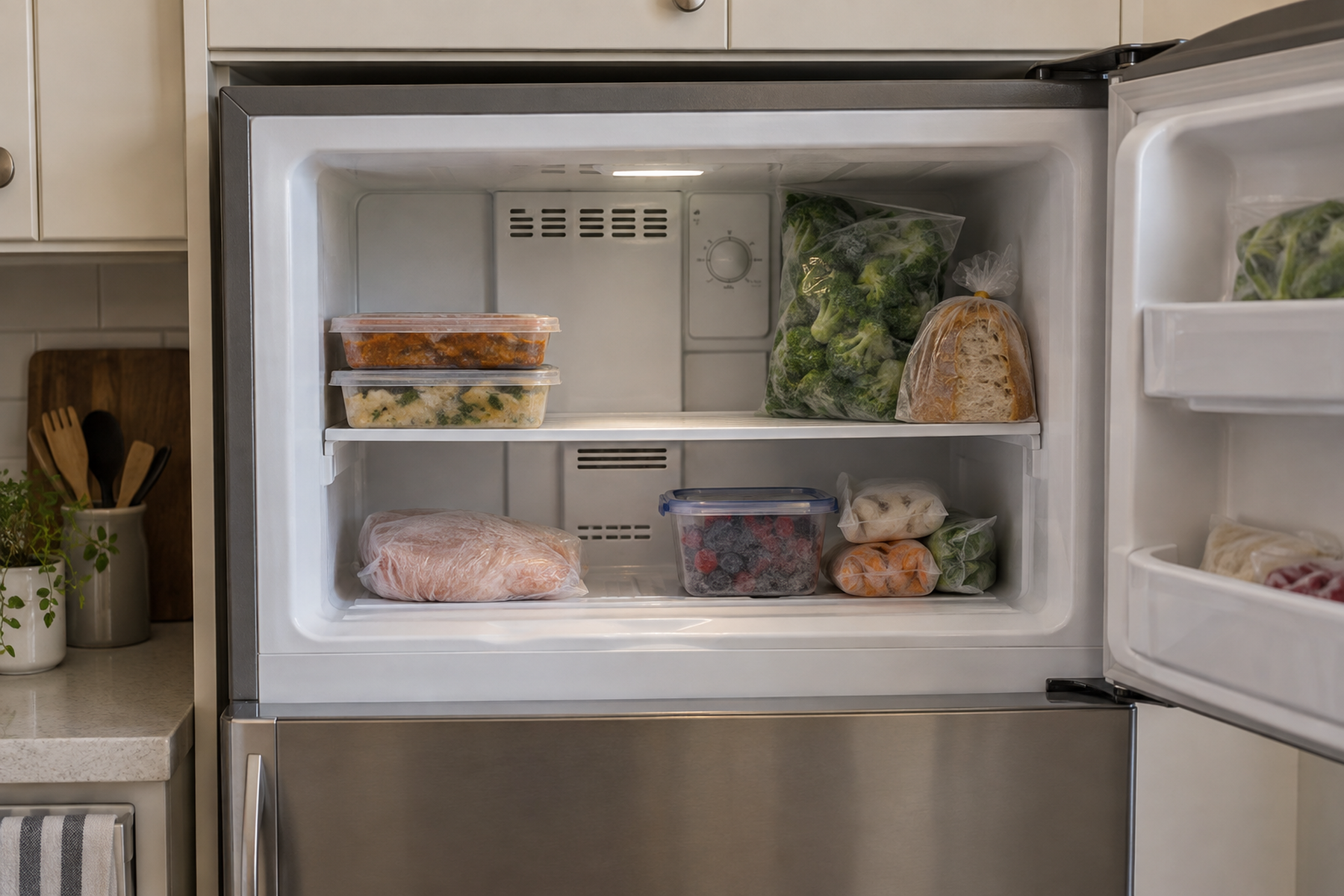
A small freezer can look organized and still fail as a food system. If every package is wedged into the compartment, newly added food has no room to freeze efficiently, older meals disappear behind newer groceries, and the household keeps adding food faster than it leaves.
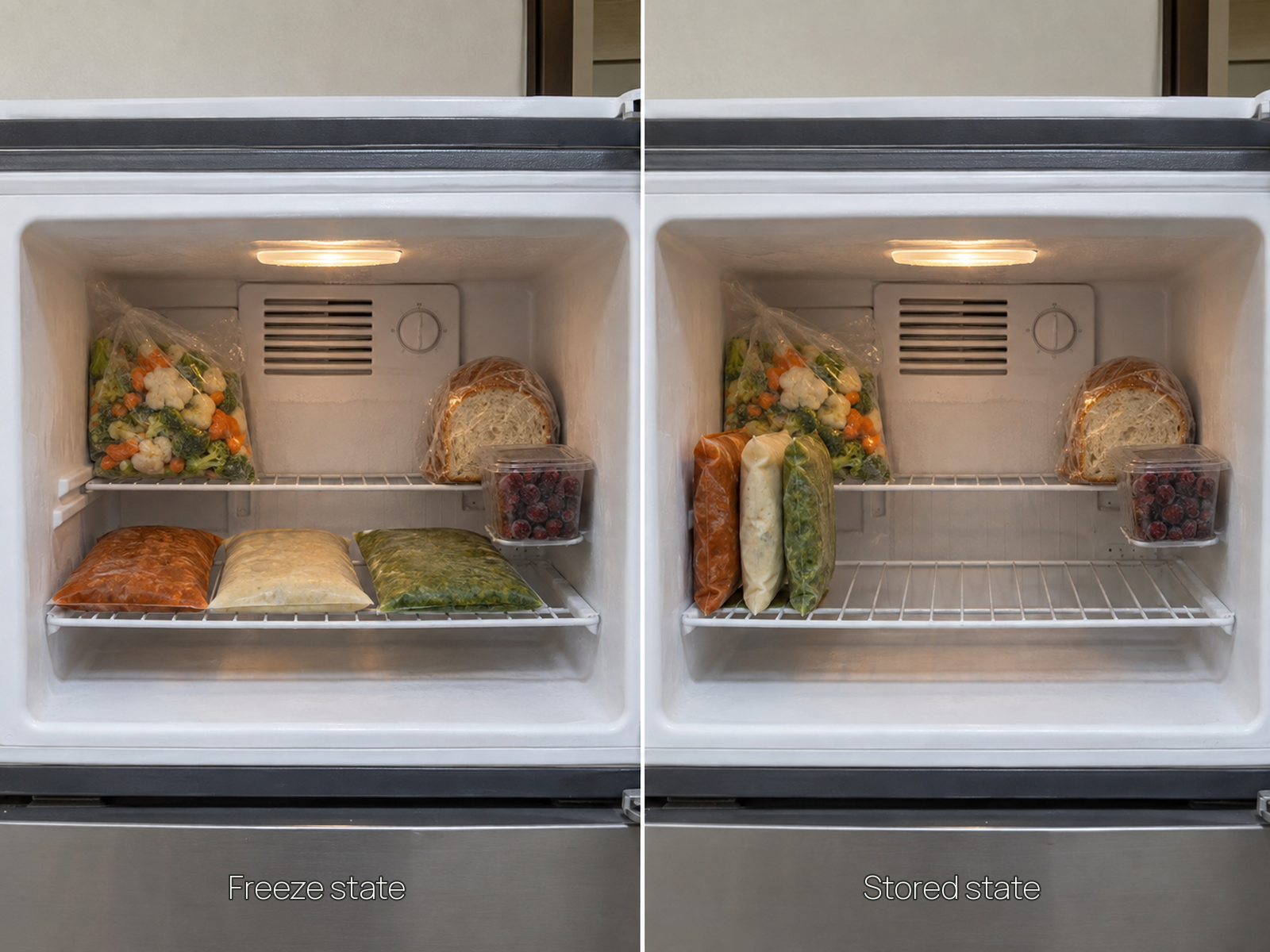
The stronger model has two operating states. Newly added unfrozen food needs temporary open space and air around the packages while it freezes; once the food is solidly frozen, the same packages can be consolidated into a denser, visible storage system that is easy to rotate.
Quick Answer
Run the Freezer as a Queue, Not an Archive
Food should enter, freeze, stay identifiable, move toward the front of its category, become a meal, and leave. If food only enters, no bin system can prevent a small freezer from eventually becoming inaccessible.
01
Verify the freezer can hold 0°F
For long-term frozen storage, confirm the compartment can maintain 0°F (-18°C) or below. If needed, use an appliance thermometer rather than assuming the control setting equals the actual temperature.
02
Keep one temporary zone available for new food
New unfrozen packages should have room around them while they freeze instead of being buried immediately in a dense stack. Consolidate them after they are frozen solid.
03
Shape, label, and rotate before you add more
Use freezer-appropriate packaging, portion food for future meals, keep contents and dates readable, move older equivalents forward, and eat down the freezer when the next batch has nowhere to go.
01
Verify Temperature Before You Plan Long-Term Storage
USDA guidance uses 0°F (-18°C) or below as the baseline for long-term frozen storage. An appliance thermometer can verify the actual compartment temperature when the setting or dial does not tell you enough.
That check matters especially in a small refrigerator freezing compartment. USDA notes that a compartment that cannot maintain 0°F, or that is opened frequently, is better treated as shorter-term frozen storage for best quality rather than assumed to function like a dedicated long-term freezer.
Keep quality guidance separate from safety. USDA and FoodSafety.gov state that food held continuously at 0°F can remain safe indefinitely; published freezer-storage times are primarily about quality, assuming the food was handled safely before freezing and remained continuously frozen.
Freezer burn belongs in that quality category too. It can make food dry or less appealing, but freezer burn by itself does not establish that continuously frozen food is unsafe.
02
Reset the Inventory Before You Add Organizers
Empty enough of the freezer to identify what is actually there before buying bins. Group duplicate frozen vegetables, proteins, breads, prepared meals, fruit, and leftovers, and separate anything whose handling history or safety is uncertain for the appropriate food-safety decision rather than trying to solve it through organization.
Use dates as rotation tools, not automatic safety-expiration dates for food that has remained continuously frozen at 0°F. Older packages should generally move forward because quality declines over time and because visible dates make first-in, first-out easier to operate.
Look for volume that can leave immediately through normal meal planning. A half-used bag of berries, three older prepared meals, and two duplicate bread packages may represent more recoverable capacity than a new organizer can create.
Do not reorganize around food the household no longer intends to use. A small freezer has too little volume to carry permanent mystery packages simply because they still fit.
03
Protect a Temporary Freeze Zone for New Food
USDA and the National Center for Home Food Preservation both support rapid freezing rather than overloading the freezer with a dense mass of new unfrozen food. Newly added packages should be spread or spaced so cold air can circulate around them.
USDA specifically advises not stacking packages while they are freezing. Once the food is frozen solid, the packages can be moved together and stored more densely.
That gives empty space a real job in a small freezer. One modest shelf section, tray area, or open patch can function as a loading zone for a new meal-prep batch or fresh leftovers before they join the permanent storage layout.
If the freeze zone is never available because every category is permanently saturated, the problem is throughput. Reduce the next batch, eat down existing inventory, or change the shopping rhythm before adding more frozen food.
Measure / Check First
Before the next meal-prep batch or organizer purchase, check the freezer’s actual temperature, available freeze-zone space, and the package shapes you are about to add.
Check Temperature, Freeze-Zone Capacity, and Package Geometry First
01
Actual freezer temperature
Confirm the compartment can maintain 0°F or below if you are relying on it for long-term frozen storage; use an appliance thermometer when the actual temperature is uncertain.
02
Room for new food to freeze
Reserve enough open surface or shelf area to space the next unfrozen packages instead of stacking a whole batch immediately into an already-dense freezer.
03
Final stored shape and retrieval
Choose meal-size packages that fit the compartment once frozen, keep labels readable, avoid blocking model-specific vents or controls, and make sure one item can be removed without unloading the freezer.
If a new batch only fits by stacking warm packages tightly, blocking airflow, or burying older food, reduce the batch before you freeze it.
04
Portion and Package Food for the Way You Will Use It
Package geometry starts before the organizer. The National Center for Home Food Preservation recommends freezer packaging that is moisture-vapor resistant, durable, leakproof, protective against odor transfer, and easy to seal and mark.
It also recommends packaging food in quantities that will be used for a single meal. In a small freezer, that can turn one oversized frozen block into several practical portions that are easier to identify, retrieve, and use without thawing more than the household needs.
Choose rigid or flexible freezer-appropriate packaging to match the food. Rigid rectangular containers can work well for soups, sauces, and leftovers that need structure; freezer-grade flexible packaging can reduce awkward air pockets around suitable foods.
Do not standardize every package for appearance alone. A container wall still consumes volume, and some foods need headspace, protection from crushing, or a shape that does not lend itself to flat storage.
05
Freeze Flat Only When the Food and Packaging Fit the Method
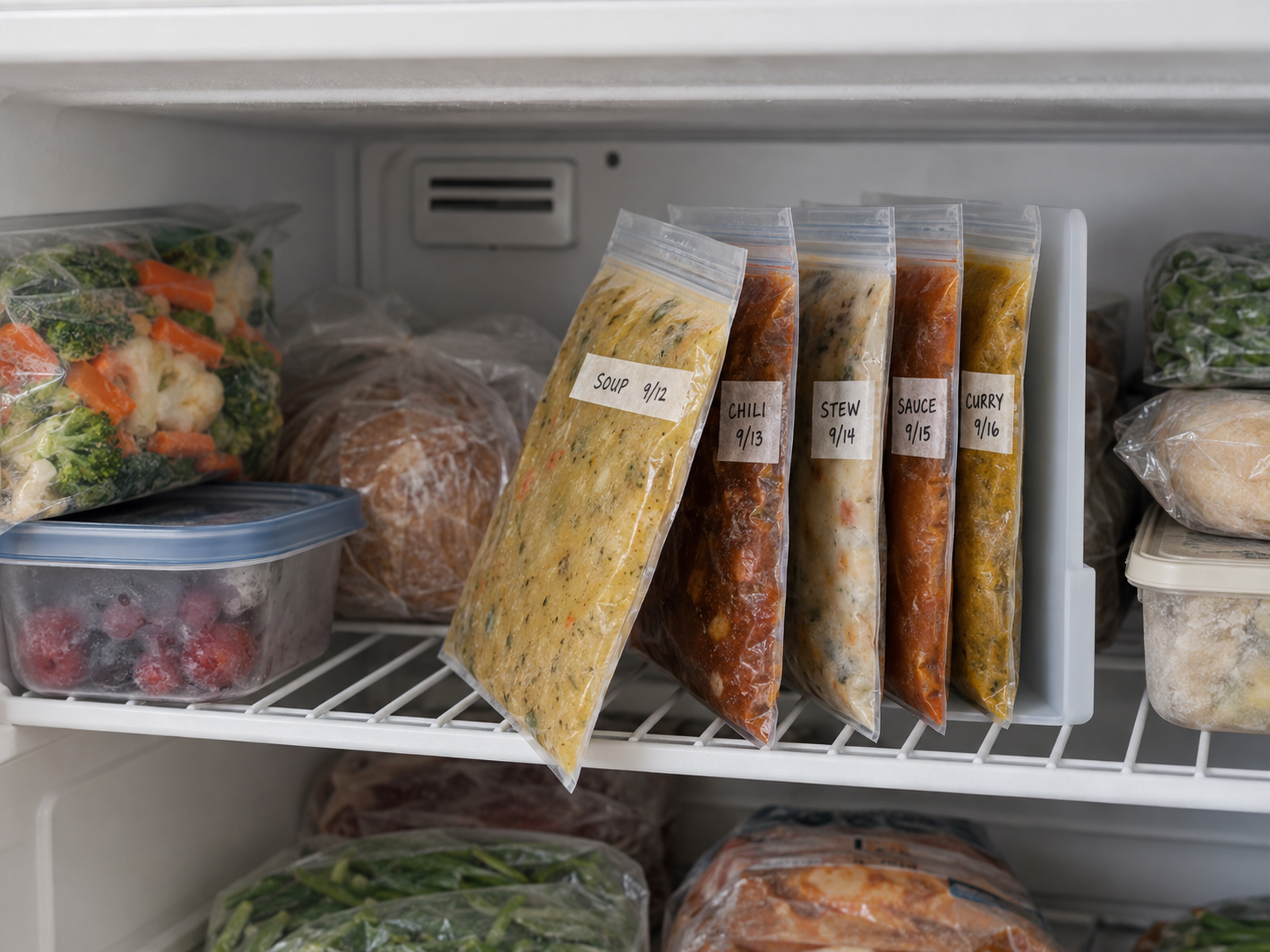
For suitable foods, freezing in a thin flat package can reduce bulky shapes and make labels easier to see. Once the package is solid, several flat portions can often be stored upright like files instead of stacked in a pile.
This is a geometry strategy, not a universal food rule. The food has to tolerate the shape, the packaging has to be appropriate for freezer use, and liquids or expanding foods still need the sealing and headspace required for that food and package.
Flat packages are strongest when they remain easy to identify and pull out individually. If a vertical row becomes so tight that removing one packet collapses the rest, reduce the density or use a small divider only if it genuinely improves retrieval.
Fragile foods, bulky retail packages, and foods that need rigid protection may be better kept in containers or their appropriate original packaging. Do not flatten food merely to make the freezer look uniform.
Use / Skip
Freeze Flat, Then File
Use
Use it for foods that suit freezer-safe flexible packaging and thin portions
Freeze suitable meal-size portions flat when the food can be safely packaged that way, the seal and any required headspace are correct, and the solid packages can later stand upright with labels visible for easy retrieval.
Skip
Skip it when the food needs rigid protection or the file row becomes another jammed stack
Use an appropriate rigid container or other freezer-safe form when the food is fragile, awkward, expansion-sensitive, or difficult to seal flat, and avoid vertical filing when removing one packet makes the whole row collapse.
06
Build Broad Zones, Labels, and Oldest-First Rotation
A tiny top freezer usually needs broad categories rather than a bin for every food type. Prepared meals, proteins, fruit and vegetables, and bread or breakfast items may be enough; the exact categories should reflect what the household actually freezes.
Labels should make packages useful at a glance. NCHFP recommends information such as product name, packaging date, servings or amount, and food form where relevant. For an ordinary small freezer, contents and date may be enough when the rest is obvious.
Use first-in, first-out inside each repeated category. New berries should not permanently cover the older berries, and a fresh batch of soup should not push last month’s portions into the back corner.
When packages are opaque, double-deep, or shared among roommates, extend visibility outside the freezer. A short paper list, whiteboard, phone note, or simple category count can prevent duplicate buying without turning the household into a full inventory-management project.
07
Keep Vents Clear and Organizers Selective
Airflow geometry is appliance-specific. Current Whirlpool freezer guidance, for example, warns that blocking freezer vents can interfere with airflow and temperature performance, but the exact vent locations and clearances depend on the appliance.
Check the actual refrigerator or freezer manual before placing a bin, divider, or dense row of packages against a vent, control, door seal, drawer path, or ice-maker zone.
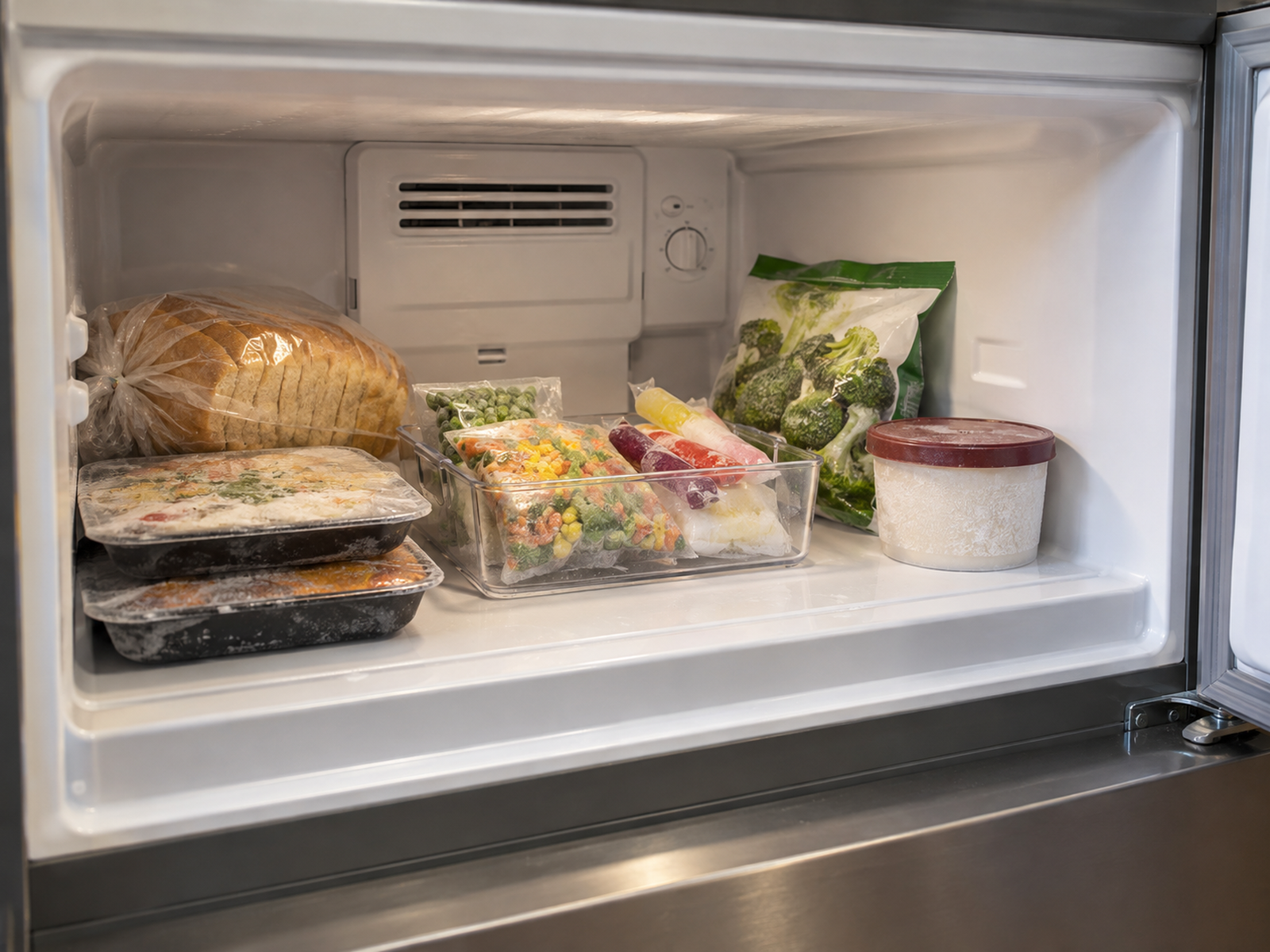
Use one organizer for one real retrieval problem. A shallow bin can keep loose packets together, and a simple divider can help upright flat packages stay stable, but every organizer also consumes internal volume.
Do not cover the freezer with containers just because the layout looks cleaner. In a very small compartment, package shape, labels, and rotation can recover more useful capacity than another rigid plastic wall.
08
Eat Down the Freezer Before the Next Big Batch
Meal prep has a spatial ceiling. A cooking session that produces more unfrozen portions than the freezer can spread, freeze, and store properly is too large for the current system even if the cooking itself was efficient.
Set batch size from available freezer intake capacity, not only from the number of recipes you want to cook. Alternating freezer-heavy and refrigerator-heavy weeks, using older frozen meals before shopping, or buying a smaller bag of frozen produce can restore operating room without another appliance.
Shared freezers may need explicit ownership boundaries as well. One side, shelf, or small bin per person plus a shared common area can make capacity predictable, even though equal freezer volume will not always match equal household need.
Use the stop rule when the freeze zone is gone and older food is still waiting: do not add another batch, another sale purchase, or another organizer. Eat from the freezer until the system has room to operate again.
Closing Decision
Keep Enough Room for the Freezer to Receive, Rotate, and Release Food
A small freezer works best when it has flow. New food gets a temporary place to freeze, stored food stays identifiable, older packages move forward, and every category eventually exits as a meal instead of becoming permanent frozen inventory.
Improve package shape and labels before adding organizers, and let available freeze-zone capacity set the next batch size. When the freezer is saturated, the next organization move is not more storage—it is eating down what is already there.
RELATED GUIDES
What to Read Next
NEXT GUIDE
How to Organize a Small Refrigerator Without Overpacking It
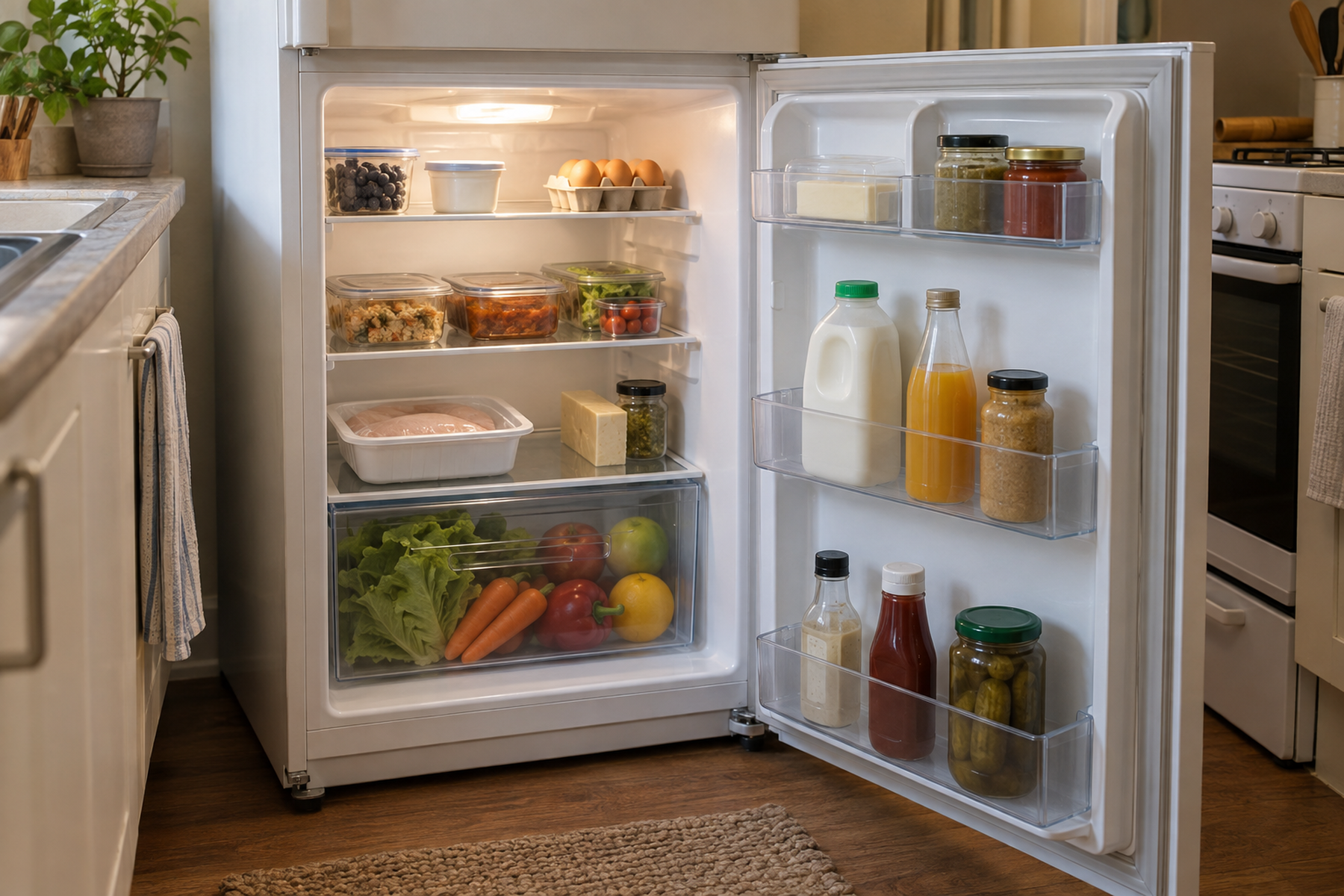
Use this next if the freezer is only one part of a crowded cold-storage system; that guide focuses on 40°F refrigerator temperature, airflow, raw-food containment, leftovers, crispers, door bins, and refrigerated grocery load.
GUIDE
How to Organize Food Storage Containers and Lids in a Small Kitchen
Use this if freezer meal prep depends on rigid containers but the empty containers and lids create a separate cabinet problem; that guide solves the storage system outside the freezer.
GUIDE
How to Organize Food Storage in a Small Kitchen With No Pantry
Use this if dry-food and bulk-buying habits are pushing more inventory into cold storage than the small kitchen can support; that guide helps assign shelf-stable food outside the refrigerator and freezer.