
Small Kitchen Organization
How to Organize Everyday Dishes in a Small Kitchen With Limited Cabinet Space
Design the cabinet around the dishes you use every day, not the full collection: protect the easiest reach for the working set, test the real unloading route, recover wasted shelf height only when access stays simple, and move guest, seasonal, and duplicate pieces out of prime storage.
In This Guide
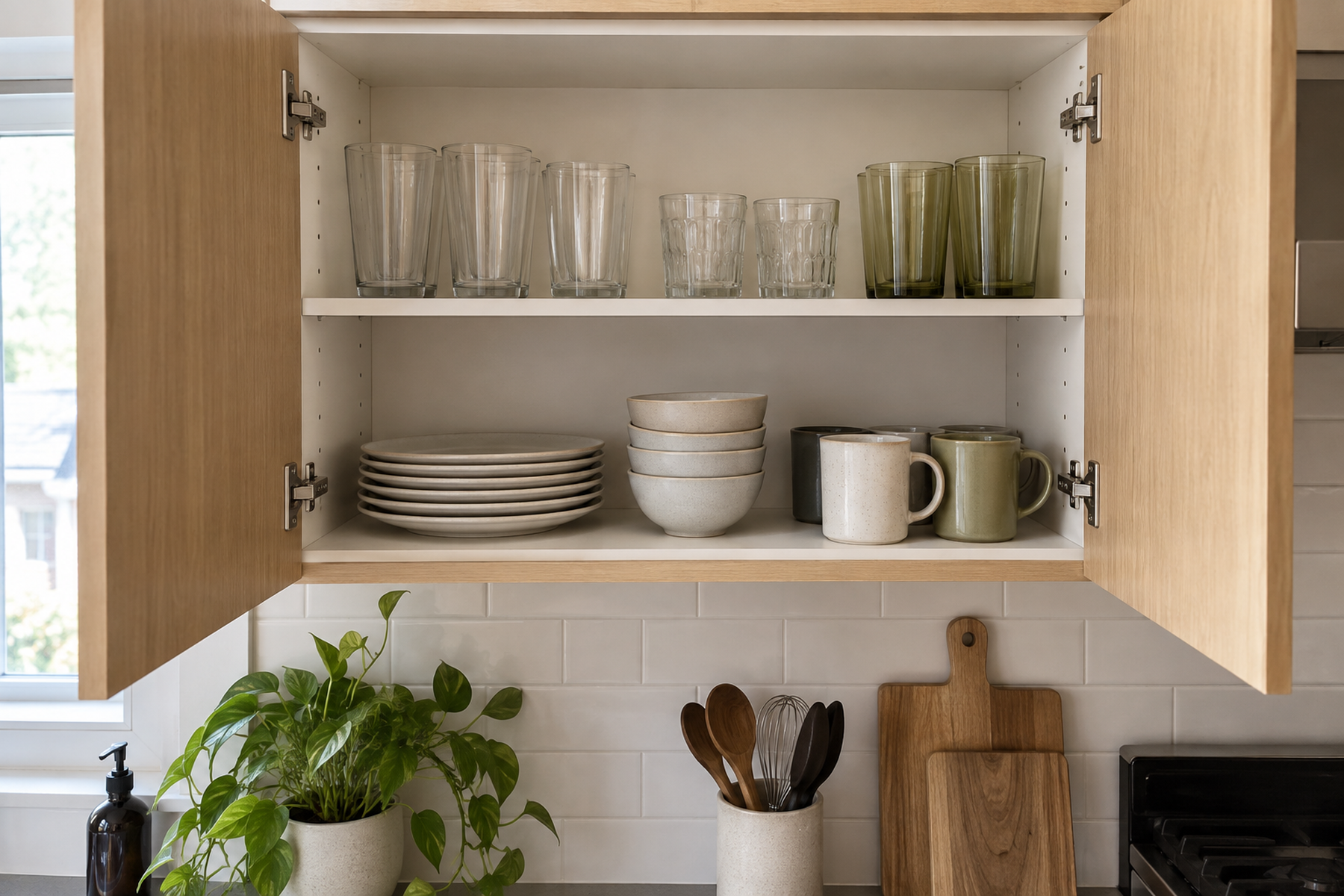
Everyday dishes are deceptively demanding storage. Plates, bowls, mugs, and glasses are used repeatedly, returned repeatedly, and shaped differently enough that one cabinet can feel full even when there is technically unused volume above or behind the stacks.
The strongest small-kitchen system is not the one that fits the most pieces. It is the one that gives the true daily working set a low-friction retrieval and return path while using shelf height, cabinet width, drawer volume, and secondary storage according to what each category actually needs.
Quick Answer
Organize the Working Set Before the Full Collection
Start with the dishes that move through the kitchen every day, then give them the easiest cabinet or drawer geometry. Only after the daily cycle works should guest, seasonal, oversized, or duplicate pieces compete for the remaining space.
01
Keep the daily set inside one clear storage boundary
Separate frequently used plates, bowls, mugs, and glasses from guest, seasonal, decorative, and duplicate pieces so prime storage is not sized for the largest possible gathering.
02
Test access with the kitchen in its real unloading state
Open the dishwasher, cabinet doors, and drawers and stand where unloading actually happens. A cabinet that is physically close can still be the wrong daily location if the appliance door or reach angle blocks it.
03
Use the organizer that matches the actual constraint
A shelf riser recovers unused height, a vertical plate holder changes individual plate access and width use, and a deep-drawer peg system uses top-down drawer volume. Do not treat them as interchangeable space savers.
01
Define the Daily Working Set Before You Organize the Cabinet
Separate the dishes that move through the kitchen every day from guest sets, seasonal pieces, decorative mugs, oversized serving bowls, duplicate glasses, and other low-frequency items before buying organizers.
The research does not establish one universal number of plates, bowls, mugs, or glasses per person. Household size, dishwasher frequency, hand-washing habits, hosting, and accessibility needs all change the useful working set.
Use the prime cabinet or drawer to support the daily cycle, not the maximum event. A small kitchen can function better when the everyday set is bounded and occasional pieces move to a higher, farther, or secondary storage zone.
If the daily set itself exceeds the cabinet footprint, first identify the geometry-breaking category—often mugs, wide bowls, or oversized dishes—before making every shelf denser.
02
Choose the Storage Zone by Reach and Unloading
Proximity to the sink or dishwasher can reduce reset effort, but only when the storage remains reachable during unloading. Test the route with the dishwasher door fully open if the household uses one.
A cabinet directly above the dishwasher may look ideal on a floor plan and still be awkward for a shorter user or anyone forced to lean over the open door while carrying a stack.
NKBA planning guidance supports keeping frequently used storage in accessible zones and concentrating substantial storage near the main cleanup and prep sink, but those figures are planning guidance rather than universal retrofit rules for every existing rental kitchen.
Choose the location that makes repeated removal and return easiest for the actual household, even if that means distributing plates and bowls near cleanup while mugs or glasses live in another bounded micro-zone closer to coffee, tea, or beverage use.
Measure / Check First
Before adding shelf risers, plate racks, hooks, or drawer inserts, measure the actual daily dishes and test the storage zone in the kitchen’s real unloading and serving conditions.
Check Dish Geometry, Reach, and the Reset Route First
01
The actual dish dimensions and stack behavior
Measure plate diameter, bowl width and nesting, mug handle spread, glass height, shelf depth, and cabinet opening. Do not assume one organizer format fits every dinnerware set.
02
Reach with doors and appliances open
Open the dishwasher, cabinet doors, adjacent drawers, and any nearby appliance doors and confirm the user can retrieve and return the daily set without awkward reaching or unloading around an obstruction.
03
The normal return path
Put away a realistic load of clean dishes and note which categories force extra lifting, unstacking, or cabinet rearrangement. The best arrangement is the one that survives the daily reset, not the staged photo.
If an organizer increases nominal capacity but makes the daily dish cycle slower, higher, more fragile, or harder to reset, it has improved density without improving storage.
03
Re-Space Adjustable Shelves Before Buying Organizers
When cabinet shelves already move on pins, use that free adjustment before adding another object inside the cabinet. A shelf opening should reflect the real height of the dishes stored there rather than the cabinet’s default spacing.
Lower a shelf when a plate or bowl stack leaves a large unused band of headspace above it, provided the shelf above still has enough useful clearance for its own category.
Do not optimize one level in isolation. Moving a shelf to fit short plates more tightly can make tall glasses or mugs on the next shelf unusable, so test the whole cabinet stack before finalizing the position.
If the cabinet shelves are fixed, move to a removable insert only when the unused vertical space is genuinely large enough to create a second accessible tier.
04
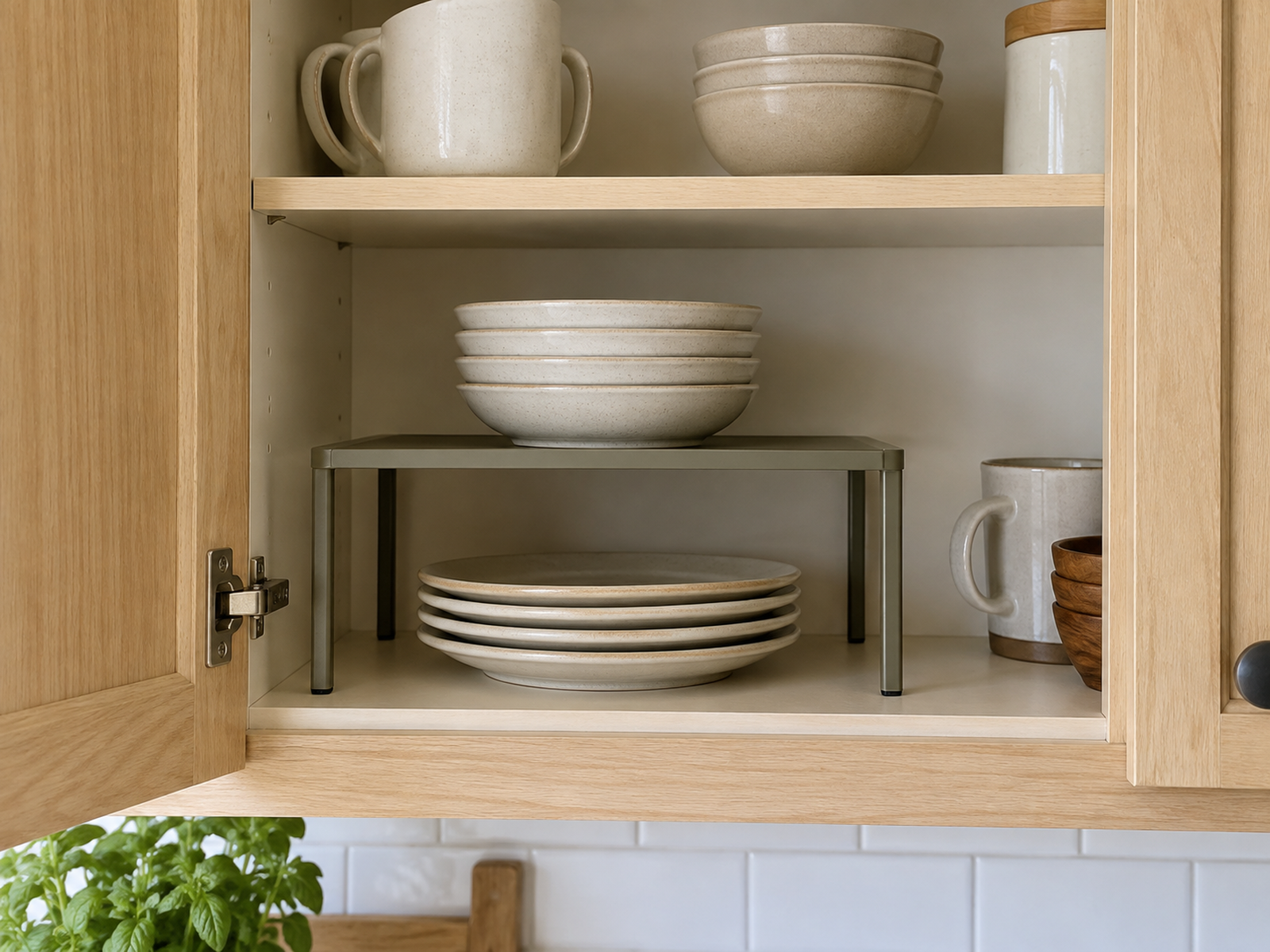
Recover Wasted Shelf Height With a Freestanding Riser
A shelf insert can create another usable level inside a tall cabinet opening when short stacks occupy only the bottom portion of the shelf. IKEA’s current VARIERA system verifies this as a real cabinet-storage architecture for bowls, glasses, and similar items.
Use a riser when the lower and upper tiers can both be reached independently. The extra level is not useful if one category has to be unloaded to reach the other or if the clearances are so tight that dishes scrape the shelf above.
The riser also consumes some width and height, so measure the actual dish stack, cabinet opening, and organizer footprint together instead of assuming the insert simply doubles the cabinet.
A good use case is one short plate or bowl stack below and a second category above. A poor use case is forcing fragile glassware into a cramped upper tier simply because there is technically room.
05
Use Vertical Plate Storage Only When Individual Access Is Worth the Width
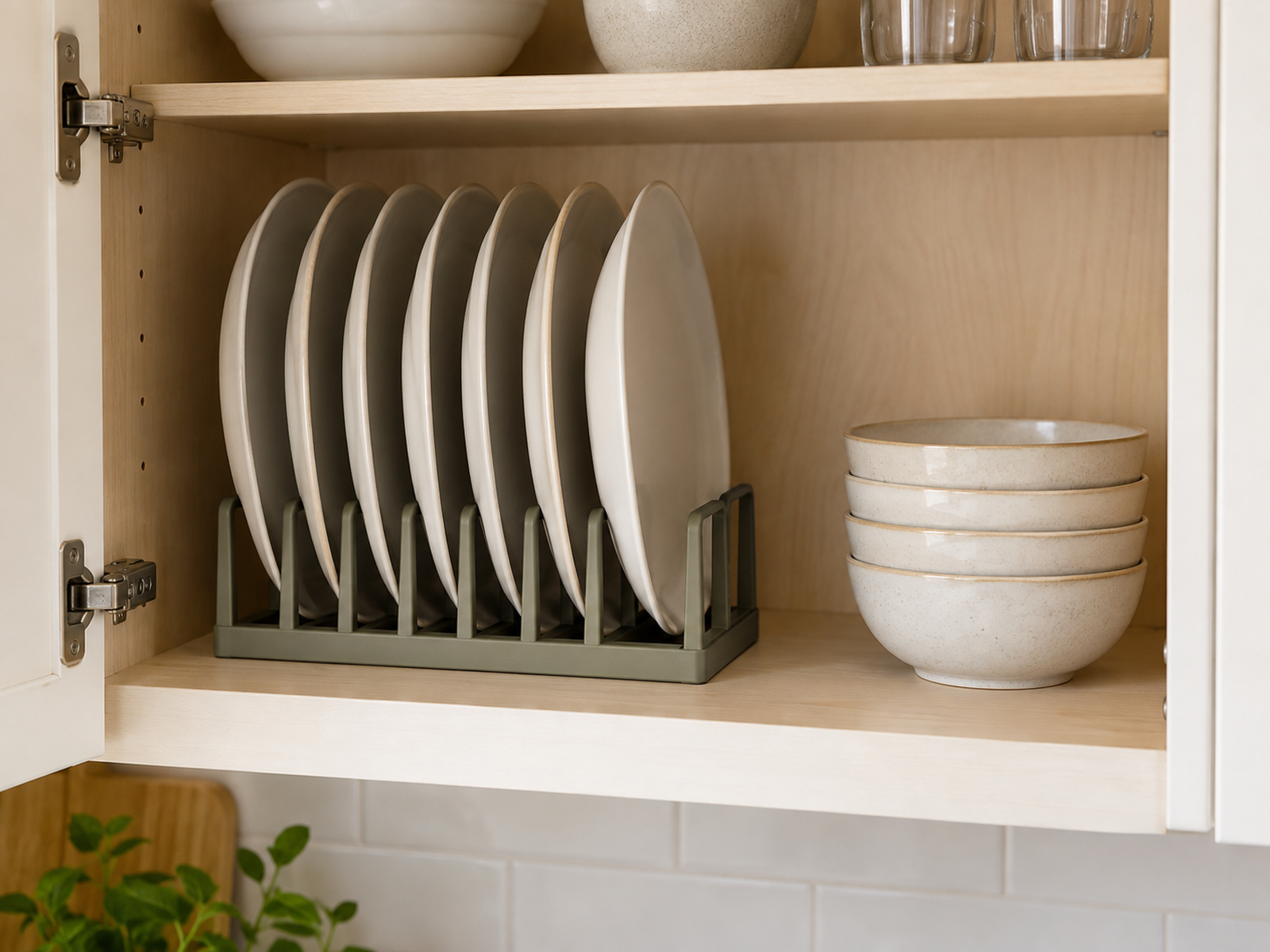
Vertical plate holders are a legitimate storage form, not just a social-media trick. Current manufacturer products such as IKEA’s OSTBIT are designed to hold plates upright in cabinets or drawers.
The benefit is individual access: one plate can be removed without lifting the weight of the stack above it. The cost is width, because the rack and slot spacing occupy a fixed lateral footprint.
That means upright storage can be excellent when mixed plate sizes, heavy stacks, or frequent individual retrieval are the problem, and less efficient when a uniform daily plate set already stacks compactly and access is easy.
Deep-rimmed bowls, oversized plates, or unusually thick dinnerware may not fit a plate holder designed around flatter plates. Measure the actual dishes and the rack rather than generalizing from the category name.
Use / Skip
Vertical Plate Storage
Use
Use it when individual access solves a real stack problem
Vertical storage can work when plate diameter, thickness, slot spacing, cabinet depth, and rack stability all fit, and the household benefits from removing one plate without lifting or rearranging a heavy or mixed-size stack.
Skip
Skip it when a simple stack already uses the cabinet more efficiently
Keep plates stacked when the set is uniform, the stack is easy to reach, and the rack would spend more cabinet width than the access benefit is worth. Do not turn every plate collection vertical simply because the organizer looks tidy.
06
Use Deep Drawers Only When the Kitchen Already Has the Right Architecture
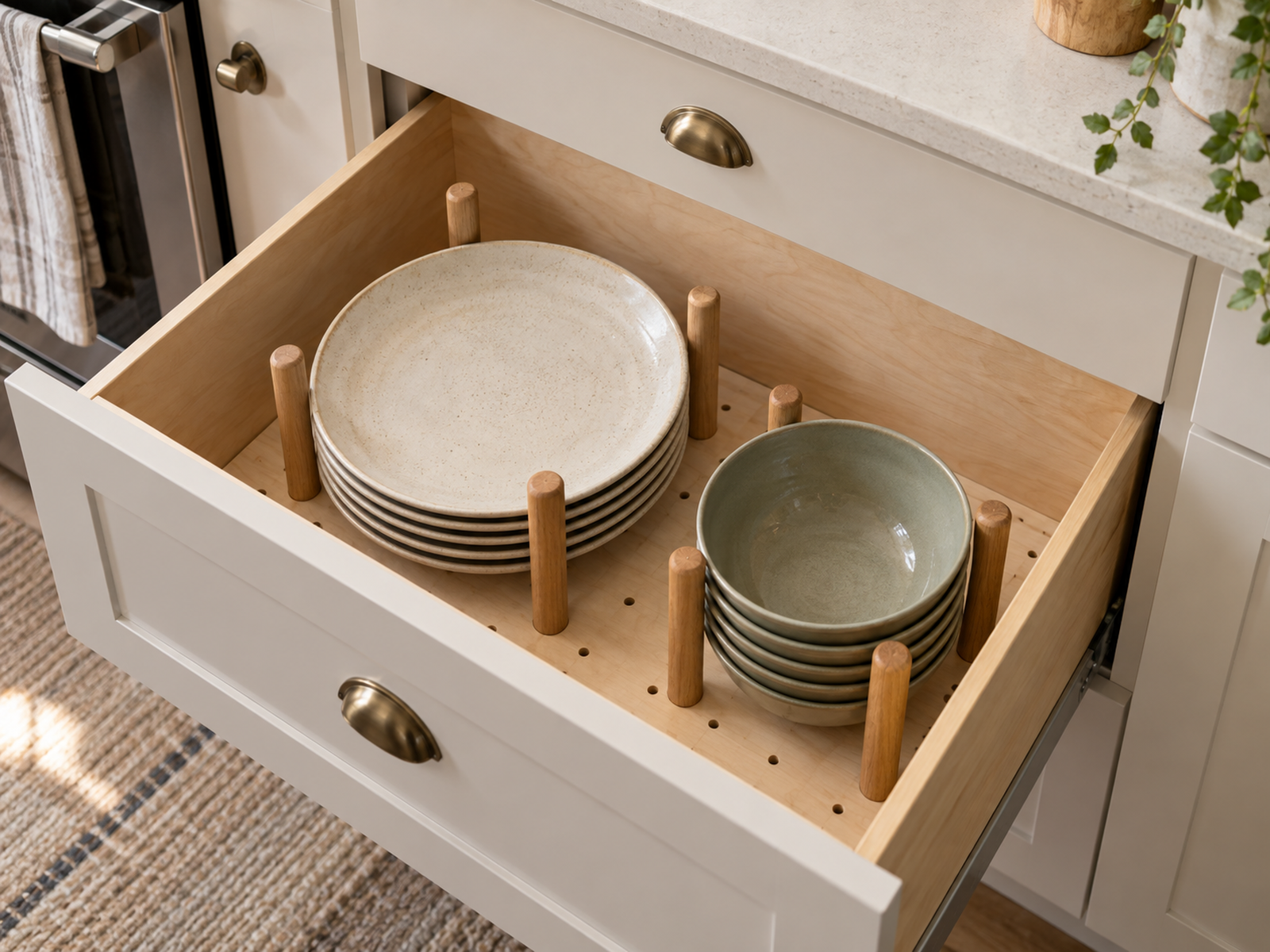
A deep base drawer can make plates and bowls visible from above and reduce high reaching when the kitchen already has a suitable drawer. Adjustable peg systems from IKEA and Rev-A-Shelf verify this as a current dish-storage category.
The drawer has to be deep and wide enough for the actual dinnerware, and the peg system has to fit the drawer dimensions. This is not a universal retrofit for kitchens that only have standard shelves.
Keep the peg layout simple enough that dishes can be returned without threading every plate through a complicated grid. The goal is stable separation and easy access, not maximum peg density.
Treat drawer hardware and product compatibility as specific. Do not infer one universal weight capacity for every drawer or peg system from appearance.
07
Treat Mugs, Glasses, and Guest Dishes as Separate Geometry Problems
Mugs often break an otherwise efficient dish cabinet because their handles create dead space and their heights vary. A large mug collection should not automatically determine the spacing of every plate and bowl shelf.
Create a bounded mug micro-zone sized to the mugs actually used regularly. That can be a short dedicated shelf, one part of a riser, or a coffee-and-tea cabinet when the workflow supports it.
Treat glassware similarly. Daily tumblers can stay in the prime routine while stemware, specialty glasses, and other occasional pieces move to a higher or secondary zone when retrieval remains safe and practical.
Do not assume mugs or glasses can be stacked unless their actual design supports stable stacking. Handles, rims, and shape vary too much for a universal rule.
08
Move Guest, Seasonal, and Duplicate Dishes Out of Prime Storage
Prime cabinet space should support repeated daily use. Guest plates, holiday pieces, decorative mugs, duplicate bowls, and special-occasion glassware can move to a higher, farther, or secondary location when they are used infrequently.
Higher shelves are reasonable for low-frequency dishes only when the items are still safe and practical for the user to retrieve. Heavy or fragile serving pieces may be poor high-shelf candidates even when they are rarely used.
If the household genuinely uses the full collection every day, keep it in the primary system and solve the geometry directly. The working-set model should reflect real use rather than forcing a smaller collection for the sake of appearance.
When freestanding and drop-in organizers no longer solve the capacity problem, mounted wall shelves or racks become an installation decision involving fasteners, substrate, exposed-dish maintenance, and landlord or lease permission.
Closing Decision
Make the Daily Reset Easier Than the Maximum-Capacity Setup
A strong everyday-dish system is measured by how easily plates, bowls, mugs, and glasses move through the daily cycle—not by how many pieces can be packed into one cabinet. Keep the working set in the easiest useful zone, then use shelf height, cabinet width, or drawer volume only when the organizer solves a specific access problem.
Re-space shelves before adding hardware, use risers for wasted height, use vertical plate storage only when individual access earns the width, and move guest or seasonal pieces out of prime storage when they do not belong in the daily cycle. If the reset remains awkward, change the zone before adding another organizer.
RELATED GUIDES
What to Read Next
NEXT GUIDE
How to Organize High Kitchen Cabinets When Upper Shelves Are Hard to Reach
Use this next if everyday dishes are being pushed upward because the lower cabinet is saturated; that guide helps separate active storage from low-frequency upper-shelf capacity.
GUIDE
How to Organize Water Bottles and Tumblers in a Small Kitchen Cabinet
Use this if drinkware is the geometry-breaking category; that guide focuses on tall, awkward reusable vessels that behave differently from plates, bowls, and standard glasses.
GUIDE
How to Organize a Deep Corner Kitchen Cabinet With a Narrow Opening
Use this if the only available dish capacity is trapped in a deep or awkward corner cabinet; that guide focuses on access geometry rather than dinnerware allocation.