
Small Bathroom Storage
How to Organize Makeup and Skincare in a Small Bathroom Without Filling the Counter
Size the bathroom system to the routine, not the whole collection: keep the true daily set easy to reach, move reserve and storage-sensitive products elsewhere when needed, and use portable or narrow storage that lets the sink counter return to a clear working surface after the routine.
In This Guide
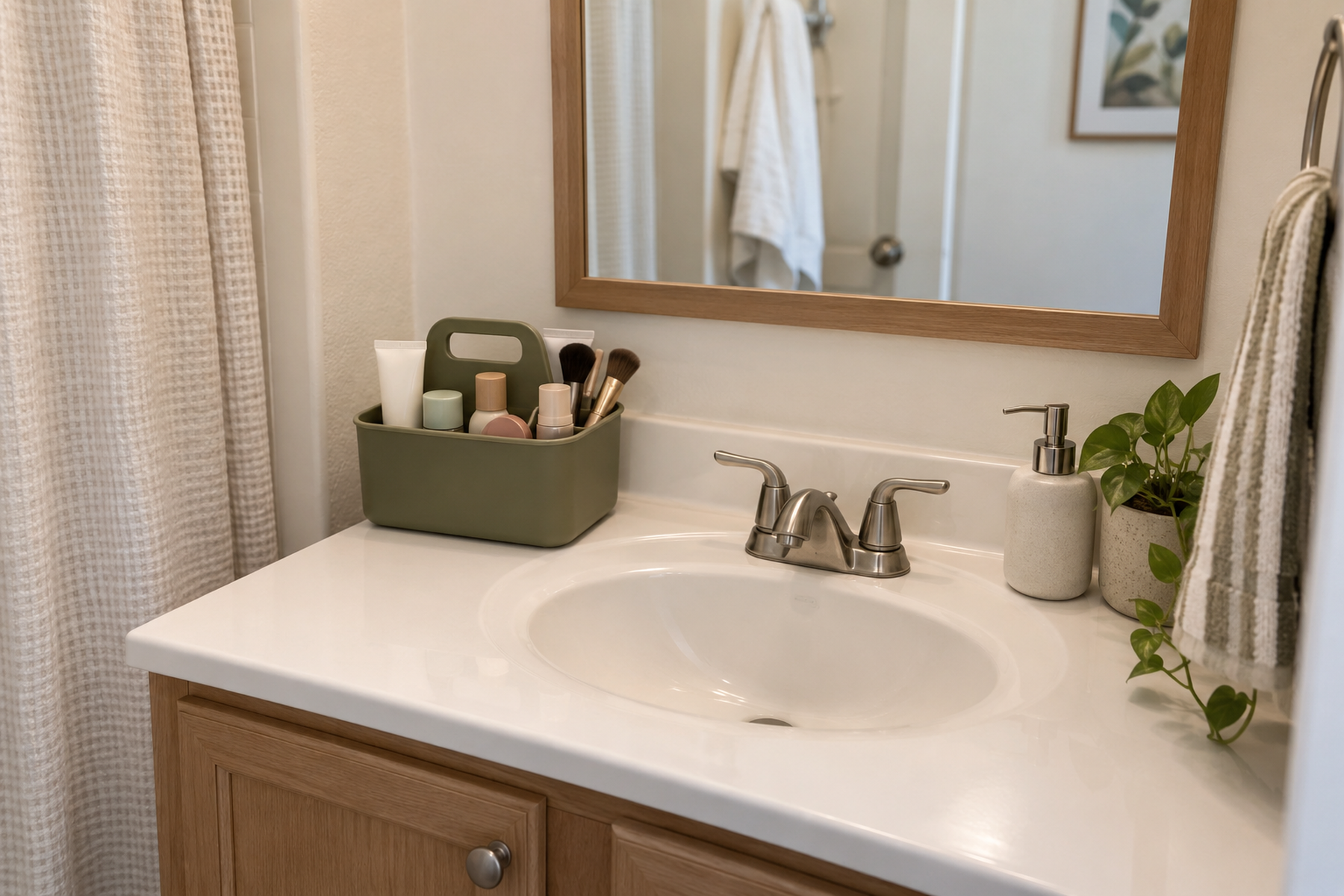
A small bathroom counter can disappear under bottles, jars, palettes, brushes, tubes, and backup products even when the actual morning or evening routine uses only a fraction of them. The result is a surface that stays cluttered because hiding everything creates too much retrieval friction.
The stronger system separates use from storage. The products needed for the current routine stay easy to reach, the counter resets after use, and products that do not need point-of-use access—or that should not live in a warm, damp bathroom—can occupy a different storage location.
Quick Answer
Organize the Routine, Not the Entire Collection
Start by identifying the products actually used every day, then check whether the bathroom is an appropriate storage environment for each one. Only after that should you choose the caddy, drawer, cart, tray, or other storage form.
01
Keep the active set small and visible
Give daily skincare and makeup the easiest access. Move backups, duplicate shades, samples, occasional masks, and other low-frequency products out of the prime bathroom zone.
02
Let the label and storage environment override organizer convenience
FDA guidance says cosmetic shelf life and microbiological stability can be affected by storage conditions. Follow manufacturer directions and do not assume every cosmetic, sunscreen, acne treatment, or combination product belongs in a steamy bathroom.
03
Use temporary point-of-use access when the counter is scarce
A portable caddy or deliberately small tray can make the routine easy without turning the sink counter into permanent storage. Reset the surface after use so washing and cleaning space returns.
01
Separate the Active Routine From the Rest of the Collection
Begin with what is used, not with what is owned. Separate the collection into an active routine, occasional products, and reserve or backup stock before choosing an organizer.
Daily storage should be sized to the first group. A moisturizer, cleanser, sunscreen, mascara, concealer, or other product that appears in the routine repeatedly deserves much easier access than a duplicate, sample, alternate shade, or product used a few times a month.
This is not a request to follow a universal decluttering quota or a generic cosmetic-expiration chart. FDA says ordinary cosmetics in the United States are not generally required to carry expiration dates, and product life depends partly on formulation, use, and storage.
Remove products the household no longer intends to use, and follow product or manufacturer guidance when a label gives an expiration or discard instruction. FDA also advises discarding cosmetics if their color or smell changes.
02
Check Which Products Should Live in the Bathroom
Treat the bathroom environment as a storage constraint, not a neutral backdrop. FDA states that exposure to moisture, such as in a bathroom, may make it easier for bacteria and fungi to grow in cosmetics.
FDA also advises storing cosmetics as manufacturers instruct and notes that microorganisms may grow faster in warm or damp conditions while preservatives may break down. That supports an environment check without turning the evidence into a blanket rule that every bathroom is unsuitable.
Skincare is not one regulatory category. FDA distinguishes ordinary cosmetics from drugs and cosmetic/drug combination products; acne treatments, skin protectants, sunscreens, and some moisturizers or makeup with SPF can fall under drug or combination rules.
Read the exact label before assigning a permanent location. Drug products and combination products can carry formal expiration and storage requirements that matter more than the convenience of a particular bathroom organizer.
Measure / Check First
Before buying organizers, measure the real active routine and test whether its containers, storage instructions, and reset path fit the bathroom you actually have.
Check Routine Volume, Product Geometry, and Storage Conditions Together
01
The true daily routine volume
Set out only the products used in a normal morning or evening routine and size the storage around that set rather than around every backup, sample, alternate shade, and occasional product.
02
Bottle, palette, brush, and drawer geometry
Measure the tallest bottles, widest palettes, smallest pencils, shallow drawers, medicine-cabinet depth, under-sink access, and any caddy or cart zone so the organizer fits the actual product shapes.
03
Bathroom conditions and the reset route
Check product storage directions, the amount of steam or splash in the intended zone, and whether the daily set can return to storage quickly enough that the sink counter does not become the permanent home again.
If an organizer fits the collection but keeps unsuitable products in a poor environment or creates so much reset friction that the counter stays full, it is not the right system.
03
Build a Portable Daily Routine Caddy
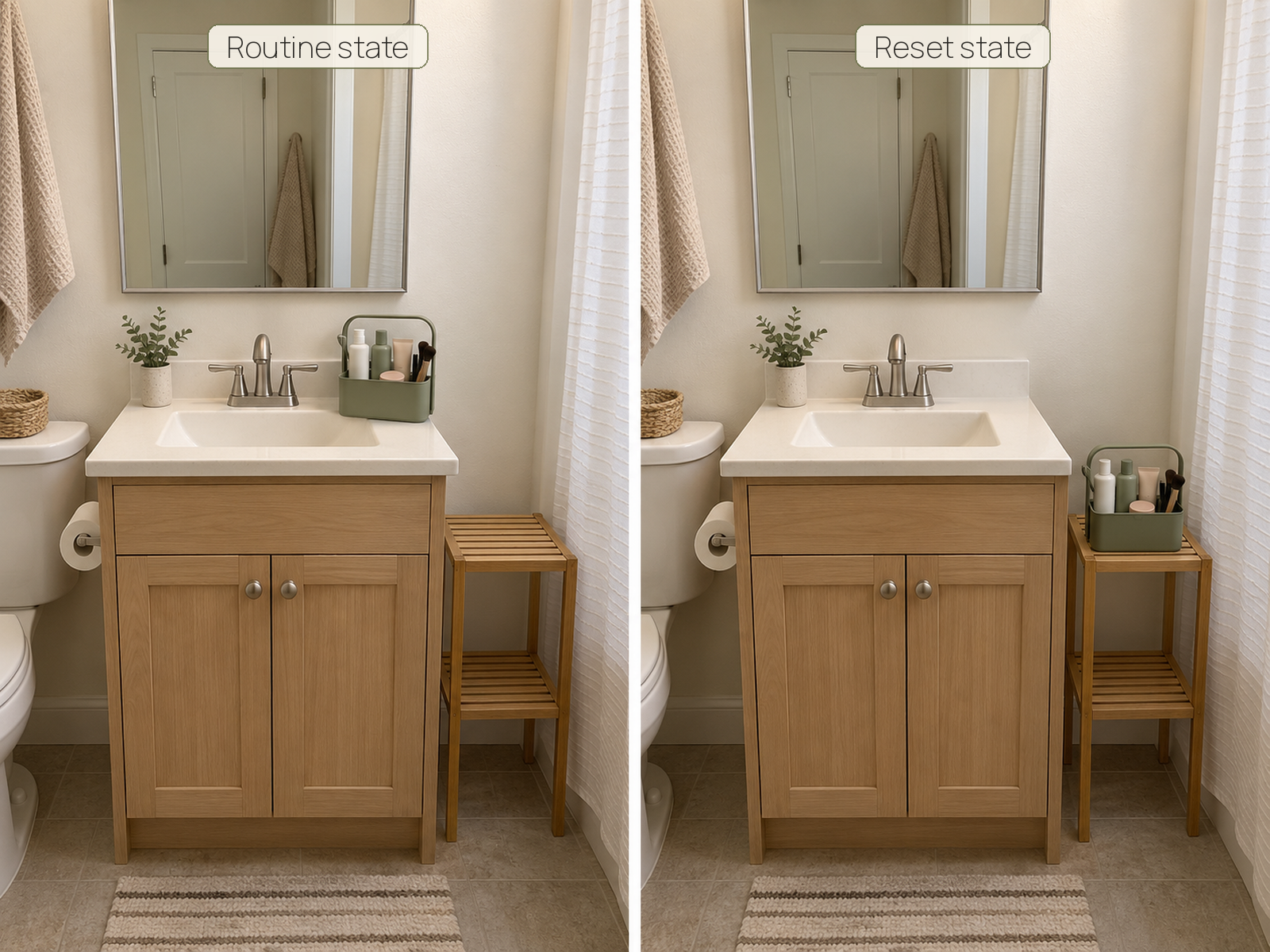
A portable caddy separates use location from storage location. Bring the active set to the sink or mirror, use the products, then return the entire group to a cabinet, shelf, cart, or nearby dry storage zone.
The caddy can follow the routine rather than the product category. One household may prefer separate skincare and makeup caddies; another may need one morning kit, one evening kit, or person-specific caddies in a shared bathroom.
Keep the loaded caddy manageable. Tall pump bottles, palettes, jars, pencils, brushes, and tubes need different geometry, and a container that becomes too heavy or crowded will lose the low-friction advantage that made portability useful.
Keep containers and applicators clean and closed. FDA advises keeping cosmetic containers clean and tightly closed when not in use, and its eye-area guidance adds particular caution around applicator cleanliness and sharing.
04
Use the Shallowest Built-In Storage for the Smallest Daily Items
If the bathroom has a shallow drawer or medicine cabinet, use that scarce geometry for products that actually benefit from it: pencils, mascara, lip products, compact makeup, small jars, and other items that are easy to lose in deep storage.
Simple dividers or shallow bins can stop tiny products from layering on top of one another, but the organizer should preserve visibility rather than turn a small drawer into multiple opaque compartments.
Larger bottles may not belong in shallow storage simply because the category is skincare. Keep them in a caddy, cabinet, cart, or another suitable location where they can stand securely and remain easy to identify.
Do not make a no-medicine-cabinet article inside this one. If the built-in shallow storage is missing entirely, treat that as a geometry fact and move to portable or freestanding capacity instead of recreating the whole bathroom architecture.
05
Use Under-Sink Storage Only When It Is Dry and Easy to Retrieve
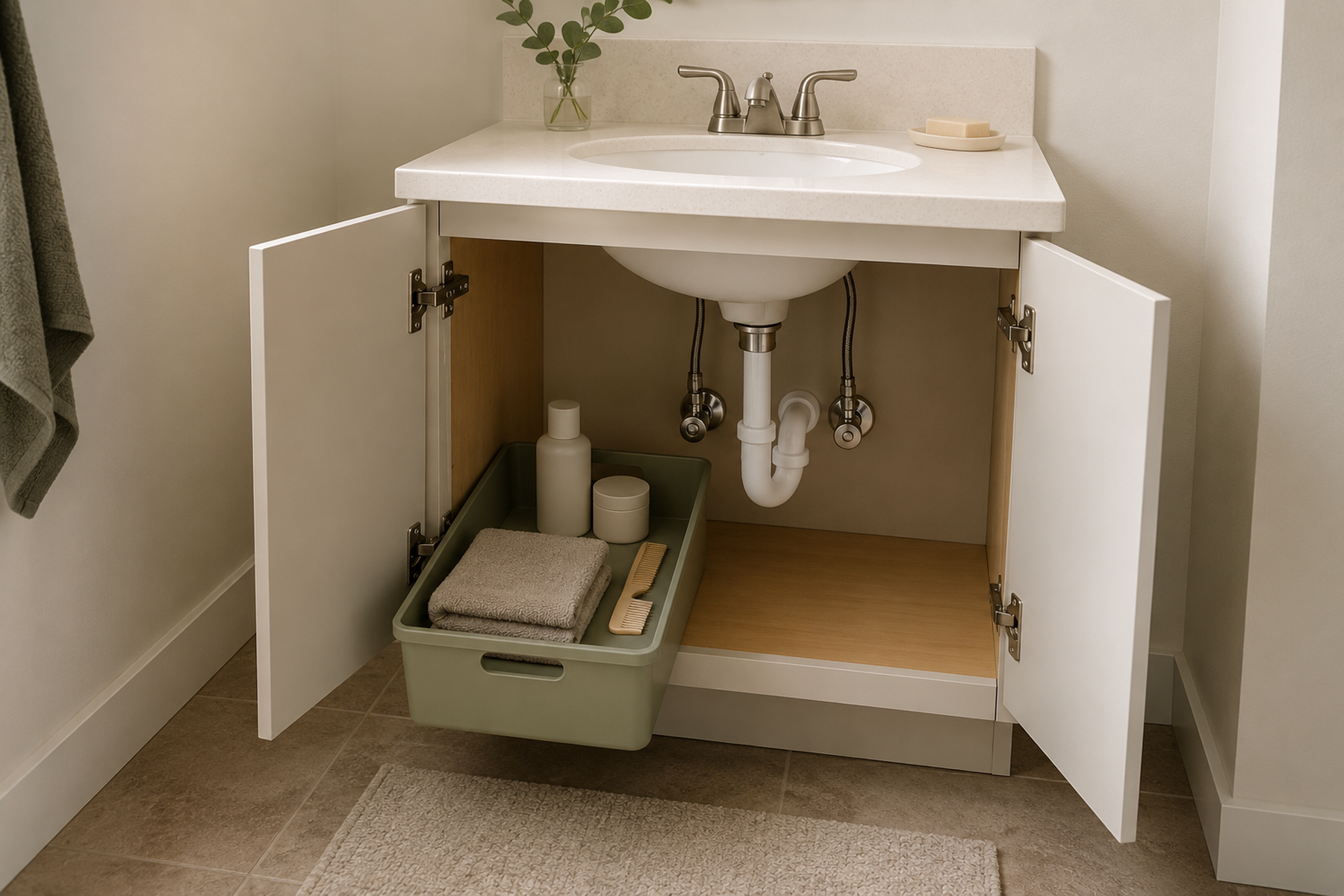
Under-sink storage can keep daily products close without using the counter, but only when the cabinet is dry, reasonably accessible, and not so fragmented by plumbing that the caddy disappears behind other categories.
Use removable bins or caddies rather than stacking individual makeup and skincare products deep behind pipes. The value is being able to retrieve the whole routine quickly and clear the cabinet when access or cleaning is needed.
Do not treat the cabinet as an environmental upgrade automatically. If it is damp, leak-prone, difficult to inspect, or routinely exposed to the same warm bathroom conditions, move storage-sensitive or reserve products elsewhere.
The strongest under-sink role is often short-distance routine storage for bathroom-suitable products, not permanent warehouse space for every backup the household owns.
06
Add a Narrow Cart Only When the Floor Lane Can Afford It
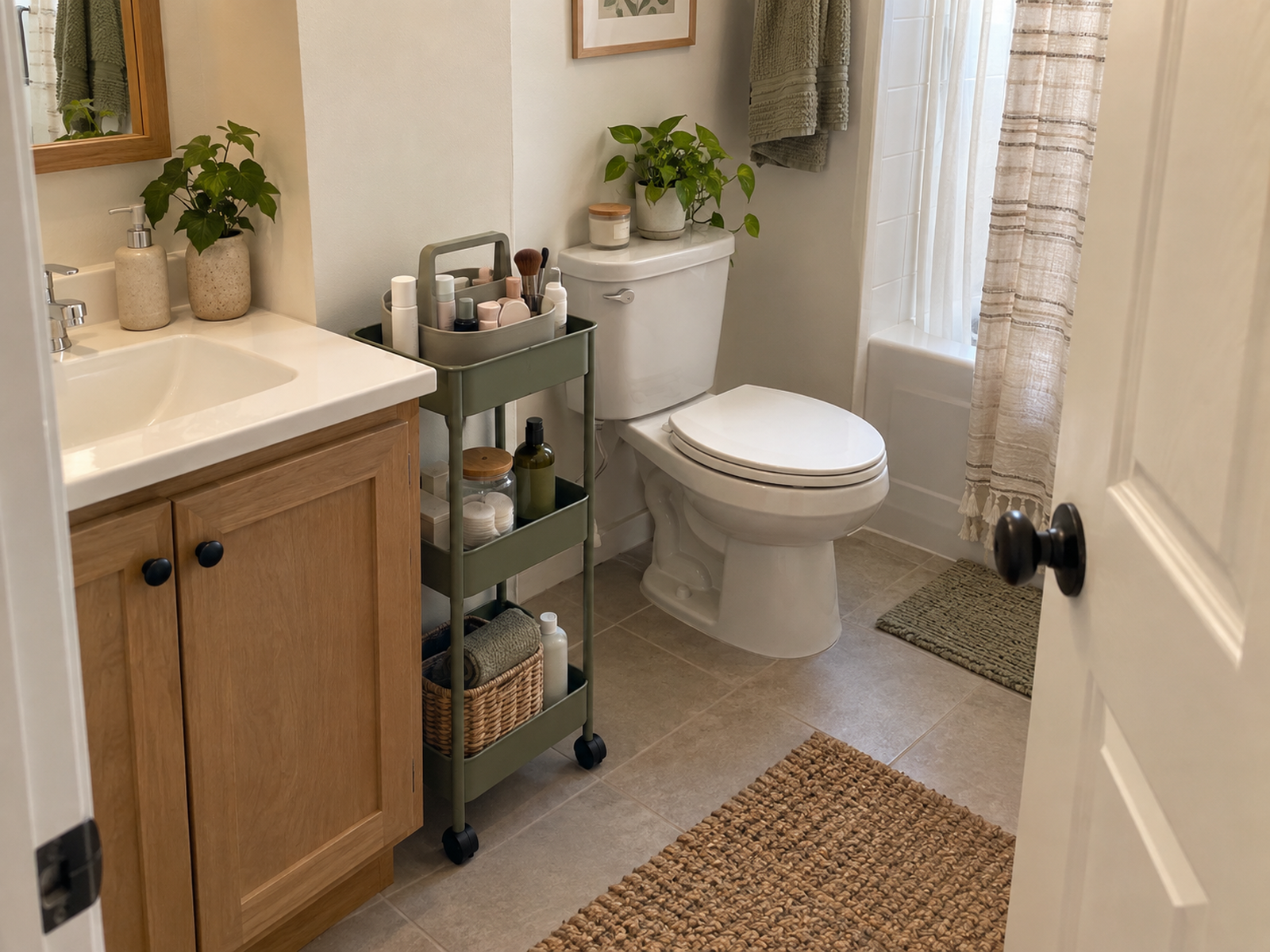
A narrow freestanding cart can add useful vertical capacity without drilling when the bathroom lacks drawers and cabinet space. Current manufacturer products such as IKEA’s VESKEN verify that very shallow rolling bathroom storage exists as a real solution family.
The spatial trade is floor area. Test the cart with the bathroom door, toilet, shower or tub access, bath-mat zone, and main circulation path in use rather than evaluating only the cart’s catalog footprint.
Use shelves deliberately. The active caddy can occupy the easiest level, while occasional products, tools, or towels use lower-priority shelves; do not fill every tier simply because the cart has capacity.
Remember that open cart storage does not change the bathroom’s temperature or humidity. It solves missing storage volume, not product-environment suitability.
07
Keep Permanent Counter Storage Deliberately Small
Some routines benefit from leaving a few products at immediate reach. A small tray can work when it contains only the true daily set and still leaves enough clear surface for washing, grooming, and routine counter cleaning.
The tray should be a boundary, not permission for the collection to expand. When occasional products, backups, and new purchases start accumulating around it, move them back into reserve storage instead of buying a larger countertop organizer.
Keep the tray outside obvious splash zones when possible and keep containers closed. An open tray improves access but does not protect products from steam, temperature swings, or bathroom moisture.
A clear acrylic tower, rotating organizer, or tiered stand can make products look orderly while still consuming the same scarce work surface. Organized and space-efficient are not the same result.
Use / Skip
A Small Countertop Daily Tray
Use
Use it when a few bathroom-suitable products earn permanent reach
A deliberately small tray can work when it holds only the true daily routine, stays outside the wettest splash zone, leaves enough counter for washing and cleaning, and the products themselves are appropriate for the bathroom under their labels and manufacturer instructions.
Skip
Skip it when the tray becomes the collection or the environment is the problem
Use a portable caddy or off-bathroom storage instead when the tray expands into backups and occasional products, blocks the sink work surface, sits in constant splash, or keeps storage-sensitive products in a bathroom that is consistently warm or steamy.
08
Move Reserve and Storage-Sensitive Products Out Before Adding Installed Storage
Before adding another shelf or cabinet, move reserve stock, duplicates, samples, occasional products, and any product whose storage instructions favor a different environment into a suitable dry location outside the bathroom.
A split system can preserve routine consistency: keep the active set in a portable caddy, bring it into the bathroom for use, then return it to a bedroom drawer, closet bin, or other appropriate location afterward when the bathroom itself is a poor long-term home.
If portable and freestanding storage still does not provide enough capacity, a bathroom-rated adhesive hook with a light pouch or caddy can be a conditional no-drill branch. Check the exact product’s load, compatible surfaces, installation, and removal instructions rather than assuming every adhesive is rental-safe.
Screw-mounted shelves and surface-mounted cabinets belong later because wall structure, fasteners, load, drilling, and lease approval become part of the project. Do not add permanent bathroom storage merely to avoid distributing reserve products elsewhere.
Closing Decision
Let the Counter Reset and Let the Products Live Where They Belong
The strongest small-bathroom beauty system is not the organizer that holds the largest collection beside the sink. It is the system that gives the active routine easy point-of-use access, lets the counter return to a usable work surface, and keeps each product in a location compatible with its label and the actual bathroom environment.
Edit the bathroom down to the routine, use portable and built-in storage before adding new fixtures, and move reserve or storage-sensitive products out when that is the better home. When more bathroom capacity is still necessary, escalate from freestanding to surface-dependent removable storage and only then to installed shelving or cabinetry.
RELATED GUIDES
What to Read Next
NEXT GUIDE
How to Organize a Bathroom Vanity With No Drawers—Without Filling the Counter
Use this next if makeup and skincare are only part of a broader no-drawer vanity problem; that guide handles the whole storage architecture around the sink while protecting the work surface.
GUIDE
How to Organize a Small Bathroom With No Medicine Cabinet
Use this if the bathroom lacks shallow eye-level storage entirely; that guide focuses on replacing the missing medicine-cabinet function without turning the counter into the default storage zone.
GUIDE
How to Store Hair Tools in a Small Bathroom Without Losing Counter Space
Use this if powered or hot styling tools are competing with the same get-ready surface; that guide handles cooling, cords, access, and storage for hair tools as a separate operating category.