
Small Apartment Storage Ideas
How to Organize Recycling in a Small Apartment With No Sorting Space
Start with what your building or local recycling program actually requires: keep only the necessary in-unit streams, flatten cardboard immediately, use carryable capacity instead of oversized bins, and let trip frequency reduce how much recycling lives in the apartment at once.
In This Guide
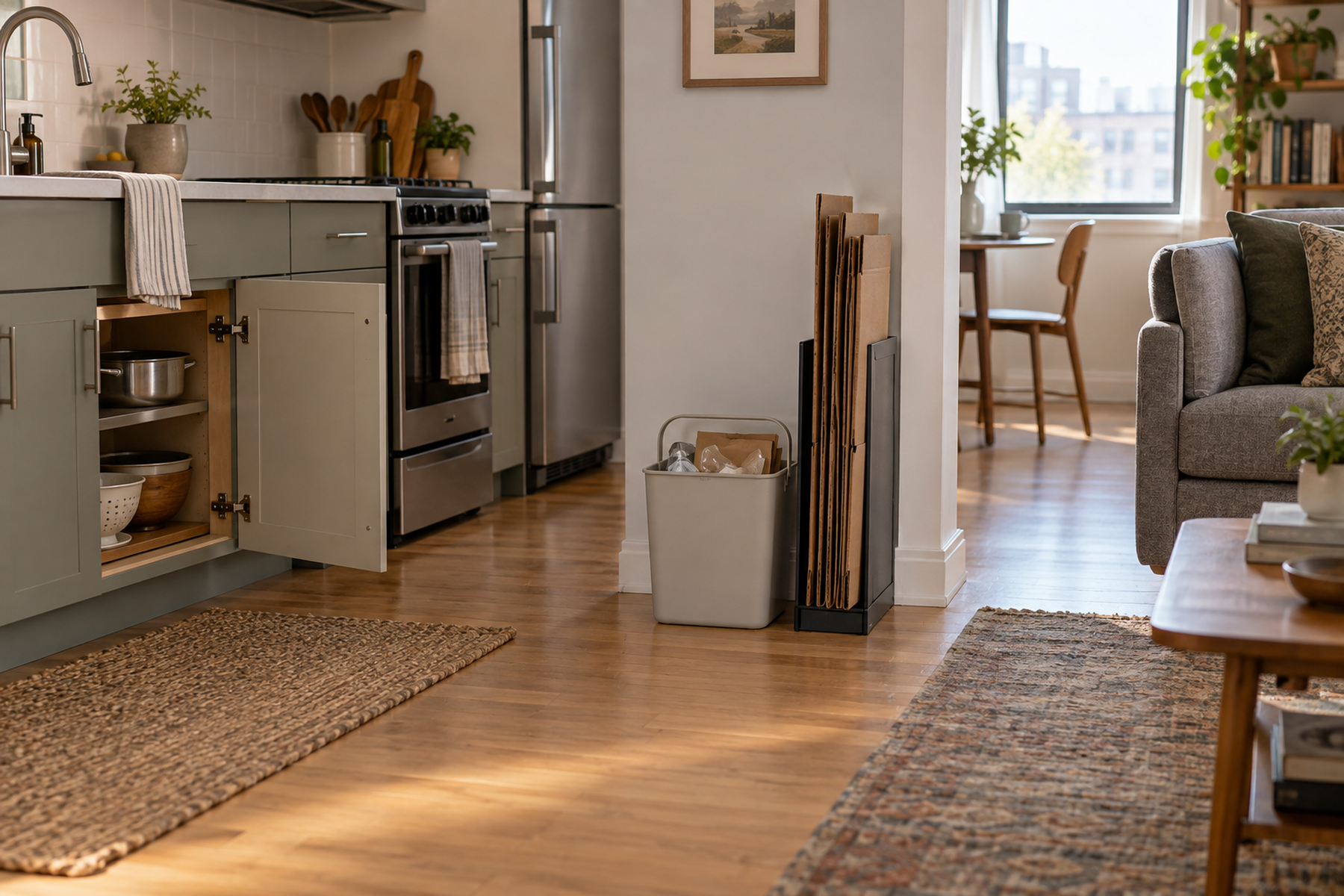
A small apartment can run out of recycling space long before it runs out of recyclable material. The usual response is to add more bins, but that can create an in-unit sorting system that is more complicated than the building or local program actually requires.
Treat recycling as temporary logistics rather than long-term storage. The apartment should capture only the streams the destination needs, reduce bulky material before it accumulates, and move recyclables out on a cadence that protects the home’s floor, cabinet, and circulation space.
Quick Answer
Sort to the Destination, Not to an Imagined Ideal
The building recycling room, shared carts, chute area, or local drop-off should determine how many categories exist inside the apartment. A compact system is strongest when the apartment does no more sorting than the collection program needs.
01
Verify the actual collection system first
Check what the building or local program accepts, whether it is single-stream or multi-stream, whether recyclables must be loose, and which materials require a separate drop-off or special collection route.
02
Use the smallest carryable capacity that supports the trip
A small handled bin or tote emptied more often can use less permanent apartment space than a large recycling station. The route through doors, halls, elevators, stairs, or outdoor enclosures is part of the storage system.
03
Treat cardboard as a shape-change problem
Empty and flatten boxes promptly, then stage the flat pieces vertically in one bounded dry slot. Cardboard often needs a narrow staging zone more than it needs another full-size bin.
01
Check the Building or Local Recycling Rules Before You Buy Bins
Start with the destination. EPA says recycling programs vary locally, and residents should verify what their local program accepts instead of assuming one national list applies everywhere.
Determine whether the building or local system is single-stream or multi-stream. EPA notes that some programs accept different recyclable materials together while others require separate streams.
Then check the details that change the apartment setup: whether materials need to be loose at the communal bin, whether glass or cardboard is separated, and whether bags, film plastic, batteries, electronics, or other special items use a different collection route.
Do not build a four-bin apartment system simply because paper, plastic, glass, and metal are four recognizable categories. If the destination accepts them together, the extra in-unit separation may consume space without improving the actual recycling process.
02
Decide How Many Streams Actually Need to Exist Inside the Apartment
Match the number of containers to the collection system. A verified single-stream program may need only one main in-unit capture container plus a separate cardboard staging slot.
A building that genuinely requires two streams can justify two smaller containers—for example, fiber and cardboard separated from accepted bottles, cans, or jars—when that matches the posted rules.
Keep special items out of the main system. Batteries, electronics, household hazardous waste, film plastic, textiles, or other exceptions may have separate collection paths depending on the local program; they do not automatically justify more full-size recycling bins.
The apartment’s job is to prepare material for the next step, not to recreate the entire municipal sorting system inside the home.
Measure / Check First
Before buying bins, stackers, pull-outs, or door-mounted containers, test the collection rules and the entire trip from the apartment to the final collection point.
Check the Program, Carry Route, and Volume Peak First
01
The actual collection rules
Confirm accepted materials, single-stream versus multi-stream collection, loose-versus-bagged requirements, cardboard instructions, and special-item exclusions using the building signage and local program guidance.
02
The full carry route
Measure the loaded container against the apartment door, hallway, elevator or stairs, recycling-room door, outdoor enclosure, or drop-off route. The container should remain manageable when full and easy to empty into the final stream.
03
The material that creates the volume peak
Watch which material fills the apartment first. Cardboard, bottles, cans, or another stream may determine the trip cadence even when the rest of the container is not full.
If a system fits the apartment but does not match the destination, or matches the destination but becomes too heavy or awkward to carry there, the recycling workflow is not finished.
03
Use One Portable Bin When the Program Is Single-Stream
A single portable capture bin can be the most space-efficient in-unit system when the building or local program genuinely accepts mixed recyclables together.
Choose a size the household can carry comfortably to the destination. A handled tub, rigid tote, reusable carry bin, or another simple container can be more useful than a larger fixed bin when the trip happens through a hall, elevator, stairs, or parking area.
Keep the material in the state the program requires. EPA recommends keeping recyclables clean and dry and keeping food and liquids out; local instructions can be more specific.
The carrier and the recyclable material are not automatically the same thing. Some programs require residents to empty recyclables loose into the communal container rather than putting the carrying bag into recycling.
Use / Skip
One Portable Mixed-Recycling Bin
Use
Use it when the destination is genuinely single-stream
One portable bin can replace several in-unit containers when the building or local program accepts the relevant paper, cardboard, metal, glass, or approved plastics together, the load remains manageable, and the final container can be emptied according to the program’s loose or bagged rules.
Skip
Skip it when the collection system requires separation
Use separate in-unit streams only when the building or local program actually requires them, or when one material—such as cardboard—creates a distinct physical staging problem. Keep batteries, electronics, hazardous items, and other special streams out unless the program explicitly accepts them.
04
Flatten Cardboard Before It Becomes Apartment Storage
Cardboard is often the largest recycling problem in a small apartment because delivery boxes occupy their shipping volume until someone changes their shape.
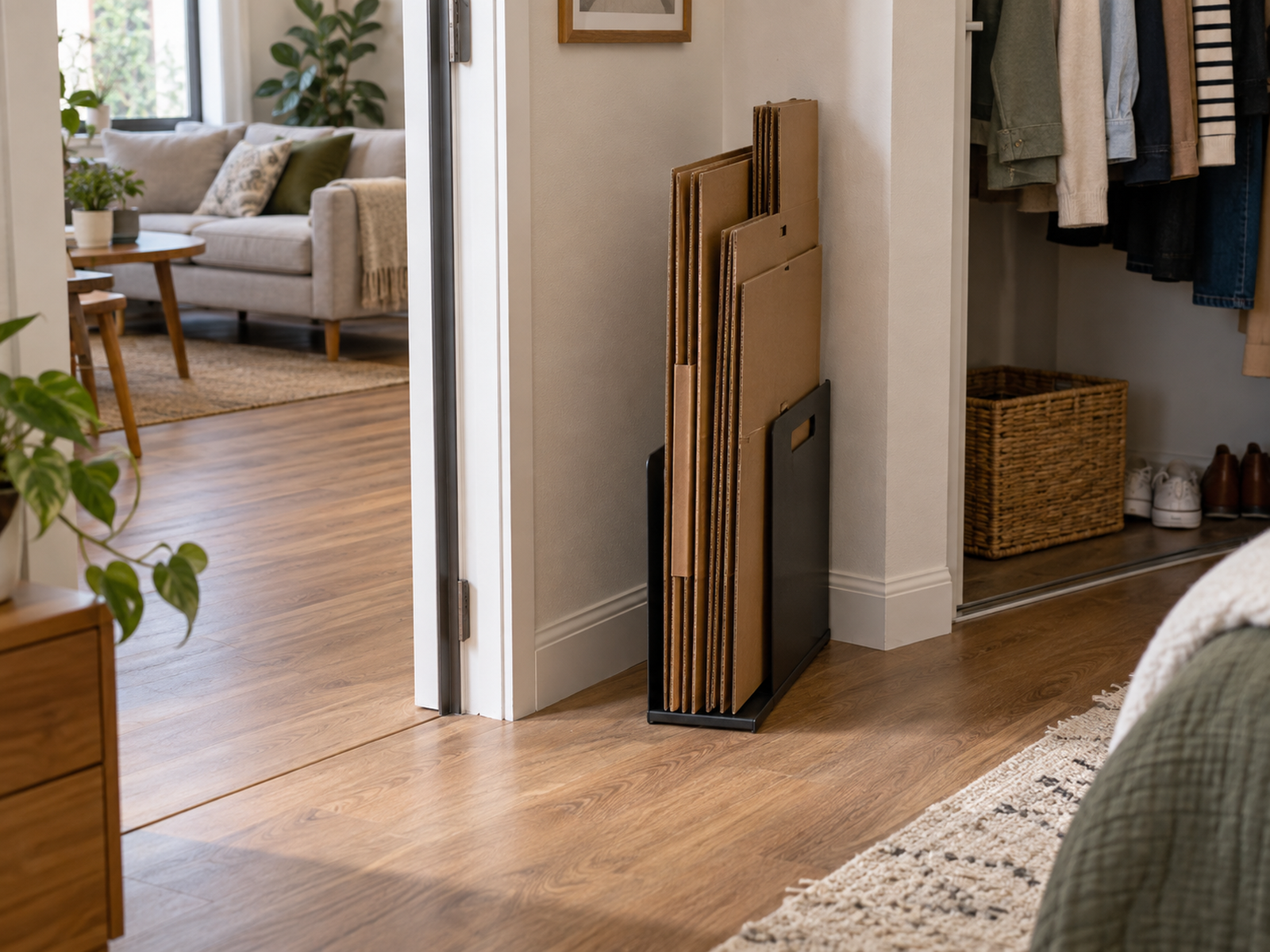
EPA specifically recommends emptying and flattening cardboard boxes before recycling. Flattening turns bulky three-dimensional packaging into a thin stack that can use a narrow vertical slot instead of a large floor container.
Choose one bounded dry staging location: a narrow closet side, a reusable box, a wall-adjacent slot outside circulation, or another legitimate in-unit storage edge that stays easy to empty.
Do not let flattened cardboard migrate into the hallway or primary exit route. Public or common circulation is not private overflow space, and wet or food-contaminated cardboard should follow the actual local program’s rules rather than being mixed automatically with clean dry fiber.
05
Use Two or Stackable Streams Only When the Rules Justify Them
Multiple containers make sense when the destination requires multiple streams or when the household has a real volume split that one portable bin cannot manage cleanly.
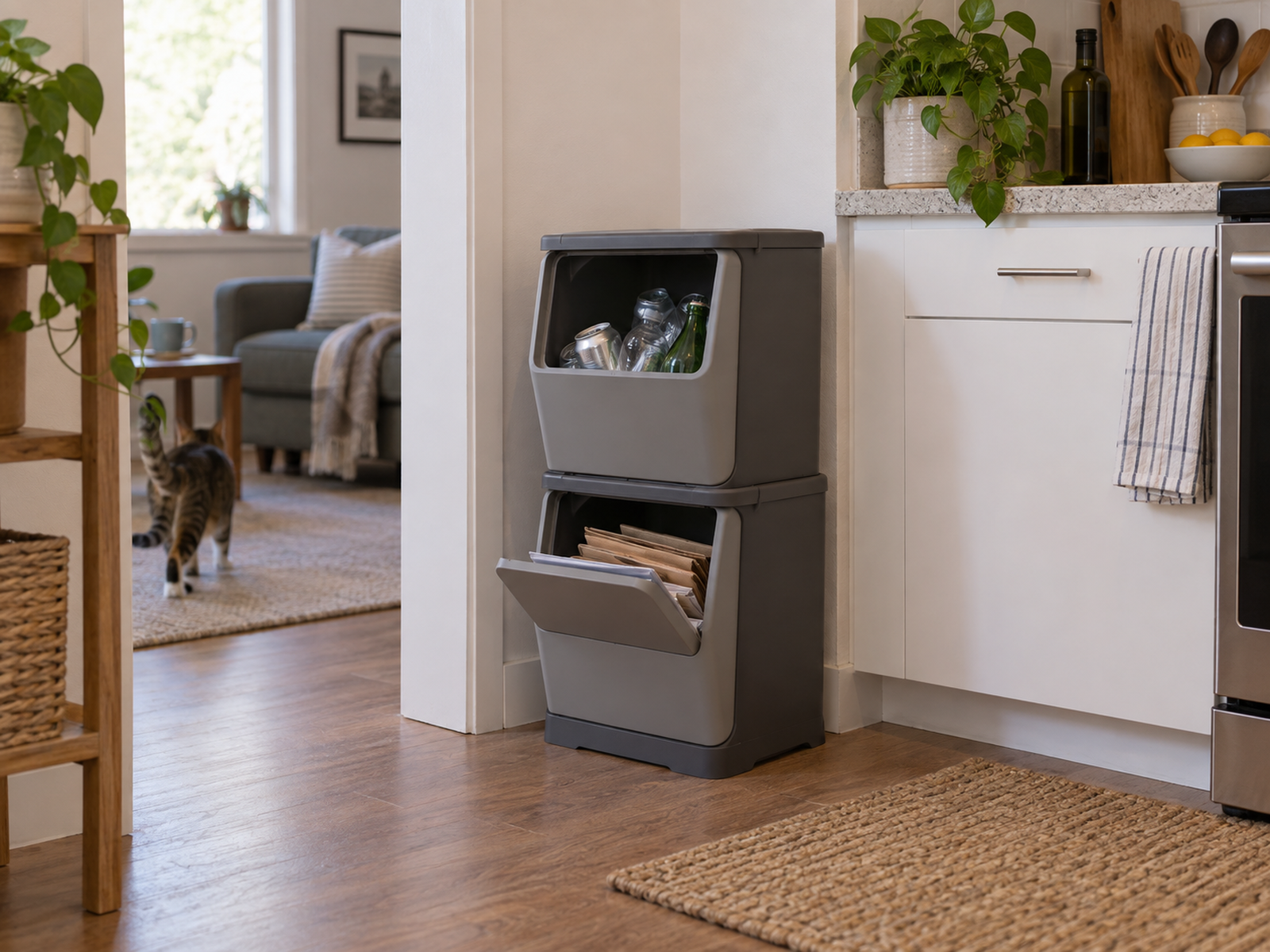
Stackable freestanding bins can save floor width by spending vertical space. Current systems such as IKEA HÅLLBAR verify that stackable recycling containers are a real storage architecture, but the apartment should not stack categories simply because the product can.
Keep access practical. A bottom stream that requires lifting a heavy upper bin for every deposit may save floor width while increasing daily friction enough that the system stops working.
If two small streams are required, give the highest-frequency or heaviest stream the easiest access and keep the stack stable, light enough to handle, and out of door or circulation paths.
06
Let Trip Frequency Replace Permanent Bin Capacity
Outbound cadence is a legitimate small-space storage tool. A smaller bin emptied every few days can protect more apartment floor area than a large container designed to hold a week or two of material.
Set the trip trigger around the material that fills fastest or becomes awkward to carry—not around a universal gallon number. The right capacity depends on household volume, building distance, stairs or elevators, and how often the route is realistic.
A folding handle or comfortable grip can matter more than maximum capacity when the destination is several doors or floors away. The recycling container is also a transport tool.
Do not let a larger bin compensate for a route the household rarely uses. If recycling repeatedly overflows, change the outbound rhythm or the collection access problem before dedicating more permanent apartment space.
07
Connect the In-Unit System to the Shared Recycling Room
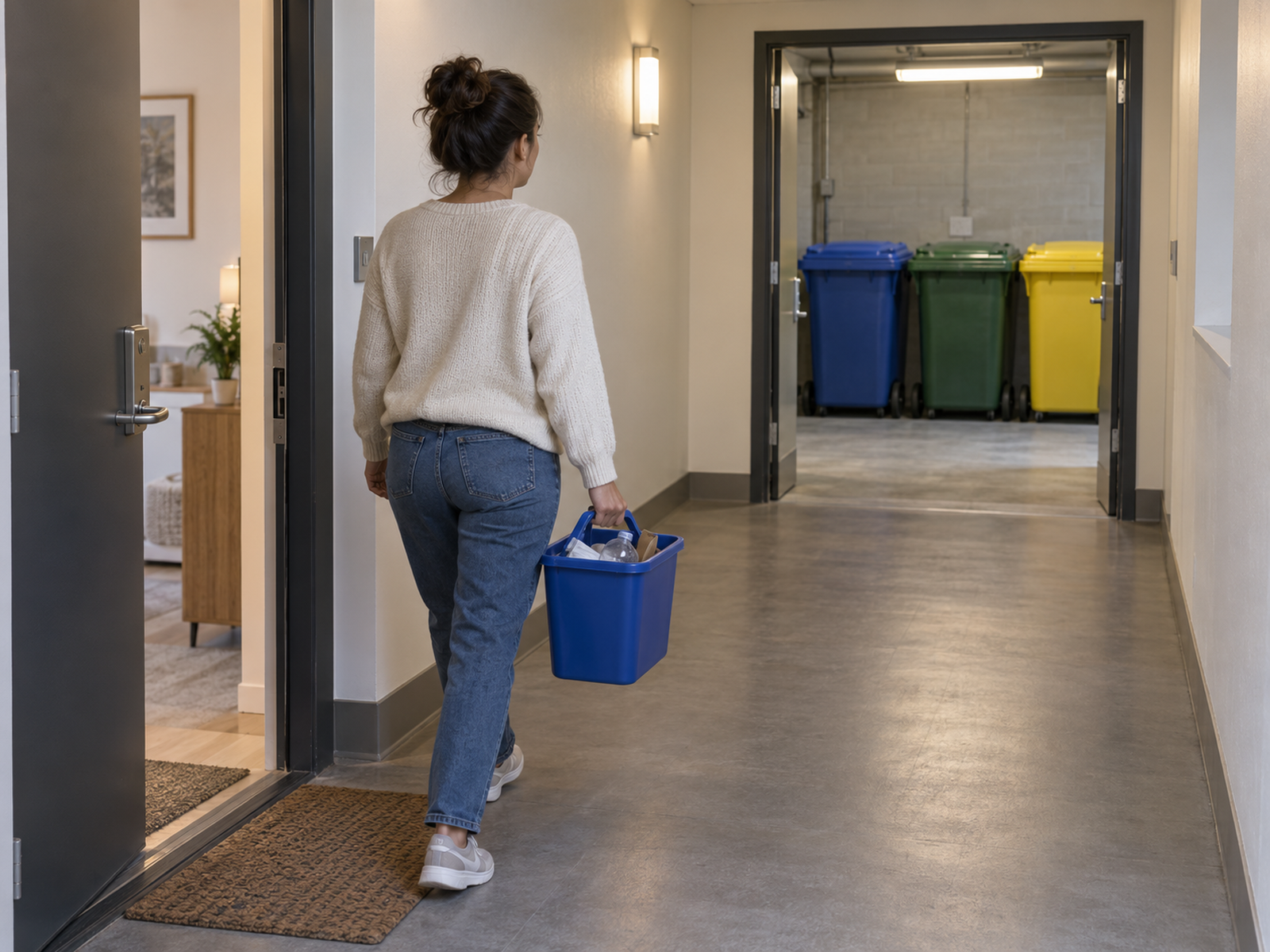
The recycling room, outdoor carts, chute area, or other communal collection point is part of the apartment organization system. Read the actual signage there and make the in-unit setup mirror those final streams.
Seattle’s multifamily guidance provides a useful jurisdiction-specific example: residents with limited apartment space may use simple capture containers such as a paper grocery bag, plastic tub, or cardboard box and then place recyclables into the building container according to local rules.
Carry the in-unit container to the destination and empty it cleanly rather than turning the communal area into an overflow sorting table. If final sorting is permitted there, keep it quick and follow the posted labels.
Keep one tiny exception container only for materials that genuinely need a different route. A small battery or electronics box can prevent contamination without multiplying the main recycling station into several permanent bins.
08
Build a Realistic Plan When the Building Does Not Provide Recycling
When the building has no recycling service, the problem changes from in-unit organization to access and transport. A larger recycling station cannot create missing infrastructure.
First verify that service is truly unavailable and ask property management what options exist. Then check the city, county, transfer station, convenience center, retailer, or other local program for accepted materials and drop-off requirements.
Set a staging limit based on the transport reality. If the household has no car, the nearest drop-off is difficult to reach, or cardboard volume grows faster than trips can happen, store only what can realistically be removed and prioritize reduction or reuse where practical.
Do not assume every U.S. landlord has the same recycling obligation. Municipal solid-waste rules and multifamily requirements vary by jurisdiction; examples from Seattle, Austin, or New York City demonstrate possible systems, not one nationwide rule.
Closing Decision
Keep Recycling Moving Instead of Building a Waste Room
The strongest small-apartment recycling system does not maximize the number or capacity of bins. It matches the actual collection program, shrinks bulky material before it accumulates, and moves recyclables out of the apartment often enough that temporary capture never becomes permanent storage.
Verify the destination first, use one carryable stream when single-stream rules allow it, add a second or stacked stream only when the program earns the footprint, and let flattened cardboard and outbound cadence do more work than oversized containers.
RELATED GUIDES
What to Read Next
NEXT GUIDE
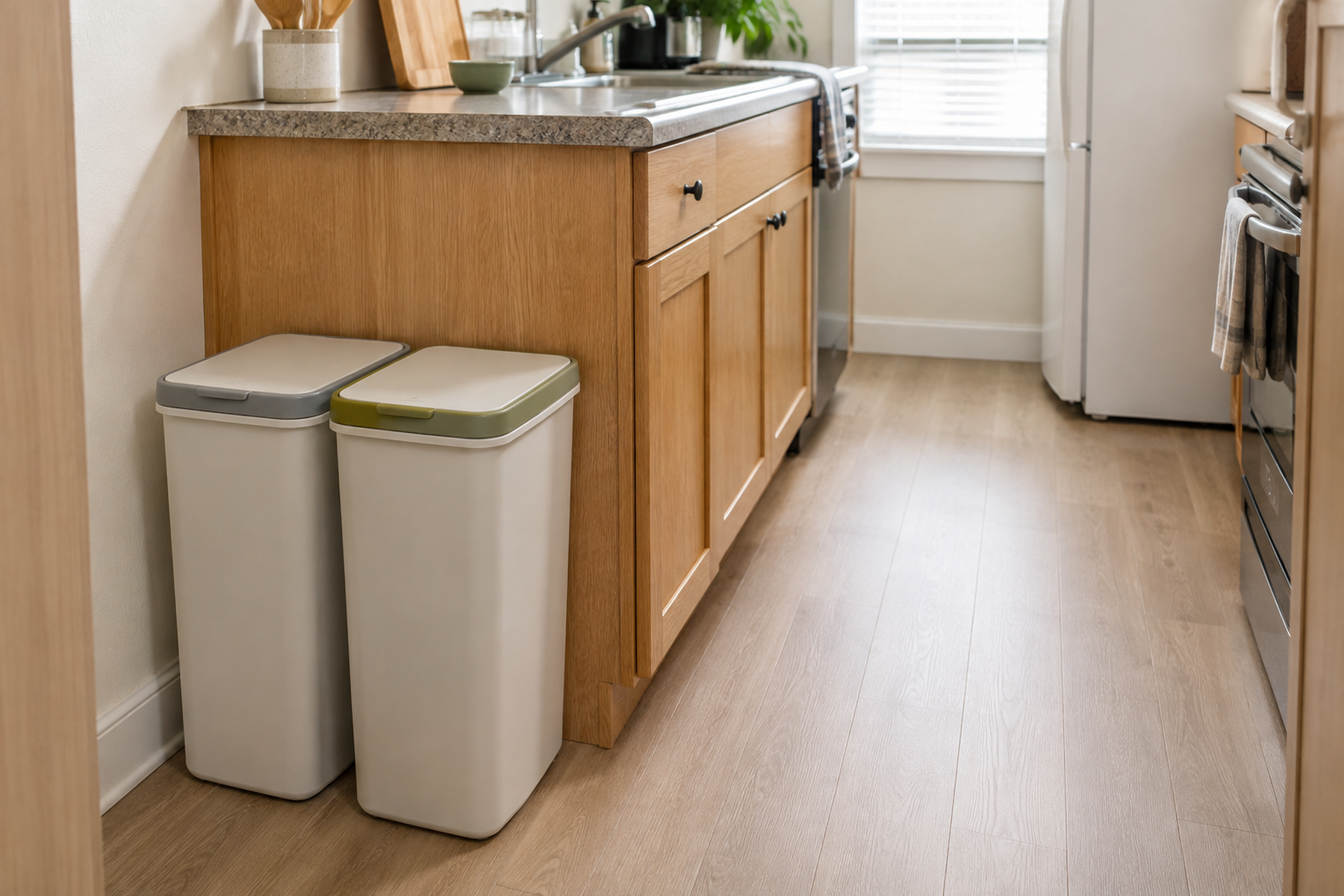
How to Create a Trash and Recycling Zone in a Small Kitchen
Use this next if the apartment-wide workflow is clear but the kitchen still needs a physical trash and recycling capture point; that guide focuses on cabinet, floor, and daily-use geometry inside the kitchen.
GUIDE
How to Store Food Scraps for Compost Collection in a Small Kitchen With No Counter Space
Use this if organics or food scraps create a separate collection stream; that guide handles the container, state, and outbound routine for apartment compost collection.
GUIDE
How to Store Household Backstock in a Small Apartment With No Storage Closet
Use this if bulk packaging and household supplies are contributing to the recycling volume; that guide helps reduce stored backstock competition before the packaging reaches the recycling stream.