
Small Bathroom Storage
How to Store Period Products in a Small Bathroom With No Storage Near the Toilet
Keep a small working supply of the products you actually use within easy reach of the toilet, then separate bathroom reserve from bulk backstock so scarce floor, wall, and shelf space is not sized around the retail package.
In This Guide
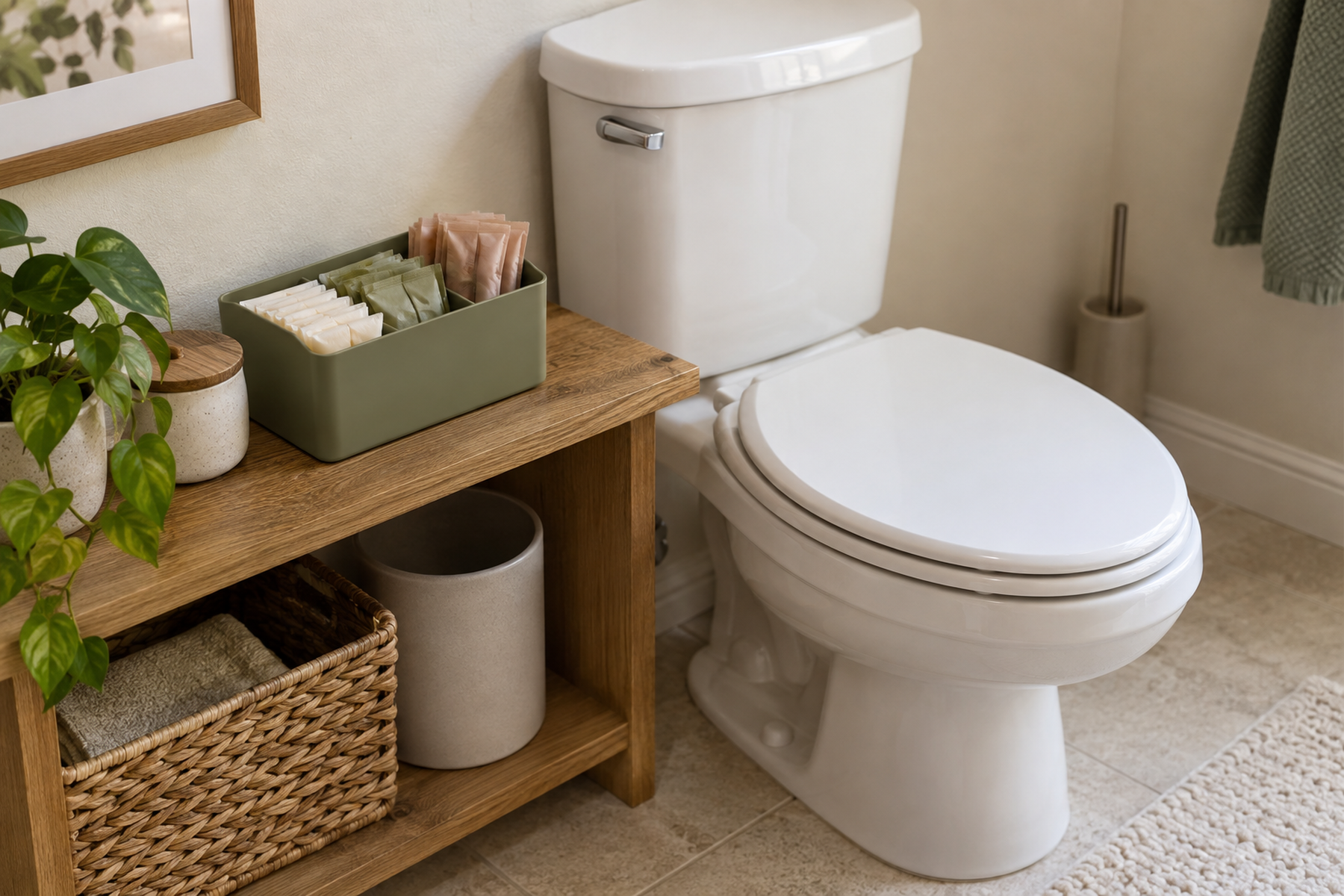
Period products have a different access requirement from many bathroom categories: being neatly stored somewhere in the apartment is not enough if the product is needed after the user is already in the bathroom. A high shelf, deep vanity, or bedroom closet may hold plenty of inventory and still fail at the moment of use.
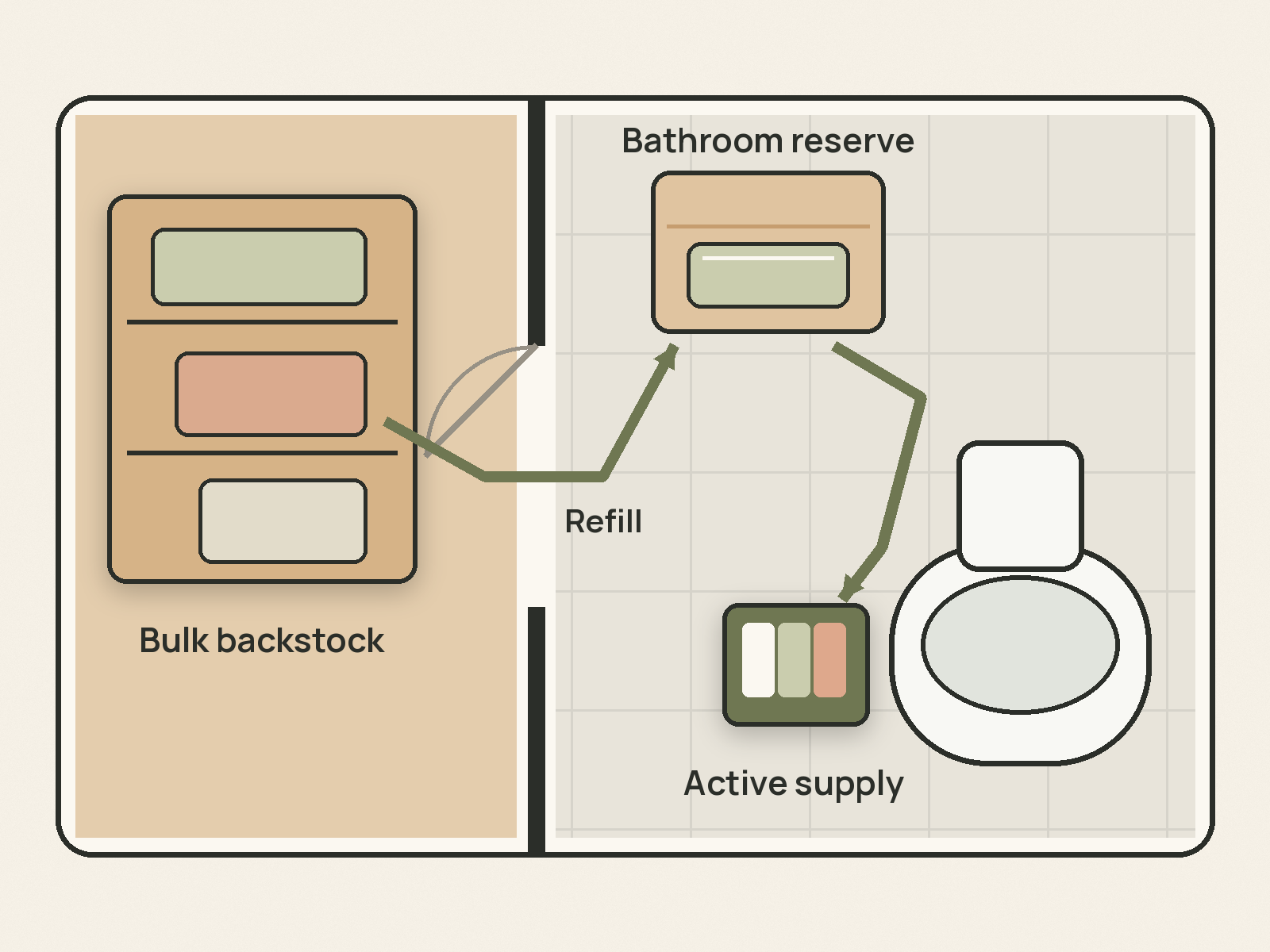
A small bathroom works better when the inventory is split by job. Keep a small active supply close to the toilet, use a second bathroom reserve only if the room has capacity for it, and let bulk packages live elsewhere when they would consume too much prime bathroom space. The organizer then has to solve reach, product recognition, visibility preference, splash exposure, and renter-compatible mounting—not maximum capacity.
Quick Answer
Keep the Working Supply Close and the Bulk Package Somewhere Else
01
Create a small point-of-use reserve
Keep enough of the product types you actually use near the toilet to avoid leaving the bathroom for a replacement, but do not size the organizer around the full retail package.
02
Separate products only as much as recognition requires
Use broad compartments, visible wrappers, or clearly defined sections so different pads, liners, or tampons are easy to identify without forcing every format into tiny fixed dividers.
03
Use the least-committed surface that really works
An existing ledge or shelf is simplest, a compatible adhesive bin can recover floor and counter space, and a narrow freestanding unit is useful only when its full footprint does not interfere with toilet use or cleaning.
04
Choose visible or discreet storage after access is solved
Personal storage can be open or concealed by preference; guest supplies may need clearer visual signaling so visitors know the products are available without searching private cabinets.
01
Build the Near-Toilet Supply First
Begin with the products that need to be available at the moment of use. That usually means a small working reserve near the toilet rather than every unopened box or multipack the household owns.
Current user discussions show why this matters. People who moved pads to a bedroom or another room sometimes reported forgetting to bring one into the bathroom and then having to go back and forth. A beautiful backstock system does not solve that failure.
Do not turn the active reserve into a fixed number. Product mix, usage, household size, and refill habits vary too much. The useful threshold is operational: the near-toilet supply should be reliable enough that an ordinary use does not require leaving the bathroom, while remaining small enough that it does not dominate the room.
This also keeps retail packaging from dictating the bathroom footprint. Buying a larger package is a purchasing decision; it does not mean the entire package belongs beside the toilet.
02
Make Product Types Easy to Identify
Containment alone is not enough when several product types look similar. The storage should make it quick to distinguish the pad, liner, tampon, or other packaged item the user intends to reach for.
A few broad sections are usually more adaptable than a grid of narrow fixed compartments. Pads vary in package width and thickness, tampon applicators vary in length, and households change brands or absorbencies over time. Over-specific dividers can create empty space around one format and a poor fit around another.
Original wrappers can also carry useful identification. If decanting removes the cues the user relies on, the organizer has made the category harder to use even if the bathroom looks calmer.
Reusable period products can have different washing, drying, and storage requirements. Keep this article’s active-supply logic focused on packaged products unless the exact reusable product instructions support a specific storage method.
Measure / Check First
Before buying a bin, dispenser, cart, or caddy, verify the active-supply job and the exact bathroom location rather than shopping by capacity alone.
Check Reach, Product Fit, and Mounting Before You Commit
01
Point-of-use reach
Sit or stand where the product will actually be needed and confirm that the active supply can be reached without leaving the bathroom, unloading another category, or relying on a high or deep storage zone.
02
Product recognition and container fit
Check the largest pad or tampon package format you plan to keep in the active zone and make sure the organizer preserves enough wrapper or compartment information to identify different types quickly.
03
Surface, splash, and installation fit
Confirm that the location is dry enough to avoid routine splash exposure and that any adhesive or mechanical mounting system is approved for the exact surface and acceptable for the rental. For floor storage, measure the entire footprint and cleaning path.
If the organizer holds a large quantity but makes the correct product harder to identify, sits outside practical reach, occupies the cleaning or walking path, or depends on unverified mounting, reduce the storage job or choose another surface.
03
Use Existing Near-Toilet Space Before Adding Hardware
An existing stable shelf, vanity ledge, or other dry surface near the toilet is the lowest-commitment place to test the active reserve. A small open or lidded box can establish the workflow before the household buys a wall system or gives up floor area.
Keep the container shallow enough that the needed product is not buried under several layers. A deep decorative box can look tidy while recreating the same search problem as a crowded cabinet.
Toilet-tank storage is conditional rather than universal. Tank lids vary in shape and stability, and the lid may need to be removed for service. If the container interferes with plumbing access, feels unstable, or crowds normal use, move the active supply to another surface.
Keep packaged products away from locations that are routinely splashed or exposed to water. FDA emergency guidance treats water-damaged packaged feminine-hygiene products cautiously, but that should not be expanded into a claim that ordinary bathroom humidity automatically makes all period products unsafe.
04
Use Adhesive Wall Storage Only on a Verified Surface
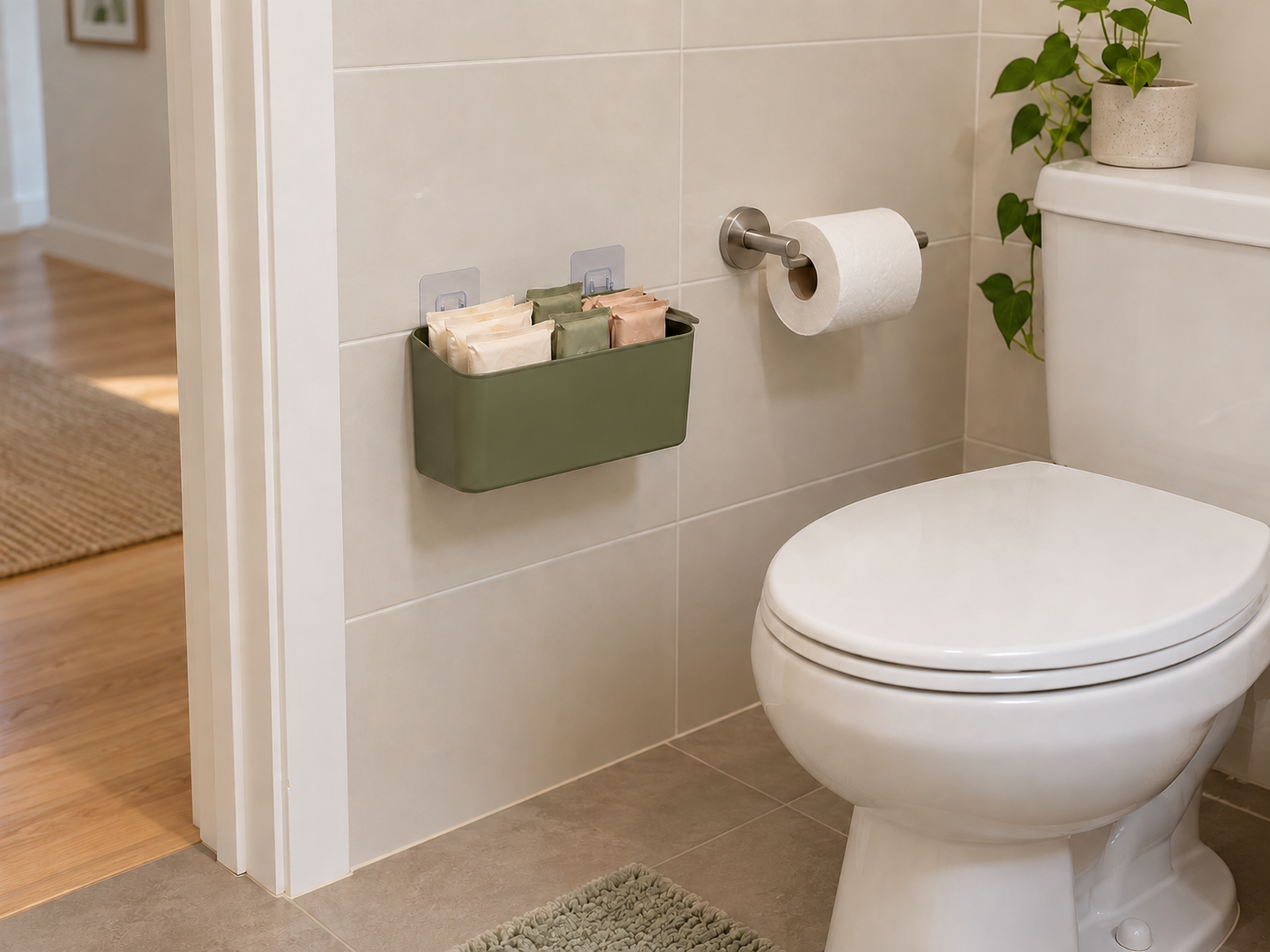
When no usable ledge or cabinet exists near the toilet, a compact wall bin can recover point-of-use storage without spending floor area. The renter question is not simply whether the organizer says “adhesive.” The exact product, surface, load, installation, and removal instructions have to agree.
Current 3M Command Bath products demonstrate a legitimate water-resistant, no-tool bathroom-mounting class on supported surfaces. That supports the method, not a universal claim that any adhesive bin can be mounted on any bathroom wall.
Umbra’s current Flex Adhesive Bin documentation warns that damage can occur when adhesive mounting is removed from drywall, concrete, wallpaper, and porous surfaces even though the product is positioned as non-damaging on tile.
Commercial period-product dispensers show how compact the wall form can be. Aunt Flow’s current Display Box is about 7.2 by 3.62 by 4.13 inches and can sit on a flat surface or mount with included Command strips. It is a useful form-factor reference, not a reason to turn a home bathroom into a commercial dispenser setup.
Place any wall bin where it can actually be reached and refilled without interfering with toilet-paper hardware, doors, towels, or cleaning. A wall solution that is too high to use easily has recovered surface area by sacrificing the main reason the storage exists.
05
Use Floor Storage Only in a True Residual Zone
A narrow freestanding bin or small cart can create excellent point-of-use access without touching the wall, which makes it highly reversible in a rental. The cost is floor space—the scarcest resource in many small bathrooms.
Measure the complete footprint, including feet, casters, handles, and the space needed to pull the unit forward or open it. A product marketed as slim can still be too long for the strip beside the toilet.
The storage should not narrow the approach to the toilet, catch the bathroom door, block a trash can, or make routine floor cleaning awkward. If those conflicts appear, the floor strip is not residual space.
Keep the category bounded. A period-product bin that gradually absorbs toilet paper, cleaning supplies, extra toiletries, and towels will expand until the original point-of-use benefit disappears.
06
Use a Portable Caddy When Permanent Storage Is Impossible
A handled basket or caddy is the most flexible answer when the bathroom cannot permanently spare wall, shelf, cabinet, or floor space. The whole active assortment can move into the bathroom for the part of the month when it is needed and return to a dry secondary location afterward.
The weakness is behavioral. Current organizing discussions describe this exact routine, and it works only when someone remembers to move the basket into position before it is needed.
Reduce that memory burden by giving the caddy one predictable storage location and one predictable bathroom landing spot. If the basket has to be found in a closet and then a stool or trash bin moved before it can sit near the toilet, the system has too many steps.
For households that experience unexpected need, keep at least a very small permanent point-of-use reserve if the bathroom can support one. The portable caddy can then carry the larger working assortment without being the only line of access.
07
Keep the Bathroom Reserve Easy to Refill
A second bathroom reserve is useful only when the room has spare capacity after the point-of-use zone is solved. It can live under a sink, on an existing shelf, or in another dry bathroom storage area even when it is not within seated reach.
Keep it near the front of deeper storage so replenishing the active supply does not require unloading cleaning products or several unrelated categories. The bathroom reserve has a refill job, not an emergency-access job.
If there is no suitable reserve zone, skip it. A two-level system—active supply in the bathroom, bulk backstock elsewhere—is completely valid and may be cleaner in a very small room.
08
Move Bulk Backstock Out of the Bathroom When It Helps
Full packages, duplicates, and rarely used product types can move to another dry household location when bathroom volume is scarce. That keeps the near-toilet zone sized for use rather than for shopping quantity.
Cora’s current brand guidance recommends cool, dry storage for pads and tampons and cautions against humid long-term storage. Treat that as manufacturer or brand guidance rather than a government rule for every product, and continue to follow the exact packaging and manufacturer instructions for the products in the home.
The backstock location should still make inventory visible enough to refill the bathroom supply before it runs out. A large box buried behind seasonal items may be dry but operationally poor.
A simple refill loop is stronger than maximum capacity: notice the near-toilet supply getting low, replenish it from reserve or backstock, and leave the bulk inventory where it does not compete with bathroom circulation or daily storage.
09
Choose Visible or Discreet Storage Intentionally
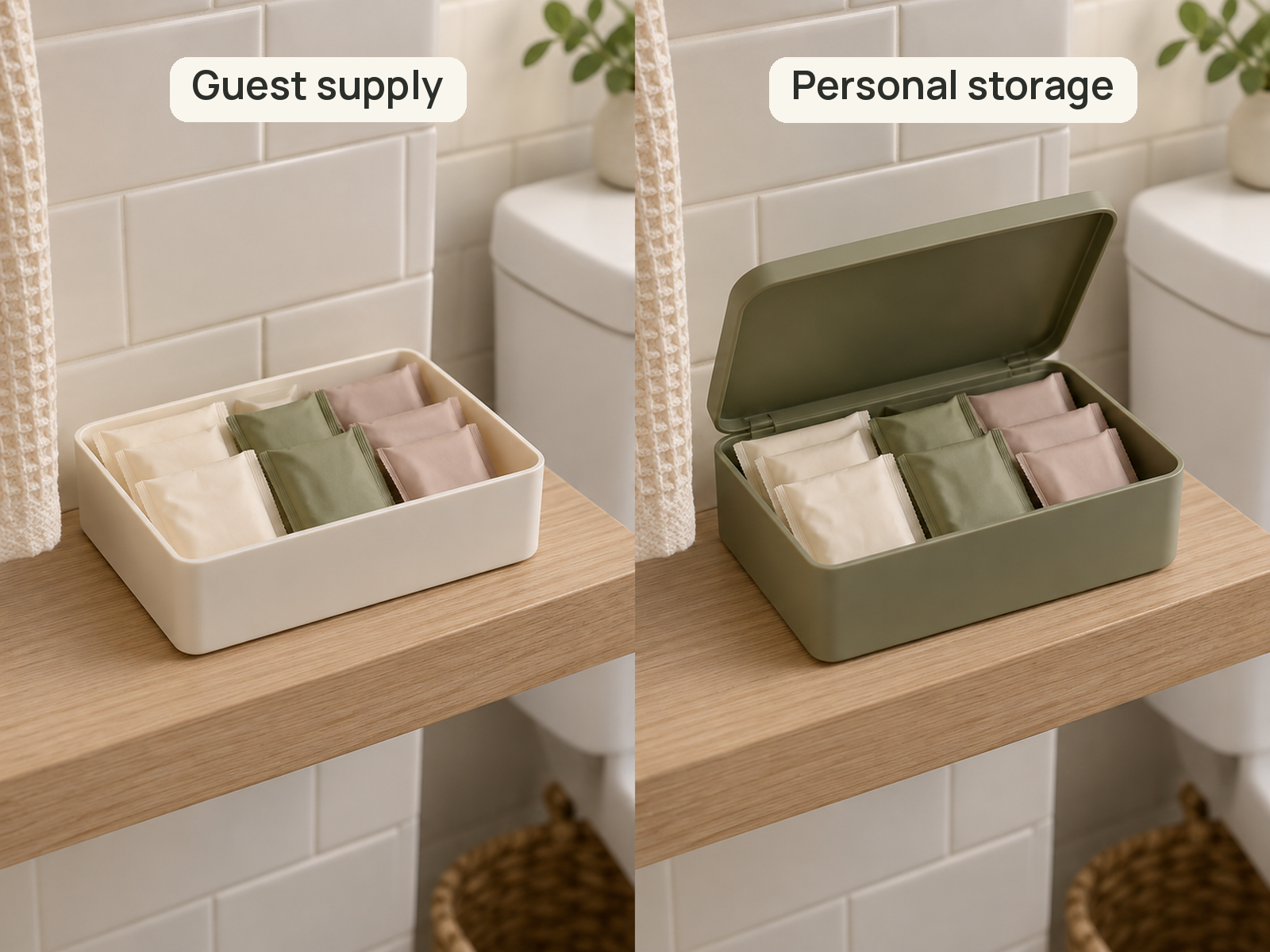
Visibility is a preference and communication decision, not a hygiene ranking. One household may prefer an open divided container because the products are instantly recognizable; another may prefer an opaque box because the bathroom is shared and visual calm matters.
Guest supplies add a different requirement: availability has to be understandable. A few products can be physically present yet functionally unavailable if they are hidden inside a private-looking drawer or box that a visitor would not reasonably open.
For a guest-facing supply, a small clearly recognizable container can work better than maximum concealment. For personal storage, discretion may matter more. The product quantity and storage form can stay compact in either case.
After choosing the visibility level, run one final test: can the correct product be reached quickly, can the active container be refilled in seconds, and does the bathroom still work normally around it? If yes, the storage is doing its job.
Closing Decision
Store for the Moment of Need, Then Refill From Somewhere Less Valuable
The highest-value space in this category is not the biggest cabinet in the home. It is the small amount of dry, easy-to-reach volume near the toilet. Use that zone for a working supply of the products that are actually needed there, and preserve recognition so the right item can be found without searching through a deep mixed container.
Everything else can step back in priority. A compatible wall bin can recover floor space, a narrow freestanding unit can work when a true residual strip exists, and a portable caddy can bridge bathrooms with no permanent storage. Keep reserve and bulk inventory farther away when that protects the room, and choose visible or discreet storage according to the household or guest-access goal rather than treating either as universally better.
RELATED GUIDES
What to Read Next
NEXT GUIDE
How to Organize a Small Bathroom With No Medicine Cabinet
Use this next if period products are only one part of a broader daily-toiletry problem and the bathroom still needs accessible storage without relying on a medicine cabinet.
GUIDE
How to Store Toilet Paper in a Small Bathroom With No Linen Closet
Use this if another near-toilet category is also competing for scarce bathroom capacity; that guide applies a similar reserve-versus-backstock distinction to toilet paper without repeating the period-product access and visibility decisions.