
Small Bathroom Storage
How to Store Toilet Paper in a Small Bathroom With No Linen Closet
Separate the rolls you need close to the toilet from the bulk package, then choose the smallest storage form that fits the full bathroom footprint without blocking the tank, outlet, door, walking path, cleaning access, or required wall anchoring.
In This Guide
- Split Near-Toilet Reserve From Bulk Backstock
- Use Existing Bathroom Storage Before Adding Furniture
- Measure the Full Footprint and Operating Clearance
- Use Floor Storage Only in a True Residual Zone
More
- Split Near-Toilet Reserve From Bulk Backstock
- Use Existing Bathroom Storage Before Adding Furniture
- Measure the Full Footprint and Operating Clearance
- Use Floor Storage Only in a True Residual Zone
- Treat Over-the-Toilet Storage as an Anchoring Decision
- Move Bulk Backstock Outside the Bathroom When It Does Not Fit
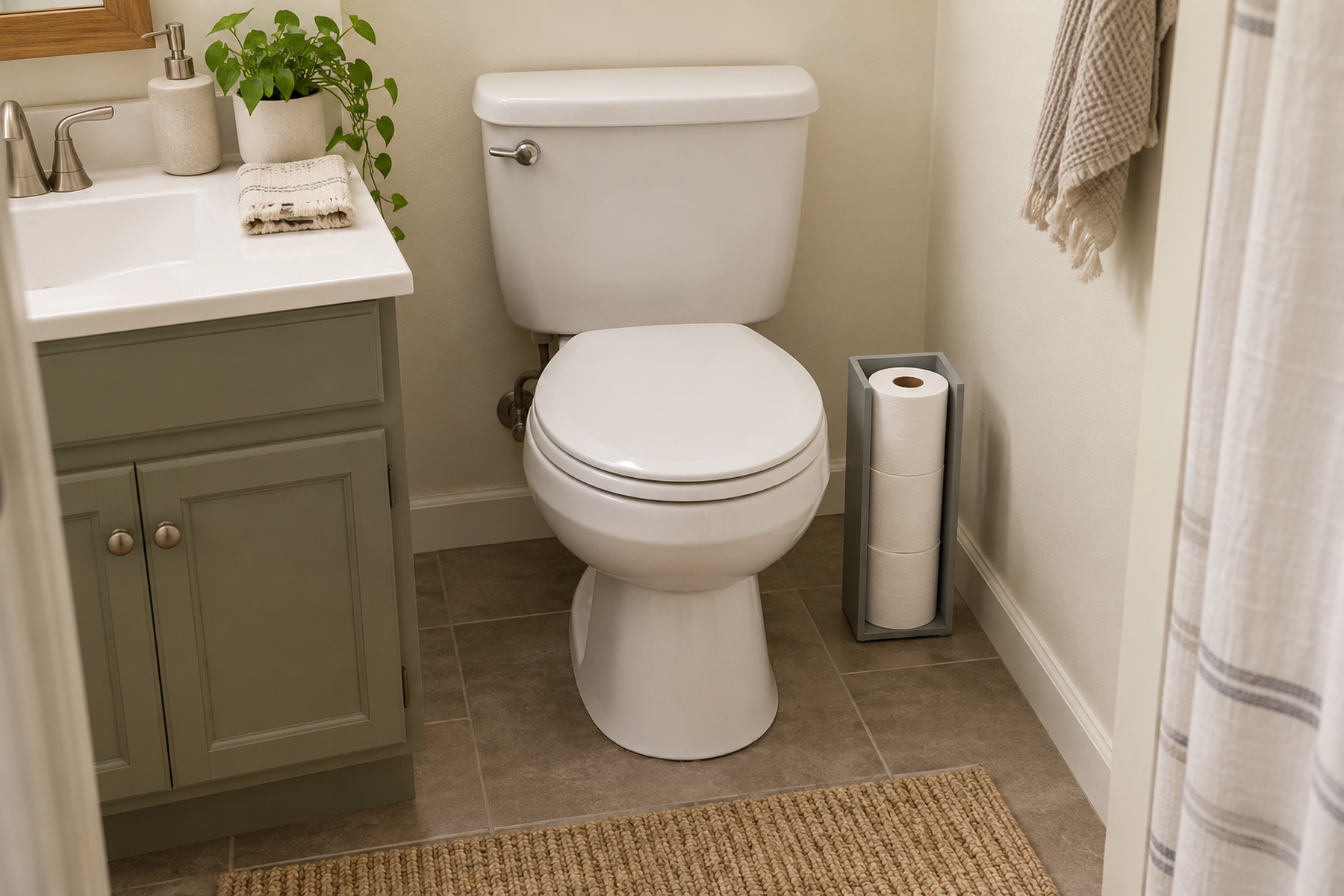
A small bathroom does not need to hold the full package of toilet paper just because the product is used there. The room has a higher-priority job: keep the active roll and a practical replacement reserve easy to reach without sacrificing circulation, fixture access, or cleaning space.
Treat toilet-paper storage as three access tiers: the active roll, a near-toilet reserve, and bulk backstock. Once those jobs are separated, a small stand, narrow stocker, cart, vanity shelf, over-toilet unit, or off-room backstock location can be judged by the job it actually needs to perform instead of by maximum roll capacity alone.
Quick Answer
Store the Reserve Close; Store the Package Where It Fits
01
Keep only a practical reserve in the bathroom
Do not let a warehouse-size package dictate the room layout. Keep enough replacement rolls close to the toilet for normal use, and treat the remaining package as backstock.
02
Use existing capacity before adding another floor object
If a vanity or sink cabinet has genuine unused space, it can be the lowest-footprint reserve zone. Do not force toilet paper into it when that space is already serving higher-priority bathroom storage.
03
Measure the full storage footprint, not the slim dimension
Check length, depth, height, loading side, pull or roll path, door swing, tank access, outlet access, and cleaning clearance before buying a stocker, cart, cabinet, or over-toilet unit.
04
Treat required anchoring as installation, not a renter footnote
An over-the-toilet shelf or tall cabinet that the manufacturer says must be secured to the wall is not automatically a no-drill renter solution, even when the furniture itself stands on the floor.
01
Split Near-Toilet Reserve From Bulk Backstock
The purchase package and the bathroom reserve are different storage jobs.
The near-toilet reserve exists so a replacement roll is easy to identify and retrieve when the active roll runs out. Bulk backstock exists only to replenish that reserve. It does not need the same access priority, and it does not automatically deserve scarce bathroom floor or wall capacity.
Avoid a universal roll count. Household size, buying habits, roll format, and restocking routine vary. The useful question is whether the local reserve is large enough to be dependable without forcing the bathroom to store the entire package.
If a large package currently sits on the floor, beside the toilet, or on top of other bathroom storage, separate a small working reserve first. That single decision often removes the pressure to add a large cabinet or tall tower just to accommodate bulk stock.
02
Use Existing Bathroom Storage Before Adding Furniture
Existing enclosed storage has one important advantage in a tiny bathroom: it adds no new floor footprint.
If the vanity or sink cabinet has a genuinely open shelf or side zone, use that capacity before adding another freestanding object. IKEA’s current NYSJÖN sink cabinet explicitly lists toilet paper among the items its shelf can store, which verifies the form rather than proving that every vanity has spare capacity.
Do not displace daily toiletries, plumbing access, or another higher-priority category merely to keep toilet paper inside the bathroom. The reserve belongs in the existing cabinet only when the rolls fit cleanly and remain easy to retrieve.
If the vanity is already crowded, shallow, obstructed, or absent, move to a dedicated reserve form instead of overfilling the cabinet and creating a second access problem.
03
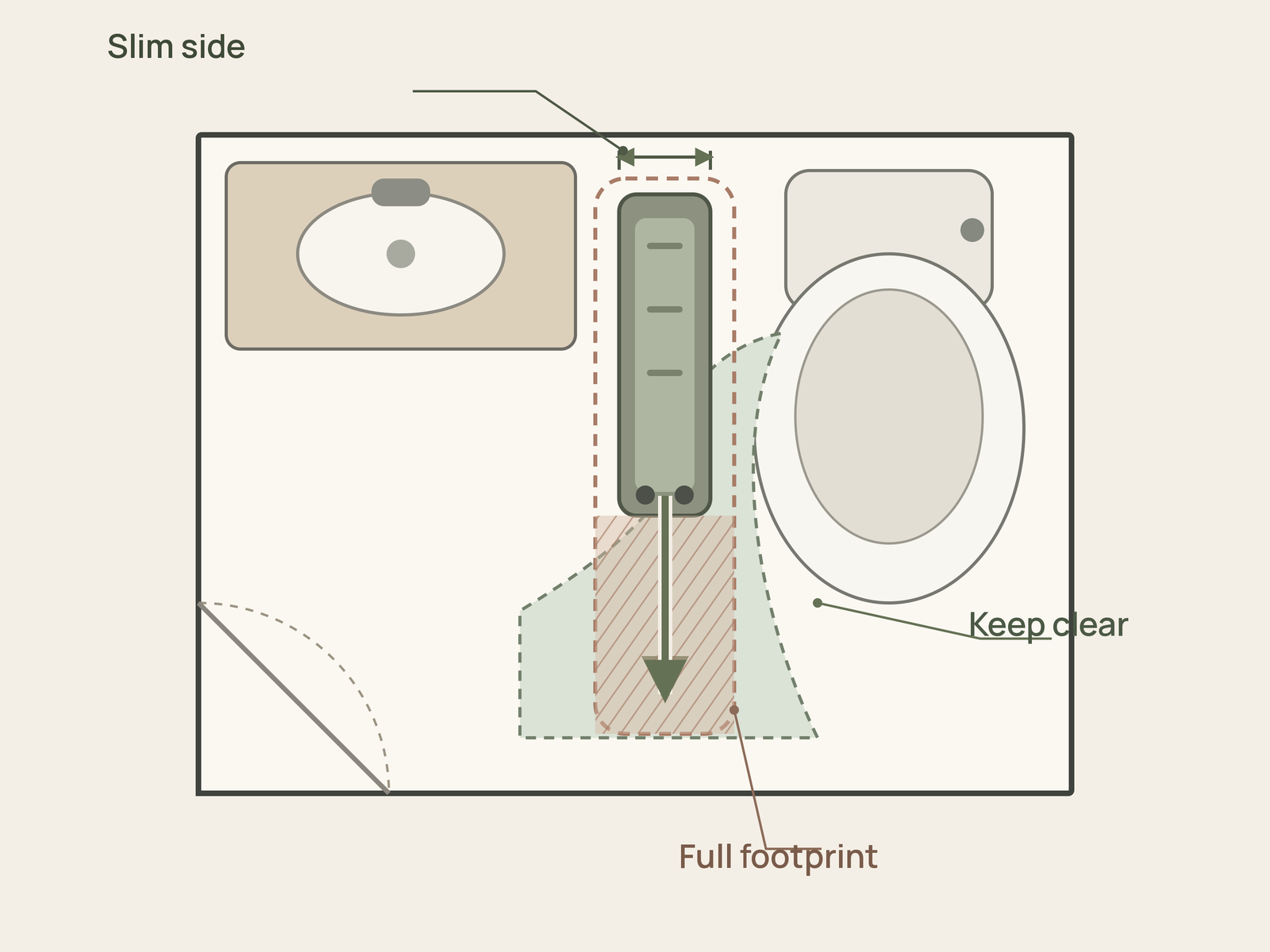
Measure the Full Footprint and Operating Clearance
A product described as “slim” can still be too large for a small bathroom because the narrow side is only one dimension.
Measure the entire floor or wall run, the height, the side from which rolls are loaded, and any pull-out or rolling travel. Include baseboards, pipes, radiators, vanity projections, and other obstacles that reduce the usable rectangle.
Then map the bathroom around the storage. The toilet tank lid still needs to come off when required, the flush control needs to remain usable, the bathroom and vanity doors need to open, outlets and switches need to remain accessible, and the floor should still be cleanable.
Operational clearance is part of the footprint. A holder that fits only while everything else is closed or untouched does not actually fit the room.
Measure / Check First
Before buying a stocker, cart, cabinet, shelf, or over-toilet unit, test the storage against the complete bathroom operation—not only the advertised width or roll capacity.
Check the Footprint in Three Different Ways
01
Parked footprint
Measure the full width, depth, height, base, loading side, pull-out travel, and any caster or handle projection. Include baseboards, pipes, trim, and other fixed obstacles.
02
Fixture and service clearance
Confirm tank-lid removal, flush-control access, toilet approach, bathroom and vanity door swing, outlet or switch access, and enough floor access for normal cleaning.
03
Installation and reach
Verify the exact product’s wall-securing or mounting instructions, the lease or wall compatibility, and whether the intended reserve can be reached normally. High or anchored storage is a different solution class from a loose floor stocker.
If the storage passes only the product-dimension test but fails fixture access, cleaning, reach, or required installation, it does not fit the bathroom.
04
Use a Small Reserve Stand When Floor Space Is Truly Available
A small freestanding reserve stand is the simplest no-install answer when a genuine narrow strip exists beside the toilet or vanity.
Yamazaki’s current Tosca Toilet Paper Stocker is designed for up to three rolls. That product-specific capacity is useful as a form example: a deliberately small reserve can solve access without turning the bathroom into bulk storage.
The strongest use case is a stable stand that stays completely inside a residual floor zone and can be moved for cleaning. Do not place it in the toilet approach, doorway, or the space needed to remove the tank lid or reach a nearby fixture.
A small-capacity stand is not “too small” if the bathroom reserve is intentionally separated from backstock. Its job is access, not package storage.
05
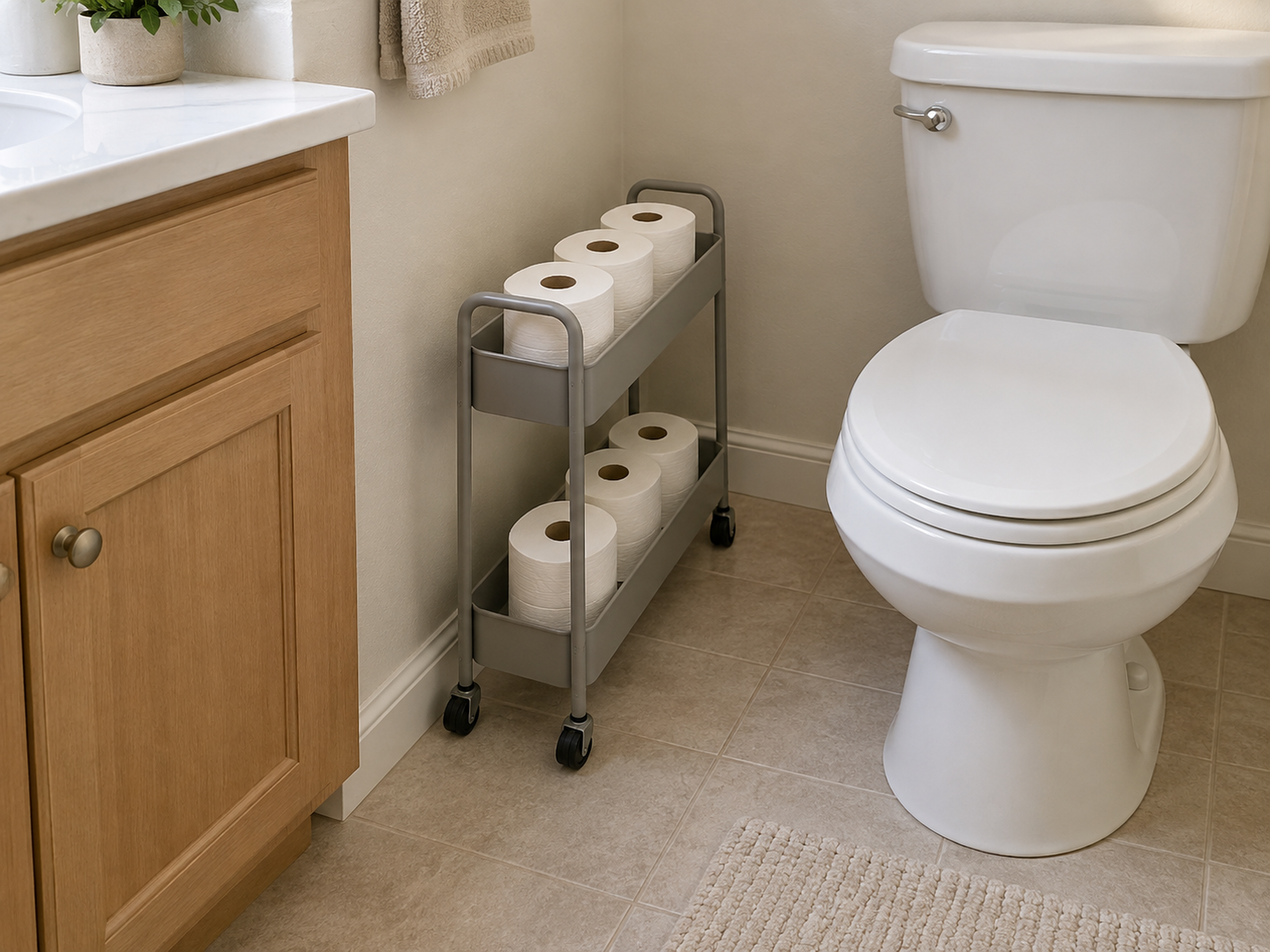
Use Floor Storage Only in a True Residual Zone
More capacity requires more commitment to the floor plan.
A concealed stocker or rolling cart can work when the bathroom has a long, narrow strip that is genuinely unused. Yamazaki’s current Plate stocker is described as holding 8–12 rolls, while IKEA’s VESKEN cart measures about 21 1/4 inches wide, 7 1/8 inches deep, and 28 inches high and clicks together without tools. Those specifications show why one slim dimension never tells the whole story.
A cart also needs a practical rolling path and a reason to move. If it cannot leave the zone for cleaning without moving the trash can, closing the door, or shifting another fixture-side object, the mobility benefit is mostly theoretical.
Keep the storage job bounded. A toilet-paper cart that gradually absorbs towels, toiletries, cleaners, and unrelated backups can recreate the same floor-space problem under a different name.
06
Treat Over-the-Toilet Storage as an Anchoring Decision
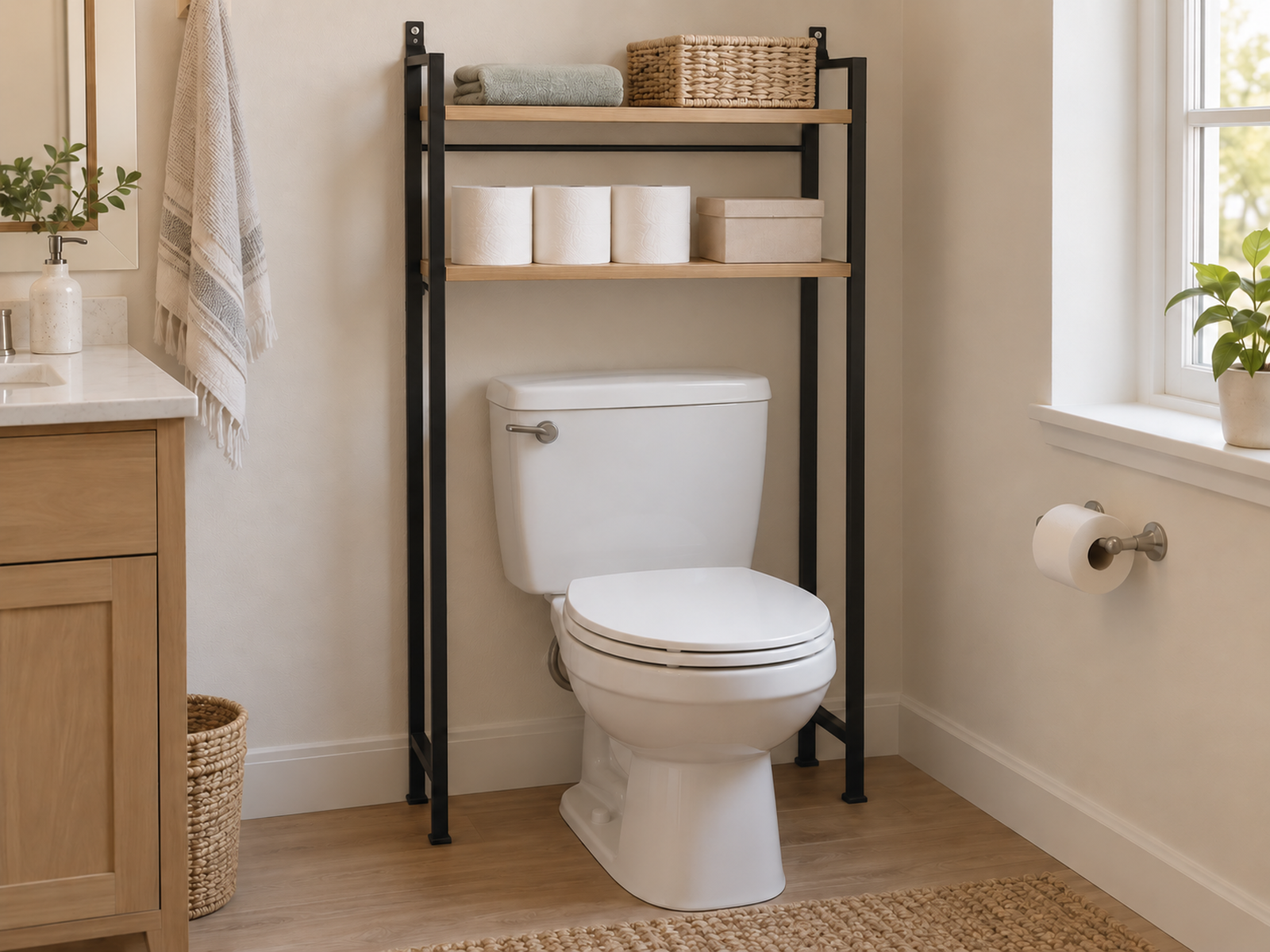
Over-the-toilet furniture trades side-floor space for vertical capacity, but that does not make it automatically renter-friendly.
IKEA’s current FRÖSJÖN over-the-toilet shelf is approximately 25 5/8 inches wide, 11 3/4 inches deep, and 61 3/8 inches high. IKEA states that it must be secured to the wall for safe installation and includes a tipping-hazard warning.
Before choosing this form, check more than width. Confirm tank-lid removal, flush-control access, the toilet approach, outlet or switch access, any baseboard interference, and the exact wall-fixing requirements. If the only bathroom outlet would be blocked, the storage form has failed even if the shelf physically fits over the toilet.
If the lease does not permit the required securing method, choose another storage path. Do not downgrade a manufacturer-required anchor into an optional stability suggestion.
07
Use Tall Cabinets and High Shelves for Lower-Frequency Reserve
Tall cabinets can consolidate bathroom categories while preserving some floor width, but they are a larger intervention than a small reserve stand.
IKEA’s current NYSJÖN high cabinet is approximately 11 3/4 inches wide, 10 5/8 inches deep, and 74 3/4 inches high, and IKEA states that it must be secured to the wall. That makes it an installation-required path, not simply a narrow freestanding solution.
Use higher shelves for lower-frequency reserve rather than emergency replacement access. A roll that is technically stored in the room but awkward to reach is not serving the same job as a near-toilet reserve.
If a tall cabinet is being considered mainly because the bathroom must hold a bulk package, compare that intervention against moving the backstock elsewhere. The simpler option may protect both floor space and the lease.
08
Use Over-the-Tank Storage Only for Immediate Backup
Over-the-tank storage can preserve side-floor space, but it should remain a small-capacity access solution.
Use this form only when the holder does not interfere with the tank lid, flush mechanism, seat operation, or normal cleaning behind the toilet. Tank geometry varies, so do not assume a hanging holder or basket fits every toilet.
This is a good place for one or two replacement rolls when the exact hardware fits the toilet. It is not a strong place for bulk backstock or a deep basket that turns tank service into a furniture-removal task.
If the tank area is already needed for access, leave it open and use another reserve zone.
09
Move Bulk Backstock Outside the Bathroom When It Does Not Fit
The strongest small-space solution may be to let the bathroom stop storing the purchase package.
Keep the local reserve easy to replenish, then give the bulk package one defined home elsewhere: a household backstock zone, closet shelf, bedroom storage zone, or another appropriate space that already serves reserve inventory.
Do not create a second loose pile outside the bathroom. The off-room location should be specific enough that the household knows where the next refill comes from and can see when the backstock is actually running low.
Use the room itself as the stop rule. If storing more rolls blocks the tank, outlet, door, walking path, cleaning access, or requires an installation that is not appropriate for the lease, the bathroom has reached its practical capacity.
Closing Decision
Store the Bathroom Reserve, Not the Purchase Package
A small bathroom works better when toilet paper is treated as an access system instead of a maximum-capacity challenge. Keep the active roll and a dependable near-toilet reserve in the smallest practical footprint, then use existing vanity space, a true residual floor zone, or vertical storage only when the complete geometry and installation requirements pass.
Let bulk backstock live elsewhere when keeping it in the room would block circulation, tank access, outlets, cleaning, or renter constraints. The correct reserve size is household-specific, but the capacity rule is universal for the room: once additional paper makes the bathroom harder to use, it no longer earns in-room storage.
RELATED GUIDES
What to Read Next
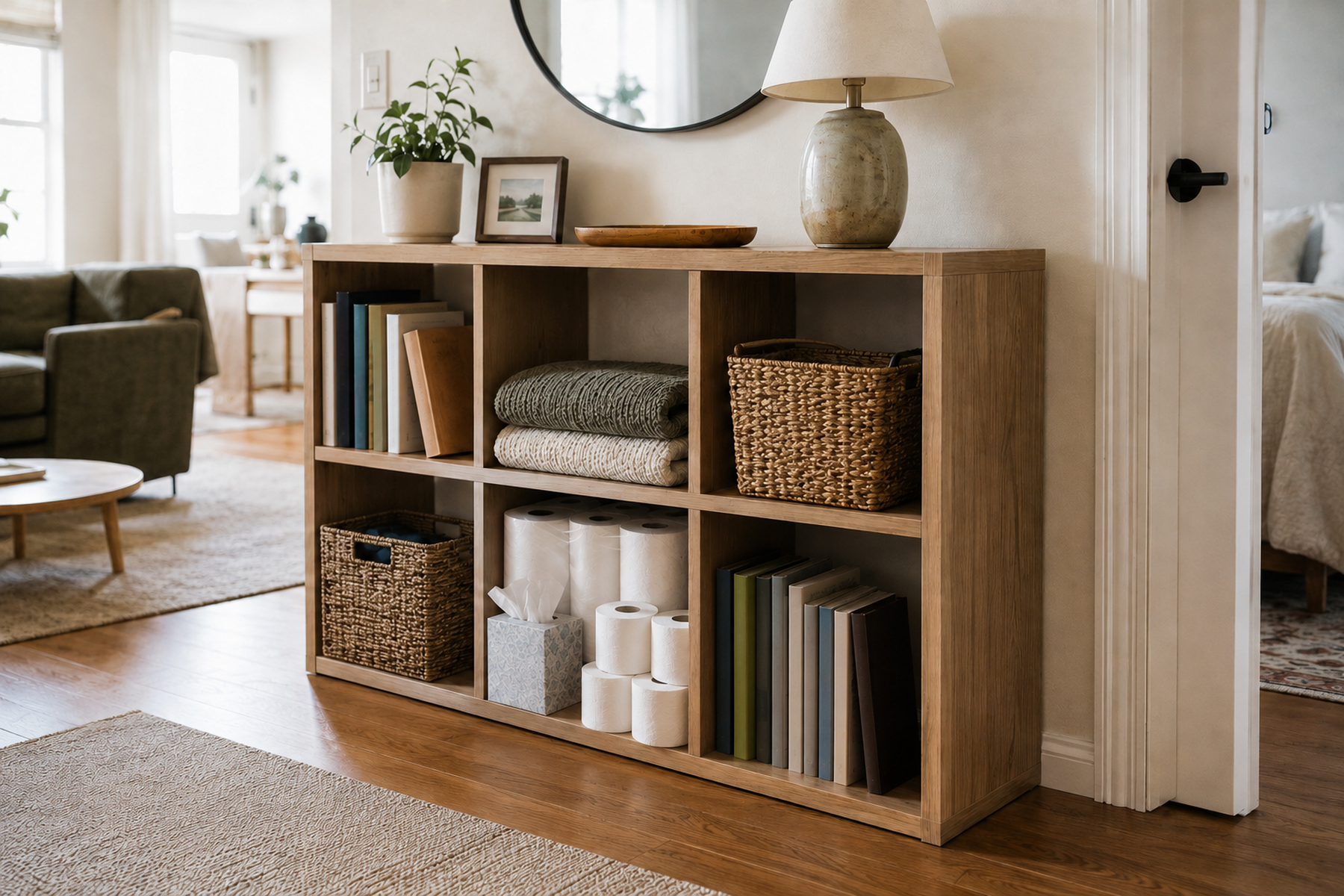
NEXT GUIDE
How to Store Household Backstock in a Small Apartment With No Storage Closet
Use this next if the bathroom can hold a practical reserve but the remaining toilet-paper package still needs a defined, compact home elsewhere in the apartment.
GUIDE
How to Use a Narrow, Deep Gap for Storage in a Small Bathroom
Use this if a toilet-paper stocker or cart appears to fit beside the toilet, vanity, or wall but the residual gap is narrow, deep, or difficult to access cleanly.
GUIDE
How to Add Storage Around a Pedestal Sink in a Small Bathroom
If the bathroom has almost no vanity storage, this guide helps evaluate the broader pedestal-sink area without letting toilet-paper storage take over the available floor and wall capacity.