
Small Apartment Storage Ideas
How to Use a Portable Washing Machine in a Small Apartment With No Washer Hookup
Prove the apartment can support the washer before you shop by checking permission, faucet compatibility, drainage, power, and a level operating zone. Then match capacity, drying, and the washer’s parked-versus-operating routine to the laundry you actually do.
In This Guide
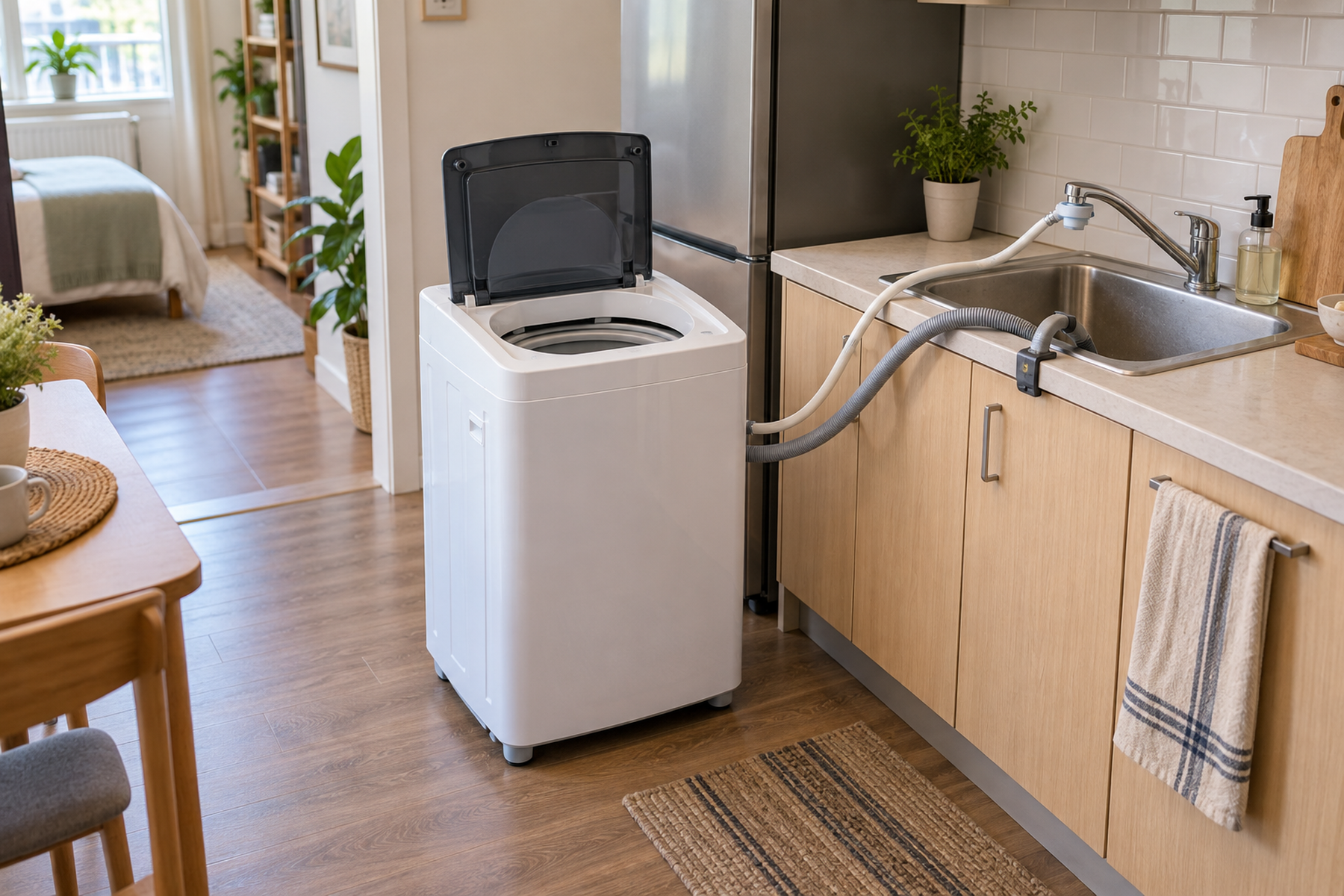
A portable washing machine can reduce shared-laundry trips without recreating a full laundry room inside the apartment. But “portable” does not mean hookup-free: an automatic washer still needs a supported water source, a secure drain route, the right electrical connection, and a stable place to spin.
Treat the purchase as a feasibility test before it becomes a storage decision. The strongest sequence is permission → water → drain → power → level operating zone → capacity → drying → storage/reset. If one hard gate fails, a different laundry system may be more practical than forcing the washer into the apartment.
Quick Answer
Prove the Laundry System Before You Buy the Washer
The machine is only a fit when the apartment, the lease, and the daily laundry routine can support the complete wash cycle—not just the washer’s parked footprint.
01
Check permission before product dimensions
Review the lease and building rules before shopping. A portable washer may avoid permanent plumbing, but it still introduces water, drainage, vibration, and leak risk, so “portable” does not automatically mean permitted.
02
Verify water in, water out, power, and level operation
Confirm the exact faucet or fill method, secure drain route, model-specific electrical requirements, and a hard, level operating zone where the washer can spin without walking into furniture or circulation.
03
Match capacity and drying to the real household routine
Choose the machine around the loads you want to keep at home, then decide where wet clothes go. A small washer can be excellent for frequent everyday loads while bedding and bulky items remain a shared-laundry or laundromat job.
01
Check Permission Before You Shop
Start with the lease, building rules, and property-management requirements. A machine that physically fits can still be the wrong purchase if portable washers or temporary plumbing connections are restricted.
Do not assume that avoiding a permanent washer hookup automatically makes the appliance renter-approved. Water-using equipment can create leak liability even when the faucet connection is temporary and the machine rolls away after use.
If the rules are unclear, verify before buying rather than planning to hide the machine. Aptly Small’s renter-friendly standard is reversible and authorized, not simply easy to remove.
Keep permanent plumbing modifications outside the default plan. Adding tees, valves, drilled drain routes, or other fixed changes is a different installation project and can require landlord approval or professional work.
02
Verify Water, Drain, Power, and a Level Operating Zone
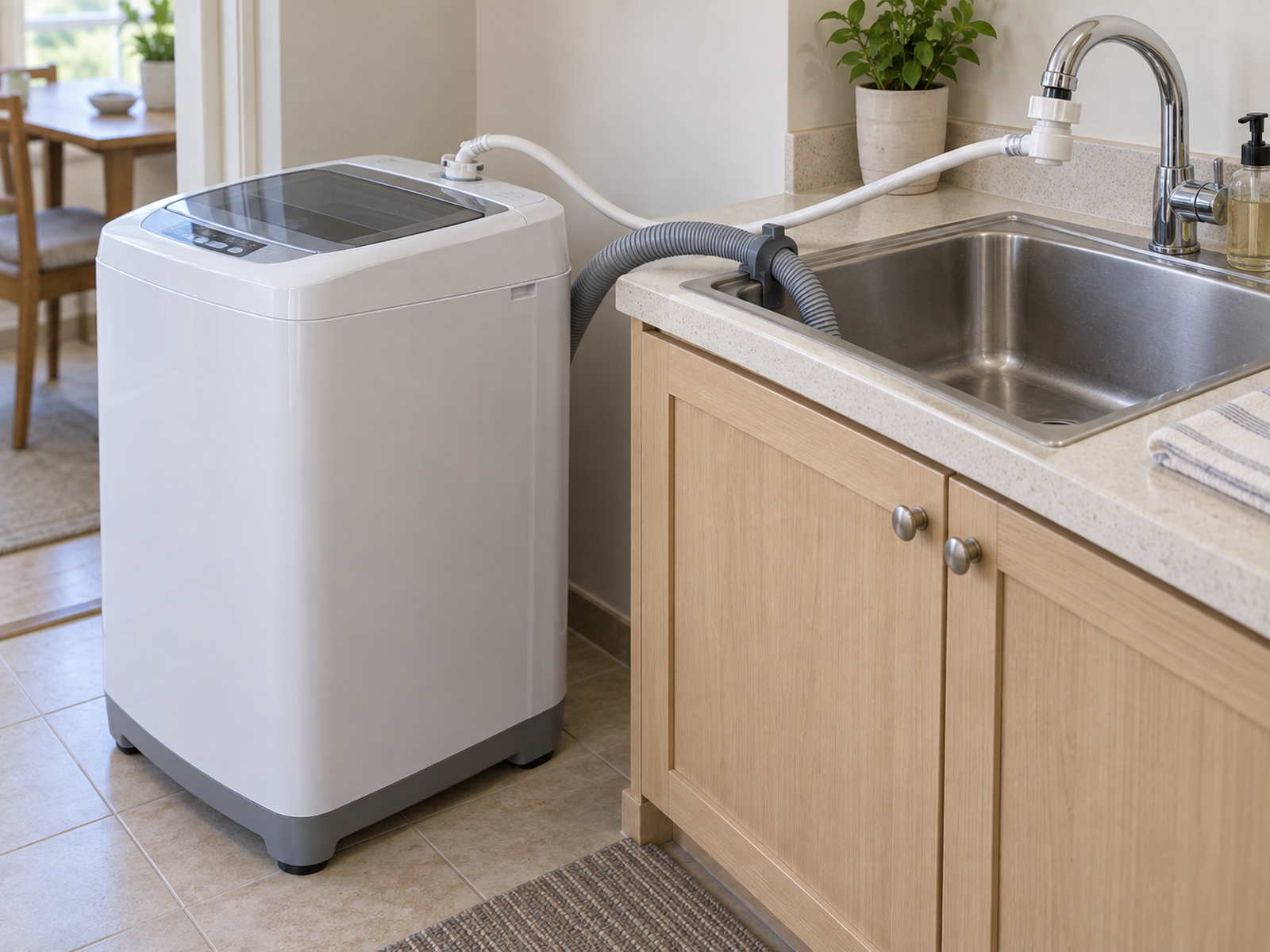
For a sink-connected automatic washer, faucet compatibility is a hard gate. GE’s current portable-washer support says its one-faucet unicouple setup requires a faucet with a removable aerator, which shows why “near the sink” is not enough.
Check the exact washer manual against the exact faucet. Pull-down, pull-out, touchless, proprietary, damaged, or non-removable-aerator faucets should not be assumed compatible with a generic adapter.
Plan drainage separately from water supply. The drain hose or combined connection has to reach an approved destination, remain secured during draining and spinning, and avoid kinks, overflow, or a route that crosses the room.
Then verify the electrical connection and the floor. GE’s current portable-washer guidance requires a model-appropriate grounded electrical setup and says an unlevel washer can become unbalanced, vibrate, or move while running. Other models can differ, so the exact manual remains controlling.
Measure / Check First
Before choosing capacity or comparing features, test the apartment against the washer’s complete operating system.
Check the Faucet, Drain Route, and Spin Zone First
01
The exact water connection
Confirm whether the washer is faucet-connected, manually filled, or supports another manufacturer-approved supply method. For sink-connected models, verify the aerator, threads, included adapter, hose reach, and whether the sink remains usable enough during the cycle.
02
The drain, power, and level floor
Map the drain hose to its approved destination, confirm the outlet and grounding requirements in the exact manual, and identify a hard, stable, level zone where the washer can remain stationary during spin.
03
The full operating envelope
Measure body width, depth, and height, then add lid-open height, hose projection, loading stance, control access, and the route used to roll or move the washer between storage and operation.
If the washer only “fits” by using an unsupported faucet adapter, stretching the drain hose, blocking a walkway, or spinning on an unstable or sloped surface, stop before purchase.
03
Give the Washer a Parked Home and an Operating Home
A portable washer can have two legitimate locations: one where it lives between loads and one where it runs. Separating those states can protect scarce kitchen or bathroom space.
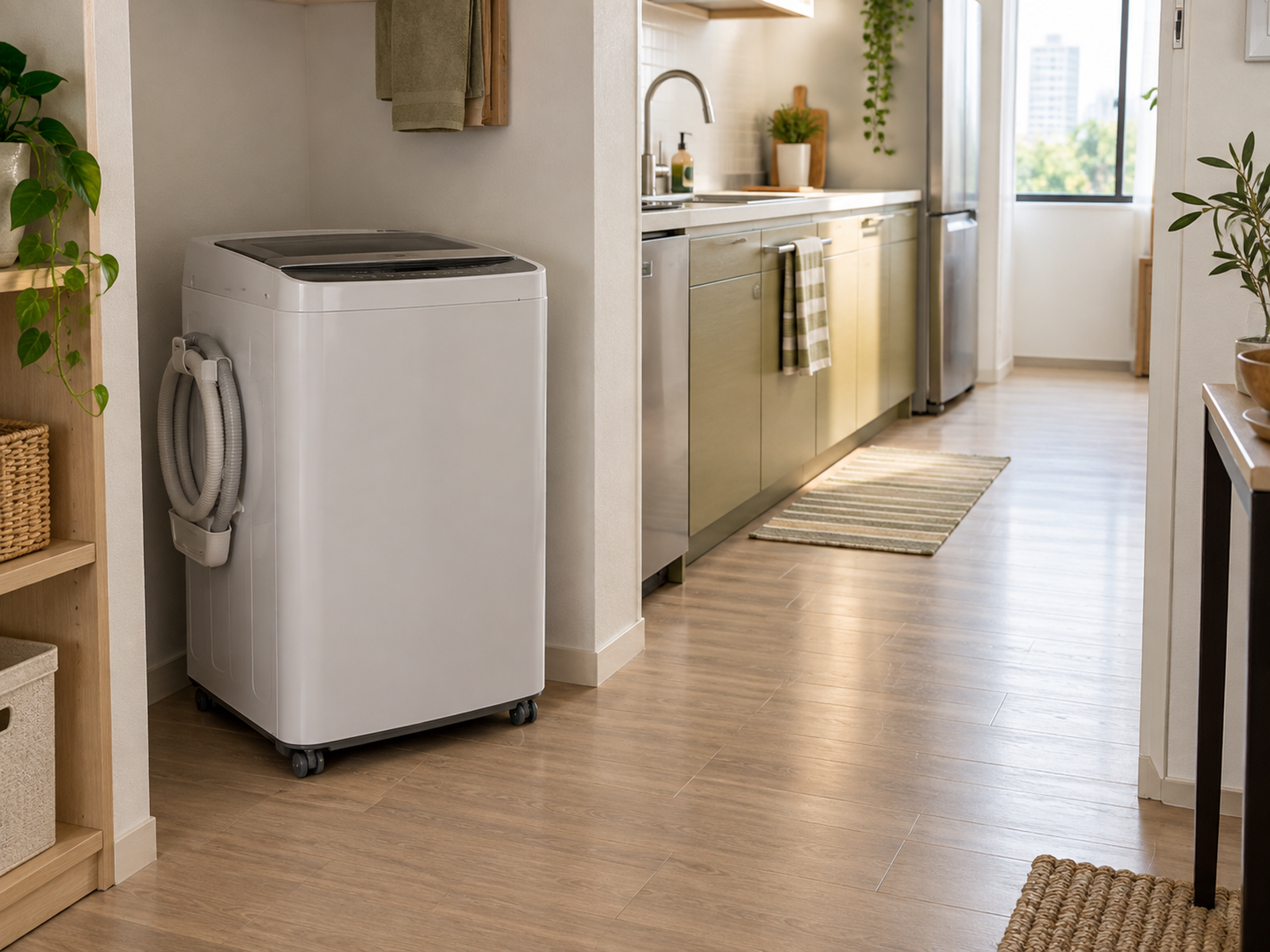
The parked home should keep the washer out of circulation while preserving an easy rolling route to the sink. A closet edge, bathroom corner, kitchen end wall, or another dry floor zone can work only when the machine actually fits there and can leave without moving half the room.
The operating home needs more space. Add the faucet and drain-hose paths, lid opening, loading stance, leveling-foot setup, and enough clearance to monitor the first connection for leaks.
Weight matters even when the machine has wheels. Current manufacturer examples range from roughly 44 pounds for a 0.9-cubic-foot BLACK+DECKER unit to about 99 pounds for larger GE and BLACK+DECKER portable models. Wheels make repositioning possible; they do not make a large washer casually liftable.
04
Match Capacity to the Loads You Actually Wash
“Portable washer” covers very different machines. A tiny automatic unit can preserve floor space but require many cycles, while a larger wheeled washer can handle more laundry at the cost of a much bigger operating and storage footprint.
BLACK+DECKER’s current 0.9-cubic-foot BPWM09W is rated for up to 6.6 pounds of laundry and is roughly 17.7 by 18.1 inches at the floor. Its 3.0-cubic-foot BPW30MW is closer to 23.7 by 24.8 inches, weighs about 99 pounds, and is rated for substantially larger loads.
Use those examples to understand scale, not to create a universal household-size rule. Your normal shirts, underwear, towels, work clothes, baby items, and workout gear matter more than a capacity label by itself.
Estimate the number of cycles a normal week would require. If a very small machine turns one weekly load into several back-to-back cycles, the storage savings may be offset by setup time, sink occupation, drying congestion, and repeated water handling.
05
Keep the Connection and Spin Setup Stable Every Time
A temporary connection still needs a repeatable setup. GE’s current guidance tells users to lock the unicouple onto the faucet adapter, secure the fill and drain hoses, and verify the connections to reduce leaking or mechanical problems.
Build a short pre-run check into the routine: washer level, water connection secure, drain secured, hoses not kinked, lid clearance open, and nothing in the path where the machine could move or vibrate.
Do not extend hoses, substitute adapters, or improvise plumbing because the included setup almost reaches. Hose length, drain height, pressure, and connection hardware are model-specific engineering conditions rather than generic small-space hacks.
After the cycle, follow the manufacturer’s disconnection and reset instructions. The useful organization system is not merely “roll it away”; it is a repeatable park → connect → wash → drain/disconnect → reset routine that does not leave water or loose hoses across the apartment.
Use / Skip
A Small Sink-Connected Automatic Washer
Use
Use it when the apartment passes every hard gate and everyday loads are genuinely small
A compact automatic washer can work well when the lease allows it, the exact faucet accepts the supported connection, drainage is secure, the washer has a level operating zone, the electrical setup matches the manual, and the household mainly wants to keep frequent small loads out of the shared laundry room.
Skip
Skip it when compatibility or laundry volume forces constant workarounds
Use shared laundry, a laundromat, wash-and-fold, or a different washer architecture when the faucet is incompatible, drainage is insecure, the machine cannot stay level, the route is too tight, or the tiny capacity would require so many cycles that the apartment becomes a permanent wash station.
06
Decide How the Clothes Will Dry Before the First Wash
A portable washer solves only the washing half of laundry. If the apartment has no dryer, every load still needs a realistic drying destination.
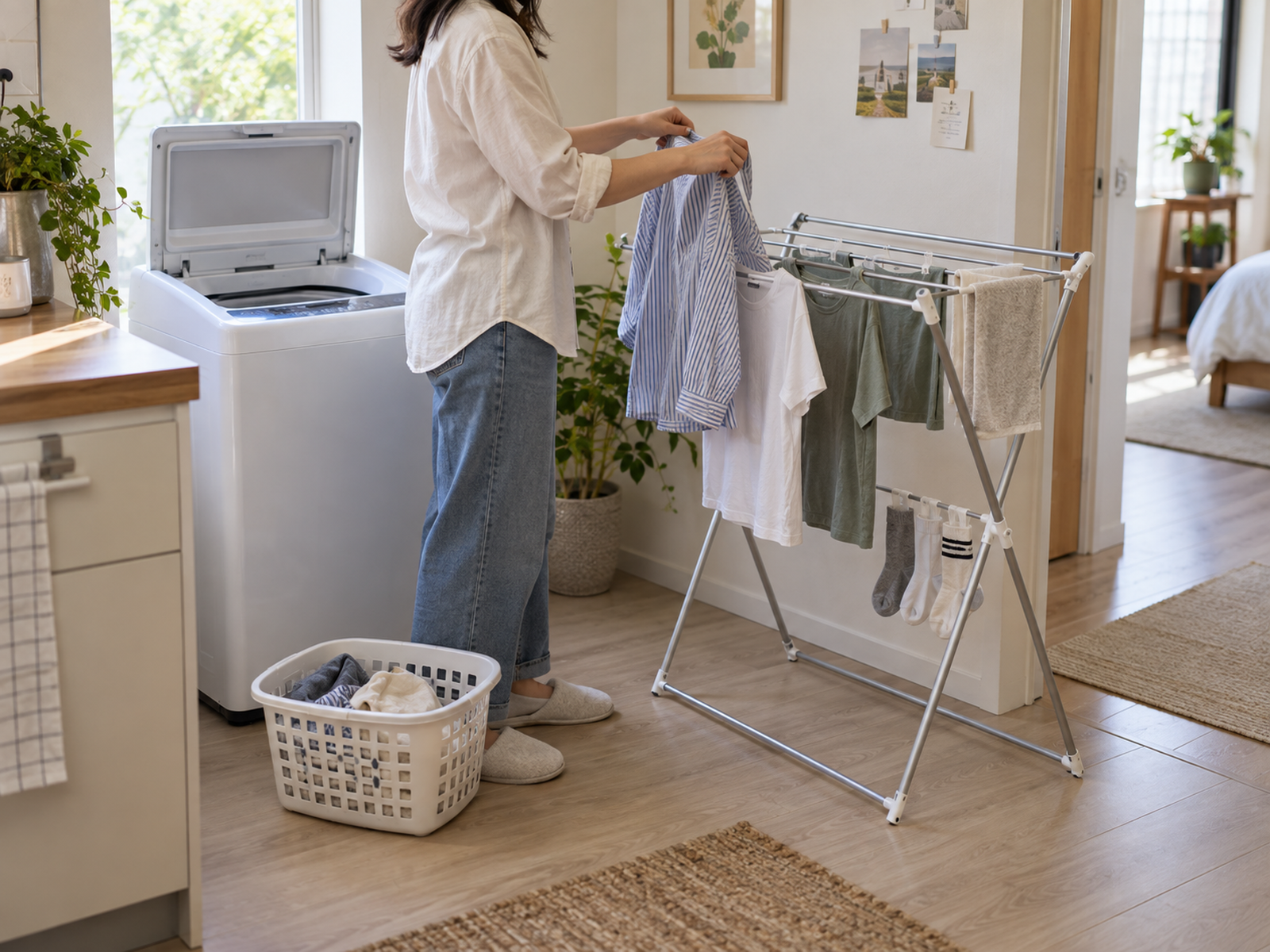
That can mean a shared building dryer, a laundromat dryer, or an indoor drying rack when the apartment can support the moisture, airflow, and temporary footprint. Do not let wet laundry become the new bottleneck after the washer is installed.
Separate washer capacity from drying capacity. A machine may be able to finish another load before the drying rack has cleared, which can create piles of wet clothing even when the washer itself is small.
If indoor air-drying is part of the plan, use Aptly Small’s dedicated indoor-drying system rather than duplicating it here. The important pre-purchase question is whether the drying route exists at all.
07
Use a Hybrid Laundry System for Bulky Loads
A portable washer does not have to eliminate every trip to the shared laundry room or laundromat to be useful.
Current apartment users describe a practical split: everyday clothing is washed at home, while bedding, comforters, large towel loads, or other bulky items stay with larger shared or commercial machines.
That approach can let the apartment buy a smaller washer, reduce the number of sink-connected cycles, and avoid trying to make a compact machine handle items that do not fit its drum well.
Define the boundary before purchase. Decide which recurring loads will move in-house and which will remain outsourced, then size the washer for that actual role instead of treating maximum independence as the goal.
08
Reject the Washer When a Hard Gate Fails
A portable washer is not automatically the best answer to inconvenient shared laundry. The right small-space decision can be to stop when the apartment cannot support the appliance safely and repeatably.
Reject the purchase if the lease or building does not permit it, the faucet has no supported connection, the drain route cannot be secured, the outlet or floor zone does not meet the manual, or the washer cannot be stored without blocking normal room use.
Also reject a technically compatible machine when the workflow is wrong. A tiny capacity that creates constant cycles, no viable drying plan, or a 100-pound machine with no realistic parking route can be a poor apartment system even when every hose connects.
That is not a failure of organization. It is the feasibility test doing its job before money, floor space, and leak risk are committed to the wrong appliance.
Closing Decision
Prove the Infrastructure, Then Spend the Floor Space
A portable washer belongs in a small apartment only when the complete system works: permission, water, drainage, power, a level operating zone, realistic capacity, drying, and a repeatable parked-to-operating routine.
Verify those gates before comparing features. Then choose the smallest machine that handles the loads you actually want to keep at home—not the smallest washer in the catalog and not the largest one the apartment can barely contain.
RELATED GUIDES
What to Read Next
NEXT GUIDE
How to Dry Clothes Indoors in a Small Apartment With No Dryer
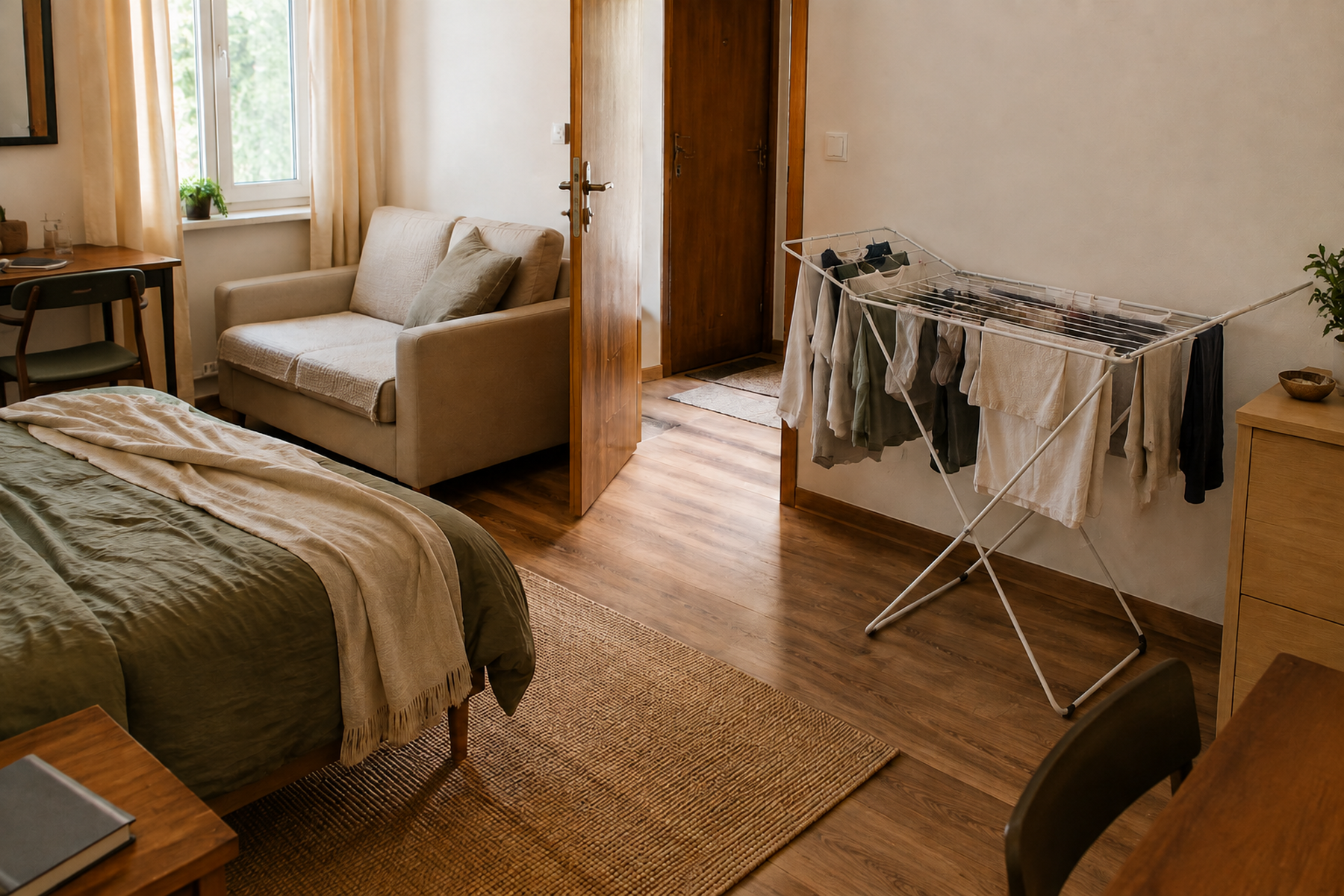
Use this next if the washer is feasible but the apartment still needs a drying system; that guide handles rack placement, airflow, moisture, and temporary drying footprint.
GUIDE
Where to Put Dirty Laundry in a Small Bathroom With No Floor Space
Use this if the portable washer is part of a bathroom laundry routine and dirty clothes are already competing for the same limited floor and circulation space.
GUIDE
How to Use a Countertop Dishwasher in a Small Kitchen With No Built-In Dishwasher
Use this if the apartment is also considering another temporary sink-connected appliance; that guide applies the same feasibility-first principle to faucet compatibility, drainage, power, and work-surface cost.