
Small Bathroom Storage
How to Store Cleaning Supplies in a Small Bathroom With Limited Under-Sink Space
Keep only the bathroom cleaning products that earn immediate access, store them in a compact working kit that fits around the plumbing, and move reserve bottles elsewhere when they would make the vanity harder to use, clean, or access safely.
In This Guide
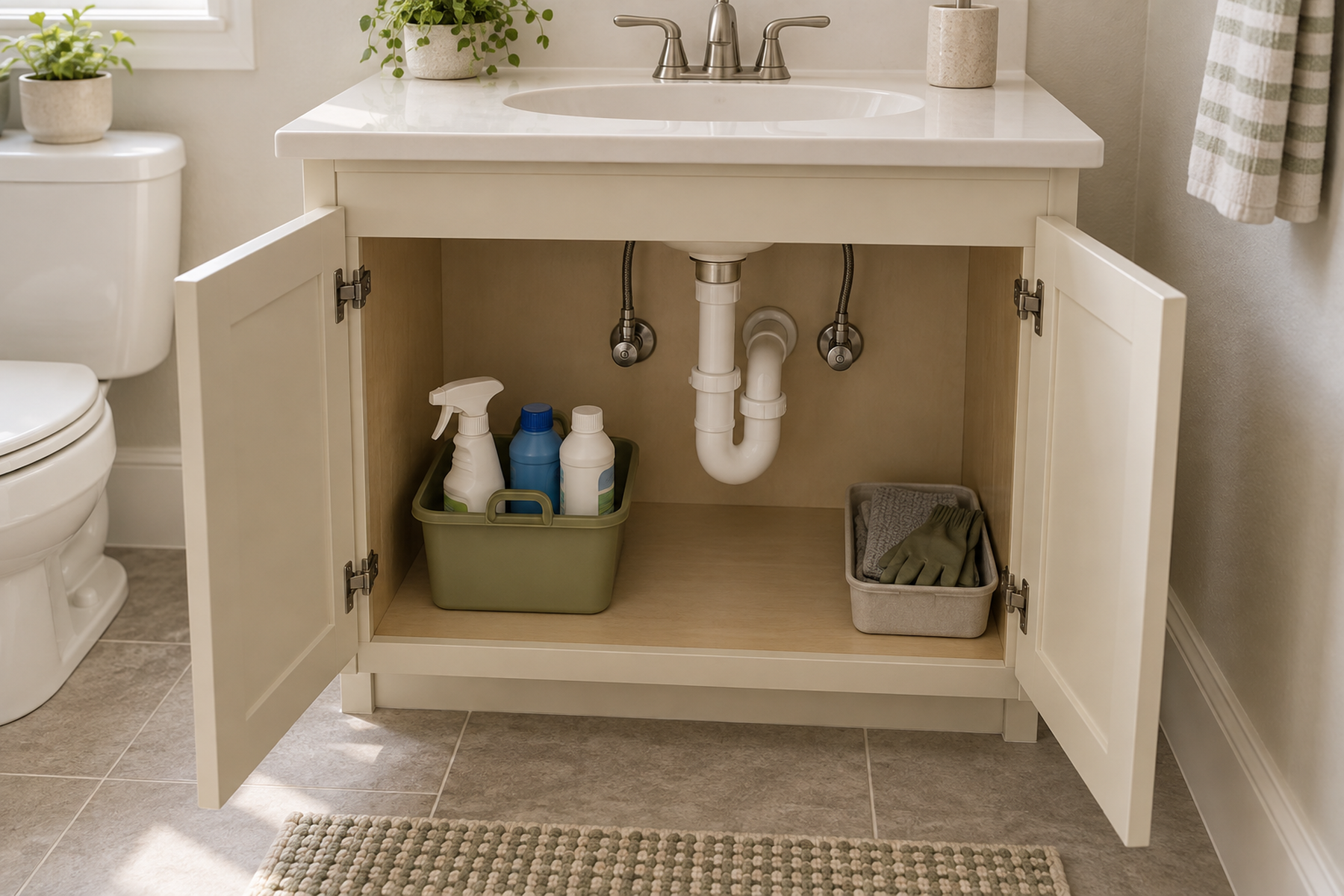
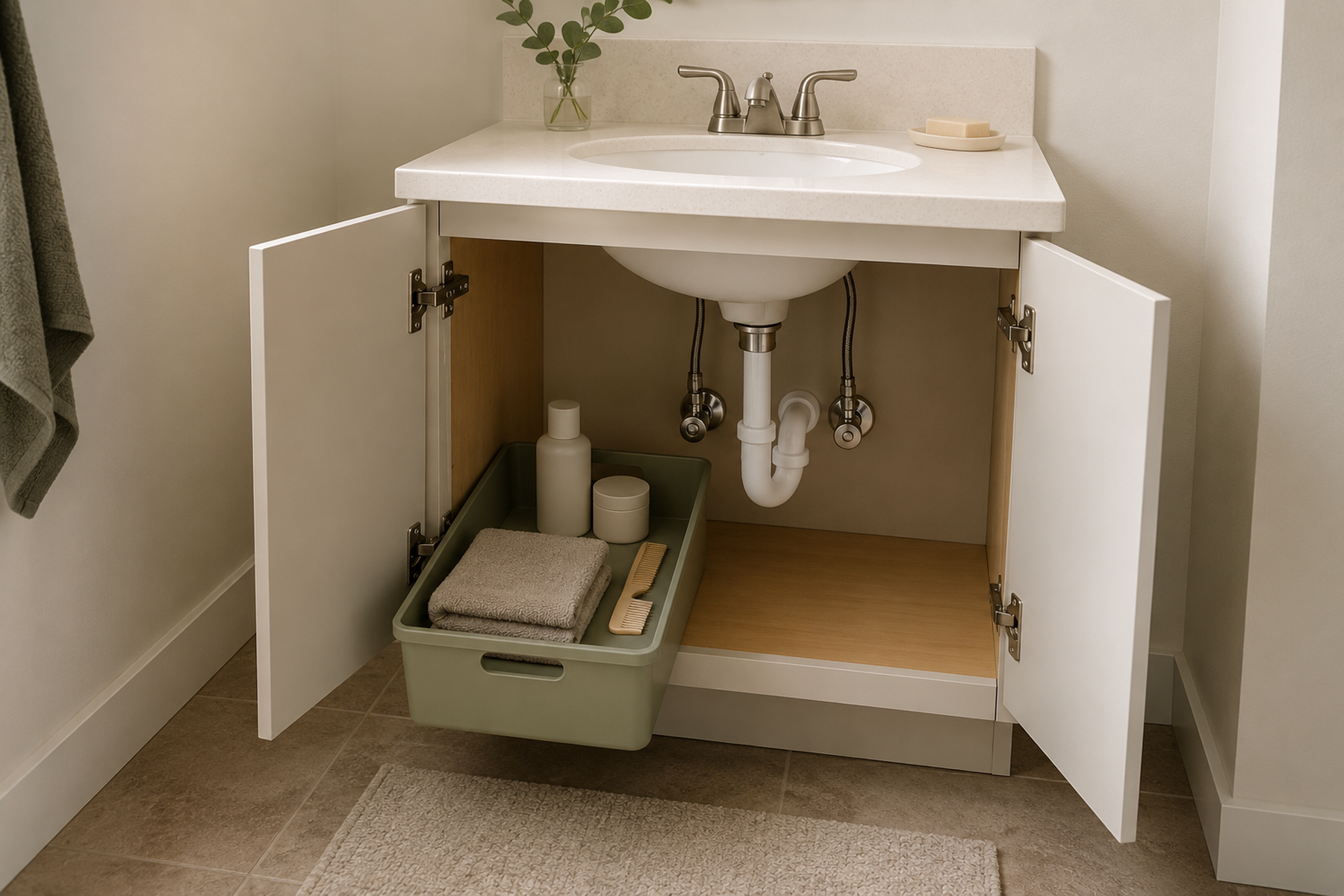
A small bathroom vanity can look like one storage cabinet while functioning more like several narrow pockets divided by the P-trap, supply lines, hinges, face frame, and door opening. When daily toiletries, cleaning bottles, and backup supplies all compete for that irregular volume, adding another organizer can make access worse instead of better.
Start by reducing the job the bathroom has to perform. Keep a deliberately small working cleaning kit near the room when it can be stored safely, move reserve inventory to another defined location when possible, and choose the under-sink organizer only after the real access lanes and removal path are clear.
Quick Answer
Separate the Working Kit From the Backstock First
01
Keep only the cleaners that genuinely serve this bathroom
The vanity should not become the default home for every household cleaner. Keep the small set used for this room and move specialty products or duplicates out of premium bathroom space when another safe storage zone exists.
02
Let product labels and household safety override convenience
Store household chemicals according to their labels and keep them in their original containers. If children are present, harmful products need an inaccessible location; EPA guidance supports locked storage where appropriate.
03
Measure the clear lanes around the plumbing
Record the cabinet opening, usable left and right zones, depth, bottle height, lip or face-frame obstruction, hinge intrusion, and the path needed to lift or roll the organizer out.
04
Choose the access method before the organizer style
Use a lift-out caddy when the whole kit should travel with you, a pull-forward form when a deep lane is clear, a turntable only when a full circular footprint exists, and the cabinet door only after proving closure clearance.
01
Build a Small Bathroom Working Kit
The first organizing decision is which cleaning products need premium bathroom access at all.
Separate the inventory into three groups: the products routinely used to clean this bathroom, occasional or surface-specific products, and duplicate or refill stock. The working kit should contain only what makes the normal bathroom cleaning route easier.
This does not require a universal number of bottles. Different bathrooms have different surfaces and products. The goal is simply to stop backup stock and rarely used cleaners from occupying the same easy-reach space as the active kit.
If the vanity becomes easier to use after the backstock leaves, that is real capacity gained without adding hardware.
02
Check the Safety Rules Before the Storage Zone
Organization does not override the storage instructions on a household chemical.
The U.S. Environmental Protection Agency advises following household-product directions and warnings and storing chemical products according to manufacturer instructions. EPA guidance also says not to mix household products unless the label directs it.
Keep hazardous household products in their original labeled containers rather than transferring them into food or drink containers. EPA’s household hazardous waste guidance preserves that boundary and also cautions against mixing leftover hazardous products.
If children are present, convenience may eliminate an otherwise attractive low cabinet or open cart. EPA advises keeping pesticides and other harmful household chemicals out of children’s reach and preferably in a locked cabinet. A portable caddy can be renter-friendly and still be the wrong storage location if it makes harmful products easier to access.
03
Measure the Cabinet as Usable Lanes
Do not measure an under-sink vanity as one empty rectangle.
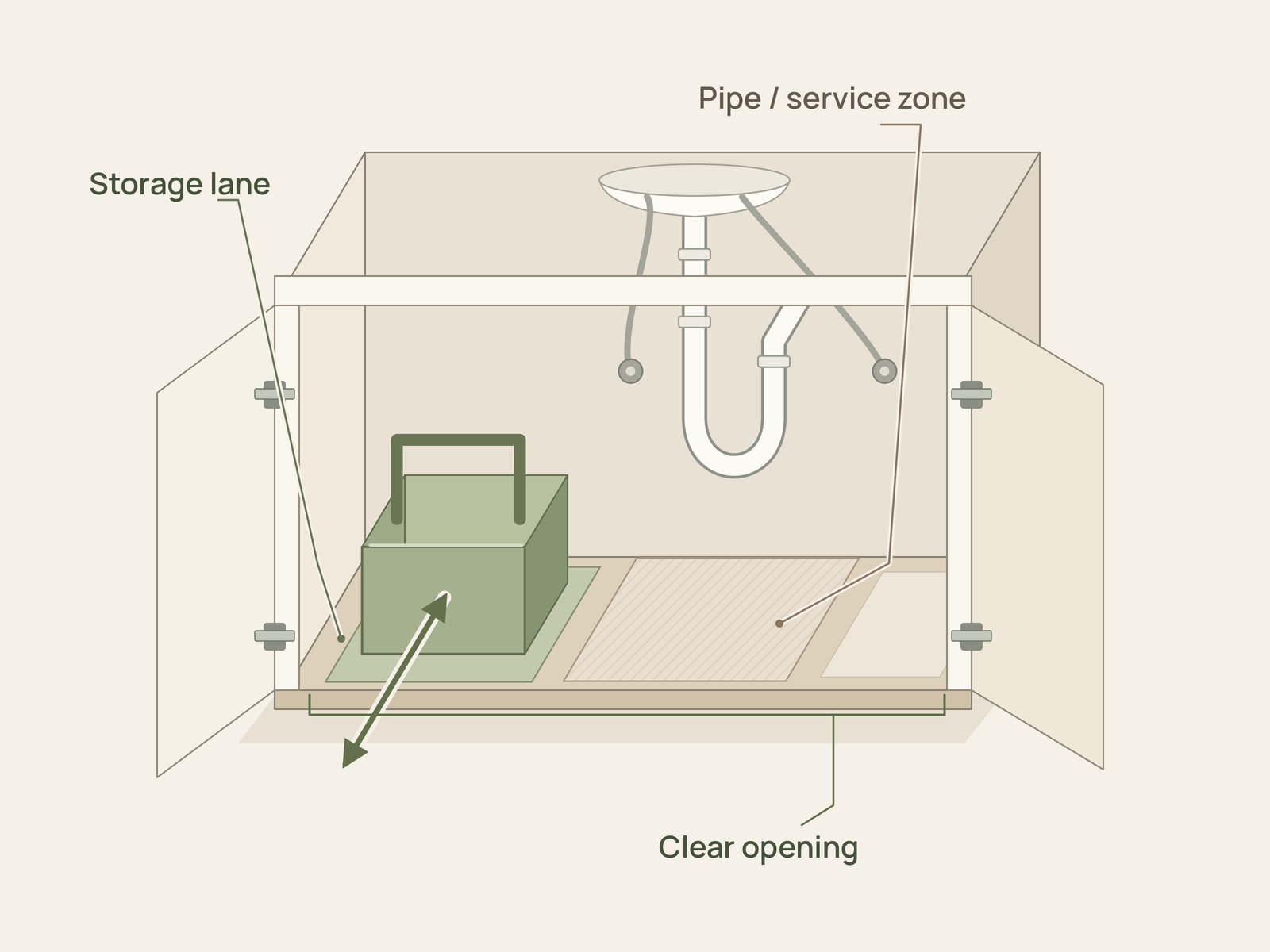
Treat it as usable lanes around the plumbing. Measure the clear door opening, the left and right spaces beside the pipes, cabinet depth, the tallest bottle, hinge intrusion, and any face-frame or cabinet lip that an organizer must clear on the way in and out.
Also preserve access to plumbing and enough empty cabinet floor to wipe the area or inspect a leak. A container that technically fills every cubic inch can reduce the cabinet’s operational value.
The organizer has to pass through the opening and move along its intended path. A pull-forward unit that fits behind the face frame but cannot roll over the cabinet lip does not fit the bathroom.
Measure / Check First
Before buying an under-sink organizer, test the cabinet opening, the active products, and the exact movement the organizer needs to make.
Check the Cabinet Before You Commit to an Organizer
01
Opening and pipe lanes
Measure the clear door opening, left and right usable spaces around the plumbing, cabinet depth, face-frame or lip height, hinge intrusion, and the path needed to lift, roll, or rotate the storage form.
02
Loaded product geometry
Measure the tallest and widest active bottles and the real caddy or bin in its loaded state. Confirm the products remain upright and that the organizer can still be removed without striking pipes or the cabinet frame.
03
Safety, mounting, and service access
Confirm product-label storage requirements, child-access needs where relevant, adhesive or screw instructions, cabinet-door closure, and enough clear space to inspect plumbing and clean the cabinet floor.
If the organizer fits only when the door cannot close, the caddy cannot clear the opening, the plumbing becomes inaccessible, or the chemical-storage location fails the product or household safety requirements, choose another storage form or another location.
04
Choose Lift-Out or Roll-Out Storage by the Access Path
A portable caddy and a roll-out organizer solve different access problems.
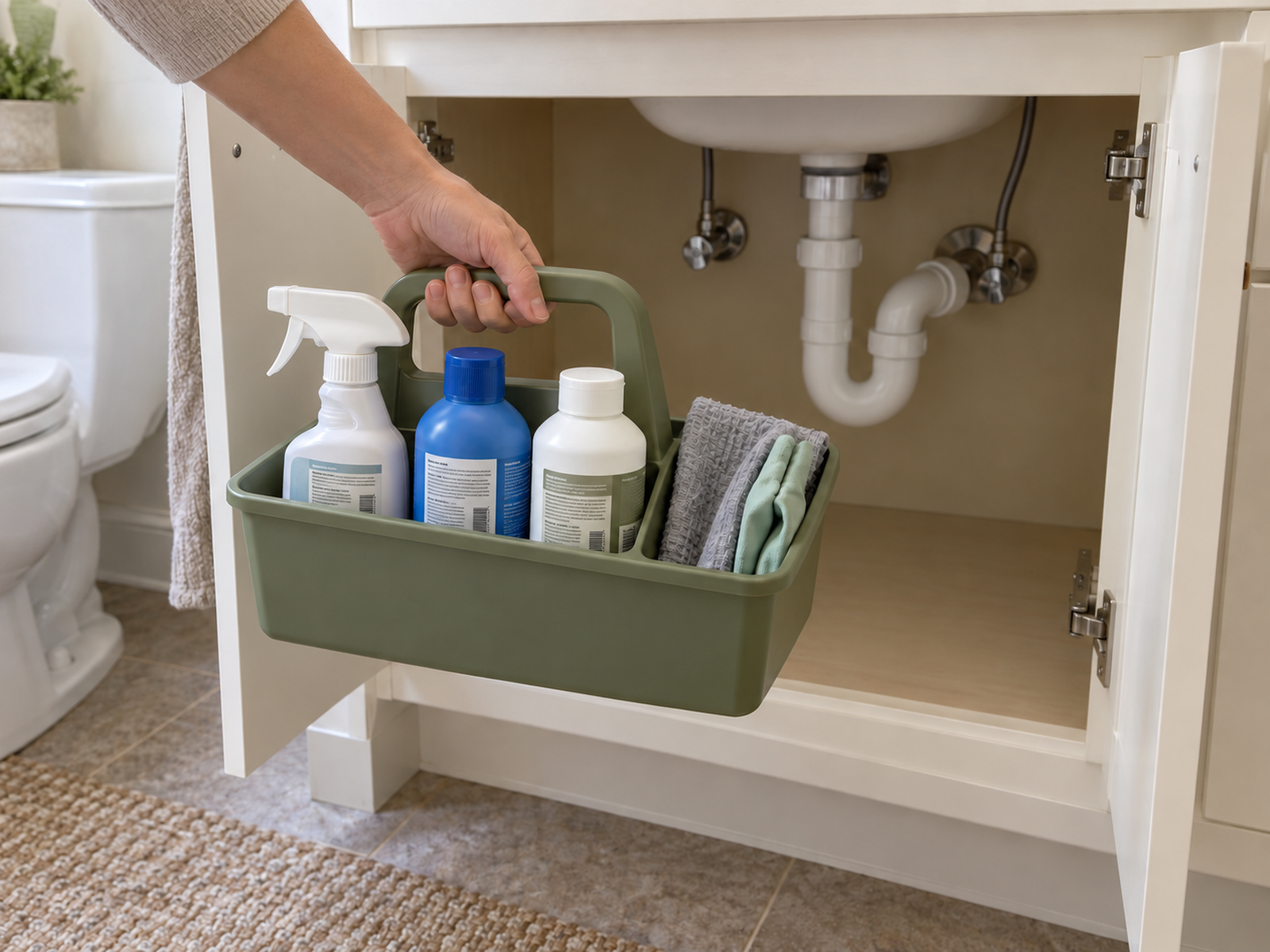
Use a lift-out caddy when the active products should travel with you from sink to toilet to tub or shower and the cabinet opening makes sliding hardware awkward. The caddy should stay small enough to lift cleanly through the opening and stable enough that tall bottles remain upright.
Use a pull-forward or rolling form when a deep lane is the problem and the organizer has a clear path past the pipes and cabinet lip. YouCopia’s current 8-inch RollOut under-sink caddy is one verified example of the form: the manufacturer lists an approximately 7.7-inch width and 16.4-inch body depth, extending farther with its front basket. Those dimensions illustrate why both the lane and the pull path matter.
Do not treat a manufacturer capacity or organizer size as proof of fit in your cabinet. The exact bottle mix, plumbing, opening, and removal motion still control the decision.
05
Use a Turntable Only in a Clear Side Zone
A turntable can make a small group of bottles easier to reach when one side of the vanity has a clean footprint.
The geometry matters. YouCopia’s current SinkSuite under-sink turntable uses a 12-by-12-inch rotating footprint. A circle like that can work well beside the plumbing, but it is a poor choice when pipes, hinges, or a narrow cabinet break the footprint into smaller fragments.
Rotation also needs clearance around the full circle. Do not wedge bottles so close to the side wall or plumbing that the organizer can no longer turn normally.
The advantage is access, not maximum density. If a shallow lift-out bin exposes the same products with less footprint, the simpler form may be stronger.
06
Use the Cabinet Door Only After a Clearance Test
The inside of a cabinet door can hold lightweight accessories, but it is not free space.
Before adding a caddy or hooks, close the door slowly with the interior shelves and bottles in place. Check that the mounted items clear the face frame, shelves, plumbing, and anything stored near the front of the cabinet.
For adhesive systems, follow the exact product’s surface-preparation, cure-time, load, moisture, and removal instructions. 3M’s current Command product-weight guide demonstrates why no-drill storage still has model-specific limits; its published Under Sink Cabinet Caddy rating is 7.5 pounds.
Do not describe adhesive storage as universally damage-free for renters. Surface finish, exact adhesive, loaded weight, removal method, and lease terms all matter.
07
Move Backstock Out of the Bathroom When It Crowds the Working Kit
No linen closet does not mean every duplicate cleaner has to live under the vanity.
Keep the active bathroom kit in the room when that location is safe and practical, then assign unopened duplicates or rarely used specialty products to one separate backstock zone elsewhere in the apartment when available.
That zone still has to follow the exact products’ storage instructions and household safety requirements. Moving a bottle out of the bathroom is useful only when it gains a defined, appropriate home rather than becoming loose bedroom or under-bed clutter.
This split also makes replenishment visible: the bathroom contains one working unit, and reserve stock is clearly secondary instead of competing for immediate access.
08
Use a Narrow Cart Only in Proven Residual Floor Space
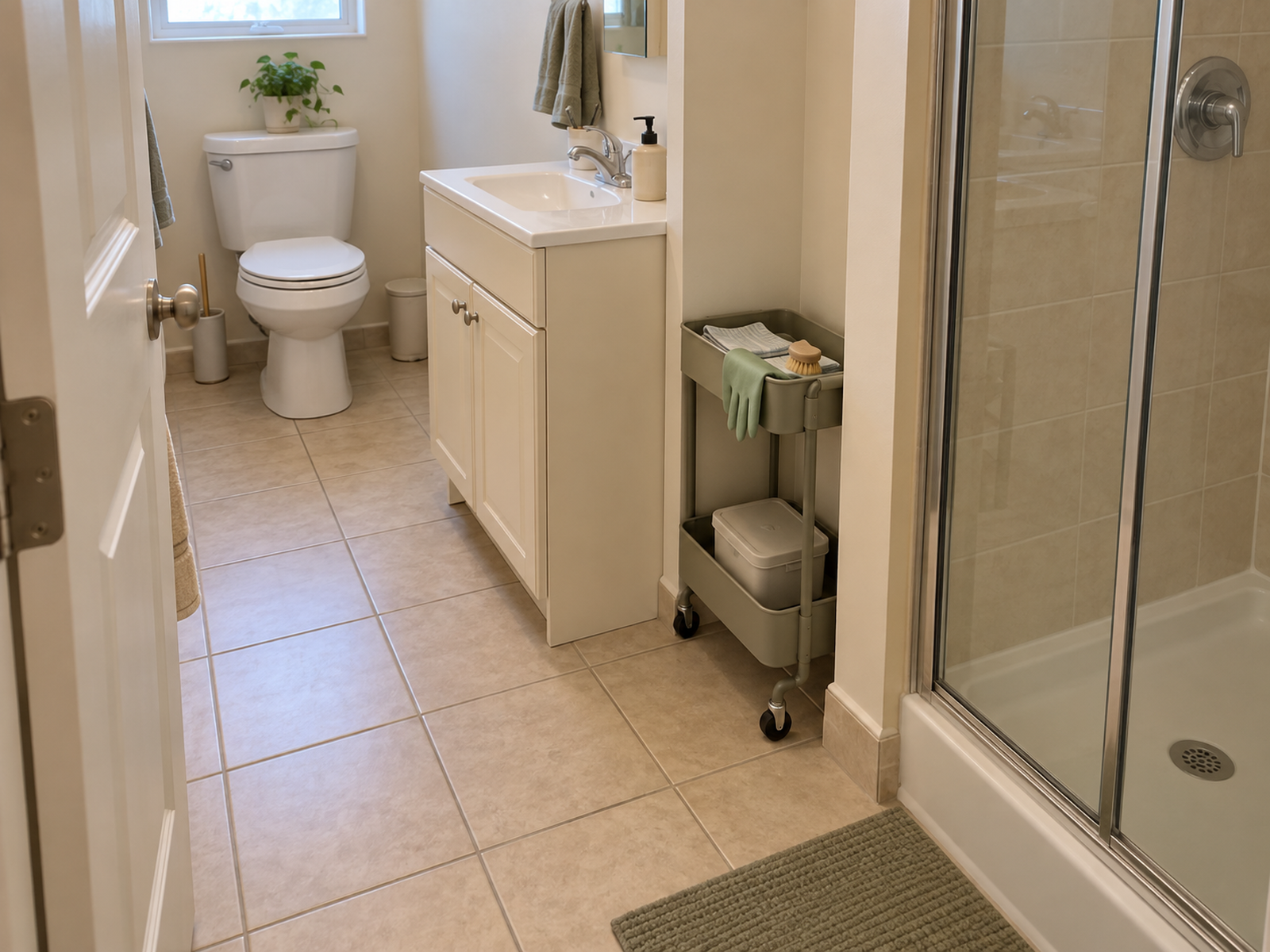
A freestanding cart can solve a bathroom with no usable vanity cabinet, but the floor strip has to be genuinely expendable.
Check the bathroom door, vanity doors or drawers, toilet approach, normal standing space, and the path used to clean the floor. A cart that must be moved every time someone uses the room is not functioning as residual-space storage.
IKEA’s current NISSAFORS utility cart verifies the narrow-cart form at about 7 1/2 inches wide, but its roughly 19 7/8-inch length remains part of the floor plan. IKEA also states that this model is suitable for bathroom use only in a splash- and water-free area.
Open carts can also make chemical products easier to reach. If household safety requires locked or otherwise inaccessible storage, a visually convenient cart may fail the safety gate.
09
Keep Cloths and Small Accessories Separate From Bottle Storage
Microfiber cloths, gloves, small brushes, and trash liners do not have to compete with tall bottles for the same geometry.
Use a shallow light bin, a small approved door caddy, or another easy-reach compartment for these flexible accessories when the cabinet has room. This lets the bottle lane stay upright and easier to scan.
Keep the categories broad. Creating a separate organizer for every brush, cloth color, and glove type can consume more storage volume than the accessories themselves.
If an accessory has its own product-specific storage or safety requirement, follow that instruction instead of forcing it into the general bathroom kit.
10
Use the Safety-and-Capacity Stop Rule
The bathroom cleaning system is finished when the active kit is easy to retrieve, the vanity and fixtures still work normally, and the products can be stored according to their instructions.
Stop adding organizers when the cabinet door cannot close cleanly, plumbing becomes difficult to inspect, a caddy cannot be lifted out, a turntable cannot rotate, a cart steals necessary floor clearance, or harmful products become too accessible.
If the safe working kit still does not fit, reduce what the bathroom stores or move part of the category to another appropriate zone. Do not solve an under-sink capacity problem by moving bottles permanently onto the counter or bathroom floor.
A little empty space is functional capacity when it lets you reach the products, remove the organizer, wipe the cabinet, and inspect the plumbing.
Closing Decision
Keep the Bathroom Kit Small Enough to Stay Safe and Reachable
A small bathroom does not need to store the entire household cleaning inventory. Give the room a deliberately small working kit, map the usable lanes around the plumbing, and choose a lift-out, roll-out, turntable, door, or floor-storage form only when its movement and clearance actually fit.
Keep reserve products secondary, preserve access to the cabinet and plumbing, and follow the exact storage instructions on the products you own. When more bottles would make the system harder to reach, harder to clean around, or less safe, the correct move is to reduce the bathroom load rather than add another organizer.
RELATED GUIDES
What to Read Next
NEXT GUIDE
How to Organize a Bathroom Vanity With No Drawers—Without Filling the Counter
Use this next if the cleaning kit is now contained but toiletries and everyday bathroom items still compete for the same vanity cabinet.
GUIDE
How to Store Household Backstock in a Small Apartment With No Storage Closet
Use this if duplicate cleaners and refill products need a deliberate reserve zone outside the bathroom instead of remaining in premium vanity space.
GUIDE
How to Use a Narrow, Deep Gap for Storage in a Small Bathroom
If the vanity cannot safely hold the working kit and a narrow cart is being considered, this guide helps test whether the residual floor strip is actually usable storage.