
Small Bathroom Storage
How to Add Shower Storage in a Small Bathroom With No Niche
A shower caddy only works when its mounting method fits the surface and the loaded organizer still leaves the shower usable. Map the wet zone first, then choose the lowest-conflict storage plane.
In This Guide
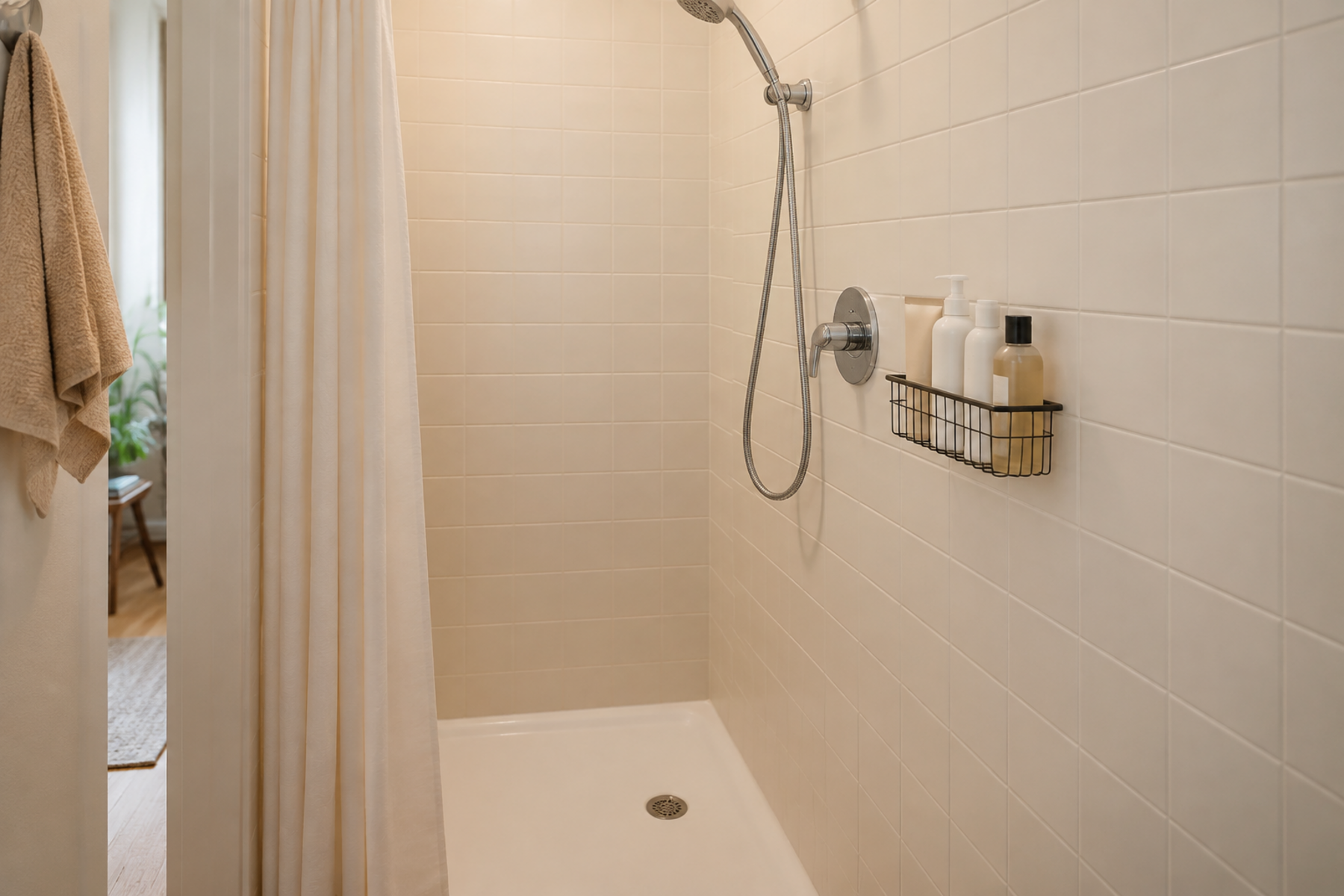
In a compact shower, an empty wall or corner can look like available storage even when it is doing another job. That same area may sit in your shoulder space, cross a grout line, carry the handheld-hose path, or need to stay open for a door, curtain, control, or cleaning routine.
A better shower-storage decision starts by ruling out incompatible mounting planes before comparing capacity. Keep the wet-zone inventory small, match the mounting family to the real surface and geometry, then judge the organizer with bottles loaded so projection, reach, drainage, cleaning access, and removal are part of the fit.
Quick Answer
Choose the Mounting Plane Before the Caddy
Start by keeping only the daily-use shower inventory in the wet zone, then let surface, fixture, door, and floor geometry eliminate incompatible mounting options. Judge the remaining organizer in its fully loaded state, and for a rental, verify the exact installation and removal requirements before committing.
01
Reduce the wet-zone load
Keep daily-use shower products inside the wet zone and move backups or low-frequency items elsewhere before adding storage capacity.
02
Eliminate incompatible mount families
Surface texture, grout, showerhead and hose geometry, door type, ceiling span, and floor space can rule out options before you shop.
03
Judge the organizer when it is loaded
Bottles, pump heads, hooks, and accessories add real depth and can change reach, door movement, body clearance, and cleaning access.
01
Keep Only Daily-Use Products in the Wet Zone
A bigger caddy is not the first answer to a crowded shower. Separate the products used during a normal shower from backups, occasional treatments, and duplicates that can live outside the wet zone. Less inventory reduces the storage volume, loaded weight, and projection that the shower has to absorb.
This matters even when only a few bottles are involved. A recurring problem is the wrong mounting plane, not an unusually large product collection. A small daily set can still be awkward if the only smooth tile is beside a control, the showerhead is crowded by a hose, or the floor corner is part of the standing area.
02
Map the Shower as an Operating Space, Not an Empty Box
Before choosing suction, adhesive, tension, hanging, or floor storage, map what the shower already needs to do. Note the smooth and textured surfaces, grout pattern, showerhead and handheld dock, hose path, controls, door or curtain movement, usable corner space, and the places a person naturally stands and turns.
Then add the organizer’s future depth to that map. A basket attached flat to a wall still projects into the shower once bottles and pump heads are loaded. A door-mounted caddy still rides on an operating door. A tension pole can occupy a corner continuously even though it never touches the wall with screws.
This guide does not set a universal remaining-clearance number. The practical check is whether the real users can enter, turn, reach the controls, use the hose, and exit without the organizer becoming a new obstacle.
Measure / Check First
Empty hardware can look compact. The useful dimensions appear when the surface, bottles, moving parts, and user all occupy the shower at the same time.
Measure the Shower in the State You Actually Use It
01
Map the attachment zone
Record surface type and texture, grout lines, door edge, showerhead and handheld hardware, ceiling span, and any corner you are considering.
02
Add the real loaded projection
Use the actual tallest bottle, pump heads, hooks, and accessories to estimate how far the organizer will project into the shower.
03
Trace the operating path
Check entry, turning, controls, hose movement, door or curtain travel, comfortable reach, and the space needed to clean around the organizer.
Exact fit comes from the shower and the product instructions together. Do not substitute a generic clearance, mounting height, surface rule, or load rating for either one.
03
Use Suction Only When the Surface and Grout Pattern Fit
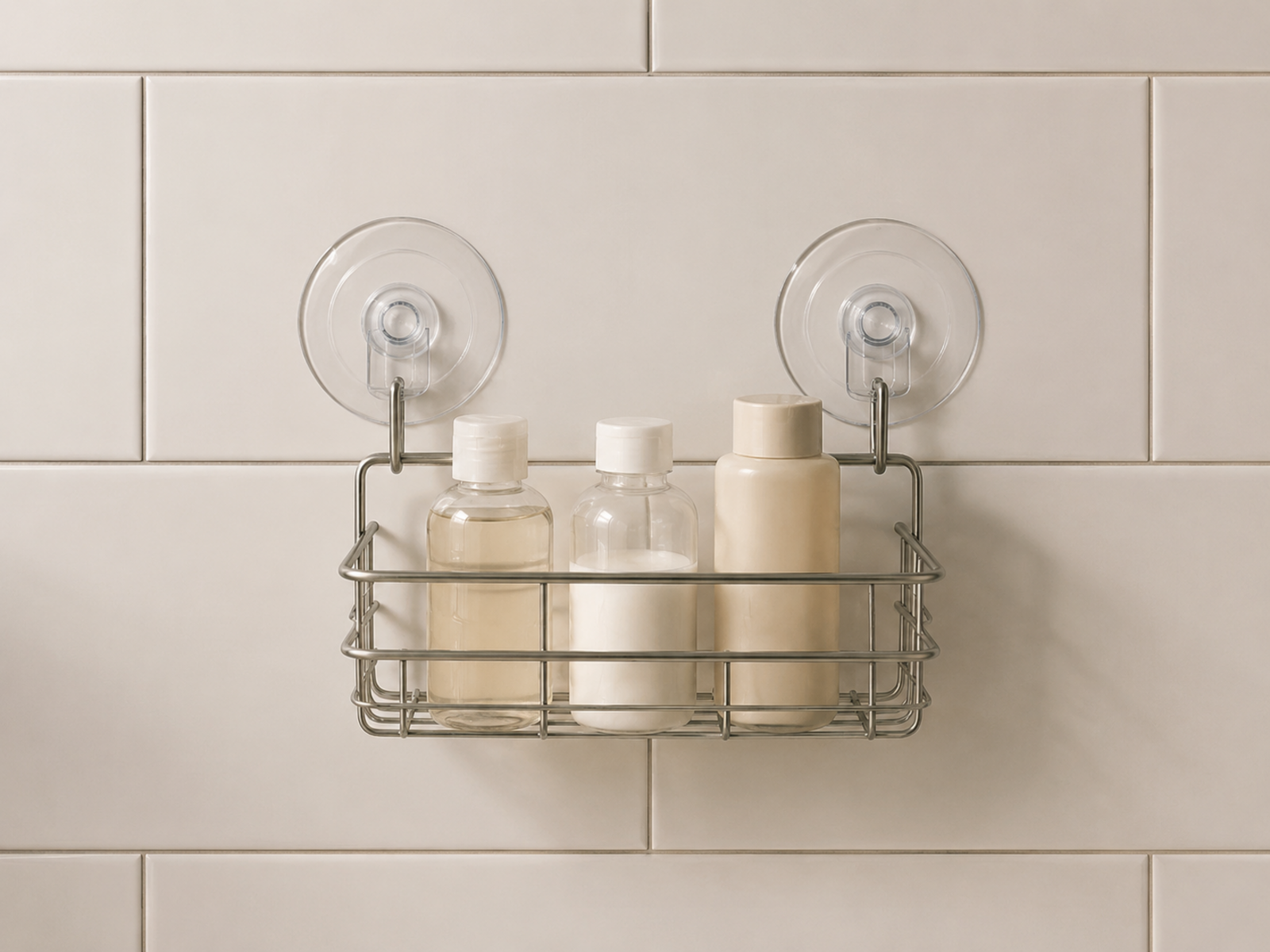
Suction can be a strong low-intervention option, but ’tile’ is not a complete surface description. OXO’s current StrongHold suction basket guidance is written for smooth glazed surfaces, mirrors, or glass and does not treat textured or porous surfaces as equivalent. IKEA’s current TISKEN suction basket similarly specifies flat surfaces such as glass, mirrors, and tile.
Grout can also decide whether the mounting area works. The OXO StrongHold Large Basket uses adjustable suction positions so the contacts can avoid grout lines. That is an exact-product feature, not a promise that every suction basket can bridge the same tile layout.
If the only available wall is matte, textured, porous, heavily interrupted by grout, or otherwise outside the exact product instructions, rule suction out rather than hoping the attachment behaves differently in your shower.
04
Treat Adhesive Storage as an Exact-Product Decision
Water-resistant adhesive storage is a different mounting family from suction. It may create a stable no-drill location on a compatible surface, but the wet-area rating, surface list, load, cure or installation process, and removal method all belong to the exact product.
For example, 3M’s current Command Bath Shower Caddy BATH11 uses water-resistant adhesive, lists specific compatible surfaces, and carries a manufacturer clean-removal claim for that product. That documentation does not make ‘adhesive caddy’ a category-wide damage-free promise.
For a rental, read the removal instructions before installation and compare them with the actual surface and lease. A no-drill attachment can still be a poor renter choice if the surface is excluded, the removal path is unacceptable, or the organizer occupies the wrong part of the shower.
05
Choose a Tension Caddy From Span and Reach, Not Height Alone
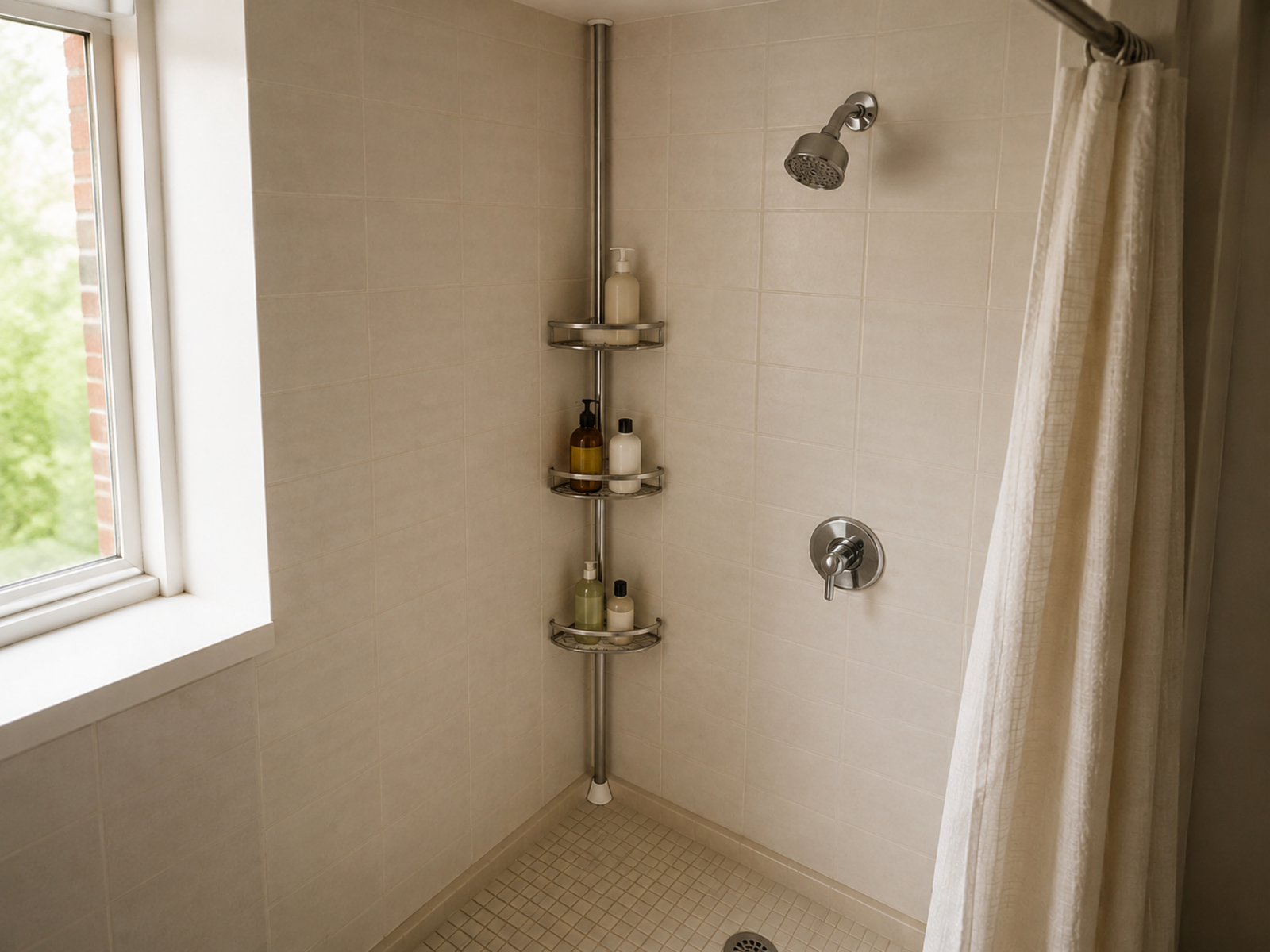
A tension caddy shifts storage vertically without adhesive or screws, but it trades wall compatibility for span, contact-surface, corner, and reach requirements. Measure the actual floor-to-ceiling or tub-to-ceiling distance at the intended location before treating a tension pole as an automatic fit.
Manufacturer ranges are model-specific. Simplehuman’s current 8 ft tension shower caddy extends approximately 5–8 ft, while its 9 ft model extends approximately 6–9 ft. Those examples show why a category label cannot substitute for the exact product range.
Shelf height matters just as much as pole fit. Put everyday bottles where regular users can reach them without stretching through the spray or leaning into the corner, and keep the pole and shelves out of the standing and cleaning zones.
06
Check Hanging Storage Against the Showerhead, Hose, or Door
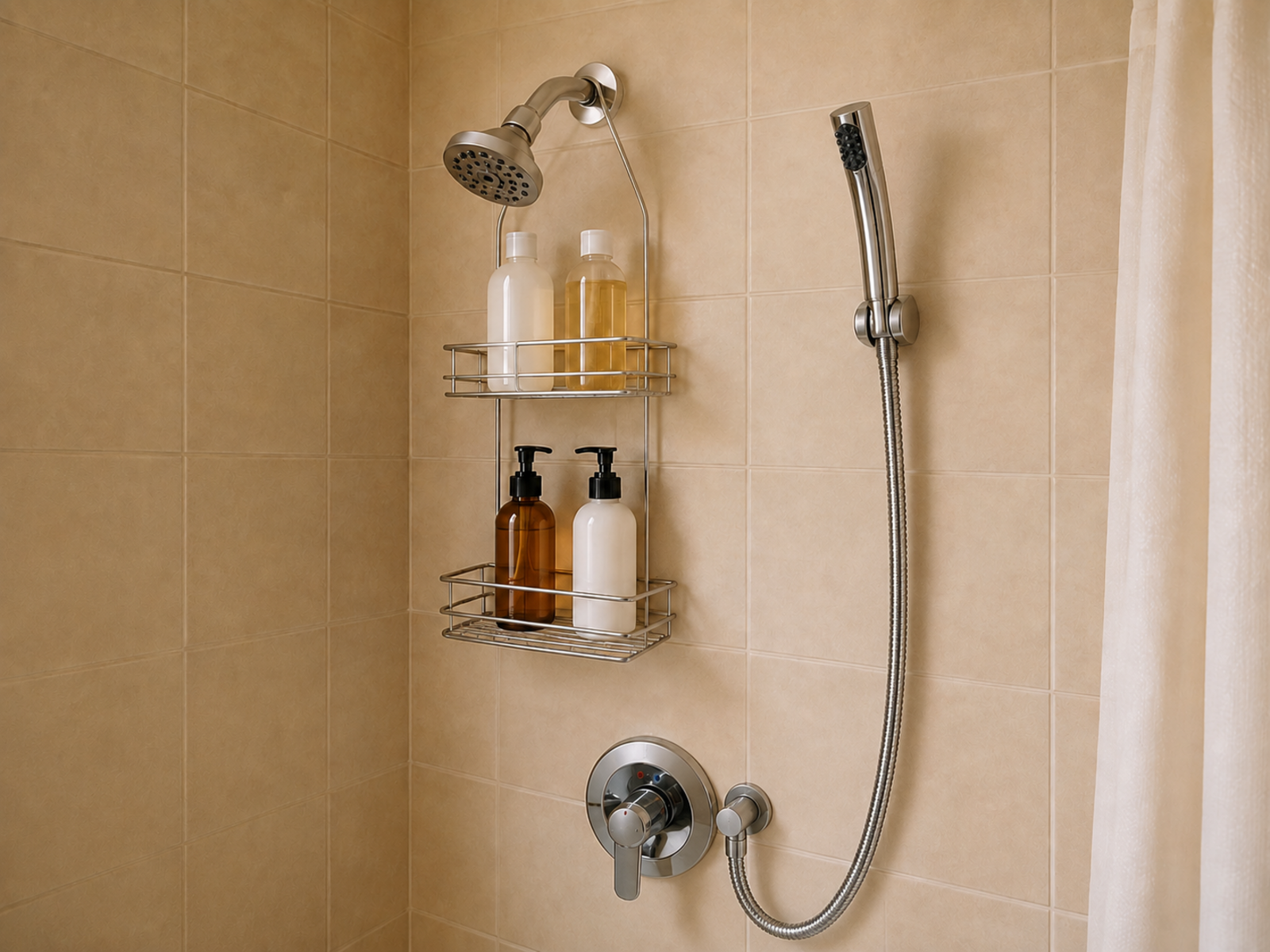
Hanging storage can avoid both wall attachment and floor footprint, but it borrows an operating plane. Over-showerhead caddies depend on the shower arm, showerhead size, stabilizing design, user reach, and any handheld hose sharing the same area.
A handheld hose deserves its own path. If the caddy forces the hose to bend around shelves, interferes with the dock, or leaves daily products too high to reach comfortably, the format may be wrong even when it hangs securely.
Over-door storage creates a different test: a compatible shower door has to keep moving after the organizer is loaded. Bottle depth and hooks can project into a narrow stall or the entry route. Curtain-only showers, of course, do not have that mounting plane at all.
What Not to Do
Don’t Choose a Shower Caddy by Capacity Alone
Shelf count and bottle count are easy to compare, but they can hide the small-space failure. A larger organizer may hold more products while taking away shoulder room, blocking a hose, crowding a control, or turning an operating door into a storage wall.
Choose the smallest system that handles the real daily-use inventory on a compatible mounting plane. When the shower cannot support that without new conflicts, reduce what stays inside or use a portable system instead of escalating automatically to more installed storage.
07
Use Floor Storage—or a Portable Tote—When the Mounting Planes Fail
A freestanding corner caddy removes the wall-surface question, but the trade is direct: it spends shower-floor area. In a genuinely narrow stall, that can move the storage problem into the user’s foot and turning space and can make the floor harder to clean.
Choose it only when the corner remains outside the main standing and entry path and the shelves are comfortable to reach. A tool-free product is not automatically the lowest-conflict product if the shower has almost no spare floor.
When the walls, door, showerhead, ceiling span, and floor all create conflicts, a portable shower tote is a legitimate fallback. Carrying products in and out adds a routine step, but it can be better than forcing permanent-looking infrastructure into a shower that has no compatible storage plane.
08
Run a Loaded-State Test Before You Commit
Test the final setup with the real daily bottle set, including the tallest bottle and any pump heads or hanging accessories. Enter the shower, turn, reach every product, operate the controls, move the handheld hose, and open or close the door or curtain exactly as you normally would.
Then check maintenance. Drainage holes or ventilated bases help water leave some organizers, but they do not prove a mold-prevention result. Make sure the organizer can be cleaned and that the wall, grout, floor, or door behind it remains reasonably accessible.
Bathrooms are moisture-prone spaces; the U.S. EPA recommends bathroom exhaust ventilation or opening a window when conditions allow in its mold and moisture guidance. Storage should not make that wet environment harder to dry or maintain.
Finally, keep the organizer in its real role. A shower caddy, suction basket, tension pole, or towel bar is storage hardware—not a grab bar unless it is specifically designed and rated for that purpose.
Decision Sequence
Choose the Lowest-Conflict Shower Storage
01
Reduce the daily inventory
Separate daily-use products from backups and occasional items so the shower only has to support the storage that earns wet-zone access.
02
Eliminate incompatible mounting planes
Use the real surface, grout, showerhead and hose, door, span, and floor conditions to remove mount families that cannot work reliably.
03
Choose the mount with the lowest operating cost
Compare suction, exact-product adhesive, tension, hanging, freestanding, or portable storage by projection, reach, cleaning access, and renter exit—not by capacity alone.
04
Load-test before you settle
Use the real bottle set and normal shower routine to confirm movement, controls, reach, maintenance access, and removal planning before treating the setup as finished.
Closing Decision
Let the Shower Geometry Choose the Storage
A missing niche does not automatically mean the shower needs the biggest removable caddy that will fit. The most reliable choice comes from a narrower question: which mounting plane can carry the daily-use set without interfering with the person, hardware, cleaning routine, or move-out plan?
Once incompatible planes are removed, the shortlist gets much smaller. That is the advantage of compatibility-first shower storage: the organizer becomes a consequence of the room, rather than another object the room has to work around.
RELATED GUIDES
Related Guides
NEXT GUIDE
How to Organize a Bathroom Vanity With No Drawers—Without Filling the Counter
Organize daily-use bathroom storage outside the shower when the vanity has no drawers.
GUIDE
How to Hang and Dry Bath Towels in a Small Bathroom With No Towel Bar
Solve another renter-friendly bathroom hanging problem without turning the room into a permanent installation project.
GUIDE
How to Add Storage Around a Pedestal Sink in a Small Bathroom
Add useful bathroom storage around a sink with almost no built-in cabinet space.