
Small Apartment Storage Ideas
Where to Put a Space Heater in a Small Apartment With Limited Floor Space
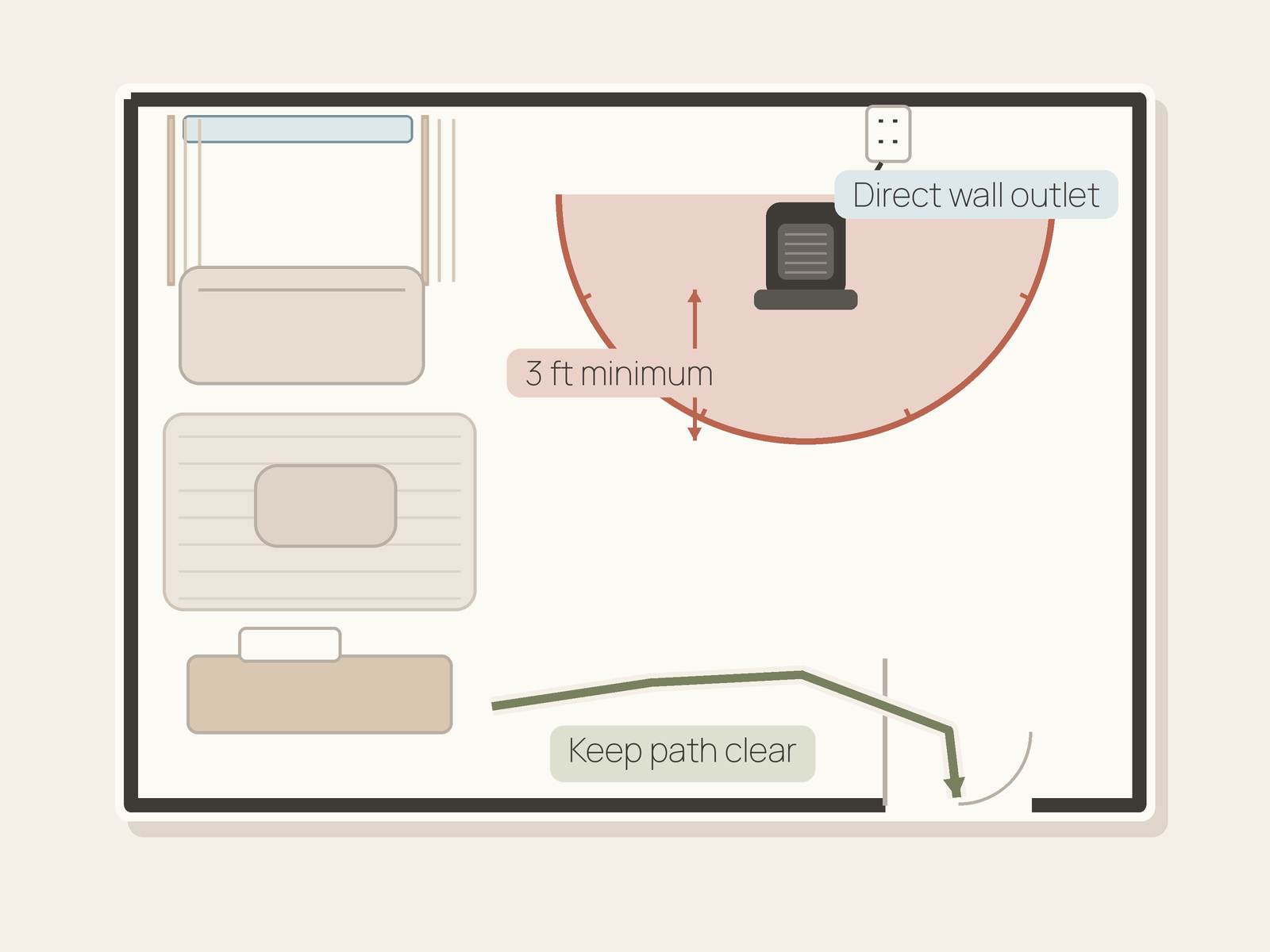
Measure the operating zone, not the heater body: confirm the appliance is allowed, keep combustibles at least 3 feet away, use a direct wall outlet on a stable hard surface, and reject any location that turns a doorway, desk, bed, or curtain zone into the safety compromise.
In This Guide
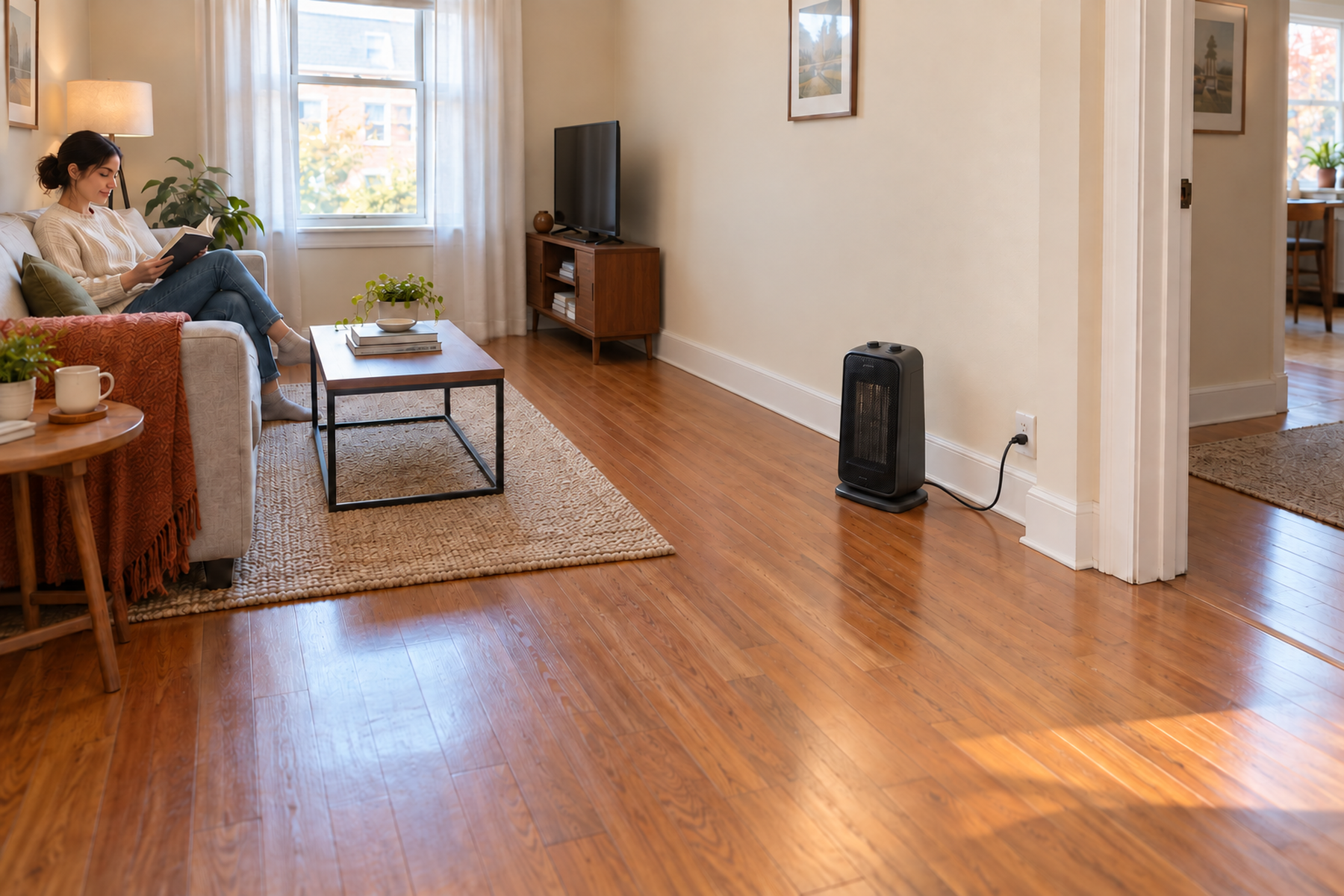
A portable electric space heater can have a small product footprint and still need a large operating footprint. Current CPSC, USFA, NFPA, Red Cross, and ESFI guidance used for this article all point to the same core geometry: keep combustible materials at least 3 feet away, use a direct wall outlet, place the heater on an appropriate stable level surface, and keep it out of doorways and traffic.
That reverses normal small-space logic. The gap beside a sofa, the corner under a desk, the patch below a curtain, or the route beside the bed may look like unused floor, but the heater does not belong there unless the full safety zone works in real use. If the room cannot satisfy the clearance, outlet, surface, and circulation conditions together, the correct result is no heater operation in that layout.
Quick Answer
Measure the Operating Zone Before You Place the Heater
The useful footprint includes the heater body, at least 3 feet of separation from things that can burn, a direct wall-outlet connection, a stable hard surface, and enough circulation that people, pets, bedding, curtains, and furniture do not move into the zone.
01
Check permission before geometry
Read the lease or building policy and the exact heater instructions first. A perfect floor zone does not matter if the appliance is prohibited or its manufacturer requires more restrictive placement.
02
Map clearance and outlet together
Start at a direct wall outlet and ask whether the full 3-foot combustible-clearance zone can exist there without an extension cord, power strip, doorway conflict, curtain, bedding, rug, or furniture inside it.
03
Accept a no-zone result
If every candidate spot fails because of combustibles, traffic, surface, children or pets, or electrical access, do not force the heater into the room. A small heater does not create an exception to the operating rules.
01
Check the Lease and Exact Heater Instructions First
Portable does not automatically mean permitted. Current 2026 renter discussions include leases that prohibit space heaters or require written approval, so permission belongs before floor-plan optimization rather than after the heater has already been purchased.
Use the actual lease or building policy rather than assuming what a landlord allows. This article does not provide jurisdiction-specific habitability or heating-law advice, and it does not treat a portable heater as a substitute for required building heat.
Then read the exact heater instructions. The general safety guidance in this article is a baseline, not permission to ignore a manufacturer rule that is more restrictive for clearance, surface, location, electrical connection, or wet-area use.
If the lease or the product instructions rule out the intended use, stop there. Small-space organization should not be used to work around an appliance restriction.
02
Measure the Operating Zone, Not the Heater
CPSC’s 2026 guidance says to keep portable space heaters at least 3 feet away from furniture, bedding, curtains, and other combustible materials. USFA, NFPA, Red Cross, and ESFI reinforce the same 3-foot separation principle.
That means an 8- or 12-inch heater can still demand a large clear part of the room. Product width does not define the usable footprint, and a compact or mini heater does not earn a smaller safety envelope merely because it looks easier to tuck away.
Mark the candidate zone against the apartment as it is actually used. Include the sofa arm, throw blanket, side table, paper pile, clothing, pet bed, rug edge, curtain swing, and bedding rather than measuring only hard furniture outlines.
A residual gap is not automatically useful space. If the heater fits only by being boxed between furniture or by relying on soft goods to stay perfectly still, the operating zone has not passed.
03
Map the Direct Wall Outlet Before You Choose the Floor Spot
Current CPSC, USFA, NFPA, Red Cross, and ESFI guidance says portable electric space heaters should plug directly into a wall outlet rather than an extension cord or power strip. That makes outlet location part of the room plan.
Start from the wall outlet and work outward instead of choosing an attractive floor patch first. A visually open spot is not a valid candidate if the cord has to cross a doorway, pass under a rug, run through the chair path, or reach through an extension device.
Do not turn this into a DIY circuit project. Follow the heater’s electrical instructions, and stop using the setup if the plug or cord is damaged, the outlet fit is loose, the plug or outlet becomes abnormally hot, or protection repeatedly trips.
If the only floor zone with adequate combustible clearance has no suitable direct wall outlet, the placement problem is unresolved. Moving the heater there with an extension cord does not solve it.
Measure / Check First
Before operating a portable heater in any candidate spot, test the full zone with the apartment in its normal furnished and occupied state.
Check Clearance, Outlet, Surface, and Circulation Together
01
Three-foot combustible zone
Measure from the heater to furniture, bedding, curtains, papers, clothing, rugs, and other things that can burn. Include materials that can move into the zone during ordinary use.
02
Direct wall outlet and cord path
Confirm the heater reaches a suitable wall outlet directly, with no extension cord or power strip and no cord crossing a doorway, chair path, rug, or main walking route.
03
Stable surface and real room movement
Confirm the heater sits on the surface allowed by the safety guidance and exact instructions, stays outside doorways and high-traffic paths, and remains separated from children, pets, chair movement, and bedding.
If even one of those conditions fails, reject the spot. Do not shrink the clearance, add an extension cord, or invent a platform to make an otherwise invalid zone fit.
04
Protect the Hard Surface, Doorway, and Walking Path
USFA says portable heaters should sit on a solid, flat surface, while Red Cross and ESFI guidance used here emphasizes a level hard or nonflammable surface and advises against rugs, carpet, furniture, tables, or cabinets as generic heater supports.
That rules out many normal small-space tricks. Do not lift the heater onto furniture to recover floor space, and do not place a board or tile on a rug as an improvised workaround when the safety guidance for portable heaters already tells the user not to use carpet or rugs.
NFPA and ESFI also advise keeping heaters out of foot-traffic areas and doorways. In a studio or one-bedroom apartment, the center of the room may technically clear furniture but still be the route between the bed, desk, kitchen, bathroom, and exit.
Run the room in motion before approving the location. Open the door, pull out the chair, walk around the bed, carry laundry, and use the sofa normally. The heater body and cord should not become something the household steps around or over.
05
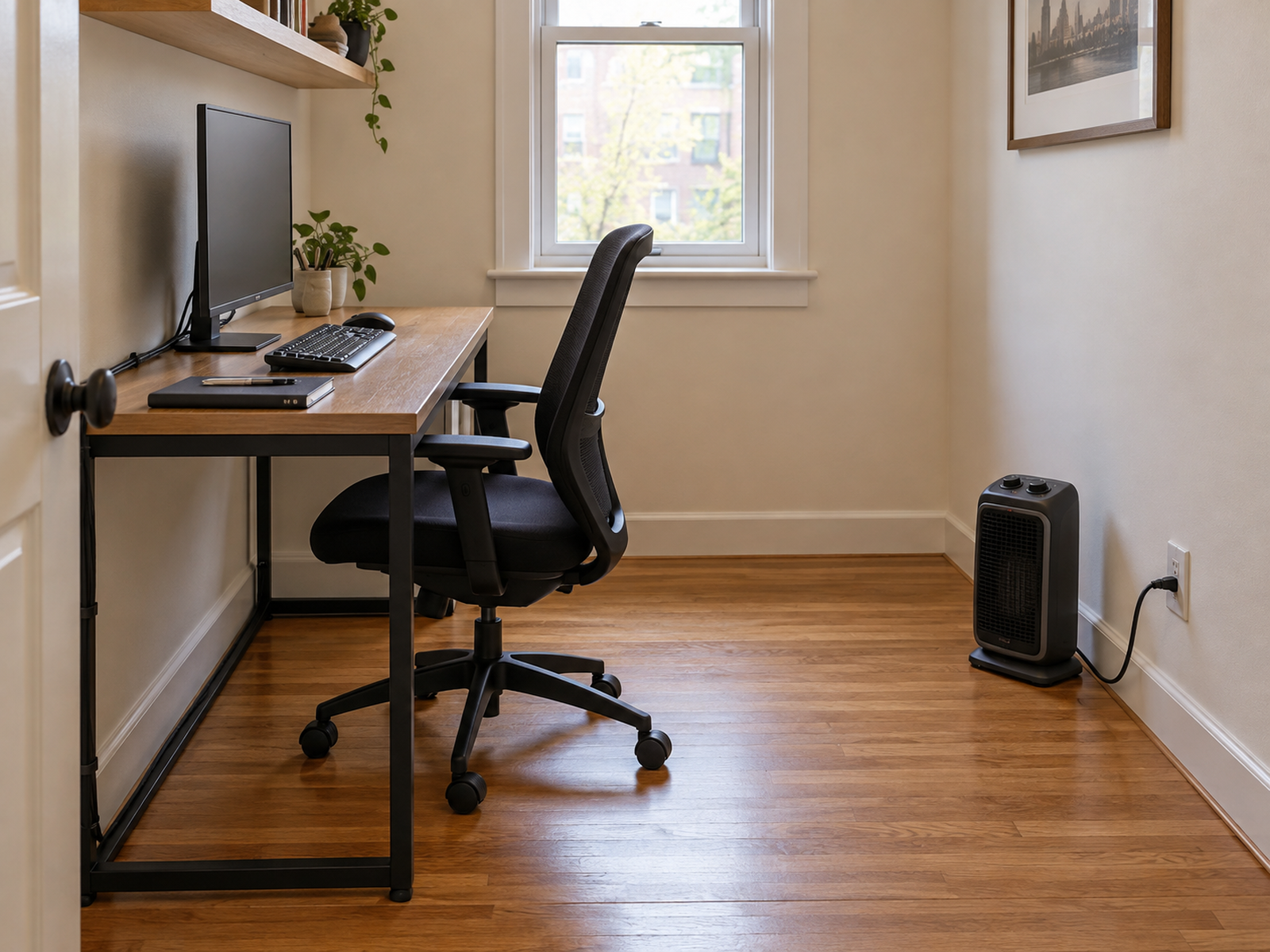
Treat Under-Desk Placement as a Full Clearance Test
Under-desk warmth is a real user goal, but the desk cavity is not automatically a valid heater zone. Papers, bags, power cables, clothing, chair movement, knees, feet, and modesty panels can all occupy the same small volume.
Apply the same 3-foot combustible-clearance rule there that you would anywhere else. A heater marketed as compact, personal, or desk-friendly does not override the room-clearance guidance or the exact product instructions.
The chair path matters as much as the desktop. If rolling back can strike the heater, if feet can contact it, or if the cord has to run through the chair’s travel path, move the heat source outside the desk cavity rather than treating the tucked-away position as a space-saving win.
A desk-side open floor zone can be stronger when it keeps the heater outside paper and cable clutter while still reaching a direct wall outlet. If that side zone cannot maintain the full operating envelope, the desk area has no valid portable-heater position.
06
Use a Temporary Deployed Zone When a Permanent Heater Corner Does Not Fit
A portable heater does not have to own permanent floor space simply because it is used regularly. Current authoritative guidance also says to turn portable heaters off when leaving the room or going to sleep, which makes an attended-use deployment model more realistic for a small apartment.
A repeatable deployed zone can work when one small chair, side table, basket, or other movable item can be relocated completely so the heater gains the required clearance, direct outlet, stable surface, and clear circulation for the duration of attended use.
The key is repeatability, not improvisation. Do not depend on tying back a curtain that can fall loose, pushing bedding aside by a few inches, or moving paper and clothing just enough each time.
When use ends, turn the heater off, unplug it, allow it to cool according to its instructions, and store it safely. The operating zone and the off-state storage location are two different systems.
07
Treat Curtains, Bedding, Children, and Pets as Moving Boundaries
Curtains are not fixed wall geometry. Drafts, opening and closing, pets, and ordinary handling can move fabric toward a heater, so a location that works only when a curtain is tied back is not automatically robust.
Bedding behaves the same way. Duvets, blankets, pillows, clothing, and sheets can extend far beyond the neat daytime outline of a bed, which makes bedside heater placement a higher-friction branch than an empty floor measurement suggests.
CPSC, USFA, NFPA, and Red Cross guidance also emphasizes keeping children and pets away from portable heaters. Tip-over protection is a backup feature, not permission to place the heater in a pet route, play zone, tail path, or chair collision zone.
Test the apartment in its normal messy state. If the safety zone depends on everyone remembering to keep movable combustibles or bodies away every minute, the location is too fragile for routine use.
08
Know When the Room Has No Valid Heater Zone
Aptly Small usually looks for ways to reclaim awkward corners, residual gaps, and underused floor area. A portable heater is one category where that instinct needs a hard stop.
If every candidate location fails one of the controlling conditions—combustible clearance, direct wall outlet, approved surface, doorway or traffic clearance, child or pet conditions, lease permission, or the exact manufacturer instructions—the room has no valid portable-heater operating zone under the current layout.
Do not solve that failure with an extension cord, power strip, furniture platform, rug workaround, tighter corner, or overnight-use assumption. Those moves change the appearance of the problem without satisfying the safety guidance.
The next step is to change the room, the heating strategy, or the building issue rather than force the heater into an invalid position. This article does not prescribe one substitute appliance or provide legal advice about landlord heating obligations.
Closing Decision
A Small Heater Can Still Need More Room Than the Apartment Has
The best space-heater location is not the smallest gap where the appliance body fits. It is the place where at least 3 feet of combustible clearance, a direct wall outlet, an appropriate stable surface, and normal circulation all work at the same time while the heater is attended.
If that footprint cannot exist, the useful answer is not another storage hack. Treat the room as having no valid portable-heater operating zone until the layout, permission, or heating strategy changes, and store the heater only after it is turned off, unplugged, and cooled according to its instructions.
RELATED GUIDES
What to Read Next
NEXT GUIDE
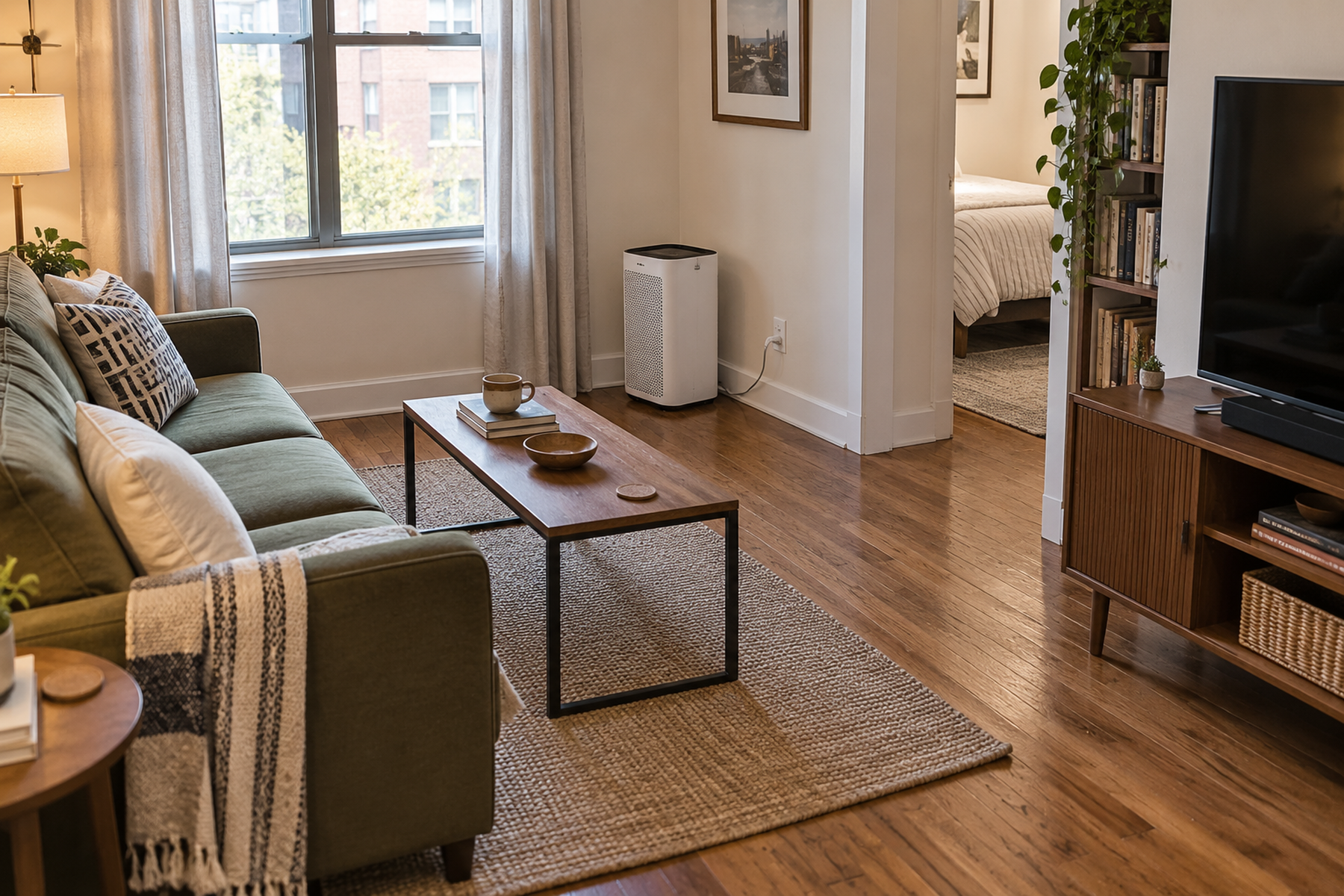
Where to Put an Air Purifier in a Small Apartment With Limited Floor Space
Use this next if another portable appliance is competing for the same floor area; that guide focuses on invisible operating footprint, airflow, service access, noise, and room relevance without the heater’s fire-clearance rules.
GUIDE
Where to Put a Fire Extinguisher in a Small Apartment
Use this if the heater is changing how the room’s fire-safety equipment and exit path need to be organized; that guide focuses on access, visibility, heat separation, and exit-oriented extinguisher placement.
GUIDE
How to Place a PC Tower Around a Small Desk Without Losing Work Surface
Use this if a cold desk area is already crowded with floor hardware and cables; that guide focuses on tower placement, cable routes, airflow, and keeping the workstation usable.